Volume 3 — THE COAL-HEAVERS. (continued 2)
Reading edition
The second teetotaler, who had been an inveterate drunkard in his time, stated as follows. Like most of the coalwhippers, he thought once that he could not do his work without beer. He used to drink as much as he could get. He averaged two pots at his work, and when he came on shore he would have two pots more.
“He had been a coalwhipper for upwards of twenty years, and for nineteen years and three months of that time he was a hard drinker,—a regular stiff ’un,” said he; “I not only used,” he added, “to get drunk, but I taught my children to do so,—I have got sons as big as myself, coalbackers, and total abstainers. Often I have gone home on a Sunday morning drunk myself, and found two of my sons drunk,—they’d be unable to sit at the table. They were about fourteen then, and when they went out with me I used to teach them to take their little drops of neat rum or gin. I have seen the youngest ‘mop up’ his half-quartern as well as I did. Then I was always thirsty; and when I got up of a morning I used to go stalking round to the first public-house that was open, to see if I could get a pint or a quartern. My mouth was dry and parched, as if I had got a burning fever. If I had no work that day I used to sit in a public-house and spend all the money I’d got. If I had no money I would go home and raise it somehow. I would ask the old woman to give me the price of a pint, or perhaps the young uns were at work, and I was pretty safe to meet them coming home. Talk about going out of a Sunday! I was ashamed to be seen out. My clothes were ragged, and my shoes would take the water in at one end and let it out at the other. I keep my old rags at home, to remind me of what I was—I call them the regimentals of the guzzler. I pawned everything I could get at. For ten or twelve years I used a beer-shop regularly. That was my house of call. Now my home is very happy. All my children are teetotalers. My sons are as big as myself, and they are at work carrying 1¾ cwt. to 2 cwt. up a Jacob’s ladder, thirty-three steps high. They do this all day long, and have been doing so for the last seven days. They drink nothing but water or cold tea, and say they find themselves the better able to do their work. Coalbacking is about the hardest labour a man can perform. For myself, too, I find I am quite as able to do my work without intoxicating drinks as I was with them. There’s my basketman,” said he, pointing to the other teetotaler, “and he can tell you whether what I say is true or not. I have helped to whip 147 tons of coal in the heat of summer. The other men were calling for beer every time they could see or hear a purlman, but I took nothing—I don’t think I perspired so much as they did. When I was in the drinking custom, I have known the perspiration run down my arms and legs as if I’d been in a hot bath. Since I’ve taken the pledge I scarcely perspire at all. I’ll work against any man that takes beer, provided I have a good teetotal pill—that is, a good pound of steak, with plenty of gravy in it. That’s the stuff to work upon—that’s what the working man wants—plenty of it, and less beer, and he’d beat a horse any day. I am satisfied the working man can never be raised above his present position until he can give over drinking. That is the reason why I am sticking to the pledge, that I may be a living example to my class that they can and may work without beer. It has made my home happy, and I want it to make every other working man’s as comfortable. I tried the principle of teetotalism first on board a steam-boat. I was stoker, and we burnt 27 cwt. of coals every hour we were at sea—that’s very nearly a ton and a-half per hour. There, with the heat of the fire, we felt the effects of drinking strong brandy. Brandy was the only fermented drink we were allowed. After a time I tried what other stimulants we could use. The heat in the hold, especially before the fires, was awful. There were nine stokers and four coal-trimmers. We found that the brandy that we drank in the day made us ill, our heads ached when we got up in the morning, so four of us agreed to try oatmeal and water as our drink, and we found that suited us better than intoxicating liquor. I myself got as fat as a bull upon it. It was recommended to me by a doctor in Falmouth, and we all of us tried it eight or nine voyages. Some time after I left the company I went to strong drink again, and continued at it till the 1st of May last, and then my children’s love of drink got so dreadful that I got to hate myself as being the cause of it. But I couldn’t give up the drinking. Two of my mates, however, urged me to try. On the 1st of May I signed the pledge. I prayed to God on the night I went to give me strength to keep it, and never since have I felt the least inclination to return. When I had left off a fortnight I found myself a great deal better; all the cramps that I had been loaded with when I was drinking left me. Now I am happy and comfortable at home. My wife’s about one of the best women in the world. She bore with me in all my troubles, and now she glories in my redemption. My children love me, and we club all our earnings together, and can always on Sunday manage a joint of sixteen or seventeen pounds. My wife, now that we are teetotalers, need do no work; and, in conclusion, I must say that I have much cause to bless the Lord that ever I signed the teetotal pledge.
“After I leave my work,” added the teetotaler, “I find the best thing I can have to refresh me is a good wash of my face and shoulders in cold water. This is twice as enlivening as ever I found beer. Once a fortnight I goes over to Goulston-square, Whitechapel, and have a warm bath. This is one of the finest things that ever was invented for the working man. Any persons that use them don’t want beer. I invited a coalwhipper-man to come with me once. ‘How much does it cost?’ he asked. I told him, ‘A penny.’ ‘Well,’ he said, ‘I’d sooner have half-a-pint of beer. I haven’t washed my body for these twenty-two years, and don’t see why I should begin to have anything to do with these new-fangled notions at my time of life.’ I will say, that a good wash is better for the working man than the best drink.”
The man ultimately made a particular request that his statement might conclude with a verse that he had chosen from the Temperance Melodies:—
“And now we love the social cheer Of the bright winter eve; We have no cause for sigh or tear, We have no cause to grieve. Our wives are clad, our children fed; We boast where’er we go— ’Twas all because we sign’d the pledge, A long, long time ago.”
At the close of my interview with these men I received from them an invitation to visit them at their own houses whenever I should think fit. It was clearly their desire that I should see the comforts and domestic arrangements of their homes. Accordingly on the morrow, choosing an hour when there could have been no preparation, I called at the lodgings of the first. I found the whole family assembled in the back kitchen, that served them for a parlour. As I entered the room the mother was busy at work, washing and dressing her children for the day. There stood six little things, so young that they seemed to be all about the same height, with their faces shining with the soap and water, and their cheeks burning red with the friction of the towel. They were all laughing and playing about the mother, who, with comb and brush in hand, found it no easy matter to get them to stand still while she made “the parting.” First of all the man asked me to step up-stairs and see the sleeping-room. I was much struck with the scrupulous cleanliness of the apartment. The blind was as white as snow, half rolled up, and fastened with a pin. The floor was covered with patches of different coloured carpet, showing that they had been bought from time to time, and telling how difficult it had been to obtain the luxury. In one corner was a cupboard with the door taken off, the better to show all the tumblers, teacups, and coloured-glass mugs, that, with two decanters, well covered with painted flowers, were kept more for ornament than use. On the chimneypiece was a row of shells, china shepherdesses, and lambs, and a stuffed pet canary in a glass-case for a centre ornament. Against the wall, surrounded by other pictures, hung a half-crown water-colour drawing of the wife, with a child on her knee, matched on the other side by the husband’s likeness, cut out in black paper. Pictures of bright-coloured ducks and a print of Father Moore the teetotaler completed the collection.
“You see,” said the man, “we manages pretty well; but I can assure you we has a hard time of it to do it at all comfortably. Me and my wife is just as we stands—all our other things are in pawn. If I was to drink I don’t know what I should do. How others manage is to me a mystery. This will show you I speak the truth,” he added, and going to a secretary that stood against the wall he produced a handful of duplicates. There were seventeen tickets in all, amounting to 3l. 0s. 6d., the highest sum borrowed being 10s. “That’ll show you I don’t like my poverty to be known, or I should have told you of it before. And yet we manage to sleep clean;” and he pulled back the patchwork counterpane, and showed me the snow-white sheets beneath. “There’s not enough clothes to keep us warm, but at least they are clean. We’re obliged to give as much as we can to the children. Cleanliness is my wife’s hobby, and I let her indulge in it. I can assure you last week my wife had to take the gown off her back to get 1s. on it. My little ones seldom have a bit of meat from one Sunday to another, and never a bit of butter.”
I then descended into the parlour. The children were all seated on little stools that their father had made for them in his spare moments, and warming themselves round the fire, their little black shoes resting on the white hearth. From their regular features, small mouths, large black eyes, and fair skins, no one would have taken them for a labouring man’s family. In answer to my questions, he said: “The eldest of them (a pretty little half-clad girl, seated in one corner) is ten, the next seven, that one five, that three, and this (a little thing perched upon a table near the mother) two. I’ve got all their ages in the Bible up-stairs.” I remarked a strange look about one of the little girls. “Yes, she always suffered with that eye; and down at the hospital they lately performed an operation on it.” An artificial pupil had been made.
The room was closed in from the passage by a rudely built partition. “That I did myself in my leisure,” said the man; “it makes the room snugger.” As he saw me looking at the clean rolling-pin and bright tins hung against the wall, he observed: “That’s all my wife’s doing. She has got them together by sometimes going without dinner herself, and laying out the 2d. or 3d. in things of that sort. That is how she manages. To-day she has got us a sheep’s head and a few turnips for our Sunday’s dinner,” he added, taking off the lid of the boiling saucepan. Over the mantelpiece hung a picture of George IV., surrounded by four other frames. One of them contained merely three locks of hair. The man, laughing, told me, “Two of them are locks of myself and my wife, and the light one in the middle belonged to my wife’s brother, who died in India. That’s her doing again,” he added.
After this I paid a visit to the other teetotaler at his home, and there saw one of his sons. He had six children altogether, and also supported his wife’s mother. If it wasn’t for him, the poor old thing, who was seventy-five, and a teetotaler too, must have gone to the workhouse. Three of his six children lived at home; the other three were out at service. One of the lads at home was a coalbacker. He was twenty-four years of age, and on an average could earn 17s. 6d. It was four years since he had taken to backing. He said, “I am at work at one of the worst wharfs in London; it is called ‘the slaughter-house’ by the men, because the work is so excessive. The strongest man can only last twelve years at the work there; after that he is overstrained and of no use. I do the hardest work, and carry the coals up from the hold. The ladder I mount has about thirty-five steps, and stands very nearly straight on end. Each time I mount I carry on my back 238 pounds. No man can work at this for more than five days in the week. I work three days running, then have a day’s rest, and then work two days more. I myself generally do five days’ work out of the six. I never drink any beer, and have not for the last eight months. For three years and four months I took beer to get over the work. I used to have a pint at eleven, a pot at dinner, a pint at four o’clock, and double allowance, or a couple of pots, after work. Very often I had more than double allowance. I seldom in a day drank less than that; but I have done more. I have drunk five pots in four minutes and a-half. So my expenditure for beer was 1s. 4d. a-day regularly. Indeed, I used to allow myself three half-crowns to spend in beer a-week, Sundays included. When a coal-worker is in full work, he usually spends 2s. a-day, or 12s. a-week, in beer. The trade calls these men temperate. When they spend 15s. the trade think they are intemperate. Before I took the pledge I scarcely ever went to bed sober after my labour. I was not always drunk, but I was heavy and stupid with beer. Twice within the time I was a coalbacker I have been insensibly drunk. I should say three-fourths of the coalbackers are drunk twice a-week. Coalbacking is as heavy a class of labour as any performed. I don’t know any that can beat it. I have been eight months doing the work, and can solemnly state I have never tasted a drop of fermented liquor. I have found I could do my work better and brisker than when I drank. I never feel thirsty over my work now; before, I was always dry, and felt as if I could never drink enough to quench it. Now I never drink from the time I go to work till the time I have my dinner; then my usual beverage is either cold coffee or oatmeal and water. From that time I never drink till I take my tea. On this system I find myself quite as strong as I did with the porter. When I drank porter it used to make me go along with a sack a little bit brisker for half-an-hour, but after that I was dead, and obliged to have some more. There are men at the wharf who drink beer and spirits that can do six days’ labour in the week. I can’t do this myself. I have done as much when I took fermented liquors, but I only did so by whipping myself up with stimulants. I was obliged to drink every hour a pint of beer to force me along. That was only working for the publican; for I had less money at the week’s end than when I did less work. Now I can keep longer and more steadily at my work. In a month I would warrant to back more coals than a drunkard. I think the drunkard can do more for a short space of time than the teetotaler. I am satisfied the coalbackers as a class would be better off if they left off the drinking; and then masters would not force them to do so much work after dark as they do now. They always pay at public-houses. If that system was abandoned, the men would be greatly benefited by it. Drinking is not a necessity of the labour. All I want when I’m at work is a bit of coal in the mouth. This not only keeps the mouth cool, but as we go up the ladder we very often scrunch our teeth—the work’s so hard. The coal keeps us from biting the tongue, that’s one use; the other is, that by rolling it along in the mouth it excites the spittle, and it moistens the mouth. This I find a great deal better than a pot of porter.”
In order to complete my investigations concerning the necessity of drinking in the coalwhipping trade, I had an interview with some of the more intelligent of the men who had been principally concerned in the passing of the Act that rescued the class from the “thraldom of the publican.”
“I consider,” said one, “that drink is not a necessity of our labour, but it is a necessity of the system under which we were formerly working. I have done the hardest work that any labouring man can do, and drank no fermented liquor. Nor do I consider fermented liquors to be necessary for the severest labour. This I can say of my own experience, having been a teetotaler for sixteen months. But if the working man don’t have the drink, he must have good solid food, superior to what he is in the habit of having. A pot of coffee and a good beef dumpling will get one over the most severe labour. But if he can’t have that he must have the stimulants. A pint of beer he can always have on credit, but he can’t the beef dumpling. If there is an excuse for any persons drinking there is for the coalwhippers, for under the old system they were forced to become habitual drunkards to obtain work.”
I also questioned another of the men, who had been a prime mover in obtaining the Act. He assured me, that before the “emancipation” of the men the universal belief of the coalwhippers, encouraged by the publicans, was, that it was impossible for them to work without liquor. In order to do away with that delusion, the three principal agents in procuring the Act became teetotalers of their own accord, and remained so, one for sixteen months and another for nine years, in order to prove to their fellow workmen that drinking over their labour could be dispensed with, and that they might have “cool brains to fight through the work they had undertaken.”
Another of the more intelligent men who had been a teetotaler:—“I performed the hardest labour I ever did, before or after, with more ease and satisfaction than ever I did under the drinking system. It is quite a delusion to believe that with proper nutriment the health declines under principles of total abstinence.”
After this I was anxious to continue my investigations among the coalporters, and see whether the more intelligent among them were as firmly convinced as the better class of coalwhippers were, that intoxicating drinks were not necessary for the performance of hard labour. I endeavoured to find one of each class, pursuing the same plan as I had adopted with the coalwhippers: viz. I sought first, one who was so firmly convinced of the necessity of drinking fermented liquors during his work, that he had never been induced to abandon them; secondly, I endeavoured to obtain the evidence of one who had tried the principle of total abstinence and found it fail; and thirdly, I strove to procure the opinion of those who had been teetotalers for several years, and who could conscientiously state that no stimulant was necessary for the performance of their labour. Subjoined is the result of my investigations.
Concerning the motives and reasons for the great consumption of beer by the coalporters, I obtained the following statement from one of them:—“I’ve been all my life at coalportering, off and on, and am now thirty-nine. For the last two years or so I’ve worked regularly as a filler to Mr. ——’s waggons. I couldn’t do my work without a good allowance of beer. I can’t afford so much now, as my family costs me more; but my regular allowance one time was three pots a-day. I have drank four pots, and always a glass of gin in the morning to keep out the cold air from the water. If I got off then for 7s. a-week for drink I reckoned it a cheap week. I can’t do my work without my beer, and no coalporter can, properly. It’s all nonsense talking about ginger-beer, or tea, or milk, or that sort of thing; what body is there in any of it? Many a time I might have been choked with coal-dust, if I hadn’t had my beer to clear my throat with. I can’t say that I’m particularly thirsty like next morning, after drinking three or four pots of beer to my own work, but I don’t get drunk.” He frequently, and with some emphasis, repeated the words, “But I don’t get drunk.” “You see, when you’re at such hard work as ours, one’s tired soon, and a drop of good beer puts new sap into a man. It oils his joints like. He can lift better and stir about brisker. I don’t care much for beer when I’m quiet at home on a Sunday; it sets me to sleep then. I once tried to go without to please a master, and did work one day with only one half-pint. I went home as tired as a dog. I should have been soon good for nothing if I’d gone on that way—half-pinting in a day. Lord love you! we know a drop of good beer. The coalporters is admitted to be as good judges of beer as any men in London—maybe, the best judges; better than publicans. No salt and water will go down with us. It’s no use a publican trying to gammon us with any of his cag-mag stuff. Salt and water for us! Sartainly, a drop of short (neat spirit) does one good in a cold morning like this; it’s uncommon raw by the waterside, you see. Coalporters doesn’t often catch cold—beer and gin keeps it out. Perhaps my beer and gin now cost me 5s. a-week, and that’s a deal out of what I can earn. I dare say I earn 18s. a-week. Sometimes I may spend 6s. That’s a third of my earnings, you say, and so it is; and as it’s necessary for my work, isn’t it a shame a poor man’s pot of beer, and drop of gin, and pipe of tobacco, should be so dear? Taxes makes them dear. I can read, sir, and I understand these things. Beer—four pots a-day of it doesn’t make me step unsteady. Hard work carries it off, and so one doesn’t feel it that way. Beer’s made of corn as well as bread, and so it stands to reason it’s nourishing. Nothing’ll persuade me it isn’t. Let a teetotal gentleman try his hand at coal-work, and then he’ll see if beer has no support in it. Too much is bad, I know, but a man can always tell how much he wants to help him on with his work. If beer didn’t agree with me, of course I wouldn’t drink it: but it does. Sartainly we drops into a beer-shop of a night, and does tipple a little when work’s done; and the old women (our wives) comes for us, and they get a sup to soften them, and so they may get to like it overmuch, as you say, and one’s bit of a house may go to rack and manger. I’ve a good wife myself, though. I know well enough all them things is bad—drunkenness is bad! All I ask for is a proper allowance at work; the rest is no good. I can’t tell whether too much or no beer at coal-work would be best; perhaps none at all: leastways it would be safer. I shouldn’t like to try either. Perhaps coalporters does get old sooner than other trades, and mayn’t live so long; but that’s their hard work, and it would be worse still without beer. But I don’t get drunk.”
I conversed with several men on the subject of their beer-drinking, but the foregoing is the only statement I met with where a coalporter could give any reason for his faith in the virtues of beer; and vague as in some points it may be, the other reasons I had to listen to were still vaguer. “Somehow we can’t do without beer; it puts in the strength that the work takes out.” “It’s necessary for support.” Such was the pith of every argument.
In order fully to carry out this inquiry, I obtained the address of a coalbacker from the ships, who worked hard and drank a good deal of beer, and who had the character of being an industrious man. I saw him in his own apartment, his wife being present while he made the following statement:—“I’ve worked at backing since I was twenty-four, and that’s more than twelve years ago. I limit myself now, because times is not so good, to two pots of beer a-day; that is, when I’m all day at work. Some takes more. I reckon, that when times was better I drank fifteen pots a-week, for I was in regular work, and middlin’ well off. That’s 780 pots, or 195 gallons a-year, you say. Like enough it may be. I never calculated, but it does seem a deal. It can’t be done without, and men themselves is the best judges of what suits their work—I mean, of how much to take. I’ll tell you what it is, sir. Our work’s harder than people guess at, and one must rest sometimes. Now, if you sit down to rest without something to refresh you, the rest does you harm instead of good, for your joints seem to stiffen; but a good pull at a pot of beer backs up the rest, and we start lightsomer. Our work’s very hard. I’ve worked till my head’s ached like to split; and when I’ve got to bed, I’ve felt as if I’ve had the weight on my back still, and I’ve started awake when I fell off to sleep, feeling as if something was crushing my back flat to my chest. I can’t say that I ever tried to do without beer altogether. If I was to think of such a thing, my old woman there would think I was out of my head.” The wife assented. “I’ve often done with a little when work’s been slackish. First, you see, we bring the coal up from the ship’s hold. There, sometimes, it’s dreadful hot, not a mouthful of air, and the coal-dust sometimes as thick as a fog. You breathe it into you, and your throat’s like a flue, so that you must have something to drink. I fancy nothing quenches you like beer. We want a drink that tastes. Then there’s the coals on your back to be carried up a nasty ladder, or some such contrivance, perhaps twenty feet, and a sack full of coals weighs 2 cwt. and a stone, at least; the sack itself’s heavy and thick: isn’t that a strain on a man? No horse could stand it long. Then, when you get fairly out of the ship, you go along planks to the waggon, and must look sharp, ’specially in slippery or wet weather, or you’ll topple over, and then there’s the hospital or the workhouse for you. Last week we carried along planks sixty feet, at least. There’s nothing extra allowed for distance, but there ought to be. I’ve sweat to that degree in summer, that I’ve been tempted to jump into the Thames to cool myself. The sweat’s run into my boots, and I’ve felt it running down me for hours as I had to trudge along. It makes men bleed at the nose and mouth, this work does. Sometimes we put a bit of coal in our mouths, to prevent our biting our tongues. I do, sometimes, but it’s almost as bad as if you did bite your tongue, for when the strain comes heavier and heavier on you, you keep scrunching the coal to bits, and swallow some of it, and you’re half choked; and then it’s no use, you must have beer. Some’s tried a bit of tobacco in their mouths, but that doesn’t answer; it makes you spit, and often spit blood. I know I can’t do without beer. I don’t think they ’dulterate it for us; they may for fine people, that just tastes it, and, I’ve heard, has wine and things. But we must have it good, and a publican knows who’s good customers. Perhaps a bit of good grub might be as good as beer to strengthen you at work, but the straining and sweating makes you thirsty, more than hungry; and if poor men must work so hard, and for so little, for rich men, why poor men will take what they feel will satisfy them, and run the risk of its doing them good or harm; and that’s just where it is. I can’t work three days running now without feeling it dreadful. I get a mate that’s fresher to finish my work. I’d rather earn less at a trade that would give a man a chance of some ease, but all trades is overstocked. You see we have a niceish tidy room here, and a few middling sticks, so I can’t be a drunkard.”
I now give the statement of a coalporter who had been a teetotaler:—“I have been twenty-two years a coalheaver. When I began that work I earned 50s. a-week as backer and filler. I am now earning, one week with another, say 15s. We have no sick fund among us—no society of any sort—no club—no schools—no nothing. We had a kind of union among us before the great strike, more than fourteen years back, but it was just for the strike. We struck against masters lowering the pay for a ton to 2¼d. from 2½d. The strike only lasted two or three weeks, and the men were forced to give way; they didn’t all give way at once, but came to gradual. One can’t see one’s wife and children without bread. There’s very few teetotalers among us, though there’s not many of us now that can be called drunken—they can’t get it, sir. I was a teetotaler myself for two years, till I couldn’t keep to it any longer. We all break. It’s a few years back, I forget zactly when. At that time teetotalers might drink shrub, but that never did me no good; a good cup of tea freshened me more. I used then to drink ginger-beer, and spruce, and tea, and coffee. I’ve paid as much as 5s. a-week for ginger-beer. When I teetotaled, I always felt thirsty. I used to long for a drink of beer, but somehow managed to get past a public-house, until I could stand it no longer. A clerk of ours broke first, and I followed him. I certainly felt weaker before I went back to my beer; now I drink a pint or two as I find I want it. I can’t do without it, so it’s no use trying. I joined because I felt I was getting racketty, and giving my mind to nothing but drink, instead of looking to my house. There may be a few teetotalers among us, but I think not. I only knew two. We all break—we can’t keep it. One of these broke, and the other kept it, because, if he breaks, his wife’ll break, and they were both regular drunkards. A coalporter’s worn out before what you may call well old. There’s not very old men among us. A man’s done up at fifty, and seldom lives long after, if he has to keep on at coalportering. I wish we had some sick fund, or something of that kind. If I was laid up now, there would be nothing but the parish for me, my wife, and four childer (here the poor man spoke in a broken voice). The masters often discharge old hands when they get feeble, and put on boys. We have no coals allowed for our own firesides. Some masters, if we buys of them, charges us full price, others a little cheaper.”
I saw this man in the evening, after he had left his work, in his own room. It was a large and airy garret. His wife, who did not know previously of my visit, had in her domestic arrangements manifested a desire common to the better disposed of the wives of the labourers, or the poor—that of trying to make her “bit of place” look comfortable. She had to tend a baby four months old; two elder children were ill clad, but clean; the eldest boy, who is fifteen, is in the summer employed on a river steamboat, and is then of great help to his parents. There were two beds in the room, and the bedding was decently arranged so as to form a bundle, while its scantiness or worn condition was thus concealed. The solitary table had a faded green cloth cover, very threadbare, but still a cover. There were a few cheap prints over the mantelshelf, and the best description I can give is, in a phrase not uncommon among the poor, that the whole was an attempt to “appear decent.” The woman spoke well of her husband, who was kind to her, and fond of his home, and never drank on Sundays.
Last of all, I obtained an interview with two coalporters who had been teetotalers for some years:—
“I have been a coalporter ever since I have been able to carry coals,” said one. “I began at sixteen. I have been a backer all the time. I have been a teetotaler eight years on the 10th of next March. My average earnings where I am now is about 35s. per week. At some wharfs work is very bad, and the men don’t average half that. They were paid every night where I worked last, and sometimes I have gone home with 2½d. Take one with the other, I should say the coalporter’s earnings average about 1l. a-week. My present place is about as good a berth as there is along the waterside. There is only one gang of us, and we do as much work as two will do in many wharfs. Before I was a teetotaler, I principally drank ale. I judged that the more I gave for my drink, the better it was. Upon an average, I used to drink from three to four pints of ale per day. I used to drink a good drop of gin, too. The coalporters are very partial to ‘dog’s nose’—that is, half a pint of ale with a pennyworth of gin in it; and when they have got the money, they go up to what they term ‘the lucky shop’ for it. The coalporters take this every morning through the week, when they can afford it. After my work, I used to drink more than when I was at it. I used to sit as long as the house would let me have any. Upon an average, I should say I used to take three or four pints more of an evening; so that, altogether, I think I may fairly say I drank my four pots of ale regularly every day, and about half a pint of dog’s nose. I reckon my drink used to cost me 13s. a-week when I was at work. At times I was a drunken, noisy gentleman then.”
Another coalporter, who has been a teetotaler ten years on the 25th of last August, told me, that before he took the pledge he used to drink a great deal after he had done his work, but while he was at work he could not stand it. “I don’t think I used to drink above three pints and a half and a pennyworth of gin in the daytime,” said this man. “Of an evening I used to stop at the public-house, generally till I was drunk and unfit to work in the morning. I will vouch for it I used to take about three pots a-day after I had done work. My reckoning used to come to about 1s. 8d. a-day, or, including Sundays, about 10s. 6d. per week. At that time I could average all the year round about 30s. a-week, and I used to drink away 10s. of it regularly. I did, indeed, sir, more to my shame.”
The other coalporter told me his earnings averaged about the same, but he drank more.
“I should say I got rid of nearly one-half of my money. I did like the beer then: I thought I could not live without it. It’s between twelve and thirteen years since the first coalporter signed the pledge. His name was John Sturge, and he was looked upon as a madman. I looked upon him myself in that light. The next was Thomas Bailey, and he was my teetotal father. When I first heard of a coalporter doing without beer, I thought it a thing impossible. I made sure they wouldn’t live long; it was part of my education to believe they couldn’t. My grandfather brewed home-brewed beer, and he used to say to me, ‘Drink, my lad, it’ll make thee strong.’ The coalporters say now, if we could get the genuine home-brewed, that would be the stuff to do us good; the publican’s wash is no good. I drank for strength; the stimulation caused by the alcohol I mistook for my own power.”
“Richard Hooper! He’s been a teetotaler now about twelve years. He was the fourth of the coaleys as signed the pledge, and he first instilled teetotalism on my mind,” said the other man. “Where he works now there’s nine out of fifteen men is teetotalers. Seeing that he could do his work much better than when he drinked beer, induced me to become one. He was more regular in his work after he had given it up than whenever I knowed him before.”
“The way in which Thomas Bailey put it into my head was this here,” continued the other. “He invited me to a meeting: I told him I would come, but he’d never make a teetotaler of me, I knowed. I went with the intention to listen to what they could have to say. I was a little bit curious to know how they could make out that beer was no good for a body. The first man that addressed the meeting was a tailor. I thought it might do very well for him; but then, says I, if you had the weight of 238lbs. of coals on your back, my lad, you couldn’t do it without ale or beer. I thought this here, because I was taught to believe I couldn’t do without it. I cared not what any man said about beer, I believed it was life itself. After the tailor a coalporter got up to speak. Then I began to listen more attentively. The man said he once had a happy home and a happy wife, everything the heart could wish for, but through the intoxicating drinks he had been robbed of everything. The man pictured the drunkard’s home so faithfully, that the arrows of conviction stuck fast in my heart, and my conscience said, Thou art a drunkard, too! The coalporter said his home had been made happy through the principle of total abstinence. I was determined to try it from that hour. My home was as miserable as it possibly could be, and I knowed intoxicating drink was the cause on it. I signed the pledge that night after the coalporter was done speaking, but was many months before I was thoroughly convinced I was doing right in abstaining altogether. I kept thinking on it after going home of a night, tired and fatigued with my hard work, some times scarcely able to get up-stairs through being so overwrought; and not being quite satisfied about it, I took every opportunity to hear lectures upon the subject. I heard one on the properties of intoxicating drinks, which quite convinced me that I had been labouring under a delusion. The gentleman analysed the beer in my presence, and I saw that in a pint of it there was 14 ozs. of water that I had been paying 2d. for, 1 oz. of alcohol, and 1 oz. of what they call nutritious matter, but which is the filthiest stuff man ever set eyes upon. It looked more like cobblers’ wax than anything else. It was what the lecturer called the—residyum, I think was the name he gave it. The alcohol is what stimulates a man, and makes him feel as if he could carry two sacks of coal while it lasts, but afterwards comes the depression; that’s what the coalporters call the ‘blues.’ And then he feels that he can do no work at all, and he either goes home and puts another man on in his place, or else he goes and works it off with more drink. You see, where we coalporters have been mistaken is believing alcohol was nutriment, and in fancying that a stimulant was strength. Alcohol is nothing strengthening to the body—indeed, it hardens the food in the stomach, and so hinders digestion. You can see as much any day if you go into the hospitals, and look at the different parts of animals preserved in spirits. The strength that alcohol gives is unnatural and false. It’s food only that can give real strength to the frame. I have done more work since I’ve been a teetotaler in my eight years than I did in my ten or twelve years before. I have felt stronger. I don’t say that I do my work better, but this I will say, without any fear of contradiction, that I do my work with more ease to myself, and with more satisfaction to my employer, since I have given over intoxicating drinks. I scarcely know what thirst is. Before I took the pledge I was always dry, and the mere shadow of the potboy was quite sufficient to convince me that I wanted something. I certainly haven’t felt weaker since I left off malt liquor. I have eaten more and drank less. I live as well now as any of the publicans do, and who has a better right to do so than the man who works? I have backed as many as sixty tons in a day since I took the pledge, and have done it without any intoxicating drink, with perfect ease to myself, and walked five miles to a temperance meeting afterwards. But before I became a teetotaler, after the same amount of work, I should scarcely have been able to crawl home; I should have been certain to have lost the next day’s work at least: but now I can back that quantity of coals week after week without losing a day. I’ve got a family of six children under twelve years of age. My wife’s a teetotaler, and has suckled four children upon the principle of total abstinence. Teetotalism has made my home quite happy, and what I get goes twice as far. Where I work now, four out of five of us are teetotalers. I am quite satisfied that the heaviest work that a man can possibly do may be done without a drop of fermented liquor. I say so from my own experience. All kind of intoxicating drinks is quite a delusion. They are the cause of the working man’s wages being lowered. Masters can get the men who drink at their own price. If it wasn’t for the money spent in liquor we should have funds to fall back upon, and then we could stand out against any reduction that the masters might want to put upon us, and could command a fair day’s wages for a fair day’s work: but as it is, the men are all beggars, and must take what the master offers them. The backing of coals out of the holds of ships is man-killing work. It’s scandalous that men should be allowed to force their fellow-men to do such labour. The calves of a man’s leg is as hard as a bit of board after that there straining work; they hardly know how to turn out of bed of a morning after they have been at that for a day. I never worked below bridge, thank God! and I hope I never shall. I’ve not wanted for a day’s work since I’ve been a teetotaler. Men can back out of a ship’s hold better without liquor than with it. We teetotalers can do the work better—that is, with more ease to ourselves—than the drinking men. Many teetotalers have backed coals out of the hold, and I have heard them say over and over again that they did their work with more comfort and ease than they did when they drank intoxicating drink. Coalbacking from the ship’s hold is the hardest work that it is possible for a man to do. Going up a ladder 16 feet high with 238 lbs. weight on a man’s back is sufficient to kill any one; indeed, it does kill the men in a few years, they’re soon old men at that work: and I do say that the masters below bridge should be stopped going on as they’re doing now. And what for? Why, to put the money they save by it into their own pockets, for the public ain’t no better off, the coals is just as dear. Then the whippers and lightermen are all thrown out of work by it; and what’s more, the lives of the backers are shortened many years—we reckon at least ten years.”
“I wish to say this much,” said the other teetotaler: “it’s a practice with some of the coal-merchants to pay their men in public-houses, and this is the chief cause of a great portion of the wages being spent in drink. I once worked for a master upon Bankside as paid his men at a public-house, and I worked a week there, which yearned me 28s. and some odd halfpence. When I went on Saturday night the publican asked me what I was come for. In reply, I said ‘I’m come to settle.’ He said, ‘You’re already settled with,’ meaning I had nothing to take. I had drinked all my lot away, he said, with the exception of 5s. I had borrowed during the week. Then I told him to look back, and he’d find I’d something due to me. He did so, and said there was a halfpenny. I had nothing to take home to my wife and two children. I asked the publican to lend me a few shillings, saying my young un’s had nothing to eat. His reply was, ‘That’s nothing to me, that’s your business.’ After that I made it my business. While I stood at the bar in came the three teetotalers, and picked up the 28s. each that was coming to them, and I thought how much better they was off than me. The publican stopped all my money for drink that I knowed I’d not had, and yet I couldn’t help myself, ’cause he had the paying on me. Then something came over me as I stood there, and I said, ‘From this night, with the help of God, I’ll never taste of another drop of intoxicating liquors.’ That’s ten years ago the 25th of last August, and I’ve kept my pledge ever since, thank God! That publican has been the making of me. The master what discharged me before for getting drunk, when he heard that I was sober sent for me back again. But before that, the three teetotalers who was a working along with me was discharged by their master, to oblige the publican who stopped my money. The publican, you see, had his coals from the wharf. He was a ‘brass-plate coal-merchant’ as well as a publican, and had private customers of his own. He threatened to take his work away from the wharf if the three teetotalers wasn’t discharged; and sure enough the master did discharge them, sooner than lose so good a customer. Many of the masters now are growing favourable to teetotalism. I can say that I’ve done more on the principle of total abstinence than ever I done before. I’m better in health, I’ve no trembling when I goes to my work of a morning; but, on the contrary, I’m ready to meet it. I’m happier at home. We never has no angry words now,” said the man, with a shake of the head, and a strong emphasis on the now. “My children never runs away from me as they used to before; they come and embrace me more. My money now goes for eatables and clothes, what I and my children once was deprived on through my intemperate habits. And I bless God and the publican that made me a teetotaler—that I do sincerely—every night as I go to bed. And as for men to hold out that they can’t do their work without it, I’m prepared to prove that we have done more work without it than ever we have done or could do with it.”
I have been requested by the coalwhippers to publish the following expression of gratitude on their part towards the Government for the establishment of the Coalwhippers’ Office:—
“The change that the Legislature has produced in us, by putting an end to the thraldom of the publican by the institution of this office, we wish it to be generally known that we and our wives and children are very thankful for.”
I shall now conclude with the following estimate of the number of the hands, ships, &c. engaged in the coal trade in London.
There are about 400 wharfs, I am informed, from Wapping to Chelsea, as well as those on the City-canal. A large wharf will keep about 50 horses, 6 waggons, and 4 carts; and it will employ constantly from 3 to 4 gangs of 5 men. Besides these, there will be 6 waggoners, 1 cart-carman, and about 2 trouncers—in all, from 24 to 29 men. A small wharf will employ 1 gang of 5 men, about 10 horses, 3 waggons, and 1 cart, 3 waggoners, 1 trouncer, and 1 cart-carman. At the time of the strike, sixteen years ago, there were more than 3000 coalporters, I am told, in London. It is supposed that there is an average of 1½ gang, or about 7 men employed in each wharf; or, in all, 2000 coalporters in constant employment, and about 200 and odd men out of work. There are in the trade about 4 waggons and 1 cart to each wharf, or 1600 waggons and 400 carts, having 5200 horses; to these there would be about 3 waggoners and 1 cart-carman upon an average to each wharf, or 1600 in all. Each wharf would occupy about 2 trouncers, or 900 in the whole.
Hence the statistics of the coal trade will be as follows:—
No.
Ships2,177
Seamen21,600
Tons of coal entering the Port of London each year3,418,140
Coalmeters170
Coalwhippers2,000
Coalporters3,000
Coalfactors25
Coalmerchants502
Coaldealers295
Coal waggons1,600
Horses for ditto5,200
Waggoners1,600
Trimmers800
I continue my inquiry into the state of the coal-labourers of the metropolis.
The coalheavers, properly so called, are now no longer known in the trade. The class of coalheavers, according to the vulgar acceptation of the word, is divided into coalwhippers, or those who whip up or lift the coals rapidly from the hold, and the coalbackers, or those who carry them on their backs to the wharf, either from the hold of the ship moored alongside the wharf, or from the lighter into which the coals have been whipped from the collier moored in the middle of the river, or “Pool.” Formerly the coals were delivered from the holds of the ships by the labourers shovelling them on to a series of stages, raised one above the other till they ultimately reached the deck. One or two men were on each stage, and hove the coals up to the stage immediately above them. The labourers engaged in this process were termed “coalheavers.” But now the coals are delivered at once from the hold by means of a sudden jerk, which “whips” them on deck. This is the process of coalwhipping, and it is performed chiefly in the middle of the river, to fill the “rooms” of the barges that carry the coals from the ship to the wharf. Coals are occasionally delivered immediately from the ship on to the wharf by means of the process of “coalbacking,” as it is called. This consists in the sacks being filled in the hold, and then carried on the men’s backs up a ladder from the hold, along planks from the ship to the wharf. By this means, it will be easily understood that the ordinary processes of whipping and lightering are avoided. By the process of coalwhipping, the ship is delivered in the middle of the river, or the “Pool” as it is called, and the coals are lightered, or carried to the wharf, by means of barges, whence they are transported to the wharf by the process of backing. But when the coals are backed out of the ship itself on to the wharf, the two preliminary processes are done away with. The ship is moored alongside, and the coals are delivered directly from the ships to the premises of the wharfinger. By this means the wharfingers, or coalmerchants, below bridge, are enabled to have their coals delivered at a cheaper price than those above bridge, who must receive the cargoes by means of the barges. I am assured that the colliers, in being moored alongside the wharfs, receive considerable damage, and strain their timbers severely from the swell of the steamboats passing to and fro. Again, the process of coalbacking appears to be of so extremely laborious a nature that the health, and indeed the lives, of the men are both greatly injured by it. Moreover, the benefit remains solely with the merchant, and not with the consumer, for the price of the coals delivered below bridge is the same as those delivered above. The expense of delivering the ship is always borne by the shipowner. This is, at present, 8d. per ton, and was originally intended to be given to the whippers. But the merchant, by the process of backing, has discovered the means of avoiding this process; and so he puts the money which was originally paid by the shipowner for whipping the coals into his own pocket, for the consumer is not a commensurate gainer. Since the merchant below bridge charges the same price to the public for his coals as the merchant above, it is clear that he alone is benefited at the expense of the public, the coalwhippers, and even the coalbackers themselves; for on inquiry among this latter class, I find that they object as much as the whippers to the delivery of a ship from the hold, the mounting of the ladders from the hold being of a most laborious and injurious nature. I have been supplied by a gentleman who is intimately acquainted with the expenses of the two processes with the following comparative account:—
Expenses of delivering a Ship of 360 tons by the process of Coalwhipping.
£s.d.
For whipping 360 tons at 8d. per ton1200
Lighterman’s wages for 1 week engaged in lightering the said 360 tons from ship to wharf1100
Expenses of backing the said coals from craft to wharf at 11¼d. per ton16176
£3076
Expense of delivering a Ship of 360 tons by the process of Coalbacking.
For backing a ship of 360 tons directly from the ship to the wharf£16176
By the above account it will be seen, that if a collier of 360 tons is delivered in the Pool, the expense is 30l. 7s. 6d., but if delivered at the wharf-side the expense is 16l. 17s. 6d., the difference between the two processes being 13l. 10s. Hence, if the consumer were the gainer, the coals should be delivered below bridge 9d. a ton cheaper than they are above bridge. The nine coalwhippers ordinarily engaged in the whipping of the coals would have gained 1l. 6s. 8d. each man if they had not been “backed” out of the ship; but as the coals delivered by backing below bridge are not cheaper, and the whippers have not received any money, it follows that the 12l. which has been paid by the shipowner to the merchant for the expense of whipping has been pocketed by the merchant, and the expense of lightering, 1l. 10s., saved by him; making a total profit of 13l. 10s., not to mention the cost of wear and tear, and interest of capital sunk in barges. This sum of money is made at the expense of the coalbackers themselves, who are seldom able to continue the labour (so extreme is it) for more than twenty years at the outside, the average duration of the labourers being only twelve years. After this period, the men, from having been overstrained by their violent exertion, are unable to pursue any other calling; and yet the merchants, I am sorry to say, have not even encouraged them to form either a benefit society, a superannuation fund, or a school for their children.
Wishing to perfect the inquiry, I thought it better to see one of the seamen engaged in the trade. Accordingly, I went off to some of the colliers lying in Mill Hole, and found an intelligent man, ready to give me the information I sought. His statement was, that he had been to sea between twenty-six and twenty-seven years altogether. “Out of that time,” he said, “I’ve had nine or ten years’ experience at the coal-trade. I’ve been to the East Indies and West Indies, and served my apprenticeship in a whaler. I have been to the Mediterranean, and to several parts of France. I think that, take the general run, the living and treatment of the men in the coal-trade is better than in any other going. It’s difficult to tell how many ships I’ve been in, and how many owners I’ve served under. I have been in the same ship for three or four years, and I have been only one voyage in one ship. You see, we are obliged to study our own interest as much as we can. Of course the masters won’t do it for us. Speaking generally, of the different ships and different owners I’ve served under, I think the men are generally well served. I have been in some that have been very badly victualled: the small stores in particular, such as tea, sugar, and coffee, have been very bad. They, in general, nip us very short. There is a regular allowance fixed by Act of Parliament; but it’s too little for a man to go by. Some owners go strictly by the Act, and some give more; but I don’t know one that gives under. Indeed, as a general rule, I think the men in the trade have nothing to complain of. The only thing is, the wages are generally small; and the ships are badly manned. In bad weather there is not enough hands to take the sail off her, or else there wouldn’t be so many accidents as there are. The average tonnage of a coal-ship is from 60 up to about 250 tons. There are sometimes large ships; but they come seldom, and when they do, they carry but part coal cargo. They only load a portion with coals that they may be able to come across the bar-harbours in the north. If they were loaded altogether with coals, they couldn’t get over the bar: they would draw too much water. For a ship of about from 100 to 130 tons, the usual complement is generally from five to six hands, boys, captain, and men all included together. There might be two men before the mast—a master, a mate, and a boy. This is sadly too little. A ship of this sort shouldn’t, to my mind, have less than seven hands: that is the least to be safe. In rough weather, you see, perhaps the ship is letting water: the master takes the ‘hellum,’ one hand, in general, stops on deck to work the pumps, and three goes aloft. Most likely one of the boys has only been to sea one or two voyages; and if there’s six hands to such a ship, two of them is sure to be ‘green-boys,’ just fresh from the shore, and of little or no use to us. We haven’t help enough to get the sail off the yards in time,—there’s no one on deck looking out,—it may be thick weather,—and, of course, it’s properly dangerous. About half the accidents at sea occur from the ships being badly manned. The ships generally, throughout the coal-trade, have one hand in six too little. The colliers, mostly, carry double their registered tonnage. A ship of 250 tons carrying 500, will have ten hands, when she ought to have twelve or thirteen; and out of the ten that she does have, perhaps four of them is boys. All sailors in the coal-trade are paid by the voyage. They vary from 3l. 10s. up to 4l. for able-bodied seamen. The ships from the same port in the north give all alike for a London journey. In the height of summer, the wages is from 3l. 5s. to 3l. 15s.; and in the winter they are 4l. Them’s the highest wages given this winter. The wages are increased in the winter, because the work’s harder and the weather’s colder. Some of the ships lay up, and there’s a greater demand for those that are in the trade. It’s true that the seamen of those that are laying up are out of employ; but I can’t say why it is that the wages don’t come down in consequence. All I know is they go up in the winter. This is sadly too little pay, this 4l. a journey. Probably, in the winter, a man may make only two journeys in four months; and if he’s got a wife and family, his expenses is going on at home all the while. The voyage I consider to last from the time of sailing from the north port, to the time of entering the north port again. The average time of coming from the north port to London is from ten to eleven days. Sometimes the passage has been done in six: but I’m speaking of the average. We are generally about twenty-two days at sea, making the voyage from the north and back. The rest of the time we are discharging cargo, or lying idle in the Pool. On making the port of London, we have to remain in ‘the Section’ till the cargo is sold. ‘The Section’ is between Woolwich and Gravesend. I have remained there as much as five weeks. I have been there, too, only one market-day—that is, three days. It is very seldom this occurs. The average time that we remain in ‘the Section’ is from two to three weeks. The cause of this delay arises from the factors not disposing of the coals, in order to keep up the prices. If a large fleet comes, the factors will not sell immediately, because the prices would go down; so we are kept in ‘the Section,’ for their convenience, without no more wages. When the cargo is sold we drop down into the Pool; and there we remain about two days more than we ought, for want of a meter. We are often kept, also, a day over the day of delivery. This we call a ‘balk day.’ The owners of the ship receive a certain compensation for every one of these balk days. This is expressed in the charter-party, or ship’s contract. The whippers and meters, too, receive a certain sum for these balk days, the same as if they were working; but the seamen of the colliers are the only parties who receive nothing. The delay arises entirely through the merchant, and he ought to pay us for it. The coal-trade is the only trade that pays by the voyage; all others paying by the month: and the seamen feel it as a great grievance, this detention not being paid for. Very often, while I have been laying in ‘the Section,’ because the coalfactor would not sell, other seamen that entered the port of London with me have made another voyage and been back again, whilst I was stopping idle; and been 3l. 10s., or 4l., the better for it. Four or five years since the voyage was 1l. or 2l. better paid for. I have had, myself, as much as 6l. the voyage, and been detained much less. Within the last three years our wages have decreased 30 per cent, whilst the demand for coals and for colliers has increased considerably. I never heard of such a thing as supply and demand; but it does seem to me a very queer thing that, whilst there’s a greater quantity of coals sold, and more colliers employed, we poor seamen should be paid worse. In all the ships that I have been in, I’ve generally been pretty well fed; but I have been aboard some ships, and heard of a great many more, where the food is very bad, and the men are very badly used. On the passage, the general rule is to feed the men upon salt meat. The pork they in general use is Kentucky, Russian, Irish, and, indeed, a mixture of all nations. Any kind of offal goes aboard some ships; but the one I’m on now there’s as good meat as ever went aboard; aye, and plenty of it—no stint.”
A basketman, who was present whilst I was taking the above statement, told me that the foreman of the coalwhippers had more chances of judging of the state of the provisions supplied to the colliers than the men had themselves; for the basketmen delivered many different ships, and it was the general rule for them to get their dinner aboard, among the sailors. The basketman here referred to told me that he had been a butcher, and was consequently well able to judge of the quality of the meat. “I have no hesitation,” said he, “in stating, that one half the meat supplied to the seamen is unfit for human consumption. I speak of the pork in particular. Frequently the men throw it overboard to get it out of the way. Many a time when I’ve been dining with the men I wouldn’t touch it. It fairly and regularly stinks as they takes it out of the coppers.”
The Coalmeters.
I now come to the class called Coalmeters. These, though belonging to the class of “clerks,” rather than labourers, still form so important a link in the chain, that I think it best to give a description of their duty here.
The coalmeters weigh the coals on board ship. They are employed by a committee of coalfactors and coalmerchants—nine factors and nine merchants forming such committee. The committee is elected by the trade. They go out every year, and consequently two new members are elected annually. They have the entire patronage of the meter’s office. No person can be an official coalmeter without being appointed by the coal-committee. There were formerly several bye-meters, chosen by the merchants from among their own men, as they pleased. This practice has been greatly diminished since April last. The office of the coalmeter is to weigh out the ship’s cargo, as a middle-man between the factor and the merchant. The cargo is consigned by the pit-owner or the shipowner to the coalfactor. The number of coalfactors is about twenty-five. These men dispose of all the coals that are sold in London. As soon as the ship arrives at Gravesend, her papers are transmitted to an office appointed for that purpose, and the factor then proceeds to the Coal Exchange to sell them. Here the merchants and the factors assemble three times a-week. The purchasers are divided into large and small buyers. Large buyers consist of the higher class coalmerchants, and they will sometimes buy as many as three or four thousand tons in a-day. The small buyers only purchase by multiples of seven—either fourteen, twenty-one, or twenty-eight tons, as they please. The rule of the market is, that the buyers pay one half of the purchase-money the first market-day after the ship is cleared, and for the remainder a bill at six weeks is given. After the ship is sold she is admitted from the Section into the Pool, and a meter is appointed to her from the coalmeter’s office. This office is maintained by the committee of factors and merchants, and the masters appointed by them are registered there. According as a fresh ship is sold, the next meter in rotation is sent down to her. There are in all 170 official meters, divided into three classes, called respectively “placemen,” “extra men,” and “supernumeraries.” The placeman has the preference of the work. If there is more than the placeman can do the extra man takes it, and if both classes are occupied then the supernumerary steps in. Should the earnings of the latter class not amount to 25s. weekly, that sum is made up to them. Before “breaking bulk,” that is, before beginning to work the cargo of the ship, the City dues must, under a penalty, be paid by the factor. These amount to 1s. 1d. per ton. The 1s. goes to the City, and the 1d. to the Government. Formerly the whole of the dues went to the City, but within a short period the odd 1d. has been claimed by Government. The coal dues form one of the principal revenues of the city. The dues are collected by the clerk of the Coal Exchange. All the harbour dues and light dues are paid by the shipowner. After the City dues have been paid, the meter receives his papers and goes on board to deliver the cargo, and see that each buyer registered on the paper gets his proper complement. The meter’s hours of attendance are from seven to four in winter, and from seven to five in summer. The meter has to wait on board the ship until such time as the purchasers send craft to receive their coals. He then weighs them previously to their delivery into the barge. There are eight weighs to the ton. The rate of payment to the meter is 1½d. per ton, and the merchant is compelled to deliver the cargo at the rate of forty-nine tons per day, making the meter’s wages amount to 6s. 1½d. per day. “If there is a necessity or demand for more coals, we can do double that amount of work. On the shortest day in the year we can do ninety-eight tons.” One whom I saw said, “I myself have done 112 tons to-day. That would make my earnings to-day 15s., but as I did nothing on Saturday, of course that reduces them one half.”
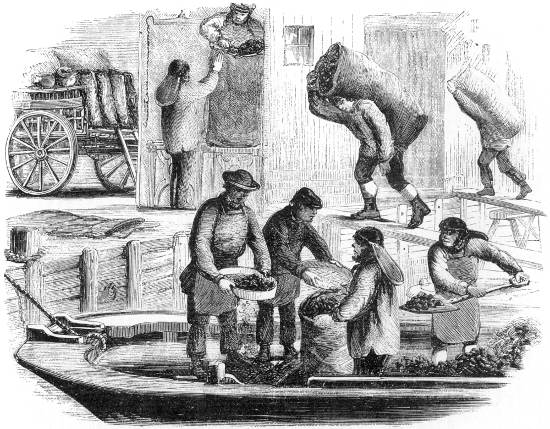
COAL-PORTERS FILLING WAGGONS AT COAL-WHARF.
[From a Sketch.]
Upon an average, a place-meter is employed about five days in the week. An extra meter is employed about four days in the week, and a supernumerary about half his time, but he has always his 25s. weekly secured to him, whether employed or not. Two pounds a-week would be a very fair average for the wages of a place-meter, since the reduction on the 1st of April. Many declare they don’t earn 36s. a-week, but many do more. The extra man gets very nearly the same money as the place-man, under the present arrangement. The supernumerary generally makes his 30s. weekly. As the system at present stands, the earnings of the meters generally are not so much as those of superior mechanics. It is an office requiring interest to obtain it: a man must be of known integrity; thousands and thousands of pounds of property pass through his hands, and he is the man appointed to see justice between factor and merchant. Before the Act directing all coals to be sold by weight, the meter measured them in a vat, holding a quarter of a chaldron. In those days a first-class meter could reckon upon an income of from 400l. to 500l. a-year, and the lowest salary was not under 300l. per annum. The meter’s office was then entirely a city appointment, and none but those of considerable influence could obtain it. This system was altered eighteen years ago, when the meter’s office was placed in the hands of a committee of coalfactors and coalmerchants. Immediately after this time the salaries decreased. The committee first agreed to pay the meters at the rate of 2d. per ton, undertaking that that sum should produce the place-meter an income of 120l. One gentleman assured me that he never exceeded 114l., but then he was one of the juniors. Under the old system the meters were paid at a rate that would have been equivalent to 3d. a ton under the present one. In the year 1831 the salary was reduced to 2d., and on the 1st of April in the present year, the payment has again been cut down to 1½d. per ton. Besides this, the certificate money, which was 2s. per ship, and generally amounted to 30s. per quarter, was entirely disallowed, making the total last reduction of their wages amount to full 30 per cent. No corresponding reduction has taken place in the price of coals to the consumer. At the same time the price of whipping has been reduced 1d. per ton, so that, within the last year, the combined factors and merchants have lowered the price of delivery 1½d. per ton, and they (the merchants and factors) have been the sole gainers thereby. This has been done, too, while the demand for coals has been increasing every year. Now, according to the returns of the clerk of the Coal Exchange, there were 3,418,340 tons of coals delivered in the port of London in the year 1848, and assuming the amount to have remained the same in the present year, it follows that the factors and merchants have gained no less than 21,364l. 12s. 6d. per annum, and that out of the earnings of the meters and the whippers.
The coalwhippers, already described, whip the coals by means of a basket and tackle from the hold to the deck of the ship. The coalmeters weigh the coals when so whipped from the hold, previously to their being delivered into the barge alongside. The “coalbacker” properly carries the coals in sacks upon his back from the barges, when they have reached the premises of the coal-merchants, on to the wharfs.
I will now proceed to speak of
The Coalporters.
Coalporters are employed in filling the waggons of the merchants at their respective wharfs, and in conveying and delivering the coal at the residence of the customers. Their distinguishing dress is a fantail hat, and an outer garment—half smock-frock and half jacket—heavy and black with coal-dust: this garment is often left open at the breast, especially, I am told, on a Monday, when the porter generally has a clean shirt to display. The narrative I give, will show how the labour of these men is divided. The men themselves have many terms for the same employment. The man who drives the waggon I heard styled indifferently, the “waggoner,” “carman,” or “shooter.” The man who accompanies him to aid in the delivery of the coals was described to me as the “trimmer,” “trouncer,” or “pull-back.” There are also the “scurfs” and the “sifters,” of whom a description will be given presently. The coalporters form a rude class; not, perhaps, from their manners being ruder than those of other classes of labourers, whose labour cannot be specified under the description of “skilled,” (it is, indeed, but the exertion of animal strength—the work of thew and muscle), but from their being less educated. I was informed that not one man in six—the manager in a very large house in the coal-trade estimated it at but one in eight—could read or write, however imperfectly. As a body, they have no fellowship or “union” among themselves, no general sick fund, no organization in rules for their guidance as an important branch (numerically) of an important traffic; indeed, as it was described to me by one of the class, “no nothing.” The coalporters thus present a striking contrast to the coalwhippers, who, out of means not exceeding those of the porters, have done so much for the sick among them, and for the instruction of their children. The number of men belonging to the Benefit Society of Coalwhippers is 436; and there are about 200 coalwhippers belonging to another society, that was instituted before the new office. There are 200 more in connexion with other offices. There were 130 sick men relieved by the Coalwhippers’ Society last year. There were 14 deaths out of the 436 members. Each sick man receives 10s. a-week, and on death there is a payment of 5l. a man, and 3l. in the case of a wife. The amount of subscription to the fund is 3d. per week under forty years of age, 4d. to fifty, 5d. to sixty, and above that, 6d. On account of the want of any organization among the coalporters, it is not easy to get at their numbers with accuracy. No apprenticeship is necessary for the coalporter, no instruction even; so long as he can handle a shovel, or lift a sack of coals with tolerable celerity, he is perfect in his calling. The concurrent testimony of the best-informed parties, gave me the number of the porters (exclusive of those known as sifters, scurfs, or odd men,) as 1500; that is, 1500 employed thus: in large establishments on “the waterside,” five men are employed as backers and fillers—two to fill the sacks, and three to carry them on their backs from the barge to the waggon, (in smaller establishments there are only two to carry). There are two more then employed to conduct the load of coal to the residence of the purchaser—the waggoner (or carman), and the trimmer (or trouncer). Of these the waggoner is considered the picked man, for he is expected to be able to write his name. Sometimes he can write nothing else, and more frequently not even so much, carrying his name on the customer’s ticket ready written; and he has the care of the horses as driver, and frequently as groom.
At one time, when their earnings were considerable, these coalporters spent large sums in drink. Now their means are limited, and their drunkenness is not in excess. The men, as I have said, are ill-informed. They have all a pre-conceived notion that beer sometimes in large quantities (one porter said he limited himself to a pint an hour, when at work), is necessary to them “for support.” Even if facts were brought conclusively to bear upon the subject to prove that so much beer, or any allowance of beer, was injurious, it would, I think, be difficult to convince the porters, for an ignorant man will not part with a pre-conceived notion. I heard from one man, more intelligent than his fellows, that a temperance lecturer once went among a body of the coalporters and talked about “alcohol” and “fermentation,” and the like, until he was pronounced either mad or a Frenchman.
The question arises, Why is this ignorance allowed to continue, as a reproach to the men, to their employers, and to the community? Of the kindness of masters to the men, of discouragement of drunkenness, of persuasions to the men to care for the education of their children, I had the gratification of hearing frequently. But of any attempt to establish schools for the general instruction of the coalporters’ children, of any talk of almshouses for the reception of the worn-out labourer, of any other provision for his old age, which is always premature through hard work,—of any movement for the amelioration of this class, I did not hear. Rude as these porters may be, machines as they may be accounted, they are the means of wealth to their employers, and deserve at least some care and regard on their part.
The way in which the barges are unladen to fill the waggons is the same in the rivers as in the canals. Two men standing in the barge fill the sacks, and three (or two) carry them along planks, if the barge be not moored close ashore to the waggon, which is placed as near the water as possible. In the canals, this work is carried on most regularly, as the water is not influenced by the tide, and the work can go on all day long. I will describe, therefore, what I saw in the City Basin, Regent’s Canal. This canal has been opened about twenty years. It commences at the Grand Junction at Paddington, and falls into the Thames above the Limehouse Dock. Its course is circuitous, and in it are two tunnels—one at Islington, three-quarters of a mile long; the other at the Harrow Road a quarter of a mile long. If a merchant in the Regent’s Canal has purchased the cargo of a collier, such cargo is whipped into the barge. For the conducting of this laden barge to the Limehouse Basin of the canal, the merchant has to employ licensed lightermen, members of the Waterman’s Company, as none else are privileged to work on the river. The canal attained, the barge is taken into charge by two men, who, not being regular “watermen,” confine their labours to the canal. These men (a steerer and a driver) convey the barge,—suppose to the City Basin, Islington, which, as it is about midway, gives a criterion as to the charge and the time when other distances are concerned. They go back with an empty barge. Each of these bargemen has 2s. a barge for conveyance to the City Basin. The conveyance of the loaded barge occupies three hours, sixty-four tons of coal being an average cargo. Two barges a-day, in fine weather, can be thus conducted, giving a weekly earning to each man in full work of 24s. This is subject to casualties and deductions, but it is not my present intention to give the condition of these bargemen. I reserve this for a future and more fitting occasion. In frosty weather, when the ice has caused many delays, as much as 6s. a-barge per man has been paid; and, I was told, hard-earned money, too. A barge at such times has not been got into the City Basin in less than forty-eight hours. The crowded state of the canal at the wharfs at this time of the year, gives it the appearance of a crowded thoroughfare, there being but just room for one vessel to get along.
From the statement with which I was favoured by a house carrying on a very extensive business, it appears that the average earnings of the men in their employ was, the year through, upwards of 28s. I give the payments of twelve men regularly employed as the criterion of their earnings, on the best paid description of coalporters’ labour, for four weeks at the busiest time:—
December22£2155
„1521173
„822101
November172880
This gives an average of more than 1l. 19s. per man a-week for this period; but the slackness of trade in the summer, when coals are in smaller demand, reduces the average to the amount I have stated. In the two weeks omitted in the above statement, viz. those ending December 1st and November 24th, fourteen men had to be employed, on account of the briskness of trade. Their joint earnings were 39l. 12s. 5d. one week, and 33l. 6s. 7d. the other. By this firm each waggoner is paid 1l. a-week, and 6s. extra if he “do” 100 tons; that is, 6s. between him and the trimmer. For every ton above 100 carried out by their waggoner and trimmer, 1d. extra is paid, and sometimes 130 are carried out, but only at a busy time; 142 have been carried out, but that only was remembered as the greatest amount at the wharf in question. For each waggon sent out, the waggoner and the trimmer together receive 4d. for “beer money” from their employers. They frequently receive money (if not drink) from the customers, and so the average of 28s. and upwards is made up. I saw two waggoners fully employed, and they fully corroborated this statement. Such payment, however, is not the rule. Many give the waggoner 21s. a-week, and employ him in doing whatever work may be required. A waggoner at what he called “poor work,” three or four days a-week, told me he earned about 13s. on the average.
The scurfs are looked upon as, in many respects, the refuse of the trade. They are the men always hanging about the wharfs, waiting for any “odd job.” They are generally coalporters who cannot be trusted with full and regular work, who were described to me as “tonguey, or drunken,” anxious to get a job just to supply any pressing need, either for drink or meat, and careless of other consequences. Among them, however, are coalporters seeking employment, some with good characters. These scurfs, with the sifters, number, I understand, more than 500; thus altogether making, with the coalbackers and other classes of coalporters, a body of more than 2000.
I now come to the following statement, made by a gentleman who for more than thirty years has been familiar with all matters connected with the coal-merchants’ trade. “I cannot say,” he began, “that the condition of the coalporter (not referring to his earnings, but to his moral and intellectual improvement) is much amended now, for he is about the same sort of man that he was thirty years ago. There may be, and I have no doubt is, a greater degree of sobriety, but I fear chiefly on account of the men’s earnings being now smaller, and their having less means at their command. Thirty-five years ago, before the general peace, labourers were scarce, and the coalporters then had full and ready employment, earning from 2l. to 3l. a-week. I have heard a coalporter say that one week he earned 5l.; indeed, I have heard several say so. After the peace, the supply of labour for the coal-trade greatly increased, and the coalporters’ earnings fell gradually. The men employed in a good establishment thirty years ago, judging from the payments in our own establishment as a fair criterion, were in the receipt of nearly 3l. a-week on the average. At that time coal was delivered by the chaldron. A chaldron was composed of 12 sacks containing 36 bushels, and weighing about 25 cwt. (a ton and a-quarter). For the loading of the waggons a gang of four men, called ‘fillers,’ was, and is, employed. They were paid 1s. 4d. per chaldron; that is, 4d. per man. This was for measuring the coal, putting it into sacks, and putting the sacks into the waggon. The men in this gang had nothing to do with the conveyance of the coal to the customers. For that purpose two other men were employed; a ‘waggoner,’ and a man known as a ‘trimmer,’ or ‘trouncer,’ who accompanied the waggoner, and aided him in carrying the sacks from the waggon to the customers’ coal-cellar, and in arranging the coal when delivered, so as properly to assort the small with the large, or indeed making any arrangement with them required by the purchaser. The waggoner and the trimmer were paid 1s. 3d. each per chaldron for delivery, but when the coal had to be carried up or down-stairs any distance, their charge was an extra shilling—2s. 3d. Many of the men have at that time, when work was brisk, filled and delivered fifteen chaldrons day by day, provided the distance for delivery was not very far. Drink was sometimes given by the customers to the waggoner and trimmer who had charge of the coal sent to their houses—perhaps generally given; and I believe it was always asked for, unless it happened to be given without asking. At that time I did not know one teetotaler; I do not know one personally among those parties now. Some took the pledge, but I believe none kept it. In this establishment we discourage drunkenness all that we possibly can. In 1832, wages having varied from the time of the peace until then, a great change took place. Previous to that time a reduction of 4d. per ton had been made in the payment of the men who filled the waggons (the fillers), but not in that of the waggoner or the trimmer. The change I allude to was that established by Act of Parliament, providing for the sale of all coal by the merchant being by weight instead of by measure. This change, it was believed, would benefit the public, by ensuring them the full quantity for which they bargained. I think it has benefited them. Coal was, under the former system, measured by the bushel, and there were frequently objections as to the way in which the bushel was filled. Some dealers were accused of packing the measure, so as to block it up with large pieces of coal, preventing the full space being filled with the coal. The then Act provided that the bushel measure should be heaped up with the coal so as to form a cone six inches above the rim of the measure. When the new Act came into operation the coalporters were paid 10d. a-ton among the gang of four fillers, and the same to the waggoner and trimmer. Before two years this became reduced generally to 9d. The gang could load twenty-five tons a-day without extra toil; forty tons, and perhaps more, have been loaded by a gang: but such labour continued would exhaust strong men. With extra work there was always extra drink, for the men fancy that their work requires beer ‘for support.’ My opinion is that a moderate allowance of good malt liquor, say three pints a-day when work is going on all day, is of advantage to a coalporter. In the winter they fancy it necessary to drink gin to warm them. At one time all the men drank more than now. I estimate the average earnings of a coalporter fully employed now at 1l. a-week. There are far more employed at present than when I first knew the trade, and the trade itself has been greatly extended by the new wharfs on the Regent’s Canal, and up and down the river.”
I had heard from so many quarters that “beer” was a necessity of the coal-labourers’ work, that finding the coalwhippers the most intelligent of the whole class, I thought it best to call the men together, and to take their opinion generally on the subject. Accordingly I returned to the basketmen’s waiting-room at the coalwhippers’ office, and, as before, it was soon crowded. There were eighty present. Wishing to know whether the coalbacker’s statement already given, that the drinking of beer was a necessity of hard labour, was a correct one, I put the question to the men there assembled: “Is the drinking of fermented liquors necessary for performing hard work? How many present believe that you can work without beer?” Those who were of opinion that it was necessary for the performance of their labour, were requested to hold up their hands, and four out of the eighty did so.
A basketman who had been working at the business for four years, and for two of those years had been a whipper, and so doing the heaviest labour, said that in the course of the day he had been one of a gang who had delivered as many as 189 tons. For this he had required no drink at all; cocoa was all he had taken. Three men in the room had likewise done without beer at the heaviest work. One was a coalwhipper, and had abstained for six years. Some difference of opinion seemed to exist as to the number in the trade that worked without beer. Some said 250, others not 150. One man stated that it was impossible to do without malt liquor. “One shilling a day properly spent in drink would prolong life full ten years,” he said. This was received with applause. Many present declared that they had tried to do without beer, and had injured themselves greatly by the attempt. Out of the eighty present, fourteen had tried teetotalism, and had thrown it up after a time on account of its injuring their health. One man, on the other hand, said he had given the total-abstinence principle a fair trial for seven months, and had never found himself in such good health before. Another man stated, that to do a day’s work of ninety-eight turns, three pints of beer were requisite. All but three believed this. The three pints were declared to be requisite in winter time, and four pints, or two pots, were considered to be not too much in a hot summer’s day. Before the present office was instituted, each man, they told me, drank half-a-pint of gin and six pots of beer daily. That was the average—many drank more. Then they could not do their work so well; they were weaker from not having so much food. The money went for drink instead of meat. They were always quarrelling on board a ship. Drunken men could never agree. “A portion of beer is good, but too much is worse than none at all.” This was the unanimous declaration.