GROUP IV (continued 2)
Reading edition
Beginning at the south end of the modern Bishopsgate we see on the west the Bank of Scotland, the National Bank of Australasia, and the Delhi and London Bank, housed under one roof in a large stone building with the lower windows enclosed in exceptionally high and bold arches. Baring Bros. Bank is opposite. It is a plain, well-proportioned brick building, symmetrical and without tawdry 182ornament; it was designed by R. Norman Shaw. It is flanked on either side by a public-house, The Black Lion and the City of London Tavern. Just opposite the entrance of Threadneedle Street the Wesleyan Centenary Hall attracts attention by its size and solidity. Four immense fluted columns run up the facade to a frieze and triangular pediment. It was erected in 1839. Close by is the Bank of Scotland. It looks out on the really fine National Provincial Bank of England at the north corner of Threadneedle Street. This has fluted stone columns running up to the frieze along the whole frontage. They enclose very tall, round-headed windows, and above the windows are deep panels of great size executed in basso-relievo. It was erected in 1833 and the architect was J. Gibson. Along the parapet of the roof at intervals are placed statues which break the hard line.
Immediately opposite the entry, on the east side of the square we see a dreary block of brick houses; these are Crosby Buildings, and are fully occupied by representatives of trade and commerce. On the south side there is an old stuccoed house with a square pillared porch. The next house is of red brick with decorative brick panels let in on the face. This is an old house which has been recased. Its fine stuccoed doorway is still preserved. On the west a large red brick building bearing date 1876 fills up the space, and on the north is an old brick house with a plain projecting pediment over the door, and brackets similar to those on the south side. No. 7 in the north-east corner is a new stone house of plain but rather original design. A couple of little plane-trees grow up at either end of the quiet square.
A covered entry leads from Crosby Square to Great St. Helen’s. The first part of this tortuous thoroughfare is lined by the side of Crosby Buildings, modern brick, on the one side, and the end of the stuccoed synagogue, which stands back from the frontage of the street, on the other. About this part, and the narrow lane which succeeds it running north and south, there is little to say; the substantial business spirit pervades even the bricks and mortar. But in the open space beyond, facing the church, are some features of interest. Nos. 8, 9, and 10 have all been rebuilt in the large-windowed flat modern style. No. 7 is a fine old red brick house. No. 2 is a delightful one and has an ornamental doorway with fluted columns and pilasters supporting the lintel, beneath which on either side are cherubs’ heads. Across the wide space before the quaint and interesting church are other red brick houses, some old and some of more modern date. Close by the entry the builder is at work on the site of some charming old gabled houses demolished within the last five years.
ST. HELEN, BISHOPSGATE
There is a well-known tradition that a church was built here in the fourth century by the Emperor Constantine, and there is a record preserved which proves that the church was in existence before the year 1010. A church standing on this site was given by one Ranulph, and Robert his son, to the Dean and 183Canons of St. Paul’s at a date unknown. About 1212, permission was obtained to found the Priory of St. Helen for nuns of the Benedictine Order and with this the real history of the church begins. It is always stated that the north aisle of the church was used by the nuns, while the south was occupied by the parishioners, but the first rector mentioned dates from 1541, that is to say, after the suppression of the Religious Houses. On the dissolution of the priory in 1538 the church was given in its entirety to parochial uses. It was largely repaired in 1631 (under the direction of Inigo Jones), in 1841, 1865, and again in 1891-93. In 1873 the Parish of St. Martin Outwich was united with this, its church having been pulled down.
Houseling people in 1548 were 220.
The church consists of two parallel naves, each of 122 feet in length and about 25 feet in width, and a south transept, out of which two eastern chapels open. In the north wall is an arched doorway which led from the choir into the priory, also a hagioscope through which the nuns were able to discern the high altar from the cloisters. All this part and some of the south transept dates from the thirteenth century; the side chapels were added about the middle of the fourteenth and the rest dates from the fifteenth century.
A chantry was founded in honour of the Holy Ghost for the soul of Adam Fraunceys, to which Joan, Prioress of the Convent of St. Helen, presented Robert Gryngeley, May 18, 1399, and for Agnes his wife (Hennessey’s Chantries, p. 39).
The church contains a remarkable number of interesting monuments. The following are commemorated: Alderman John Robinson, Merchant Taylor and merchant of the Staple of England; died 1599. Francis Bancroft, who bequeathed over £28,000 to the Drapers Company for the erection of almshouses and a school for boys; he died 1727. Martin Bond, M.P. in 1624 and 1625 for the City of London. Alberticus Gentilis, Merchant Adventurer and a prolific legal author who was an exile from Italy on account of his Protestant opinions; he became Regius Professor of Civil Law at Oxford and died in 1608. Sir Thomas Gresham, founder of the Royal Exchange and Gresham College, who died in 1579. Sir Andrew Judde, Lord Mayor in 1550, and a great benefactor of the parish. Sir Julius Cæsar, judge, Master of the Rolls under James I.; his monument was executed by Nicholas Stone, Master Mason to King Charles I. Sir William Pickering, Knt., soldier and scholar, whose monument is the most magnificent in the church; he distinguished himself greatly under Henry VIII., Edward VI., Mary, and Elizabeth; he died in 1574. Sir John Crosby, already mentioned in connection with Crosby Hall. Sir John Spencer, Lord Mayor in 1594, commonly known as “Rich Spencer” on account of his vast wealth. The Rev. J. E. Cox, D.D., who was Vicar-in-charge of the united parishes, wrote The Annals of St. Helen’s, Bishopsgate, London; he was for nine years in succession Grand Chaplain of England. On the floors of the two chapels there are several brasses very well executed.
A considerable number of benefactors are recorded by Stow, but the amounts of their gifts were small individually. Sir John Crosby, at his death in 1475, bequeathed 500 marks for the repair of the church. In more recent times Francis Bancroft bequeathed over £28,000; this has been devoted to founding a school at Woodford, Essex, for boys—100 boarders and 200 day-boys. Sir Andrew Judde left the Skinners Company trustees for the accomplishment of charitable aims.
There were five almshouses near the church for as many decayed Skinners and their wives. Six almshouses also were founded by Sir Andrew Judde; in Little St. Helen Street there were seven houses for the same number of widows, each of whom had £5 : 4s. per annum.
Thomas Horton (d. 1673), Vice-Chancellor of Cambridge, 1649, was rector here.
For an account of the ancient nunnery of St. Helen, see Mediæval London, vol. ii. p. 313.
St. Helen’s Place is a quiet corner with monotonous rows of Early Victorian or Georgian brick houses finished off with yellow paint. No. 1, near the entrance, and No. 2 have slight pillared porches over their doorways. In the northeast 184corner the small but richly-decorated front of the Leathersellers’ Hall attracts attention. The place is shut off from the street by spiked iron gates.
THE LEATHERSELLERS COMPANY
Dealers in leather are supposed to have existed as a society or corporation in Britain from the time of the Romans.
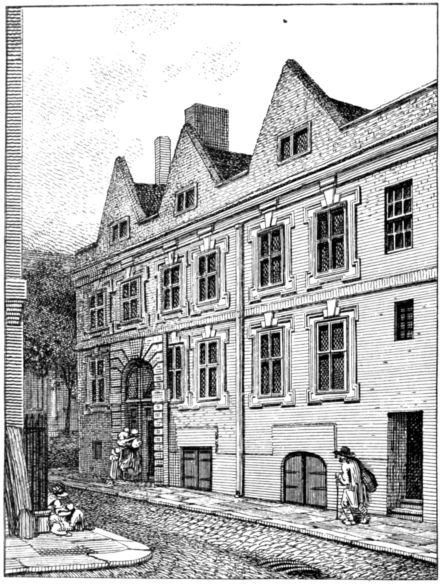
PRINCIPAL ENTRANCE TO LEATHERSELLERS’ HALL. DEMOLISHED 1799
The “leathersellers,” as a company, are first mentioned about A.D. 1372, in Edward III.’s reign, when their “probi homines,” or “bons gentz,” their wardens or seniors, came before the Court of Aldermen, together with those of the craft of Pursers, afterwards amalgamated with the Leathersellers Company, and jointly presented a bill or “supplication” desiring some stringent regulations to be made for the prevention of the sale of other than genuine leather, and to prevent fraudulent colouring of leather.
The leathersellers were known as a corporation in London, and were governed by ordinances, 1377-99.
The first charter of incorporation was granted to the Company by 22 Henry VI., 1444. It is still in their possession, and, “after reciting the petition of Thomas Bigge and fourteen others, men of the 185mistery of leathersellers of the city of London, sets forth an ordinance made by Richard Whittington, mayor, and the aldermen of the city, 21 Richard II., A.D. 1398, that two or four of the better or more approved men of the mistery should yearly be chosen and sworn to guard and oversee defaults in the same mistery, and to present, from time to time, to the mayor and chamber of the said city aforesaid for the time being; and that none of the mistery aforesaid, to wit, master or servant, should be rebellious or contrarious to such men so chosen and sworn, duly exercising search in the said mistery, nor points, or laces, unless they were well and sufficiently made, nor straps of the leather of sheep or calf, nor thereof any other work, should falsely or deceitfully be wrought to the deception of the people under pain of the heavy punishment upon such cases ordained, and the payment of 6s. 8d.; to wit, to the use of the Chamber of the city aforesaid 40d., and to the use of the said mistery 40d.”
There are now 151 members of the livery. They have a Corporate Income of £17,000 and a Trust Income of £3000. With the Leathersellers were incorporated the White Tawyers, or makers of white leather; the Pouchmakers, the Pursers, the Mailmakers, the Galoche-makers, the Tiltmongers, the Leather-dressers, the Parchment-makers and the Leather-dyers.
The earliest quarters of the trades connected with Leather were in the north under London Wall. Here they had their first hall. After the dissolution of the Religious Houses the Company obtained the site of the nunnery known as St. Helen’s. Part of the house was converted into the Company’s Hall, the old Refectory becoming the Company’s place of meeting and banqueting. This ancient structure was destroyed in 1797, the present one was built in 1878.
The low small Church of St. Ethelburga peers over some old houses, which seem to have stuck to it as barnacles to a decayed ship.
ST. ETHELBURGA THE VIRGIN
This church is dedicated to Ethelburga, who was sister of Erconwald, fourth Bishop of London, and first Abbess of Barking. In all probability the parish was formed and the church was built in the century which succeeded the Conquest. It escaped the Great Fire, and has subsequently had a great deal of attempted restoration. The earliest date of an incumbent is 1304.
The patronage of the church was in the hands of: the Prioress and Convent of St. Helen’s, London, 1366; then Henry VIII. seized it and it was granted in 1569 to the Bishop of London, and continues with his successors.
Houseling people in 1548 were 140.
The present church, originally Early English, appears to have been altered at the close of the fourteenth century or early fifteenth. It is very small, measuring less than 60 feet by 30, and under 31 feet in height, and is almost crowded out by houses. Entrance is obtained through an archway between two shops, the upper stories of which conceal everything but the top of the west window and turret. It contains a south aisle separated from the rest by four pointed arches, with a clerestory above. The roof is divided into compartments and slopes slightly at the sides. The arch at the entrance of the nave is fine and there are remnants of wood-carving, probably of the sixteenth century, on the porch.
A chantry was founded here at the Altar of the Blessed Virgin Mary by Gilbert Marion, and Christina his wife, to which Thomas More was admitted chaplain, December 15, 1436.
There are tablets affixed to the wall commemorating parishioners, but little interest attaches to the individuals. The only two connected with this church of any eminence are John Larke, a friend of Sir Thomas More, who was executed in 1554 for denying the King’s supremacy; and Luke Milbourne (1649-1720), Dryden’s hostile critic, rector here in 1704. William Bray (d. 1644), chaplain to Archbishop Laud, was also sometime rector.
In Clark’s Place is a building containing the Marine Society, with the statues of 186a woman and boy in a niche. In Bishopsgate Street, No. 68, is an old stuccoed house with projecting upper stories. No. 67 is also old though not so noticeable.
Part of Ethelburga House and the numbers on the north, as far as 23 inclusive, are in this ward. The corner house has a stone mitre of large size on its corner and an inscription, rather quaintly worded, announcing that the gate stood formerly “adjoining to this spot.” Looking back down Bishopsgate from here we get a fine perspective view. The modern buildings are of all heights, but distance blends them not inharmoniously, leaving enough variety to be pleasing.
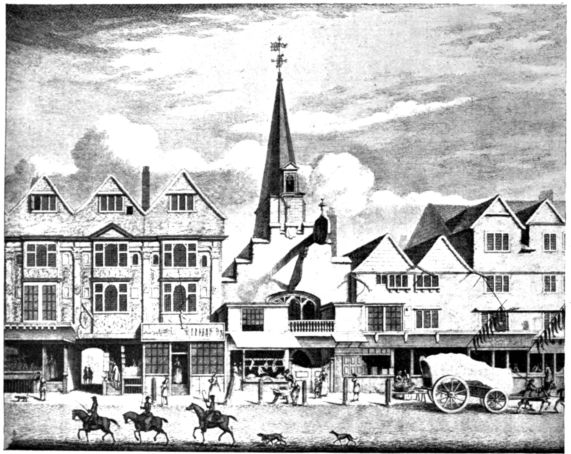
Drawn by R. West, 1736. ST. ETHELBURGA, BISHOPSGATE ST.
The Mail Coach public-house is at the corner, and on the opposite house is a small mitre in memory of the Bishopsgate.
Just outside the City Wall is
ST. BOTOLPH, BISHOPSGATE
This church escaped the Great Fire of 1666, but was rebuilt in 1725-29 by James Gold. In 1615 the City gave the parishioners additional ground on the west for burial purposes. The earliest date of an incumbent is 1323.
187The patronage of the church has always been in the hands of the bishops of London since 1323.
Houseling people in 1548 were 650.
The building includes two aisles, separated from the main body by composite columns. There are galleries on the north, south, and west. The steeple rises at the east end, and the chancel, therefore, is formed beneath the tower. It is built of stone and consists of three stories, the third of which is completed by a small composite temple surrounded by a balustrade and surmounted by an urn. The remainder of the exterior is of red brick with stone dressings.
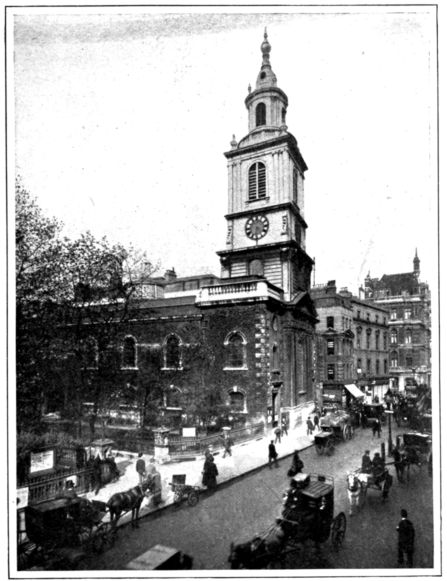
Pictorial Agency. ST. BOTOLPH, BISHOPSGATE
Sir Paul Pindar, a great benefactor to the church, who acted as James I.’s Turkish Ambassador in 1611, was buried in this church, and a monument was erected to his memory. Close to this, also in the chancel, is a brass plate in memory of Sir William Blizard, President of the Royal College of Surgeons, who died in 1835. John Keats was baptized here in 1795, and Edward Alleyn, founder of Dulwich College, in 1566. Here also Archibald Campbell, 7th Earl of Argyll and father of the celebrated first marquis, was married in 1609.
There were a considerable number of small charitable gifts belonging to this parish. Of the larger, 188Ralph Pindar was a donor of £60; Nicholas Reive, of £406 : 5s. in 1626; William, Earl of Devonshire, of £100.
There was one charity school for twenty-five boys and twenty-five girls, who were taught and made apprentices by subscription and legacies. Also almshouses in Lamb’s Court for the poor of the parish, maintained by Dulwich College, and three almshouses by the pesthouse for three poor widows, the gift of Lady Lumley.
Some of the notable rectors were: Alfred Earle, Bishop of Marlborough, in 1888; Charles James Blomfield (1786-1857), Bishop of Chester; John Lake (1624-89), Bishop of Chichester.
On the site of Spital Square, Bishopsgate Street Without, stood the ancient house called St. Mary Spital, for an account of which see Mediæval London, vol. ii. p. 322.
Bishopsgate Street Without is a curious mixture of old houses, some with grotesque features, and modern buildings presenting only a strip of much-ornamented stone or brick frontage. After the Great Eastern Hotel on the west, the frontage of the station presents a very long row of uniform buildings in new red brick with stone dressings and ornamental gable ends. The famous old house named Paul Pindar’s was pulled down to make way for these.
Paul Pindar (b. 1565) was the son of Ralph Pindar, alderman’s deputy for the ward of Bishopsgate. At sixteen he was apprenticed to one Parvish, an Italian merchant who sent him to Venice as his factor, and he stayed there many years. In 1615 he was sent to Turkey as Ambassador by request of the Turkey Company, and he remained there for nine years. He returned in 1623, and was knighted. The King offered him also the Lieutenancy of the Tower, which he declined. Charles thereupon made him Farmer of Customs.
In 1639 he possessed £236,000, out of which he gave large sums to the King. He died August 22, 1650. The row of houses that now stand on the site of his house have fairly good shops on the ground-floors, and there are one or two archway entrances into the station premises near the north end. The Black Raven public-house is one of these. Acorn Street, Skinner Street, and Primrose Street need very little comment. They are chiefly composed of the sides of houses fronting Bishopsgate, and some ordinary modern brick buildings.
Nos. 131-2-3 are old plaster houses, and No. 120, beyond Acorn Street, has a projecting bay window carried up two stories. This is also an old house. These are all on the west side. On the east, beginning again from the south end, the first building to attract attention is the Metropolitan Fire Brigade Station, erected 1885. It is an improvement on the monstrosities continually perpetrated in the name of the Fire Brigade. The Bishopsgate Institute is near Brushfield Street. It fronts Bishopsgate with an elaborate yellow terra-cotta façade, and has an open entry. The entrance to the Bishopsgate Chapel is under an old stuccoed house, and the chapel itself is a large stuccoed building. Beyond this, after a Great Northern Receiving Office, are some very old houses, plastered with rough stucco in imitation 189of stone. These are Nos. 82 to 84. One of them has wooden rusticated work from above the first story to the top of the gable end. The date 1590 is stated to have been visible on one of them within the memory of man. On the corner house of Spital Street is a tablet noting the point of the City Bounds. This was placed here in 1846.
190