GROUP III
Reading edition
The third group of streets is that which is bounded on the south by Cannon Street, on the east by Bishopsgate Street and Gracechurch Street, and on the west by Moorgate Street, Princes Street, and Walbrook, and northward by the City limits.
This, with Cheapside, includes the very heart and centre of the City. In it are the streets called Cornhill, Lombard Street, Threadneedle Street, Throgmorton Street, Lothbury, Princes Street, and Broad Street. Here were formerly the ecclesiastical foundations of the Austin Friars and St. Anthony’s. Here are the Royal Exchange, the Bank of England, the Mansion House, the offices of many Banks and of Companies; the site of such well-known houses as the Baltic, the South Sea House, Garraway’s, the Jerusalem, the London Tavern. In Lombard Street we have the first house of City Firemen and the first Post Office. In Broad Street is the site of Gresham House, afterwards Gresham College, founded with such a noble ambition, fallen now to so poor a place.
In this place it is proposed to take the principal streets and lanes and to set down whatever points of interest have not been touched upon in the large History of London.
Cornhill has been a crowded street from time immemorial. Stow says that there was here a corn market. It does not seem proved, however, that there ever was one here. Loftie points out that the London corn market was on the east side of St. Michael-le-Querne, opposite Bread Street. It has been suggested that the family of Coren Hell or Corn Hill gave their name to the ward. In 1125 there is Edward Heep Cornhill among those engaged in the conveyance of the Portsoken to the Holy Trinity Priory. But a market of some sort was most certainly held here, and it may have been originally a corn market.
We must not suppose that the division of trades and markets was ever rigidly observed. If there were bakers in Bread Street, there may have been bakers elsewhere for the general convenience. Then in 1347 (Riley’s Memorials, p. 236) there was a corn market in Gracechurch Street and another in Newgate Street. The market was opposite the Franciscan House, so that perhaps we may accept Stow’s statement and conclude that the corn market of Cornhill gradually receded 92eastward into Gracechurch Street, where it was presently absorbed by Leadenhall Market, which is reckoned by Stow as in Cornhill.
In 1310 proclamation was made in the City as follows:
“It is ordered and commanded on the King’s behalf, that no man or woman shall be so daring or so bold as from henceforth to hold a common market for any manner of merchandise in the highway of Chepe after the hour of None, as heretofore they have done; nor yet in any other place within the City, save only upon Cornhulle; and that, from Matins until the hour of None, and not after: on pain of forfeiture of the goods so carried there to sell, by way of holding common market there” (Riley’s Memorials, p. 75).
The hour of “None” is from two to three. What was the meaning of this proclamation? Why must the markets of Chepe be closed at three while those of Cornhill remained open? But in 1369, because many cheats had been possible by selling things after dark, it was ordered that at the ringing of the bell upon the Tun at sunset (not the bell of St. Mary-le-Bow, which only belonged to West Chepe), all shops and stalls were to be closed.
The Tun, of which mention has often been made in other volumes of this book, was a small prison, something like a tun, built by Henry le Waleys in 1282. Beside it was a conduit built by the same citizen. And there was a standard for Thames water brought there by the contrivance of one Peter Morris, a Dutchman. Distances were reckoned from the standard of Cornhill.
Here were stocks for the sturdy beggar, the lazar, should he venture into the City, and fraudulent dealers. Here was a pillory for similar offenders; one William Felde stood in it in 1375 for cheating hucksters of ale. Here Gyleson also, in 1348, was so put to public shame for selling putrid pork, some of which was burned under his nose to his unspeakable discomfort.
The earliest occupants of Cornhill, according to Strype, were drapers. It is, however, certain that other trades were established there. Thus in 1302 there is a baker of Cornhill; in 1318 a bakehouse opposite the Pillory; in 1345 the City poulterers are ordered not to sell east of the Tun on Cornhill, while the “foreign” poulterers are sent to Leadenhall; in 1342, “false” blankets are burned in Cornhill; in 1347 there is a turner of Cornhill; in 1364 a tailor; in 1365 the pelterers are ordered to carry on their business in Cornhill, Walbrook, and Budge Row only; in 1372 the blacksmiths are confined for the exhibition of their wares to Gracechurch Street, St. Nicholas Fleshambles’ (Newgate), and the Tun of Cornhill.
The punishment of common clerks illustrated by Stow is noted elsewhere. As regards the Tun, he writes:
93
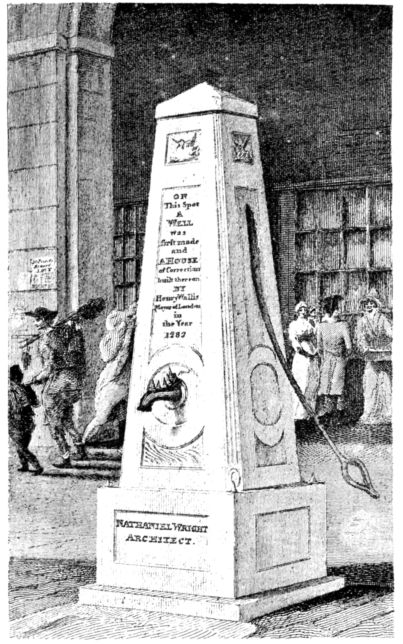
THE PUMP IN CORNHILL, 1800
“By the west side of the foresaid prison, then called the Tun, was a fair well of spring water curbed round with hard stone; but in the year 1401, the said prison house, called the Tun, was made a cistern for sweet water, conveyed by pipes of lead from Tiborne, and was from thenceforth called the Conduit upon Cornhill. Then was the well planked over, and a strong prison made of timber called a cage, with a pair of stocks therein set upon it, and this was for night walkers. On the top of which cage was placed a pillory, for the punishment of bakers offending in the assize of bread, for millers stealing of corn at the mill, for bawds, scolds, and other offenders. As in the year 1468, the 7th of Edward IV., divers persons being common jurors, such as at assizes were forsworn for rewards, or favour of parties, were judged to ride from Newgate to the pillory in Cornhill, with mitres of paper on their heads, there to stand, and from thence again to Newgate, and this judgment was given by the mayor of London. In the year 1509, the 1st of Henry VIII., 94Darby, Smith, and Simson, ringleaders of false inquests in London, rode about the city with their faces to the horse tails, and papers on their heads, and were set on the pillory in Cornhill, and after brought again to Newgate, where they died for very shame, saith Robert Fabian.
“The foresaid conduit upon Cornhill, was in the year 1475 enlarged by Robert Drope, draper, mayor, that then dwelt in that ward; he increased the cistern of this conduit with an east end of stone and castellated it in comely manner” (Stow’s Survey, p. 208).
In the time of Stow there were still standing some of the old houses, built of stone in accordance with the regulations of Henry Fitz Aylwin and other mayors. The danger of fire was thus diminished. But those houses which in many cases were built round open courts, covering a large space and of no more than two stories in height, were gradually taken down and houses of four or five stories built in their place, a fact which must be remembered when we read of the Great Fire. All those broad courts and open spaces which might have checked the Fire at so many points were gone in 1666, and replaced by high houses standing together and by narrow courts.
The Royal Exchange, the Bank of England, and the Mansion House are so mixed up with the general history of London that they must be sought for in the volumes that have preceded this.
The Weigh-house was the place where all merchandise brought across the sea was taken to be weighed at the King’s beam. “This house hath a master, and under him four master porters, with porters under them: they have a strong cart, and four great horses, to draw and carry the wares from the merchants’ houses to the beam and back again” (Stow, p. 73). The house was built by Sir Thomas Lovell, “with a fair front of tenements towards the street.” The cart therefore was taken into an inner court through a gateway, as we might expect.
There were many taverns in and about Cornhill.
In the sixteenth century was still standing one of the old stone houses of which we have spoken. This was popularly known as “King John’s House.” Now at the granting of the commune to the City, John lodged at the house of Richard Fitz Richer, the sheriff. Possibly this was the house. Pope’s Head Alley marks the site of the Pope’s Head Tavern, which had the ancient arms of England, three leopards between two angels, engraved in stone on the front. Stow thinks it may have been a royal palace.
A perspective view of Cornhill at the present day gives a very fine effect. The sides are lined with large buildings on the erection of which no time or expense has been spared, and the protuberant stone decoration and the lines of enriched windows give on the whole an appearance of wealth and dignity. Yet, taken singly, there are few of these buildings that deserve any commendation. There is a sameness 95and want of originality. Everywhere are round-headed windows and stone foliage; everywhere the same shaped roof projections and pinnacles. The flagged space in front of the Royal Exchange is decorated by trees in tubs, and on it stands an equestrian statue of the Duke of Wellington. This was executed by Sir Francis Chantrey in 1844. The Royal Exchange lines the side of the street for some distance and all round the ground-floor are shops, etc. Beyond it is a second open space. The statue here facing southward is of Rowland Hill. The figure is on a block of polished granite.
Beyond Finch Lane the Union Bank of Australia stands out as one of the exceptions to the general monotony of the street. It is of white stone, in a severe style without undue excrescences, and the chief ornament is a row of sculpturesque figures supporting the cornice.
On the south side of Cornhill an entrance to St. Peter’s Church first attracts attention.
ST. PETER, CORNHILL
This church is possibly the most ancient in the City. It was practically rebuilt in the reign of Edward IV. and thoroughly renovated in 1632, but so damaged by the Great Fire that after attempts at restoration it had to be rebuilt. The present building was erected by Wren in 1680-81. The earliest known date of an incumbent is 1263—one John de Cabanicis. There is an unbroken succession since John de Exeter, 1282.
The patronage of the church was in the hands of the family of Nevil before 1263, one of whom, Lady Alice Nevil, conveyed it in 1362 to Richard, Earl of Arundell, for a term of years; in 1380 to Thomas Coggeshall and others; in 1402 to Hampweyde Bohern, Earl of Hereford. It was again conveyed about, or shortly before, 1395 to Robert and Margaret Rykedon and others, who presented to it in 1405; it was confirmed to Richard Whittington and others in 1408, who in turn confirmed it in 1411 to the Mayor and Commonalty of London, in whose successors it continued.
Houseling people in 1548 were 500.
The church measures 80 feet in length, 47 feet in breadth, and 40 feet in height, and contains a nave and two aisles separated from the central portion by Corinthian columns. There is a very fine screen, one of the only two erected in the City of London, and the only one remaining in its original position. The steeple, which rises at the south-west, attains a height of 140 feet, and consists of a tower and cornice surmounted by a cupola, an octagonal lantern, and a spire, terminating in St. Peter’s emblem, the Key. The view of the exterior is blocked on the north by intervening houses, but on the south the church is open to the churchyard.
Chantries were founded here by Roger FitzRoger previous to 1284; by Nicholas Pycot at the Altar of St. Nicholas in 1312; by Philip de Ufford at the Altar of St. Katherine in 1321; by Robert de la Hyde at the Altar of St. George in 1328; by William Elliot (William of Kingston) at the Altar of the Holy Trinity, for himself, Sarah and Alynor his wives, and for his father and mother in 1375; by John Foxton at the Altar of St. George in 1382; by John Waleys at the same altar in 1409; and by Dame Alice Brudenel in 1437 to the Altar of St. Nicholas. There were also chantries founded by Richard Morley, Peter Mason, and John Lane. The Guild or Fraternity of St. Peter was established in this church by Henry IV. in 1403 at the intercession of Queen Johanna, William Aghton being rector. The valuation of the Rectory temp Henry VIII. was £39 : 5 : 7½, to which was added tenths from the chantries amounting to £14 : 14 : 4.
A large number of monuments are recorded by Stow, some of the most notable of which were in 96memory of: William of Kingston; Margery Clopton, widow of Robert Clopton; Sir Christopher Morice, Master Gunner of England to Henry VIII.; Sir Henry Huberthorne, Merchant Taylor, and Lord Mayor of the City; Francis Breerewood, Treasurer of Christ’s Hospital; Sir William Bowyer. John Carpenter, the famous Town Clerk of London and compiler of the Liber Albus, was also buried here. In the vestry is an interesting tablet copy of one hanging in St. Paul’s Cathedral from A.D. 1300, and preserved from the Great Fire, to the effect that this church was the first founded in London, and that it was erected by King Lucius in 179—a legend which Stow himself appears not to have believed. There is here, also, the old key-board and organ-stops used by Mendelssohn when he played in St. Peter’s in 1840 and 1842. The portraits of Bishop Beveridge and Bishop Waugh, both of whom were rectors here for some years, hang on the walls. A fine manuscript Vulgate, with illuminations, written for the Altar of the Holy Trinity in St. Peter’s, is also preserved in the vestry.
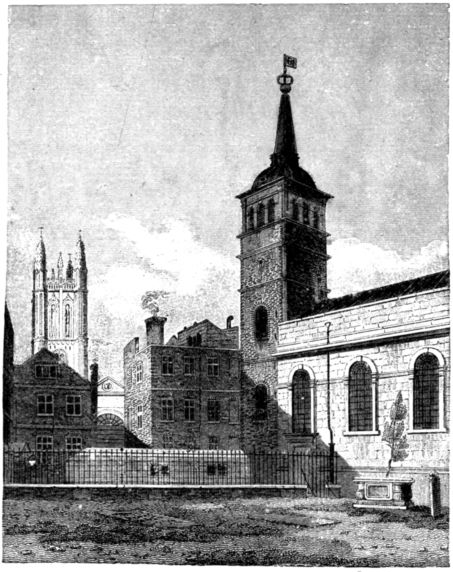
Drawn by G. Shepherd. ST. PETER’S, CORNHILL
Among the most important charities were those of: Laurence Thompson, 1601, who left £100 in trust for tea, coal, and bread for the poor of the parish. William Walthal, 1606, who left £246 : 13 : 4, £200 of which was to be lent to the struggling shopkeepers of the parish, the interest to be distributed in bread and coal. The Robert Warden (1609) bequest for Ash Wednesday sermons and Sunday bread to be administered through the Poulterers Company. The Lucy Edge (1630) bequest for the weekly lecture. Sir 97Benjamin Thorowgood’s (1682) bequest of three shops at the west end of the church for the maintenance of the organ and organist; and the Gibbs’ bequest (1864). Of these, all, with the exception of the Lucy Edge and Gibbs’ bequests, which provide for the Thursday lecturer, and part of the Robert Warden bequest, which provides for the Ash Wednesday sermon before the Poulterers Company, have been appropriated, with other endowments, by the City Parochial Charities, out of which common fund a yearly allowance is made for the upkeep of the Church.
John Hodgkin, Bishop of Bedford, 1537, was rector here; also John Taylor (d. 1554), Bishop of Lincoln; Francis White (d. 1638), Bishop of Ely; William Beveridge (1637-1708), Bishop of St. Asaph; John Waugh, Bishop of Carlisle, 1723—he is buried in front of the present altar.
Next door to the church is another of the exceptions in the street, a well-designed terra-cotta building. The building is in a late Perpendicular or Tudor style, and is appropriately named Tudor Chambers. St. Peter’s Alley leads to the graveyard at the back of the church, which is cut in two by an abnormally broad sweeping way up to the centre door. Plainly built chambers of many stories look down on the dusty evergreens of the churchyard. The next object of interest is the deeply recessed and beautifully ornamented porch of St. Michael, which stands back a little from the line of the street. By the side of the church is St. Michael’s Alley, which leads us to the graveyard. In this a small cloister or entry with vaulted roof leads through to the churchyard, a space of newly turned soil with a fringe of the inevitable evergreen bushes.
The great London coffee-house was set up in St. Michael’s Alley in 1652 by one Pasqua Rosee.
ST. MICHAEL, CORNHILL
The body of St. Michael’s Church was destroyed in the Great Fire and rebuilt by Wren in 1672; the tower was injured and pulled down in 1722, when the present tower, also the work of Wren, was erected. In 1858 it was greatly altered by Sir Gilbert Scott. The earliest date of an incumbent is 1287.
The patronage of the church was in the hands of: Alnoth the priest, before 1133, who granted it to the Abbot and Convent of Evesham, who gave it in 1133 to Sparling the priest; the Abbot and Convent of Evesham, who granted it in 1505 to Simon Hogan, who bequeathed it to the Drapers’ Company, who presented to it in 1515, and in whose successors it continued.
The church measures 87 feet in length, 60 feet in breadth, and 35 feet in height, and contains two aisles divided from the nave by Doric columns. The church was originally in the Italian style, but the alterations in 1858-60 by Sir Gilbert Scott give the appearance of a nineteenth-century imitation of mediævalism. The tower is Gothic in architecture, and contains three stories crowned by a parapet from the angles of which four pinnacles rise up. The total height is 130 feet. The church has always been famous for its bells, of which it possesses 12.
Chantries were founded here by: Walter de Bullingham, to which John de Bourge was admitted chaplain, August 22, 1390; Thomas Baker augmented the endowment by £2 : 18 : 8; Ralph More was chaplain in 1548, “a man of 50 yrs. who hath lyen bedridden this 18 years”; Simon Smith; William Comerton at the Altar of Blessed Virgin Mary; Hamo Box, for which the King granted his licence, July 28, 1321; William Rus, whose endowment for this and other purposes fetched £27 : 13 : 4 in 1548, when William Penne was priest “of the age of 38 years, and of indifferent learning and hath none other living but this his yearly stipend of £8”; Andrew Smythe, who endowed it with lands, etc., which fetched £12 in 1548, when John Paddye was priest “of the age of 26 years, indifferently learned, having no other living or promotion over and above his stipend of £7 : 6 : 7”; Simon Mordonne, mayor, 1368, who left tenements 98valued at £9 in 1548, when John Campyon was priest, “of the age of 66 years, a good singer and indifferently well learned, having none other living besides this his stipend of £6 : 18 : 4”; John Langhorne, who endowed it with tenements which yielded £10 : 8s. in 1548, when Abail Mortcock was priest, “of the age of 36 years, whose qualities, conversation, and learning is as the other and hath none other living but this his stipend of £6 : 13 : 4.” The King granted his licence to Peter Smart and others to found a guild in honour of St. Anne and Our Lady, September 27, 1397, which was valued at £17 : 13 : 4 in 1548, when Sir William Bryck was chaplain “of the age of 33 years, moderately well learned.” John Shopman and others have licence to found a guild in honour of Blessed Virgin Mary with special devotion to St. Michael the Archangel, October 4, 1442.
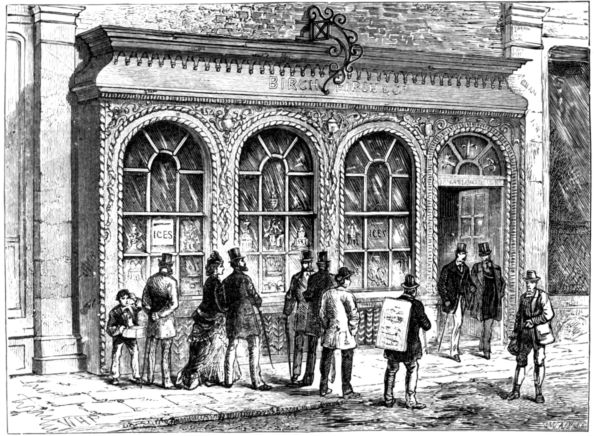
CONFECTIONER’S SHOP, CORNHILL
Alderman Robert Fabian (d. 1513) was buried here in 1513; he compiled an elaborate chronicle, The Concordance of Histories, dealing with France as well as England. This church is specially connected with the antiquary John Stow, and both his father and grandfather were buried here. Against the north walk there is a monument in memory of John Vernon, erected in place of one consumed by the Fire, by the Merchant Taylors in 1609; he was a donor of several large legacies. In 1609 John Cowper was buried here—founder of a family whose memory is still preserved in connection with Cowper’s Court, Cornhill. To this family the poet Cowper belonged.
The parish was extremely rich in charitable gifts. Brass tablets are affixed to the sides of the tower recording the dates, etc., of repairs, and the benefactors in connection, amongst whom are the following: Sir John Langham, £500; Sir Edward Riccard, £100; James Clotheroe, £50. Other benefactors were Robert Drope, donor of £30, and his wife Jane, afterwards Viscountess Lisle, of £90.
William Brough (d. 1671), Dean of Gloucester, and author of several religious works, was rector here; also Robert Poole-Finch (1724-1803), chaplain of Guy’s Hospital and a preacher of some eminence.
99No. 15 Cornhill is the oldest shop of its class in the Metropolis. The window is set in a carved wooden framework, painted green, which encloses the small glass panes in three arches. It was established as a confectioner’s shop in the time of George I., and it is a confectioner’s still. Within, the low roof and thick woodwork testify its age. It might easily be overlooked, as the brick house rising above it presents no noticeable feature.
Of Change Alley one has to note that Jonathan’s Coffee-house was the resort of those who dealt and dabbled in stocks.
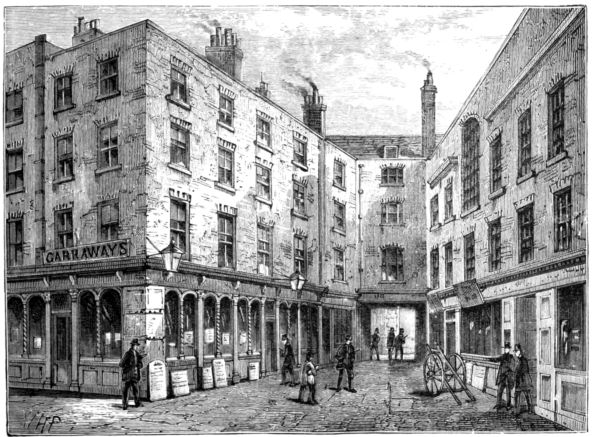
GARRAWAY’S COFFEE-HOUSE
Why did ‘Change Alley waste thy precious hours,
Among the fools who gap’d for golden show’rs?
No wonder if we found some poets there,
Who live on fancy and can feed on air;
No wonder they were caught by South-Sea schemes,
Who ne’er enjoyed a guinea but in dreams.
Here also were Garraway’s and Robins’ Coffee-houses. In 1722 “the better sort,” according to Defoe, who carried on business as a hosier in Freemason’s Court, met at these coffee-houses before going to the Exchange.
The present Stock Exchange was not erected till the year 1801.
100Strype thus speaks of the Alley as it was after improvements:
“Exchange Alley, that lies next eastward, hath two passages out of Cornhill; one into Lombard Street, and another bending east into Birchin Lane. It is a large Place vastly improved, chiefly out of an house of Alderman Backwall’s, a Goldsmith, before the Great Fire, well built, inhabited by tradesmen; especially that passage into Lombard Street against the Exchange, and is a place of a very considerable concourse of Merchants, seafaring men and other traders, occasioned by the great Coffee houses, Jonathan’s and Garraway’s, that stand there. Chiefly now brokers, and such as deal in buying and selling of Stocks, frequent it. The Alley is broad and well paved with free-stones, neatly kept. The Fleece Tavern, seated in Cornhill, hath a passage into this Alley, being a very large house and of great resort.” At No. 41 Thomas Gray the poet was born on December 24, 1716.
Change Alley is at present a winding and tortuous thoroughfare. It bears the date 1886 over the western entry, and contains many red and glazed white brick houses. Close by this entry is the Bakers’ Chop House, a curious little old building with projecting windows of dark wood.
In the next portion of Change Alley is a well-built red brick building by R. Norman Shaw, with a slab on the north-east corner bearing the inscription:
The site of Garraway’s Coffee House, rebuilt 1874;
and beneath is a large stone grasshopper.
Gracechurch Street, called also Grass church, Garscherche, and Gracious Street, was formerly a market for hay, corn, malt, cheese, etc. There was uncertainty about the name, for in 1329 we find it written Grescherche Street, in 1333 Grascherche Street, a form of the name which is afterwards repeated.
In 1275 there is a will by one Martin de Garscherche bequeathing property to his sons and daughters; in 1294, 1311, and 1324, we hear of tenements in Garscherche, which seems as if the place was then an open market, not yet settled down to a street; perhaps, however, the dignity of a street was sometimes conferred upon it, for in 1296 there is mention of Leadenhall in Garscherch Street, and in 1342 it is also named as a street.
In 1320 one of the supervisors of shoes was Richard le Cordewaner of “Gras cherche”; in 1347 a jury of “Graschirche,” consisting of a butcher and eleven others, accused John de Burstalle of selling corn at more than the legal price, and he was sent to prison for forty days; in 1372 it was ordained that the blacksmiths should send their work either to “Graschirche” or to the “Pavement” by St. Nicholas Fleshambles, or by the Tun on Cornhill, and should stand by their work openly. Therefore the market here was not confined to hay and corn. In 1386 one Thomas Stokes was in trouble for pretending to be an officer and taker of ale for the household of the King, under which pretence he marked with an arrowhead 101several barrels in the brewery of William Roke of Graschirche. There was therefore a brewery in the market. One finds so many breweries scattered about the City that one asks how they got the water; it must certainly have been drawn up from a local well. Another case of personating an officer of the King was that of William Redhede in 1417, who tried to carry off certain bushels of wheat at Graschirche pretending that they were for the King. He was clapped into prison and then put in pillory. “Upon the three market days ensuing he was to be taken each day from the Prison of Newgate to the Market called ‘le Cornmarket’ opposite to the Friars Minors and there the cause of the judgment aforesaid was to be proclaimed: and after that he was to be taken through the middle of the high street of Chepe to the Pillory on Cornhille; and upon that he was to be placed on each of those three days there to stand for one hour each day, the reason of his sentence being then and there proclaimed, and after that he was to be taken from thence through the middle of the high street of Cornhill to the Market of Graschirche aforesaid, where like proclamation was to be made: and from thence back to prison.”
Roman remains, such as vases, bronzes, coffins, have been found in this street.
In 1654 Brethmer, citizen of London, gave to the Church at Canterbury his messuage at “Gerscherche” as also the Church of Allhallows, Lombard Street.
The street is continually mentioned in connection with tenements, messuages, houses, and rents.
In more modern times Richard Tarleton the actor lived in Gracechurch Street, at the sign of the Saber. Probably he acted in the courtyard of the Cross Keys in the same street, licensed in 1570, but only for that year. Many pageants and processions were conducted through Gracechurch Street.
In Gracechurch Street at the corner of Fenchurch Street was St. Benet’s Church.
St. Benet, Grasschurch, was so called after St. Benedict. The date of its foundation is unknown. It was burnt down in the Great Fire, rebuilt and finished in 1685. In 1868 the building was pulled down, and in 1869 and 1870 the site was occupied by offices. The earliest date of an incumbent is 1170.
The patronage of the church was in the hands of the Dean and Chapter of St. Paul’s, who granted it about 1142 to Algarus the priest, for his life.
Houseling people in 1548 were 223.
A chantry was founded here in the chapel of St. Mary and St. Katherine for Lady Joan Rose; the endowment fetched £14 : 3 : 4 in 1548.
Few notable monuments in this church are recorded by Stow. It originally contained Queen Elizabeth’s monument. The parish was rich in charitable gifts, some of the donors of which were: Mrs. Doxie of £50, for the better maintenance of the parson; Lady Elizabeth Newton £40, and many others whose names are not recorded.
In modern Gracechurch Street, at the corner of Eastcheap, is a fine new building of the National Provident Institution for Mutual Life Assurance. The courts opening out of the street are lined with countless window reflectors and are very monotonous. The Russian Bank is fine and of great height; on the west there is a long line of 102brick and stucco buildings which can boast no style at all. The street is given over to merchants, solicitors, bankers, agents, etc. The great building at the corner of Lombard Street is the City Linen Company Bank, and is conspicuous by reason of its stone ornamentation.
The northern portion of the street is not remarkable for architectural beauty. The street consists chiefly of great square blocks of buildings interspersed with dull early nineteenth-century brick boxes. In Bell Yard there is an almost unbroken line of old houses on the south side, and at the end the half-embedded gilt bell over a public-house points to the name-derivation. On the east of Gracechurch Street a high arch of rusticated stone leads to Leadenhall market (see p. 160). Gracechurch Buildings follow, and Bull’s Head Passage, leading to Skinner’s Place, is lined by open stalls. The flat end of St. Peter’s, Cornhill, faces Leadenhall Buildings.
Lombard Street.—Shops and tenements are mentioned belonging to Lombard Street in the fourteenth century. The Calendar of Wills has a reference in the year 1327. Riley’s earliest reference is 1382.
When the street first received its name is not known. Stow ventures back no further than Edward II., but there were Italian merchants before that time:
“Then have ye Lombard Street, so called of the Longobards, and other merchants, strangers of divers nations assembling there twice every day, of what original or continuance I have not read of record, more than that Edward II., in the 12th of his reign, confirmed a messuage, sometime belonging to Robert Turke, abutting on Lombard Street, toward the south, and toward Cornehill on the north, for the merchants of Florence, which proveth that street to have had the name of Lombard Street before the reign of Edward II. The meeting of which merchants and others there continued until the 22nd of December, in the year 1568; on the which day the said merchants began to make their meetings at the burse, a place then new built for that purpose in the ward of Cornhill, and was since by her majesty, Queen Elizabeth, named the Royal Exchange.”
The Lombards came over at first as collectors of the papal revenue; but they did much more than this: they opened up trade between the Italian towns and London—every year the fleets of Genoa and Venice brought goods from the East and from the Mediterranean. Moreover, the Italians in England sent wool from England instead of precious metals by way of Florence, if not other cities. Their wealth enabled them to take the place of the Jews in their expulsion; if the City was suddenly and heavily taxed they made advances to the merchant who could not immediately realise. Of course they charged heavy interest—as heavy as the necessities of the case permitted—and they became unpopular. The lending of money, forbidden and held in abhorrence, was absolutely necessary for the conduct of business: those who carried on this trade naturally lived together, if only to be kept in knowledge of what was going on. And as the progress of trade went on, 103their power increased year by year. Lombard Street, where they lived, was the daily mart of the London merchants before the erection of the Exchange.
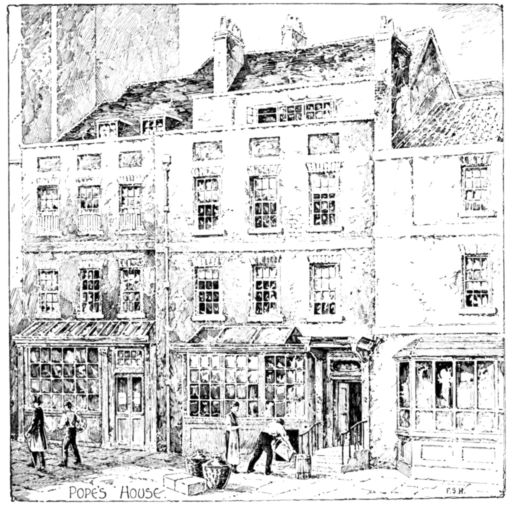
POPE’S HOUSE IN PLOUGH COURT
“Jane Shore’s husband was a goldsmith in this street; so at least the old ballad, printed in Percy’s Reliques, would lead us to believe. No. 68, now Messrs. Martin, Stones and Martin’s (bankers), occupies the site of the house of business of Sir Thomas Gresham, founder of the Royal Exchange. When Pennant wrote, the Messrs. Martin still possessed the original grasshopper that distinguished his house. ‘How the Exchange passeth in Lombard Street’ is a phrase of frequent occurrence in Sir Thomas Gresham’s early letters. No. 67, now in the occupation of Messrs. Glyn and Co. (bankers), belongs to the Goldsmiths’ Company, to whom it was left by Sir Martin Bowes, an eminent goldsmith in the reign of Queen Elizabeth. Guy, the founder of Guy’s Hospital, was a bookseller in this street. The father of Pope, the poet, was a linendraper in Lombard Street; and here, in 1688, his celebrated son was born. Opposite the old-fashioned gate of the Church of St. Edmund the Martyr is a narrow court, leading to a Quakers’ Meeting-house where Penn and Fox frequently preached” (Cunningham’s Handbook).
The house in which Pope is said to have been born is that at the end of Plough Court.
104Between the Church of St. Edmund and the west end of the street were two mansions formerly belonging, one to William de la Pole, Knight Banneret, and “King’s Merchant” in the reign of Edward III., and afterwards to his son, Michael de la Pole, Earl of Suffolk, and the other to Sir Martin Bowes, mayor, 1545. Here also was the Cardinal’s Hat Tavern, one of the oldest of the City taverns, mentioned in 1492.
The modern street gives a general impression similar to that of Cornhill. Everywhere we are confronted by solid banks and insurance offices, which seem to divide the ground between them.
George Yard contains the imposing building of the Deutsche Bank in London, as well as a couple of large houses let in flats, and presents a decidedly dignified appearance. The Bank is an immense building, with a granite-columned portico, and rusticated stonework round it.
Of the two churches now remaining in this street, one is
ST. EDMUND, KING AND MARTYR
This church was anciently called by some St. Edmund Grass-Church, because of its proximity to the grass market. It was burnt down in the Great Fire and rebuilt by Wren in 1690. In 1864 and 1880 the church was restored. After the Great Fire, the parish of St. Nicholas Acon was annexed. The earliest date of an incumbent is 1150.
The patronage was in the hands of the Prior and Convent of Holy Trinity, London, but Henry VIII. seized it and granted it to the Archbishop of Canterbury in 1545, in whose successors it continues.
Houseling people in 1548 were 240.
The present church measures 59 feet in length, 40 feet in breadth, and 57 feet 9 inches in height. It is singular from its standing north and south, but this was forced upon Wren by the position of the ground at his disposal. There are no aisles. The steeple, which rises at the south, consists of a three-storied tower and octagonal lantern and spire, and a pedestal supporting a finial and vane. The lantern is ornamented at the angles by flaming urns, in allusion to the Great Fire. A projecting clock is attached to the face of the second story and is a prominent feature in Lombard Street. The total height is 136 feet.
Chantries were founded here: By Thomas Wyllys for himself and Christian his wife, whose endowment fetched £24 in 1548, when Richard Auncell was chaplain; by and for Matilda at Vane, relict of John Atte Rose, dedicated to SS. John, Peter, and Thomas the martyr, to which John Reynes was admitted chaplain on the resignation of William Belgrave, September 25, 1382; by Richard Toky for himself and Matilda his wife, to which William Howes de Blackolm was admitted chaplain, October 20, 1362; by John Longe, whose endowment fetched £35 in 1548, when William Myller and Edward Mamyn or Hamonde were chaplains.
The old church contained a monument to John Shute, a painter-stainer, who wrote one of the earliest English works on Architecture. He died in 1563. On the east wall a monument commemorates Dr. Jeremiah Milles, Dean of Exeter, President of the Society of Antiquaries, and rector of the united parishes, who died in 1784.
Addison was married in this church to the Dowager Countess of Warwick and Holland in 1716.
This parish was not rich in charitable gifts. Some of the donors were: Richard Jaie of 45s. for bread, etc., for the poor; Mrs. Joan Lowen of 52s.; Mrs. Anne Whitmore, £5.
105
ALLHALLOWS, LOMBARD STREET
This church went by the name of Allhallows “Grasse Church” from its proximity to the grass and hay market. It was consumed by the Great Fire, but subsequently rebuilt and completed by Wren in 1694. The parish of Allhallows was one of the thirteen “Peculiars” of the Archbishop of Canterbury in the City of London. The earliest date of an incumbent is 1279.
The patronage of the church was in the hands of: Brihterus, citizen of London, who in 1052 gave it to the Prior and Convent of Christ Church, Canterbury; the Dean and Chapter of Canterbury, in whose successors it continued, who first presented to it in 1552.
Houseling people in 1548 were 300.
The interior of the church is constructed on a rectangular plan, without aisles, and with only one pillar, rising at the centre of the west gallery. It is 84 feet in length, 52 feet in breadth, and the height 30 feet. The church contains much good woodwork, the carved oak altar-piece being especially fine. The stone tower, which rises at the south-west, is divided into three stories, the lowest of which has a large doorway at its south face; the second is pierced by a circular-headed window, and the third by square openings with louvres, each surmounted by a cornice. The height of the tower is about 85 feet. The church is entered by a porch and vestibule through a doorway in the tower.
Chantries were here founded by: John Chircheman, citizen, and Richard Tasburgh, late parson of Heylesdon County, Norfolk, July 15, 1392 (Pat. 16 Richard II. p. i. m. 25); John Buck, whose endowment yielded £40 : 6s. in 1548; John Maldon, whose endowment yielded £20 : 3 : 4 in 1548, when Edward Hollonde was priest; William Trystor, who endowed it with £6 : 6 : 8 in 1548.
The most notable of the monuments in this church is to the memory of Simon Horsepoole, Sheriff of London in 1591.
The sole donor of charities seems to have been this same Simon Horsepoole, who appointed to this parish £4 : 4s. per annum.
The original church was indebted for its south aisle, steeple, and other sections to John Warner, Robert Warner, and the Pewterers.
Clothes were found for forty boys, as well as books, and the boys were put out as apprentices by a Society of Langbourn Ward.
The most notable rectors were: Robert Gilbert, Bishop of London, 1436; Thomas Langton (d. 1501), Bishop of St. David’s and Sarum, and of Winchester; Francis Dee (d. 1638), Bishop of Peterborough.
At the corner formed by the junction of Lombard and King William Streets stands the Church of
ST. MARY WOOLNOTH
“The church was founded by Wulfnuth, son of Earl Godwin, about the time of the Confessor. This name was corrupted into Woolnoth” (Rev. J. M. S. Brooke, Rector). It was rebuilt, according to Newcourt, from its very foundations about 1438. Though damaged by the Great Fire, it was not destroyed, and Wren repaired and rebuilt various parts in 1677. In 1716 the building was pulled down and the present church, the work of Nicholas Hawksmoor, was commenced and finished in 1727. The earliest date of an incumbent is 1252.
The patronage of the church, before 1252, was in the hands of: The Prioress and Convent of St. Helen’s, London; then Henry VIII., who seized it and granted it to Sir Martin Bowes, Alderman and Mayor of London, whose son and heir, Thomas Bowes, sold it to William Pelham, December 19, 1571; Robert Viner Miles, and several other persons, the last being Sir George Broke-Middleton, who presented to it in 1883.
Houseling people in 1548 were 300.
The interior of the church is almost square. It contains twelve Corinthian columns, placed at the 106angles in groups of three, and supporting an entablature prolonged to the walls by means of pilasters. There is a clerestory above, pierced on its four sides by semicircular windows. The tower, which rises at the west, contains the doorway in its basement story; the cornice is surmounted by a pedestal supporting composite columns, and the summit is divided into two turrets with balustrades above. The north front has three niches, each enclosing two Ionic columns on pedestals; the south front is plain.
Chantries were founded here by: Gregory de Rokeslie, Mayor of London, 1275-81, for himself and Amicia his wife, to which John de Pory was admitted chaplain, July 15, 1333; Thomas Noket, for himself and for Alice, wife of Gregory de Norton, called atte Shire, at the Altar of the Blessed Virgin Mary and St. Anne, in the south side of the church, to which William Weston was admitted chaplain, January 28, 1400-1401; the endowment fetched £13 : 6 : 8 in 1548, when William Wentors, or Ventrys, and Richard Browne were chaplains; Henry Brige, Knt., whose endowment yielded £13: 13 : 4 in 1548, when John Meres was priest.
Sir Hugh Brice, keeper of the King’s Exchange under Henry VII., was buried in this church; he built a chapel here called the “Channel”; also Sir Thomas Ramsey, Lord Mayor in 1577; William Hilton, Merchant Taylor and Taylor to Henry VIII., and Sir Martin Bowes, patron of the church for over thirty years.
Among the later monuments, Stow records one in memory of Sir William Phipps, who discovered a sunken Spanish ship in 1687 containing silver to the value of £300,000 sterling, and one commemorating Sir Thomas Vyner, goldsmith, and Mayor of London, who died in 1665.
The list of legacies and bequests was too long for insertion, Stow says, but was to be seen by any one in the Parish Book. He records a gift of £1 : 6s. per annum from Sir Nicholas Rainton, and one of £3 : 15 : 8 paid by the Merchant Taylors.
Richard Rawlins (d. 1536), Bishop of St. David’s, was rector here; also John Newton, author of “Olney Hymns.”
King William Street contains few associations of interest, having been built, as its name implies, in the reign of the fourth monarch of that name, whose statue on a pedestal, which outrivals every other in the City on the score of weight alone, stands at the south end. This is the work of W. Nixon and was set up in December 1844. The figure is 15 feet 3 inches high, and the whole statue weighs 20 tons. Special arrangements had to be made for carrying the Metropolitan Railway beneath it. The statue is on the site of the Boar’s Head Tavern, noted in old days as a famous rendezvous, and familiar to readers of Shakespeare from Falstaff’s frequent resort thither. Goldsmith and Washington Irvine have written on the Boar’s Head Tavern, which rose again after the Fire; the sign of the later house is preserved in the Guildhall Museum.
King William Street was cut through various lanes, which are now dealt with. At the north end in Gresham Place is Gresham Club, which was built in 1844; the architect was Henry Flower. It is for merchants and City men; the entrance fee is twenty guineas, annual subscription eight guineas, and the membership is limited to 500. It is a grey stone building with triangular stone pediments projecting over the upper windows.
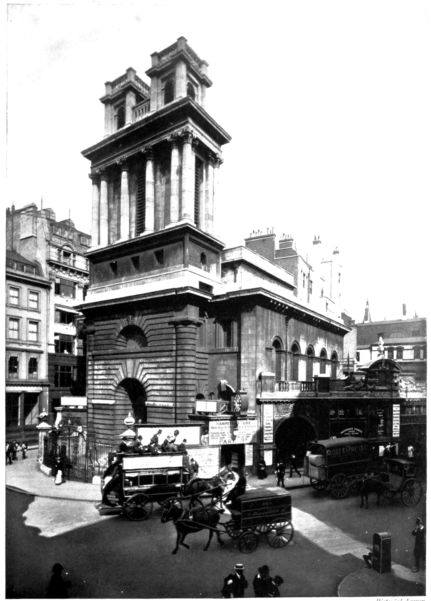
Pictorial Agency. ST. MARY WOOLNOTH
107St. Clement’s Lane leads to St. Clement’s Church. I find a reference to rents in Clement’s Lane in 1322. In 1371 the “good folk” of Candelwyke Street and Clement’s Lane petitioned the mayor against certain plumbers who proposed to melt their lead in a place hard by called the Woodhaugh; they said that the vapours were noxious and even fatal to human life, that trustworthy people would depose to the mischief caused by inhaling these fumes, and that the shaft of the furnace was too low. In the end the plumbers were allowed to go on with their work, provided that they raised the shaft. In the lane was the bank in which Samuel Rogers was a partner.
In Church Court, we come to the ancient graveyard of St. Clement, a minute space with one great shapeless tomb in the centre of the asphalt and a few small erect tombstones in the little border running inside the railings.
ST. CLEMENT, EASTCHEAP
The Church of St. Clement was destroyed by the Great Fire, but rebuilt by Wren in 1686, when St. Martin’s Orgar was annexed to it. The earliest date of an incumbent is 1309.
The patronage of the church was in the hands of: The Abbot and Convent of Westminster, 1309; then Henry VIII., who seized it and gave it to the Bishop of Westminster in 1540; next the Bishop of London, by Mary, March 3, 1553-54, in whose successors it continues.
Houseling people in 1548 were 271.
The present building measures 64 feet in length, 40 feet in breadth, and 34 feet in height. It has one aisle on the south side, separated from the rest of the church by two high-based columns. The square tower at the south-west is built of brick, with stone dressings, and contains three stories, with a cornice and balustrade above. The total height is 88 feet.
Chantries were founded here: by John Chardeney for himself and Margaret his wife, to which William Hocchepound was admitted chaplain, July 23, 1371, at the Altar of the Blessed Virgin Mary; for William Ivery.
There were very few monuments in this church originally. In the west window is a memorial to Thomas Fuller, the church historian, Bishop Bryan Walton, and Bishop Pearson. Fuller and Pearson were lecturers here for some time; the preaching of Pearson on the Creed and Thirty-nine Articles made him famous. Walton, the compiler of the Polyglot Bible, was created Bishop of Chester, 1660. The stained-glass window on the southern side was erected in 1872 by the Clothworkers’ Company in memory of Samuel Middlemore, who died in 1628, leaving a charitable bequest to the parish. Henry Purcell and Jonathan Battishill, the musical composers, who were organists at the church, are commemorated by brass tablets.
There were several gifts belonging to the parish, but the names of the donors are not recorded by Stow.
Sir Thomas Gooch (1674-1754), Bishop of Bristol, of Norwich and of Ely, was rector here.
St. Nicholas Lane, also one of the most ancient lanes in London. In 1258 we find that one Ralph was chaplain in the Church of St. Nicholas Acon. In 1275 the church is endowed with a small rent; in 1279, a testator bequeaths his “Stone house” in the lane; and in many subsequent entries the lane is mentioned. The dedication of the church may possibly indicate the date of its foundation. It was in the eleventh century that the bones of St. Nicholas were brought from Myra in Asia Minor, then in the hands of the Mohammedans, to Bari on the Adriatic, where they still lie. There grew up quite suddenly an extraordinary belief in the power of this saint. Pilgrimages were instituted, in which thousands flocked to his tomb; 108miracles were multiplied at the sacred spot; the churches without end were dedicated to his name of Nicholas. In England 372 churches are said to be named after him. It would be interesting to learn the date of this dedication. May we, however, connect this saint of Italian pilgrimage with the coming of Italian merchants to London? St. Nicholas was the protector of sailors, virgins, and children. Cunningham calls him also the protector of merchants, but of merchants as sailors. His emblem was the three purses, round and filled with gold, or the three golden balls. We may therefore at least assume that this was the church of the “Lombards” and the financiers from Italy. The churchyard still remains, a square patch of ground, railed in, very similar to the generality of such quiet little spaces. It has asphalt paths running in and out of stunted evergreen bushes. Nicholas Passage runs on the south side, and near is the Acorn public-house, an old house, with its sign of a huge gilt acorn hanging over the door.
St. Nicholas Acon was situated on the west side of Nicholas Lane, near Lombard Street; it was burnt down in the Great Fire, and not rebuilt, its parish being annexed to that of St. Edmund the King and Martyr, and its site turned into a burying-ground. The earliest date of an incumbent is 1250.
The patronage of the church was in the hands of Godwin: and Thurand his wife gave it in 1084 to the Abbot and Convent of Malmesbury; Henry VIII. seized it, 1542, and so it continued in the Crown up to 1666, when it was annexed to St. Edmund the King; since then the patronage is alternately in the Crown and the Archbishop of Canterbury.
Houseling people in 1548 were 154.
Johanna Macany, who left large legacies to the parish about 1452, was buried in this church, also John Hall, Master of the Company of Drapers; he died in 1618.
No legacies or gifts are recorded by Stow except that of Johanna Macany, of which he gives full details.
Maurice Griffith, Bishop of Rochester in 1554, was rector here.
Of Birchin Lane Stow says it should be Birchover Lane. It is also spelt Berchernere and Borcherveres Lane. It is frequently mentioned in the Calendar of Wills. In 1260 there is “land” in the lane; in 1285 there is a mansion house; there are a bakehouse and shops in 1319; in 1326, a tenement; twenty years later, other tenements; in 1358, a place called “la Belle”; in 1363, lands and a tenement; and in 1372, tenements in “Berchers” Lane. In 1386 and the following century we have it spelled Birchin Lane. In 1348, Riley quotes the name as Bercherners Lane.
In the sixteenth and seventeenth centuries the lane was inhabited by “fripperers,” i.e. old-clothes men. Here was Tom’s Coffee-house, frequented by Garrick. Chatterton wrote a letter to his sister from this house. In a court leading out of Birchin Lane is the George and Vulture, a well-known tavern, which still preserves the custom of serving chops and steaks on pewter.
Abchurch Lane gives its name to the church of St. Mary Abchurch, which, according to Stow, is also Upchurch (see below). The parish of Abchurch or Abbechurch is mentioned as early as 1272 and 1282, and tenements in Abbechurch Lane are devised by a testator of the year 1297.
109
ST. MARY ABCHURCH
The additional name signifies “Up-church,” and is accounted for by the position of the edifice on rising ground. The church was burnt down by the Great Fire and rebuilt in 1686 from the designs of Sir Christopher Wren, when the parish of St. Lawrence Pountney was annexed. The earliest date of an incumbent is 1323.
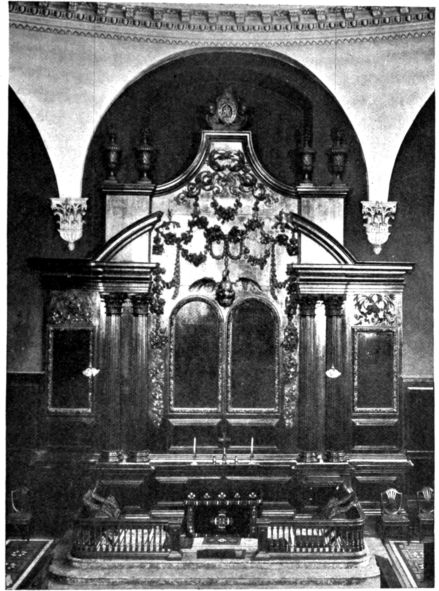
Pictorial Agency. ALTAR OF ST. MARY ABCHURCH
The patronage of the church was in the hands of the Prior and Convent of St. Mary Overy, Southwark, who exchanged it to the Master and Wardens of Corpus Christi College near St. Lawrence Pountney, 1448; Henry VIII., who seized it in 1540, and so continued in the Crown till Elizabeth, in 1568, granted it to Corpus Christi College, Cambridge, with whom it continued. Elizabeth’s grant was procured by Archbishop Parker, who gave her the rectory of Penshurst in Kent, in order that he might make over the patronage of a London living to his old college.
Houseling people in 1548 were 368.
The church is almost square, measuring 63 feet in length and 60 feet in breadth, and is surmounted 110by a cupola 51 feet in height supported by pendentives attached to the walls; the latter is decorated with painting by Sir James Thornhill. The altar-piece is adorned with carving, which is considered to be some of Gibbon’s finest work. The steeple consists of a tower of four stories, finished by a cornice, and surmounted by a cupola, lantern, and lead-covered spire, with ball and cross; the total height is about 140 feet. The building is of red brick with Portland stone dressings.
Chantries were founded here: By and for Simon de Wynchecombe, citizen and armourer, in the chapel of Holy Trinity, to which Robert de Bruysor Chesterson was admitted, November 18, 1401—a licence was granted by the King to found this, July 26, 1359; by John Lyttelton; by Simon Wryght.
The church formerly contained monuments to Sir James Hawes and Sir John Branch, mayors in 1574 and 1580; and to Master Roger Mountague, “illustrious Precedent of Bounty and pious Industry.” Against the eastern wall, there is a large monument to Sir Patience Ward, mayor in 1680, and senior member for the City of London in the Convention Parliament of 1688-89.
The parish had no legacies or charitable gifts of any considerable amount. Mrs. Hyde gave £3 : 18s. for bread. The Merchant Taylors Company (the gift of several benefactors) gave £16 : 19 : 6 for coal.
Sherborne Lane.—Stow asserts that originally Langbourn Water, “breaking out of the ground in Fenchurch Street, ran down the same street, Lombard Street, to the west end of St. Mary Woolnoth’s church, where, turning south and breaking into small shares, rills, or streams, it left the name of Share-borne Lane,” or as he had also read it, South-borne Lane, “because it ran south to the river Thames.” Wheatley thinks that Scrieburne, from scir, a share (sciran, to divide), is the more likely etymology. This “long bourne of sweet water,” Stow further relates, “is long since stopped up at the head, and the rest of the course filled up and paved over, so that no sign thereof remaineth more than the names.” The existence of the stream indeed is more than problematical. The lane is narrow, and now occupied wholly by business premises more or less modern. The back of the City Carlton Club shows on the west side, and near the north end is the narrow way into St. Swithin’s Lane at the south end of the street (possibly Plough Alley); and the back way into the old General Post Office “by the sign of the Cock” (east side, north end), both shown in Strype’s 1754 map, have vanished. The former is built up; the latter is occupied by King William Street, which was cut clean through St. Mary Woolnoth’s churchyard and the old General Post Office (formerly the residence of Sir Robert Vyner, Lord Mayor, 1675). Before the Fire the General Postmaster lived “at his house in Sherburne Lane neere Abchurch,” and hither “The Carriers’ Cosmographie, by John Taylor, the Water Poet,” written in 1637, bids repair all who desired to send letters abroad or to various parts of the kingdom.
The name occurs as early as A.D. 1300, and is very frequently referred to in the Calendar of Wills, but under quite another form, viz. as “Shiteburn Lane.” Stow’s derivation of “Sharebone” or “Southbone” Lane will not, therefore, hold.
St. Swithin’s Lane.—Oxford Court in this lane was so called from John de Vere, 16th Earl of Oxford, who died here in 1562.
As early as 1277 we find houses in St. Swithin’s Lane. In 1310 we find turners of St. Swithin’s Lane.
111The houses are of modern brick and stone, some of them are finished with polished granite piers. The great richly wrought iron gates before the courtyard of Salters’ Hall immediately attract attention. The hall itself, built in 1823, is painted and stuccoed, and has a fine Ionic portico. Salters’ Hall was used as a Presbyterian chapel in the reign of William III.
THE SALTERS COMPANY
The first evidence of the existence of the Company is a Patent Roll of 17 Richard II., 1394; but from documents in their possession, there is every reason to believe that the Company had a much earlier existence.
In 1454 Thomas Beamond, citizen and salter (at one time sheriff in London), left to the wardens of the brotherhood and guild of the Body of our Lord Jesus Christ in the Church of All Saints, Bread Street, London, and their successors for ever, land in Bread Street, whereon had recently been erected the “Salters’ Hall,” together with other property, out of the rents and profits of which he directed that the hall should be repaired or rebuilt as occasion might require. This will also gave directions for certain religious observances, and for the support of poor Salters in almshouses, etc.
At some time subsequently to 1454 an attempt was made to prove that the religious guild and the Company of Salters were distinct corporations, and that Mr. Beamond intended to bequeath the property mentioned in his will to the spiritual body exclusively, but the legal decision was that the religious guild and the Salters Company were identical.
In the reign of Edward IV., 1465, ordinances were made for the good government of the “Company of Salters”; and in a suit presented by Lord Arundel against the Company (about the same time) it was proved that the Company of Salters and the guild or fraternity mentioned in the Patent Roll of Richard II. were identical corporations.
1507.—Ordinances were confirmed by the Lord Chancellor, the Lord Treasurer, and the two Lord Chief Justices, to the wardens and fellowship of the mystery and craft of Salters in the City of London, and keepers of the fraternity of Corpus Christi in the Church of Allhallows, Bread Street.
1530.—Arms were granted to the Company by Thomas Benolt, Clarencieux. This deed of grant is in the Company’s possession.
1539.—The hall in Bread Street was burnt down, and rebuilt by the Company.
1551.—In consideration of a large payment made by them King Edward VI. reconveyed to the Company of Salters the whole of the annual payments issuing out of their property in respect of superstitious uses, which had been held forfeited to the Crown at the time of the abolition of chantries in the reign of Henry VIII. (1545).
1559.—First charter of incorporation granted by Queen Elizabeth to the “Keepers or Wardens and Commonalty of the art or mystery of Salters, London.” About the same time some new ordinances were drawn up and doubtless sanctioned by the proper authorities, which make provision for the government of the guild, and prescribe oaths for its various members and officers; and also conferred the right of search in the premises of persons using the art or mystery of Salters in the City of London and suburbs thereof, for unwholesome merchandise and false weights and measures.
1607-1609.—Acts of Parliament passed in the reign of James I., confirming to the Company all their property.
In these years a fresh charter and statutes were granted by the King.
1613 to 1619.—The Company’s Irish estate was acquired by payment to the Crown of the sum of £5000 (being the twelfth part of £60,000 raised by the twelve chief companies) with the object of planting an English and Scotch Protestant colony there.
1641.—Oxford House (with gardens), which formerly stood on the present site of the Company’s hall and offices, was purchased with corporate funds of the Company, and used as their hall: this was the third, that left by Mr. Beamond (1454) having been destroyed by fire and rebuilt about 1539.
1121666.—The whole of the Company’s estate in London and the greater part of their archives were destroyed by the “great fire,” whereby heavy losses were entailed on them.
1684, 1685.—King James II. granted the Company another charter, but the whole of these proceedings were rendered void by an Act passed in the following reign, William and Mary, under which the Salters Company, amongst others, were restored to their ancient rights, privileges, and franchises.
1821, 1827.—The hall of the Company, erected after the Fire in 1666, was taken down, and the existing building was erected, being the fifth hall of the Company.
The application of salt to the preservation of food, and particularly of fish for consumption in winter, must have given rise to a distinct trade for that purpose in the earliest times; and, as civilization advanced, the term “Salter” no doubt became more extended in its commercial interpretation, until it included, as in the present day, all persons trading wholly or partially in salt, such as oilmen, drysalters, and druggists.
Salt manufacturers and merchants, oilmen, druggists, and grocers (who made salt one of their trading commodities) have been and are largely represented on the guild.
The number of liverymen is given as 183; the Corporate Income is £20,000; the Trust Income is £2000.
The only advantage incident to the position of a freeman is a claim for relief, if in pecuniary distress.
Liverymen are entitled to vote at the election for the office of renter warden, of assistant, of master and of wardens; and, if free of the City of London, for candidates for the office of Lord Mayor, and for some officers of the corporation; also, if free of the City, and resident within a radius of twenty-five miles, for members of Parliament for the said City. All liverymen not in receipt of pecuniary assistance are invited to entertainments of the Company, and have a claim for relief should they fall into misfortune.
The present Salters’ Hall and garden, with some adjoining land, occupies the site of the “fair and large built house” which Sir Robert Aguylum devised in 1285-86 to the priors of Tortington in Sussex for their town inn or mansion. The Dissolution brought it to the Crown, and Henry VIII., in 1540, gave it to John de Vere, Earl of Oxford. Then it became known as Oxford Place or House. Mary probably restored it; at all events Elizabeth regranted it in 1573 to the Earldom of Oxford, then held by Edward, grandson of John de Vere above named. The new tenant apparently resided here in good style. Stow quaintly tells of his pomp. “He hath been noted within these forty years to have ridden into this City, and so to his house by London Stone, with 80 gentlemen in a livery of Reading tawny, and chains of gold about their necks, before him, and one hundred tall yeomen in the like livery to follow him, without chains but all having his cognisance of the blue boat embroidered on their left shoulder.” He appears not to have remained here long, for Sir Ambrose Nicholas, salter, kept his mayoralty here in 1575, and Sir John Hart dwelt here as Lord Mayor in 1589. Hart bought the place from the Earl, who was then dissipating his great estates from motives of pique and indignation against his father-in-law, Cecil, Lord Burleigh.
113
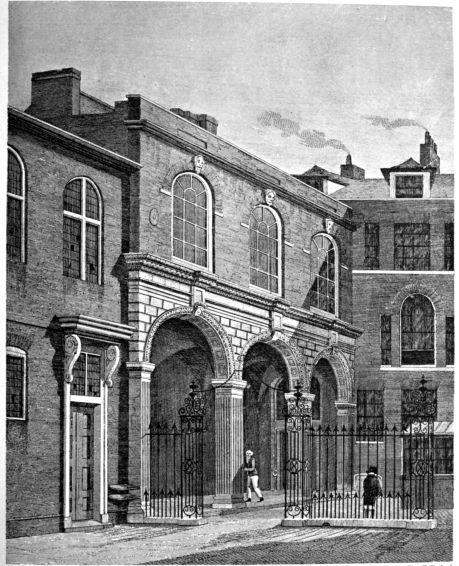
Drawn by Thos. H. Shepherd. SALTERS’ HALL, 1822
114The house was sold to the feofees of the Salters Company in 1641. The Great Fire of 1666 probably destroyed only a part of the great house (Wilkinson in Londina Illustrata goes too far in maintaining that the building wholly escaped, but is probably nearer right than those who say it was quite destroyed), statements to the contrary notwithstanding, for, at the request of the Bishop of London, the parishioners of St. Swithin’s assembled in the long parlour for worship whilst their church was building, and several of the companies held their courts here until their halls had risen from the ashes. The destroyed portion, perhaps indeed the whole, and the wall of the great garden, and some adjoining houses, were rebuilt about this time by the Company and their tenants. The history of the Salters’ Hall has already been told.
In 1687 a congregation of “protestant dissenters” took from the Company, on moderate terms, a lease of certain ground on which part of Oxford House had stood before the Fire. Here they built their meeting-house, where Mr. Mayo preached until his death in 1695, drawing, by his eloquence, congregations so large that it is said even the windows were crowded when he preached. William Long, writer for Matthew Henry’s Commentary, was minister in 1702. In 1716 he and Mr. John Newman, popular with the congregation, became co-pastors. In 1719 the general body of dissenting ministers met here to discuss means for stopping the spread of Arianism. “You that are against subscribing to a declaration as a test of orthodoxy, come upstairs,” cried the Arians and the private-judgment men of a stormy synod. “And you that are for declaring your faith in the doctrine of the Trinity, stay below,” replied Mr. Bradbury of New Court. A count showed fifty-seven to have gone up, and fifty-three to have remained down, giving the “scandalous majority” of four. Arianism meanwhile had become the coffee-house topic of the town. In March 1726 Long died, and Newman became sole pastor till his death in 1741. In the reign of William III., Robert Bragge started a “Lord’s Day evening lecture,” popular for many years, but afterwards removed by the originator to his meeting-house in Lime Street. The celebrated Thomas Bradbury shortly afterwards revived it at Salters’ Hall Chapel, and for more than twenty years delivered it to crowded audiences. Samuel Baker continued it on Bradbury’s resignation in 1725. Presbyterians of some eminence followed him, as Dr. William Prior, Dr. Abraham Rees, Dr. Philip Furneaux, and Hugh Farmer (1761), the writer of an exposition on demonology and miracles, which aroused sharp controversy. When the Salters determined to rebuild their hall, they gave the congregation notice to quit by Lady Day 1821. Whereupon the congregation acquired premises in Oxford Court, upon the site of which they erected a handsome new meeting-house completed in 1822. But the glory of the place as a dissenting centre was departing, and the Presbyterians abandoned it. Then came some erratic fanatics who called themselves “The Christian Evidence Society,” and their meeting-house was “Areopagus.” Their leader went bankrupt and the experiment collapsed. In 1827 the Baptists reopened the place, and remained there for some years, but, shortly before 1870, removed to Islington, where to this day the “Salters’ Hall” Chapel in the Baxter Road preserves the memory of the struggles, quarrels, and triumphs of the old City 115meeting-house. In Tom Brown’s Laconics (1709) is this allusion: “A man that keeps steady to one party, though he happens to be in the wrong, is still an honest man. He that goes to a Cathedral in the morning, and Salters’ Hall in the afternoon, is a rascal by his own confession.”
In Hudibras Redivivus (1706) this is found:
I thumb’d o’er many factious Reams,
Of canting Lies, and Poets’ Dreams,
All stuffed as full of Low-Church Manners,
As e’er was Salters’ Hall with Sinners.
On the south side of St. Swithin’s Lane is Founders’ Hall. The hall is on the first floor, and there are shops below. The building is of stone with pilasters running up the front, and the coat-of-arms is over the door, which has a very projecting cornice. The hall was rebuilt 1877. On the north side of Salters’ Hall is New Court showing through behind a covered entry. The opposite side of St. Swithin’s Lane seems to contain the offices of an absolutely unlimited number of companies. The court, opening out of it, consists of uninteresting earth brick houses shut in by an iron gate. The City Carlton Club is in Nos. 28 and 29. It is a Conservative Club, with fifteen-guinea entrance fee, and eight-guinea subscription. The building is of stone with a porch over the door. There are bay windows with polished granite columns. Richard Roberts was the architect.
THE FOUNDERS COMPANY
The Founders Company existed as a “Mistery” prior to the year 1365, as appears from a petition to the City of London from the “Good Men of the Mistery of the Founders of the City of London.” This petition is to be found in the Letter Books at Guildhall, and the entry is also evidence that ordinances were granted on the 29th July, 39 Edward III. The Company possesses no copy of these ordinances.
In the year 1389 (Riley, Memorials, p. 512), certain “good folks of the trade of Founders” made plaint to the mayor and aldermen as to the bad work put into candlesticks, stirrups, buckles, and other things, and they prayed that certain ordinances which they submitted should be accepted by the mayor and made law. Among these ordinances was one to the effect that two or three masters should be chosen and sworn to guard and oversee the trade.
In Williams’ History of this Company (1867) he gives the above petition word for word under the date of 1365. It is certain from this document, as with many other Companies, that as yet the Fraternity of Founders had no power or authority to enforce good work on pains and penalties.
They were incorporated January 1, 1614, for a master, 2 wardens, 15 assistants, and 100 liverymen. At present the number of the livery is 79; their Corporate Income is £1855; their Trust Income is £102; and their Hall is in St. Swithin’s Lane. The original home of the Founders was that part of London north of Lothbury.
The name of Founders’ Court marks the site; this was formerly the lane which led through the Company’s buildings to a garden beyond; the buildings stretched from St. Margaret Street to Coleman Street, Moorgate Street not then existing. This hall was burnt down in the Great Fire and rebuilt. The Company let off portions of their hall, and in 1853 let the whole on a long lease and bought a house in St. Swithin’s Lane, on the site of which they built their present hall in 1877.
116
ST. SWITHIN’S CHURCH
St. Swithin, to whom this church is dedicated, was Bishop of Winchester and Chancellor to King Egbert. Formerly the usual designation of the church was St. Swithin’s in Candlewick Street, but Newcourt (1708) states that St. Swithin, London Stone, was becoming the more common title. The stone at that time stood on the south side of the road opposite to the church. No record exists of the original foundation of the church. Probably it was built soon after the death of St. Swithin in 862, or at any rate before A.D. 1000. It is mentioned in the taxation book of Pope Nicholas IV. in 1291. The first rector given by Newcourt is Robert de Galdeford, who resigned in 1331. In 1420 licence was obtained to rebuild and enlarge the church and steeple, and Sir John Hend, Lord Mayor, 1391 and 1404, was, says Stow, “an especial benefactor thereunto, as appeareth by his arms in the glass windows, even in the tops of them.” The hall of the Drapers Company was at that time Sir John Hend’s house in St. Swithin’s Lane. The church thus rebuilt consisted of a chancel and a nave separated from the north and south aisles by pillars. There was a chapel of St. Katherine and St. Margaret. From the date of rebuilding it is evident that the style of the architecture was Early Decorated. The maps of Aggas (1560) and Newcourt (1658) agree in showing a small battlemented church, with a square battlemented tower (without spire) at the west end and level with the street. In 1607-1608 the church was “fully beautified and finished at the cost and charge of the parishioners.” It was again repaired shortly before the Great Fire, when £1000 was spent upon it. The church was burnt down in the Great Fire, and rebuilt by Wren in 1678, when the neighbouring parish of St. Mary Bothaw was annexed. In 1869 and 1879 it was entirely “rearranged.”
The patronage of the church was in the hands of: Sir Robert Aguylum, Knt., who gave it by will dated February 28, 1285, to Richard, Earl of Arundel, who has licence from the King to assign it to the Prior and Convent of Tortington, June 21, 1367; the Prior and Convent of Tortington, Sussex, in whose successors it continued up to 1538, when Henry VIII. seized it and granted it June 8, 1536, to John de Vere, Earl of Oxford, who sold it, 1561, to John Hart, citizen and alderman of London, who gave it to George Bolles (his son-in-law), citizen of London, from whose descendants it was purchased about 1683; the Salters Company, in whose successors it continued up to 1666, when the parish of St. Mary Bothaw was annexed, and the patronage shared alternately with the Dean and Chapter of Canterbury; Elizabeth Beachcroft presented to it in 1765, the Salters Company having parted with their share of the patronage.
Houseling people in 1548 were 320.
The church measures 61 feet in length, 42 feet in breadth, and 41 feet in height. It is surmounted by an octagonal cupola, divided by bands, and powdered with stars on a blue ground. The tower, which rises at the north-west, is square but contracted at the top into an octagonal shape. Above this a simple spire rises with a ball and vane. The total height is 150 feet.
Chantries were founded here: By Roger de Depham at the Altar of SS. Katherine and Margaret, to which William de Kyrkeby was presented, November 5, 1361—in 1548 the mayor and commonalty of London paid to carry out the object of Roger de Depham’s will, £5 : 6 : 8; by William Newe, who endowed it with lands, etc., which fetched £17 : 8 : 4, when John Hudson was priest; by James de Sancto Edmund, who left five marks per annum for an endowment in 1312; by Geoffrey Chittick, who gave lands to endow it which fetched £13 : 6 : 8 in 1548, when Sir Roger Butte was priest; by John Betson, who endowed it with all his lands in this parish, which yielded £13 : 6 : 8 in 1548, when Richard Hudson was priest.
Sir John Hart and Sir George Bolles, patrons of the church, were both buried here, but their monuments perished in the Great Fire. There is a large tablet affixed to a column on the north side of the church commemorating Michael Godfrey, first deputy governor of the Bank of England; he was slain in 1695 by a cannon ball at Namur, whither he was sent on business to King William’s camp.
In 1663 Dryden was married here to Lady Elizabeth Howard.
Only two charities are recorded by Stow: 12d. per week in bread, 50s. per annum in coals for the poor, the gift of Henry Hobener; £10 : 10s. for a weekly lecture, the gift of Thomas Wetnal.
117The parish churchyard is situated in Salters’ Hall Court, by which it is separated from the church. It is elevated above the court and contains two trees, two or three bushes and shrubs, and a few tombstones. Across it is a right-of-way to the premises of the National Telephone Company, to which it has the appearance of being a garden.
George Street was anciently Bearbinder Lane. Riley notes “Berbynderslane” in the City records so early as 1358. It was renamed George Street within the nineteenth century. If Charlotte Row, west of the Mansion House, was so called in honour of Queen Charlotte, surely this was rechristened in honour of George III., whom she married in 1761. It is quite small compared with its former extent, for it once ran from Walbrook past the south side of St. Mary Woolchurch into St. Swithin’s Lane, and also had a northern limb, passing the west end of Dove Court, into Lombard Street. Now the Mansion House stands upon all the old course west of Walbrook churchyard, and the northern limb is built over. This was the fatal spot where the plague of 1665 first made its appearance within the City. Defoe, in his history of the dire disease, relates how a Frenchman living in Long Acre, near the plague-stricken houses, moved hither “for fear of the distemper.” Alas! he was already stricken, and in the beginning of May he died, the first victim within the City walls. Strype calls Bearbinder Lane “a place of no great account as to trade: well inhabited by merchants and others.” In his time about thirty yards at the east end were reckoned in Langbourn ward, and apparently also most of the northern arm. It now belongs wholly to Walbrook ward, and is merely a narrow passage containing no houses older than the nineteenth century.
We now take Walbrook, leaving Cannon Street to be dealt with subsequently. The memory of the stream of the Walbrook coming down from the heights to the north is preserved in the name of this short street.
In 1279 and in 1290 we find that there were houses on the banks of the stream. In the year 1307, there was one William le Marischale living beside the stream. It must have been almost impossible, even then, to live near the stream, because it was a common open sewer with latrines built over it. These were farmed by certain persons. Part of the stream, however, was covered over by the year 1300; it was not till the close of the sixteenth century that it was completely covered over. Empson and Dudley, the instruments of Henry VII.’s extortions, lived in Walbrook; and later Sir Christopher Wren is said to have lived here at the house afterwards No. 5.
The modern street is chiefly composed of ordinary stone-faced business houses. But on the west side are three charming seventeenth-century buildings of mellow red brick, Nos. 10, 11, and 12. On the centre one is a stone tablet supported by brackets, and covered by a projecting cornice; this bears date 1668. A little farther up on the opposite side an eighteenth-century brick house stands over the entry to 118Bond Court. The doorway immediately opposite the entry is a nice piece of woodwork. There are also one or two doorways of different designs in the northern part of the court. These belong to old houses, though those buildings on the west facing them are quite modern.
Returning to the street, the ornamental front of the City Liberal Club, founded 1874, draws attention to itself. The front is of light stone with the windows and doorway framed in granite. Farther north on the same side is Ye Olde Deacons Tavern, next door to Bell Court, a narrow passage of no particular interest. Representations of almost every trade occupy the street; it contains two great houses let in flats, one of which, Worcester House, seems to be especially given up to the offices of company promoters.
ST. STEPHEN, WALBROOK
St. Stephen, Walbrook, stands at the back of the Mansion House. It was formerly often called St. Stephen-upon-Walbrook, from the fact that its first site was actually upon the bank of the stream so named. There is only one other church in the City dedicated to St. Stephen, viz. St. Stephen, Coleman Street. The date of its foundation is not known, but it dates back at least as far as the reign of Henry I.; Eudo Dapifer’s gift of it to his Abbey of St. John, Colchester, in 1096, being the earliest reference to it. It was rebuilt early in Henry VI.’s reign, chiefly through the agency of Robert Chicheley, Lord Mayor in 1411 and 1421. It was totally consumed by the Fire, and rebuilt by Wren in 1672, when the neighbouring parish of St. Benet Sherehog was annexed. The earliest date of an incumbent is 1315.
The patronage of the church was in the hands of: Eudo, Steward to Henry I., who gave it to the Abbot and Convent of St. John, Colchester, who held it up to 1422; John, Duke of Bedford, who sold it in 1432 to Sir Robert Whytingham, Knt., who gave it to Richard Lee in 1460, who gave it in 1502 to the Grocers Company, in whose successors it continued.
Houseling people in 1548 were 250.
This church is, after St. Paul’s Cathedral, considered Wren’s masterpiece. It is oblong in shape, traversed by four rows of Corinthian columns, which divide it into five aisles, of which the central is the broadest; it is crowned by a circular dome supported on eight arches. The effect thus produced of the circle springing from an octagonal base is especially graceful. The building measures 82½ feet in length, 59½ feet in width, and the height to the dome is 63 feet, to the ceiling of the side aisles 36 feet. The tower contains four stories; upon it the steeple is placed, tapering to a spirelet with finial and vane; the total height is about 130 feet. Against the wall of the north transept is a picture of St. Stephen being carried from the scene of his martyrdom; this is by Benjamin West, P.R.A., and is generally considered his best work; it was presented by the rector, Dr. Wilson, and put up in 1776, though it then stood over the reredos.
Chantries were founded here: By Lettice Lee, whose endowment fetched £14 : 10s. in 1548; by William Adams, who left £126 : 13 : 4 as an endowment for a priest to sing for his soul “as long as the money would endure”—this in 1548 was in the hands of one named Myller of Lynn, Norfolk.
The church originally contained a monument in memory of Sir Thomas Pope, the founder of Trinity College, Oxford. The oldest monument is one in memory of John Lilbourne, citizen and grocer of London, who died in 1678. On the north wall two physicians are commemorated—Nathaniell Hodges, who wrote a treatise on the Plague, and died in 1688; and Percival Gilbourne, who died 1694. In 1726 Sir John Vanbrugh the architect was interred here; he was also a playwright.
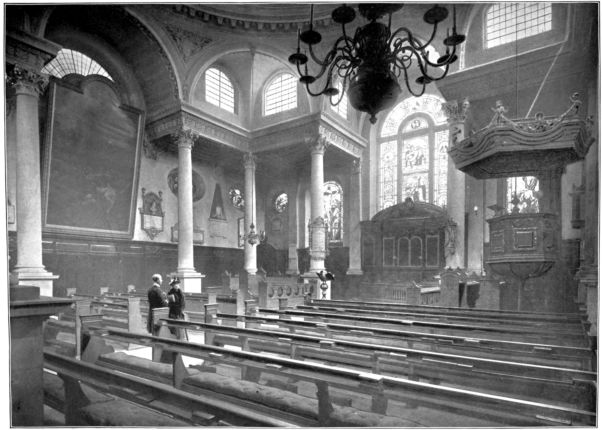
Pictorial Agency. ST. STEPHEN, WALBROOK
119According to Stow, the parish possessed £100 per annum, employed in repairing the church, etc., the exact uses of which were unknown. He records a legacy of £20 per annum for charitable uses left by one named Dickenson.
Henry Chicheley, L.L.D. (d. 1443), Archbishop of Canterbury, was a rector here; also Thomas Wilson (1703-84), author of the History of St. Margaret’s; John Kite (d. 1537), Archbishop of Armagh; and Thomas Howell (1588-1646), Bishop of Bristol.
The Church of St. Stephen stood on the west side of the original course of Walbrook stream. Over the new course of the stream a “covering” or small bridge was made for access to the church, and in 1300 the parishioners were found, by inquisition before the mayor, to be under the obligation of repairing it. Little is known of this building; that it possessed a belfry is shown from an entry in the coroner’s roll of 1278, which records the death of one William le Clarke, who, having gone pigeon-nesting in the belfry, accidentally fell as he was climbing the beams, and so ruptured and crushed his body on one of them that he died. The fatal beam was thereupon “appraised at four pence, and two neighbours nearest to the church were attached, each by two sureties, to see the fine or deodand paid” (Riley’s Memorials of London, p. 13).
The “parsonage house,” before the Great Fire, stood, Stow tells us, on the site of the first church, next to the course of the Walbrook. It was rebuilt by one Jerome Raustorne (or Rawstorne) upon a lease of forty years, commencing 1674, and by this, Newcourt says, was “reserved to the parson £17 a year ground-rent.” The parish at this time enjoyed an income of £100 a year, and with part of this, supplemented by sums of money received from leases, and from compensations for encroachments and new “lights” made upon the churchyard at the rebuilding of the City after the Fire, the Vestry determined to build a new rectory house. The leave of the Grocers Company, as patrons, and a faculty from the Bishop of London, dated 1692-93, having been obtained, the new house was built (between 1693 and 1708) adjoining the west end of the church by the tower on a piece of ground, about 20 feet square, previously occupied by a portion of the ante-Fire edifice. It was considered that the rector had a title to some portion of the ground, and to half the compensation money paid for new lights, and accordingly it was provided that in case the rector or any of his successors should find it inconvenient or inadvisable to live in the house, then the Vestry should let the same from year to year, the parish to have two-thirds of the rental, and the remaining third to go to the rector. This house is still standing, but is let out for offices, the rector living at Brockley. It is a quaint and small house, which almost touches the church wall at the back. Two of its rooms stand over the church porch. The original staircase and panelled walls remain. It is the only old house standing on the east side of Walbrook. The churchyard is situated at the east end of the church. It has a round flower-bed in the centre, two trees, and several bushes, and is kept in excellent order. It is entered from Church Row by an iron gate, and from the church by the door in the east wall.
120The Mansion House occupies the sites of Stocks Market and St. Mary Woolchurch Haw.
ST. MARY WOOLCHURCH HAW
This church was situated on the eastern side of the market. It probably derived its name “Woolchurch” from the fact that a beam was erected in the churchyard for the weighing of wool. It was probably built about the time of William I. by one Hubert de Ria, founder of the Abbey of St. John in Colchester. His son Eudo Dapifer, Steward to the Conqueror, endowed his newly-built Abbey and Convent of St. John, Colchester, with it. The charter of foundation (1096) calls it St. Mary de Westcheping, or Newchurch, and states that Ailward Gross the priest held the living by gift of Hubert de Ria. The exact words are these, and constitute the earliest mention of the church:
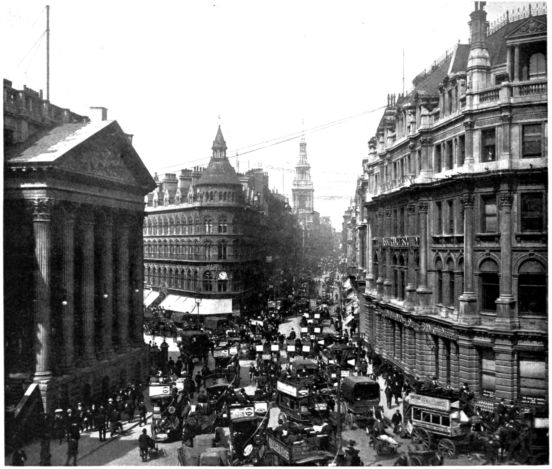
Photochrom Co., Ltd. THE MANSION HOUSE AND CHEAPSIDE
Et ecclesiam S. Mariae de Westcheping, London, quae vocatur Niewecherche, concedente Ailwardo Grosso, presbytero qui in eadem ecclesia et donatione antecessoris mei Huberti de Ria personatum consecutus fuerat (Newcourt 1. p. 459).
In the “Taxatio Ecclesiastica” of Pope Nicholas IV. (1291) occurs reference to ecclesia Sancte 121Marie de Wolchurche hawe, indicating that the names of St. Mary de Westcheping and Niewecherche had alike disappeared to give place to a title in some way derived from the wool staple and market. This is Stow’s etymology of the name. Mr. J. H. Round doubts the theory; he suggests that this St. Mary’s was a daughter-church to St. Mary Woolnoth (Athenæum, August 17, 1889, p. 223) (Woollen-hithe-hatch, or haw). This would give as the full and new name of our “Niewecherche” St. Mary-in-Woollenhaw, Church-Haw, and by contraction St. Mary Woolchurch Haw. It is actually styled St. Mary Wolmaricherch in 1280-81, which certainly appears to support Mr. Round’s theory.
The first rector given by Newcourt is John Dyne, who resigned in 1382. By licence granted 1442 (20 Henry VI.), the church was rebuilt; the new building stood farther south than the old, in accordance with a condition imposed by the licence, which ordained it to be 15 feet from the Stocks Market “for sparing of light to the same.” The foundation stone of this new building was discovered when digging the foundations of the Mansion House in 1739.
The stone was drawn by R. West, engraved by Toms, and relegated to an obscurity from which it has never since emerged: its whereabouts is unknown. The new church, whose foundation was laid on May 4, 1442, is described by Stow as “reasonably fair and large.”
The church was destroyed in the Great Fire and not rebuilt, its parish being annexed to the neighbouring one of St. Mary Woolnoth. The earliest date of an incumbent is 1349.
The patronage of the church was in the hands of: Hubert de Ria, father of Eudo, Steward of the Conqueror’s household; Abbot and Convent of St. John, Colchester, being the gift of Eudo; Henry VIII. seized it, and thus it continued in the Crown until the church was burnt down and the parish annexed to St. Mary Woolnoth, of which the Crown shares the alternate patronage.
Houseling people in 1548 were 360.
Chantries were founded here by: Anne Cawood, at the Altar of St. Nicholas, whose endowment fetched £8 in 1548, when Henry Cockes was priest, and to which John Chamberlayne was admitted June 2, 1525; Roger Barlow, whose endowment fetched £3 : 6 : 8 in 1548, which was spent on maintaining the Cawood chantry: by Godwine le Hodere in 1313 for himself and his wife, for which the King granted his licence July 8, 1321.
The church formerly contained monuments to several benefactors, amongst whom were John Winger, mayor in 1504, donor of £20 for church purposes; Richard Shaw, sheriff in 1505, and donor of £20.
Stow records that the list of legacies and gifts was too long for the churchwardens to give account of in their parochial visitation of 1693, but that it could be seen in the parish registers.
William Fuller (1608-75), Bishop of Lincoln, was rector here.
Of the Wool Haw it is interesting to know: “They set up a beam for the tronage or weighing of wool in the churchyard of St. Mary, Westcheping, which was henceforth known as the Wool Haw or yard, and became a wool market. The date is not known, but it was before 1275 (‘S. Mary de Wolcherche’ occurs in a will of 1265 (see Calendar of Wills, vol. i. p. 26)). ‘Les Customes de Wolchirchaw’ as ordained in the reign of Edward I., were as follows (Liber Albus, p. 216):—‘For one pound of wool (sold) to a foreigner (non-freeman) one halfpenny; and for one sack, only one halfpenny. For two woolfels and more, one halfpenny, and for one hundred only one halfpenny. For one pound of woolen yarn, one halfpenny; for one hundred only one halfpenny. If any foreigner brings wool, woolfels, or yarn through the city for sale, to the value of ten pence and more, he shall pay as custom one farthing.’
“The weighing of wool was continued here until 1383 (6 Richard II.) when John 122Churchman, having built the Custom House upon Wool Quay (Tower Ward) the tronage was discontinued in this spot” (Strype).
When the watercourse of the Walbrook was open, there was a bridge over it at the junction of Walbrook, Broad Street, and Cheap wards. At the east side of the Mansion House, running from Mansion House Street to Church Row, is Mansion House Place. It contains only the sides of buildings.
Previously to the erection of the Mansion House, Mansion House Place formed merely the east side of Stocks Market, and was planted with rows of trees. On the east, about the middle, was a court, and in it, says Strype (1720), “a good large house, the habitation of Godfrey Woodward, one of the attorneys of the Sheriff’s court.” Strype’s map shows the position of the court, which opened into a fair-sized quadrangle.
Stocks Market.—In Plantagenet London the Westcheping (Westcheping comprised at least the present Cheapside, Poultry, and Mansion House Street) had an open space, “very large and broad,” where the Mansion House now stands. South of the space was St. Mary Woolchurch Haw, already described; in the space itself a pair of stocks for punishment of offenders. By patent of Edward I., in 1282, Henry Waley, several times mayor, built sundry houses in the City, whose profits were destined for the maintenance of London Bridge. The void space by the Woolchurch he built and otherwise turned into a market, known as “Les Stokkes,” otherwise Stocks Market, sometimes Woolchurch Market. He appointed it a market-place for fish and flesh. The keepers of the bridge let out the stalls to fishmongers and butchers for term of their lives, until 1312-13, when John de Gisors, mayor, and the whole commonalty decreed that life-leases should not be granted in future without the consent of the mayor and commonalty (for full text of the decree see Strype, 1754 ed.). In 1322, Edward II. sent Letters Patent from the Tower commanding that no one should sell fish or flesh save in the markets of Bridgestreet, Eastcheap, Old Fish Street, St. Nicholas Shambles, and Stocks Market—a first offence to be punished by forfeiture of such fish or flesh as was sold, second offence by loss of freedom; and it was accordingly thus decreed by the mayor, Hamo de Chigwell. The rents of the market at that time amounted to £46 : 13 : 4 per annum. Foreigners, i.e. non-freemen, were allowed to sell in this “house called the Stocks,” but under conditions. None might cut meat after 2 P.M. rung at St. Paul’s; meat cut and remaining unpurchased at that time was all to be sold by vespers, “without keeping any back or carrying any away.” In 1320 three alleged “foreigners” were accused of selling their pork and beef by candlelight, after curfew had rung at St. Martin’s-le-Grand. One did not appear to defend himself, one acknowledged his offence; the meat of both was forfeited. The third contended that he possessed the City freedom, and his meat was returned to him (Riley, Memorials of London).
The “butchers of the Stokkes” were jealous of their honour. In 1331 they 123petitioned Sir John Pountney, mayor, and the aldermen, that ordinance should be made against certain abuses. Their prayer was granted; henceforth no butcher having once or twice failed in payment should trade in the market until he had paid his debts. The trade had evidently got into bad repute owing to insolvent butchers. Likewise no “foreigner” was to sell by retail in the market; no butcher to “take another’s man” except such man had paid his former master that he owed him, otherwise the new master was to be held responsible for his servant. Also that butchers of the market who had bought their freedom should be obliged to live in the City. Hitherto some of them had dwelt in Stratford, and had thus avoided bearing “their part in the franchise of the City.” Infringement of the ordinance was punishable by a fine of 40s. payable to the Chamber of London (Riley, ibid.).
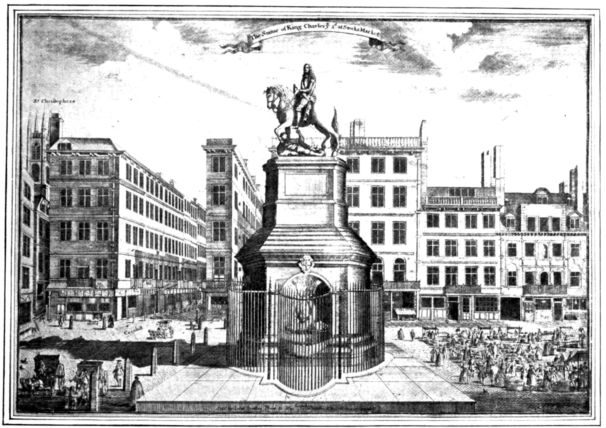
STOCKS MARKET
By degrees the flesh and fish trade centred hereabouts overflowed into the King’s highway from Cheap conduit to the market, and became an obstruction. The common serjeant complained to the mayor and aldermen in 1345. As a result, ordinary butchers, poulterers, and fishmongers were to confine their operations to their houses and shops: market men to sell within the market. On fish days the fishmongers were to occupy the market enclosure, and the butchers the pent-house adjoining; on flesh days the enclosure was for the butchers, and the pent-house for the fishmongers. Obstruction of the highway henceforth entailed forfeiture of goods 124exposed for sale. That same year the common serjeant found three butchers selling from stalls in the highway of Poultry, and confiscated their meat (Riley, ibid.).