GROUP III (continued 2)
Reading edition
The butchers of the “Stokkes” gave £17 to Edward III. for the carrying on of the French Wars. This was a large contribution, showing their prosperous condition. Their brethren, St. Nicholas Shambles, gave only £9, those of West Cheap only £8; the greater Companies £20 to £40, the lesser mostly below £7. This old market was under strict supervision. In 1319 the market wardens cited one William Sperlyng for offering two putrid beef carcases for sale. A jury of twelve pronouncing the carcases putrid as alleged, the unhappy man was ordered to be put in the pillory and to have the two carcases burned beneath him (Riley), as in the case of the pork butcher already mentioned. In 1351 one Henry de Passelewe, cook, was cited before the commonalty on a charge of selling at the Stocks a pasty in which the two capons baked therein were “putrid and stinking, and an abomination to mankind: to the scandal, contempt and disgrace of all the City,” and the manifest peril of the life of the purchaser. Passelewe contended that when sold the capons were “good, well-flavoured, fitting and proper.” However, eight good and trusty cooks pronounced them “stinking and rotten, and baneful to the health of man.” So poor Passelewe was sentenced to the pillory, the offensive pasty to be carried before him, and a proclamation to be made as to the reason of his punishment.
Considerable prejudice existed against non-freemen using the market. In 1382 Adam Carlelle, late alderman of Aldgate, approached the places of the “foreign fishmongers” and “in a haughty and spiteful manner cursed the said strangers, saying that he did not care who heard it or knew of it, but that it was a great mockery and badly ordained than such ribalds as those should sell their fish in the City, and further that he would rather a fishmonger who was his neighbour in the City should make 20s. by him, than such a ribald barlelle was adjudged to have thus expressed contempt for the command of the king and the ordinance of the City, and was excluded from ever holding any offices of dignity in the City” (Riley, Memorials).
In 1410 (2 Henry IV.) it was found necessary to rebuild the market, and the work was completed in the next year. The annual rents were valued at £56 : 19 : 6 in 1507, an increase of £10 on 185 years. In 1543, only 36 years later, the sum reached £82 : 3s. per annum. The market must have been fully let at that time: fishmongers had 25 stalls, producing £34 : 13 : 4 in rent; the butchers rented 18 stalls at £41 : 16 : 4; there were also 16 upper chambers rented at £5 : 13 : 4—total £82 : 3s. per annum (Stow’s Survey, p. 243, 1754).
In 1509 (1 Henry VIII.) the dwellers about the Stocks obtained leave of the Common Council to substitute for a leaden water-pipe at the south-east of the market a stone conduit, or, as it is called in the petition, “a portico of stone, with a cesterne of lead therein” from which water was “to bee drawne out by cocks.” 125Time wrought changes in the market and its uses. After the Great Fire, the fishmongers and most of the butchers gave place to the sellers of fruits, roots, and herbs. It was of note, says Strype (1720), “for having the choicest in the kind of all sorts, surpassing all other markets in London.” The post-Fire market was increased by the addition of the sites of St. Mary Woolchurch Haw and its churchyard, the sites of three houses belonging to the parish, purchased for £350, and of the site of the rectory house, obtained at a perpetual rental of £10 per annum. Thus the new market was 230 feet from north to south, and 108 feet from east to west, measured at the middle; besides the open roadways or passages on the west and east sides. The eastern side was planted with “rows of trees, very pleasant.” The market-place itself had twenty-two covered fruit stalls, most of them at the north side; two ranges of covered butchers’ stalls, with racks, blocks, and scales, in the south-east corner; the remaining space was occupied by gardeners and others who sold “fruits, roots, herbs, and flowers” (Strype, 1720). Well might Shadwell ask in his Bury Fair (1689), “Where is such a garden in Europe as the Stocks Market?” Here follows an amusing description of it taken from a paper called The Wandering Spy (1705):
“I saw Stocks Market, all garnished with nuts, and pears, and grapes, and golden pippins, all in rank and file most prettily. And then on the other side for physic herbs there is enough to furnish a whole country, from the nourishing Eringo, to the destructive Savine, where a man may buy as much for a penny as an apothecary will afford for half-a-crown, and do a man twice as much good as their specific bolusses, hipnotic draughts, sudorific hausteses, anodyne compositions, and twenty other flip-flops with hard names, which only disorder the body, put nature into convulsions, and prepare a man for the sexton. But here a man may consult a female doctor in a straw hat without fee, have what quantity he pleases, of what herb he pleases, be his distemper what it will, and convert it into a juice, concoction, syrup, purge, or glister, in a quarter of an hour, without any danger to body or pocket” (Malcolm, Londinium Redivium).
Oak Apple Day, 1672, was a gala day for the market. Then it was that Sir Robert Vyner inaugurated the “nobly great statue of King Charles II. on horseback” which he had, at his own charge, caused to be set upon the conduit at the north end of the same. The King was represented in armour, his head uncovered; the horse trampled beneath its feet the fallen form of Oliver Cromwell. The whole, which was of white marble, stood upon a freestone pedestal 18 feet high, carved with the royal arms and niches containing dolphins. Handsome iron gates and rails enclosed this loyal tribute to a great king. That day the market conduit ran with wine; three years afterwards Sir Robert Vyner was Lord Mayor. Alas! the glory of the statue, as of the monarch it portrayed, was short-lived. It was soon criticised as a clumsy work, and the revelation of its 126history turned it into a laughing-stock. Early in the eighteenth century it was discovered that the loyal Vyner had found somewhere abroad a statue of John Sobieski, King of Poland, conqueror of the Turks at Choozim. The statue represented the King’s horse trampling on a Turk. It lay on the sculptor’s hands. Sir Robert, seeing the means of paying his sovereign a compliment without great expense, obtained the statue, and secured Latham to substitute the head of Charles for that of the Pole. The downtrodden Turk was christianised into Cromwell, only, unfortunately, Latham omitted to alter the Turk’s turban, which remained intact and incongruous upon Oliver’s head, and served as a confirmation of the story. There is a lampoon on the statue worth quoting. It occurs in Lord Rochester’s History of the Insipids (1676):
Could Robert Vyner have foreseen
The glorious triumphs of his master,
The Woolwich Statue gold had been,
Which now is made of alabaster:
But wise men think had it been wood
’Twere for a bankrupt king too good.
When Stocks conduit was removed, the “ridiculous statue” was relegated to the rubbish heaps of Guildhall; finally the Common Council granted it to Mr. Robert Vyner, a descendant of Sir Robert, in 1779, and it was taken by its new owner to adorn his country seat at Gantly Park, Lincolnshire. The year 1737 saw the end of Stocks Market in this place. On March 12 the sheriffs petitioned the House of Commons to remove it to Fleet Ditch, and to erect the Mansion House upon its site. Their prayer was granted; the market was removed at Michaelmas 1737, and the ancient market-place was enclosed with a broad fence. In its new home the name which it had borne for 255 years was lost, and it became known as the Fleet Market. At Michaelmas 1829, exactly 82 years after its removal, it was closed and the site cleared to form Farringdon Street. St. Christopher le Stocks, so called from its proximity to the market, stood on part of the site of the present Bank of England. Seven streets now meet before the Bank and pour forth omnibuses, cabs, and other vehicles in an endless stream of traffic. Below are the white-bricked subways of the electric railway which form a safe crossing for those who cannot ford the river of traffic.
St. Christopher le Stocks stood on the north side of Threadneedle Street in the ward of Broad Street. The date of its foundation is unknown. The building was much injured by the Great Fire and subsequently repaired. In 1780, after the Gordon Riots, it was taken down and its site is now covered by part of the Bank of England. The earliest date of an incumbent is 1280.
The patronage of the church was in the hands of: The family of Nevil in 1281; the Bishop of London, 1415, in whose successors it continued up to 1783.
Houseling people in 1548 were 221.
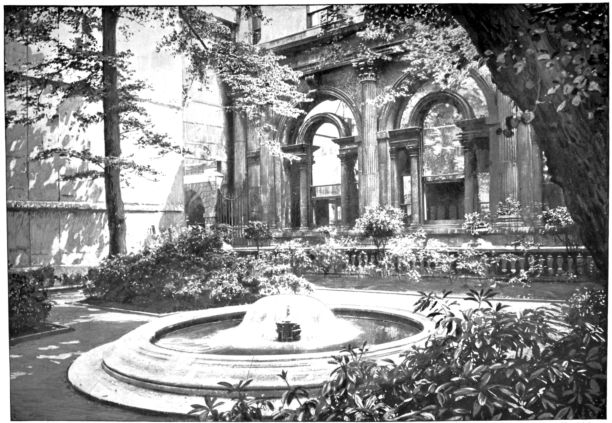
Pictorial Agency. BANK OF ENGLAND FOUNTAIN
127The church originally contained monuments to Robert Thorne, a donor of £4445 to the parish for charitable uses; William Hampton, mayor, 1472, and great benefactor, and other donors. Few of these were to be seen after the Fire.
Chantries were founded here: By John Walles, mercer, whose endowment fetched £10 : 13 : 4 in 1548; for Thomas Legg, to which William Swynbrok was admitted chaplain, January 10, 1370-71; for John Gedney, Mayor of London, 1427, at the Altar of Holy Trinity; for Margerie de Nerford, William de Bergh, cl. and Christian Vaughan, widow, at the Altar of Holy Trinity, for which the King granted his licence, February 23, 1406-1407: the endowment was valued at £10 : 4s. in 1548; by John Plonkett, whose endowment fetched £13 : 17 : 8 in 1548; by Alice, wife of Benedict Harlewyn, late citizen and clothier, at the Altar of Holy Trinity, for the king, John Wenlok, Knt., herself, Richard, Duke of York, and Benedict her husband; the King granted his licence, March 20, 1461-62: the endowment fetched £5 : 13 : 4 in 1548.
Robert Thorne was donor of more than £4445 to the parish. John Kendrick was also a great benefactor, whose will is recorded in full by Stow. Sir Peter le Maire bequeathed £100 to the poor of the parish. There were many other donors of smaller amounts.
Among notable vicars were John Pearson (1631-86), Bishop of Chester, the theologian, and William Peirse, Bishop of Peterborough in 1630.
The site of the Church of St. Bartholomew is now also absorbed by the Bank.
St. Bartholomew Exchange, formerly called Little St. Bartholomew, stood at the south-east corner of St. Bartholomew Lane, over against the Royal Exchange. The date of its foundation is unknown, but about 1438 it was rebuilt. In 1840 it was sold, and possession given to Kames William Freshfield, junr., for the Bank of England; instead thereof the Church of St. Bartholomew, Moor Lane, was built. The earliest date of an incumbent is 1331.
The patronage was in the hands of: Simon Goddard, citizen and draper of London, who bequeathed it to his heir, Johanna, in 1273-74; Edward III. in 1364; Richard Plessy; Abbot and Convent of St. Mary Graces, 1374, confirmed February 19, 1422-23; Henry VIII., and continued in the Crown.
Houseling people in 1548 were 392.
Chantries were founded here for: Richard de Plessis, Dean of the Arches, who died 1362, when John Radyng was admitted chaplain; Mary, wife of Sir John Lepington.
Sir William Capell, mayor, 1509, was buried here, also James Wilford, sheriff, 1499. The church originally contained a monument to Richard Croshawe, Master of the Company of Goldsmiths. He lived in this parish for thirty-one years, and left by his will over £4000 for the maintaining of lectures, relief of the poor, and other charitable uses. There are no other gifts recorded.
Ralf Brideoake (1613-78), Bishop of Chichester, was rector here; also John Sharp (1645-1714), Archbishop of York, and Zachary Pearce (1690-1774), Bishop of Rochester and Bangor.
Threadneedle Street.—The derivation of this extraordinary name is very uncertain. Stow calls it Threeneedle Street, and it may possibly have arisen from some tavern with the sign of the three needles. The arms of Needlemakers Company are “three needles in fesse argent.” This is one of the humbler Companies and has no hall.
On the north side there were in the sixteenth century “divers fair and large” houses, after which came the Hospital of St. Anthony, close to the Royal Exchange.
The very interesting foundation of St. Anthony is considered elsewhere, as so long an account would interrupt our perambulation unduly. One of the oddest customs at a time when there were so many odd customs, was that the pigs belonging to this house were allowed to roam about the City as they pleased, and on the 12817th January, any year, had the privilege of going into any house that was open. But in 1281, and again in 1292, there are no exceptions made to the rule that all pigs, to whomsoever they may belong, shall be killed, if found in the street.
An open concrete-covered space beyond the Royal Exchange lines part of this street. Here there is a fountain erected in 1878 by the exertions and donations of an alderman. A gilded canopy overhangs a stone group of a mother and two children. The pedestal and basins are of granite. On the east there is a seated figure of Peabody, life size. The buildings on the north side of the street do not require much comment; the North British & Mercantile Insurance Company is the most noticeable, because the horizontal lines are broken by the deeply recessed windows. The Postal Telegraph Office next door has a little tower on the summit, and the frontage is sprinkled with rather conventional stone panels and has a superfluity of stone ornament. The Consolidated Bank, after the following corner, has a plain frontage, which makes a deep frieze across the upper part more striking; this is an allegorical subject in a stone bas relievo under a heavy cornice. The National Bank of India is a solid, well-proportioned building with symmetrical columns of polished granite running up the front.
St. Benet Finck was situated on the south side of Threadneedle Street, east of the Royal Exchange. It was dedicated to St. Benedict and took its additional name from its founder, Robert Fincke. The date of its foundation is unknown. It was burnt down in the Great Fire, and rebuilt by Wren, who completed it in 1673. The church was taken down in 1842, and its parish united with that of St. Peter-le-Poer. The earliest date of an incumbent is 1323. The patronage of the church was in the hands of: The family of Nevils in 1281, who presented to it as a Rectory; Master and Brethren of the Hospital of St. Anthony, then the Dean and Chapter of Windsor, 1474, up to 1844, when it was annexed to St. Peter-le-Poer.
Houseling people in 1548 were 300 and above.
Wren’s church was elliptical in shape, and measured 63 feet by 48 feet. It was traversed by six composite columns, which, with the connecting arches, supported the roof. The steeple, which rose to a height of 110 feet roughly, consisted of a tower, lead-covered cupola, and lantern.
The original church contained monuments to John Wilcocks and Dame Anne Awnsham (d. 1613), both benefactors of the parish. After the Great Fire a Table of Benefactors was set up to the memory of: George Holman, donor of £1000 to the rebuilding of the church; Anne Thriscrosse, donor of £100 for apprenticing poor children, and several other donors. On a table in the organ loft there was an inscription to Mrs. Sarah Gregory, donor of £600 for various charitable purposes. In 1662 Richard Baxter, the celebrated Nonconformist divine, was married here.
In Threadneedle Street, at the corner of Bartholomew Lane, is the Sun Fire Office with glittering gilt suns over the corner and windows. The angle has been sliced off to form an entrance. A heavy wreath of foliage in stone surrounds the window above. The architect was C. R. Cockerell. A graceful new building in white stone with engaged pillars fluted, rising from the top of the ground-floor, contains the Life Alliance and Fire Office in Bartholomew Lane. Next door is Bartholomew House with the usual stereotyped stone detail, and a couple of somewhat 129cumbrous stone figures reclining over each side window. Capel Court leads to the Stock Exchange.
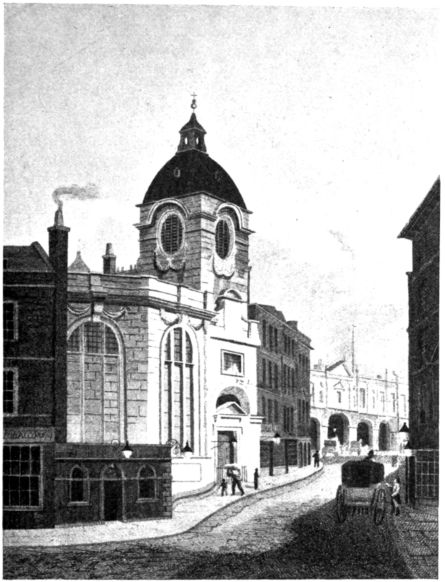
Drawn by G. Shepherd. ST. BENET FINCK
At No. 40 Threadneedle Street is a paved courtyard shut in by iron gates and behind an archway, striking because of its size and the massiveness of its stonework. This leads to entrances of the National Provincial Bank of England, and the Mercantile Bank of India. Beyond it is the Baltic and South Sea House. This differs from all the preceding buildings because it belongs to the eighteenth century, as the deep tinge of its well-preserved bricks tells.
The centre window and doorway are encased in stonework, and the solidity of the whole structure is in contrast with its “bubble” reputation. It is now occupied as chambers by merchants, brokers, etc., and the secretary of the Baltic Company finds lodging here among others.
130On the south side of Threadneedle Street we have the Bank of Australasia. Then two great doorways with an interval between them. These bear over them the arms of the powerful Merchant Taylors Company, whose hall is behind.
MERCHANT TAYLORS COMPANY
The precise date of the foundation of the Company is not known, but one of the earliest civic records mentioning the Taylors as a separate craft, is the “Chronicle of the Mayors and Sheriffs of London,” which narrates their dispute with the Goldsmiths in November 1267.
In 1299 Edward I. granted them his licence to adopt the name of “Taylors and Linen Armourers of the Fraternity of St. John the Baptist.” Stow says that on St. John Baptist’s Day, 1300, a master (Henry de Ryall) and four wardens were chosen, the master being then called “the pilgrim,” as travelling for the whole Company, and the warders “the purveyors of alms or quarterages,” plainly showing that the gild was originally a charitable as well as a commercial fraternity.
In March 1326 the first charter was granted to the Company by Edward III.
In 1371 the Company, under this charter, made an ordinance to regulate their trade, with the special object of recovering damages from workmen miscutting the cloth entrusted to them.
The Company acquired that portion of their Threadneedle Street estate upon which their present hall stands in 1331.
In 1351 they enrolled their first honorary member; and about 1361 obtained a grant of a chapel at the north side of St. Paul’s, in honour of St. John the Baptist, for daily service and prayers for “the preservation of them that are or shall be of the fraternity.”
In 1480 the Company received their first grant of arms, taking religious emblems, viz. a holy lamb set within a sun, the crest being within the pavilion, Our Blessed Lady St. Mary the Virgin, Christ her Son standing naked before her, holding between His hands a vesture (tunica inconsutilis).
In 1484 the celebrated controversy for precedence in processions, etc., between the Taylors and Skinners arose, which was settled by the award of the Lord Mayor that each Company should have precedence in alternate years, and that each should invite the other to dine once in every year. This custom has been ever since kept up, the master and wardens of the Taylors dining with the Skinners on the first Thursday in December, the master and wardens of the Skinners with the Taylors on the 14th July.
It was not till 1502 that the Company attained to the full privileges which they afterwards enjoyed. Under Henry VII.’s charter, not only were the Company made “Merchant” Taylors, but they ceased to be exclusively Taylors, and were permitted to receive others into their fraternity.
The principal object of the guild was the preservation of the trade or calling of the fraternity, no one being permitted to work in London as a “tailor” unless a freeman of the Company. For the protection of the trade the right of search was vested in the guild, such search being a guarantee to the public that the honest usages of trade were observed, and to the fraternity that their monopoly was not infringed. Before a tailor’s shop was opened a licence had to be obtained from the master and wardens of the Company, and they granted the licence only when satisfied of the competency of the freeman. Until the abolition of Bartholomew Fair in 1854, after an existence of 700 years, the beadle of the Company used annually to attend the fair and to proceed to the drapers’ shops, taking with him the Company’s silver yard stick as the standard by which to test the measures used for selling cloth in the fair.
In 1555, anticipation of the foundation of Merchant Taylors’ School, Sir Thomas White, a member of the Court of the Merchant Taylors Company, founded St. John’s College, Oxford, reserving forty-three out of its fifty endowed fellowships for scholars from the school.
The Company’s school was founded in 1561 on Lawrence Pountney Hill.
Great Crosby School, near Liverpool, of which the Company are sole trustees and managers, was founded in 1618 by John Harrison.
131In 1622 Dr. Thomas White established Sion College, giving to the Company the nomination to eight of the twenty almshouses which he connected with the college.
In 1666 the losses sustained by the Company in the Fire of London obliged them to let their land in the City upon small ground-rents to enable their tenants to rebuild, and their resources were thus much crippled.
The number of the livery is 288. The Corporate Income is £37,000; the Trust Income is £13,000. Their hall is at 30 Threadneedle Street.
Privileges of membership:
(1) The only advantages that a freeman in easy circumstances possesses is eligibility for the livery, and prospectively for the court, and the comfortable assurance that, should he fall into poverty by misfortune and maintain his respectability, he will receive a pension from the Company varying in amount from £5 to £40 a year, and that, should his wife and daughters be left in poverty, they will be assisted by the Company to earn a living. Freemen are eligible for certain gifts and loans of money for their advancement in life.
Poverty from ill-health, old age, or incapacity to earn a livelihood, alone constitutes a claim to a pension or donation.
The only patronage enjoyed by individual members of the court is the power of presenting boys to the Company’s school in London. Each member of the court has two or sometimes three presentations annually, according to vacancies.
The present magnificent hall was built in 1671 by Jerman. It has been altered and improved, but it remains much the same as when Jerman handed it over to the Company.
The Company has almshouses and schools, notably the great school on the site of the Charter House. It also gives largely to the City and Guilds of London Technical Institute.
At the east end of Threadneedle Street, where it meets Bishopsgate Street, stood St. Martin Outwich.
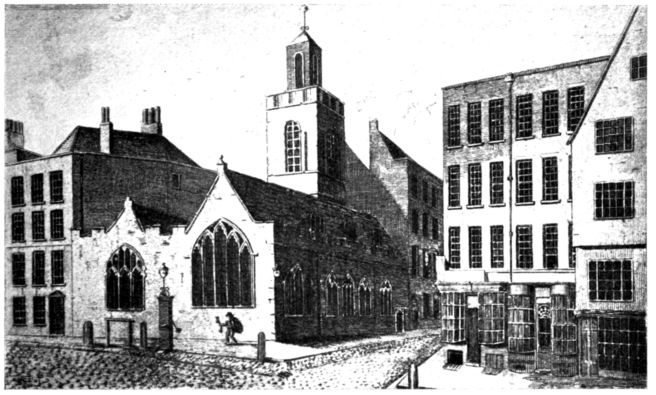
ST. MARTIN OUTWICH
St. Martin Outwich was called Oteswich or Outwich from four brothers of that name who founded it. It escaped the Great Fire, but was rebuilt in 1796 by the Merchant Taylors Company. In 1873 the 132parish of St. Martin Outwich was united with that of St. Helen, Bishopsgate, and the former church pulled down; the Capital and Counties Bank stands on its site. The earliest date of an incumbent is 1300.
The patronage of the Church was in the hands of: Edward III., who granted it to John de Warren, Earl of Surrey, in 1328; the Oteswiches, who, by their trustee, John Churchman, conveyed it to the Merchant Taylors Company, July 15, 1406, who presented it up to 1855.
Houseling people in 1548 were 227.
A chantry was founded here by John de Bredstrete, whose endowment for this and other purposes fetched £4 : 3 : 4 in 1548. The King granted his licence to found the Guild of St. Baptist, July 15, 1406.
Money fetched 5 per cent in 1548, for one John Kyddermester the elder by his will bequeathed £200 to purchase £10 by year to keep an obite, etc., in St. Martin Outwich.
A considerable number of monuments are recorded by Stow. Some of the most notable are those in memory of: Matthew Pemberton, Merchant Taylor, donor of £50 for repairing the chapel of St. Lawrence; Richard Staper, alderman, 1594, and greatest merchant of his day; George Sotherton, sometime Master of the Merchant Taylors Company, and M.P. for the City of London, who died in 1599. All the monuments in St. Martin Outwich were removed to St. Helen, Bishopsgate, on the union of the parishes.
No detailed account of the charities is recorded by Stow. The benefactors whose names are given, were: Sir Henry Rowe, donor of £5 yearly; Mrs. Taylor, donor of £2 : 15s., for two special sermons a year.
George Gardiner (d. 1589), chaplain to Queen Elizabeth and Dean of Norwich, was rector here; also Richard Kidder (1633-1703), Bishop of Bath and Wells; Samuel Bishop (1731-95), head master of Merchant Taylors’ School.
There was near the church a well with two buckets; this was afterwards turned into a pump.
There are references to “rents” in Broad Street as early as 1258; in 1278, Matthew de Hekham, on his way from Broad Street to the Jewry, was murdered by Jews; in 1331 there is the conveyance of a very large and substantial house belonging to Edmund Crepin, citizen, and deed of hire by Sir Oliver Ingham, Knt. In 1387, the parson of St. Peter’s, Broad Street, brings to the mayor and aldermen a breviary called “Portehers,” i.e. for carrying about, bequeathed to the prison of Newgate by the late Hugh Tracy, chaplain, so that priests and clerks there imprisoned might say their service from it. And he also obtained permission to visit the prison from time to time in order to see that the book was well kept.
“East from Currier’s row is a long and high wall of stone, inclosing the north side of a large garden adjoining to as large an house, built in the reign of King Henry VIII., and of Edward VI., by Sir William Powlet, lord Treasurer of England. Through this garden, which of old time consisted of divers parts, now united, was sometimes a fair footway, leading by the west end of the Augustine Friars church straight north, and opened somewhat west from Allhallows church against London wall towards Moregate; which footway had gates at either end, locked up every night; but now the same way being taken into those gardens, the gates are closed up with stone, whereby the people are forced to go about by St. Peter’s church, and the east end of the said Friars church, and all the said great place and garden of Sir William Powlet to London Wall, and so to Moregate.
133“This great house, adjoining to the garden aforesaid, stretcheth to the north corner of Broad Street, and then turneth up Broad Street all that side to and beyond the east end of the said Friars church. It was built by the said lord treasurer in place of Augustine Friars house, cloister, and gardens, etc. The Friars church he pulled not down, but the west end thereof, inclosed from the steeple and choir, was in the year 1550 granted to the Dutch nation in London, to be their preaching place: the other part, namely, the steeple, choir, and side aisles to the choir adjoining, he reserved to household uses, as for stowage of corn, coal, and other things; his son and heir, Marquis of Winchester, sold the monuments of noblemen (there buried) in great number, the paving-stone and whatsoever (which cost many thousands), for one hundred pounds, and in place thereof made fair stabling for horses. He caused the lead to be taken from the roofs, and laid tile in place whereof; which exchange proved not so profitable as he looked for, but rather to his disadvantage” (Stow’s Survey, p. 184).
This house stood on the north side of what was afterwards called Winchester Street; the garden and grounds between it and the nave of Austin Friars’ Church having been built over. The beautiful steeple of the church, in spite of the remonstrances of the parishioners and of a letter of remonstrance addressed to the Marquis by the mayor and aldermen, was pulled down in 1604. The letter, the earliest in favour of the preservation of ancient monuments, is given in Strype, vol. i. p. 442:
“Right Honorable, my very good Lord—There hath been offered of late, unto this Court, a most just and earnest Petition, by divers of the chiefest of the Parish of St. Peter the Poor, in London, to move us to be humble Suitors unto your Lordship in a Cause, which is sufficient to speak for itself, without the Mediation of any other, viz.:—for the Repairing of the ruinous Steeple of the Church, sometime called, The Augustine Friars, now belonging to the Dutch Nation, situate in the same Parish of St. Peter the Poor: The Fall whereof, which, without speedy Prevention, is near at hand, must needs bring with it not only a great deformitie to the whole City, it being, for Architecture, one of the beautifullest and rarest Spectacles thereof, but also a fearful eminent danger to all the inhabitants next adjoining. Your Lordship being moved herein, as we understand, a year since, was pleased then to give honorable Promises with Hope of present help, but the effects not following according to your honorable intention, we are bould to renew the said Suit agayne; eftsoons craving at your Lordship’s hands a due consideration of so worthy a work, as to help to build up the House of God; one of the cheefest fountains, from whence hath sprung so great glory to your Lordship’s most noble descendency of the Powlets; whose steps your Lordship must needs follow, to continue, to all posterity, the fame of so bountiful benefactors both to Church and Commonwealth.
134“So that I trust we shall have the less need to importune your Lordship in so reasonable a suite; first, Bycause it doth principally concern your Lordship, being the Owner of the greatest part of the said Speare, or Steeple; but especially that by disbursing of a small sum of money, to the value of 50 or 60 £s, your Lordship shall do an excellent work, very helpful to many, and most grateful to all, as well English as strangers; who, by this means, shall have cause to magnify to the world this so honorable and charitable an action. And I and my brethren shall much rejoice to be releeved herein by your Lordship’s most noble disposition, rather than to fly to the last remedie of the Law of the Land; which, in this case, hath provided a Writ De reparatione facienda.
“Thus, hoping as assuredlie on your Lordship’s favour, as we pray incessantlie for your continual Felicitie, we humbly take leaves of your Lordship. From London, the 4th of August, 1600.
“Your Lordship’s humbly to be commauned,
Nycholas Mosly, Mayor. Richard Martyn, John Hart, Henry Billingsly, Stephen Soame, William Ryder, John Garrard, Thomas Bennett, Thomas Lowe, Leonard Holiday, Robert Hampson, Ry. Godard, John Wattes, Tho. Smythe, William Craven, and Humphrey Weld.”
The ancient Church of Austin Friars was given by Edward VI. to the Dutch congregation, in whose possession it still continues. All that remains is the nave. In 1862 this was badly damaged by fire, but was carefully restored, the window tracery and roof dating from that time as well as many other additions. For an account of the Austin Friars, see Mediæval London, vol. ii. p. 345.
Gilbert Talbot, Earl of Shrewsbury, lived in Broad Street in Queen Elizabeth’s reign, Lords Weston and Dover in that of Charles I.
“Here was a Glass House where Venice Glasses were made and Venetians employed in the work; and Mr. James Howel (author of the familiar Letters which bear his name) was Steward to this house. When he left this place, scarce able to bear the continual heat of it, he thus wittily expressed himself, that had he continued still Steward he should in a short time have melted away to nothing among those hot Venetians. This place afterwards became Pinners’ Hall” (Cunningham’s Handbook).
General Monk (February 1660) took up his quarters at the Glass House. On the north side was the Navy Pay Office, on the south the Excise Office.
On the site of the Excise Office was Gresham College. Sir Thomas Gresham, who died in 1596, bequeathed his dwelling-house in Bishopsgate Street for the 135purposes of the college, besides presenting the Corporation of the City of London and the Mercers Company with the Royal Exchange on the condition that they carried on lectures in the college as he prescribed. His house was a very fine one, well suited for the purpose he had in view. After the death of his widow in 1596, lectures on seven subjects were appointed and the work began. The house escaped the Great Fire of 1666, and the mayor took the college for courts and meetings; the merchants used the inner court for their Exchange, and temporary shops were put up for the use of those who had been burned out by the destruction of the Exchange. In the history of the college there has been a good deal of litigation, the full story of which may be found in Maitland and elsewhere.
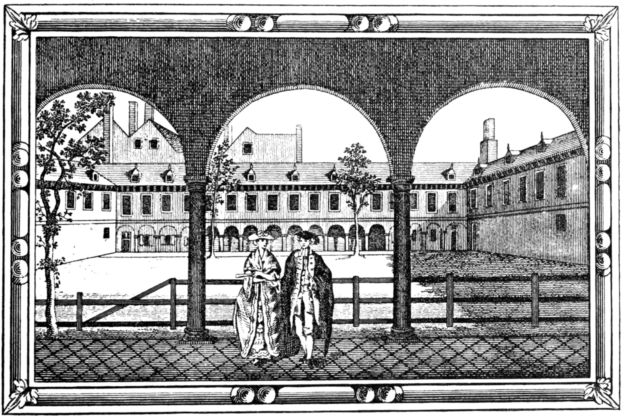
GRESHAM COLLEGE
The following Regulations are given in Stow and Strype, in 1720, in full. They are here abridged:
1. Precedency of the Professors.
The three Professors of Divinity, Law, and Medicine to be Governor or President of the College in turn.
2. The Professors to live in the College.
3. The Professors to be unmarried.
4. To have a common table, and not to entertain friends as guests at more than three meals in one month.
1365. The Year to consist of five terms:
(1) To begin on the Monday before Trinity Term and to continue one month.
(2) From the first Monday in September and to continue a fortnight.
(3) From the Monday before Michaelmas Term and to continue to the end of that Term.
(4) From the Monday after Epiphany to continue two months or sixty days.
(5) From the Monday seven night after Easter Day to the end of Easter Term.
6. The Divinity Lecture to be read on Monday and Wednesday at 8 A.M. in Latin and on Friday in English.
7. The Divinity Lecturer to deal especially with the controversies which affect the Church of Rome.
8. The Law and Physick Lectures to be read, like the Divinity Lecture, twice in Latin and once in English.
9. The other lectures in Astronomy, Geometry, Rhetoric, and Music to be read alternately in Latin and English.
10. The Professors to wear their hoods and gowns.
11. A keeper of the House to be appointed by the Lord Mayor.
The college was intended to be a rival, in some sort, to Oxford and Cambridge. It seems never to have succeeded in attracting students. Dr. Johnson attributed its failure to the fact that the lectures were free, and that what is given is not valued. The House was pulled down in 1768 and the Excise Office took its place. The lectures were then read in a room at the Royal Exchange. In 1843 the present building was erected and the college entered upon a new course. So far, however, it does not seem to fulfil the intentions of the Founder as a great educational centre. Isaac Barrow, Robert Hooke, and Christopher Wren have been Professors in the college. The Royal Society held its meetings here for fifty years (1660-1710).
ST. PETER-LE-POER
In Broad Street at present still stands St. Peter-le-Poer, nearly opposite the Excise Office. It escaped the Great Fire, but was rebuilt in 1791 from the designs of Jesse Gibson. In 1842-44 St. Benet Finck was demolished, and its parish was united with this. The earliest date of an incumbent is 1356.
So far as there is any record, since 1181 at least, the patronage of the church has always been in the hands of the Dean and Chapter of St. Paul’s.
Houseling people in 1548 were 160 or 200.
The church is circular in shape, with a recess at the north for the altar; a gallery originally ran round the building, but in 1888 the greater part of this was removed. The steeple rises at the south, the only side on which the exterior is visible, owing to surrounding buildings. It consists of a square tower, supporting a stone cupola which is terminated by a vane.
The most interesting monument which the present church contains is that in memory of Dr. Richard Holdsworth, rector here in 1623, who was for some time imprisoned by the Long Parliament. He was Master of Emmanuel College, Cambridge, and several times Vice-Chancellor of the University. The church originally contained monuments to: John Lucas, Master of the Requests to Edward VI., who died 1556; Robert Calthrop, mayor, 1588; Sir William Roche, mayor, 1540; and Sir William Garaway, at whose expense a new aisle was made in 1616, costing £400.
Some of the charities given yearly to the poor were: £4, the gift of Lady Ramsey; £5, the gift of John Quarles, for bread; £20, the gift of Lady Richard, for housekeepers at Christmas time; £30, the gift of Gerard Vanheithuysens, to be distributed among the poor.
137There were six almshouses in Broad Street, the gift of Sir Thomas Gresham.
Richard Holdsworth (1590-1649), Dean of Worcester, was rector here; also Benjamin Hoadley (1676-1761), successively Bishop of Bangor, of Hereford, of Sarum, of Winchester.
Opposite the church of St. Peter-le-Poer stood the “old” South Sea House, and behind it the yards used by the Company. This was the back of South Sea House, the front of which was at the east end of Threadneedle Street where it runs into Bishopsgate Street. The City of London Club now has its premises here; it is a large building with a massive porch, built by P. Hardwick.
Of the other business houses in this street there is nothing to say. At the corner of Winchester Street is Winchester House (modern), which keeps alive the memory of old Winchester House, standing until 1839, the town house of the marquises of Winchester.
The Pinners’ Hall was formerly in this street (see Appendix).
Wormwood Street is a continuation of London Wall, facing it. “In the street,” says Strype, “briefly, there be divers courts and alleys.” In other words, that part of London was occupied as lately as 1720 or 1750 by a population of industrial folk not yet driven out by the increase of merchants’ offices and banks. There appear to have been no antiquities in this street, unless we reckon a small burial-ground belonging to St. Martin Outwich, which lay in the point of the wall.
Of London Wall we have already spoken.
Northward are three stations, Broad Street, Bishopsgate Street, and Liverpool Street.
There are dreary rows of old brick houses on either side of the part of New Broad Street which runs east and west. Towards the west end of the street are one or two well-built business houses. The site of the Jews’ Synagogue is occupied by Blomfield House, largely inhabited by secretaries of companies and syndicates. When we turn the corner into the part of New Broad Street running north and south, we find some large modern buildings. On the east the building is uniform for a considerable way. Broad Street House occupies all the frontage between the two passages of St. Botolph’s Churchyard. It is stone fronted and is in an Italian style. Dashwood House behind it covers a very large area of ground. It is of ugly design in red brick with each line of windows in a different style. Both of these are largely occupied by agents, engineers, secretaries of companies, etc. Dashwood House looks out on the churchyard. This is an uninviting strip of ground surrounded on the south by the backs of warehouses. A small house at the east end is called “The Old Watchhouse,” and bears an inscription to the effect that it was rebuilt in 1771 by an alderman named James Townsend.
In Blomfield Street was formerly the Royal London Ophthalmic Hospital, 138now removed to the City Road. The Hospital had its origin in 1804 when some gentlemen founded a free dispensary for eye diseases.
There are some large buildings on the east known as Blomfield Buildings, also the London Provident Institution Savings Bank, and the headquarters of the London Missionary Society. The bank bears an inscription to the effect that it was erected 1835 and enlarged 1875. This Society was first formed a hundred years ago (January 15, 1795) in the Castle and Falcon Inn, Aldersgate Street, and it now sends missionaries to every quarter of the world. Close by is St. Mary’s Roman Catholic Chapel, stucco-covered, and a Roman Catholic School. At the corner of East Street is a fine building called Finsbury House, with grey granite columns of considerable strength running from the ground-floor upwards. It is well proportioned and has a well-finished angle.
Finsbury Circus is surrounded by a uniform line of dull brick houses having their ground-floors covered with yellow stucco. At one point only do the area railings give way, and that is at the London Institution, built of Portland stone, with a heavy portico and fluted columns. The Institution was established in 1806 in Old Jewry and afterwards removed to King’s Arms Yard, Coleman Street. It was incorporated a year after its establishment. The present building was founded in 1815 and opened four years later.
A great many solicitors have their offices in the Circus, and there is also a sprinkling of surgeons, accountants, and secretaries of companies. The centre of the Circus is occupied by a wide space of grass surrounded by a thick shrubbery of trees.
Northward of this is Finsbury Square, built in 1789 by George Dance. At the junction of Finsbury Pavement and Moorgate Street stood Moor Gate from which northwards outside the walls stretched the great open moor, the playground of the London citizens; this is now all built over with the exception of the Square and Circus mentioned above.
Moorfields so frequently occurs in documents before the end of the eighteenth century, and played so large a part in the life of the Londoner, that it deserves some notice. The earliest mention made of it is in the reign of Henry II., and was apparently a large open mere or marsh on which water lay in parts, so that in winter it was covered with ice, and formed a playground where the young citizens practised a primitive kind of skating. It was drained in 1627, and in Queen Elizabeth’s time was much resorted to for the practice of archery. It was also used as a general rendezvous for all who desired to meet without the gates, a perpetual fair, a drying ground, a preaching place, and many other things. It is generally said that the houseless people assembled here after the Great Fire; but Moorfields could have accommodated but a tenth part of them, so that the camps must have extended northward and westward far beyond the limits of Moorfields into Finsbury Fields northwards and to Islington.
139Various attempts were made from time to time to enclose parts of Moorfields and build on the space, and these were resisted by the citizens with much ardour; but the spreading tide heeds not resistance, and gradually the whole area was built over—even in the seventeenth century the fields were enclosed and surrounded by shops.
Moor Gate was rebuilt in 1672, and the central gateway made higher than usual that the City Trained Bands might march through with pikes erect.
From end to end Moorgate Street is composed of comparatively uniform stucco-fronted houses in a hideous Victorian style, with little projecting pediments and cornices over the windows. To this there is one exception, at the south-east corner, in the British and Fire Insurance Office, a stone and grey granite building of imposing size.
Great Swan Alley is a narrow entry which comes out just beside Ye Old Swan’s Nest public-house, which is a new stone-faced building. At the north-east corner are Swan Chambers, designed by Basil Champneys in 1891.
Moorgate Court (late Coleman Street Buildings) contains the Institute of Chartered Accountants, a very fine building of stone, with panels of female figures in relief; on each panel is a shield, and the words Arts, Sciences, Crafts, Education, Commerce, Agriculture, Manufacture, Mining, Railways, Shipping, India, Colonies, Building are inscribed on these shields. This frieze extends across the whole frontage, but is cut up by intersecting columns. It is the work of Hamo Thorneycroft. The angle at the corner has the merit of being thoroughly unconventional. The figure of Justice surmounts the balcony. The building was designed by John Belcher, 1892. Facing south is a red brick and stone building known as Moorgate Court. This is in a picturesque style of Perpendicular Gothic, and the building over the projecting porch is carried up to the roof, giving relief to the frontage. Altogether this is an unexpectedly picturesque Court. In the covered entry leading to it from Moorgate Street are two old doorways, the northern one fascinating, with grotesque faces on the keystone of the lintel, and vertical Wrenian ornaments on either side. Looking back at the entry from the street we see that these doorways belong to a very old plaster house, with tiled roof, which stands back from the street line, overlooking two shops, one on either side the entry, which are finished with parapets. The windows in the tiled roof also peep over a parapet. This is the only picturesque bit in that very ugly but useful thoroughfare—Moorgate Street.
Close at hand the Ocean Accident and Guarantee Corporation have fitted up their ground-floor with pink terra-cotta which jars with the yellow plaster above. Altogether, to the east of Moorgate Street lie an amazing number of quiet courts, without beauty, but lined by respectable solid brick-and-plaster houses.
Between Moorgate and Old Broad Streets east and west, and London Wall and Throgmorton Street north and south, lies a typical business quarter.
In Copthall Buildings we see great modern houses. The Chambers here are 140filled by stock-jobbers and stockbrokers. Copthall Avenue is made up of fine well-built houses and little old ones. Lanthorn, Moorgate, Throgmorton, Copthall Houses are all in a sensible but not displeasing style. Some are of the lighter red brick and light stone which shows up well in a London Street, others in grey stone and granite. Copthall House, which runs round the corner along the south part of Sun Court, has windows bayed in imitation of an old style. Basil Champneys was the architect. For the old houses, Nos. 4 and 6 on the east side date from the seventeenth century. Nos. 10 and 12 are of about the same date. Nos. 22, 24, and 26 farther northward are also old, and are perhaps early eighteenth century; their discoloured bricks and the bent lines of the windows and doorway bear testimony to their years.
Of Lothbury there is not much to say; it contains the Bank of Scotland, and the chief office of the London and Westminster Bank, and numerous companies are promoted and worked from this address.
The building at the corner of Tokenhouse Yard is in the style known as Venetian Gothic. It is harmoniously carried out. There is a somewhat deeply recessed doorway. The building bears a frieze or panel on it which divides an upper window into two parts. It was designed by G. Somers Clarke and built in 1866. No. 19, the Auction Mart in Tokenhouse Yard, owns the same architect, and is characterised by the same air of neatness and finish.
ST. MARGARET, LOTHBURY
St. Margaret, Lothbury, was probably rebuilt about 1440; the building was destroyed by the Great Fire; the present church was designed by Wren and completed in 1690. It serves, besides its own original parish, for 6 other parishes—those of St. Christopher, St. Bartholomew by the Exchange, St. Olave Jewry, St. Martin Pomeroy, St. Mildred in the Poultry, and St. Mary Colechurch. The earliest date of an incumbent is 1181.
The patronage of the church was in the hands of: the Abbess and Convent of Barking, Essex, 1303. Henry VIII. who seized it, and so it continues in the Crown to the present time.
Houseling people in 1548 were 279.
The church measures 66 feet in length, 54 feet in breadth, and 36 feet in height. It contains a nave, chancel, and one aisle, separated by Corinthian columns. The south aisle, which is railed off, contains a side-altar at the east. The steeple consists of a three-storied tower and cornice, surmounted by a lantern and obelisk with finial and vane; its total height is 140 feet.
Chantries were founded here by: John le Boteler, sen., citizen, for himself and Matilda his wife, for which the King granted his licence, August 2, 1321; John Julyan, whose endowment fetched £7 : 4 : 0 in 1548, when John Badye was priest; John Iforde, whose endowment yielded £6 : 13 : 4 in 1548, when Patrick Faber was priest.
Reginald Coleman, son of Robert, who is supposed to be the first builder of Coleman Street, was buried here in 1483. Also John Benet, rector of the parish and a great benefactor; John Dimocke, who served Henry VIII. and Edward VI.; Nicholas Style, Alderman of London, who died in 1615.
On the demolition of St. Olave’s, a monument to Alderman John Boydell, the engraver (Lord Mayor in 1790), was removed to this church.
Anthony Bedingfield gave £100 to the parish; Mary Barnes, £100; Thomas Bremley, £5; Henry 141VIII., £3 : 6 : 8; John Hanson, £50 for the completion of the church. Many other names are recorded on the Table of Benefactors.
Throgmorton Street takes its name from Sir Nicholas Throckmorton who, tradition says, was poisoned by Dudley, Earl of Leicester, Queen Elizabeth’s favourite. Sir Nicholas Throckmorton was born in 1515 and died in 1570. There is nothing to warrant the statement that he was poisoned by Dudley, with whom he was on friendly terms. What was the name of the street before the life and death of Sir Nicholas Throckmorton? Stow simply says that in Throgmorton Street, Thomas Cromwell built a large house in the place of certain tenements. The house in 1541 became the property, and the second hall, of the Drapers Company. It could hardly have been named after a man at that time only twenty-six years of age.
There were, however, other Throckmortons; the name in the Dictionary of National Biography occupies nearly eight pages. Most of them lived a good deal in London; all of them occupied good positions; the street, formerly part of Lothbury, may have received its name from one or other of the family. The following imperfect genealogy of the family will illustrate this possibility:
Sir John Throgmorton (Under Treasurer of Chamberlain of Exchequer) Lived in London, where his will is dated (d. 1445).
+Alianora, heiress of Sir Guy de la Spirn of Coughton.
├── Sir Thomas (d. 1472).
│ └── Sir Robert, Privy Councillor Henry VII. (d. 1518).
│ └── Sir George
│ +Katherine, daughter of Lord Vaux.
│ ├── Thomas (d. 1614).
│ │ └── Thomas, Baronet, 1642.
│ ├── Clement.
│ │ └── Job (1545-1601), Puritan Controversialist.
│ ├── Sir Nicholas (1515-1570).
│ │ └── Etc.
│ └── Sir John (Master of Requests, lived in London, d. 1580).
│ └── Francis, Conspirator (b. 1554, executed Aug. 1584).
├── John.
└── Seven daughters.
We have here a choice of four generations of Throckmortons, all more or less intimately connected with London, any one of whom may have given his name to the street.
The courts leading out of Throgmorton Street on the north were, in 1750, Whalebone Court, Angel Court, Copt Hall Court, Warnford Court, and Austin Friars. On the south were formerly Bartholomew Lane, Bartholomew Court, Shorters Court, and Crown Court. All of these, except Whalebone and the Bartholomew Courts, still exist.
The present Throgmorton Street is lined by the usual business houses in a 142decorative style, with a general uniformity pervading all. The Drapers’ Hall occupies a great part of the northern side with its curving frontage and highly decorative frieze.
THE DRAPERS COMPANY
The association from which the Drapers Company derive their origin appears to have partaken of the nature of a social and religious as well as a commercial guild. The exact date of their foundation cannot be ascertained, but they undoubtedly existed as a brotherhood at a very early period. Madox (Hist. Exch. p. 391) mentions the Gilda Parariorum, whereof John Maur was alderman, among the adulterine guilds amerced in the 26 Henry II. (1180). The Company possess a certificate by William Camden, Clarencieux King-of-Arms, certifying the arms borne by Henry Fitz Alwin, Lord Mayor 1198-1212, and that he was a member of the Drapers Company.
The earliest charter of which the Company have any record is the Charter of Privileges of 38 Edward III.
The earliest ordinances of which the Company possess any record purport to be a revision of an earlier set made in 1322. The revised ordinances were made in 1418.
The earliest accounts in the possession of the Company are those of the wardens for the year 1415. In that year the number of members is shown to exceed 100, and quarterage was received from 83 persons, and due from 13 more.
The arms of the Company were first granted by Sir William Bruges, Garter King-of-Arms, March 10, 1439-40. This grant was confirmed with the addition of crest and supporters by William Harvey, Clarencieux, July 10, 1561, and again confirmed with a slight alteration by Sir William Segar, Garter, June 6, Jac. I. 1613.
In 1607 the Company obtained an entirely new charter (4 Jac. I., 19th January), incorporating them by their ancient style of “The Masters and Wardens and Brethren and Sisters of the Guild or Fraternity of the Blessed Mary the Virgin of the Mystery of Drapers of the City of London,” and vesting the government in the master, four wardens and assistants. Under this charter the government of the Company has been carried on down to the present day.
(1) The advantages incident to the position of a freeman of the Company consist of the eligibility to participate in the various charitable funds held by the Company in trust for their members, and to become liverymen of the Company.
(2) Liverymen of the Company, as such, have no pecuniary or other direct advantages, but they constitute the class from which the governing body is elected, and every liveryman, except in cases of special disqualification, is in his turn placed in nomination for the governing body.
(3) The master is entitled to, and is paid, certain small bequests which amount to £2 : 13 : 4 per annum.
The wardens are also entitled to certain bequests and allowances which amount on an average to £106 : 4 : 10 per annum. This sum is not paid to them, but goes towards the cost of the election dinner in August, which in ancient times was provided by the wardens.
The members of the governing body, as such, have no direct pecuniary or other advantages.
Freemen and liverymen of the Company receive no fees.
The fees paid to the master, wardens, and other members of the governing body, for their attendance at courts and committees during the last ten years, average £3225 : 12 : 6 per annum.
No pensions or donations are paid to liverymen. Liverymen who have become reduced in circumstances, and have applied for and received the return of their livery fine, are then eligible to receive charitable assistance as freemen.
Assistance by way of pension or donation is not granted to any member of the Company except on full inquiry into his circumstances, to ascertain that he is in need of assistance, and that his necessity is not occasioned by his own improvidence or misconduct.
143The number of the livery of the Drapers is 300; their Corporate Income is £50,000; their Trust Income is £28,000.
The Drapers have had several places of meeting. The first is said to have been the Church of St. Mary Bethlehem outside Bishopsgate; the next, where Nos. 19 to 23 St. Swithin’s Lane now is. This was formerly the house of Sir John Hend, draper, Lord Mayor 1391 and 1404, who materially assisted towards the rebuilding of St. Swithin’s Church in 1420. In 1479 the Company’s annals have this entry respecting tithes: “Paid to the parson of St. Swithin for our place for a year VIs. VIIId.,” implying that it had now regularly passed into the Company’s hands. Herbert, in his History of the London Livery Companies, has sifted out information regarding this hall, which tells much concerning its apartments, and the brave feasts held therein on election days and other occasions. The great hall was strewed with rushes and hung mostly with tapestry, but the upper end, above the dais for the high table, with blue buckram. It must have been of large dimensions, capable of dining two to three hundred persons, and here assembled bishop and prior and parson, Lord Mayor and Mayoress, to feast with the master and wardens and brethren and sisters of the Drapers Company all seated at table in due order of rank. The sisters had a dining-room of their own, “the ladies’ chamber,” and there was a “chekker chamber” laid with mats and set apart for “maydens,” but both married and unmarried ladies usually dined in hall with the brothers of the fraternity. Besides the refectory, there was a large kitchen with its three fire-places, and there were buttery and pantry, a store-house for cloth, and “a scalding yard”; also a court-room, a “great chamber” or livery-room, and parlours hung with tapestry or painted green, and all contained beneath the shelter of leaded roofs. The Drapers continued to feast and transact their business here until 1541, when they bought the house in Throgmorton Street which had belonged to Thomas Cromwell, Earl of Essex.
The Earl had suffered attainder under Henry VIII. This estate formed the finest hall that any City Company had hitherto obtained. It contained, besides the buildings, a large garden at the back. This garden was still preserved until a few years ago, when the greater part of it was sold and converted into offices.
The hall, after the Fire, was rebuilt, but a hundred years afterwards, in 1774, it was greatly damaged by another fire. The present hall was altered and remodelled, with the addition of a screen, in 1866-70.
In February 1660 General Monk made Drapers’ Hall his headquarters. The Company point to many illustrious members. The Pulteneys, Earls of Bath; the Capels, Earls of Essex; the Brydges, Dukes of Chandos were descended from members of the Drapers Company.
What was said of the Mercers may be repeated of this Company. They administer their great Trust Income in the endowment of hospitals, schools, and almshouses; and they have large funds for purely charitable and philanthropic purposes. Of late the Drapers Company have taken up the cause of Technical Education; at the People’s Palace they have a Polytechnic attended by thousands of students, with classes of instruction in all the principal trades.
At the north end of Throgmorton Avenue, near London Wall, is the Carpenters’ Hall.
THE CARPENTERS COMPANY
A brotherhood or guild of carpenters is believed to have existed in London about 1350, but under what circumstances we have no information. The first charter to the present Company was granted in 1477, 17 Edward IV. This granted to certain freemen of the mystery of carpentry of the City of London, that they or any of them might establish a brotherhood or guild within the City to remain for ever, to consist of one master, three wardens, and commonalty of freemen of the mystery of carpentry abiding in the City of London, and the suburbs and precincts of the same, and of the brethren and sisters of the freemen of the said mystery, and of all others who of their devotion will be of the same brotherhood 144or guild; and that the same master, wardens, and commonalty should be one body and one commonalty, incorporated by the name of Master, Wardens, and Commonalty of the Mystery of Freemen of the Carpentry of the City of London.
This charter was exemplified, ratified, and confirmed by Philip and Mary (a Charter of Inspeximus), and also by Elizabeth; the latter exemplification being dated 8th November, 2 Elizabeth.
James I., by charter (dated 15th July, 5 James I.), granted to the master, wardens, and commonalty of the mystery of freemen of the carpentry of the City of London, that they should exercise the powers of search, correction, and government of all the freemen of the art or mystery of Carpenters of the City, or using or exercising the said art or mystery within the said City or the suburbs of the same, or within two miles thereof, together with powers for the inspection of timber, and regulation of matters relating to the trade.
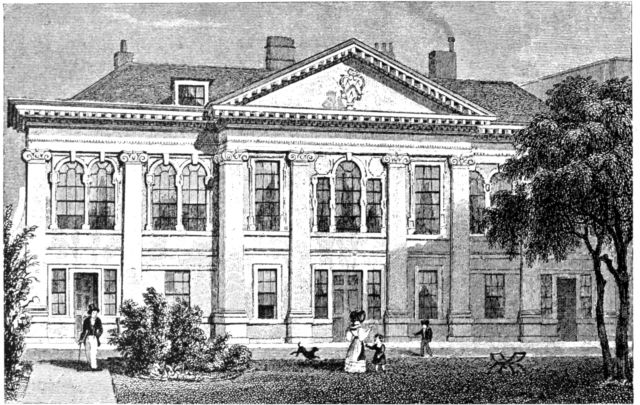
Drawn by Thos. W. Shepherd. CARPENTERS’ HALL, LONDON WALL, 1830
Charles I., by charter (dated 17th July, 16 Charles I.), reciting the preceding charters, and that various frauds and deceptions were practised in the trade, granted to the master, wardens, and commonalty of the Company, that the master, wardens, and assistants for the time being, to the number of twelve or more, of which the master and wardens for the time being to be four, being met together upon summons to be made for that purpose, should have full power and authority to appoint, constitute, and make ordinances, decrees, and constitutions in writing for the good rule and government of the master, wardens, and commonalty of the mystery, and of all other persons being free of the art or mystery, or using the same art or mystery within the City of London, or liberties of the same, and for declaring in what manner the master, wardens, and commonalty, and all such persons as aforesaid, should behave themselves, and use the occupation of the said art or mystery.
Charles II., by charter (dated 20th October, 26 Charles II.), reciting and confirming the preceding charters, granted, upon the humble petition of the master and wardens of the Company, the oversight and government of all and singular persons, whether freemen of the said mystery, or using or occupying the 145same within the City of London, or within four miles of the same, together with very extensive powers and privileges for exercising the oversight, search, and measurement of all and all manner of timber, timber stuff, and materials, and the works and workmanship thereto within the before-mentioned limits.
In 1666 an Act of Parliament was passed ordering brick building in place of wood, and all carpenters, etc., not freemen of the City employed in the building were, for the space of seven years, to be allowed the liberty of working as freemen, and all who should so help for seven years were to enjoy the same liberty for their lives. In 1693 an Act of Common Council was passed by which all persons carrying on the trade of carpentry in the City of London were compelled to bind their apprentices to the Carpenters Company.
The Company is now governed by a master, three wardens, and a varying number of assistants.
The livery numbers 150. The hall in Throgmorton Avenue was built when the old hall at London Wall was taken down in 1876. The Corporate Income of the Company is £16,000 and the Trust Income is £1180.
146