GROUP I (continued 2)
Reading edition
We may return to the Poultry by the next north and south thoroughfare, namely:
Ironmonger Lane, which is frequently mentioned in early deeds and documents. As early as the middle of the twelfth century documents are spoken of in “Ismongers’ Lane,” in the parish of St. Mary Colechurch. In 1245 there are shops, solars, and cellars in the street. Riley (Mem. 128. 15) presents two most interesting inquests connected with two murders in this street. The lane is called variously Ismongers’, Iremongers’, and Ironmongers’.
On the east side of this street, near Cheapside, was the Church of St. Martin Pomeroy.
St. Martin Pomeroy is supposed by Stow to have gained its second name from an apple garden there, but it was more probably from a family named Pomeroy. In 1629 the church was repaired, but it was burnt down in the Great Fire and not rebuilt, its parish being united to that of St. Olave, Jewry. The earliest date of an incumbent is 1361.
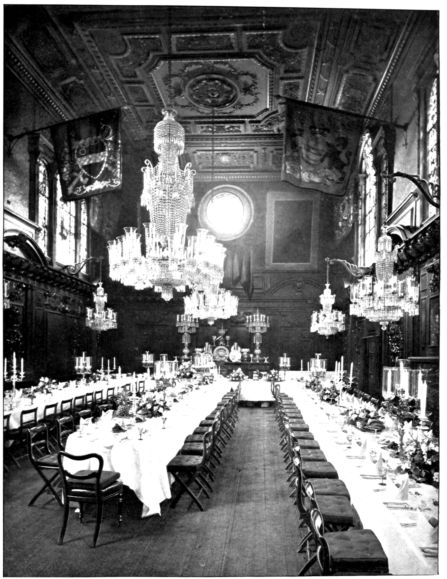
Photo. Sandell, Ltd. MERCERS’ HALL
33The patronage of the church before 1253 was in the hands of Ralph Tricket, who gave it in 1253 to the Prior and Canons of St. Bartholomew, Smithfield; after the Reformation it continued in the Crown up to 1666, when it was annexed to St. Olave.
Houseling people in 1548 were 120.
Chantries were, founded here: For Henry atte Roth, chandeler, to which Richard Scot was admitted, February 7, 1391-92; for William Love, to which Stephen Benet was collated, January 24, 1391-92. Only two monuments are recorded by Strype, neither of which commemorate persons of eminence. There was a free school, said to have been founded by Thomas à Becket, in the Old Jewry, for twenty-five scholars. There were also two almshouses for nine widows of Armourers or Braziers, the gift of Mr. Tindal, citizen and armourer of London.
John Kingscote, Bishop of Carlisle, 1462, was rector here.
In Ironmonger Lane is the Mercers’ Hall.
THE MERCERS COMPANY
The Mercers, although not incorporated until the year 1393 (17th Richard II.), were in very early times associated voluntarily for the purposes of mutual aid and comfort. They come to light as a fraternity first in the time of Henry II., for Gilbert à Becket, the father of St. Thomas of Canterbury, is said to have been a mercer; and in the year 1192, Agnes de Helles, sister of St. Thomas, and her husband, Thomas Fitztheobald de Helles, in founding the hospital of St. Thomas of Acon, which is distinctly stated to have been built on the spot where the future archbishop was born, constituted the fraternity of mercers patrons of the hospital. The hospital and the Company were intimately connected until the Reformation, and afford a good example of the connection of secular guilds and ecclesiastical foundations in the Middle Ages, secular guilds being established for the promotion of trade and almsdeeds, and ecclesiastical foundations for devotion and almsdeeds.
It is probable that a guild could not be carried on without the King’s licence at this early date; and it would seem a necessary interference that the mercers had a licence at the time of Henry II., from their not appearing among the “adulterine” guilds, or guilds set up without the King’s licence, which were fined in 1180 for being established without such licence.
The Merchant Adventurers Company gradually became detached from the Mercers Company in the course of the fifteenth century, especially by the opening of the trade with Flanders in the year 1497; and yet more so in 1564, when Queen Elizabeth, by charter, constituted the Merchant Adventurers a distinct body politic or corporation in England; but the Mercers Company still kept up an intimate connection with the “Brotherhood beyond the Sea,” the last link connecting the two companies being only severed by the Great Fire of London in 1666, which destroyed the office which the Merchant Adventurers held of the mercers under Mercers’ Hall.
It is probable, however, that trade in former times was separated into main divisions, the staple and the miscellaneous, now known as mercery. Silk, when first imported, fell in England into the latter division, hence the combined appellation “silk mercers”; but on the Continent the word was applied to the vendors of all goods carried about for sale. Cervantes, speaking of the original history in Arabic of Don Quixote, says he purchased it of a book mercer; and Guicciardini, in his description of the Netherlands, speaks of merceries as well of silk as of other materials, and in another place says that mercery comprehends all things sold by retail or by the little balance or scales. Skinner, in his Etymologicon, published in 1671, says “that a mercer was mercator peripateticus” or an itinerant merchant.
The master and wardens superintended the taking of apprentices by their members, searching the weights and measures of shopkeepers belonging to the Company, and otherwise regulating their commercial dealings. The Company appointed brokers of mercery wares, under the first charter to the City by Edward II., by which it was declared that there should be no brokers in the City but those chosen by the merchants in the mysteries in which they exercised their office, and under the charter of Edward III., which declared that none should exercise the office of broker in foreign merchandise in London unless chosen by the 34merchants of the mysteries in which they should act. The Company also appointed a common meter of linen cloth and silk, a common weigher of raw silk, and tackle porters to do their work at the waterside. The Company no longer appoint to any of these offices, because of the different methods of carrying on business which have obtained in modern times.
In the 13th year of Edward II. the Companies had advanced towards the phase of “Livery Companies.” “Moultz des gens de Mesters en Loundres furent vestus de suite.”
The Company seem to have exercised some supervision over the retailers of silk and other mercery wares previous to the reign of Queen Elizabeth; but such supervision was probably not founded on any legal basis, as a petition to the privy council at the commencement of that queen’s reign, praying that these rights should be recognised, was unsuccessful.
The numbers of the Company have been recruited by the admission of apprentices, and from the sons of mercers, who have from very early times been always entitled to the freedom; and one reason for the smallness of the Company may probably have been the old custom, established so long ago as 1347, that no strangers should be admitted to the freedom without the consent of the generality. The Company has never been very numerous. In 1347, when it was refounded, 103 persons paid their entrance fees; in 1527 the Company numbered 144; in 1707, when most numerous, 331; and on December 31, 1880, 166.
The earliest date of which there is a record in the Company’s books is the year 1347, when it was reorganised, if not refounded.
The statement that no one should take as an apprentice one who had carried packs through the country, called pedlars, seems to show that a mercer at this time had ceased to be, if he had ever been, a pedlar.
Previous to the charter granted by Richard II., the mercers did not pretend to be a corporation, but simply a member of the City. In their petition to Parliament in 10th Richard II., against Nicholas Brembre, then mayor, they call themselves “the folk of the mercerie, a member of the city.” The Company, having at this time no hall of their own, assembled either in the house of one of the wardens, or in the hall or church of the hospital of St. Thomas of Acon, the site of which is now occupied by their chapel and hall, and subsequently occasionally at the Prince’s Wardrobe in the Old Jewry. They had then no landed property, and their income was derived from subscriptions, apprentice fees, and fines, and amounted to about £20 a year.
The Company’s first charter, enrolled at the Record Office (the original of which has been lost), is dated at Westminster the 13th January, 17th Richard II. (1393).
The most important event in the early history of the Mercers Company was the appointment of the Company as trustees of the charities of Sir Richard Whittington, several times master or principal warden of the Company, and four times Lord Mayor of London. He died in the year 1422-23. It is not necessary to enumerate precisely the munificent works of charity which were carried out by Sir Richard Whittington in his lifetime, or by his executors after his death; suffice it to say that he, or they by his direction, rebuilt the parish church of St. Michael Royal, rebuilt the prison of Newgate, built or repaired the City conduits, contributed very largely to the building of St. Bartholomew’s Hospital and of the Guildhall, to the library of the Corporation of London, and the library of the Greyfriars, and established a chaplain at St. Paul’s. Whittington appointed John Coventry, John White, John Carpenter, and William Grove to be executors of his will, which was proved in March 1422-23. On the 12th November, 3rd Henry VI. (1424), his executors obtained a charter from the King to found Whittington college and almshouses. Of both these foundations the Mercers Company were made trustees.
The Company’s second charter was granted by Henry VI. at the prayer of the executors of Whittington.
On the accession of Edward IV. it became necessary for the quieting of men’s titles that the grants made by the Lancastrian kings should be confirmed, and accordingly the statute 1st Edward IV. cap. 1 was passed, by which it was enacted that all liberties and franchises granted by Henry IV., Henry V., and Henry VI., to counties or corporations, and among others to the wardens and commonalty of the Mystery 35of Mercers of the City of London, should be of the same force and virtue as if they had been granted by kings reigning de jure. The Mercers Company is the only company named in the Act, the others being included in general words.
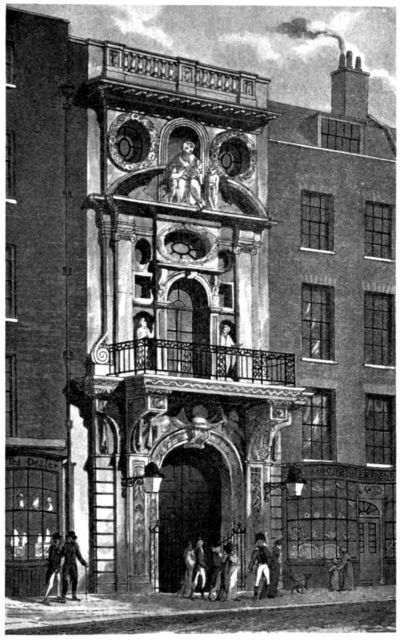
MERCERS’ HALL
1463. This year is a most important one in the Company’s annals, as in it the court of assistants was first established. The business of the Company having very much increased, both on account of their connection with the Merchant Adventurers Company and also from the management of the trusts of Whittington, Abbot, and Estfield, it was felt that the whole burden of the Company’s affairs should not be cast upon the wardens, and that it was not desirable that the generality should be constantly called together. For many years previous to this date it had been the practice that the wardens, and the aldermen free of the Company, and their peers, should hold assemblies for the devising of ordinances or other matters, their deliberations being afterwards submitted to a general court for approval. On the 23rd of July 1463, at a general court of the Company, the following resolution was passed: “It is accorded 36that for the holding of many courts and congregations of the fellowship it is tedious and grievous to the body of the fellowship, and specially for matters of no great effect, that hereafter yearly shall be chosen and associate to the custoses for the time being, 12 other sufficient persons to be assistants to the said custoses, and all matters by them, or most part of them, finished, to be holden firm and stable, and the fellowship to abide by them.”
The rest of the history of the Mercers Company is mainly occupied by a recital of charities which were placed in their hands to administer. It is sufficient to call attention to the many and splendid endowments which have been placed in the hands of the Company.
The general court appoint three trustees of the Prisons’ Charities Trust, decide when the corporate seal shall be affixed, and determine the amount of fees which shall be paid for attendance at general courts, courts of assistants, and committees. The fee paid to a member for his attendance at general courts and courts of assistants is £4 : 4s., and to a member attending a committee, £2 : 2s.
(1) A freeman is entitled from Lady Campden’s legacy for loans, and from the money legacies for loans, to have the loan of not more than £500 without interest for not more than five years, giving approved security.
He is entitled, if his circumstances warrant it, and within the limits of the Company’s nominations, to have his sons placed in Christ’s Hospital under Daniel Westall’s gift, and clothed, boarded, and educated there from eight years old to fifteen, and perhaps to nineteen; and his daughters educated out of the Company’s funds at an expense not exceeding £50 per annum, from nine years of age to fifteen, and if they show reasonable proficiency and ability to seventeen, under regulations approved by the general court.
He is also entitled in case of old age, misfortune, or infirmity to receive relief proportioned to his circumstances out of the Company’s or out of Sir Richard Whittington’s estate, which was left to the Company specially for that purpose; and his widow and daughters are entitled to relief under similar circumstances.
(2) Liveryman.—A liveryman is entitled to the same advantages as a freeman, and in addition is invited to three dinners in the course of the year. He has the right to attend common hall, and to vote at elections of lord mayors and sheriffs and of such other officers of the Corporation of London as are elected by the livery; and if resident within a radius of twenty-five miles from the City, to vote at elections of members of Parliament for the City of London.
He is eligible, and if of sufficient position and standing he is generally called in rotation by the court of assistants, to be a member of their body.
(3) Master, Warden, or otherwise a member of the governing body.—A member of the court of assistants is summoned to general courts as well as to meetings of the court of assistants (which are held weekly, except during Christmas and Easter weeks and six weeks in August and September). He is also eligible to be placed on committees appointed by the court and on the Gresham committee.
He is invited to dine at all dinners in the Company’s hall.
He recommends in rotation to appointments to Mercers’ School, and to out-pensions on the Whittington estate, and to the Whittington almshouses.
The court of assistants appoint nine governors of St. Paul’s School under the provisions of the scheme, and also governors and members of the council and of the executive committee of the City and Guilds of London Institute for the Advancement of Technical Education.
The master and wardens are members of every committee appointed by the Company. They distribute Alderman Walthall’s and Lady Hungerford’s gifts, appoint preachers in Mercers’ Chapel under various gifts, and are ex officio governors of St. Paul’s School.
They also receive under various wills of benefactors to the Company certain small annuities, and are entitled to the surplus of Blundell’s estate, which surplus amounted in 1880 to £205 : 9 : 9.
A member of the Company will probably come on to the court of assistants when he is about forty-five years of age, and he remains a member for life.
The Company does not carry on any trade or occupation whatever.
37The Mercers’ Hall is interesting as standing on the site of the ancient House of St. Thomas Acon. On the dissolution the Mercers purchased the buildings of the House.
The Mercers had occupied a house adjoining for more than a hundred years before this acquisition. The Religious House itself was undoubtedly on the site of the house where Thomas was born. The buildings were destroyed in the Great Fire. The second hall was built on the same site with another chapel in which service is held every Sunday evening. Fragments of the ancient buildings can still be seen. The present hall is said to have been designed by Wren. The entrance in Cheapside was built in 1879.
Among the more distinguished members of this great Company have been Whittington, Caxton, and Sir Thomas Gresham, Sir Henry Colet, Sir Baptist Hicks. The present number of the livery is returned in Whitaker as 187; the Corporate Income as £48,000; the Trust Income as £35,000.
For an account of the Hospital of St. Thomas of Acon, which at first extended from Ironmonger Lane to Old Jewry, see Mediæval London, vol. ii. p. 262.
King Street was constructed after the Fire, in order to give a nobler approach to the Guildhall. Pepys refers to the ground having been already bought in December 1667. Strype says that “it is well inhabited by Norwich Factors and other wholesale dealers of wealth and reputation.” He calls it New King Street.
Trump Street or Trump Alley is not named in Agas, Stow, or Ogilvy; Strype calls it Duke Street.
The mention of John Carsyl, Tromppour, Trumper or Trumpet-maker (1308), also of William Trompeor (1321) and William le Trompour, gives Riley occasion for the following notes:
“The persons who followed this trade mostly lived, in all probability, in Trump Street, formerly Trump Alley (a much longer street then than it is now), near the Guildhall; their principal customers not improbably being the City waits, or watchmen; each of whom was provided with a trumpet, also known as a “wait,” for sounding the hours of the watch, and giving the alarm. In reference to this trade it deserves the remark, that the only memorial that has come down to us of the Chapel of St. Mary the Virgin, and of St. Mary Magdalen and all Saints, formerly adjoining the Guildhall, is a massive stone coffin (now in the Library at Guildhall) with its lid, whereon is sculptured a cross between two trumpets, and around its margin the following inscription: Godefrey le Trompour: gist: ci: Deu: del: ealme: eit: merci. ‘Godefrey the Trompour lies here, God on the soul have mercy.’ In Trump Alley, close adjoining, he probably lived, sold trumpets, and died—if we may judge from the character of the writing, in the latter half of the fourteenth century” (Riley’s Memorials, p. xxi).
St. Lawrence Lane.—“Antiquities in this lane I find none other, than that among many fair houses, there is one large inn for receipt of Travellers called Blossoms inn, but corruptly Bosoms inn, and hath to sign St. Laurence the Deacon, in a border of blossoms or flowers” (Stow’s Survey).
Cunningham adds as follows:
“When Charles V. came over to this country in 1522, certain houses and inns 38were set apart for the reception of his retinue, and in St. Lawrence Lane, at ‘the signe of Saint Lawrence, otherwise called Bosoms yn, xx beddes and a stable for lx horses’ were directed to be got ready. The curious old tract about Bankes and his bay horse (Maroccus Extaticus) is said to be by ‘John Dando, the wier-drawer of Hadley, and Harrie Runt, head ostler of Besomes Inne.’”
The inn was also called “Bossamez” Inn and Boscham’s Inn.
Honey Lane Market was established soon after the Fire. Strype thus speaks of it (vol. i. p. 566):
“Adjoining to this street, on the north side, is Honey Lane, being now, as it were, an alley with a Freestone pavement, serving as a passage to Honey Lane Market; the former Lane, and other buildings, being since the fire of London converted into this market. Among which buildings, was the Parish Church of St. Allhallow’s, Honey Lane; and, because it was thought fit not to rebuild it, the parish is united to St. Mary-le-Bow. This Market is well served, every Week, on Mondays, Wednesdays, Fridays and Saturdays, with Provisions. The Place taken up by this Market is spacious. In the middle is a large and square Market-house, standing on pillars, with rooms over it, and a bell-tower in the midst. There are in the market one hundred and thirty-five standing stalls for butchers, with racks, blocks, and others necessaries, all covered over, to shelter them from the injury of the weather; and also several stalls for fruiterers. The west end of the market lieth open to Milk Street, where there is a cock of conduit water for the use of the market. There are two other passages into it, that is, one out of St. Lawrence’s Lane, besides that which comes out of Cheapside; which passages are inhabited by grocers, Fishmongers, Poulterers, Victuallers, and Cheesemongers.”
Complaints are found in the wardmote book of people making fires in the market; of butchers killing sheep and lambs there; and of the annoyance caused by the farmers letting soil and refuse lie about the place. Honey Lane, which led to it, is said by Stow to be so called, being a dark and narrow place, on account of the constant washing required to keep it clean—a far-fetched derivation. The name is indeed very ancient. In a grant, dated 1203-15, made by the Dean and Chapter of St. Paul’s to one Richard de Corilis mention is made of “Huni” Lane, and in another grant of the same period the house in question, “a stone built house,” is mentioned in between Milk Street and “Huni” Lane. There was one Elias de Honey Lane in 1274.
The market was closed in 1835 and the City of London School built on its site. The school has now been removed to the Embankment and the place is let out in offices.
The Church of Allhallows, Honey Lane, stood on the north side of Cheapside in Honey Lane. It was burnt down in the Great Fire and the parish was then annexed to St. Mary-le-Bow. Honey Lane Market was on the site of the church. The earliest date of an incumbent is 1327.
39The patronage was in the hands of: Simon de Creppyng, citizen, who presented in 1327; several private persons, among whom was Thomas Knoles, Mayor of London, 1399; the Grocers Company, 1471-1666, when it was annexed to St. Mary-le-Bow.
Houseling people in 1548 were 150.
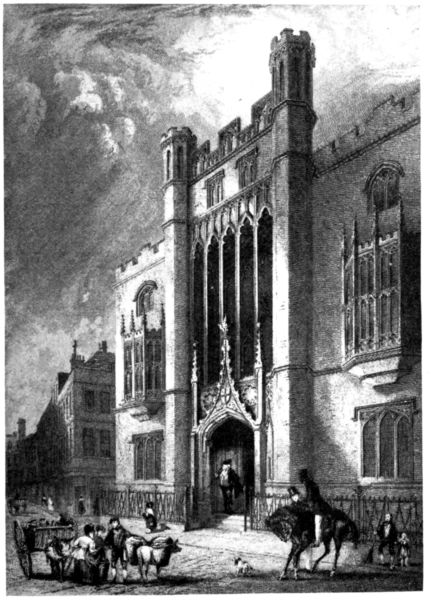
CITY OF LONDON SCHOOL, MILK STREET
Chantries were founded here for John Fourneys, citizen, and Katherine his wife, at the Altar of Blessed Virgin Mary, August 22, 1396 (Pat. 20 Rd. II. p. i. m. 21), and by Alexander Speat, Thomas Trompington, John Downe, and Henry Edelmeton. Sir John Norman, Mayor of London, 1453, was buried in this church. No bequests or charitable gifts are recorded in Parish Clerk’s Summary of 1732.
Among the notable rectors were Thomas Garrard, who was burnt at Smithfield, and John Young, Bishop of Gallipoli.
Milk Street is one of the streets of Cheapside which peculiarly recalls the site of the old market by its name. There is not much recorded of this street. 40Sir Thomas More was born here, “the brightest star,” says Fuller, “that ever shone in that via Lactea.” In the Calendar of Wills the street is repeatedly mentioned as containing shops. The earliest date on which it occurs is 1278. In Riley’s Memorials we find a cook living here in 1351; in 1377 the sheriff has “his own Compter” in this street; in 1390 one Salamon Salaman, a mercer of Milk Street, gets into trouble for having putrid fish in his possession; and in 1391 one William of Milk Street, no name or trade given, is falsely imprisoned by means of a conspiracy.
Milk Street in the thirteenth century was the residence of certain Jews. Thus in 1247 Peter the Jew had a house there; and in 1250 leave was granted to John Brewer to build a chapel in his house, formerly that of Benedict the Jew; and in 1285 Cresse the Jew had a house there. In 1294 Martin the Arbalestin lived in Milk Street; and in 1285 the mayor had his residence there, his house being rented of the Prior of Lewes.
The Church of St. Mary Magdalene, Milk Street, formerly stood on the east side, towards the south end of Milk Street, Cheapside. It was burnt down in the Great Fire and not rebuilt, its parish being annexed to that of St. Lawrence, Jewry. The earliest date of an incumbent is 1162.
The patronage of the church was in the hands of the Dean and Chapter of St. Paul’s continuously from 1162, until it was burnt down, when the parish was annexed; the Dean and Chapter now share the alternate patronage of the amalgamated parish (see Hist. MSS. Rept. ix. p. 18bc 19a as to a lawsuit concerning the patronage).
Houseling people in 1548 were 220.
Chantries were founded here by: Robert de Kelsey, about 1334, for himself, Julian his wife, Hen. de Galeys, and Sara de Eldham, to which Hen. de Kelsey was admitted chaplain, September 5, 1336; the above Robert de Kelsey endowed it with the “Caufare” in Westcheap, which fetched £3 : 14 : 8 in 1548; John Offam, whose endowment fetched £14 : 9 : 6 in 1548, when William Baker was priest; Thomas Kelsey, whose endowment fetched £12 : 13 : 4 in 1548.
A great number of the monuments in this church had been defaced by Stow’s time. He records the interment of Thomas Knesworth, mayor in 1505; Sir John Langley, mayor in 1576. No names of benefactors are recorded by him.
Lawrence Bothe, Bishop of Durham 1457, of York 1476, was rector here; also John Bullingham (d. 1598), Bishop of Gloucester.
Wood Street or Lane is the next important thoroughfare westward. It is supposed by Stow to have been so called because it was built wholly of wood; but Stow suggests also an alternative derivation, that it may have been named after one Thomas Wood, sheriff in 1491. The latter suggestion must be ruled out, because in 1394 a testator bequeathed his “mansion” in Wood Street. It is worthy of note that the first mention of the street is of houses, rents, and tenements, and so it continues until the end of the thirteenth century, when we begin to hear of shops; in 1349 a brewery is spoken of—the water, as in the case of Mugwell Street, must have been furnished by one of the numerous City wells. There were many inns in Wood Street: the Bell, the Coach and Horses, the Castle, and the Cross Keys. The Castle is still commemorated in a stone slab.
41The Church of St. Michael, Wood Street, was sometimes called St. Michael Hogge or Huggen from one of that name who lived in the lane which runs down by the church. It was destroyed by the Great Fire (with the exception of the steeple) and rebuilt by Wren, who completed it in 1675, when the parish of St. Mary Staining was annexed. It was repaired in 1888, and taken down at the end of the nineteenth century. The earliest date of an incumbent is 1150.
The patronage of the church was in the hands of: The Abbot of St. Albans before 1150; Henry VIII., who seized it in 1540 and sold it in 1543 to William Burwell; John Marsh and others in trust for the parish—it so continued up to 1666, when St. Mary Staining was annexed and the patronage was alternately in the Crown and parishioners.
Houseling people in 1548 were 317.
The latest church was very plain and measured 63 feet in length, 42 feet in breadth, and 31 feet in height. The east front had four Ionic pilasters supporting a pediment, and in the spaces between the columns there were three circular-headed windows. The tower, which was connected with the church by a porch, contained three stories, terminated by a parapet which was surmounted by a narrow spire with a vane; the total height was 130 feet.
Richard de Basingstoke founded a chantry here before 1359, probably at the Altar of St. John Baptist. Amongst those buried in the old church was Alderman John Lambarde, sheriff, 1551, who was father to Stow’s great friend William Lambard, the antiquary; he died in 1554. The church contained a monument to Queen Elizabeth.
The legacies of charity left to the parish were: 8s. per annum, of which Lady Read was donor; 5s. per annum, of which Mr. Hill was donor; £2 for 20 years, of which Mr. Longworth Cross was donor; £1 per annum, of which Mr. Bowman was donor. There were also ground-rents amounting to £36 : 4s. leased for 61 years.
Anthony Ellis or Ellys (1690-1761), Bishop of St. David’s, was a rector here; also Thomas Birch (1705-66), Secretary to the Royal Society, 1752-65.
The modern Wood Street, for a considerable distance after Gresham Street, is one series of immensely high warehouses, on which the vertical lines of bricks between the plate-glass windows are the most prominent feature. The effect of these lines is rather neat and workmanlike; horizontally beneath the windows are carved stone designs of flowers and fruit in very heavy relief. On the other side of the street are the entries into Pickford’s Yard under an old eighteenth-century house of the plainer sort.
The Church of St. Alban, Wood Street, is too far north to fall within our present section; but as it belongs to this street it must find a place here.
ST. ALBAN, WOOD STREET
The Church of St. Alban, the only one remaining in this street, is on the west side, in the Cripplegate Ward. In 1632 it was pulled down, but was rebuilt in 1634, probably by Inigo Jones, but was destroyed by the Great Fire, and the present building is the work of Wren, who completed it in 1685. The earliest date of an incumbent is 1244.
The patronage of the church, as far as can be traced, was in the hands of: St. Alban’s Abbey, who exchanged it in 1077 to Westminster Abbey; St. James’ Hospital, Westminster, presented before 1244; Provost and Fellows of Eton, 1477, with whom it remained up to 1666, when the parish of St. Olave, Silver Street, was annexed and the patronage shared alternately with the Dean and Chapter of St. Paul’s.
Houseling people in 1548 were 300.
42The church is in a quasi-Gothic style and somewhat after the model of the church destroyed by the Fire. It measured 33 feet in height, 66 feet in length, and 59 feet in breadth, and has two side aisles divided from the central portion by clustered columns and flat pointed arches. The church terminates at the east in an apse, containing three stained-glass windows. It has been greatly altered and modernised, the most striking alteration being the formation of the apse and the substitution of three smaller windows for the original large east window. The tower attains a height of 85 feet and terminates in an open parapet; it is surmounted by eight pinnacles of 7 feet each, giving a total altitude of 92 feet. On the north side there is a small churchyard, separating the church from Little Love Lane.
There was a chantry founded here by Roger Poynel before 1366. The church formerly contained monuments to Sir John Cheke (1514-57), tutor of Edward VI. and others.
The donors of charitable gifts were: William Peel, of St. Mary Savoy, who bequeathed an annuity of £10 in 1623 for the use of the poor; Gilbert Keat; Susan Ibel, £40 for providing coals for the poor; Richard Wynne, £20 to be distributed among eight poor people, at 2s. 6d. apiece; Thomas Savage, citizen and goldsmith, donor of premises in Holborn Bridge; Mr. Londson, £1 : 6s. per annum for bread for the poor, through the Company of Embroiderers.
There was a charity school for fifty boys and twenty-five girls, supported by voluntary contributions from the Church of St. Alban and others, from which the boys were apprenticed and the girls placed out to service. The parish had in 1732 a workhouse hired in the parish of St. Giles, Cripplegate.
The following are some of the notable vicars of the church: William Watts (d. 1649), chaplain to Charles I.; John Adams (1662-1720), chaplain to William III. and Queen Anne.
Foster Lane was originally St. Vedast’s. It is mentioned in a document of 1281 as St. Fauster’s, which was actually a corruption of St. Vedast’s. It was, before the Fire, a neighbourhood much frequented by goldsmiths and jewellers; William Fleetwood, Recorder of London in 1571, dated some of his letters to Lord Burleigh from Foster Lane.
St. Vedast’s Church, commonly known as St. Fauster’s or Foster’s. It was severely damaged by the Fire, and rebuilt by Wren; the steeple was erected in 1697, the old one having been retained until then. The parish was united after the Fire with St. Michael-le-Querne, and St. Matthew, Friday Street, to which St. Peter, Westcheap, had been annexed. The earliest date of an incumbent is 1291.
The patronage of the church was in the hands of: The Prior and Convent of Christ Church, Canterbury; the Archbishop of Canterbury before 1396, in whose successors it continued up to 1666, when the parish of St. Michael-le-Querne was annexed and the patronage was alternately shared with the Dean and Chapter of St. Paul’s up to 1882, when St. Matthew, Friday Street, with St. Peter, Westcheap, were annexed; the patronage is now in the hands of the Bishop of London for two turns, the Duke of Buccleugh for one turn.
Houseling people in 1548 were 460.
The church measures 69 feet in length, 51 feet in breadth, and 36 feet in height, and consists of a nave and south aisle separated by arches supported on four Tuscan columns. The steeple, which rises at the south-west, consists of a tower, surmounted by three stages, the lowest of which is concave, the second convex, and the third an obelisk-shaped spire; the total height is about 160 feet.
Chantries were founded here: By Galfridus atte gate for himself and his wives Joan and Alice, about 1447, when Edmund Brennyng was admitted chaplain—the lands fetched £8 : 6 : 8, which was augmented by Christopher Tury and yielded in all £14 : 10s. in 1548, when John Markehame was priest, “of the age of 59 years, of mean qualities and learning”; by William de Wyndesore for himself and Tolonia his wife; by John de Wyndesore, brother of the above William; by Mr. Cote in 1530, who gave £160 to purchase lands for the endowing of it, which were not purchased, but one Mr. Hayton, in 1548, finds a priest; by William Tryston, who endowed it £6 : 14 : 4, which was augmented by Simon Atwoll to 43£18 : 5 : 2 in 1548, when Albert Copeman was priest, “of the age of 39 years, of mean qualities and mean learning.”
John Longson, Master of the Mint, was buried in this church in 1583. Among the later interments Stow records those of: William Fuller, D.D., Dean of Durham, who suffered imprisonment for his loyalty in the times of the rebellion; Sir John Johnson, Alderman of the City, who died in 1698; and William Hall, deputy of this ward, who died in 1680; Robert Herrick was baptized here in 1591. No legacies or gifts are recorded by Stow.
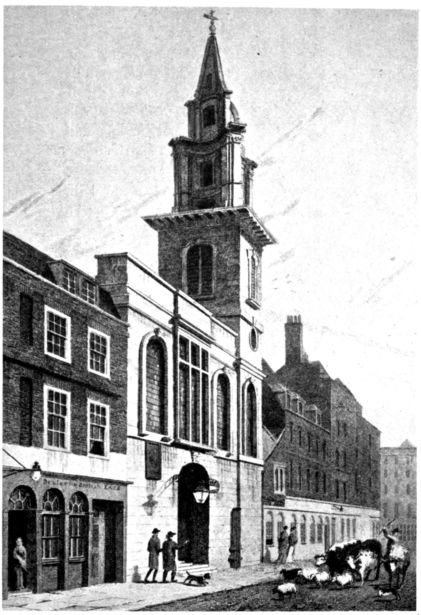
Drawn by G. Shepherd. CHURCH OF ST. VEDAST
Thomas Rotherham (1423-1500), afterwards Archbishop of York, was rector here; also Isaac Maddox (1697-1759), Bishop of St. Asaph and of Worcester; Adam Moleynes (or Molyneux, d. 1450), LL.D., Bishop of Chichester, who was slain by the marines at Portsmouth, incited by Richard, Duke of York; Thomas Blage (d. 1611), Dean of Rochester; Nathaniel Marshall (d. 1730), Canon of Windsor.
In Gresham Street, between Foster Lane and Gutter Lane corners, is the Goldsmiths’ Hall.
44
THE GOLDSMITHS COMPANY
The Goldsmiths Company is mentioned in the year 1180, when it appears to have been a voluntary association. It doubtless had its origin in a combination of goldsmiths, for their mutual protection, and to guard the trade against fraudulent workers. In the year 1300 the existence of the Company is recognised by a statute, viz., the 28th Edward I., cap. 80, which provides for the standards of gold and silver, and enacts that all articles of those metals shall be assayed by the wardens of the craft, to whom certain powers of search are also given.
The first of the Company’s charters was granted to them by Edward III., in the first year of his reign (1327).
It states that it had been theretofore ordained that all those who were of the goldsmiths’ trade should sit in their shops in the High Street of Cheap (Cheapside), and that no silver or plate, nor vessel of gold or silver, ought to be sold in the City of London, except at the King’s Exchange, or in the said street of Cheap amongst the goldsmiths, and that publicly, to the end the persons of the said trade might inform themselves whether the sellers came lawfully by such vessel or not; that no gold or silver shall be manufactured to be sent abroad but what shall be sold at the King’s Exchange, or openly amongst the goldsmiths, and that none pretending to be goldsmiths shall keep any shops but in Cheap.
By two subsequent charters Edward III. confirmed and extended the privileges before granted, and he gave the Company licence to purchase and hold tenements and rents to the value of £20 per annum, for the relief of infirm members.
Richard II., by letters patent of the sixteenth of his reign, after reciting that Edward III. had allowed the Company of the said craft to accept charitable donations, and to purchase estates as aforesaid, and that they might retain a chaplain to celebrate Mass amongst them every day, confirmed the liberties granted by Edward III. and granted and licensed the men of the craft that thenceforth they may be a perpetual community or society amongst themselves.
Henry IV., by letters patent of his fifth year, recited and confirmed the preceding charters of Edward III. and Richard II.
Henry VI., by letters patent of his first year, also recited and confirmed the charter of Henry IV.
Edward IV., by letters patent of his second year, recited and confirmed the charters of his predecessors.
Moreover, he granted that the said then wardens and their successors may be a corporation or body corporate to consist of and be called the Wardens and Commonalty of the Mystery of Goldsmiths of the City of London. That they may be capable in law to purchase, take, and hold in fee and perpetuity lands, tenements, rents, and other possessions whatsoever of any persons whomsoever that shall be willing to give, devise, and assign the same to them. That they may have perpetual succession and a common seal.
Henry VII., by letters patent of the twentieth year of his reign, confirmed the whole of the preceding charters, and on account of the Company being opposed in their trade search and assay, granted by Edward IV., gave them the additional power to imprison or fine defaulters in the trade at their discretion; to seize and break unlawful work; to compel the trade, within three miles of the City, to bring their work to the Company’s common hall, to be assayed and stamped; and gave them power for ever, when it was not standard, to utterly condemn the same, without rendering account to the Crown.
The whole of the liberties and franchises granted to the Company by the preceding charters are set forth and confirmed by inspeximus charters of 1st of Henry VIII., 1st of Edward VI., 1st of Mary, 3rd of Elizabeth, 2nd of James I., and 18th of Charles II.
The Company also received a charter from James II. dated 4th of May in the first year of his reign, whereby, amongst other things, that monarch reserved to the Crown a right of control over the appointment of the wardens and clerk. The statute was made void by the Act of Parliament 2nd William and Mary, cap. 8.
45The Company have also a copy of that part of the following patent which relates to their property, viz. 4th of Edward VI. The King to Augustine Hynde, and others.
The Company have also an exemplification under the great seal of letters patent granted to them by James I., in the seventeenth year of his reign (July 24, 1619), confirming to them the possession of a large quantity of property in the City of London.
The powers of the Company are exercised at the present time chiefly under the Acts of 12th George II., cap. 26, and 7th and 8th Victoria, cap. 22.
As before stated, it appears that the Company was at first a voluntary association, and had for its chief objects the protection of the mystery or craft of goldsmiths; but it was evidently also formed for religious and social purposes, and for the relief of the poor members.
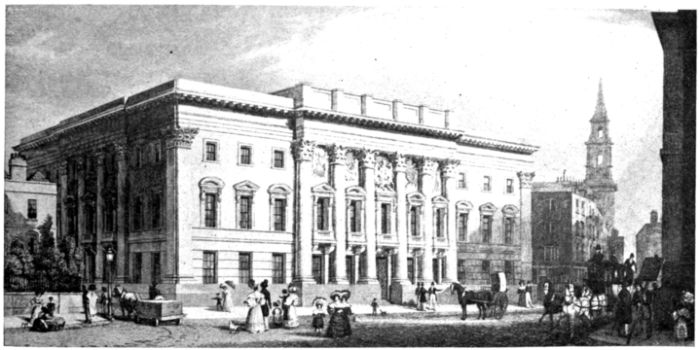
From a drawing by Thos. H. Shepherd. GOLDSMITHS’ HALL, 1835
The powers exercised by this voluntary association over the craft were subsequently confirmed to them by their charters. The wardens fined workmen for making wares worse than standard, entered their shops and searched for and seized false wares, settled disputes between masters and apprentices, and frequently punished rebellious apprentices by flogging, levied heavy fines upon members for slander and disobedience of the wardens, and for reviling members of the livery; and generally exercised a very powerful and absolute control, not only over the members of the fellowship, but also over all other persons exercising the goldsmiths’ trade.
For the purpose of the assay they had an assay office in the early part of the fourteenth century. The statute of 28th Edward I. enacts that no vessel of gold or silver shall depart out of the hands of the workman until it is assayed by the wardens of the craft, and stamped with the leopard’s head; the leopard being at that time part of the royal arms of England.
The Company and its members, even at this early period, appear to have acted as bankers and pawnbrokers. They received pledges, not only of plate, but of other articles, such as cloth of gold and pieces of napery.
The London goldsmiths were divided into two classes, natives and foreigners. They inhabited chiefly Cheapside, Old Change, Lombard Street, Foster Lane, St. Martin’s-le-Grand, Silver Street, Goldsmiths’ Street, Wood Street, and the lanes about Goldsmiths’ Hall. Cheapside was their principal place of residence; the part of it on the south side, extending from Bread Street to the Cross, was called “the Goldsmiths’ Row.” The shops here were occupied by goldsmiths, and here the Company possess 46many houses at the present time. The Exchange for the King’s coin was close by, in what is now called Old Change.
The native and foreign goldsmiths appear to have been divided into classes, and to have enjoyed different privileges. First, there were the members of the Company, who were chiefly, but not exclusively, Englishmen; their shops were subject to the control of the Company; they had the advantages conferred by the Company on its members, and they made certain payments for the support of the fellowship. The second division comprised the non-freemen, who were called “Allowes,” that is to say, allowed or licensed. There were the “Allowes Englis,” “Allowes Alicant,” “Alicant Strangers,” “Dutchmen,” “Men of the Fraternity of St. Loys,” etc. All these paid tribute to the Company, and were also subject to their control. The quarterage paid by the members, and the tribute so paid by the “Allowes,” constituted the Company’s original income. We find frequent mention of efforts made by the English goldsmiths to prevent foreign goldsmiths from settling in London, but they did not succeed. The wise men of the craft probably knew that the best artists were foreigners, and were willing to profit by observation of their works and mode of working. In 1445, thirty-four persons, who were strangers, were sworn, and paid 2s. a head. In 1447 Carlos Spaen paid £8 : 6 : 8 to the alms of St. Dunstan, to be admitted a freeman, and in 1511 John de Loren paid £20 for the same object.
The wardens also frequently obliged foreigners applying for the freedom to produce testimonials from the authorities of the towns abroad where they had resided.
The government of the trade under the Company’s charters continued up to the reign of Charles the Second. But some time before this period, and in the interval between it and the passing of the Act of the 12th George II., cap. 26, the powers which had been granted to the Company began to be questioned, and the Company experienced difficulty in putting them into force. In 1738 the Company considered it expedient to obtain an Act of Parliament.
And the 12th George II., cap. 26, passed in 1739, was prepared by the officers of the Company, brought into Parliament by them, with the assent of the government of the time, and all the cost of soliciting it and getting it passed was paid for by the Company, although it is a public Act.
Under this Act the Assay Office is regulated. The Company are empowered thereby to make charges for the assaying and marking plate sufficient only to defray the expenses of the office, and are prohibited from making any profit thereby or deriving any pecuniary advantage therefrom.
It may here be mentioned that at a very early period we find members of the governing body of the Company, both wardens and assistants, who were not of the craft. Amongst others, the leading bankers, themselves the descendants in trade of the old goldsmiths, from the time of the Stuarts to the present time, have been some of the most conspicuous members of the body. Amongst them we find the names of Sir Martin Bowes, who was Master of the Mint in the reign of Elizabeth; Sir Hugh Myddelton, the enterprising founder of the New River; Sir Francis Child, of Temple Bar; Sir Charles Duncombe, Sir James Pemberton, Sir Robert Vyner; and in the 19th century, Robert Williams and Thomas Halifax, Henry Sykes Thornton, William Banbury, John Charles Salt, Herbert Barnard, William Newmarch, William Cunliffe Brooks, Robert Ruthven Pym, Arthur B. Twining, Charles Hoare, and Robert Williams, jun.
It remains to mention the connection of the Company with the coinage of the realm in what is called the trial of the Pyx, an office which has been performed by the Company ever since the reign of Edward I. Its object is to ascertain that the metal of which the gold and silver money coined by the Mint is composed is standard, and that the coins themselves are of the prescribed weight.
This duty was performed in ancient times at uncertain intervals, and usually had for its immediate object the giving an acquittance to the Mint Master, who was bound to the Crown by indentures to coin money of the prescribed fineness and weight. But the Coinage Act of 1870 provides for and establishes an annual trial, and since that date the Pyx has been brought to Goldsmiths’ Hall and tried annually.
In 1900, for the first time, at the request of H.M.’s Treasury, a Pyx from each of the Colonial Mints coining Imperial Coinage was tried.
47Formerly a jury of competent freemen, summoned by the wardens, was charged by the Lord Chancellor, who subsequently received their verdict.
The jury is sworn by the Crown Remembrancer, who, the trial having been made and the verdict of the jury reduced to writing, attends at the Hall and receives them; after which their names are published in the Gazette.
The number of the livery is 150. The Hall is in Foster Lane.
Privileges of membership:
A freeman of the Company has no advantages as such, except that if he be a deserving man and in need of pecuniary assistance he is eligible to receive, and would certainly receive, aid from the Company, either by pension or donation.
When the Guild first had a Hall we know not, but the Hall has stood on its present site for upwards of 550 years.
About 1340, land and a house at St. Vedast Lane and Ing Lane[2] corner, formerly belonging to Sir Nicholas de Segrave, was bought. This land still underlies part of the present Hall, and was in the midst of the gold- and silver-smiths’ quarter. In 1407, Sir Dru Barentine built the Goldsmiths a second Hall, wherefrom a gallery led to his house. Within the great hall were arras hangings, streamers, banners, tapestried benches, worked cushions, and a screen bearing their patron’s (St. Dunstan’s) silver-gilt statue bejewelled. There were chambers, parlour, ‘say-house, chapel with coloured hangings, great kitchen, vaults, granary, armoury, clerk’s house, beadle’s house, assayer’s house. This Hall decayed. Borrowing money, they built a third and larger, 1635-40, Stone being surveyor.
After the Great Fire they repaired and partly rebuilt their Hall, 1666-69, raising money slowly. Jarman was architect. The buildings, brick and stone, surrounded a paved quadrangle entered through the Doric archway in Foster Lane.
The great hall was “magnificent” with marbled floor, moulded ceiling, pillared screen, high wainscot, painted banners, costly plate. Within 140 years they found this Hall decaying. They pulled it down and built the present (fourth) Hall in 1830-35, Philip Hardwick being architect.
Like the Drapers, the Goldsmiths Company has taken up the cause of Technical Higher Education.
On the west side of Foster Lane stood also St. Leonard’s Church, which was the parish church for St. Martin’s-le-Grand. It was burnt down in the Great Fire and its parish annexed to that of Christ Church, Newgate Street. The earliest date of an incumbent is 1291.
The patronage of the church was in the hands of: the Dean and Canons of St. Martin’s-le-Grand, 1291; the Abbot and Convent of Westminster, 1509; Henry VIII., who seized it in 1540; the Dean and Chapter of Westminster, 1553-54, in whose successors it continues, they being the alternate patrons of Christ Church, Newgate Street.
Houseling people in 1548 were 452.
A chantry was founded here by and for William de Wyndesore, at the Altar of Virgin Mary, before 1368, when his endowment fetched £3 : 13 : 4. There are few charities recorded by Stow.
The church of St. Mary Staining was situated on the north side of Oat Lane, Foster Lane, and derived its name Staining from Painter Stainers dwelling there; or, according to some from stein, the Saxon for stone, other churches being built of wood. It was repaired and redecorated in 1630, and was burnt down in the Great Fire, but not rebuilt, its parish being annexed to that of St. Michael, Wood Street; the site of this church was made a burying-ground. The earliest date of an incumbent is 1270.
The patronage of the church was in the hands of: The Prioress and Convent of St. Mary, Clerkenwell; Henry VIII., and so continued in the Crown till the Great Fire, when the parish was annexed to St. Michael, Wood Street.
Houseling people in 1548 were 98.
48Two monuments only are recorded by Stow, one in memory of George Smithes, goldsmith and alderman, who died in 1615, and the other of Sir Arthur Savage, knighted at Cadiz in 1596, who was General of Queen Elizabeth’s forces in France at the siege of Amiens; he died in 1632.
The parish received three legacies, payable yearly, namely: 15s. 6d. from Lady Read and Mr. Hill; £1 : 4s. from Mr. Lawne; and 1s. 6d. from Mr. Dean.
What Gresham Street is on the north of our present section, so Watling Street is on the south. It runs roughly parallel with Cheapside and Poultry. Stow says of it:
“Then for Watheling Street, which Leland called Atheling, or Noble Street; but since he showeth no reason why, I rather take it to be so named of that great highway of the same calling. True it is that at the present the inhabitants thereof are wealthy drapers, retaillers of woollen cloths, both broad and narrow, of all sorts, more than in any one street of this city.”
How came Watling Street, the old country road, into the City? The old Roman road, as it approached the Thames, passed down the Edgware Road. Where is now the Marble Arch it divided into two, of which the older part crossed the marsh, and so over Thorney Island? The other ran along what is now Oxford Street and Holborn.
It then crossed the valley of the Fleet and entered the City at the New Gate. If now we draw a line from Newgate to London Stone, just south of its present position, we shall find that it passes the north-east course of St. Paul’s precinct, cutting it off, so to speak, and meets the present Watling Street where it bends to the south of Bow Lane; it then follows the old Budge Row as far as the Stone. That was the original Watling Lane of the City. The Saxons, however, who found the streets a mass of confused ruins, built over part of the old Watling, and continued it as far as the south-east course of St. Paul’s. The street has few antiquities apart from its churches.
There is no mention of Watling Street in Riley’s Memorials.
In the Calendar of Wills we find shops in this street in 1307, a brewery in 1341, a widow’s mansion in 1349, and shops in 1361, “lands, tenements, and rents” in 1373, a house called “le Strelpas” in 1397. The other references to Watling Street are those of “tenements” only.
The yearly procession of the City rectors with the mayor and aldermen started from St. Peter’s, Cornhill, marched along Chepe as far as St. Paul’s Churchyard, turning to the south and so to “Watling Street Close,” which was the eastern entrance to the churchyard.
After the Fire, while the rubbish was being cleared away, on the east of the street were discovered nine wells in a row. They were supposed to have belonged to a street of houses from Watling Street to Cheapside. But one hardly expects to find a well in every house.
49In Watling Street and its continuation, Budge Row, were the following churches, beginning at the west end: St. Augustine’s; Allhallows, Bread Street; St. Mary Aldermary; St. Anthony’s. For St. Augustine’s see p. 62, and for Allhallows see p. 58.
ST. MARY ALDERMARY
The Church of St. Mary Aldermary stands in a triangle formed by Bow Lane, Queen Victoria Street, and Watling Street. It is called Alder, Older, or Elder, Mary, from its being the oldest church in the City having that dedication. Sir Henry Keble, Lord Mayor in 1510, began to rebuild it, and left at his death £1000 towards its completion; this was augmented by William Rodoway and Richard Pierson in 1626. The building was destroyed by the Great Fire, but rebuilt by Wren in 1681-82. For this purpose the legacy of £5000 was applied, which had been left by Henry Rogers for the rebuilding of a church; stipulation, however, was made that the new church should be an exact imitation of Keble’s, so that Wren was forced to adopt methods very different from his own. The building was greatly restored in 1876-77. The church now serves for four parishes—its original one, that of St. Thomas the Apostle, of St. Antholin, and of St. John the Baptist. The earliest date of an incumbent is 1233.
The patronage of the church was in the hands of Henry III., 1233; the Prior and Chapter of Christ Church, Canterbury, 1288, who exchanged it with the Archbishop of Canterbury, 1401, in whose successors it continued up to 1666, when the parish of St. Thomas was annexed; and thus the Archbishop shared the patronage alternately with the Dean and Chapter of St. Paul’s.
Houseling people in 1548 were 400.
The church is in the Tudor style of architecture, and consists of a nave, chancel, and two side aisles, separated from the central part by clustered columns and slightly pointed arches. It is 100 feet long, 63 feet broad, and about 45 feet high. The north side of the chancel is longer than the south, which gives the church a somewhat curious appearance. The tower, the upper portion of which was rebuilt about 1701, contains four storeys, with an open parapet, and is surmounted by four pinnacles. The total height is 135 feet.
Sir Henry Keble, the founder of the original church, was buried here, and a monument erected to him in 1534; also Sir William Laxton, mayor, 1556, and Henry Gold, one of the rectors here, who was executed at Tyburn in 1534. “The Holy Maid of Kent” was also buried here. The monuments in the present church are of little interest. Over the west door there is a Latin inscription recording the munificence of Henry Rogers. Mr. Garret gave £100 to the lecturer of this church, to endure as long as the Gospel was preached. The particulars of the numerous other gifts and charities did not come into the possession of Stow. There were two almshouses for the poor of the Salters Company, who are four in number, each of whom has an allowance of 1s. per week.
Thomas Browne (d. 1673), chaplain to Charles I., was rector here; also Robert Gell (1595-1665), Fellow of Christ’s College, Cambridge; Offspring Blackall (1654-1716), Bishop of Exeter; White Kennett (1660-1728), Bishop of Peterborough; Henry Ware, Bishop of Chichester; Henry Gold, who was executed at Tyburn, 1534; George Lavington, D.D. (1684-1762), Bishop of Exeter.
Budge Row, northward, was spelt Begerow in 1376. Of it Stow says: “So called of Budge fur and the Skinners dwelling there.”
At the south-western corner of Sise Lane, in Budge Row, there is a rectangular railed-in space about a dozen feet by six, sheltered by the corner of the adjoining house. Against the wall, facing eastward, is a monument in stone of considerable size. Two columns with Corinthian capitals support an architrave, and enclose a 50view in slight relief of St. Antholin’s as it was. Beneath the view are the words:
Here stood the parish church of St. Antholin, destroyed in the Great Fire, A.D. 1666, rebuilt 1677 by Sir Christopher Wren, architect.
On the bases of the columns are inscribed the names of the churchwardens of St. Antholin’s and St. John Baptist’s, Walbrook, respectively. While the following inscription is beneath:
The change of population in the City during two centuries rendering the church no longer necessary, it was taken down A.D. 1875, under the Act of Parliament for uniting City Benefices; the funds derived from the sale of the site were devoted in part to the Restoration of the neighbouring church of St. Mary Aldermary, where are also erected the monumental tablets removed from St. Antholin, and the erection at Nunhead of another church dedicated to St. Antholin greatly needed in that thickly populated district.
And again, right across the bases of the pillars and the stone, run the words:
In a vault beneath are deposited the greater part of the human remains removed from the Old church. The remainder are laid in a vault in the City of London Cemetery at Ilford, where also a monument marks the place of interment.
The Church of St. Anthony or Antholin stood on the north side of Budge Row, at the corner of Shoe Lane, in Cordwainer Street Ward. It derived its name from being dedicated to St. Anthony of Vienna, who had a cell here founded by Henry II., but it is not known when the church was first built. About 1399 it was rebuilt, and again in 1513, but the Great Fire of 1666 destroyed it. From Wren’s design it was rebuilt, and completed in 1682; it was remarkable for its tower, with a spire all of freestone. In 1874 the building (except the steeple) was taken down, and in 1876 the steeple was also demolished, the materials of which were sold for £5. The earliest date of an incumbent is 1181.
The patronage of the church was always in the hands of the Dean and Chapter of St. Paul’s, who granted one part to John, son of Wizo the goldsmith, about 1141.
Houseling people in 1548 were 240.
In 1623 a very beautiful gallery was added to the church, every division of which (52 in number) was filled with the arms of kings, queens, and princes of the kingdom, from Edward the Confessor to Frederick, Count Palatine of the Rhine.
Chantries were founded here by: Nicholas Bole, citizen and skinner, at the Altar of St. Katherine, to which William Pykon was admitted chaplain, 1390, on the resignation of Richard Hale—the endowment fetched £6 : 13 : 4 in 1548, when Robert Smythe was chaplain; John Grantham, whose endowment fetched £4 in 1548.
In this church Thomas Hind and Hugh Acton, benefactors to the parish, were buried. There was also a monument to William Daunsey, mercer and alderman of the City.
Some of the donors of gifts and charities were: the Mercers and Drapers, of £6 respectively; Sir William Craven and William Parker, £100, to which £118 were added by the parishioners, for establishing a daily lecture. There were a considerable number of charities in this parish.
Among the rectors of this church were William Colwyn, who made a recantation at St. Paul’s Cross, Advent 1541, and Thomas Lamplugh (1615-91), Archbishop of York.
On the opposite side of the street extends for some way a really old brick building, evidently built immediately after the Fire. Over a centre window is a curved pediment of brickwork. Beneath, an opening leads into a yard, and the building is used by Stationers. The west side of the lane is modern.
51St. Pancras Lane was formerly Needlers’ Lane. The church, the parish, the chantries and endowments, and the parishioners are mentioned frequently in the Calendar of Wills. The earliest entry there is of A.D. 1273, where John Hervy bequeaths to Juliana his daughter his mansion in the parish of St. Pancras, and to his daughter Johanna his shop in the parish of Colechurch. The Lane, except that it contained two parish churches, was of little importance.
Pancras Lane is an open space, once the graveyard of St. Pancras, Soper Lane. The houses are dull brick and stucco. The graveyard bears a great similarity to all that is left of the others; it is covered with dingy gravel and decorated by blackened evergreens. The iron gate bears a little shield telling that it was erected in 1886. There are one or two tombs still left.
The Church of St. Pancras, Soper Lane, stood near a street called Soper Lane, but since the Fire called Queen Street. It was repaired 1621, and in 1624 Thomas Chapman the younger built a porch to it. The building was destroyed by the Great Fire, when its parish was annexed to that of St. Mary-le-Bow. The earliest date of an incumbent is 1312.
The patronage of the church was in the hands of the Prior and Convent of Christ Church, Canterbury, who granted it, April 25, 1365, to the Archbishop of Canterbury, in whose successors it continued up to 1666, when the church was destroyed in the Great Fire and the parish annexed to St. Mary-le-Bow.
Houseling people in 1548 were 146.
Chantries were founded here by: John Causton at the Altar of St. Anne, which was augmented by Simon Rice and Lettice his wife, before 1356, to which William de la Temple was presented by the King, January 10, 1374-75—the endowment was valued at £13 in 1548, when Adam Arnolde was priest; Margaret Reynolds, who bequeathed £233 : 6 : 8, which the Mercers had, and guaranteed a rent charge of £8 : 13 : 4 for the same to find a priest.
The church originally contained monuments to John Stockton, mercer and mayor, 1470; Richard Gardener, mercer and mayor, 1478; and Thomas Knowles, twice Lord Mayor.
Two charitable gifts are recorded by Stow, the donors of which were Thomas Chapman, whose benefaction was lost by Stow’s time, and Thomas Chapman his son, to the amount of £11 : 3 : 8.
Only a few steps farther on is another melancholy little spot, with a stone slab on the wall near with inscription as follows: “Before the dreadful Fire, Anno 1666, stood the church of St. Benet Sherehog.” The railing and low wall were put up in 1842. Within the enclosure stands a tomb over the “Family Vault of Michael Davison, 1676.”
The church was called St. Benet Sherehog, from one Benedict Shorne, or Shrog, or Shorehog, who was connected with it in the reign of Edward II. It was repaired in 1628, but destroyed by the Great Fire and not rebuilt, its parish being annexed to St. Stephen, Walbrook, and its site made into a burying-ground. The earliest date of an incumbent is 1285.
The patronage of the church was in the hands of the Prior and Convent of St. Mary Overy, of Southwark, 1324; then the Crown, since Henry VIII. seized it in 1542.
Houseling people in 1548 were 300.
Chantries were founded here: For Ralph le Fever and Lucy his wife—the endowment fetched £3 : 11 : 8 in 1548, when Anthony Gyplyn, lately deceased, had been priest; for Thomas Romayn and Julia his wife, to which John de Loughebourgh was admitted, August 12, 1326.
52Edward Hall, who wrote the large chronicle from Richard II. to Henry VIII., was buried here. The church formerly contained a monument to Sir Ralph Warren, twice Lord Mayor of London, who died in 1553. Mrs. Katherine Philips of Cardigan, the poetess, who died in 1664, was also buried here.
Only one charitable gift is recorded by Stow in this parish, that of £5 per annum left by Mr. Davison for keeping his family vault in repair. Some of this was used for charitable purposes.
John Wakering (d. 1425), Bishop of Norwich, was rector here.
Queen Street was constructed in part after the Fire, and covers the old Soper Lane, so called from the soap-makers who formerly lived here (though Stow wants to derive the name from an ancient resident). The south end, leading to the river, seems to have been the later part.
Soper Lane is mentioned in the Calendar of Wills as early as 1259, when Nicholas Bat, a member of the old City family of that name, bequeathed to his wife rents in Sopers’ Lane.
Here, in 1297, there sprang up an evening market—“Eve Chepynge”—called the New Fair. It was established against the knowledge of the mayor by “strangers, foreigners, and beggars,” and was the cause of many deeds made possible by selling in the dark, and of much strife and violence. Therefore it was abolished.
In the reign of Edward II. Soper Lane was the market-place of the Pepperers; seventy years later of the Curriers and Cordwainers. In the reign of Queen Mary there were many shops here for the sale of pies.
In the year 1316 the “good folks in Soper Lane, of the trade of Pepperers,” agreed upon certain regulations for the observance of the trade and the prevention of dishonesty.
In 1375 we find cordwainers between Soper Lane and the Conduit.
The name of Size Lane is derived from St. Osyth.
For Bucklersbury we will first let Stow speak:
“Bucklersbury, so called of a manor and tenements pertaining to one Buckle, who there dwelt and kept his courts. This manor is supposed to be the great stone building, yet in part remaining on the south side of the street, which of late time hath been called the Old Barge, of such a sign hanged out near the gate thereof. This manor or great house hath of long time been divided and letten out into many tenements; and it hath been a common speech, that when Walbrooke did lie open, barges were rowed out of the Thames, or towed up so far, and therefore the place hath ever since been called the Old Barge.
“Also on the north side of this street, directly over against the said Bucklersbury, was one ancient and strong tower of stone, the which tower King Edward III., in the 18th of his reign, by the name of the king’s house, called Cornet stoure in London, did appoint to be his Exchange of money there to be kept. In the 29th he granted it to Frydus Guynysane and Landus Bardoile, merchants of Luke, for 53twenty pounds the year. And in the 32nd he gave the same tower to his college or free chapel of St. Stephen at Westminster, by the name of Cornet Stoure at Bucklersbury in London. This tower of late years was taken down by one Buckle, a grocer, meaning in place thereof to have set up and built a goodly frame of timber; but the said Buckle greedily labouring to pull down the old tower, a part thereof fell upon him, which so sore bruised him that his life was thereby shortened, and another that married his widow set up the new prepared frame of timber, and finished the work.
“This whole street called Bucklersbury on both the sides throughout is possessed of grocers and apothecaries towards the west end thereof: on the south side breaketh out one other short lane called in records Peneritch street; it reacheth but to St. Sythe’s Lane, and St. Sythe’s church is the farthest part thereof, for by the west end of the said church beginneth Needler’s Lane, which reacheth to Soper Lane, as is aforesaid” (Stow’s Survey, p. 276).
The origin of the name of Bucklersbury is Bukerel, and not Buckle; Bukerel was the name of an old City family. Andrew Bukerel was mayor from 1231 to 1236.
Many Roman antiquities, pavements, bronzes, Samian ware, spoons, etc., have been found in Bucklersbury. A bronze armlet also found there may belong to pre-Roman times. The street is mentioned in many ancient documents, beginning with the thirteenth century. In the fifteenth century there were tenements here known as “Sylvestre tour” assigned by the Dean of St. Stephen, Westminster, to the Dean and Chapter of St. Paul.
In the seventeenth and eighteenth centuries, druggists, furriers, herbalists, and tobacconists had shops in Bucklersbury.
In 1688 there was a Roman Catholic chapel in Bucklersbury, which was one of those destroyed or burned by the mob, chiefly consisting of London apprentices, during the riots pending the arrival of the Prince of Orange.
An argument between the Dean and Canons of St. Paul’s and a carpenter of Bucklersbury shows that the parish of St. Benet Sherehog was called in 1406 the parish of St. Osyth, in which part of Bucklersbury stood. In 1455 the former name is given to the parish.
Bucklersbury was cut in two when Queen Victoria Street was made. The upper portion consists chiefly of large modern many-windowed business houses. Near the north-east corner there is an old brick house containing part of Pimm’s restaurant. In the southern half Barge Yard is modern. The Bourse Buildings, occupied by a great number of engineers, accountants, and business men of all sorts, take up a large part of the street.
Passing westward we come to Bow Lane, which was formerly called in the lower part Hosier Lane, from the trade of those who occupied it, and in the upper part, for a similar reason, Cordwainers’ Street.
54The street spoken of in the Calendar of Wills by the name of Hosier Lane belonged to the parish of St. Sepulchre without the wall. The same street is mentioned in Riley’s Memorials.
For the Church of St. Mary-le-Bow see p. 10.
In its modern aspect Bow Lane is not uninteresting.
A covered entry, inappropriately named New Court, leads into a fascinating corner. There is a gateway really and ruinously old; it is said to have survived the Fire. The ironwork pattern is lost now in meaningless and broken twists, though there is a semblance of what might have been a monogram over the centre gate. The houses all round the court evidently date from the period directly after the Fire. That facing the street is of red brick toned by age, and is said to have been the residence of a Lord Mayor. The others are of dark brick, picked out in red. No. 5 contains the offices of the Financial World.
Beyond it a narrow passage leads at an angle round to the churchyard. A more spacious way runs beside the church itself. At the corner of this is a polished granite drinking fountain, erected in 1859, supporting green painted dolphins.
In the churchyard a scene of confusion and turmoil daily takes place on the pavement which lies over the bones of the “ancient dead.” Great wooden crates and packing-cases are littered about. They are from that large modern building on the west, facing the church, belonging to warehousemen and manufacturers. But one old seventeenth-century house, of a date immediately succeeding the Fire, remains, on the south side of the churchyard, facing Cheapside. Its quiet blackened bricks and flat windows have beheld many a change of scene on the stage before it. The ground-floor windows and doorway are connected by an ornamental cornice. The red bricks of the church in Bow Lane contrast with a long narrow building of the eighteenth century which is squeezed against them. These contrast with the gaping cellars and basements of the more modern buildings.
Of Bread Street there is very early mention. In 1204 the leprous women of St. James’s received a charter respecting a certain tenement in Chepe, at the head of Bread Street; in 1290 this tenement again becomes the subject of a charter. In 1263 there was a fire which consumed a part of Bread Street.
“So called of bread in old time there sold: for it appeareth by records, that in the year 1302, which was the 30th of Edward I., the bakers of London were bound to sell no bread in their shops or houses, but in the market: and that they should have four hall-motes in the year, at four several terms, to determine of enormities belonging to the said Company.
“Bread Street is now wholly inhabited by rich traders; and divers fair inns be there, for good receipt of carriers and other travellers to the city. It appears in the will of Edward Stafford, Earl of Wyltshire, dated the 22nd of March, 1498, and 14 Hen. VII., that he lived in a house in Bread-street in London, which belonged to 55the family of Stafford, Duke of Bucks afterwards; he bequeathing all the stuff in that house to the Lord of Buckingham, for he died without issue” (Strype, vol. i. pp. 686-687).
The bakers gave continual trouble to the City by their light-weight loaves and their bad bread. When they were “wanted” by the alderman they gat themselves out of the City and to their hills beyond the jurisdiction of the mayor. It was ordained, in order to meet this difficulty, that the servants who sell the bread thus complained of should be punished as if they were masters. It was also discovered that “hostelers and habergeons” bought bread in the market and sold it to their guests at a profit. This was not allowed in mediæval times. It was ordered that every loaf was to be bought of a baker, with his special stamp, and sold at the price regulated by the assize of bread.
But there were others besides bakers who used the market of Bread Street, Cheapside; it became a place for cooks. In 1351, one Henry Pecche bought a caper pasty of Henry de Passelowe, cook at the Stocks, and found on opening it that the fowl was putrid. The case coming before the mayor, experts were called in, among them six cooks of Bread Street and three of Ironmonger Lane. The story shows how the exclusive character of a market had to be broken up for the conveniences of the people. Here we have cooks carrying on their trade in three different parts of the great market of Chepe. A few years later, one of the Bread Street cooks, John Welburgh Man by name, was convicted by the evidence of his neighbours of selling a pie of conger, knowing the fish to be bad.
In 1595 a singular discovery was made at the north-east end of this street. In the construction of a vault was found, 15 feet deep, a “fair” pavement, and at the farther end a tree sawed into five steps—Stow says: “which was to step over some brook running out of the west towards Walbrooke; and upon the edge of the said brook, as it seemeth, there were found lying along the bodies of two great trees, the ends whereof were then sawed off, and firm timber as at the first when they fell, part of the said trees remain yet in the ground undigged. It was all forced ground until they went past the trees aforesaid, which was about seventeen feet deep or better; thus much hath the ground of this city in that place been raised from the main.”
The first turning to the east going down Bread Street was, until recently, called the Spread Eagle Court. One of the corner houses of this court is supposed to have been the work-place of John Milton, whose father traded under the sign of the “Spread Eagle.” He was baptized in the church of Allhallows. House and church were destroyed in the Fire, but the register remains.
On the corner house between Watling and Bread Streets is a stone slab fixed to the wall; this bears a bust of the poet in alto relievo. The rest of the building, which runs along Watling Street as far as Red Lion Court, is in new red brick, 56dated 1878. It has ornamental brickwork and festoons here and there, and the roof terminates in curiously shaped gables, some of which follow the old shell pattern. The doorways and windows are carried out in stone. The penthouse pediment over Milton’s bust is also in brick. Beneath, two little red cherubs hold a laurel wreath. Below the head is the one word—Milton; and lower follows the inscription:
Born in Bread Street, 1608.
Baptized in the Church of Allhallows, which stood here ante 1678.
The Mermaid, like many other London inns, stood in a court with an entrance from Friday Street and from Bread Street.
On the west side of Bread Street, on a site which, when Stow wrote, was occupied by “large houses for merchants and fair inns for passengers,” stood the Bread Street Compter, one of the two sheriffs’ prisons. As we have seen, it was later removed to Wood Street.
Behind St. Mildred’s Church stood Gerard’s Hall, the entrance from Basing Lane. Of this place Stow speaks at length:
“On the south side of this lane is one great house, of old time built upon arched vaults, and with arched gates of stone, brought from Caen in Normandy. The same is now a common hostrey for receipt of travellers, commonly and corruptly called Gerards hall, of a giant said to have dwelt there. In the high-roofed hall of this house sometime stood a large fir pole, which reached to the roof thereof, and was said to be one of the staves that Gerard the giant used in the wars to run withal. There stood also a ladder of the same length, which (as they say) served to ascend to the top of the staff. Of later years this hall is altered in building, and divers rooms are made in it. Notwithstanding, the pole is removed to one corner of the hall, and the ladder hanged broken upon a wall in the yard. The hosteler of that house said to me, ‘the pole lacketh half a foot of forty in length’: I measured the compass thereof, and found it fifteen inches.
“I read that John Gisors, mayor of London in the year 1245, was owner thereof, and that Sir John Gisors, knight, mayor of London, and constable of the Tower 1311, and divers others of that name and family, since that time owned it. William Gisors was one of the sheriffs 1329. More, John Gisors had issue, Henry and John; which John had issue, Thomas; which Thomas deceasing in the year 1350, left unto his son Thomas his messuage called Gisor’s Hall, in the parish of St. Mildred in Bread Street: John Gisors made a feoffment thereof, 1386, etc. So it appeareth that this Gisor’s Hall, of late time by corruption hath been called Gerard’s Hall for Gisor’s Hall; as Bosom’s inn for Blossom’s inn, Bevis Marks for Buries Marks, Marke Lane, for Marte Lane, Belliter Lane for Belsetter’s Lane, Gutter Lane for Guthuruns Lane, Cry Church for Christ’s Church, St. Michel in the Querne for St. Michel at corne, and sundry such others. Out of this Gisor’s Hall, at 57the first building thereof, were made divers arched doors, yet to be seen, which seem not sufficient for any great monster, or other man of common stature to pass through, the pole in the hall might be used of old time (as then the custom was in every parish), to be set up in the summer as May-pole, before the principal house in the parish or street, and to stand in the hall before the screen, decked with holme and ivy, at the feast of Christmas. The ladder served for the decking of the may-pole and roof of the hall. Thus much for Gisor’s hall, and for that side of Bread street, may suffice” (Stow’s Survey, 393-394).
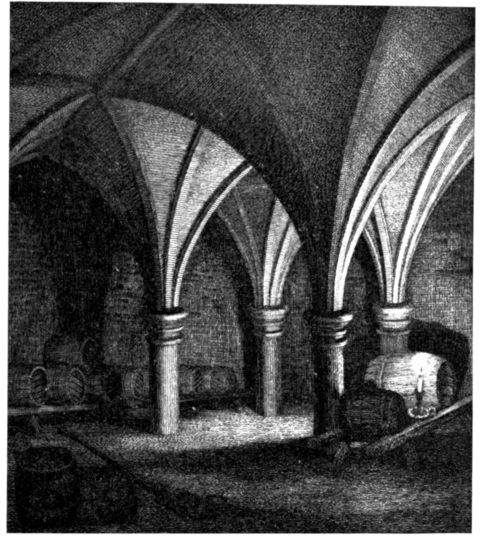
GERARD’S HALL CRYPT IN 1795
The crypt of this house escaped the Fire. On its site was erected an inn called Gerard’s Hall, which contained seventy-eight bedrooms, and was one of the principal hotels of the City. The whole was removed for the construction of Cannon Street; Basing Lane, which ran from Bread Street to Bow Lane, disappeared at the same time.
ST. MILDRED, BREAD STREET
The Church of St. Mildred, Bread Street, still stands. It is on the east side of the street, a little to the south of Cannon Street, and is supposed to have been rebuilt in 1300 by Lord Trenchaunt, of 58St. Alban’s, knight, whose monument was in the church. It was destroyed by the Great Fire and rebuilt by Wren in 1683, when the parish of St. Margaret Moses was annexed. The earliest date of an incumbent is 1170.
The patronage of the church was in the hands of: The Prior and Convent of St. Mary Overy, Southwark, who had it in 1300, and granted it to John Incent and John Oliver, 1333; the above Prior and Convent.
Houseling people in 1548 were 216.
The present church measures 62 feet in length, and 36 feet in breadth, while the total height, to the summit of the cupola, is 52 feet. The interior remains practically in its original state. The carvings about the altar-piece and pulpit are attributed to Grinling Gibbons. The steeple, which rises at the south-east, consists of a plain brick tower, lantern, and slender spire culminating in a ball and vane. The total height is 140 feet, but only the upper portion is visible, owing to the buildings surrounding it.
A chantry was founded here by Stephen Bull, citizen, of which Thomas Chapman was chaplain, April 26, 1453.
The church originally contained monuments to: Lord Trenchaunt, a great benefactor, who was buried here about 1300; also Sir John Shadworth, mayor, 1401, who gave a parsonage house and other gifts to the church. Here too John Ireland and Ellis Crispe were buried in 1614 and 1625, the grandfather and father of Sir Nicholas Crispe, the devoted adherent of Charles I., who is greatly eulogised for his loyalty by Dr. Johnson; he died in 1666.
Few details of the charities belonging to the parish are recorded by Stow; Thomas Langham and Mr. Coppinger being the only names mentioned besides those commemorated by monuments.
Thomas Mangey (1688-1755), D.D., Prebendary of Durham, was a rector here; also Hugh Oldham (d. 1519) of Exeter.
The Church of Allhallows, Bread Street, stood on the east side of the street. In 1625 the building was repaired, but ruined by the Great Fire shortly after. It was subsequently rebuilt. In 1878 it was taken down. The earliest date of an incumbent is 1284.
The patronage of the church was in the hands of the Prior and Chapter of Christ Church, Canterbury; Archbishop of Canterbury, April 24, 1365, by gift (1284-85) from the above, in whose successors it continued up to 1666, when St. John’s, Watling Street, was annexed to it, these being annexed to St. Mary-le-Bow by Order in Council dated July 21, 1876.
Houseling people in 1548 were 300.
On the south side of the chancel there was a small part of the church, called “The Salters’ Chapel,” containing a window with the figure of the donor, Thomas Beaumont, wrought upon it. The church originally had a steeple, but in 1559 it was destroyed by lightning and not restored. The King granted a licence to Roger Paryt and Roger Stagenhow to found a guild in honour of our Lord, April 12, 1394 (Pat. 17 Rd. II. p. 2 m. 15). Some of the most notable monuments were those of Thomas Beaumont of the Company of Salters, John Dunster, a benefactor of the church, and Arthur Baron.
The following were among the numerous benefactors: David Cocke, £100; William Parker, £100; John Dunster, £200, to be laid out in lands and tenements; Edward Rudge, £200, to be laid out in lands and tenements; Lady Middleton, £100.
The most notable rectors of the church were: William Lyndwood (d. 1446), Chancellor to the Archbishop of Canterbury; Thomas Langton (d. 1501), Bishop of St. David’s. John Milton was baptized in this church.
A tablet formerly affixed to the exterior of the church in commemoration of the event was put up outside St. Mary-le-Bow after the destruction of Allhallows.
Friday Street.—“So called,” says Stow, “of fishmongers dwelling there, and serving Friday’s market.” In the roll of the Scrope and Grosvenor controversy, the poet Chaucer is recorded as giving evidence connected with this street, for when 59he was once in Friday Street he observed a sign with the arms of Scrope hanging out; and on his asking what they did there, was told they were put there by Sir Robert Grosvenor.
Cunningham also notes as follows: “The Nag’s Head Tavern, at the Cheapside corner of Friday Street, was the pretended scene of the consecration of Matthew Parker, Archbishop of Canterbury in the reign of Queen Elizabeth. The real consecration took place in the adjoining church of St. Mary-le-Bow; but the Roman Catholics chose to lay the scene in a tavern. ‘The White Horse,’ another tavern in Friday Street, makes a conspicuous figure in the Merry Conceited Jests of George Peele. In this street, in 1695, at the ‘Wednesdays Clubs,’ as they were called, certain well-known conferences took place, under the direction of William Paterson, which ultimately led to the establishment of the Bank of England.”
In the year 1247, certain lands in Friday Street are held by the nuns of “Halliwelle.” In 1258, one William Eswy, mercer, bequeathed to the Earl of Gloucester all his tenements in Friday Street for 100 marks, wherein he was bound to the Earl, and for robes, capes, and other goods received from him. In 1278, Walter de Vaus left to Thomas, his uncle, shops in Friday Street. Therefore in the thirteenth century the street was already a lane of shops. The date shows that the former character of Chepe market as a broad open space set with booths and stalls had already undergone great modifications. Other early references to the street show that it was one of shops. Chaucer’s evidence shows that a hundred years later there were “hostelers” or “herbergeours” living there.
In 1363, certain citizens subscribed money as a present to the King. Among them is one Thomas, a scrivener of Friday Street, and in 1370 we find one Adam Lovekyn in possession of a seld which has been used for time out of mind by foreign tanners. He complains that they no longer come to him, but keep their wares in hostels and go about the streets selling them in secret.
In Friday Street at the corner in Watling Street is a railed-in space, all that remains of an old churchyard, the churchyard of St. John the Evangelist. This is a piece of ground containing very few square yards, separated from the street by high iron railings, and filled with stunted laurel bushes and other evergreens. A hard gravel walk runs round a circular bed of bushes, and on one side stands a raised tomb-like erection. On the wall are one or two slabs indicating the names of those who are buried in the vault below.
The Church of St. John the Evangelist was burnt down in the Great Fire and not rebuilt, its parish being annexed to Allhallows, Bread Street, and both of these to St. Mary-le-Bow, by Order in Council, 1876. The earliest date of an incumbent is 1354.
The patronage of the church was in the hands of: The Prior and Convent of Christ Church, Canterbury, before 1354; Henry VIII. seized it in 1540; the Dean and Chapter of Christ Church, Canterbury, 1546 up to 1666, when it was annexed to Allhallows, Bread Street.
60Houseling people in 1548 were 100.
A chantry was founded here by William de Angre, before 1361, whose endowment fetched £8 : 13 : 4 in 1548, when John Taylor was chaplain. No monuments of any note are recorded by Stow.
In the north part of Friday Street is Blue Boar Court on the east side. This court was rebuilt in 1896, but previous to this was surrounded by old houses. One of these, No. 56, was interesting as having been the City home of Richard Cobden until 1845. It is said that this house was built on the site of a garden attached to Sir Hugh Myddelton’s house in Cheapside. The cellars beneath the building once covered the bullion belonging to the Bank of England. This was at the time when the Bank was in a room of the old Grocers’ Hall.
The Church of St. Matthew, Friday Street, was situated on the west side of the street near Cheapside. It was burnt down in the Great Fire, and rebuilt from the designs of Sir Christopher Wren in 1685; it was then made the parish church for this and St. Peter’s, Westcheap, which was annexed to it. About 1887 the building was pulled down. The earliest date of an incumbent is 1322.
The patronage of the church was in the hands of: The Abbot and Convent of St. Peter, Westminster, 1322, then Henry VIII., who seized it and gave it to the Bishop of Westminster, January 20, 1540-41; the Bishop of London, March 3, 1553-54; it continued in his successors up to 1666, when St. Peter’s, Cheapside, was annexed, and the patronage was shared alternately with the patron of that parish.
Houseling people in 1548 were 200.
The church was plain, without aisles, measuring 64 feet by 33 feet and having a tower 74 feet high.
Chantries were founded here: By Adam de Bentley, goldsmith, for himself and Matilda his wife, to which Adam Ipolite de Pontefracto was admitted chaplain, June 14, 1334; by Thomas Wyrlyngworth, at the Altar of St. Katherine, to which John Donyngton was admitted chaplain, November 13, 1391: the King granted his licence, June 16, 1404; by John Martyn, whose endowment fetched £10 in 1548, when Henry Coldewell was priest, “70 years of age, meanly learned”; for Nicholas Twyford, miles, about 1400.
The church originally contained monuments to Sir Nicholas Twyford, goldsmith and mayor, who died 1583, also Sir Edward Clark, Lord Mayor in 1696. Sir Hugh Myddelton, the designer of the New River, was a parishioner, and was buried here in 1631.
A legacy of £5 a year was left to the poor of the parish by Mrs. Cole.
James Smith, Edward Clark, and others contributed to the furnishing of the necessities of the church. The parish was to receive £240 out of the “cole-money” for the use of the parish or poor (Stow).
John Thomas (1691-1766), Bishop of Lincoln, 1744, of Sarum 1761-66, was rector here; also Edward Vaughan (d. 1522), Bishop of St. David’s; John Rogers, who was burnt at Smithfield, 1555; Lewis Bayley (d. 1631), Bishop of Bangor, and Michael Lort (1725-90), Vice-President of Society of Antiquaries; Henry Burton, the ardent Puritan, who was put in the pillory and imprisoned for his religious opinions and attacks.
The Church of St. Margaret Moses was situated on the east side of Friday Street, opposite Distaff Lane, now merged in Cannon Street, and derived its name from one Moses, who founded it. It was burnt down in the Great Fire and its parish annexed to that of St. Mildred, Bread Street. The earliest date of an incumbent is 1300.
The patronage of the church was in the hands of: Robert Fitzwalter, the founder, who gave it in 1105 to the Priors and Canons of St. Faith, Horsham, Norfolk, being confirmed to that house by Pope Alexander III. in his Bill dated at Turin, May 26, 1163; Edward III., who seized it from St. Faith, as an alien priory, and so it continued in the Crown till the parish was annexed to St. Mildred, Bread Street, in 1666.
61Houseling people in 1548 were 240.
Chantries were founded here by: Nicholas Bray, whose endowment fetched £8 : 16 : 8 in 1548, when John Griffyn was “priest of the age of 46 years, of virtuous living and of small learning”; John Fenne, whose endowment yielded £9 : 10s. in 1548, when John Brightwyse was “priest of the age of 46 years, of honest behaviour and indifferently learned”; Gerard Dannyell, whose endowment fetched £8 in 1548, when Nicholas Prideoux was priest.
The church originally contained monuments to Sir Richard Dobbes, mayor, 1551; Sir John Allot, mayor, 1591.
Only two legacies are recorded by Stow: 18s. per annum, the gift of John Bush; 16s. per annum, the gift of John Spot.
John Rogers, who was burnt at Smithfield in 1555, was rector here.
Distaff Lane.—“On the west side of Friday Street, is Mayden lane, so named of such a sign, or Distaffe lane, for Distar lane, as I read in the record of a brew-house called the Lamb, in Distar Lane, the 16th of Henry VI. In this Distar Lane, on the north side thereof, is the Cordwainers, or Shoemakers’ hall, which company were made a brotherhood or fraternity, in the 11th of Henry IV. Of these cordwainers I read, that since the fifth of Richard II. (when he took to wife Anne, daughter to Wenceslaus, King of Bohemia), by her example, the English people had used piked shoes, tied to their knees with silken laces, or chains of silver or gilt, wherefore in the 4th of Edward IV. it was ordained and proclaimed, that beaks of shoone and boots, should not pass the length of two inches, upon pain of cursing by the clergy, and by parliament to pay twenty shillings for every pair. And every cordwainer that shod any man or woman on the Sunday, to pay thirty shillings.
“On the south side of this Distar Lane, is also one other lane, called Distar Lane, which runneth down to Knightrider Street, or Old Fish Street, and this is the end of Bread Street Ward” (Stow’s Survey, p. 393).
The other lane was afterwards called Little Distaff Lane. Another name for this street was Maiden Lane. There was another Maiden Lane in Thames Street, and a third in Lad Lane, and a fourth on Bank side.