TRUE STORIES ABOUT PETS, ANECDOTES, &c.
Reading edition
QUEER DOINGS OF A HEN.
DEAR Mr. Editor,—I am writing to tell you of a hen who had a good memory. She had some ducks' eggs put under her, which she sat on and hatched; she was very proud of her brood, and accordingly she took them out into the yard. In the yard was a pond, which the young ducks immediately ran to, and in they went. She was in a great fright, and flew from the shore to an island there was in the middle of the pond incessantly, and ran round and round, and called them, but in vain. After a time they came out of the pond, and she brought them up quite safely.
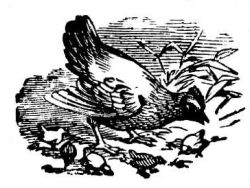
Again she was set on duck's eggs, and again they went into the pond and put her in a terrible fright. These she reared as before. After this she was set upon hen's eggs, and she hatched them all. Then she took the chickens into the yard, expecting them to go into the pond as the ducklings had; but they would not go near. So she called to them, and flew backwards and forwards from the island; and when they would not go in she actually took each one and tipped it over into the water! Thus she drowned all her brood—a very queer thing for a hen to do.
Florence J. Meddlycot. (Aged 12¾.)
Hill Vicarage, Falfield, R. S. O., Gloucestershire.
A STRANGE NURSLING.
DEAR Mr. Editor,—A friend of mine many years ago was walking with her brothers and sisters, when she found a young rabbit which had been slightly hurt. She picked it up and resolved to take it home and keep it. But now the question arose, How was she to feed it? Suddenly a bright idea seized her. The cat at home had lately had kittens, and some of them being drowned, she (the girl) determined to put the rabbit with the survivors. She did so, and to her delight the cat brought it up as one of her own.
Sidney H. Duxbury. (Aged 13¾.)
Locksley, Southborne-on-Sea, near Christchurch, Hants.
WHO HID THE BRUSHES?
DEAR Mr. Editor,—My mother had a horse which she used to drive called "Jacky," who disliked being groomed. The stable-men kept their brushes in a little cupboard near his stall; but sometimes when they came to groom him they could not find them. So one day they watched him, and saw him slip his halter and go to the cupboard and knock with his nose until he got it open. Then he took out the brushes and hid them under his straw!
Adelaide Bentinck. (Aged 11.)
Froyle House, Alton, Hants.
A CURIOUS FRIENDSHIP.
DEAR Mr. Editor,—Last year, when we were staying at Amiens, I was very much struck by a great friendship between a duck and a heron, both of which were in the hotel garden. The heron looked very ill and weak, and used to remain in the same spot for a long time, standing first on one leg and then the other, the duck lying a little distance off. When the heron wished to walk about it gave a feeble croak, and the duck would immediately join it, and the two commenced walking round the garden. When the heron was tired, it gave another croak, and the two companions stopped their walk. The only time that the duck left the heron entirely was for its meals, as the two birds were fed at different times. The heron had a great aversion to rain, and at the least drop would shiver, and shake its feathers. So, when it began to rain, the duck hurried its companion on until they reached the little shed where they slept. Sometimes the heron would begin walking without giving its croak for the duck to accompany it. This annoyed the duck dreadfully, and it used to waddle after the heron, quacking very angrily. If the heron appeared more unwell than usual, the duck redoubled its attention. It was most curious and interesting to watch them.
Muriel Nash. (Aged 14¼.)
Tudor House, Belvedere Road, Upper Norwood, S. E.
Note.—Each Story, Anecdote, &c., when sent to the Editor, must be certified by a Parent, Teacher, or other responsible person, as being both True and Original.