OUR SUNDAY AFTERNOONS.
Reading edition
SOLOMON'S DREAM AT GIBEON.
I t had been a great day at Gibeon. A thousand animals had been slaughtered, and laid upon the altar of burnt-offering; and, as the successive sacrifices were consumed, the flames had ascended, and the smoke, in curling clouds, had gone up towards heaven in token of acceptance.
A new king had come to the throne, a grand, and great, and mighty king, Solomon, the most comely of the sons of David. The fierce fightings of David, the man of war, were over. The glittering crown of Israel had been placed upon the head of Solomon the Peaceable; and the people hoped great things, and celebrated his accession with loud and hearty rejoicings. The dominion of Israel extended, as had been promised to Abraham, from the Euphrates to the river of Egypt. David and his mighty men had fought and conquered. And now the people of Israel were entering into rest, and into the enjoyment of that which his sword had won for them.
So Solomon, in his gratitude, offered up his thousand burnt-offerings; and the people, with heart and soul, joined him in praise to God, and their joyous psalms of thanksgiving went up with the ascending smoke.
Gibeon, which was a priestly city, lay in the tribe of Benjamin, about six miles and a half from Jerusalem; and there, in the reign of David, the Tabernacle, which had been at Shiloh, had somehow come to be pitched.
So Gibeon had become an important place; and thither Solomon went to offer up his sacrifice.
The flames that had consumed the last animal had died away, and the cloud of smoke had ceased to go up. The sun that had lighted up the world had sunk below the horizon, amid clouds of gold and purple, seemingly well pleased to have witnessed, on this sin-stained earth, so grand and noble a scene as that of a young and happy, handsome and rich king, recognising God's providence, and offering up so worthy a sacrifice of praise and thanksgiving to Him who had placed him upon the throne.
The shades of night had fallen upon all, and the joyous king himself had retired to rest. With a clear conscience and a light heart, he had lain down, and, after the fatigues of the eventful day, had fallen into a peaceful sleep.
For all his subjects loved and honoured Solomon, and gloried in having him for their king.
Well might his heart be light and his sleep be sweet. Well might his face be radiant with joy, even as he lay unconscious upon his bed. But soon an expression of still greater joy overspread his countenance. A still brighter light came into his face, and his heart leaped within him; for, in a dream of the night, God drew near this chosen and well-beloved son of David, to heap upon him still greater favours.
Pleased with the love and gratitude and devotion, to which the young king had given expression by his costly sacrifice, God, who loves a thankful heart, and pours into it still more of His goodness, visited the sleeping Solomon in the stillness of the night.
"Ask what I shall give thee," He said; and as the voice fell upon Solomon's ear—
"The heart of the sleeper beat high in his breast, Joy quickened his pulse;"
for that was the voice that he then most loved, and most desired to hear.
And what an exceedingly gracious offer it made! To get whatever he should desire! Had ever grandest king been so favoured? But what should he ask for—this youthful king, to whom life was just opening out as a pleasant paradise, offering him all that seemed worth the coveting? Was there anything yet wanting to him? How many things he might have requested!
His father is said to have died, at the age of seventy years, feeble and broken down. Would he, in so short a time, be tired of living? Would he, so soon, be ready to leave the glory and honour to which he had been called? Should he ask for length of days? Should he request that, till he had reached an age exceeding that of Methuselah, the cold hand of death might not be laid upon him, and the greedy and all-devouring tomb might not claim him as its victim? Should he ask that he might plant his feet upon the neck of all his enemies, not one daring to raise up a finger against him? Or should he desire that the vast riches, that had been heaped up by his father during his long and victorious wars, and that had been left to him, might be still further increased, and that he might be the richest and grandest king on the face of the earth? Or should he ask that he might become so famous, that so long as the world should endure, his name might be a household word, not only amongst his own people, but in distant lands, from east to west, and from north to south, wherever the foot of man might tread?
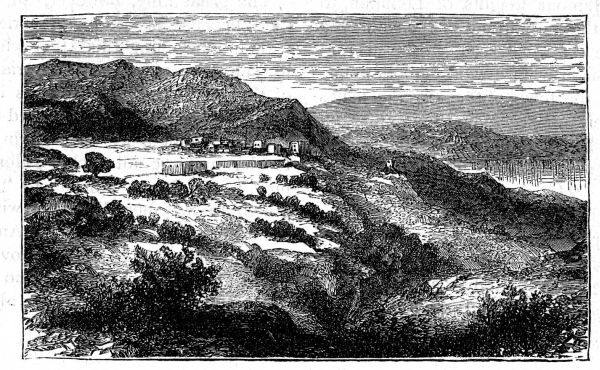
view near gibeon
Oh, no! All these things, which many would have desired, were to him but empty things of earth, trifles that must pass away, vain bubbles that must burst and disappear, leaving behind them no true and lasting benefit. His thoughts did not dwell upon them, but upon higher, and better, and nobler things.
He, the last born of David's sons, had been chosen before all his brethren, to sit upon the glorious throne of his father. Those over whom he had been called to rule were the chosen people of God. They had been taken out of all the nations of the world to be His own peculiar people, and to witness, amidst the idolatrous nations around them, to the living and true God. The heart of God was set upon them. His love was freely poured out upon them, and He had bound them to Himself, closely as a man bound around him his valued girdle. They were the descendants of faithful Abraham, of Isaac, and Jacob. They had become great, and mighty, and powerful, spreading themselves out like the cedars of Lebanon, and flourishing like the stately palms. All the surrounding nations looked upon them as the favoured of Heaven, and feared them.
And he was called to rule them—he, so young and so inexperienced! It was his mission to rule them with justice, to train them in the paths of righteousness, and to bring them still nearer to Him who had chosen them.
And how should he accomplish it? How small and insignificant he felt, and how utterly worthless! How he seemed to dwindle into nothing beside the great work that he was called to do! And yet how anxious he was to do it well! How he longed to be like his father David, a true shepherd to his people! How his heart yearned over his subjects; and how greatly he desired to govern them aright, and to be the channel through which the blessings of the great King of Heaven might be poured down upon them!
Yes, that was the one thing he desired—worthily to perform the great work which had been given him to do. And young and inexperienced as he was, he could not do it of himself, and he must ask for the needful wisdom.
A shade of regret for a moment darkened the face of the sleeper as he thought of his own inefficiency. But it soon passed away. There was wisdom for the asking; and his bright red lips moved in humble prayer.
"O Lord," he murmured in deep reverence, "Thou hast showed great mercy unto David my father, and hast made me to reign in his stead. And Thy servant is in the midst of Thy people, which thou hast chosen—a great people that cannot be counted for multitude. I am but a little child. I know not how to go out, or to come in. Give me now wisdom and knowledge, for who can judge this Thy people that is so great?"
How pleasing to God were the deep humility expressed in this prayer, the discernment of the great work that he was called to do; the earnest desire to be fitted to do it nobly and well, and the utter forgetfulness of all earthly glory and fame!
There was no word of reproach, no saying that as the son of David he ought to be well qualified for governing. Only the gracious answer came, that, because all this was in the heart of the young king, because he had made the worthy fulfilment of his mission the grand aim of his life, wisdom and knowledge were granted to him. And because he had desired these rather than long life, or riches, or honour, or the lives of his enemies, there should also be given to him riches, and wealth, and honour, such as no king had ever enjoyed before him or should ever know after him. And if he served God faithfully, as his father David had done, length of days, also, should be added unto him.
The young king awoke, "and, behold it was a dream." But it was not one of those fanciful dreams, that come and go, and mean nothing. It was a dream from God, a great reality, as he was soon to prove.
From that time Solomon became noted for his wisdom and knowledge. On the most difficult points he was able to give a just judgment, that astonished all who heard it. "And the people feared him; for they saw that the wisdom of God was in him."
His wisdom excelled that of all the wise men of the east, and the understanding of even the wise men of Egypt sank into the shade when compared with his.
He gave his people three thousand proverbs. He wrote a thousand and five songs; one of them which is called the "Song of Songs," or the "Song of Solomon," and which has a place in the Bible, having a depth of beautiful meaning, which only the very wise can understand. He knew all about the trees, from the kingly cedar that reared its proud head on the famous heights of Lebanon, to the humble hyssop that sprang out of the wall. He could tell the nature of each, describe its flowers and its fruit, and point out of what it was symbolic. The beasts of the earth, the fowls of the air, the fishes of the sea, and even the creeping things were all to him as an open book. He could tell for what each was created, and what lesson each was intended to convey. He could answer the most difficult questions that any one could put to him; and his fame rapidly spread through all the countries of the then known world.
He became so rich, too, that silver and gold were as common as the stones that he saw lying in the streets, as he rode through Jerusalem in his open chariot, clothed in white, threads of glittering gold mixed with his jet black hair.
He erected the glorious temple, which for grandeur and magnificence stood unrivalled; and time would fail to tell of the splendour of his throne, of his palace, and of the palace which he built for his favourite wife.
In almost all countries, his name has been familiar; and, to this day, the wild Arabs will tell wondrous stories about him, as they gather at night round their blazing fires. His grandeur and wisdom have ever since been proverbial; and even Jesus, when He wished to compare the lilies of the field with something very magnificent, spoke of "Solomon in all his glory."
The great king, however, did not get length of days, because he afterwards grievously fell. But, without darkening this story with the account of his subsequent sins, let us try rather to learn some of the useful lessons that it is intended to teach. Perhaps you have already found them out.
Like Solomon, we have all in life a great work to do, and we all lack wisdom. But we have only, as St. James tells us, to "ask of God," who giveth to all men liberally, without reproaching them for their foolishness. And if we seek the wisdom that comes from above—the wisdom of Jesus Christ, we need have no fear; for, as the great Master Himself tells us, all other things will be added unto us.
H. D.
BIBLE EXERCISES FOR SUNDAY AFTERNOONS.
1. Which is the only miracle of our Lord that is related by all the four Evangelists?
2. What city, after its destruction, was sown with salt, as a sign of the barrenness and desolation that its enemies wished to see come upon it?
3. How many lepers are we told, were cleansed by our Lord?
4. Whence did Solomon procure the pattern according to which he built the Temple?
5. Where does the psalmist call God the health of the countenance?
6. What is the only occasion on which we read of Jesus sleeping?
7. Where is Mary, the mother of Jesus, last mentioned.
8. Where do we read that, while, in the reign of David, the old Tabernacle remained at Gibeon, a new tent was pitched at Jerusalem for the ark of the Lord?
9. In which place, after the pitching of the new Tabernacle, did the high priest officiate?
10. Where do we find that Solomon, on his accession, recognised the sanctity of both places?
11. Where is there a prophecy of Jonah concerning Israel, not recorded in the Bible, alluded to in the history of the kings?
12. From what words of St. Paul do we gather that other Christians; besides Stephen, were put to death during the persecution at Jerusalem?
ANSWERS TO BIBLE EXERCISES (61-72. See Vol. XIX., p. 346).
61. In Lev. xix. 14, and Deut. xxvii. 18.
62. In St. Matt. xxvi. 30, and St. Mark xiv. 26.
63. In Gen. xviii. 14; Jer. xxxii. 17, 27; Job xlii. 2; St. Matt. xix. 26; St. Mark x. 27, xiv. 36; St. Luke i. 37, xviii. 27.
64. In St. Mark xii. 41-44; St. Luke xxi. 1-4; and 2 Cor. viii. 12.
65. Of the mother of Samson, Judges xiii. 2-24, xiv. 2-9; and Hannah, the mother of Samuel, 1 Sam. i., ii. 1-10, 18-21.
66. In Judges xiv. 12-19; and Ezek. xvii. 1-10.
67. Proverbs xii. 10.
68. In St. Matt. vi. 25-34; and St. Luke xii. 22-30.
69. In St. Matt, xxiii. 5.
70. St. John xvii. 4.
71. In Lev. xix. 13; and Deut. xxiv. 14, 15.
72. In Deut. xxi. 22, 23.
they brought her home in triumph, a merry sight to see.