A SUMMER HOUR.
Reading edition
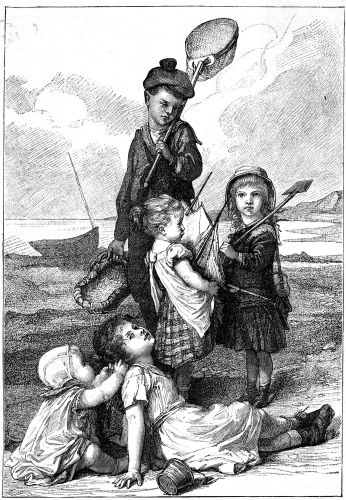
'tis here the children love to come (p. 45).

wide expanse of yellow sand, A breeze so fresh and free, Which, gently rippling, scarcely wakes The calm and tranquil sea. Beneath the clear and shining wave Bright shells and sea-weeds lie, Reflecting all the golden light Of the sweet summer sky. And many a crystal pool is there, Where hermits lurk below, And restless shrimps in coat of mail Flash swiftly to and fro. A noon-day hush is over all, Unbroken by a sound; Till ... sudden peals of baby mirth Wake all the echoes round. 'Tis here the children love to come, On the bright sand to lie, Or in the gleaming water hold Their mimic revelry. Oh, happy hearts! those gladsome day Upon the golden shore Will linger on in memory still, A joy for evermore.
D. B. McKean.
LITTLE MARGARET'S KITCHEN, AND WHAT SHE DID IN IT.—VII.
By Phillis Browne, Author of "A Year's Cookery," "What Girls can Do," &c.
"I should like my little pupils to learn to roast meat to-day," said Mrs. Herbert, as she entered the kitchen where the children were waiting for her.
"You will let it be beef, though, won't you?" said Margaret. "If we have to cook meat we might as well cook the best kind of meat there is."
"You consider beef the best kind of meat then, do you?" said Mrs. Herbert.
"Oh, yes! I should think every one does. Father says there is nothing like the roast beef of old England."
"English people generally like roast beef, I know," said Mrs. Herbert. "Indeed, they have been so accustomed to take pains with it, that now it is often said that English cooks roast well, if they do nothing else well."
"It seems to me that there is nothing to do in roasting meat," said Margaret. "The fire does all the work; we put the meat down to the fire, and in a little time we take it up, and it is done."
"But the right kind of fire for roasting is not always made up in any kitchen," said Mrs. Herbert. "The first thing which the cook who intends to roast has to see after is the fire; and she ought to make it ready quite an hour before she puts the meat down."
"Oh dear, what a trouble!" said Margaret.
"Please, ma'am, I know how to make up a fire for roasting," said Mary. "I have done it many a time for my aunt."
"Then tell us what you know about it," said Mrs. Herbert.
"The fire must be a good size, larger than the meat which is to be roasted before it. The cinders and dust must be cleared thoroughly away from the bottom of the range, the live hot coals must be pushed to the front, and the space at the back which is made empty must be filled up with knobbly pieces of coal packed closely together, though not so closely that the air cannot get through. The hearth must be swept up tidily, and the cinders, mixed with a little damped coal-dust, must be put at the back on the knobbly pieces of coal, and that is all."
"Very good indeed, Mary," said Mrs. Herbert, "you evidently know all about this part of the business."
"But I don't see the good," said Margaret. "Why do we not make up the fire when we are ready for it? It would last all the longer."
"Because we want to have the fire clear and bright, not dull and smoky. It must be kept bright all the time too, and it must not be allowed to get hollow in places. Can you tell us, Mary, what you are to do if the fire needs to be mended before the joint is finished?"
"The live coal must be drawn to the front, ma'am, gently, so as not to let any cinders go into the dripping-tin," said Mary. "But we ought not to let the fire need mending; we must watch it and keep putting cinders and pieces of coal on to keep it up."
"You see now, Margaret, how important it is to have the right kind of fire," said Mrs. Herbert. "Have you heard that red meat which is to be roasted should hang for a while before being cooked?"
"At any rate I have heard people say 'This meat is not tender; it has not been hung long enough.'"
"Just so. It is very important that red meats which are to be roasted should be left to hang till tender. When we have a cool airy larder, we can hang meat for ourselves, when there is no such larder the butcher will hang it for us. The time which the meat must hang depends upon the weather. In dry cold weather it may hang a long time—two or three weeks—but in hot weather it must be quickly cooked, or it will not keep. In frosty weather, too, it should be put in a warm kitchen for some hours before being roasted, or it will not be tender."
"What do you mean by red meats, ma'am?"
"I mean, Mary, meats red in colour when cut, such as beef, mutton, and game. What are called white meats, such as veal, lamb, and pork, will not keep, and they therefore have to be cooked when fresh. Can either of you tell me what is the first thing to be done when you are going to roast meat?"
The little girls thought for a minute, then Mary said, "When we were going to boil the leg of mutton we weighed it, that we might know how long we were to let it simmer."
"Quite right, Mary. So you must do with this piece of beef. Weigh it and then allow for roasting a quarter of an hour for every pound, and a quarter of an hour over. If the joint is thick and solid we allow twenty minutes to the pound. In fact, we should always have a little consultation with ourselves before we begin to roast, and say to ourselves, 'Is this meat solid and thick with little bone, or is it thin and small?'"
"How long must we give the sirloin of beef?"
"A quarter of an hour to the pound and a quarter of an hour over. Cook is now going to put down the dripping-tin and screen for us. I should like you to watch her and then try to remember what is necessary. Do you notice that she puts a large slice of dripping into the pan first thing?"
"What is that for?" said Margaret. "I thought the dripping dropped from the fat."
"So it will in a little time, but we want some hot fat to baste the meat with immediately. If we put a slice in the tin a few minutes before the meat is hung on the hook, the fat will melt and be ready for our purpose. Never wash the meat before roasting it. If you do, it will not brown properly, and the juices will be drawn out. Some cooks are very particular to wash meat, and they say that it is dirty not to do so, for we never know by whom meat has been handled. For my part I never feel uneasy about meat which has been bought of a good butcher. If I had any doubt on the subject I should wipe it well, but not wash it."
"The dripping is quite melted now, mother. Shall we hang the meat on the hook, and wind up the jack?" said Margaret.
"Yes, dear; wind the jack before you put the meat up. In hanging the meat recollect to put the thickest part downwards, because the heat of the fire will be greatest at the bottom. Be careful, too, to pass the hook through a secure place where there is little juice, for the flesh will give way with cooking, and if you do not provide for this your joint may fall into the pan. Do you recollect that when we were boiling meat we first plunged the meat into boiling water to harden the albumen on the outside so as to make a case to keep in the juices."
"We cannot do that now, though," said Mary.
"We can do something of the same sort. If we put the meat close to the fire and baste it with hot fat for a few minutes at the beginning we shall harden the outside. Then we may draw it back and roast it more slowly till done. Above all things, however, we must be careful to baste it well. Stand at one side of the fire, take the fat up carefully with the basting-spoon, and pour it over the lean part of the meat. The basting-spoon will not become too hot if you put it in a plate by the side, not in the tin. If you baste the meat well, it will not shrink or become dry and hard, it will be juicy and savoury, and it will be a good rich brown colour."
"How quickly the fat melts!" said Mary. "There is plenty of dripping in the pan now."
"We will pour a little of the dripping away shortly, for we want to have it a good colour," said Mrs. Herbert. "If we let it remain too long before the fire it will be burnt and discoloured."
Very patiently and for a long time the little girls basted the roasting joint, and at last they were rewarded by seeing it take a rich brown colour.
"In another quarter of an hour the beef will be roasted enough, ma'am," at length said Mary, looking at the clock.
"It smells as if it would taste all right, does it not?" said Margaret.
"Now we must prepare for the gravy. Cook has put the dish for the meat and the plates where they will get hot, for little girls cannot see after everything. In this small saucepan is a little stock made by stewing two or three bones and scraps (with no fat whatever), a sprig of parsley, a few rings of onion, which have been fried till brown, an inch of celery, and five or six peppercorns in water. I do not know whether you noticed that this stock has been stewing by the side of the fire ever since we came into the kitchen; I have skimmed it every now and then, and covered it closely again."
"I noticed it," said Margaret. "I thought it would turn out to be for something which we wanted."
"It is for gravy. You see it is a rich deep brown colour, gained from the browned onion. We must strain this gravy, put a little salt with it, let it boil, then unhook the joint, pour a couple of table-spoonfuls of this gravy into the dish, put the rest into a gravy tureen, and serve at once. There will be plenty of gravy altogether, if we use that which is in the tureen and the dish as well. Besides, our joint has been well basted, and is not dry, so gravy will run from the meat into the dish."
"Can't we make gravy from the dripping-tin?"
"We should have had to do so if there had been no stock," said Mrs. Herbert. "In that case we should pour out the fat from the tin very gently and carefully till we come to the brown sediment at the bottom. We should mix with the sediment a breakfast-cupful of boiling water, and scrape, with the spoon, any little brown dried specks of gravy there might be. When we had obtained as much gravy as possible we should strain it into a saucepan and keep it hot till the meat was quite ready."
"I am sure father will enjoy this roast beef," said Margaret.
"I hope and think he will," said Mrs. Herbert. "Beef roasted in this way before the fire is most excellent. It is, however, not nearly so common as it once was, for with the stoves and kitcheners now in use, it is easier to bake, or, as it is called, to roast meat in the oven. I therefore wanted you to understand the best way of roasting meat, and you shall next learn how to roast it in the oven."
(To be continued.)