TOO YOUNG FOR SCHOOL.
Reading edition
By the Author of "Harry Maxwell; or, Schoolboy Honour."
"Here, I say, old fellow! what's the matter? you look as sulky as a brown bear. And where's your cap gone? I say now, do wake up! You'll catch it if old Jacky catches you."
"Let me be. You would look sulky if you had a little chap of a brother sent to school, miles too young to come at all, and had got to look after him and keep him out of scrapes, and show him how to get on with his lessons, and keep the fellows from bullying him."
"Why in the world did he come, Graham?"
"Oh, don't bother, Johnny, old man," and as he spoke, Hubert Graham drew his arm away from the parapet over which he was leaning with book in hand, and turning round a frank, honest-looking face towards the boy who was questioning him, passed his hand over his eyes, and added, "What can have come to Uncle Charlie to make him send Chris off like this, I can't think. Middle of term too!"
"Well, how is it?—explain to me—but—I say, old fellow, where's your cap? you'll be in no end of a row if you lose it, you know."
leaning with book in hand (p. 21).
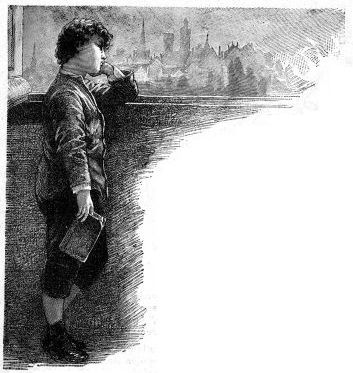
Up went Hubert Graham's hand to his head, as he answered in a bewildered way, "Cap! Haven't I got—" and then hastily turning, and looking over the parapet, he exclaimed, "Oh! I say, Seton, just look there!" and he burst out into a hearty laugh as he added "One of those barge boys has just fished it up out of the water, and he's holding it up in triumph to me. I must have been dreaming. It's out of bounds," he went on, with a face of dismay.
"I wonder if the fellow will bring it up to me."
"Not he," said Seton.
Dr. Thornley's boys were not allowed to go, without special leave, any nearer the town on the outskirts of which the school was situated than the bridge over which Hubert had been leaning. The approach of a master solved the difficulty. Hubert Graham went up to him. "If you please, sir, I was leaning over the parapet, and my cap fell into the river. A bargee has picked it up. May I run and get it?"
The master looked over, and laughed. "Perhaps he won't give it up. You may go and try."
When Hubert Graham returned to the bridge in triumph so far as the possession of a very wet cap was concerned, but rather low in his mind at having had to pay the exacting bargee a shilling out of his somewhat scanty store of pocket-money, he found John Seton lingering about for him.
"I say," he said, "I want to know about your uncle, and the little one. He's a jolly little man though; I expect he'll make his way."
"But there's a terrible set in the lower school for him to make his way with, and he a mere baby."
"Well! he's seven—and that seems like a baby to us, to be sure," said magnificent fourteen years, speaking in the person of John Seton; "and you're right. They are a set; I wish I was the prefect in his dormitory, but I'm not. Tell me how he came here in such a hurry?"
"Well, you needn't talk about it to the other fellows. Father and mother are in India. Father's regiment was ordered abroad four years ago, and mother went with him. There were three of us, and we were sent to Uncle Charlie to take care of. I was eight years old then, Nellie was five, and Chris three years old. Uncle was jolly and kind, and sent me here when I was ten. Just before the summer holidays were over Uncle Charlie married, and I'm sure our new aunt does not care for us to be there. But I never thought they'd send Chris to school. I wonder what they'll do with Nellie?"
"Can't you write to your father?"
"I will directly, but it's so long before I can hear."
* * *
A poor little fellow taken from the nursery. A brave, bright little man enough, but oh! so young, so pitifully young to be sent to a school where there were fifty or sixty boys in what was called the lower school only! Poor little Christopher! If his mother could have seen him! He came—bright—happy—full of life, determined to like it; but before two days were over his little soul was full of misery. The boys of ten and eleven years became his dread and torment. On the second day he saw nothing of Hubert till the evening, and then he said, "Hubert, why couldn't I go to our grandfather?"
"Nobody even thought of such a thing, Chris. I don't expect our grandfather would like us."
"How do you know?" said the child.
"Oh! don't bother," returned his brother. "Only by what I've heard nurse say. She was talking one day to Jane, and she said, 'The children would have gone to General Graham's, only, you know, he was angry with master for marrying, and so master never asked him to have them.' I asked nurse what she meant, and she was vexed that I'd heard it, and said it was nothing I could understand."
"But I am so miserable here."
"Try to like it. Seton says you can go into his study to-night, and do your exercises. The fellows in the school don't leave you alone, do they, Chris?"
"No," said poor little Chris; "they don't." And sitting in Seton's little study that night the child found comfort for the first time.
And for a few days things seemed better. But it was not to last. Those boys in the lower school, who had tormented him before, were worse than ever, now that they thought he was being made a favourite of by one of the senior boys, and the poor little fellow had no peace. He complained bitterly to his brother, but it was no good. Hubert said it would only make the boys ten times worse if he interfered. "And never mind, old fellow," he said; "it's half-holiday to-morrow, and you'll get some jolly games."
"Jolly games," thought poor little Christopher; "I know better. They won't be very jolly to me."
And then Christopher made up his mind, and in his brave little heart determined to tell no one, but to run away, if he only could, to his grandfather. He knew the way to the station from the school, and he knew that trains went direct to a station called Kingsdown, where Uncle Charlie always went when he visited grandfather. "After all, he can't be worse than the boys," he said to himself. "And Hubert can't help me."
But Hubert did care. His smothered indignation and anxiety knew no bounds, and the very night that Chris made up his mind to run away, long after the other boys in his dormitory were asleep, Hubert lay awake thinking how he could help his little brother. He fancied he heard a noise in one of the dormitories. It seemed, he thought, to come from the direction of the one in which Christopher was. He raised himself on his elbow to listen, and muttered to himself, "They shall only wait till to-morrow, and then those two fellows, Howard and Peters, shall have a piece of my mind. They're the ringleaders. It shall be the worse for them if they've been frightening him to-night."
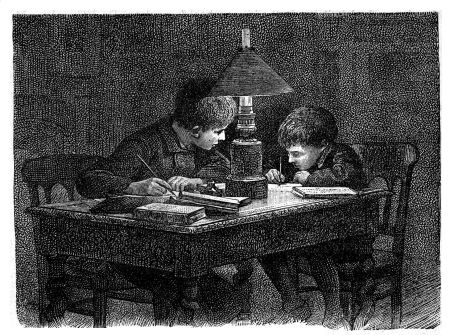
sitting in seton's little study
And he lay there listening till all seemed quiet, and then saying to himself, "The poor little chap is at peace now, I expect," he turned round, and dropped off to sleep.
But he had not been listening quite long enough.
Little Christopher waited till all the boys in his room were sound asleep, pinching himself to keep himself awake; then out of bed he crept, felt for his clothes, which were close at hand, huddled them on, put his feet into his felt slippers, as he dared not put on any boots, and got out in the passage. His bed was near the door, which was fortunate, for he thought, if he had had to pass many of the boys' beds, his courage would have failed him. Down the stairs he stole—oh! how they creaked—and unfastening the shutters of one of the school-room windows, got out of it into the garden. But ah! he hadn't calculated on the big dog, whose kennel was hard by, and who was out in a moment.
"Dear, darling Ponto," cried the poor little fellow; "don't bark, my dear." And up he went, and stroked and patted the great mastiff, who, already knowing the little fellow, put his paws on his shoulders, and licked his face with great appreciation. For Christopher was tenderly kind to animals, and he was rewarded for this now in his day of deep distress. Ponto did not bark.
Christopher whispered to him. "Ponto, I'm very unhappy. I'm running away. I wish I could take you with me. I only love you here; excepting Hubert, and he can't help me;" and away he stole.
As he got into the high road the early dawn of morning gave him a little light.
All was consternation in the school later, in the morning. A boy missing! Dr. Thornley summoned the whole school before him. Could any boy give him any information?
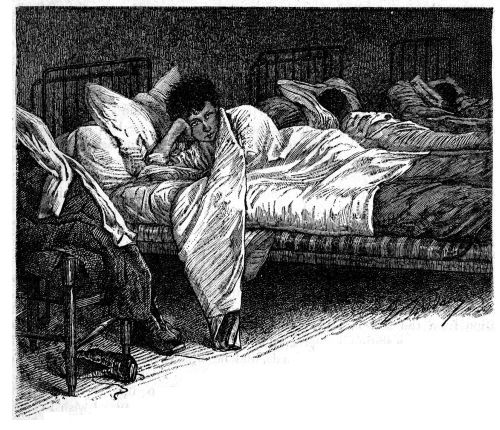
hubert lay awake (p. 23).
Hubert came forward. "He said he should run away yesterday, sir; but I had no notion the poor boy would or could, or I'd never have left him last night."
"Why?—for what reason?" said Dr. Thornley, his face growing sterner and graver.
John Seton came forward. "I'm afraid, sir, there's very bad bullying in the lower school."
"So bad as this, that a boy should run away!" said the doctor; "and you a prefect!"
The colour mounted high in John Seton's fine young face.
"I've not had anything to do with the discipline the three weeks since Graham minor has been here, sir; but some of us meant to speak. It could not go on."
"May I go after him, sir?" said Hubert, his voice quivering with anxiety.
"I have sent to search for him in all directions," said the doctor. "A poor little child like that might meet with many mishaps. I am surprised," and his voice shook, "that none of you bigger boys let me know of any of this base, low, ungentlemanly conduct."
The expression on the countenances of some of the boys of the lower school, as these words fell from the doctor's lips, may be imagined.
Dr. Thornley was the kindest-hearted of men, but there were certain offences that moved him greatly; and when moved to wrath, the boys knew he could be terrible.
"I must find this all out; and if the boys who have been bullying little Graham have not the bravery to come forward, and confess it of their own free will, I must take measures to discover who they were. But I warn them," added the doctor, "that if I find them out before they have come forward and freely confessed their base conduct, their time at this school will be short. To-day is a half-holiday. All the lower school will keep within bounds to-day."
At that instant "Old Jacky," as the boys called him, the school porter, brought the doctor a telegram. His face wore a look of great relief as he read it. And he turned to poor Hubert.
"Your brother is safe." Then to the school he said, "I have just had this telegram, which I will read, 'General Sir Henry Graham, Sefton Court, to Dr. Thornley, Middleborough. Christopher Graham safe with me. Shall make full inquiries.'"
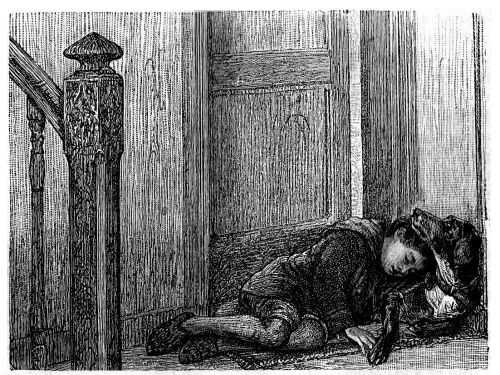
fast asleep, with his head on the dog (p. 25).
At Sefton Court the same morning all was lazy and quiet. The blinds drawn down the entrance door side of the house to keep out the sun, but doors and windows thrown wide open. An old gentleman sitting in his library, reading his paper. Something made the old gentleman restless. He fidgeted. Something was wrong with his glasses. Then to himself he said, "I wish Henry was here. Shall write by next mail. Why shouldn't his wife come home, and bring the children here? I don't half like it now that Charlie's married. Perhaps she won't like the children. Got a craze on education too. They overdo it. Dear me! I wonder where that fellow Thomas is?"
And up got the old gentleman, and walked to the door. He had no sooner opened it than he gave a great start. "Hullo! What on earth is this?" What was it he saw?
His own old dog, Bevis, whose favourite sleeping-place was the mat at his door, lying there as usual, but not asleep. Wide awake, as if on guard. And marvel of marvels! a dear little fair-haired boy fast, fast asleep, with his head on the dog, who was lying so as to make himself into as comfortable a pillow as possible.
The old gentleman stared hard for a minute, then began to shout for Thomas, which woke the child, and he began to sob.
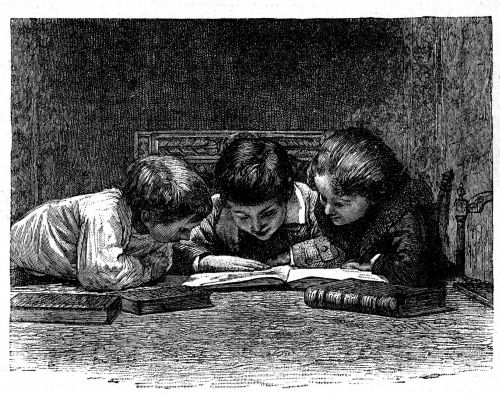
they were all three assembled (p. 26).
"There, there!" said the old general. "Who are you? You oughtn't to have come in without leave." By this time poor little Christopher, for it was he, had collected his scattered faculties, and catching hold of one of General Graham's hands, cried, "You're grandfather. Do take care of me. I'm so unhappy at school; I think I'm too little. So I said I'd come off to you. You wouldn't be as bad as the boys!"
"Who? who?" stammered the poor old general.
"I'm little Christopher Graham. Uncle Charlie sent me to school, and I'm too little, I expect. I ran away. I know it was naughty, but forgive me, and don't send me back. I had five shillings in my box, and I ran away in the night, and came here by the train in the morning; and I asked where you lived, and I walked here from the station, and I saw the door wide open, and I thought as it was grandfather's house I might come in; and I was afraid of the dog, but he didn't hurt me, and I knelt down to pat him, and I suppose I was very tired, for I can't remember any more."
But he needed to say no more, for he was in his grandfather's arms. And Thomas was close by, and brought some warm tea very quickly; and a kind-looking old lady came, who said to Christopher she was his great Aunt Susan, and that he must be undressed and have a warm bath, and go to bed to get a sound sleep before they let him tell them anything else.
The very next evening Aunt Susan called Christopher into the library. There was his very own Nellie sitting on grandfather's knee, and Hubert standing by!
Dr. Thornley had given Hubert one day's holiday to go and see Christopher. Later in the evening they were all three assembled in a pleasant cosy room, looking over funny old picture-books, which kind Aunt Susan turned out of her treasures.
"'All's well that ends well,'" said Hubert; "but you mustn't run away from school when you're bigger, old boy. You're only forgiven because you're a baby, you know."
And his grandfather said to him later on—
"My boy, in the battle-field no soldier worthy to bear the name of 'Englishman' ever turned his back on the enemy. What you had to bear was hard; but you turned your back on your enemy when you ran away. And you bear an ancient name, and you come of a noble race. We must do our Duty, come what will."
And Christopher never forgot these words.