PRETTY WORK FOR LITTLE FINGERS
Reading edition
EMBROIDERED GLASS-CLOTH.
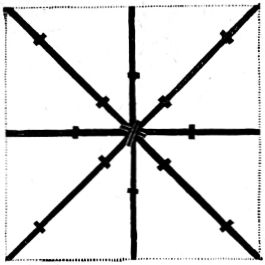
fig. 1 - pattern square
This is very pretty and easy work, just the thing for any little folk who are anxious to help a fancy sale for some good cause, or to make a nice useful present to a friend, but who have not time or skill to undertake anything long and difficult. It is very quickly done, and can be used for toilet-covers and mats (these should be edged with narrow torchon lace), night-dress cases, aprons, comb-bags, and a number of useful articles; it is much admired, and always sells well at a bazaar.
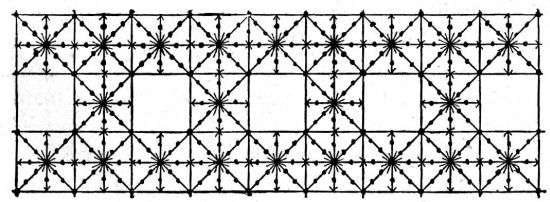
fig. 2 - border
All you have to do is to get some common glass-cloth, tolerably fine, with cross-bars of red or blue, and some red or navy blue knitting-cotton, which you can buy either by the pound or the ball. Two ounces will do a quantity of work, and cost about the same as a ball.
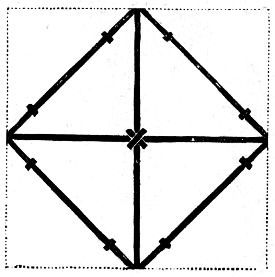
fig. 3 - worked with cotton
With this, which may be either the same colour as that of the material or the contrasting one, the pattern is worked upon the squares formed by the cross-bars, as in Fig. 1, and in this way a number of pretty devices can be formed. Toilet-covers and large aprons should have a border as in Fig. 2; for mats a single border will suffice. Bags, &c, may be worked in checquers, every alternate square, or in large cross-bars, by carrying on Fig. 2 over the whole surface, but when you choose a large pattern, always count the squares before you cut off your piece, or you may find the pattern break off in the middle.
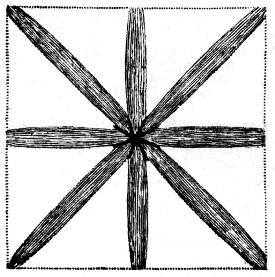
fig. 4 - worked with wool
I have seen a very effective-looking bag, all the squares of which were worked over with dark blue cotton, the bars being blue, and two tiny red stitches worked as in Fig. 3, wherever a simple cross was formed by the cotton intersecting the stripe of the material.
Use a darning or crewel needle, and a very long thread, or you will have to be continually taking fresh. This work is sometimes done with crewel wool, and in rather a different way, see Fig. 4; but it is not so neat and pretty, in my opinion, as that done with cotton, and is more extravagant, since the wool must be used double and every stitch repeated.
I once saw a large apron with bib and pocket bordered with squares worked in this style with bright dark ultramarine crewels, and with ribbon strings of the same colour; it had a handsome effect. I shall only say in conclusion that I have no doubt the clever brains and nimble fingers of some of my young readers will soon be able to improve upon these simple elementary designs, and to produce some new and more elaborate ones which will give them all the more pleasure for being of their own creating.
Somerset.
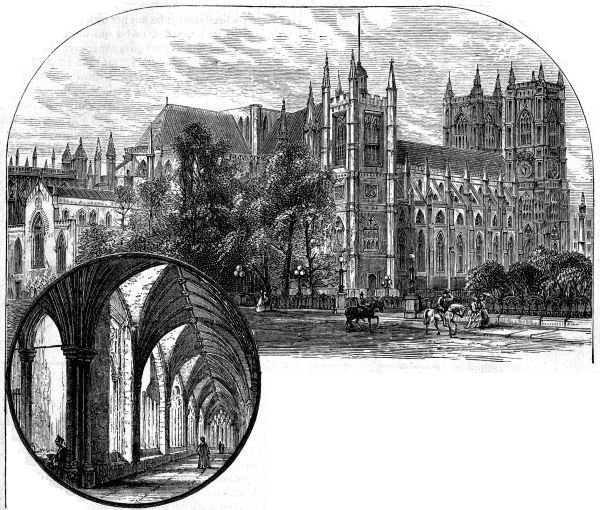
cloister westminster abbey