The Editor's Pocket-book.
Reading edition
The Natural Bridge, Virginia.
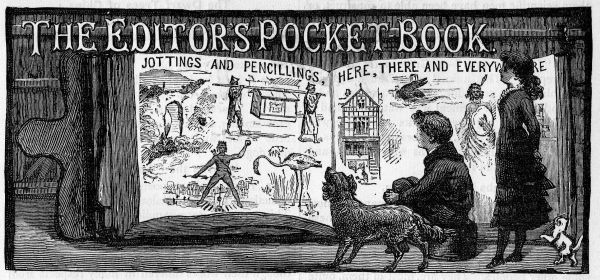
The two greatest natural curiosities—if one may use the phrase in this connection—in North America are the Falls of Niagara and the Natural Bridge in Virginia. A picture of the latter will be seen in our new heading. It is an arch cut, so to speak, out of the rock, and stands upwards of two hundred feet above the ground below. How it originated has been a kind of puzzle, some urging that the rock was hollowed by an earthquake, others that the bridge is the result of the action of water. Unfortunately for these conjectures no ruins are to be seen beneath. The bridge has formed the scene of several hair-breadth escapes.
The Colossus of Rhodes.
The city of Rhodes is situated on the island of that name, which lies some twelve miles from the coast of Asia Minor. It was founded four hundred years before the birth of Christ, and, among other things, was noted for its Colossus—pictured in our heading—which was reckoned to be one of the Seven Wonders of the ancient world. The Colossus was a gigantic statue in brass of Helios, or the Sun, and stood at the entrance of one of the ports. It was 105 feet high. According to one belief—which, however, is now abandoned—the Colossus bestrode the harbour, one foot resting upon a pier at one side, the other upon a pier at the other, while the figure itself was so lofty that ships in full sail could pass underneath the outstretched legs. Sixty years after it was built it was thrown down by an earthquake.
Chinese Palanquins.
A favourite mode of travelling in China and other countries of the East is by palanquin, which is a kind of wooden box, about twice as long as it is high, with shutters and other appliances to make it comfortable. The palanquin is carried by porters—just as in the drawing given above. The vehicle is furnished inside with a mattress—on which the traveller reclines—and cushions, and is also fitted with shelves and drawers. Travelling is continued day and night. There are different kinds of palanquins, some resembling the sedan chairs that used to be fashionable in England.
The Flamingo.
This queer bird—also shown in the heading above—is found in the tropical and temperate regions of the globe, and frequents marshes and shallow lakes. In deep water flamingoes swim, but they prefer to wade, for then they can bend down their necks and rake the bottom with their peculiar-shaped bill in search of food. Flocks of these birds, with their red plumage, when seen from a distance, have been likened by observers to troops of soldiers.
"God's Providence House."
The house represented in the new heading, and bearing the above quaint name, is situated in Chester, a city famed for its picturesque old buildings. It is built of timber and brick, and upon the beam supporting the second floor is carved "God's Providence is mine Inheritance, 1652." It is supposed that Chester was visited with plague in that year, and that this house was the only one which escaped the pestilence. Hence arose the pious inscription of the grateful tenant.
An Ancient Monster.
Once upon a time, so long ago that I cannot tell when, strange creatures lived on land and sea. They have all died out now, but their bones are sometimes found in a fossil state, and by means of them scientific men have been able to construct, or piece together, as it were, these old-world monsters. You will see the picture of one of them in the new Pocket-book heading. It is called by the long name "Ichthyosaurus"—a Greek term meaning "fish-reptile." This animal was a huge creature something like a crocodile, with four paddles and a tail, and its native element was water. It had a large head with big eyes, and its jaws were well filled with terrible teeth. It possessed features in common with fishes as well as with reptiles, and hence its compound name.
Arabs of the Soudan.
Little folk who read their newspapers know something of the dauntless courage of the Soudanese Arabs. The Soudan is a desert of vast extent, partly bordering upon the boundaries of Upper Egypt. It is inhabited by wandering Arabs and some other peoples. They are, most of them, quite fearless, and even when opposed to British forces have shown a courage worthy of their foes. Armed—like the one drawn in our heading—with spear and shield—for but a few of them owned rifles and fired them unskilfully—they rushed again and again right up to the serried ranks of the British soldiers. These Arabs have several vices, but no one has denied them the highest degree of bravery.
A Lesson in Charity.
It is related of the late Mr. Peter Cooper, an American benefactor, that he was one day watching the pupils in the portrait class connected with the Women's Art School of Cooper Institute. About thirty pupils were engaged in drawing likenesses of the same model from various points of view—some in profile, some full face, some nearer and others farther from the light, and so forth. After studying the scene for a while Mr. Cooper said, "Such a sight as this should be a lesson in charity, when we perceive how the same person may be so different, according to the way he is looked at by various people."
The Busy Bee.
Few little folk have any idea of the labour that bees have to expend in the gathering of honey. Here is a calculation, which will show how industrious the "busy" bee really is. Let us suppose the insects confine their attentions to clover-fields. Each head of clover contains about sixty separate flower-tubes, in each of which is a portion of sugar not exceeding the five-hundredth part of a grain. Therefore, before one grain of sugar can be got, the bee must insert its proboscis into 500 clover-tubes. Now there are 7,000 grains in a pound, so that it follows that 3,500,000 clover-tubes must be sucked in order to obtain but one pound of honey.
The Dwarf Trees of China.
In China, that land of curiosities, may be seen oaks, chestnuts, pines, and cedars growing in flowerpots, and fifty years old, but not twelve inches high! They take the young plant, cut off its tap-root, and place it in a basin of good soil kept well watered. Should it grow too rapidly, they dig down and shorten in several roots. Year by year the leaves grow smaller, and in course of time the trees become little dwarfs, and are made pets of like canaries and dogs.
What is the "Lake School"?
In reading about poets and poetry, you will sometimes find an allusion to the "Lake School." This was the term applied by a writer in the Edinburgh Review to Wordsworth, Southey, and Coleridge, because they resided in the lake district of Cumberland and Westmoreland, and because—though their works differed in many respects from each other—they sought for inspiration in the simplicity of Nature rather than in the study of other poets, or of the prevailing fashion.
The Cuckoo's Fag.
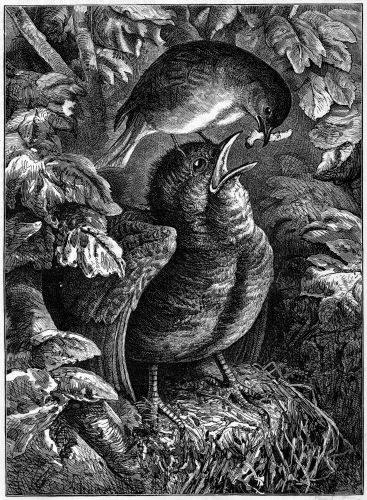
Tom Brown, as readers will remember, was in deep trouble at Rugby about the fagging system in vogue during his "school-days." Many things have happened since then, and amongst others a marked improvement in fagging. The cruelty and insolence and selfishness of it have disappeared, and the system itself will one day die out. As regards boys, so far so good. Among some feathered folk, however, fagging flourishes in full vigour; and so long as there are cuckoos so long will there be fags. Many birds are imposed upon, one of the commonest victims being the hedge-sparrow. For days a sparrow has been watched while it fed a hungry complaining intruder. It used to fly on the cuckoo's back and then, standing on its head and leaning downwards, give it a caterpillar. The tit-bit having been greedily snatched and devoured, the cuckoo would peck fiercely at its tiny attendant—bidding it, as it were, fetch more food and not be long about it. Wordsworth tells us in a famous line that "the child is father of the man," and no apter illustration of this truth could be found than the cuckoo. Let us trace his early life history, and to begin with, peep into, say, a wagtail's nest. It contains a few eggs all seemingly alike. In due time they are hatched, and you at once notice that one of the baby birds is quite different from the rest. It is blind, naked, yellowish, and ugly, and ere long will prove itself a monster. How did it come to be born there? Well, you must know that it is a young cuckoo. Now, its mother has several bad habits.
the cuckoo's fag. (See p. 52.)
For instance, she does not make a nest, but lays her egg on the ground, and then places it in a nest where there are others like the one she has laid. She is cunning, you see, as well as lazy and cruel; for she has, like a thief in the night, introduced into an innocent home a real tyrant. The young cuckoo soon reveals its true character. It begins by edging the wee wagtails to the side of the nest and then turning them out one by one. Of course the little things thus thrown over fall to the ground and die, but even if some kind person were to restore them to their home, they would be again bundled out in the same brutal fashion. Having got rid of the children of the rightful owners of the nest the ruthless sneak speedily cries for food; and the parents of the ejected birds actually tend this glutton with the greatest diligence. The young cuckoo is ever gaping for food, and for weeks the poor foster-parents are kept hard at work to supply its hunger. Why do they do so? Probably because they regard it as one of their own offspring, though they may have a sort of instinctive notion that there's something wrong; and so the weary round of fagging goes on until the cuckoo takes itself off to start life on its own account. So greedy, lazy, and thoroughly selfish, however, is this bird that after it has outgrown its nest, and is quite able to provide for itself, it will still look to its industrious comrades for its meals.
The Greatest Whirlpool in the World.
Off the coast of Norway, close to the Lofoden Islands, the current runs so strong north and south for six hours and then in the opposite direction for a similar period, that the water is thrown into tremendous whirls. This is the far-famed Maelström, or whirling-stream. The whirlpool is most active at high and low tide, and when the winds are contrary the disturbance of the sea is so great that few boats can live in it. In ordinary circumstances, however, ships can sail right across the Maelström without much danger, and the tales about the vessels and whales which have been engulfed in the stream are more or less pure fables.
The Dog and the Telephone.
An intelligent dog was recently discovered wandering about the streets of an American city, by a gentleman who knew it. He at once asked its master by means of the telephone whether he had lost his dog. The reply came "Yes; have you seen it?" To which the further instruction was sent, "Suppose you call him through the telephone." Accordingly the dog was lifted up and the ear-piece placed at its ear. "Jack! Jack!" shouted its owner, whereupon Jack, recognising the voice, began at once to yelp most vigorously, and licked the telephone in a friendly way, evidently thinking that its master was inside the machine.