Volume 13 / Part 4 — RALPH WALDO EMERSON (continued 2)
Reading edition
FROM THE 'THRENODY'
The South-wind brings Life, sunshine and desire, And on every mount and meadow Breathes aromatic fire; But over the dead he has no power, The lost, the lost, he cannot restore; And looking over the hills, I mourn The darling who shall not return.... O child of paradise, Boy who made dear his father's home, In whose deep eyes Men read the welfare of the times to come, I am too much bereft. The world dishonored thou hast left. O truth's and Nature's costly lie! O trusted broken prophecy! O richest fortune sourly crossed! Born for the future, to the future lost! The deep Heart answered, "Weepest thou? Worthier cause for passion wild If I had not taken the child. And deemest thou as those who pore, With agèd eyes, short way before,— Think'st Beauty vanished from the coast Of matter, and thy darling lost? Taught he not thee—the man of eld, Whose eyes within his eyes beheld Heaven's numerous hierarchy span The mystic gulf from God to man? To be alone wilt thou begin, When worlds of lovers hem thee in? To-morrow, when the masks shall fall That dizen Nature's carnival, The pure shall see by their own will, Which overflowing Love shall fill, 'Tis not within the force of fate The fate-conjoined to separate. But thou, my votary, weepest thou? I gave thee sight—where is it now? I taught thy heart beyond the reach Of ritual, Bible, or of speech; Wrote in thy mind's transparent table, As far as the incommunicable; Taught thee each private sign to raise Lit by the supersolar blaze. Past utterance, and past belief, And past the blasphemy of grief, The mysteries of Nature's heart; And though no Muse can these impart, Throb thine with Nature's throbbing breast, And all is clear from east to west. "I came to thee as to a friend; Dearest, to thee I did not send Tutors, but a joyful eye, Innocence that matched the sky, Lovely locks, a form of wonder, Laughter rich as woodland thunder, That thou might'st entertain apart The richest flowering of all art: And, as the great all-loving Day Through smallest chambers takes its way, That thou might'st break thy daily bread With prophet, savior, and head; That thou might'st cherish for thine own The richest of sweet Mary's Son, Boy-Rabbi, Israel's paragon. And thoughtest thou such guest Would in thy hall take up his rest? Would rushing life forget her laws, Fate's glowing revolution pause? High omens ask diviner guess; Not to be conned to tediousness. And know my higher gifts unbind The zone that girds the incarnate mind. When the scanty shores are full With thought's perilous, whirling pool; When frail Nature can no more, Then the Spirit strikes the hour: My servant Death, with solving rite, Pours finite into infinite. Wilt thou freeze love's tidal flow, Whose streams through Nature circling go? Nail the wild star to its track On the half climbed zodiac? Light is light which radiates, Blood is blood which circulates, Life is life which generates, And many-seeming life is one,— Wilt thou transfix and make it none? Its onward force too starkly pent In figure, bone, and lineament? Wilt thou, uncalled, interrogate,— Talker!—the unreplying Fate? Nor see the genius of the whole Ascendant in the private soul? Beckon it when to go and come, Self-announced its hour of doom? Fair the soul's recess and shrine, Magic-built to last a season; Masterpiece of love benign, Fairer that expansive reason Whose omen 'tis, and sign. Wilt thou not ope thy heart to know What rainbows teach, and sunsets show? Verdict which accumulates From lengthening scroll of human fates, Voice of earth to earth returned, Prayers of saints that inly burned,— Saying, What is excellent, As God lives, is permanent; Hearts are dust, hearts' loves remain; Heart's love will meet thee again. Revere the Maker; fetch thine eye Up to his style, and manners of the sky. Not of adamant and gold Built he heaven stark and cold; No, but a nest of bending reeds, Flowering grass and scented weeds; Or like a traveler's fleeing tent, Or bow above the tempest bent; Built of tears and sacred flames, And virtue reaching to its aims; Built of furtherance and pursuing, Not of spent deeds, but of doing. Silent rushes the swift Lord Through ruined systems still restored, Broad-sowing, bleak and void to bless, Plants with worlds the wilderness; Waters with tears of ancient sorrow Apples of Eden ripe to-morrow. House and tenant go to ground, Lost in God, in Godhead found."
CONCORD HYMN
Sung at the Completion of the Battle Monument, April 19, 1836
By the rude bridge that arched the flood, Their flag to April's breeze unfurled, Here once the embattled farmers stood, And fired the shot heard round the world. The foe long since in silence slept; Alike the conqueror silent sleeps; And time the ruined bridge has swept Down the dark stream which seaward creeps. On this green bank, by this soft stream, We set to-day a votive stone; That memory may their deed redeem, When, like our sires, our sons are gone. Spirit, that made those heroes dare To die, and leave their children free, Bid Time and Nature gently spare The shaft we raise to them and thee.
ODE
Sung in the Town Hall, Concord, July 4, 1857
O tenderly the haughty day Fills his blue urn with fire; One morn is in the mighty heaven, And one in our desire. The cannon booms from town to town, Our pulses beat not less, The joy-bells chime their tidings down, Which children's voices bless. For He that flung the broad blue fold O'er mantling land and sea, One third part of the sky unrolled For the banner of the free. The men are ripe of Saxon kind To build an equal state,— To take the statue from the mind And make of duty fate. United States! the ages plead,— Present and Past in under-song,— Go put your creed into your deed, Nor speak with double tongue. For sea and land don't understand, Nor skies without a frown See rights for which the one hand fights By the other cloven down. Be just at home; then write your scroll Of honor o'er the sea, And bid the broad Atlantic roll, A ferry of the free. And henceforth there shall be no chain, Save underneath the sea The wires shall murmur through the main Sweet songs of liberty. The conscious stars accord above, The waters wild below, And under, through the cable wove, Her fiery errands go. For He that worketh high and wise, Nor pauses in his plan, Will take the sun out of the skies Ere freedom out of man.
All the above citations from Emerson's works are reprinted by permission of his family, and of Messrs. Houghton, Mifflin & Co., publishers, Boston, Mass., as stated on a previous page.
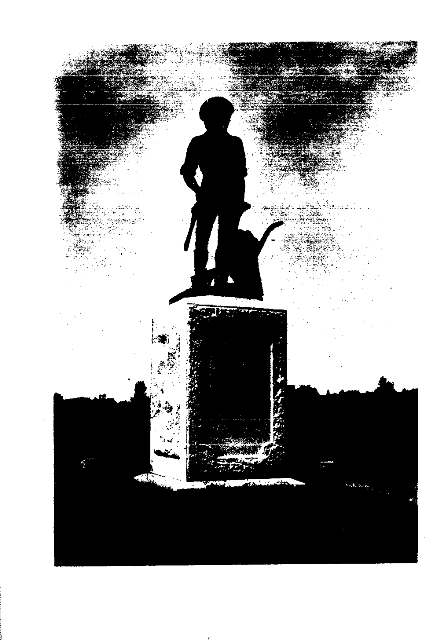
CONCORD MONUMENT.
Marking the Battle Field of April 19, 1775. From a Photograph.
TRANSCRIBER'S NOTES
1. Images have been moved from the middle of a paragraph to the closest paragraph break. Also the footnotes have been moved to the end of the chapter in which they are referred.
2. The illustrations "Gothic Bible of Ulfilas" and "Egyptian Hieroglyphic Writing" mentioned in "Full-Page Illustrations" list are missing.
3. The original text includes Greek characters. For this HTML version these letters have been replaced with transliterations.
4. Other than the corrections listed above, printer's inconsistencies in spelling, punctuation, hyphenation, and ligature usage have been retained.