Volume 13 / Part 4 — GEORGE ELIOT (continued 2)
Reading edition
The fact that it was churning day was another reason why it was inconvenient to have the whittaws, and why, consequently, Mrs. Poyser should scold Molly the housemaid with unusual severity. To all appearance Molly had got through her after-dinner work in an exemplary manner, had "cleaned herself" with great dispatch, and now came to ask submissively if she should sit down to her spinning till milking-time. But this blameless conduct, according to Mrs. Poyser, shrouded a secret indulgence of unbecoming wishes, which she now dragged forth and held up to Molly's view with cutting eloquence.
"Spinning, indeed! It isn't spinning as you'd be at, I'll be bound, and let you have your own way. I never knew your equals for gallowsness. To think of a gell o' your age wanting to go and sit with half-a-dozen men! I'd ha' been ashamed to let the words pass over my lips if I'd been you. And you, as have been here ever since last Michaelmas, and I hired you at Treddles'on stattits, without a bit o' character—as I say, you might be grateful to be hired in that way to a respectable place; and you knew no more o' what belongs to work when you come here than the mawkin i' the field. As poor a two-fisted thing as ever I saw, you know you was. Who taught you to scrub a floor, I should like to know? Why, you'd leave the dirt in heaps i' the corners—anybody 'ud think you'd never been brought up among Christians. And as for spinning, why you've wasted as much as your wage i' the flax you've spoiled learning to spin. And you've a right to feel that, and not to go about as gaping and as thoughtless as if you was beholding to nobody. Comb the wool for the whittaws, indeed! That's what you'd like to be doing, is it? That's the way with you—that's the road you'd all like to go, headlongs to ruin. You're never easy till you've got some sweetheart as is as big a fool as yourself: you think you'll be finely off when you're married, I dare say, and have got a three-legged stool to sit on, and never a blanket to cover you, and a bit o' oat-cake for your dinner, as three children are a-snatching at."
"I'm sure I donna want t' go wi' the whittaws," said Molly, whimpering, and quite overcome by this Dantean picture of her future; "on'y we allays used to comb the wool for 'n at Mester Ottley's, an' so I just asked ye. I donna want to set eyes on the whittaws again; I wish I may never stir if I do."
"Mr. Ottley's, indeed! It's fine talking o' what you did at Mr. Ottley's. Your missis there might like her floors dirted wi' whittaws for what I know. There's no knowing what people wonna like—such ways as I've heard of! I never had a gell come into my house as seemed to know what cleaning was; I think people live like pigs, for my part. And as to that Betty as was dairymaid at Trent's before she come to me, she'd ha' left the cheeses without turning from week's end to week's end; and the dairy thralls, I might ha' wrote my name on 'em, when I come down-stairs after my illness, as the doctor said it was inflammation—it was a mercy I got well of it. And to think o' your knowing no better, Molly, and been here a-going i' nine months, and not for want o' talking to, neither;—and what are you stanning there for, like a jack as is run down, instead o' getting your wheel out? You're a rare un for sitting down to your work a little while after it's time to put by."
"Munny, my iron's twite told; pease put it down to warm."
The small chirruping voice that uttered this request came from a little sunny-haired girl between three and four, who, seated on a high chair at the end of the ironing-table, was arduously clutching the handle of a miniature iron with her tiny fat fist, and ironing rags with an assiduity that required her to put her little red tongue out as far as anatomy would allow.
"Cold, is it, my darling? Bless your sweet face!" said Mrs. Poyser, who was remarkable for the facility with which she could relapse from her official objurgatory to one of fondness or of friendly converse. "Never mind! Mother's done her ironing now. She's going to put the ironing things away."
"Munny, I tould 'ike to do into de barn to Tommy, to see de whittawd."
"No, no, no; Totty 'ud get her feet wet," said Mrs. Poyser, carrying away her iron. "Run into the dairy and see Cousin Hetty make the butter."
"I tould 'ike a bit of pum-take," rejoined Totty, who seemed to be provided with several relays of requests; at the same time taking the opportunity of her momentary leisure to put her fingers into a bowl of starch and drag it down so as to empty the contents with tolerable completeness on to the ironing-sheet.
"Did ever anybody see the like?" screamed Mrs. Poyser, running towards the table when her eye had fallen on the blue stream. "The child's allays i' mischief if your back's turned a minute. What shall I do to you, you naughty, naughty gell?"
Totty, however, had descended from her chair with great swiftness, and was already in retreat towards the dairy with a sort of waddling run, and an amount of fat on the nape of her neck which made her look like the metamorphosis of a white sucking pig.
The starch having been wiped up by Molly's help, and the ironing apparatus put by, Mrs. Poyser took up her knitting, which always lay ready at hand and was the work she liked best, because she could carry it on automatically as she walked to and fro. But now she came and sat down opposite Dinah, whom she looked at in a meditative way, as she knitted her gray worsted stocking.
"You look th' image o' your Aunt Judith, Dinah, when you sit a-sewing. I could almost fancy it was thirty years back, and I was a little gell at home, looking at Judith as she sat at her work after she'd done the house up; only it was a little cottage, father's was, and not a big rambling house as gets dirty i' one corner as fast as you clean it in another; but for all that I could fancy you was your Aunt Judith, only her hair was a deal darker than yours, and she was stouter and broader i' the shoulders. Judith and me allays hung together, though she had such queer ways, but your mother and her never could agree. Ah! your mother little thought as she'd have a daughter just cut out after the very pattern o' Judith, and leave her an orphan too, for Judith to take care on, and bring up with a spoon when she was in the grave-yard at Stoniton. I allays said that o' Judith, as she'd bear a pound weight any day to save anybody else carrying a ounce. And she was just the same from the first o' my remembering her; it made no difference in her, as I could see, when she took to the Methodists, only she talked a bit different, and wore a different sort o' cap; but she'd never in her life spent a penny on herself more than keeping herself decent."
"She was a blessed woman," said Dinah: "God had given her a loving, self-forgetting nature, and he perfected it by grace. And she was very fond of you too, Aunt Rachel. I've often heard her talk of you in the same sort of way. When she had that bad illness, and I was only eleven years old, she used to say, 'You'll have a friend on earth in your Aunt Rachel, if I'm taken from you; for she has a kind heart;' and I'm sure I've found it so."
"I don't know how, child; anybody 'ud be cunning to do anything for you, I think; you're like the birds o' th' air, and live nobody knows how. I'd ha' been glad to behave to you like a mother's sister, if you'd come and live i' this country, where there's some shelter and victual for man and beast, and folks don't live on the naked hills, like poultry a-scratching on a gravel bank. And then you might get married to some decent man, and there'd be plenty ready to have you, if you'd only leave off that preaching, as is ten times worse than anything your Aunt Judith ever did. And even if you'd marry Seth Bede, as is a poor wool-gathering Methodist, and's never like to have a penny beforehand, I know your uncle 'ud help you with a pig, and very like a cow, for he's allays been good-natur'd to my kin, for all they're poor, and made 'em welcome to the house; and 'ud do for you, I'll be bound, as much as ever he'd do for Hetty, though she's his own niece. And there's linen in the house as I could well spare you, for I've got lots o' sheeting, and table-clothing, and toweling, as isn't made up. There's a piece o' sheeting I could give you as that squinting Kitty spun—she was a rare girl to spin, for all she squinted and the children couldn't abide her; and you know the spinning's going on constant, and there's new linen wove twice as fast as the old wears out. But where's the use o' talking, if ye wonna be persuaded, and settle down like any other woman in her senses, i'stead o' wearing yourself out with walking and preaching, and giving away every penny you get, so as you've nothing saved against sickness; and all the things you've got i' the world, I verily believe, 'ud go into a bundle no bigger nor a double cheese. And all because you've got notions i' your head about religion more nor what's i' the Catechism and the Prayer-book."
"But not more than what's in the Bible, Aunt," said Dinah.
"Yes, and the Bible too, for that matter," Mrs. Poyser rejoined rather sharply; "else why shouldn't them as know best what's in the Bible—the parsons and people as have got nothing to do but learn it—do the same as you do? But for the matter o' that, if everybody was to do like you, the world must come to a standstill; for if everybody tried to do without house and home, and with poor eating and drinking, and was allays talking as we must despise the things o' the world, as you say, I should like to know where the pick o' the stock, and the corn, and the best new-milk cheeses 'ud have to go. Everybody 'ud be wanting bread made o' tail ends, and everybody 'ud be running after everybody else to preach to 'em, istead o' bringing up their families, and laying by against a bad harvest. It stands to sense as that can't be the right religion."
"Nay, dear Aunt, you never heard me say that all people are called to forsake their work and their families. It's quite right the land should be plowed and sowed, and the precious corn stored, and the things of this life cared for, and right that people should rejoice in their families, and provide for them; so that this is done in the fear of the Lord, and that they are not unmindful of the soul's wants while they are caring for the body. We can all be servants of God wherever our lot is cast, but he gives us different sorts of work, according as he fits us for it and calls us to it. I can no more help spending my life in trying to do what I can for the souls of others, than you could help running if you heard little Totty crying at the other end of the house; the voice would go to your heart, you would think the dear child was in trouble or in danger, and you couldn't rest without running to help her and comfort her."
"Ah," said Mrs. Poyser, rising and walking towards the door, "I know it 'ud be just the same if I was to talk to you for hours. You'd make me the same answer, at th' end. I might as well talk to the running brook, and tell it to stan' still."
The causeway outside the kitchen door was dry enough now for Mrs. Poyser to stand there quite pleasantly and see what was going on in the yard, the gray worsted stocking making a steady progress in her hands all the while. But she had not been standing there more than five minutes before she came in again, and said to Dinah in rather a flurried, awe-stricken tone:—
"If there isn't Captain Donnithorne and Mr. Irwine a-coming into the yard! I'll lay my life they're come to speak about your preaching on the Green, Dinah; it's you must answer 'em, for I'm dumb. I've said enough a'ready about your bringing such disgrace upo' your uncle's family. I wouldn't ha' minded if you'd been Mr. Poyser's own niece—folks must put up wi' their own kin, as they put up wi' their own noses; it's their own flesh and blood. But to think of a niece o' mine being cause o' my husband's being turned out of his farm, and me brought him no fortin but my savins—"
"Nay, dear Aunt Rachel," said Dinah gently, "you've no cause for such fears. I've strong assurance that no evil will happen to you and my uncle and the children from anything I've done. I didn't preach without direction."
"Direction! I know very well what you mean by direction," said Mrs. Poyser, knitting in a rapid and agitated manner. "When there's a bigger maggot than usial in your head you call it 'direction'; and then nothing can stir you—you look like the statty o' the outside o' Treddles'on church, a-starin' and a-smilin' whether it's fair weather or foul. I hanna common patience with you."
By this time the two gentlemen had reached the palings and had got down from their horses: it was plain they meant to come in. Mrs. Poyser advanced to the door to meet them, curtseying low, and trembling between anger with Dinah and anxiety to conduct herself with perfect propriety on the occasion. For in those days the keenest of bucolic minds felt a whispering awe at the sight of the gentry, such as of old men felt when they stood on tiptoe to watch the gods passing by in tall human shape.
"Well, Mrs. Poyser, how are you after this stormy morning?" said Mr. Irwine with his stately cordiality. "Our feet are quite dry; we shall not soil your beautiful floor."
"Oh, sir, don't mention it," said Mrs. Poyser. "Will you and the captain please to walk into the parlor?"
"No, indeed, thank you, Mrs. Poyser," said the captain, looking eagerly round the kitchen, as if his eye were seeking something it could not find. "I delight in your kitchen. I think it is the most charming room I know. I should like every farmer's wife to come and look at it for a pattern."
"Oh, you're pleased to say so, sir. Pray take a seat," said Mrs. Poyser, relieved a little by this compliment and the captain's evident good-humor, but still glancing anxiously at Mr. Irwine, who she saw was looking at Dinah and advancing towards her.
"Poyser is not at home, is he?" said Captain Donnithorne, seating himself where he could see along the short passage to the open dairy door.
"No, sir, he isn't; he's gone to Rosseter to see Mr. West, the factor, about the wool. But there's father i' the barn, sir, if he'd be of any use."
"No, thank you; I'll just look at the whelps and leave a message about them with your shepherd. I must come another day and see your husband; I want to have a consultation with him about horses. Do you know when he's likely to be at liberty?"
"Why, sir, you can hardly miss him, except it's o' Treddles'on market-day—that's of a Friday, you know. For if he's anywhere on the farm we can send for him in a minute. If we'd got rid of the Scantlands we should have no outlying fields; and I should be glad of it, for if ever anything happens he's sure to be gone to the Scantlands. Things allays happen so contrairy, if they've a chance; and it's an unnat'ral thing to have one bit o' your farm in one county and all the rest in another."
"Ah, the Scantlands would go much better with Choyce's farm, especially as he wants dairy land and you've got plenty. I think yours is the prettiest farm on the estate, though; and do you know, Mrs. Poyser, if I were going to marry and settle, I should be tempted to turn you out, and do up this fine old house, and turn farmer myself."
"Oh, sir," said Mrs. Poyser, rather alarmed, "you wouldn't like it at all. As for farming, it's putting money into your pocket wi' your right hand and fetching it out wi' your left. As fur as I can see, it's raising victual for other folks, and just getting a mouthful for yourself and your children as you go along. Not as you'd be like a poor man as wants to get his bread: you could afford to lose as much money as you liked i' farming; but it's poor fun losing money, I should think, though I understan' it's what the great folks i' London play at more than anything. For my husband heard at market as Lord Dacey's eldest son had lost thousands upo' thousands to the Prince o' Wales, and they say my lady was going to pawn her jewels to pay for him. But you know more about that than I do, sir. But as for farming, sir, I canna think as you'd like it; and this house—the draughts in it are enough to cut you through, and it's my opinion the floors up-stairs are very rotten, and the rats i' the cellar are beyond anything."
"Why, that's a terrible picture, Mrs. Poyser. I think I should be doing you a service to turn you out of such a place. But there's no chance of that. I'm not likely to settle for the next twenty years, till I'm a stout gentleman of forty; and my grandfather would never consent to part with such good tenants as you."
"Well, sir, if he thinks so well o' Mr. Poyser for a tenant, I wish you could put in a word for him to allow us some new gates for the Five Closes, for my husband's been asking and asking till he's tired; and to think o' what he's done for the farm; and's never had a penny allowed him, be the times bad or good. And as I've said to my husband often and often, I'm sure if the captain had anything to do with it, it wouldn't be so. Not as I wish to speak disrespectful o' them as have got the power i' their hands, but it's more than flesh and blood 'ull bear sometimes, to be toiling and striving, and up early and down late, and hardly sleeping a wink when you lie down for thinking as the cheese may swell, or the cows may slip their calf, or the wheat may grow green again i' the sheaf—and after all, at th' end o' the year, it's like as if you'd been cooking a feast and had got the smell of it for your pains."
Mrs. Poyser, once launched into conversation, always sailed along without any check from her preliminary awe of the gentry. The confidence she felt in her own powers of exposition was a motive force that overcame all resistance.
"I'm afraid I should only do harm instead of good, if I were to speak about the gates, Mrs. Poyser," said the captain; "though I assure you there's no man on the estate I would sooner say a word for than your husband. I know his farm is in better order than any other within ten miles of us; and as for the kitchen," he added, smiling, "I don't believe there's one in the kingdom to beat it. By-the-by, I've never seen your dairy: I must see your dairy, Mrs. Poyser."
"Indeed, sir, it's not fit for you to go in, for Hetty's in the middle o' making the butter, for the churning was thrown late, and I'm quite ashamed." This Mrs. Poyser said blushing, and believing that the captain was really interested in her milkpans, and would adjust his opinion of her to the appearance of her dairy.
"Oh, I've no doubt it's in capital order. Take me in," said the captain, leading the way, while Mrs. Poyser followed.
MRS. POYSER "HAS HER SAY OUT"
From 'Adam Bede'
Something unwonted must clearly be in the wind, for the old Squire's visits to his tenantry were rare; and though Mrs. Poyser had during the last twelvemonth recited many imaginary speeches, meaning even more than met the ear, which she was quite determined to make to him the next time he appeared within the gates of the Hall Farm, the speeches had always remained imaginary.
"Good-day, Mrs. Poyser," said the old Squire, peering at her with his short-sighted eyes—a mode of looking at her which, as Mrs. Poyser observed, "allays aggravated her: it was as if you was a insect, and he was going to dab his finger-nail on you."
However, she said, "Your servant, sir," and curtsied with an air of perfect deference as she advanced towards him; she was not the woman to misbehave towards her betters, and fly in the face of the Catechism, without severe provocation.
"Is your husband at home, Mrs. Poyser?"
"Yes, sir; he's only i' the rick-yard. I'll send for him in a minute, if you'll please to get down and step in."
"Thank you; I will do so. I want to consult him about a little matter; but you are quite as much concerned in it, if not more. I must have your opinion too."
"Hetty, run and tell your uncle to come in," said Mrs. Poyser as they entered the house, and the old gentleman bowed low in answer to Hetty's curtsy; while Totty, conscious of a pinafore stained with gooseberry jam, stood hiding her face against the clock, and peeping round furtively.
"What a fine old kitchen this is!" said Mr. Donnithorne, looking round admiringly. He always spoke in the same deliberate, well-chiseled, polite way, whether his words were sugary or venomous. "And you keep it so exquisitely clean, Mrs. Poyser. I like these premises, do you know, beyond any on the estate."
"Well, sir, since you're fond of 'em, I should be glad if you'd let a bit o' repairs be done to 'em, for the boarding's i' that state as we're like to be eaten up wi' rats and mice; and the cellar, you may stan' up to your knees i' water in 't, if you like to go down; but perhaps you'd rather believe my words. Won't you please to sit down, sir?"
"Not yet; I must see your dairy. I have not seen it for years, and I hear on all hands about your fine cheese and butter," said the Squire, looking politely unconscious that there could be any question on which he and Mrs. Poyser might happen to disagree. "I think I see the door open there: you must not be surprised if I cast a covetous eye on your cream and butter. I don't expect that Mrs. Satchell's cream and butter will bear comparison with yours."
"I can't say, sir, I'm sure. It's seldom I see other folks' butter, though there's some on it as one's no need to see—the smell's enough."
"Ah, now this I like," said Mr. Donnithorne, looking round at the damp temple of cleanliness, but keeping near the door. "I'm sure I should like my breakfast better if I knew the butter and cream came from this dairy. Thank you, that really is a pleasant sight. Unfortunately, my slight tendency to rheumatism makes me afraid of damp; I'll sit down in your comfortable kitchen. Ah, Poyser, how do you do? In the midst of business, I see, as usual. I've been looking at your wife's beautiful dairy: the best manager in the parish, is she not?"
Mr. Poyser had just entered in shirt-sleeves and open waistcoat, with a face a shade redder than usual, from the exertion of "pitching." As he stood, red, rotund, and radiant, before the small, wiry, cool old gentleman, he looked like a prize apple by the side of a withered crab.
"Will you please to take this chair, sir?" he said, lifting his father's arm-chair forward a little; "you'll find it easy."
"No, thank you, I never sit in easy-chairs," said the old gentleman, seating himself on a small chair near the door. "Do you know, Mrs. Poyser—sit down, pray, both of you—I've been far from contented, for some time, with Mrs. Satchell's dairy management. I think she has not a good method, as you have."
"Indeed, sir, I can't speak to that," said Mrs. Poyser, in a hard voice, rolling and unrolling her knitting, and looking icily out of the window, as she continued to stand opposite the Squire. Poyser might sit down if he liked, she thought: she wasn't going to sit down, as if she'd give in to any such smooth-tongued palaver. Mr. Poyser, who looked and felt the reverse of icy, did sit down in his three-cornered chair.
"And now, Poyser, as Satchell is laid up, I am intending to let the Chase Farm to a respectable tenant. I'm tired of having a farm on my own hands—nothing is made the best of in such cases, as you know. A satisfactory bailiff is hard to find; and I think you and I, Poyser, and your excellent wife here, can enter into a little arrangement in consequence, which will be to our mutual advantage."
"Oh," said Mr. Poyser, with a good-natured blankness of imagination as to the nature of the arrangement.
"If I'm called upon to speak, sir," said Mrs. Poyser, after glancing at her husband with pity at his softness, "you know better than me; but I don't see what the Chase Farm is t' us—we've cumber enough wi' our own farm. Not but what I'm glad to hear o' anybody respectable coming into the parish: there's some as ha' been brought in as hasn't been looked on i' that character."
"You're likely to find Mr. Thurle an excellent neighbor, I assure you: such a one as you will feel glad to have accommodated by the little plan I'm going to mention; especially as I hope you will find it as much to your own advantage as his."
"Indeed, sir, if it's anything t' our advantage, it'll be the first offer o' the sort I've heared on. It's them as take advantage that get advantage i' this world, I think: folks have to wait long enough afore it's brought to 'em."
"The fact is, Poyser," said the Squire, ignoring Mrs. Poyser's theory of worldly prosperity, "there is too much dairy land, and too little plow land, on the Chase Farm, to suit Thurle's purpose—indeed, he will only take the farm on condition of some change in it: his wife, it appears, is not a clever dairywoman like yours. Now, the plan I'm thinking of is to effect a little exchange. If you were to have the Hollow Pastures, you might increase your dairy, which must be so profitable under your wife's management; and I should request you, Mrs. Poyser, to supply my house with milk, cream, and butter, at the market prices. On the other hand, Poyser, you might let Thurle have the Lower and Upper Ridges, which really, with our wet seasons would be a good riddance for you. There is much less risk in dairy land than corn land."
Mr. Poyser was leaning forward, with his elbows on his knees, his head on one side, and his mouth screwed up—apparently absorbed in making the tips of his fingers meet so as to represent with perfect accuracy the ribs of a ship. He was much too acute a man not to see through the whole business, and to foresee perfectly what would be his wife's view of the subject; but he disliked giving unpleasant answers: unless it was on a point of farming practice, he would rather give up than have a quarrel, any day; and after all, it mattered more to his wife than to him. So, after a few moments' silence, he looked up at her and said mildly, "What dost say?"
Mrs. Poyser had had her eyes fixed on her husband with cold severity during his silence, but now she turned away her head with a toss, looked icily at the opposite roof of the cow-shed, and spearing her knitting together with the loose pin, held it firmly between her clasped hands.
"Say? Why, I say you may do as you like about giving up any o' your corn land afore your lease is up, which it won't be for a year come next Michaelmas, but I'll not consent to take more dairy work into my hands, either for love or money; and there's nayther love nor money here, as I can see, on'y other folks' love o' theirselves, and the money as is to go into other folks' pockets. I know there's them as is born t' own the land, and them as is born to sweat on 't"—here Mrs. Poyser paused to gasp a little—"and I know it's christened folks' duty to submit to their betters as fur as flesh and blood 'ull bear it; but I'll not make a martyr o' myself, and wear myself to skin and bone, and worret myself as if I was a churn wi' butter a-coming in 't, for no landlord in England, not if he was King George himself."
"No, no, my dear Mrs. Poyser, certainly not," said the Squire, still confident in his own powers of persuasion; "you must not overwork yourself; but don't you think your work will rather be lessened than increased in this way? There is so much milk required at the Abbey, that you will have little increase of cheese and butter making from the addition to your dairy; and I believe selling the milk is the most profitable way of disposing of dairy produce, is it not?"
"Ay, that's true," said Mr. Poyser, unable to repress an opinion on a question of farming profits, and forgetting that it was not in this case a purely abstract question.
"I dare say," said Mrs. Poyser bitterly, turning her head half-way towards her husband, and looking at the vacant arm-chair—"I dare say it's true for men as sit i' th' chimney-corner and make believe as everything's cut wi' ins an' outs to fit int' everything else. If you could make a pudding wi' thinking o' the batter, it 'ud be easy getting dinner. How do I know whether the milk 'ull be wanted constant? What's to make me sure as the house won't be put o' board wage afore we're many months older, and then I may have to lie awake o' nights wi' twenty gallons o' milk on my mind—and Dingall 'ull take no more butter, let alone paying for it; and we must fat pigs till we're obliged to beg the butcher on our knees to buy 'em, and lose half of 'em wi' the measles. And there's the fetching and carrying, as 'ud be welly half a day's work for a man an' hoss—that's to be took out o' the profits, I reckon? But there's folks 'ud hold a sieve under the pump and expect to carry away the water."
"That difficulty—about the fetching and carrying—you will not have, Mrs. Poyser," said the Squire, who thought that this entrance into particulars indicated a distant inclination to compromise on Mrs. Poyser's part—"Bethell will do that regularly with the cart and pony."
"Oh, sir, begging your pardon, I've never been used t' having gentlefolks' servants coming about my back places, a-making love to both the gells at once, and keeping 'em with their hands on their hips listening to all manner o' gossip when they should be down on their knees a-scouring. If we're to go to ruin, it shanna be wi' having our back kitchen turned into a public."
"Well, Poyser," said the Squire, shifting his tactics, and looking as if he thought Mrs. Poyser had suddenly withdrawn from the proceedings and left the room, "you can turn the Hollows into feeding land. I can easily make another arrangement about supplying my house. And I shall not forget your readiness to accommodate your landlord as well as a neighbor. I know you will be glad to have your lease renewed for three years when the present one expires; otherwise, I dare say, Thurle, who is a man of some capital, would be glad to take both the farms, as they could be worked so well together. But I don't want to part with an old tenant like you."
To be thrust out of the discussion in this way would have been enough to complete Mrs. Poyser's exasperation, even without the final threat. Her husband, really alarmed at the possibility of their leaving the old place where he had been bred and born—for he believed the old Squire had small spite enough for anything—was beginning a mild remonstrance explanatory of the inconvenience he should find in having to buy and sell more stock, with—
"Well, sir, I think as it's rather hard—" when Mrs. Poyser burst in with the desperate determination to have her say out this once, though it were to rain notices to quit, and the only shelter were the workhouse.
"Then, sir, if I may speak—as, for all I'm a woman, and there's folks as thinks a woman's fool enough to stan' by an' look on while the men sign her soul away, I've a right to speak, for I make one quarter o' the rent, and save another quarter—I say, if Mr. Thurle's so ready to take farms under you, it's a pity but what he should take this, and see if he likes to live in a house wi' all the plagues o' Egypt in 't—wi' the cellar full o' water, and frogs and toads hoppin' up the steps by dozens—and the floors rotten, and the rats and mice gnawing every bit o' cheese, and runnin' over our heads as we lie i' bed till we expect 'em to eat us up alive—as it's a mercy they hanna eat the children long ago. I should like to see if there's another tenant besides Poyser as 'ud put up wi' never having a bit o' repairs done till a place tumbles down—and not then, on'y wi' begging and praying, and having to pay half—and being strung up wi' the rent as it's much if he gets enough out o' the land to pay, for all he's put his own money into the ground beforehand. See if you'll get a stranger to lead such a life here as that: a maggot must be born i' the rotten cheese to like it, I reckon. You may run away from my words, sir," continued Mrs. Poyser, following the old Squire beyond the door—for after the first moments of stunned surprise he had got up, and waving his hand towards her with a smile, had walked out towards his pony. But it was impossible for him to get away immediately, for John was walking the pony up and down the yard, and was some distance from the causeway when his master beckoned—
"You may run away from my words, sir, and you may go spinnin' underhand ways o' doing us a mischief, for you've got Old Harry to your friend, though nobody else is; but I tell you for once as we're not dumb creatures to be abused and made money on by them as ha' got the lash i' their hands, for want o' knowing how t' undo the tackle. An' if I'm th' only one as speaks my mind, there's plenty o' the same way o' thinking i' this parish and the next to 't, for your name 's no better than a brimstone match in everybody's nose—if it isna two-three old folks as you think o' saving your soul by giving 'em a bit o' flannel and a drop o' porridge. An' you may be right i' thinking it'll take but little to save your soul, for it'll be the smallest savin' y' iver made, wi' all your scrapin'."
There are occasions on which two servant-girls and a wagoner may be a formidable audience, and as the Squire rode away on his black pony, even the gift of short-sightedness did not prevent him from being aware that Molly and Nancy and Tim were grinning not far from him. Perhaps he suspected that sour old John was grinning behind him—which was also the fact. Meanwhile the bull-dog, the black-and-tan terrier, Alick's sheep-dog, and the gander hissing at a safe distance from the pony's heels, carried out the idea of Mrs. Poyser's solo in an impressive quartet.
Mrs. Poyser, however, had no sooner seen the pony moved off than she turned round, gave the two hilarious damsels a look which drove them into the back kitchen, and unspearing her knitting, began to knit again with her usual rapidity, as she re-entered the house.
"Thee'st done it now," said Mr. Poyser, a little alarmed and uneasy, but not without some triumphant amusement at his wife's outbreak.
"Yes, I know I've done it," said Mrs. Poyser; "but I've had my say out, and I shall be th' easier for 't all my life. There's no pleasure i' living if you're to be corked up forever, and only dribble your mind out by the sly like a leaky barrel. I shan't repent saying what I think, if I live to be as old as th' old Squire; and there's little likelihoods—for it seems as if them as aren't wanted here are th' only folks as aren't wanted i' th' other world."
"But thee wutna like moving from th' old place, this Michaelmas twelvemonth," said Mr. Poyser, "and going into a strange parish, where thee know'st nobody. It'll be hard upon us both, and upo' father too.'"
"Eh, it's no use worreting; there's plenty o' things may happen between this and Michaelmas twelvemonth. The captain may be master afore then, for what we know," said Mrs. Poyser, inclined to take an unusually hopeful view of an embarrassment which had been brought about by her own merit, and not by other people's fault.
"I'm none for worreting," said Mr. Poyser, rising from his three-cornered chair, and walking slowly towards the door; "but I should be loath to leave th' old place, and the parish where I was bred and born, and father afore me. We should leave our roots behind us, I doubt, and niver thrive again."
THE PRISONERS
From 'Romola'
In 1493 the rumor spread and became louder and louder that Charles the Eighth of France was about to cross the Alps with a mighty army; and the Italian populations, accustomed, since Italy had ceased to be the heart of the Roman empire, to look for an arbitrator from afar, began vaguely to regard his coming as a means of avenging their wrongs and redressing their grievances.
And in that rumor Savonarola had heard the assurance that his prophecy was being verified. What was it that filled the ears of the prophets of old but the distant tread of foreign armies, coming to do the work of justice? He no longer looked vaguely to the horizon for the coming storm: he pointed to the rising cloud. The French army was that new deluge which was to purify the earth from iniquity; the French King, Charles VIII, was the instrument elected by God as Cyrus had been of old, and all men who desired good rather than evil were to rejoice in his coming. For the scourge would fall destructively on the impenitent alone. Let any city of Italy, let Florence above all—Florence beloved of God, since to its ear the warning voice had been specially sent—repent and turn from its ways like Nineveh of old, and the storm cloud would roll over it and leave only refreshing rain-drops.
Fra Girolamo's word was powerful; yet now that the new Cyrus had already been three months in Italy, and was not far from the gates of Florence, his presence was expected there with mixed feelings, in which fear and distrust certainly predominated. At present it was not understood that he had redressed any grievances; and the Florentines clearly had nothing to thank him for. He held their strong frontier fortresses, which Piero de' Medici had given up to him without securing any honorable terms in return; he had done nothing to quell the alarming revolt of Pisa, which had been encouraged by his presence to throw off the Florentine yoke; and "orators," even with a prophet at their head, could win no assurance from him, except that he would settle everything when he was once within the walls of Florence. Still, there was the satisfaction of knowing that the exasperating Piero de' Medici had been fairly pelted out for the ignominious surrender of the fortresses, and in that act of energy the spirit of the Republic had recovered some of its old fire.
The preparations for the equivocal guest were not entirely those of a city resigned to submission. Behind the bright drapery and banners symbolical of joy, there were preparations of another sort made with common accord by government and people. Well hidden within walls there were hired soldiers of the Republic, hastily called in from the surrounding districts; there were old arms duly furbished, and sharp tools and heavy cudgels laid carefully at hand, to be snatched up on short notice; there were excellent boards and stakes to form barricades upon occasion, and a good supply of stones to make a surprising hail from the upper windows. Above all, there were people very strongly in the humor for fighting any personage who might be supposed to have designs of hectoring over them, they having lately tasted that new pleasure with much relish. This humor was not diminished by the sight of occasional parties of Frenchmen, coming beforehand to choose their quarters, with a hawk, perhaps, on their left wrist, and metaphorically speaking, a piece of chalk in their right hand to mark Italian doors withal; especially as creditable historians imply that many sons of France were at that time characterized by something approaching to a swagger, which must have whetted the Florentine appetite for a little stone-throwing.
And this was the temper of Florence on the morning of the 17th of November, 1494.
The sky was gray, but that made little difference in the Piazza del Duomo, which was covered with its holiday sky of blue drapery, and its constellations of yellow lilies and coats of arms. The sheaves of banners were unfurled at the angles of the Baptistery, but there was no carpet yet on the steps of the Duomo, for the marble was being trodden by numerous feet that were not at all exceptional. It was the hour of the Advent sermons, and the very same reasons which had flushed the streets with holiday color were reasons why the preaching in the Duomo could least of all be dispensed with.
But not all the feet in the Piazza were hastening towards the steps. People of high and low degree were moving to and fro with the brisk pace of men who had errands before them; groups of talkers were thickly scattered, some willing to be late for the sermon, and others content not to hear it at all.
The expression on the faces of these apparent loungers was not that of men who are enjoying the pleasant laziness of an opening holiday. Some were in close and eager discussion; others were listening with keen interest to a single spokesman, and yet from time to time turned round with a scanning glance at any new passer-by. At the corner looking towards the Via de' Cerrettani—just where the artificial rainbow light of the Piazza ceased, and the gray morning fell on the sombre stone houses—there was a remarkable cluster of the working people, most of them bearing on their dress or persons the signs of their daily labor, and almost all of them carrying some weapon, or some tool which might serve as a weapon upon occasion. Standing in the gray light of the street, with bare brawny arms and soiled garments, they made all the more striking the transition from the brightness of the Piazza. They were listening to the thin notary, Ser Cioni, who had just paused on his way to the Duomo. His biting words could get only a contemptuous reception two years and a half before in the Mercato; but now he spoke with the more complacent humor of a man whose party is uppermost, and who is conscious of some influence with the people.
"Never talk to me," he was saying in his incisive voice, "never talk to me of bloodthirsty Swiss or fierce French infantry; they might as well be in the narrow passes of the mountains as in our streets; and peasants have destroyed the finest armies of our condottieri in time past, when they had once got them between steep precipices. I tell you, Florentines need be afraid of no army in their own streets."
"That's true, Ser Cioni," said a man whose arms and hands were discolored by crimson dye, which looked like blood-stains, and who had a small hatchet stuck in his belt; "and those French cavaliers who came in squaring themselves in their smart doublets the other day, saw a sample of the dinner we could serve up for them. I was carrying my cloth in Ognissanti, when I saw my fine Messeri going by, looking round as if they thought the houses of the Vespucci and the Agli a poor pick of loadings for them, and eyeing us Florentines, like top-knotted cocks as they are, as if they pitied us because we didn't know how to strut. 'Yes, my fine Galli,' says I, 'stick out your stomachs; I've got a meat-axe in my belt that will go inside you all the easier;' when presently the old cow lowed,[A] and I knew something had happened—no matter what. So I threw my cloth in at the first doorway, and took hold of my meat-axe and ran after my fine cavaliers towards the Vigna Nuova. And, 'What is it, Guccio?' said I, when he came up with me. 'I think it's the Medici coming back,' said Guccio. Bembè! I expected so! And up we reared a barricade, and the Frenchmen looked behind and saw themselves in a trap; and up comes a good swarm of our Ciompi,[B] and one of them with a big scythe he had in his hand mowed off one of the fine cavaliers' feathers:—it's true! And the lasses peppered a few stones down to frighten them. However, Piero de' Medici wasn't come after all; and it was a pity; for we'd have left him neither legs nor wings to go away with again."
"Well spoken, Oddo," said a young butcher, with his knife at his belt; "and it's my belief Piero will be a good while before he wants to come back, for he looked as frightened as a hunted chicken when we hustled and pelted him in the piazza. He's a coward, else he might have made a better stand when he'd got his horsemen. But we'll swallow no Medici any more, whatever else the French king wants to make us swallow."
"But I like not those French cannon they talk of," said Goro, none the less fat for two years' additional grievances. "San Giovanni defend us! If Messer Domeneddio means so well by us as your Frate says he does, Ser Cioni, why shouldn't he have sent the French another way to Naples?"
"Ay, Goro," said the dyer; "that's a question worth putting. Thou art not such a pumpkin-head as I took thee for. Why, they might have gone to Naples by Bologna, eh, Ser Cioni?—or if they'd gone to Arezzo—we wouldn't have minded their going to Arezzo."
"Fools! It will be for the good and glory of Florence," Ser Cioni began. But he was interrupted by the exclamation, "Look there!" which burst from several voices at once, while the faces were all turned to a party who were advancing along the Via de' Cerretani.
"It's Lorenzo Tornabuoni, and one of the French noblemen who are in his house," said Ser Cioni, in some contempt at this interruption. "He pretends to look well satisfied—that deep Tornabuoni—but he's a Medicean in his heart; mind that."
The advancing party was rather a brilliant one, for there was not only the distinguished presence of Lorenzo Tornabuoni, and the splendid costume of the Frenchman with his elaborately displayed white linen and gorgeous embroidery; there were two other Florentines of high birth, in handsome dresses donned for the coming procession, and on the left hand of the Frenchman was a figure that was not to be eclipsed by any amount of intention or brocade—a figure we have often seen before. He wore nothing but black, for he was in mourning; but the black was presently to be covered by a red mantle, for he too was to walk in procession as Latin Secretary to the Ten. Tito Melema had become conspicuously serviceable in the intercourse with the French guests, from his familiarity with Southern Italy and his readiness in the French tongue, which he had spoken in his early youth; and he had paid more than one visit to the French camp at Signa. The lustre of good fortune was upon him; he was smiling, listening, and explaining, with his usual graceful unpretentious ease, and only a very keen eye bent on studying him could have marked a certain amount of change in him which was not to be accounted for by the lapse of eighteen months. It was that change which comes from the final departure of moral youthfulness—from the distinct self-conscious adoption of a part in life. The lines of the face were as soft as ever, the eyes as pellucid; but something was gone—something as indefinable as the changes in the morning twilight.
The Frenchman was gathering instructions concerning ceremonial before riding back to Signa, and now he was going to have a final survey of the Piazza del Duomo, where the royal procession was to pause for religious purposes. The distinguished party attracted the notice of all eyes as it entered the Piazza, but the gaze was not entirely cordial and admiring; there were remarks not altogether allusive and mysterious to the Frenchman's hoof-shaped shoes—delicate flattery of royal superfluity in toes; and there was no care that certain snarlings at "Mediceans" should be strictly inaudible. But Lorenzo Tornabuoni possessed that power of dissembling annoyance which is demanded in a man who courts popularity, and Tito, besides his natural disposition to overcome ill-will by good-humor, had the unimpassioned feeling of the alien towards names and details that move the deepest passions of the native.
Arrived where they could get a good oblique view of the Duomo, the party paused. The festoons and devices placed over the central doorway excited some demur, and Tornabuoni beckoned to Piero di Cosimo, who, as was usual with him at this hour, was lounging in front of Nello's shop. There was soon an animated discussion, and it became highly amusing from the Frenchman's astonishment at Piero's odd pungency of statement, which Tito translated literally. Even snarling onlookers became curious, and their faces began to wear the half-smiling, half-humiliated expression of people who are not within hearing of the joke which is producing infectious laughter. It was a delightful moment for Tito, for he was the only one of the party who could have made so amusing an interpreter, and without any disposition to triumphant self-gratulation he reveled in the sense that he was an object of liking—he basked in approving glances. The rainbow light fell about the laughing group, and the grave church-goers had all disappeared within the walls. It seemed as if the Piazza had been decorated for a real Florentine holiday.
Meanwhile in the gray light of the unadorned streets there were on-comers who made no show of linen and brocade, and whose humor was far from merry. Here too the French dress and hoofed shoes were conspicuous, but they were being pressed upon by a large and larger number of non-admiring Florentines. In the van of the crowd were three men in scanty clothing; each had his hands bound together by a cord, and a rope was fastened round his neck and body in such a way that he who held the extremity of the rope might easily check any rebellious movement by the threat of throttling. The men who held the ropes were French soldiers, and by broken Italian phrases and strokes from the knotted end of the rope, they from time to time stimulated their prisoners to beg. Two of them were obedient, and to every Florentine they had encountered had held out their bound hands and said in piteous tones:—
"For the love of God and the Holy Madonna, give us something towards our ransom! We are Tuscans; we were made prisoners in Lunigiana."
But the third man remained obstinately silent under all the strokes of the knotted cord. He was very different in aspect from his two fellow prisoners. They were young and hardy, and in the scant clothing which the avarice of their captors had left them, looked like vulgar, sturdy mendicants. But he had passed the boundary of old age, and could hardly be less than four or five and sixty. His beard, which had grown long in neglect, and the hair which fell thick and straight round his baldness, were nearly white. His thick-set figure was still firm and upright, though emaciated, and seemed to express energy in spite of age—an expression that was partly carried out in the dark eyes and strong dark eyebrows, which had a strangely isolated intensity of color in the midst of his yellow, bloodless, deep-wrinkled face with its lank gray hairs. And yet there was something fitful in the eyes which contradicted the occasional flash of energy; after looking round with quick fierceness at windows and faces, they fell again with a lost and wandering look. But his lips were motionless, and he held his hands resolutely down. He would not beg.
This sight had been witnessed by the Florentines with growing exasperation. Many standing at their doors or passing quietly along had at once given money—some in half-automatic response to an appeal in the name of God, others in that unquestioning awe of the French soldiery which had been created by the reports of their cruel warfare, and on which the French themselves counted as a guarantee of immunity in their acts of insolence. But as the group had proceeded farther into the heart of the city, that compliance had gradually disappeared, and the soldiers found themselves escorted by a gathering troop of men and boys, who kept up a chorus of exclamations sufficiently intelligible to foreign ears without any interpreter. The soldiers themselves began to dislike their position, for with a strong inclination to use their weapons, they were checked by the necessity for keeping a secure hold on their prisoners, and they were now hurrying along in the hope of finding shelter in a hostelry.
"French dogs!" "Bullock-feet!" "Snatch their pikes from them!" "Cut the cords and make them run for their prisoners. They'll run as fast as geese—don't you see they're web-footed?" These were the cries which the soldiers vaguely understood to be jeers, and probably threats. But every one seemed disposed to give invitations of this spirited kind rather than to act upon them.
"Santiddio! here's a sight!" said the dyer, as soon as he had divined the meaning of the advancing tumult; "and the fools do nothing but hoot. Come along!" he added, snatching his axe from his belt, and running to join the crowd, followed by the butcher and all the rest of his companions except Goro, who hastily retreated up a narrow passage.
The sight of the dyer, running forward with blood-red arms and axe uplifted, and with his cluster of rough companions behind him, had a stimulating effect on the crowd. Not that he did anything else than pass beyond the soldiers and thrust himself well among his fellow-citizens, flourishing his axe; but he served as a stirring symbol of street-fighting, like the waving of a well-known gonfalon. And the first sign that fire was ready to burst out was something as rapid as a little leaping tongue of flame; it was an act of the conjurer's impish lad Lollo, who was dancing and jeering in front of the ingenuous boys that made the majority of the crowd. Lollo had no great compassion for the prisoners, but being conscious of an excellent knife which was his unfailing companion, it had seemed to him from the first that to jump forward, cut a rope, and leap back again before the soldier who held it could use his weapon, would be an amusing and dexterous piece of mischief. And now, when the people began to hoot and jostle more vigorously, Lollo felt that his moment was come: he was close to the eldest prisoner; in an instant he had cut the cord.
"Run, old one!" he piped in the prisoner's ear, as soon as the cord was in two; and himself set the example of running as if he were helped along with wings, like a scared fowl.
The prisoner's sensations were not too slow for him to seize the opportunity; the idea of escape had been continually present with him, and he had gathered fresh hope from the temper of the crowd. He ran at once; but his speed would hardly have sufficed for him if the Florentines had not instantaneously rushed between him and his captor. He ran on into the Piazza, but he quickly heard the tramp of feet behind him, for the other two prisoners had been released, and the soldiers were struggling and fighting their way after them, in such tardigrade fashion as their hoof-shaped shoes would allow—impeded, but not very resolutely attacked, by the people. One of the two younger prisoners turned up the Borgo di San Lorenzo, and thus made a partial diversion of the hubbub; but the main struggle was still towards the Piazza, where all eyes were turned on it with alarmed curiosity. The cause could not be precisely guessed, for the French dress was screened by the impending crowd.
"An escape of prisoners," said Lorenzo Tornabuoni, as he and his party turned round just against the steps of the Duomo, and saw a prisoner rushing by them. "The people are not content with having emptied the Bargello the other day. If there is no other authority in sight they must fall on the sbirri and secure freedom to thieves. Ah! there is a French soldier; that is more serious."
The soldier he saw was struggling along on the north side of the Piazza, but the object of his pursuit had taken the other direction. That object was the eldest prisoner, who had wheeled round the Baptistery and was running towards the Duomo, determined to take refuge in that sanctuary rather than trust to his speed. But in mounting the steps, his foot received a shock; he was precipitated towards the group of signori, whose backs were turned to him, and was only able to recover his balance as he clutched one of them by the arm.
It was Tito Melema who felt that clutch. He turned his head, and saw the face of his adoptive father, Baldassarre Calvo, close to his own.
The two men looked at each other, silent as death: Baldassarre, with dark fierceness and a tightening grip of the soiled worn hands on the velvet-clad arm; Tito, with cheeks and lips all bloodless, fascinated by terror. It seemed a long while to them—it was but a moment.
The first sound Tito heard was the short laugh of Piero di Cosimo, who stood close by him and was the only person that could see his face.
"Ha, ha! I know what a ghost should be now."
"This is another escaped prisoner," said Lorenzo Tornabuoni. "Who is he, I wonder?"
"Some madman, surely," said Tito.
He hardly knew how the words had come to his lips: there are moments when our passions speak and decide for us, and we seem to stand by and wonder. They carry in them an inspiration of crime, that in one instant does the work of premeditation.
The two men had not taken their eyes off each other, and it seemed to Tito, when he had spoken, that some magical poison had darted from Baldassarre's eyes, and that he felt it rushing through his viens. But the next instant the grasp on his arm had relaxed, and Baldassarre had disappeared within the church.
FOOTNOTES
"OH, MAY I JOIN THE CHOIR INVISIBLE"
Oh, may I join the choir invisible Of those immortal dead who live again In minds made better by their presence; live In pulses stirred to generosity, In deeds of daring rectitude, in scorn For miserable aims that end with self, In thoughts sublime that pierce the night like stars, And with their mild persistence urge man's search To vaster issues. So to live is heaven: To make undying music in the world, Breathing as beauteous order, that controls With growing sway the growing life of man. So we inherit that sweet purity For which we struggled, failed, and agonized, With widening retrospect that bred despair. Rebellious flesh that would not be subdued, A vicious parent shaming still its child,— Poor anxious penitence,—is quick dissolved; Its discords, quenched by meeting harmonies, Die in the large and charitable air; And all our rarer, better, truer self, That sobbed religiously in yearning song, That watched to ease the burthen of the world, Laboriously tracing what must be, And what may yet be better—saw within A worthier image for the sanctuary, And shaped it forth before the multitude Divinely human, raising worship so To higher reverence more mixed with love— That better self shall live till human Time Shall fold its eyelids, and the human sky Be gathered like a scroll within the tomb Unread for ever. This is life to come, Which martyred men have made more glorious For us who strive to follow. May I reach That purest heaven; be to other souls The cup of strength in some great agony; Enkindle generous ardor; feed pure love; Beget the smiles that have no cruelty— Be the sweet presence of a good diffused, And in diffusion even more intense. So shall I join the choir invisible Whose music is the gladness of the world.
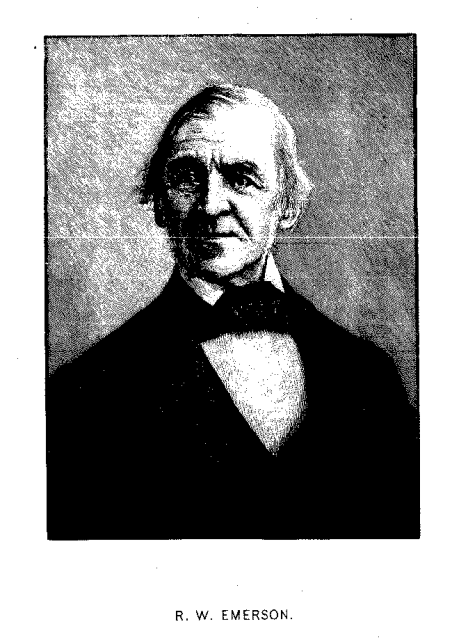
R. W. EMERSON.