Volume 13 / Part 4 — EGYPTIAN LITERATURE (continued 3)
Reading edition
Thou art in my heart, There is none other that knoweth thee but thy son, Fairest of the Forms of Ra, the Only One of Ra[220]; Thou causest him to be exercised in thy methods and in thy might. The whole earth is in thy hand even as thou hast made them; At thy rising all live, at thy setting they die.
Translation of F. Ll. Griffith.
HYMNS TO AMEN RA[221]
The following collection of hymns to Amen Ra is from the orthodox worship of the New Kingdom; that is to say, it dates from the period beginning in the XVIIth Dynasty, about 1700 B.C. The series is contained in a papyrus now preserved in the museum at Gîzeh and in very perfect condition.
In the original, the lines are punctuated with red dots, and the stanzas are marked by rubrics, a very valuable clue being thus provided both as to meanings and form.
The first hymn is divided into five stanzas of seven lines each,[222] but the fourth stanza contains an error of punctuation which has perhaps prevented this arrangement from being noticed hitherto. The other hymns do not appear to be so divisible.
The text presents several instances of embellishment by far-fetched, and to our minds very feeble, puns and punning assonances. It is impossible to reproduce these to the English reader, but some lines in which they occur are here marked with asterisks indicating the words in question.
Although these hymns have been much admired, it must be confessed that they are somewhat arid in comparison with the simple expression of Akhenaten's devotion in the 'Hymn to the Aten.' To the Egyptians, however, the mythological references were full of meaning, while to us they are never fully intelligible. Such an enumeration as that of the symbols and insignia of divine royalty which we find in the second hymn, is as empty to us as references to the Stars and Stripes, the White House, the Spread Eagle, the Union Jack, the Rose, the Shamrock, and the Thistle may be to the lords of the world in 5000 to 6000 A.D.
Praise of Amen Ra! The bull in Heliopolis, the chief of all the gods, The beautiful and beloved god Who giveth life to all warm-blooded things, To all manner of goodly cattle!
I
Hail to thee, Amen Ra! lord of the thrones of the two lands, Thou who dwellest in the sanctuary of Karnak. Bull of his mother, he who dwelleth in his fields, Wide-ranging in the Land of the South. Lord of the Mezau[223], ruler of Punt, Prince of heaven, heir of earth, Lord of all things that exist! Alone in his exploits even amongst the gods, The goodly bull of the Ennead[224] of the gods, Chiefest of all the gods, Lord of truth, father of the gods, Maker of men, creator of animals, Lord of the things which are, maker of fruit-trees, Maker of pasture, who causeth the cattle to live! Image made by Ptah[225], youth fair of love! The gods give praise unto him; Maker of things below and of things above, he illuminateth the two lands: He traverseth the sky in peace. King of Upper and Lower Egypt, Ra the Justified, chief of the two lands. Great one of valor, lord of awe; Chief, making the earth in its entirety! Nobler in thy ways than any god, The gods rejoice in his beauties! To him are given acclamations in the Great House, Glorious celebrations in the House of Flame; The gods love his odor when he cometh from Punt. Prince of the dew, he entereth the land of the Mezau! Fair of face, coming to the Divine Land[226]! The gods gather as dogs at his feet, Even as they recognize his majesty as their lord. Lord of fear, great one of terror, Great of soul, lordly in manifestations, Flourishing of offerings, maker of plenty, Acclamations to thee, maker of the gods, Thou who dost upraise the sky, and press down the ground!
II
Wake in health, Min-Amen! Lord of the everlasting, maker of eternity, Lord of adorations, dwelling in [Khemmis], Established of two horns, fair of face, Lord of the uraeus crown with lofty double plume, Beautiful of diadem, with lofty white crown, The kingly coif with the two uraei are on his forehead. He is adorned within the palace, With the Sekhet crown, the Nemes cap, and the Khepersh helmet. Fair of face, he taketh the Atef crown, Loving its south and its north. Lord of the Sekhemt sceptre, receiving the Ames sceptre, Lord of the Meks sceptre, holding the Nekhekh, Beautiful Ruler, crowned with the white crown! Lord of rays, making light! The gods give praises unto him Who giveth his two hands [for aid] to him that loveth him, Who casteth his enemies in the fire; His eye it is which overthroweth the wicked; It casteth its lance at the devourer of Nu; It causeth the serpent Nak to cast up that which it swallowed. Hail to thee, Ra, lord of truth, Whose sanctuary is hidden! lord of the gods, Khepera in the midst of his bark, He gave command, and the gods were created. Tum, maker of the Rekhyt, Distinguishing their kinds, making their lives, Distinguishing their complexions one from another. Hearing the complaint of him who is oppressed, Kindly of heart when called upon. He delivereth the timid from him who is of a froward heart, He judgeth the cause of the weak and the oppressed. Lord of Understanding, Taste is on his lips, The Nile cometh at his desire. Lord of sweetness, great one of love, He maketh the Rekhyt to live, He giveth keenness to every eye. He is made out of Nu, Creating the rays of light. The gods rejoice in his beauties, Their hearts live when they behold him.
III
Ra, exalted in Karnak! Great of splendor in the House of the Obelisk Ani, lord of the New Moon festival, To whom are celebrated the festival of the sixth day and of the quarter month. Liege lord, to whom Life, Prosperity, Health! lord of all the gods, Who see him[?] in the midst of the horizon, Chief over the Pat and Hades, His name is more hidden* than his birth, In his name of Amen,* the hidden One. Hail to thee who art in peace! Lord of enlargement of heart, lordly in manifestations, Lord of the uræus crown, with lofty double plume; Fair of diadem, with lofty white crown! The gods love the sight of thee, The Sekhemt* crown is established upon thy forehead. Thy loveliness is shed* abroad over the two lands; Thy rays shine forth in the eyes of men; fair for the Pat and the Rekhyt is thy rising, Weary are the flocks when thou art radiant. Thy loveliness is in the southern sky, thy sweetness in the northern sky, Thy beauties conquer hearts, Thy loveliness maketh arms to droop, Thy beautiful form maketh hands to fail; Hearts faint at the sight of thee. Sole figure, who didst make all that is! One and only one, maker of all that are, From whose eyes mankind issued, By whose mouth the gods were created, Who makest the herbage, and makest to live the cattle, goats, swine, and sheep, The fruit-trees for the Henememt. He maketh the life of fishes in the river, The fowl of the air, Giving breath to that which is in the egg; Making the offspring of the serpent to live; Making to live therewith the flies, The creeping things, and the leaping things, and the like. Making provision for the mice in their holes; Making to live the birds in every tree, Hail to thee, maker of all these! One and only one, with many arms! At night wakeful while all sleep, Seeking good for his flock. Amen,* who *establishest all things! Tum Horus of the horizon! Praises be to thee in that all say, "Acclamations to thee, for that thou outweariest thyself with us! Obeisance to thee for that thou didst make us!" Hail to thee, from all animals! Acclamations to thee from every land, To the height of heaven, to the breadth of earth, To the depth of the great waters! The gods bow before thy majesty, Exalting the mighty spirit that formed them; They rejoice at the coming of him who begat them; They say unto thee:—"Come, come in peace! Father of the fathers of all the gods, Thou who dost upraise the sky and press down the ground." Maker of that which is, former of those which have being, Liege lord—to whom Life, Prosperity, Health!—chief of the gods, We adore thy mighty spirit even as thou madest us; Who were made for thee when thou fashionedst us. We give praises unto thee for that thou outweariest thyself with us. Hail to thee who didst make all that is! Lord of truth, father of the gods, Maker of men, fashioner of animals, Lord of corn, Making to live the animals of the desert. Amen, bull fair of face, Beloved in Thebes, Great one of splendors in the House of the Obelisk, Twice crowned in Heliopolis, Thou who judgest between the twain in the Great Hall! Chief of the great Ennead of the gods, One and only one, without his peer, Dwelling in Thebes, Ani in his divine Ennead, He liveth on truth every day. God of the horizon, Horus of the East, Who hath made the hills that have silver, gold, Real lapis lazuli, at his pleasure: Gums and incense are mingled for the Mezau, Fresh incense for thy nostrils. Fair of face he cometh to the Mezau, Amen Ra, lord of the throne of the two lands, He who dwelleth in Thebes, Ani in his sanctuary.
IV
Sole King is he, even in the midst of the gods; Many are his names, none knoweth their number. He riseth on the horizon of the east, he is laid to rest on the horizon of the west. He overthroweth his enemies In the daily task of every day; In the morning he is born each day; Thoth raiseth his eyes, And propitiateth him with his benefits; The gods rejoice in his beauties, Exalting him who is in the midst of adorers! Lord of the Sekti and of the Madet bark, Which traverse for thee Nu in peace! Thy crew rejoice When they see the overthrow of the wicked one, Whose members taste the knife; The flame devoureth him; His soul is more punished than his body; That Nak serpent, he is deprived of movement. The gods are in exultation, The crew of Ra are in peace, Heliopolis is in exultation, The enemies of Turn are overthrown. Karnak is in peace, Heliopolis is in exultation. The heart of the uræus goddess is glad, The enemies of her lord are overthrown; The gods of Kheraha are in acclamation, The dwellers in the sanctuaries are in obeisance; They behold him mighty in his power. Mighty prince of the gods! Great one of Justice*, lord of Karnak, In this thy name, "Doer of Justice*," Lord of Plenty, Peaceful Bull*; In this thy name, "Amen, Bull of his Mother," Making mankind*, creating* all that is, In this thy name of "Tum* Khepera*," Great hawk, adorning the breast! Fair of face adorning the bosom. Figure lofty of diadem. The two uræi fly on wings before him, The hearts of men run up to him [like dogs], The illuminated ones turn towards him. Adorning the two lands by his coming forth, Hail to thee, Amen Ra, lord of the throne of the two lands! His city loveth his rising. This is the end, in peace, as it was found.
Translation of F. Ll. Griffith.
SONGS TO THE HARP
[Frequently in the tombs is figured a scene in which a harper plays before the deceased. His song is ever on the same theme: Enjoy life while it lasts, for all things pass away, and are succeeded by others which also perish in their turn. Such were the encouragements to conviviality which the Egyptians put into the mouths of their minstrels.
One of these songs was apparently engraved in front of the figure of a harper in the tomb or pyramid of King Antef (of the XIth or perhaps XIIIth Dynasty, not less than 2000 B.C.), and a copy of it has been handed down to us on a papyrus of the XVIIIth Dynasty: fragments of the same song are moreover preserved at Leyden on slabs from a tomb of the same period.
Part of another song of the same kind may be read on the walls of the fine tomb of Neferhetep at Thebes (temp. XVIIIth Dynasty). This song was a long one, but the latter part of it is now mutilated and hopelessly destroyed; yet enough of the sequel remains to show that it rose to a somewhat higher level of teaching than the first song, and counseled men to feed the poor and to win a good name to leave behind them after death.
The songs seem to fall naturally into stanzas of ten lines each, though the inscriptions and papyri on which they are preserved to us are not punctuated to indicate these divisions. In the first song the ten lines fall readily into pairs, thus producing five-line stanzas.]
I
Songs which are in the tomb of King Antef, justified, which are in front of the singer on the harp
Happy is this good lord! | A goodly fate is spoiled. One body passeth | and others are set up since the time of the ancestors. The gods[227] who were aforetime | rest in their sepulchres, So also the nobles glorified | buried in their sepulchres. Palaces are built and their places are not | behold what hath been done with them! I have heard the words of Imhetep and Herdedef | who spake thus continually in their sayings: "Behold their places, their walls are ruined | their places are not, as though they had not been. None cometh thence to tell their lot | to tell their estate, To strengthen our hearts | until ye approach the place to which they have gone." Be thou of good cheer thereat | [as for me] my heart faileth me in singing thy dirge. Follow thy heart so long as thou existest | put frankincense on thy head; Be clothed in fine linen, be anointed with pure ben oil | things fit for a god. Enjoy thyself beyond measure | let not thy heart faint. Follow thy desire and thy happiness while thou art on earth | fret not thy heart till cometh to thee that day of lamentations. The Still-of-Heart heareth not their lamentations | the heart of a man in the pit taketh no part in mourning. With radiant face, make a good day,[228] And rest not on it. Behold, it is not given to a man to carry his goods with him! Behold, there is none who hath gone, And cometh back hither again!
II
[Saith the player on the harp who is in the tomb of the Osirian, the divine father of Amen,[229] Neferhetep, Justified, he saith:—]
O how weary! Truly a prince was he! That good fate hath come to pass. Bodies pass away since the time of God, The youthful come in their place. Ra presenteth himself every morning, Tum[230] setteth in the Mountain of the West, Men beget and women conceive; Every nostril tasteth the breath of sunrise; Those whom they bring forth—all of them— They come in their stead. Make holiday, O divine father! Set gums and choice unguents of every kind for thy nose, Garlands of lotuses on the shoulders, And on the breast of thy sister, who is in thy heart, Who sitteth at thy side. Set singing and music before thy face, Put all sorrow behind thee, Bethink thyself of joys, Until there cometh that day on which thou moorest at the land that loveth silence, Before the heart of the son whom thou lovest is still. Make holiday, O Neferhetep, Justified! | the excellent divine father, pure of hands! There are heard all the things | that have happened to the ancestors who were aforetime; Their walls are ruined | their places are not; They are as though they had never been | since the time of the god. May thy walls be established | may thy trees flourish on the bank of thy pond! May thy soul sit beneath them | that it drink their waters! Follow thy heart greatly | while thou art on earth. Give bread to him | who is without plot of land. Mayest thou gain a good name | for the eternal future! Mayest thou....
Translation of F. Ll. Griffith.
FROM AN EPITAPH
[In the British Museum there is a memorial tablet of Ptolemaic date for a lady of highest sacerdotal descent, on her mother's side as well as on her father's. She was married to the chief priest of Ptah, and on her death she addresses her male relations and friends among the priests of chief rank with words and sentiments very different from the orthodox prayers and formulæ which cover the funerary stelæ of Pharaonic times; though much the same line of thought found utterance in the songs of the harpers.]
O brother, husband, friend, thy desire to drink and to eat hath not ceased, [therefore] be drunken, enjoy the love of women, make holiday. Follow thy desire by night and by day. Put not care within thine heart. Lo! are not these the years of thy life upon earth? For as for Amenti, it is a land of slumber and of heavy darkness, a resting-place for those who have passed within it. Each sleepeth [there] in his own form; they never more awake to see their fellows, they behold not their fathers nor their mothers, their heart is careless of their wives and children.
The water of life with which every mouth is moistened is corruption to me, the water that is by me corrupteth me; I know not what to do[231] since I came into this valley. Give me running water; say to me: "Water shall not cease to be brought to thee." Turn my face to the north wind upon the edge of the water. Verily thus shall my heart be cooled, refreshed from its pain.[232]
Verily I think on him whose name is "Come!" All who are called of him come to him instantly, their hearts terrified with fear of him. There is none whom he regardeth among gods or men; with him the great are as the small. His hand cannot be held back from aught that he desireth; he snatcheth the child from its mother, as well as the aged who are continually meeting him on his way. All men fear and pray before him, but he heedeth them not. None cometh to gaze on him in wonder; he hearkeneth not unto them who adore him. He is not seen[233] that propitiatory offerings of any kind should be made to him.
Translation of F. Ll. Griffith.
FROM A DIALOGUE BETWEEN A MAN AND HIS SOUL
[The following is found on a papyrus of the XIIth Dynasty, preserved at Berlin. After some obscure arguments the man apparently admits that the present life is full of dissatisfaction, and proceeds.]
Death is ever before me [?] like the healing of a sick man, or like a rise in life after a fall. Death is ever before me like the smell of frankincense, or like sitting under an awning on a day of cool breeze.[234] Death is ever before me like the scent of lotuses, like sitting on the bank of the Land of Intoxication.[235] Death is ever before me like a road watered [?], or as when a man cometh from a campaign to his home. Death is ever before me like the unveiling of the sky, or as when a man attaineth to unexpected fortune. Death is ever before me like as a man desireth to see his house when he hath spent many years in pulling [the oars?].[236] Verily he that is therein is as a living god punishing the error of the evil-doer. Verily he that is therein standeth in the boat of Ra and causeth choice viands to be given thence to the temples.[237] Verily he that is therein is as a wizard; he is not prevented from complaining to Ra even as he would speak.
My soul said unto me:[238] "Lay aside [?] mourning, O Nessu my brother, that thou mayest offer upon the altar even as thou fightest for life, as thou sayest, 'Love me continually.' Thou hast refused the grave; desire then that thou mayest reach the grave, that thy body may join the earth, that I may hover [over thee] after thou art weary. Let us then make a dwelling together."
Translation of F. Ll. Griffith.
'THE NEGATIVE CONFESSION'
[It may be thought that the fundamental ideas of Egyptian morality would be most succinctly expressed in the so-called 'Negative Confession' contained in the 'Book of the Dead.' When the deceased appeared before Osiris he was supposed to recite this confession, in which he alleged his freedom from a long catalogue of sins: he repeated it in two forms. After the XVIIIth Dynasty, B.C. 1500, it was considered as perhaps the most essential of all the texts deposited in the tomb with the mummy, for the guidance of the deceased person before his fate was finally settled. It is therefore to be found in thousands of copies, but unfortunately this much-worn text is as corrupt as most of the other sections of the Book of the Dead. The hack scribes and calligraphists were content to copy without understanding it, often bungling or wresting the sense according to their very imperfect lights. It is seldom that different copies agree precisely in their readings: often the differences are very material and leave the true sense altogether uncertain. Again, even where the reading seems comparatively sure, the meaning remains obscure, owing to the occurrence of rare words or expressions. All the phrases begin with the negative "not."]
First Confession
I have not done injury to men. I have not oppressed those beneath me.[239] I have not acted perversely [prevaricated?], instead of straightforwardly. I have not known vanity.[240] I have not been a doer of mischief. . . . . . . . . . . . . . . . . . . . . . . . . . . . . . . . . . . . . . . . . . . . . . . . . . . . . . . . . . . . . . . . . . . . . . . . . . . . . . . . . . . . . . . . . . . . . . . . . . . . . . . . . . . . . I have not done what the gods abominate. I have not turned the servant against his master. I have not caused hunger. I have not caused weeping. I have not murdered. I have not commanded murder. I have not caused suffering to men. I have not cut short the rations of the temples. I have not diminished the offerings of the gods. I have not taken the provisions of the blessed dead. I have not committed fornication nor impurity in what was sacred to the god of my city. I have not added to nor diminished the measures of grain. I have not diminished the palm measure. I have not falsified the cubit of land. I have not added to the weights of the balance. I have not nullified the plummet of the scales. I have not taken milk from the mouth of babes. I have not driven cattle from their herbage.[241] I have not trapped birds, the bones of the gods. I have not caught fish in their pools.[?] I have not stopped water in its season. I have not dammed running water. I have not quenched fire when burning.[242] I have not disturbed the cycle of gods when at their choice meats. I have not driven off the cattle of the sacred estate. I have not stopped a god in his comings forth.
Second Confession
I have not done injustice. I have not robbed. I have not coveted.[?] I have not stolen. I have not slain men. I have not diminished the corn measure. I have not acted crookedly. I have not stolen the property of the gods. I have not spoken falsehood. I have not taken food away. I have not been lazy.[?] I have not trespassed. I have not slain a sacred animal. I have not been niggardly in grain. I have not stolen.... I have not been a pilferer. My mouth hath not run on. I have not been a talebearer in business not mine own. I have not committed adultery with another man's wife. I have not been impure. I have not made disturbance. I have not transgressed. My mouth hath not been hot.[243] I have not been deaf to the words of truth. I have not made confusion. I have not caused weeping. I am not given to unnatural lust. I have not borne a grudge. I have not quarreled. I am not of aggressive hand. I am not of inconstant mind. I have not spoiled the color of him who washeth the god. [??] My voice has not been too voluble in my speech. I have not deceived nor done ill. I have not cursed the king. . . . . . . . . . . . . . . . . . . . . . . . . . . . My voice is not loud. I have not cursed God. I have not made bubbles.[?] I have not made [unjust] preferences. I have not acted the rich man except in my own things. I have not offended the god of my city.
Translation of F. Ll. Griffith.
THE TEACHING OF AMENEMHAT
[The advice given by Amenemhat I., the founder of the XIIth Dynasty, to his son and successor Usertesen I. (about B.C. 2500), is a short composition that was much in vogue during the New Kingdom as an exercise for schoolboys. Six copies of portions or of the whole have survived to our day; but with one exception all are very corrupt, and the text is extremely difficult to translate. Our oldest copies appear to date from the middle of the XIXth Dynasty (about B.C. 1300). But the composition itself must be older than this; indeed, it may be a true record of the great King's charge to his son.
The following seems to be the purpose and argument of the work. Amenemhat, who has already virtually associated Usertesen with himself in the kingdom, determines in consequence of a plot against his life to insure his son's succession by announcing it in a formal manner. He has labored strenuously and successfully for his own glory and for the good of his people, but in return he is scarcely saved from ignominious dethronement or assassination through a conspiracy formed in his own household. The moral to be drawn from this is pointed out to his son with considerable bitterness and scorn in the 'Teaching,' in which, however, Usertesen is promised a brilliant reign if he will attend to his father's instructions.
It is perhaps worth while noticing that there is no expression of piety or reference to the worship of divinities either in the precepts themselves or in the narrative. The personified Nile is spoken of in a manner that would be likely to offend its worshipers; but in the last section, the interpretation of which is extremely doubtful, Amenemhat seems to acquiesce in the orthodox views concerning the god Ra.
Usertesen's reign dates from Amenemhat's XXth year, and that his association was then no secret but already formally acknowledged, is amply proved. The King seems to feel already the approach of old age and death, and though he lived on to assist his son with his counsel for no less than ten years, it was apparently in retirement from public life.[244] The work has been considered as a posthumous charge to Usertesen, but although certain expressions seem to support this view, on the whole I think its correctness improbable.
In several copies the text is divided by rubrics into fifteen paragraphs, and the phrases are punctuated by dots placed above the lines. In the following rendering the paragraphs are preserved, and summarized where they are too difficult to translate. The incompleteness of the best text leaves the last two paragraphs in almost hopeless confusion.]
1. [Title and introduction.]
Commencement in the teaching made by the majesty of the King of Upper and Lower Egypt, Sehetepabra, Son of the Sun, Amenemhat, justified, which he spake as a dividing of truth[245] to his Son, the Universal Lord. Said he:—
"Shine forth as a God! Hearken to that I say to thee, that thou mayest be king of the land and rule the territories, that thou mayest excel in all wealth.
2. [Exhortation to caution in associating with subjects.]
"Let one be armored against his associates as a whole; it befalleth that mankind turn their heart to him who inspireth them with fear. Enter not to them singly; fill not thy heart with a brother; know not an honored friend; make not to thyself free-and-easy visitors, by which nothing is accomplished.
3. [Trust not to the aid of friends.]
"When thou liest down, keep to thyself thine own heart; for friends exist not for a man on the day of troubles. I gave to the beggar, and I made the orphan to exist[246]; I caused the man of no position to obtain his purpose even as the man of position.
4. [Continuation of 3: Reward of his beneficence.]
"It was the eater of my food that made insurrection; he to whom I gave a helping hand produced terror therewith; they who put on my fine linen looked on me as shadows[247]; they who were anointed with my frankincense defiled me while using it.
5. [Men forget the heroism of his achievements on their behalf, though their happy condition speaks loudly of it; by forgetting they lose much of the advantages he has procured them.]
"My portraits are among the living, my achievements among men, making for me dirges that none heed, a great feat of combat that none see. Behold, one fighteth for a lassoed ox, that forgetteth yesterday. Good fortune is not complete for one who cannot know it.[248]
6. [An attempt upon his life: circumstances of the attack.]
"It was after supper, and night was come on. I took an hour of heart pleasure; I lay down upon my diwân; I sank-in-rest, my heart began to follow slumber. Behold! weapons were brandished [?], and there was conversation concerning me; while I acted like the serpent of the desert.[249]
7. [Taken by surprise, he could not defend himself.]
"I awoke to fight; I was alone. I found that it was the stroke of an ally. If I had taken swiftly the arms from his hand I should have caused the cowards to retreat, by dint of smiting round. But there is not a man of valor at night; there is no fighting single-handed; there happens not a successful bout in ignorance. Behold thou me.[250]
8. [Usertesen's association the only safeguard. Amenemhat is not stern enough to rule Egypt longer, but he offers to assist with his counsel.]
"Behold thou, [then?] abominable things came to pass when I was without thee, because the courtiers had not heard that I had handed on to thee [the kingdom], because I had not sat with thee [on the throne]. Let me [then] make thy arrangements,[251] for I do not confound them.[252] I am not ignorant of them, but my heart does not remember the slackness of servants.
9. [The conspiracy was hatched in the palace itself; the commons were hoodwinked; there was no ground for discontent.]
"Is it the function of women to captain assassins? Is the interior of a house the nursery of insurgents? Is mining done by dint of cutting through the snow?[253] The underlings were kept ignorant of what they were doing. Ill fortunes have not come behind me[254] since my birth; there has not been success like mine in working to the measure of my ability.
10. [Amenemhat's activity.]
"I pushed up to Elephantine and I turned back to Natho;[255] I stood upon the ends of the earth and saw its edge.[256] I carried forward the boundaries of strength-of-arm[257] by my valor and by my feats.
11. [His beneficent rule.]
"I was a maker of barley, beloved of Nepra[258]; the Nile begged my mercy in every hollow. None were hungry in my years, none were thirsty therein; the people sat [content] in what they did, saying with reference to me, 'Every command is in its right place.'
12. [His valor in war and in the chase.]
"I overcame lions, I captured crocodiles. I seized Wawat, I carried away Mezay; I caused the Setiu to go like hounds.[259]
13. [The house and tomb that he built.]
"I built a house adorned with gold, its ceiling with blue,[260] its walls having deep foundations, the gates of copper, the bolts of bronze, made for everlasting....
14. [Usertesen is the sole guardian of its secrets: he is trusted and beloved by the King and popular in the country.]
"There are numerous intricacies of passages. I know that the successor will seek its beauties, for he knoweth it not without thee. But thou art [?] my son Usertesen, as my feet walk; thou art my own heart as my eyes see, born in a good hour, with mortals who give thee praise.
15. [Amenemhat leaves Usertesen with the prospect of a brilliant reign.]
"Behold, what I have done at the beginning thou hast arranged finally. Thou art the haven of what was in my heart. All collectively offer the white crown to [thee], the Seed of God, sealed to its right place. Begin for thee greetings in the bark of Ra.[261] Then a reign cometh of the first order, not of what I did in working to the extent of my powers. Set up monuments and make good thy tomb."...
This is its arrival.
THE PRISSE PAPYRUS
[The so-called Prisse Papyrus was obtained at Thebes by the French artist and Egyptologist who gave it the name by which it is now known. It is a celebrated document, though as yet but little understood. The language being difficult and the text in many places corrupt, it is useless to offer a complete translation. In the following, several passages are omitted altogether, and the most uncertain portions are italicized, and even of what remains very little can be guaranteed. The beginning is lost; the first two pages contain the end of a book of proverbs, the text of which falls naturally into sections, although it is not divided by rubrics.]
1. [The first section lays down axioms in regard to discretion in speech.
"The cautious man succeeds; the accurate man is praised; to the man of silence the sleeping-chamber is opened. Wide scope hath he who is acquiescent in his speech; knives are set against him who forceth his way wrongfully. Let no one approach out of his turn."
2. [In regard to food: abstinence.]
"If thou sittest [at meat] with a company, hate the bread that thou desirest—it is a little moment. Restrain appetite; gluttony is base.... A cup of water, it quencheth the thirst; a mouthful of melon, it stayeth the appetite. It is a good thing to make substitute for a luxury [or, that which is good can replace a luxury]; a little of a small matter can replace a great thing. It is a base fellow who is mastered by his belly, who passeth time that he wotteth not, free ranging of his belly in their houses."
3. [When with a great eater or drinker, offend not by over-abstinence.]
"If thou sittest at meat with a gormandizer and eatest [?], his desire departeth; if thou drinkest with a toper and takest wine, his heart is satisfied. Be not afraid of meat in company with the greedy; take what he giveth thee; refuse it not, for it will humor him."
4. [Against surliness.]
"If there be a man devoid of sociability [lit., making himself known], on whom no word hath power, sulky of countenance to him who would soften the heart by being gracious to him; he is rude to his mother and to his people, every one [crieth]: 'Let thy name come forth! thou art silent with the mouth when spoken to.'"[262]
5. [Against over-confidence in view of the uncertainties of life.]
"Let not thy heart be proud for valor in the midst of thy troops. Beware of overbearingness [?]: one knoweth not what shall happen; what a god will do when he striketh."
[These proverbs were evidently set in a short story, calculated to point the moral that obedience to wise teaching leads to preferment. The introductory part has gone with the beginning of the document; but here at the end of the book there is a passage showing that they were composed by a wazîr, i. e., by the chief administrative official of the kingdom. He read them to his children; one of whom, it seems, named Kagemni, afterwards succeeded to the wazîrship. The following is the translation of this concluding text.]
The wazîr caused his children to be summoned when he had finished the conduct of men;[263] they rejoiced greatly at coming; therefore when he said to them:—"Verily, all things that are in writing on this roll, obey them as I say [them];[264] do not pass beyond what is commanded," they [the children] cast themselves upon their bellies and read them even as they were written; they were good within them[265] more than anything that is in the whole land; their uprising and their downsitting was according thereto.
Then the majesty of King Huni moored his ship;[266]then was set up the majesty of King Sneferu as the good King in this whole land. Then Kagemni was appointed governor of the royal city, and wazîr.
This is its arrival.[267]
[Huni was the last king of the IIId Dynasty, Seneferu the founder of the IVth Dynasty, and Kagemni is a name found in some of the earliest inscribed tombs; but the language, at least of this last paragraph, betrays the style of the Middle Kingdom. The proverbs themselves may be much earlier.
After a blank the second text begins.]
The Instruction Of Ptahhetep
[This is another collection of proverbs, in sixteen pages, and with the rubrics marked. Small fragments from a duplicate copy of this book of proverbs show considerable variation from the Prisse text, and prove the corruptness and uncertainty of the latter. It is however quite complete. We are able to give a list of the contents of the sections, most of which are very brief, and to append to the headings translations of a considerable proportion of the whole. Further study will doubtless throw light on much that is still obscure.
General Title and Introduction: The wazîr Ptahhetep addresses the King, and recounts the evils of old age.[268] Having received the command to take his son into his office of wazîr, he desires to teach him the rules of conduct observed in the time when the gods reigned over Egypt. The King approves, and bids him commence his instruction.]
Instruction of the governor of the royal city, and wazîr Ptahetep, before the majesty of King Assa, who liveth forever and ever
The governor of the royal city, and wazîr Ptahhetep, saith:—
"O King my lord, years come on, old age befalleth, decrepitude arriveth, weakness is renewed, he lieth helpless day by day; the two eyes are contracted, the ears are dull, strength diminisheth from weariness of heart; the mouth is silent and speaketh not, the heart is closed and remembereth not yesterday; ... good becometh evil, all taste departeth; old age is evil for man in every way: the nose is stopped and breatheth not, standing and sitting are [alike] weary [?].
"It hath been commanded the servant[269] to make a successor.[270] Let me tell unto him the sayings of those who obeyed,[271] the conduct of them of old, of them who obeyed the gods; would that the like may be done to thee,[272] that ill may be banished from among the Rekhyt, and the two lands serve thee."
Said the Majesty of this god:—
"Teach him according to the words of former days; let him do what is admirable for the sons of the nobles, so that to enter and listen unto his words will be the due training of every heart; and that which he saith shall not be a thing producing satiety."
[Title and aim of the proverbs.]
Beginning of the proverbs of good words spoken by the ha-prince,[273] the father of the god who loves the god,[274] the King's eldest son of his body, the governor of the city and wazîr, Ptahhetep, as teaching the ignorant to know according to the rule of good words, expounding the profit to him who shall hearken unto it, and the injury to him who shall transgress it. He saith unto his son:—
1. [Be not proud of thy learning: there is always more to learn.]
"Let not thy heart be great because of thy knowledge; converse with the ignorant as with the learned: the boundary of skill is not attainable; there is no expert who is completely provided with what is profitable to him: good speech is hidden more than the emeralds[275] that are found by female slaves on the pebbles."
2. [Silence will be the best weapon against a more able debater than thyself.]
"If thou findest a debater[276] in his moment,[277] persuading the heart[278] as more successful than thyself: droop thy arms, bend thy back, let not thy heart challenge him; then he will not reach unto thee.[279] Be sparing of evil words, as if declining to refute him in his moment. He will be called ignorant of things, while thy heart restraineth its wealth."[280]
3. [Refute the bad arguments of an equal in debate.]
"If thou findest a debater in his moment, thine equal, who is within thy reach, to whom thou canst cause thyself to become superior: be not silent when he speaketh evil; a great thing is the approval of the hearers, that thy name should be good in the knowledge of the nobles."[281]
4. [A feeble debater can be left to refute himself.]
"If thou findest a debater in his moment, a poor man, that is to say, not thine equal, let not thine heart leap out at him when he is feeble. Let him alone, let him refute himself, question him not overmuch.[282] Do not wash the heart[283] of him who agreeth with [?] thee: it is painful, despising the poor, ... thou strikest him with the punishment of nobles."[284]
5. [A leader of men should use his authority for justice.]
"If thou art a guide, commanding the conduct of a company, seek for thyself every good aim, so that thy policy may be without error;[?] a great thing is justice, enduring and surviving[285]; it is not upset since the time of Osiris; he who departs from the laws is punished and ... It is the modest[?] that obtain wealth; never did the greedy[?] arrive at their aim; he saith, 'I have captured for mine own self;' he saith not, 'I have captured by [another's'] command.' The end of justice is that it endureth long; such as a man will say, 'It is from [?] my father.'"
6. [Be not a disturber of the peace.]
"Make not terror amongst men;[286] God punisheth the like. There is the man that saith, 'Let him live thereby who is without the bread of his lips.' There is the man that saith, 'Strong is he who saith, I have captured for myself what I have recognized.' There is the man who saith, 'Let him smite another who attaineth, in order to give to him who is in want:' never did violence among men succeed: what God commandeth cometh to pass. Then[287] thou mayest live in a palace; pleasure cometh, and people give things freely."
7. [Behavior to a patron.]
"If thou art a man of those who sit at the place of a greater man than thyself, take what he giveth with thy hand to thy nose;[288] thou shalt look at what is before thee; pierce him not with many glances; it is abomination to the soul for them to be directed at him. Speak not unto him until he calleth: one knoweth not the evil at heart [that it causeth]; thou shalt speak when he questioneth thee, and then what thou sayest will be good to the heart. The noble who hath excess of bread, his procedure is as his soul[289] commandeth; he will give to him whom he praiseth: it is the manner of night-time.[290] It befalleth that it is the soul that openeth his hands. The noble giveth; it is not that the man winneth [the gift]. The eating of bread is under the management of God: it is the ignorant that rebelleth [?] against it."
8. [Behavior of a man sent on business from one lord to another.]
"If thou art a man that entereth, sent by a noble to a noble, be exact in the manner of him who sendeth thee; do the business for him as he saith. Beware of making ill feeling by words that would set noble against noble, in destroying justice; do not exaggerate it; but the washing of the heart shall not be repeated in the speech of any man, noble or commoner: that is abomination of the soul."
9. [Gain thy living at thy business; do not sponge on relations, nor hunt legacies.]
"If thou plowest, labor steadily in the field, that God may make it great in thine hand; let not thy mouth be filled at thy neighbor's table. It is a great thing to make disturbance of the silent. Verily he who possesseth prudence is as the possessor of goods: he taketh like a crocodile from the officials. [?] Beg not as a poor man of him who is without children, and make no boast of him. The father is important when the mother that beareth is wanting, and another woman is added unto her:[291] a man may produce a god such that the tribe shall pray [to be allowed] to follow him."
10. [If unsuccessful, take work under a good master; be respectful to those who have risen in the world.]
"If thou failest, follow a successful man; let all thy conduct be good before God. When thou knowest that a little man hath advanced, let not thine heart be proud towards him by reason of what thou knowest of him; a man who hath advanced, be respectful to him in proportion to what hath arrived to him; for behold, possessions do not come of themselves, it is their [the gods'] law for those whom they love: verily he who hath risen, he hath been prudent for himself, and it is God that maketh his success; and he would punish him for it if he were indolent."
11. [Take reasonable recreation.]
"Follow thy heart the time that thou hast; do not more than is commanded; diminish not the time of following the heart; that is abomination to the soul, that its moment[292] should be disregarded. Spend not [on labor] the time of each day beyond what [is necessary] for furnishing thy house. When possessions are obtained, follow the heart; for possessions are not made full use of if [the owner] is weary."
12. [Treatment of a son.]
"If thou art a successful man and thou makest a son by God's grace [?], if he is accurate, goeth again in thy way and attendeth to thy business on the proper occasion, do unto him every good thing: he is thy son to whom it belongeth, that thy Ka begat: estrange not thy heart from him; inheritance [?] maketh quarrels. [?] If he err and transgress thy way, and refuseth [?] everything said while his mouth babbleth vain words...."
13. [Be patient in the law court.]
"If thou art in the council hall, standing and sitting until thy going [forward], that hath been commanded for thee on the earliest day: go not away if thou art kept back, while the face is attentive to him who entereth and reporteth, and the place of him who is summoned is broad.[293] The council hall is according to rule, and all its method according to measure. It is God that promoteth position; it is not done to those who are ready of elbows."
14. [Make friends with all men.]
15. [Report progress, whether good or evil, to your chief.]
16. [A leader with wide instructions should pursue a far-sighted policy.]
17. [A leader should listen to complaints.]
18. [Beware of women.]
"If thou wishest to prolong friendship in a house into which thou enterest as master, as brother, or as friend, [in fact in] any place that thou enterest, beware of approaching the women: no place in which that is done prospereth. The face is not watchful in attaining it. A thousand men are injured in order to be profited for a little moment, like a dream, by tasting which death is reached."...
19. [Keep from injustice or covetousness.]
"If thou desirest thy procedure to be good, take thyself from all evil: beware of any covetous aim. That is as the painful disease of colic. He who entereth on it is not successful. It embroileth fathers and mothers with the mother's brothers, it separateth wife and husband. It is a thing that taketh to itself all evils, a bundle of all wickedness. A man liveth long whose rule is justice, who goeth according to its [the rule's] movements. He maketh a property thereby, while a covetous man hath no house."
20. [Be satisfied with a fair share.]
"Let not thine heart be extortionate about shares, in grasping at what is not thy portion. Let not thy heart be extortionate towards thy neighbors: greater is the prayer to a kindly person than force. Poor is he that carrieth off his neighbors [by violence] without the persuasion of words. A little for which there hath been extortion maketh remorse when the blood[294] is cool."
21. [Pay attention to thy wife when thou hast attained a competence.]
"If thou art successful and hast furnished thine house, and lovest the wife of thy bosom, fill her belly, clothe her back. The medicine for her body is oil. Make glad her heart during the time that thou hast. She is a field profitable to its owner."...
22. [Entertain visitors with thy means.]
23. [Do not repeat scandal [?].]
24. [Talk not of unfamiliar things in the council.]
25. [Advice to an able speaker.]
"If thou art strong, inspiring awe by knowledge or by pleasing, speak in first command; that is to say, not according to [another's] lead. The weak man [?] entereth into error. Raise not thine heart, lest it be cast down. Be not silent. Beware of interruption and of answering words with heat [?].... The flames of a fiery heart sweep away the mild man, when a fighter treadeth on his path. He who doth accounts all day long hath not a pleasant moment; he who enjoyeth himself all day long doth not provide his house. The archer will hit his mark even as he that worketh the rudder, at one time letting it alone, at another pulling; he that obeyeth his heart [conscience?] shall command."
26. [Do not add to others' burdens.]
27. [Teach a noble what will profit him.]
28. [Deliver an official message straightforwardly.]
29. [Call not to remembrance favors that you have bestowed, when the recipient has ceased to thank you.]
30. [Advice to one that has risen in the world.]
"If thou gainest great after small things and makest wealth after poverty, so that thou art an example thereof in thy city, thou art known in thy nome and thou art become prominent: do not wrap up [?] thy heart in thy riches that have come to thee by the gift of God,... another like unto thee to whom the like hath fallen."
31. [Obedience to chief.]
"Bend thy back to thy chief, thy superior of the king's house, on whose property thine house dependeth, and thy payments[295] in their proper place. It is ill to be at variance with the chief. One liveth [only] while he is gracious."...
32. [Against lewdness.]
33. [Judge a friend's character at first hand.]
"If thou seekest the character of a friend, mind thou, do not ask; go to him, occupy thyself with him alone so as not to interfere with his business. Argue with him after a season, test [?] his heart with an instance of speech."...
34. [Be cheerful to friends.]
"Let thy face be shining the time that thou hast: verily that which cometh out of the store doth not enter again; but bread is for apportionment, and he that is niggardly is an accuser, empty of his belly. It befalleth that a quarrelsome man is a spoiler of things; do it not unto him who cometh unto thee. The remembrance of a man is of his kindliness in the years after the staff [of power?]."[296]
35. [Importance of credit.]
"Know[297] thy tradesman when thy affairs are unsuccessful; thy good reputation with thy friend is a channel well filled; it is more important than a man's wealth. The property of one belongeth to another. A profitable thing is the good reputation of a man's son to him. The nature is better than the memory."[?]
36. [Punish for an example, instruct for the principle.]
37. [Treat kindly a seduced woman.]
"If thou makest a woman ashamed, wanton of heart, whom her fellow townspeople know to be under two laws,[298] be kind to her a season; send her not away, let her have food to eat. The wantonness of her heart appreciateth guidance."
38. [Advantage of obedience to rule.]
"If thou hearkenest to these things that I tell thee, and all thy behavior is according to what precedeth,[299] verily they have a true course. They are precious, their memory goeth in the mouth of men by reason of the excellence of their phrasing; and each saying is carried on; it is not destroyed out of this land ever; it maketh a rule to advantage by which the nobles may speak. It is a teaching for a man that he may speak to the future. He that heareth them becometh an expert. A good hearer speaketh to the future of what he hath heard. If good fortune befalleth by reason of him who is at the head of affairs, it is to him good forever, and all his satisfactoriness remaineth to eternity. It is he who knoweth that blesseth his soul[300] in establishing his excellence upon earth: he who knoweth hath satisfaction of his knowledge. A noble[301] taketh his right course in what his heart and his tongue provide; his lips are correct when he speaketh, his eyes in seeing, his ears just in hearing; a profitable thing for his son is doing right, free from wrong.
"It is a profitable thing for the son of one who hath hearkened [to instruction] to hearken [to his father], entering and listening to a hearkener. A hearkener becometh a person hearkened to, good in hearkening and good in speech; a hearkener possesseth what is profitable: profitable to the hearkener is hearkening. Hearkening is better than anything: it befalleth indeed that love is good, but twice good is it when a son receiveth what his father saith: old age cometh to him therewith. He who loveth God hearkeneth, he who hateth God doth not hearken: it is the heart that maketh its possessor hearken or not hearken, and the Life, Prosperity, and Health[302] of a man is his heart. The hearkener heareth what is said. He that loveth to hear doeth according to what is said. Twice good is it for a son to hearken to his father. How happy is he to whom these things are told! A son, he shineth as possessing the quality of hearkening. The hearkener to whom they are told, he is excellent in body. He that is pious-and-well-pleasing[303] to his father, his memory is in the mouth of the living who are upon earth, whoever they shall be."
39. [The docile son.]
"If the son of a man receive what his father saith, no plan of his shall fail. [He whom] thou teachest as thy son, or the listener that is successful in the heart of the nobles, he guideth his mouth according to what he hath been told. He that beholdeth is as he that obeyeth, i. e., a son[304]; his ways are distinguished. He faileth that entereth without hearing. He that knoweth, on the next day is established; he who is ignorant is crushed."[305]
40. [The ignorant and unteachable man is a miserable failure.]
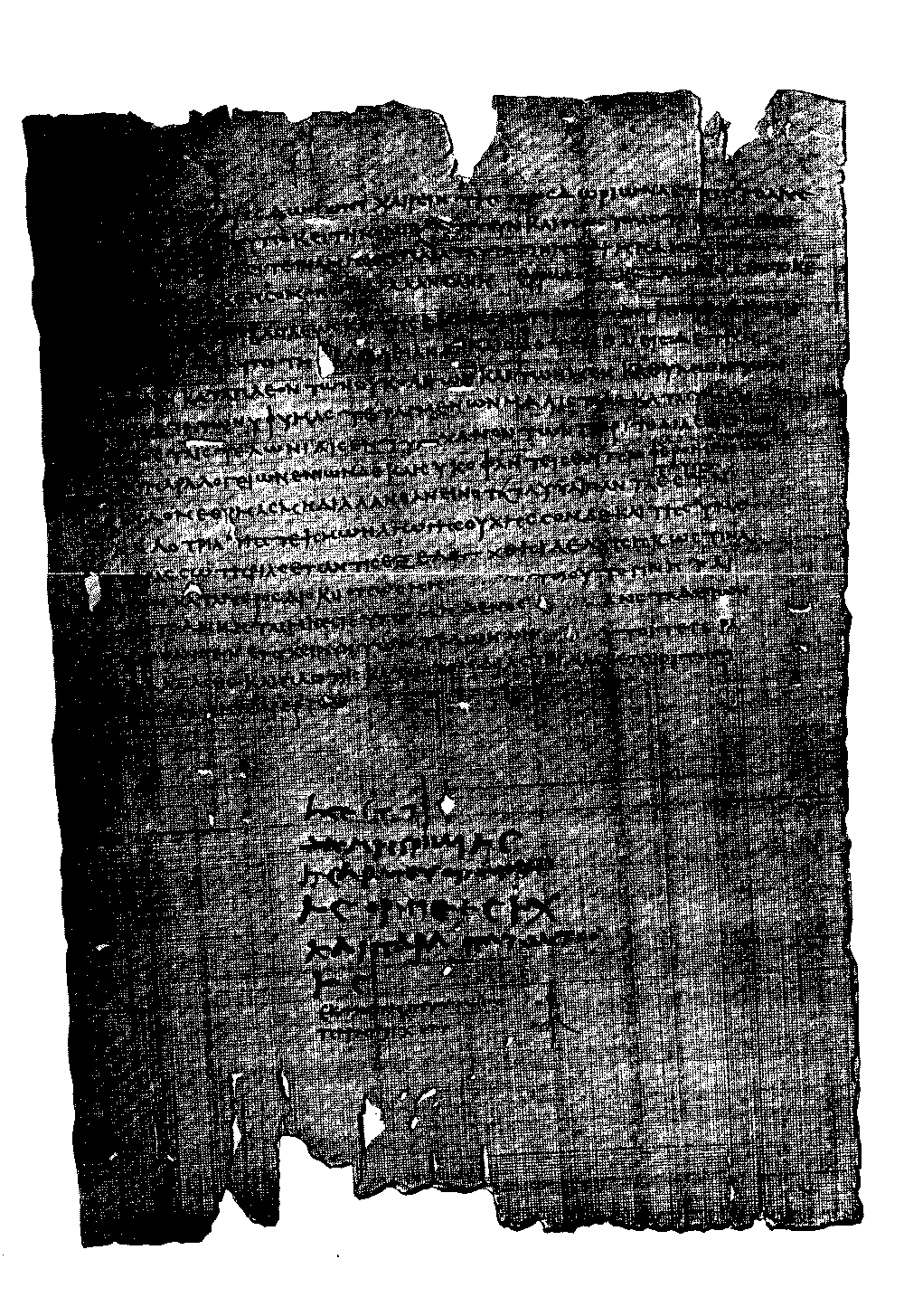
GREEK UNCIAL WRITING.
Letter of Dioscorides to Dorian, from a Manuscript on papyrus, found in a sealed clay vessel in an Egyptian tomb. Written in the IIIrd century B.C.
41. [The handing down of good precepts.]
"The son of a hearkener is as an Attendant of Horus[306]: there is good for him when he hath hearkened; he groweth old, he reacheth Amakh[307]; he telleth the like to his children, renewing the teaching of his father. Every man teacheth as he hath performed; he telleth the like to his sons, that they may tell again to their children.[308] Do what is admirable; cause not thyself to be mocked;[?] establish truth that thy children may live. If virtue entereth, vice departeth: then men who shall see such-like shall say, 'Behold, that man spoke to one who hearkened!' and they shall do the like; or 'Behold, that man was observant.' All shall say, 'They pacify the multitude; riches are not complete without them.'[309] Add not a word, nor take one away; put not one in the place of another. Guard thyself against opening the lacunæ[?] that are in thee. Guard thyself against being told, 'One who knoweth is listening; mark thou. Thou desirest to be established in the mouth of those who hear[310] when thou speakest. But thou hast entered on the business of an expert; thou speakest of matters that belong to us, and thy way is not in its proper place.'"
42. [Speak with consideration.]
"Let thy heart be overflowing, let thy mouth be restrained: consider how thou shalt behave among the nobles. Be exact in practice with thy master: act so that he may say, 'The son of that man shall speak to those that shall hearken. Praiseworthy also is he who formed him.'
"Apply thine heart while thou art speaking, that thou mayest speak things of distinction; then the nobles who shall hear will say, 'How good is that which proceedeth out of his mouth!'"
43. [Obedience to the master.]
"Do according to that thy master telleth thee. How excellent [to a man] is the teaching of his father, out of whom he hath come, out of his very body, and who spake unto him while he was yet altogether in his loins! Greater is what hath been done unto him than what hath been said unto him. Behold, a good son that God giveth doeth beyond what he is told for his master; he doeth right, doing heartily [?] in his goings even as thou hast come unto me, that thy body may be sound, that the King may be well pleased with all that is done, that thou mayest spend years of life. It is no small thing that I have done on earth; I have spent 110 years[311] of life while the King gave me praises as among the ancestors, by my doing uprightly to the King until the state of Amakh.[312]"
This is its arrival like that which was found in the writing.
Translation of F. Ll. Griffith.
[The following extracts are reproduced from the German of Professor Erman's translation.]
FROM THE 'MAXIMS OF ANY'
"Keep thyself from the strange woman who is not known in her city. Look not upon her when she cometh, and know her not. She is like unto a whirlpool in deep water, the whirling vortex of which is not known. The woman whose husband is afar writeth unto thee daily. When none is there to see her, she standeth up and spreadeth her snare; sin unto death is it to hearken thereto." Hence he who is wise will renounce her company and take to himself a wife in his youth. A man's own house is "the best thing," and also "she will give unto thee a son who shall be as the image of thyself."...
[Thy debt to thy mother.] Thou shalt never forget thy mother and what she hath done for thee, "that she bore thee, and nurtured thee in all ways." Wert thou to forget her then might she blame thee, "lifting up her arms unto God, and he would hearken unto her complaint. For she carried thee long beneath her heart as a heavy burden, and after thy months were accomplished she bore thee. Three long years she carried thee upon her shoulder and gave thee her breast to thy mouth." She nurtured thee, nor knew offense from thine uncleanness. "And when thou didst enter the school and wast instructed in the writings, daily she stood by the master with bread and beer from her house."
[Be not drunken with beer.] Drink not beer to excess! That which cometh forth from thy mouth thou canst no longer speak. Thou fallest down, thou breakest thy limbs, and none stretcheth out a hand to thee. Thy companions drink on; they arise and say, "Away with this one who hath drunken." When one cometh to seek thee, to seek counsel of thee, he findeth thee lying in the dust like a little child.
[Of inward piety.] "Clamor is abhorrent to the sanctuary of God; let thy prayers for thyself come forth out of a loving heart, whose words remain secret, that he may grant thee thy needs, may hear thy prayer, and accept thine offering."
[Of diligence and discretion.] Be diligent; "let thine eye be open that thou mayest not go forth as a beggar, for the man who is idle cometh not to honor." Be not officious and indiscreet, and "enter not [uninvited] into the house of another; if thou enter at his bidding thou art honored. Look not around thee, look not around thee in the house of another. What thine eye seeth, keep silence concerning it, and tell it not without to another, that it be not in thee a crime to be punished by death when it is heard." Speak not overmuch, "for men are deaf to him who maketh many words; but if thou art silent thou art pleasing, therefore speak not." Above all be cautious in speech, for "the ruin of a man is on his tongue. The body of a man is a storehouse, which is full of all manner of answers. Wherefore choose thou the good and speak good, while the evil remaineth shut up within thy body."
[Of manners.] Behave with propriety at table and "be not greedy to fill thy body." And "eat not bread while another standeth by and thou placest not thy hand on the bread for him. The one is rich and the other is poor, and bread remaineth with him who is open-handed. He who was prosperous last year, even in this may be a vagrant.[?]" Never forget to show respect, "and sit not down while another is standing who is older than thou, or who is higher than thou in his office."
Revised from the German of Adolf Erman.
INSTRUCTION OF DAUF
When Dauf the sage of Sebennytus went up to the Royal Residence with his son Pepy to take him to the "Court Writing-School," he admonished him "to set his heart upon writing, to love it as his mother, for there is naught that surpasseth it." He thereupon composes a poem in praise of the profession, to the disparagement of all other callings:—
"Behold, there is no profession that is not under rule; Only the man of learning himself ruleth."
And then,
"Never have I seen the engraver an ambassador, Or the goldsmith with an embassy; But I have seen the smith at his work At the mouth of his furnace; His fingers were as crocodile [hide], He stank more than fish-roe. "A craftsman who plieth the chisel Is wearied more than he who tilleth the soil; Wood is his field, and bronze his implement; At night—is he released? He worketh more than his arms are able; At night he lighteth a light."
Etc., etc.
[The praise of learning was a favorite subject with pedagogue and parent. According to other sages] "the unlearned whose name no man knoweth, is like unto a heavy-laden ass, driven by the scribe," while "he who hath set learning in his heart" is exempt from labor "and becometh a wise noble." "The rank of a scribe is princely; his writing outfit and his papyrus roll bring comfort and wealth." "The scribe alone guideth the labor of all men; but if labor in writing is hateful to him, then the goddess of good fortune is not with him."
"O scribe, be not lazy, be not lazy, else thou shalt be soundly chastised; give not thy heart to vain desires, or thou wilt come to ruin. Book in hand, read with thy mouth, and take the advice of those who know more than thyself. Prepare for thyself the office of a noble, that thou mayest attain thereto when thou art become old. Happy is the scribe clever in all his offices. Be strong and diligent in daily work. Pass no day idly, or thou wilt be flogged, for the ears of a boy are on his back, and he heareth when he is flogged. Let thine heart hear what I say; it will bring thee to fortune. Be strong in asking advice; do not overlook it in writing; be not disgusted at it. Therefore let thine heart hear my words; thou shalt find fortune thereby."
Revised from the German of Adolf Erman.
CONTRASTED LOTS OF SCRIBE AND FELLÂH
[The following is a sample of the warnings to young men to stick to the business of the scribe and not be led away by the charms of out-door life, always so dear to the Egyptian.—Date XIXth Dynasty, or earlier.]
It is told to me that thou hast cast aside learning, and givest thyself to dancing; thou turnest thy face to the work in the fields, and castest the divine words behind thee.
Behold, thou rememberest not the condition of the fellâh, when the harvest is taken over. The worms carry off half the corn, and the hippopotamus devours the rest; mice abound in the fields, and locusts arrive; the cattle devour, the sparrows steal. How miserable is the lot of the fellâh! What remains on the threshing-floor, robbers finish it up. The bronze ... are worn out, the horses [oxen?] die with threshing and plowing. Then the scribe moors at the bank who is to take over the harvest;[313] the attendants[314] bear staves, the negroes carry palmsticks. They say, "Give corn!" But there is none. They beat [the fellâh] prostrate; they bind him and cast him into the canal, throwing him headlong. His wife is bound before him, his children are swung off; his neighbors let them go, and flee to look after their corn.
But the scribe is the leader of labor for all; he reckons to himself the produce in winter, and there is none that appoints him his tale of produce. Behold, now thou knowest!
Translation of F. Ll. Griffith.
REPROACHES TO A DISSIPATED STUDENT
XIXth Dynasty
They tell me that thou forsakest books, And givest thyself up to pleasure. Thou goest from street to street; Every evening the smell of beer, The smell of beer, frightens people away from thee, It bringeth thy soul to ruin. Thou art like a broken helm, That obeyeth on neither side. Thou art as a shrine without its god, As a house without bread. Thou art met climbing the walls, And breaking through the paling: People flee from thee, Thou strikest them until they are wounded. Oh that thou didst know that wine is an abomination, And that thou wouldst forswear the Shedeh drink! That thou wouldst not put cool drinks within thy heart, That thou wouldst forget the Tenreku. But now thou art taught to sing to the flute, To recite [?] to the pipe, To intone to the lyre, To sing to the harp,
[and generally to lead a life of dissipation.]
Revised from the German of Adolf Erman.