Volume 13 — JONATHAN EDWARDS
Reading edition
(1703-1758)
BY EGBERT C. SMYTH

robably for most persons the influence of Edwards will longest survive through his wonderful personality. "From the days of Plato," says a writer in the Westminster Review, "there has been no life of more simple and imposing grandeur." There are four memoirs. The earliest is from Samuel Hopkins, D.D., a pupil and intimate friend. It "has the quaint charm of Walton's Lives." The second, by Sereno Edwards Dwight, D. D., is much more complete. He first brought to light the remarkable early papers on topics in physics, natural history, and philosophy. Dr. Samuel Miller's, in Sparks's 'Library of American Biography,' is mainly a brief compend. The latest Life is by Professor Alexander V. E. Allen, D. D. It endeavors to show "what he [Edwards] thought, and how he came to think as he did," and is an interesting and important contribution to a critical study of his works. There is still need of an adequate biography, which can only be written in connection with a thorough study of the manuscripts. A more full and critical edition of Edwards's writings is also much to be desired.
Jonathan Edwards
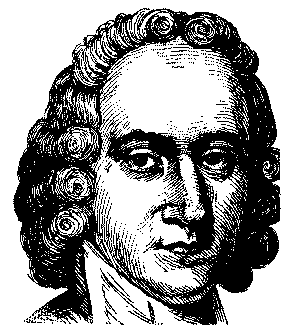
Edwards's first publication (1731) was a sermon preached in Boston on 'God Glorified in Man's Dependence.' The conditions under which it was produced afford striking contrasts to those attendant upon Schleiermacher's epoch-making 'Reden über Religion'; but the same note of absolute dependence upon God is struck by each with masterly power. A yet more characteristic and deeply spiritual utterance was given in the next published discourse, entitled 'A Divine and Supernatural Light Immediately Imparted to the Soul by the Spirit of God, Shown to be both a Scriptural and Rational Doctrine' (1734). These two sermons are of primary significance for a right understanding of their author's teaching. All is of God; faith is sensibleness of what is real in the work of redemption; this reality is divinely and transcendently excellent; this quality of it is revealed to the soul by the Holy Spirit, and becomes the spring of all holiness. "The central idea of his system," says Henry B. Smith, "is that of spiritual life (holy love) as the gift of divine grace." All of Edwards's other writings may be arranged in relation to this principle,—as introductory, explicative, or defensive.
When the sermon on the 'Reality of Spiritual Light' was delivered, the movement had begun which, as afterwards extended from Northampton to many communities in New England and beyond, is known as "The Great Awakening." The preaching of Edwards was a prominent instrumentality in its origination, and he became its most effective promoter and champion, and no less its watchful observer and critic. Among the published (1738) sermons which it occasioned should be specially mentioned those on 'Justification by Faith Alone,' 'The Justice of God in the Damnation of Sinners,' 'The Excellency of Jesus Christ,' 'The Distinguishing Marks of a Work of the Spirit of God, applied to that uncommon operation that has lately appeared on the minds of many of the people of New England: with a particular consideration of the extraordinary circumstances with which this work is attended' (1741). The same year (1741) appeared the sermon on 'Sinners in the Hands of an Angry God.' Some five years previous, moved by the notice taken in London by Dr. Watts and Dr. Guise of the religious revival in Northampton and several other towns, and by a special request from Rev. Dr. Colman of Boston, Edwards prepared a careful 'Narrative,' which, with a preface by the English clergymen just named, was published in London in 1737, and the year following in Boston. The sermon on the 'Distinguishing Marks of a Work of the True Spirit of God' was followed by the treatise entitled 'Some Thoughts Concerning the Present Revival of Religion, and the way in which it ought to be acknowledged and promoted' (1742); and four years later, by the elaborate work on 'Religious Affections.' The latter sums up all that Edwards had learned, through his participation in the movement whose beginnings and early stages are described in the 'Narrative,' and by his long-continued and most earnest endeavor to determine the true hopes of the spiritual life which had enlisted and well-nigh absorbed all the powers of his mind and soul. It is a religious classic of the highest order, yet, like the 'De Imitatione Christi,' suited only to those who can read it with independent insight. They who can thus use it will find it inexhaustible in its strenuous discipline and spiritual richness, light, and sweetness. Its chief defect lies in its failure to discover and unfold the true relation between the natural and the spiritual, and to recognize the stages of Christian growth, the genuineness and value of what is still "imperfect Christianity."
The "revival," with the endeavor to discover and apply the tests of a true Christian life, brought into prominence as a practical issue the old question of the proper requirements for church membership. The common practice failed to emphasize the necessity of spiritual regeneration and conversion, as upheld by Edwards and his followers. The controversy became acute at Northampton, and combined with other issues, resulted in his dismissal from his pastorate. His meek yet lofty bearing during this season of partisan strife and bitter animosity has commanded general admiration. Before he closed the contest he published two works which, in the Congregational churches, settled the question at issue in accordance with his principles—viz., 'An Humble Inquiry into the Rules of the Word of God concerning the Qualifications requisite to a Complete Standing and Full Communion in the Visible Christian Church,' and 'Misrepresentations Corrected and Truth Vindicated in a Reply to the Rev. Solomon Williams's Book,' etc.
The reply to Williams was written and published after Edwards's removal to Stockbridge. The period of his residence there (1751-1758, January) was far from tranquil. His conscientious resistance to schemes of pecuniary profit in the management of the Indian Mission there, brought upon him bitter opposition. For six months he was severely ill. In the French and Indian war a frontier town like Stockbridge was peculiarly exposed to alarm and danger. Yet at this time Edwards prepared the treatises on the 'Freedom of the Will,' the 'Ultimate End of Creation,' the 'Nature of Virtue,' and 'Original Sin.' The first was published in 1754, the others after his death (1758), as were many of his sermons, the 'History of Redemption,' and extracts from his note-book ('Miscellaneous Observations,' 'Miscellaneous Remarks'). Early in 1758, having accepted the presidency of the College of New Jersey, he removed to Princeton, where he died March 22d.
That with enfeebled health, and under the conditions of his life at Stockbridge, he should have prepared such works as those just enumerated, is a striking evidence of his intellectual discipline and power. It would probably have been impossible even for him, but for the practice he had observed from youth of committing his thoughts to writing, and their concentration on the subjects handled in these treatises. A careful study of his manuscript notes would probably be of service for new and critical editions, and would seem to be especially appropriate, since only the work on the 'Freedom of the Will' was published by its author.
It is impossible in the space of this sketch to analyze these elaborate treatises, or to attempt a critical estimate of their value. Foregoing this endeavor, I will simply add a few suggestions occasioned principally by some recent studies, either of the originals or copies of unpublished manuscripts.
Edwards's published works consist of compositions prepared with reference to some immediate practical aim. When called to Princeton he hesitated to accept, lest he should be interrupted in the preparation of "a body of divinity in an entire new method, being thrown into the form of a history." It was on his "mind and heart," "long ago begun," "a great work." The beginnings of it are preserved in the 'History of Redemption' posthumously published, but this was written as early as 1739, as a series of sermons, and without thought of publication. The volume of miscellanies, also published after his death, are extracts from his note-book, arranged by the editor. Nowhere has Edwards himself given a systematic exposition of his conception of Christianity. The incompleteness of even the fullest edition of his works increases the liability of misconstruction. It would not be suspected, for instance, to what extent his mind dealt with the conception of God as triune, or with the Incarnation.
His published works show on their face his relation to the religious questions uppermost in men's minds during his lifetime. "He that would know," writes Mr. Bancroft, "the workings of the New England mind in the middle of the last century and the throbbings of its heart, must give his days and nights to the study of Jonathan Edwards." And Professor Allen justly adds, "He that would understand ... the significance of later New England thought, must make Edwards the first object of his study." Besides these high claims to attention, one more may be made. The greatness of Edwards's character implies a contact of his mind with permanent and the highest truth—a profound knowledge and consciousness of God. Human and therefore imperfect, colored by inherited prepossessions, and run into some perishable molds, his thought is pervaded by a spiritual insight which has an original and undying worth. It is not unlikely that the future will assign him a higher rank than the past.
In one of the earliest, if not the first of his private philosophical papers, the essay entitled 'Of Being,' may be found the key to his fundamental conceptions. An exposition of his system, wrought out from this point of view, will show that he has a secure and eminent position among those who have contributed to that spiritual apprehension of nature and man, of matter and mind, of the universe and God, which has ever marked the thinking and influence of the finest spirits and highest teachers of our race.
Edwards was born October 5th, 1703, in East Windsor, Connecticut. He was the son of Rev. Timothy and Esther Stoddard Edwards; was graduated at Yale College in 1720; studied theology at New Haven; from August 1722 to March 1723 preached in New York; from 1724 to 1726 was a tutor at Yale; on the 15th of February, 1727, was ordained at Northampton, Massachusetts; in 1750 was dismissed from the church there, and in 1751 removed to Stockbridge, Massachusetts. He was called to Princeton in 1757, and died there March 22d, 1758.

FROM NARRATIVE OF HIS RELIGIOUS HISTORY
From about that time I began to have a new kind of apprehensions and ideas of Christ, and the work of redemption, and the glorious way of salvation by him. An inward sweet sense of these things at times came into my heart, and my soul was led away in pleasant views and contemplations of them. And my mind was greatly engaged to spend my time in reading and meditating on Christ, on the beauty and excellency of his person, and the lovely way of salvation by free grace in him....
Not long after I first began to experience these things, I gave an account to my father of some things that had passed in my mind. I was pretty much affected by the discourse we had together; and when the discourse was ended I walked abroad alone, in a solitary place in my father's pasture, for contemplation. And as I was walking there and looking upon the sky and clouds, there came into my mind so sweet a sense of the glorious majesty and grace of God as I know not how to express. I seemed to see them both in a sweet conjunction; majesty and meekness joined together: it was a sweet, and gentle, and holy majesty; and also a majestic meekness; an awful sweetness; a high, and great, and holy gentleness.
After this my sense of divine things gradually increased, and became more and more lively, and had more of that inward sweetness. The appearance of everything was altered; there seemed to be, as it were, a calm, sweet cast, or appearance of divine glory, in almost everything. God's excellency, his wisdom, his purity and love, seemed to appear in everything; in the sun, moon, and stars, in the clouds and blue sky, in the grass, flowers, trees, in the water and all nature; which used greatly to fix my mind. I often used to sit and view the moon for a long time, and in the day spent much time in viewing the clouds and sky, to behold the sweet glory of God in these things; in the meantime singing forth, with a low voice, my contemplations of the Creator and Redeemer. And scarce anything among all the works of nature was so sweet to me as thunder and lightning; formerly nothing had been so terrible to me. Before, I used to be uncommonly terrified with thunder, and to be struck with terror when I saw a thunder-storm rising; but now, on the contrary, it rejoiced me. I felt God, if I may so speak, at the first appearance of a thunder-storm; and used to take the opportunity at such times to fix myself in order to view the clouds and see the lightnings play and hear the majestic and awful voice of God's thunder, which oftentimes was exceedingly entertaining, leading me to sweet contemplations of my great and glorious God. While thus engaged it always seemed natural for me to sing or chant forth my meditations, or to speak my thoughts in soliloquies with a singing voice.
My sense of divine things seemed gradually to increase, till I went to preach at New York, which was about a year and a half after they began; and while I was there I felt them very sensibly, in a much higher degree than I had done before. My longings after God and holiness were much increased. . . .
Holiness, as I then wrote down some of my contemplations on it, appeared to me to be of a sweet, pleasant, charming, serene, calm nature, which brought an inexpressible purity, brightness, peacefulness, and ravishment to the soul. In other words, that it made the soul like a field or garden of God, with all manner of pleasant flowers; enjoying a sweet calm and the gently vivifying beams of the sun. The soul of a true Christian, as I then wrote my meditations, appeared like such a little white flower as we see in the spring of the year; low and humble on the ground, opening its bosom to receive the pleasant beams of the sun's glory; rejoicing as it were in a calm rapture; diffusing around a sweet fragrancy; standing peacefully and lovingly in the midst of other flowers round about; all in like manner opening their bosoms, to drink in the light of the sun. There was no part of creature-holiness, that I had so great a sense of its loveliness, as humility, brokenness of heart, and poverty of spirit; and there was nothing that I so earnestly longed for. My heart panted after this—to lie low before God, as in the dust; that I might be nothing, and that God might be All; that I might become as a little child.
RESOLUTIONS
"Resolved, Never to do any manner of thing, whether in soul or body, less or more, but what tends to the glory of God; nor be nor suffer it, if I can possibly avoid it."
"Resolved, To live with all my might while I do live."
"Resolved, When I think of any theorem in divinity to be solved, immediately to do what I can towards solving it, if circumstances do not hinder."
"Resolved, To endeavor to my utmost to deny whatever is not most agreeable to a good and universally sweet and benevolent, quiet, peaceable, contented and easy, compassionate and generous, humble and meek, submissive and obliging, diligent and industrious, charitable and even, patient, moderate, forgiving and sincere temper; and to do at all times what such a temper would lead me to; and to examine strictly, at the end of every week, whether I have so done."
"On the supposition that there was never to be but one individual in the world, at any one time, who was properly a complete Christian, in all respects of a right stamp, having Christianity always shining in its true lustre, and appearing excellent and lovely, from whatever part and under whatever character viewed: Resolved, To act just as I would do, if I strive with all my might to be that one, who should live in my time."
"I observe that old men seldom have any advantage of new discoveries, because they are beside the way of thinking to which they have been so long used: Resolved, If ever I live to years, that I will be impartial to hear the reasons of all pretended discoveries, and receive them if rational, how long soever I have been used to another way of thinking. My time is so short that I have not time to perfect, myself in all studies: Wherefore resolved, to omit and put off all but the most important and needful studies."
WRITTEN ON A BLANK LEAF IN 1723
They say there is a young lady [in New Haven] who is beloved of that Great Being who made and rules the world, and that there are certain seasons in which this Great Being, in some way or other invisible, comes to her and fills her mind with exceeding sweet delight, and that she hardly cares for anything except to meditate on him—that she expects after a while to be received up where he is, to be raised up out of the world and caught up into heaven; being assured that he loves her too well to let her remain at a distance from him always. There she is to dwell with him, and to be ravished with his love and delight forever. Therefore, if you present all the world before her, with the richest of its treasures, she disregards it and cares not for it, and is unmindful of any pain or affliction. She has a strange sweetness in her mind, and singular purity in her affections; is most just and conscientious in all her conduct; and you could not persuade her to do anything wrong or sinful, if you would give her all the world, lest she should offend this Great Being. She is of a wonderful sweetness, calmness, and universal benevolence of mind; especially after this great God has manifested himself to her mind. She will sometimes go about from place to place, singing sweetly; and seems to be always full of joy and pleasure; and no one knows for what. She loves to be alone, walking in the fields and groves, and seems to have some one invisible always conversing with her.
THE IDEA OF NOTHING
From 'Of Being'
A state of absolute nothing is a state of absolute contradiction. Absolute nothing is the aggregate of all the absurd contradictions in the world; a state wherein there is neither body nor spirit, nor space, neither empty space nor full space, neither little nor great, narrow nor broad, neither infinitely great space nor finite space, nor a mathematical point, neither up nor down, neither north nor south (I do not mean as it is with respect to the body of the earth or some other great body, but no contrary point nor positions or directions), no such thing as either here or there, this way or that way, or only one way. When we go about to form an idea of perfect nothing we must shut out all these things; we must shut out of our minds both space that has something in it, and space that has nothing in it. We must not allow ourselves to think of the least part of space, never so small. Nor must we suffer our thoughts to take sanctuary in a mathematical point. When we go to expel body out of our thoughts, we must cease not to leave empty space in the room of it; and when we go to expel emptiness from our thoughts, we must not think to squeeze it out by anything close, hard, and solid, but we must think of the same that the sleeping rocks dream of; and not till then shall we get a complete idea of nothing.