Volume 13 / Part 4 — EGYPTIAN LITERATURE
Reading edition
BY FRANCIS LLEWELLYN GRIFFITH AND KATE BRADBURY GRIFFITH

he advance that has been made in recent years in the decipherment of the ancient writings of the world enables us to deal in a very matter-of-fact way with the Egyptian inscriptions. Their chief mysteries are solved, their philosophy is almost fathomed, their general nature is understood. The story they have to tell is seldom startling to the modern mind. The world was younger when they were written. The heart of man was given to devious ways then, as now and in the days of Solomon,—that we can affirm full well; but his mind was simpler: apart from knowledge of men and the conduct of affairs, the educated Egyptian had no more subtlety than a modern boy of fifteen, or an intelligent English rustic of a century ago.
To the Egyptologist by profession the inscriptions have a wonderful charm. The writing itself in its leading form is the most attractive that has ever been seen. Long rows of clever little pictures of everything in heaven and earth compose the sentences: every sign is a plaything, every group a pretty puzzle, and at present, almost every phrase well understood brings a tiny addition to the sum of the world's knowledge. But these inscriptions, so rich in facts that concern the history of mankind and the progress of civilization, seldom possess any literary charm. If pretentious, as many of them are, they combine bald exaggeration with worn-out simile, in which ideas that may be poetical are heaped together in defiance of art. Such are the priestly laudations of the kings by whose favor the temples prospered. Take, for instance, the dating of a stela erected under Rameses II. on the route to the Nubian gold mines. It runs:—
"On the fourth day of the first month of the season of winter, in the third year of the Majesty of Horus, the Strong Bull, beloved of the Goddess of Truth, lord of the vulture and of the urseus diadems, protecting Egypt and restraining the barbarians, the Golden Horus, rich in years, great in victories, King of Upper Egypt and King of Lower Egypt, Mighty in Truth of Ra, Chosen of Ra,[1] the son of Ra, Rameses Beloved of Amen, granting life for ever and ever, beloved of Amen Ra lord of the 'Throne of the Two Lands'[2] in Apt Esut, appearing glorious on the throne of Horus among the living from day to day even as his father Ra; the good god, lord of the South Land, Him of Edfû[3] Horus bright of plumage, the beauteous sparrow-hawk of electrum that hath protected Egypt with his wing, making a shade for men, fortress of strength and of victory; he who came forth terrible from the womb to take to himself his strength, to extend his borders, to whose body color was given of the strength of Mentu[4]; the god Horus and the god Set. There was exultation in heaven on the day of his birth; the gods said, 'We have begotten him;' the goddesses said, 'He came forth from us to rule the kingdom of Ra;' Amen spake, 'I am he who hath made him, whereby I have set Truth in her place; the earth is established, heaven is well pleased, the gods are satisfied by reason of him.' The Strong Bull against the vile Ethiopians, which uttereth his roaring against the land of the negroes while his hoofs trample the Troglodytes, his horn thrusteth at them; his spirit is mighty in Nubia and the terror of him reacheth to the land of the Kary[5]; his name circulateth in all lands because of the victory which his arms have won; at his name gold cometh forth from the mountain as at the name of his father, the god Horus of the land of Baka; beloved is he in the Lands of the South even as Horus at Meama, the god of the Land of Buhen,[6] King of Upper and Lower Egypt, Mighty in Truth of Ra, son of Ra, of his body, Lord of Diadems Rameses Beloved of Amen, giving life for ever and ever like his father Ra, day by day." [Revised from the German translation of Professor Erman.]
As Professor Erman has pointed out, the courtly scribe was most successful when taking his similes straight from nature, as in the following description, also of Rameses II.:—
"A victorious lion putting forth its claws while roaring loudly and uttering its voice in the Valley of the Gazelles.... A jackal swift of foot seeking what it may find, going round the circuit of the land in one instant.... his mighty will seizeth on his enemies like a flame catching the ki-ki plant[7] with the storm behind it, like the strong flame which hath tasted the fire, destroying, until everything that is in it becometh ashes; a storm howling terribly on the sea, its waves like mountains, none can enter it, every one that is in it is engulphed in Duat.[8]"
Here and there amongst the hieroglyphic inscriptions are found memorials of the dead, in which the praises of the deceased are neatly strung together and balanced like beads in a necklace, and passages occur of picturesque narrative worthy to rank as literature of the olden time. We may quote in this connection from the biographical epitaph of the nomarch Ameny, who was governor of a province in Middle Egypt for twenty-five years during the long reign of Usertesen I. (about 2700 B.C.). This inscription not only recounts the achievements of Ameny and the royal favor which was shown him, but also tells us in detail of the capacity, goodness, charm, discretion, and insight by which he attached to himself the love and respect of the whole court, and of the people over whom he ruled and for whose well-being he cared. Ameny says:—
"I was a possessor of favor, abounding in love, a ruler who loved his city. Moreover I passed years as ruler in the Oryx nome. All the works of the house of the King came into my hand. Behold, the superintendent of the gangs[9] of the domains of the herdsmen of the Oryx nome gave me 3,000 bulls of their draught stock. I was praised for it in the house of the King each year of stock-taking. I rendered all their works to the King's house: there were no arrears to me in any of his offices.
"The entire Oryx nome served me in numerous attendances.[10] There was not the daughter of a poor man that I wronged, nor a widow that I oppressed. There was not a farmer that I chastised, not a herdsman whom I drove away, not a foreman of five whose men I took away for the works.[11] There was not a pauper around me, there was not a hungry man of my time. When there came years of famine, I arose and ploughed all the fields of the Oryx nome to its boundary south and north, giving life to its inhabitants, making its provisions. There was not a hungry man in it. I gave to the widow as to her that possessed a husband, and I favored not the elder above the younger in all that I gave. Thereafter great rises of the Nile took place, producing wheat and barley, and producing all things abundantly, but I did not exact the arrears of farming."
Elsewhere in his tomb there are long lists of the virtues of Amenemhat, and from these the following may be selected both on account of picturesqueness of expression and the appreciation of fine character which they display.
"Superintendent of all things which heaven gives and earth produces, overseer of horns, hoofs, feathers, and shells ... Master of the art of causing writing to speak ... Caressing of heart to all people, making to prosper the timid man, hospitable to all, escorting [travelers] up and down the river ... Knowing how to aid, arriving at time of need; free of planning evil, without greediness in his body, speaking words of truth.... Unique as a mighty hunter, the abode of the heart of the King.... Speaking the right when he judges between suitors, clear of speaking fraud, knowing how to proceed in the council of the elders, finding the knot in the skein.... Great of favors in the house of the King, contenting the heart on the day of making division, careful of his goings to his equals, gaining reverence on the day of weighing words, beloved of the officials of the palace."
The cursive forms of writing—hieratic from the earliest times, demotic in the latest—were those in which records were committed to papyrus. This material has preserved to us documents of every kind, from letters and ledgers to works of religion and philosophy. To these, again, "literature" is a term rarely to be applied; yet the tales and poetry occasionally met with on papyri are perhaps the most pleasing of all the productions of the Egyptian scribe.
It must be confessed that the knowledge of writing in Egypt led to a kind of primitive pedantry, and a taste for unnatural and to us childish formality: the free play and naïveté of the story-teller is too often choked, and the art of literary finish was little understood. Simplicity and truth to nature alone gave lasting charm, for though adornment was often attempted, their rude arts of literary embellishment were seldom otherwise than clumsily employed.
A word should be said about the strange condition in which most of the literary texts have come down to us. It is rarely that monumental inscriptions contain serious blunders of orthography; the peculiarities of late archaistic inscriptions which sometimes produce a kind of "dog Egyptian" can hardly be considered as blunders, for the scribe knew what meaning he intended to convey. But it is otherwise with copies of literary works on papyrus. Sometimes these were the productions of schoolboys copying from dictation as an exercise in the writing-school, and the blank edges of these papyri are often decorated with essays at executing the more difficult signs. The master of the school would seem not to have cared what nonsense was produced by the misunderstanding of his dictation, so long as the signs were well formed. The composition of new works on the model of the old, and the accurate understanding of the ancient works, were taught in a very different school, and few indeed attained to skill in them. The boys turned out of the writing-school would read and write a little; the clever ones would keep accounts, write letters, make out reports as clerks in the government service, and might ultimately acquire considerable proficiency in this kind of work. Apparently men of the official class sometimes amused themselves with puzzling over an ill-written copy of some ancient tale, and with trying to copy portions of it. The work however was beyond them: they were attracted by it, they revered the compilations of an elder age and those which were "written by the finger of Thoth himself"; but the science of language was unborn, and there was little or no systematic instruction given in the principles of the ancient grammar and vocabulary. Those who desired to attain eminence in scholarship after they had passed through the writing-school had to go to Heliopolis, Hermopolis, or wherever the principal university of the time might be, and there sit at the feet of priestly professors; who we fancy were reverenced as demigods, and who in mysterious fashion and with niggardly hand imparted scraps of knowledge to their eager pupils. Those endowed with special talents might after almost lifelong study become proficient in the ancient language. Would that we might one day discover the hoard of rolls of such a copyist and writer!
There must have been a large class of hack-copyists practiced in forming characters both uncial and cursive. Sometimes their copies of religious works are models of deft writing, the embellishments of artist and colorist being added to those of the calligrapher: the magnificent rolls of the 'Book of the Dead' in the British Museum and elsewhere are the admiration of all beholders. Such manuscripts satisfy the eye, and apparently neither the multitude in Egypt nor even the priestly royal undertakers questioned their efficacy in the tomb. Yet are they very apples of Sodom to the hieroglyphic scholar; fair without, but ashes within. On comparing different copies of the same text, he sees in almost every line omissions, perversions, corruptions, until he turns away baffled and disgusted. Only here and there is the text practically certain, and even then there are probably grammatical blunders in every copy. Nor is it only in the later papyri that these blunders are met with. The hieroglyphic system of writing, especially in its cursive forms, lends itself very readily to perversion by ignorant and inattentive copyists; and even monumental inscriptions, so long as they are mere copies, are usually corrupted. The most ridiculous perversions of all, date from the Ramesside epoch when the dim past had lost its charm, for the glories of the XVIIIth Dynasty were still fresh, while new impulses and foreign influence had broken down adherence to tradition and isolation.
In the eighth century B.C. the new and the old were definitely parted, to the advantage of each. On the one hand the transactions of ordinary life were more easily registered in the cursive demotic script, while on the other the sacred writings were more thoroughly investigated and brought into order by the priests. Hence, in spite of absurdities that had irremediably crept in, the archaistic texts copied in the XXVIth Dynasty are more intelligible than the same class of work in the XIXth and XXth Dynasties.
In reading translations from Egyptian, it must be remembered that uncertainty still remains concerning the meanings of multitudes of words and phrases. Every year witnesses a great advance in accuracy of rendering; but the translation even of an easy text still requires here and there some close and careful guesswork to supply the connecting links of passages or words that are thoroughly understood, or the resort to some conventional rendering that has become current for certain ill-understood but frequently recurring phrases. The renderings given in the following pages are with one exception specially revised for this publication, and exclude most of what is doubtful. The Egyptologist is now to a great extent himself aware whether the ground on which he is treading is firm or treacherous; and it seems desirable to make a rule of either giving the public only what can be warranted as sound translation, or else of warning them where accuracy is doubtful. A few years ago such a course would have curtailed the area for selection to a few of the simplest stories and historical inscriptions; but now we can range over almost the whole field of Egyptian writing, and gather from any part of it warranted samples to set before the reading public. The labor, however, involved in producing satisfactory translations for publication, not mere hasty readings which may give something of the sense, is very great; and at present few texts have been well rendered. It is hoped that the following translations will be taken for what they are intended,—attempts to show a little of the Ancient Egyptian mind in the writings which it has left to us.
We may now sketch briefly the history of Egyptian literature, dealing with the subject in periods:[12]—
I. The Ancient Kingdom, about B.C. 4500-3000
The earliest historic period—from the Ist Dynasty to the IIId, about B.C. 4500—has left no inscriptions of any extent. Some portions of the 'Book of the Dead' profess to date from these or earlier times, and probably much of the religious literature is of extremely ancient origin. The first book of *'Proverbs' in the Prisse Papyrus is attributed by its writer to the end of the IIId Dynasty (about 4000 B.C.). From the IVth Dynasty to the end of the VIth, the number of the inscriptions increases; tablets set up to the kings of the IVth Dynasty in memory of warlike raids are found in the peninsula of Sinai, and funerary inscriptions abound. The pyramids raised at the end of the Vth and during the VIth Dynasty are found to contain interminable religious inscriptions, forming almost complete rituals for the deceased kings. Professor Maspero, who has published these texts, states that they "contain much verbiage, many pious platitudes, many obscure allusions to the affairs of the other world, and amongst all this rubbish some passages full of movement and wild energy, in which poetical inspiration and religious emotion are still discernible through the veil of mythological expressions." Of the funerary and biographical inscriptions the most remarkable is that of *Una. Another, slightly later but hardly less important, is on the façade of the tomb of Herkhuf, at Aswân, and recounts the expeditions into Ethiopia and the southern oases which this resourceful man carried through successfully. In Herkhuf's later life he delighted a boy King of Egypt by bringing back for him from one of his raids a grotesque dwarf dancer of exceptional skill: the young Pharaoh sent him a long letter on the subject, which was copied in full on the tomb as an addition to the other records there. It is to the Vth Dynasty also that the second collection of *'Proverbs' in the Prisse Papyrus is dated. The VIIth and VIIIth Dynasties have left us practically no records of any kind.
II. The Middle Kingdom, B.C. 3000 TO 1600
The Middle Kingdom, from the IXth to the XVIIth Dynasty, shows a great literary development. Historical records of some length are not uncommon. The funerary inscriptions descriptive of character and achievement are often remarkable.
Many papyri of this period have survived: the *Prisse Papyrus of 'Proverbs,' a papyrus discovered by Mr. Flinders Petrie with the *'Hymn to Usertesen III.,' papyri at Berlin containing a *dialogue between a man and his soul, the *'Story of Sanehat,' the 'Story of the Sekhti,' and a very remarkable fragment of another story; besides the 'Westcar Papyrus of Tales' and at St. Petersburg the *'Shipwrecked Sailor.' The productions of this period were copied in later times; the royal *'Teaching of Amenemhat,' and the worldly *'Teaching of Dauf' as to the desirability of a scribe's career above any other trade or profession, exist only in late copies. Doubtless much of the later literature was copied from the texts of the Middle Kingdom. There are also *treatises extant on medicine and arithmetic. Portions of the Book of the Dead are found inscribed on tombs and sarcophagi.
III. The New Kingdom, etc.
From the New Kingdom, B.C. 1600-700, we have the *'Maxims of Any,' spoken to his son Khonsuhetep, numerous hymns to the gods, including *that of King Akhenaten to the Aten (or disk of the sun), and the later *hymns to Amen Ra. Inscriptions of every kind, historical, mythological, and funereal, abound. The historical *inscription of Piankhy is of very late date. On papyri there are the stories of the *'Two Brothers,' of the 'Taking of Joppa,' of the *'Doomed Prince.'
From the Saite period (XXVIth Dynasty, B.C. 700) and later, there is little worthy of record in hieroglyphics: the inscriptions follow ancient models, and present nothing striking or original. In demotic we have the *'Story of Setna,' a papyrus of moralities, a chronicle somewhat falsified, a harper's song, a philosophical dialogue between a cat and a jackal, and others.
Here we might end. Greek authors in Egypt were many: some were native, some of foreign birth or extraction, but they all belong to a different world from the Ancient Egyptian. With the adaptation of the Greek alphabet to the spelling of the native dialects, Egyptian came again to the front in Coptic, the language of Christian Egypt. Coptic literature, if such it may be called, was almost entirely produced in Egyptian monasteries and intended for edification. Let us hope that it served its end in its day. To us the dull, extravagant, and fantastic Acts of the Saints, of which its original works chiefly consist, are tedious and ridiculous except for the linguist or the church historian. They certainly display the adjustment of the Ancient Egyptian mind to new conditions of life and belief; but the introduction of Christianity forms a fitting boundary to our sketch, and we will now proceed to the texts themselves.
List of Selections
Stories: The Shipwrecked Sailor The Story of Sanehat The Doomed Prince The Story of the Two Brothers The Story of Setna
History: The Stela of Piankhy The Inscription of Una
Poetry: Songs of Laborers Love Songs Hymn to Usertesen III. Hymn to Aten Hymns to Amen Ra Songs to the Harp From an Epitaph From a Dialogue Between a Man and His Soul
Moral and Didactic: The Negative Confession The Teaching of Amenemhat The Prisse Papyrus From the Maxims of Any Instruction of Dauf Contrasted Lots of Scribe and Fellâh Reproaches to a Dissipated Student
THE SHIPWRECKED SAILOR
[One of the most complete documents existing on papyrus is the 'Story of the Shipwrecked Sailor.' The tale itself seems to date from a very early period, when imagination could still have full play in Upper Nubia. In it a sailor is apparently presenting a petition to some great man, in hopes of royal favor as the hero of the marvels which he proceeds to recount.
The Papyrus, which apparently is of the age of the XIth Dynasty, is preserved at St. Petersburg, but is still unpublished. It has been translated by Professors Golenisheff and Maspero. The present version is taken from 'Egyptian Tales,' by W. M. Flinders Petrie.]
The wise servant said, "Let thy heart be satisfied, O my lord, for that we have come back to the country; after we have long been on board, and rowed much, the prow has at last touched land. All the people rejoice and embrace us one after another. Moreover, we have come back in good health, and not a man is lacking; although we have been to the ends of Wawat[13] and gone through the land of Senmut,[14] we have returned in peace, and our land—behold, we have come back to it. Hear me, my lord; I have no other refuge. Wash thee and turn the water over thy fingers, then go and tell the tale to the Majesty."
His lord replied, "Thy heart continues still its wandering words! But although the mouth of a man may save him, his words may also cover his face with confusion. Wilt thou do, then, as thy heart moves thee. This that thou wilt say, tell quietly."
The sailor then answered:—
"Now I shall tell that which has happened to me, to my very self. I was going to the mines of Pharaoh, and I went down on the Sea[15] on a ship of 150 cubits long and 40 cubits wide, with 150 sailors of the best of Egypt, who had seen heaven and earth, and whose hearts were stronger than lions. They had said that the wind would not be contrary, or that there would be none. But as we approached the land the wind arose, and threw up waves eight cubits high. As for me, I sized a piece of wood; but those who were in the vessel perished, without one remaining. A wave threw me on an island, after that I had been three days alone, without a companion beside my own heart. I laid me in a thicket and the shadow covered me. Then stretched I my limbs to try to find something for my mouth. I found there figs and grapes, all manner of good herbs, berries and grain, melons of all kinds, fishes and birds. Nothing was lacking. And I satisfied myself, and left on the ground that which was over, of what my arms had been filled withal. I dug a pit, I lighted a fire, and I made a burnt-offering unto the gods.
"Suddenly I heard a noise as of thunder, which I thought to be that of a wave of the sea. The trees shook and the earth was moved. I uncovered my face, and I saw that a serpent drew near. He was thirty cubits long, and his beard greater than two cubits; his body was overlaid with gold, and his color as that of true lazuli. He coiled himself before me.
"Then he opened his mouth, while that I lay on my face before him, and he said to me, 'What has brought thee, what has brought thee, little one, what has brought thee? If thou sayest not speedily what has brought thee to this isle, I will make thee know thyself; as a flame thou shalt vanish, if thou tellest me not something I have not heard, or which I knew not before thee.'
"Then he took me in his mouth and carried me to his resting-place, and laid me down without any hurt. I was whole and sound, and nothing was gone from me. Then he opened his mouth against me, while that I lay on my face before him, and he said, 'What has brought thee, what has brought thee, little one, what has brought thee to this isle which is in the sea, and of which the shores are in the midst of the waves?'
"Then I replied to him, and holding my arms low before him,[16] I said to him:—'I was embarked for the mines by the order of the Majesty, in a ship; 150 cubits was its length, and the width of it 40 cubits. It had 150 sailors of the best of Egypt, who had seen heaven and earth, and the hearts of whom were stronger than lions. They said that the wind would not be contrary, or that there would be none. Each of them exceeded his companion in the prudence of his heart and the strength of his arm, and I was not beneath any of them. A storm came upon us while we were on the sea. Hardly could we reach to the shore when the wind waxed yet greater, and the waves rose even eight cubits. As for me, I seized a piece of wood, while those who were in the boat perished without one being left with me for three days. Behold me now before thee, for I was brought to this isle by a wave of the sea!"
"Then said he to me, 'Fear not, fear not, little one, and make not thy face sad. If thou hast come to me, it is God[17] who has let thee live. For it is he who has brought thee to this isle of the blest, where nothing is lacking, and which is filled with all good things. See now thou shalt pass one month after another, until thou shalt be four months in this isle. Then a ship shall come from thy land with sailors, and thou shalt leave with them and go to thy country, and thou shalt die in thy town. Converse is pleasing, and he who tastes of it passes over his misery. I will therefore tell thee of that which is in this isle. I am here with my brethren and my children around me; we are seventy-five serpents, children, and kindred; without naming a young girl who was brought unto me by chance, and on whom the fire of heaven fell and burnt her to ashes. As for thee, if thou art strong, and if thy heart waits patiently, thou shalt press thy infants to thy bosom and embrace thy wife. Thou shalt return to thy house which is full of all good things, thou shalt see thy land, where thou shalt dwell in the midst of thy kindred!'
"Then I bowed in my obeisance, and I touched the ground before him. 'Behold now that which I have told thee before. I shall tell of thy presence unto Pharaoh, I shall make him to know of thy greatness, and I will bring to thee of the sacred oils and perfumes, and of incense of the temples with which all gods are honored. I shall tell moreover of that which I do now see (thanks to him), and there shall be rendered to thee praises before the fullness of all the land. I shall slay asses for thee in sacrifice, I shall pluck for thee the birds, and I shall bring for thee ships full of all kinds of the treasures of Egypt, as is comely to do unto a god, a friend of men in a far country, of which men know not.'
"Then he smiled at my speech, because of that which was in his heart, for he said to me, 'Thou art not rich in perfumes, for all that thou hast is but common incense. As for me, I am prince of the land of Punt,[18] and I have perfumes. Only the oil which thou saidst thou wouldst bring is not common in this isle. But when thou shalt depart from this place, thou shalt never more see this isle; it shall be changed into waves.'
"And behold, when the ship drew near, attending to all that he had told me before, I got me up into an high tree, to strive to see those who were within it. Then I came and told to him this matter; but it was already known unto him before. Then he said to me, 'Farewell, farewell; go to thy house, little one, see again thy children, and let thy name be good in thy town; these are my wishes for thee!'
"Then I bowed myself before him, and held my arms low before him, and he, he gave me gifts of precious perfumes, of cassia, of sweet woods, of kohl, of cypress, an abundance of incense, of ivory tusks, of baboons, of apes, and all kinds of precious things. I embarked all in the ship which was come, and bowing myself, I prayed God for him.
"Then he said to me, 'Behold, thou shalt come to thy country in two months, thou shalt press to thy bosom thy children, and thou shalt rest in thy tomb!' After this I went down to the shore unto the ship, and I called to the sailors who were there. Then on the shore I rendered adoration to the master of this isle and to those who dwelt therein.
"When we shall come, in our return, to the house of Pharaoh, in the second month, according to all that the serpent has said, we shall approach unto the palace. And I shall go in before Pharaoh, I shall bring the gifts which I have brought from this isle into the country. Then he shall thank me before the fullness of all the land. Grant then unto me a follower, and lead me to the courtiers of the king. Cast thine eye upon me after that I am come to land again, after that I have both seen and proved this. Hear my prayer, for it is good to listen to people. It was said unto me, 'Become a wise man, and thou shalt come to honor,' and behold I have become such."
This is finished from its beginning unto its end, even as it was found in a writing. It is written by the scribe of cunning fingers, Ameniamenaa; may he live in life, wealth, and health.
THE STORY OF SANEHAT
[The story of Sanehat is practically complete. A papyrus at Berlin contains all the text except about twenty lines at the beginning, the whole being written in about three hundred and thirty short lines. Scraps of the missing portion were found in the collection of Lord Amherst of Hackney; and these, added to a complete but very corrupt text of about the first fifty lines, enable one to restore the whole with tolerable certainty. The story was written about the time of the XIIth or XIIIth Dynasty, but was known at a much later period: one extract from the beginning of the tale and one from the end have been found written in ink on limestone flakes or "ostraca" of about the XXth Dynasty (about 1150 B.C.). It seems to be a straightforward relation of actual occurrences, a real piece of biography. At any rate, it is most instructive as showing the kind of intercourse that was possible between Egypt and Palestine about 2500 B.C.]
The hereditary prince, royal seal-bearer, trusty companion, judge, keeper of the gate of the foreigners, true and beloved royal acquaintance, the attendant Sanehat says:—
I attended my lord as a servant of the king, of the household of the hereditary princess, the greatly favored, the royal wife, Ankhet-Usertesen [?], holding a place at Kanefer, the pyramid of King Amenemhat.[19]
In the thirtieth year, the month Paophi, the seventh day, the god[20] entered his horizon, the King Sehetepabra flew up to heaven; he joined the sun's disk, he attended the god, he joined his Maker. The Residence[21] was silenced, the hearts were weakened, the Great Portals were closed, the courtiers crouching on the ground, the people in hushed mourning.
Now his Majesty had sent a great army with the nobles to the land of the Temehu,[22] his son and heir as their commander, the good King Usertesen.[23] And now he was returning, and had brought away captives and all kinds of cattle without end. The Companions of the Court sent to the West Side[24] to let the king know the state of affairs that had come about in the Audience Chamber.[25] The messenger found him on the road; he reached him at the time of evening. "It was a time for him to hasten greatly [was the message]: Let the Hawk[26] fly [hither] with his attendants, without allowing the army to know of it." And when the royal sons who commanded in that army sent messages, not one of them was summoned to audience. Behold, I was standing [near]; I heard his voice while he was speaking.[27] I fled far away, my heart beating, my arms outspread; trembling had fallen on all my limbs. I ran hither and thither[28] to seek a place to hide me, I threw myself amongst the bushes: and when I found a road that went forward, I set out southward, not indeed thinking to come to this Residence.[29] I expected that there would be disturbance. I spake not of life after it.[30] I wandered across my estate[31] [?] in the neighborhood of Nehat; I reached the island [or lake] of Seneferu, and spent the day [resting?] on the open field. I started again while it was yet day,[32] and came to a man standing at the side of the road. He asked of me mercy, for he feared me. By supper-time I drew near to the town of Negau. I crossed the river on a raft without a rudder, by the aid of a west wind, and landed at the quay [?] of the quarrymen of the Mistress at the Red Mountain.[33] Then I fled on foot northward, and reached the Walls of the Ruler, built to repel the Sati.[34] I crouched in a bush for fear, seeing the day-patrol at its duty on the top of the fortress. At nightfall I set forth, and at dawn reached Peten, and skirted the lake of Kemur.[35] Then thirst hasted me on; I was parched, my throat was stopped, and I said, "This is the taste of death." When I lifted up my heart and gathered strength, I heard a voice and the lowing of cattle. I saw men of the Sati; and an alien amongst them—he who is [now?] in Egypt[36]—recognized me. Behold, he gave me water, and boiled me milk, and I went with him to his camp,—may a blessing be their portion! One tribe passed me on to another: I departed to Sun [?], and came to Kedem.[37]
There I spent a year and a month [?]. But Ammui-nen-sha, Ruler of the Upper Tenu,[38] took me and said to me:—"Comfort thyself with me, that thou mayest hear the speech of Egypt." He said thus, for that he knew my character, and had heard of my worth; for men of Egypt who were there with him bore witness of me. Then he said to me:—"For what hast thou come hither? what is it? Hath a matter come to pass in the Residence? The King of the Two Lands, Sehetepabra, hath gone to heaven, and one knoweth not what may have happened thereon." But I answered with concealment and said:—"I returned with an expedition from the land of the Temehu; my desire was redoubled, my heart leaped, there was no satisfaction within me. This drove me to the ways of a fugitive. I have not failed in my duty, my mouth hath not uttered any bitter words, I have not hearkened to any evil plot, my name hath not been heard in the mouth of the informer. I know not what hath brought me into this country." [And the Ruler Ammui-nen-sha said:][39] "This is like the disposition of God. And now what is that land like if it know not that excellent god,[40] of whom the dread was over the nations like Sekhemt[41] in a year of pestilence?" I spake [thus] to him, and replied to him:—"Nay, but his son hath entered the palace, and taken the heritage of his father, and he is a god without an equal, nor was there any other before him [like unto him]. He is a master of wisdom, prudent in his designs, excellent in his decrees; coming out and going in is at his command. It was he that curbed the nations while his father remained within the palace, and he reported the execution of that which was laid upon him [to perform]. He is a mighty man also, working with his strong arm; a valiant one, who hath not his equal. See him when he springeth upon the barbarians, and throweth himself on the spoilers; he breaketh the horns and weakeneth the hands; his enemies cannot wield their weapons. He is fearless and dasheth heads to pieces; none can stand before him. He is swift of going, to destroy him who fleeth; and none turning his back to him reacheth his home. He is sturdy of heart in the moment [of stress]; he is a lion that striketh with the claw; never hath he turned his back. He is stout of heart when he seeth multitudes, he letteth none repose beyond what his desire would spare. He is bold of face when he seeth hesitation: his joy is to fall on the barbarians. He seizeth the buckler, and leapeth forward; he repeateth not his stroke, he slayeth, and none can turn his lance; without his bow being drawn the barbarians flee from his arms like dogs; for the great goddess hath granted him to war against those who know not his name; he is thorough, he spareth not and leaveth naught behind. He is full of grace and sweetness, a love-winner; his city loveth him more than itself, it rejoiceth in him more than in its own god; men and women go their ways, calling their children by his name. For he is a king that took the kingdom while he was in the egg, and ruled from his birth. He is a multiplier of offspring. And he is One Alone, the essence of God; this land rejoiceth in his government. He is one that enlargeth his borders; he will take the lands of the South, but he will not design to hold the countries of the North: yet he prepareth to smite the Sati, to crush the Wanderers of the Sand. When he cometh here, let him know thy name; dispute not, but go over to his command[42]: for he will not fail to treat well the country that floateth with his stream."
Said he, agreeing to me:—"Verily, Egypt is excellent in its stream[43] beyond anything, and it flourisheth; behold, as long as thou art with me I will do good unto thee." He placed me at the head of his children, he married me with his eldest daughter. He allowed me to choose for myself from his land, and from the choicest of what he possessed on the border of the next land. It was a goodly land; Iaa[44] is its name. Therein were figs and grapes; its wine was more plentiful than water; abundant was its honey, many were its oil-trees, and all fruits were upon its trees; there too was barley and spelt, and cattle of all kinds without end. Great honors also were granted to me, flowing from his love to me; he set me as sheikh of a tribe in a choice portion of his country. There were made for me rations of bread, wine from day to day, cooked meat and roasted fowl, besides wild game snared for me or brought to me, as well as what my hunting dogs caught. They made me many dainties, and milk food cooked in all manner of ways. Thus I passed many years; my children became valiant men, each one the conqueror of a tribe. When a messenger came north or went south to the Residence,[45] he tarried with me; for I gave all men gifts; I gave water to the thirsty, I set the strayed wanderer on his road, and I rescued those who were carried off captive. The Sati who went to war or to repel the kings of the nations, I commanded their expeditions; for this Ruler of the Tenu made me to spend many years as captain of his army. Every land to which I turned I overcame. I destroyed its green fields and its wells, I captured its cattle, I took captive its inhabitants, I deprived them of their provisions, and I slew much people of them by my sword, my bow, my marchings, and my good devices. Thus my excellence was in his heart; he loved me and he knew my valor; until he set me at the head of his sons, when he saw the success of my handiwork.
There came a champion of the Tenu to defy me in my tent; a bold man without equal, for he had vanquished all his rivals. He said, "Let Sanehat fight with me." He thought to overcome me; he designed to take my cattle, being thus counseled by his tribe. This ruler [Ammui-nen-sha] conferred with me. I said:—"I know him not. I assuredly am no associate of his; I hold me far from his place. Have I ever opened his door, or leaped over his fence? It is perverseness of heart from seeing me doing his work. Forsooth, I am as it were a stranger bull among the cows, which the bull of the herd charges, and the strong bull catches! But shall a wretched beggar desire to attain to my fortune? A common soldier cannot take part as a counselor. Then what pray shall establish the assembly?[46] But is there a bull that loveth battle, a courageous bull that loveth to repeat the charge in terrifying him whose strength he hath measured? If he hath stomach to fight, let him speak what he pleaseth. Will God forget what is ordained for him? How shall fate be known?" The night long I strung my bow, I made ready my arrows; I made keen my dagger, I furbished my arms. At daybreak the Tenu came together; it had gathered its tribes and collected the neighboring peoples. Its thoughts were on this combat; every bosom burned for me, men and women crying out; every heart was troubled for me; they said, "Is there yet another champion to fight with him?" Then [he took] his buckler, his battle-axe, and an armful of javelins. But thereon I avoided his weapons, and turned aside his arrows to the ground, useless. One drew near to the other and he rushed upon me. I shot at him and my arrow stuck in his neck; he cried out, and fell upon his nose: I brought down upon him his own battle-axe, and raised my shout of victory on his back. All the Asiatics roared, and I and his vassals whom he had oppressed gave thanks unto Mentu; this Ruler, Ammui-nen-sha, took me to his embrace. Then I took his goods, I seized his cattle. What he had thought to do to me, I did it unto him; I seized that which was in his tent, I spoiled his dwelling. I grew great thereby, I increased in my possessions. I abounded in cattle.
"May[47] the god be disposed to pardon him in whom he had trusted, and who deserted to a foreign country. Now is his anger quenched. I who at one time fled away a fugitive, my guarantee is now in the Residence. Having wandered a starved wanderer, now I give bread to those around. Having left my land in rags, now I shine in fine linen. Having been a fugitive without followers, now I possess many serfs. My house is fair, my dwelling large, I am spoken of in the palace. All the gods destined me this flight. Mayest thou be gracious; may I be restored to the Residence; favor me that I may see the place in which my heart dwelleth. Behold how great a thing is it that my body should be embalmed in the land where I was born! Come; if afterwards there be good fortune, I will give an offering to God that he may work to make good the end of his suppliant, whose heart is heavy at long absence in a strange land. May he be gracious; may he hear the prayer of him who is afar off, that he may revisit the place of his birth, and the place from which he removed.
"May the King of Egypt be gracious to me, by whose favor men live. I salute the mistress of the land, who is in his palace; may I hear the news of her children, and may my body renew its vigor thereby. But old age cometh, weakness hasteneth me on, the eyes are heavy, my arms are failing, my feet have ceased to follow the heart. Weariness of going on approacheth me; may they convey me to the cities of eternity. May I serve the mistress of all.[48] Oh that she may tell me the beauties of her children; may she bring eternity to me."
Now the Majesty of the King of Upper and Lower Egypt, Kheper-ka-ra, justified, spake concerning this condition in which I was. His Majesty sent unto me with presents from before the king, that he might make glad the heart of your servant,[49] as he would unto the Ruler of any country; and the royal sons who were in his palace caused me to hear their news.
Copy of the command which was brought to the humble servant to bring him back to Egypt.
"The Horus, Life of Births, Lord of the Crowns, Life of Births, King of Upper and Lower Egypt, Kheper-ka-ra, Son of the Sun, Usertesen[50] Ever Living unto Eternity. Royal Command for the attendant, Sanehat.
"Behold, this command of the king is sent to thee to give thee information: Whereas thou didst go round strange lands from Kedem[51] to Tenu, one country passed thee on to another as thy heart devised for thee. Behold, what thou hast done hath been done unto thee: Thou hast not blasphemed, so also the accusation against thee hath been repelled. So also thy sayings have been respected; thou hast not spoken against the Council of the Nobles. But this matter carried away thy heart; it was not [devised] in thy heart.
"This thy Heaven[52] who is in the palace is stablished and flourishing even now: she herself shareth in the rule of the land, and her children are in the Audience Chamber.[53]
"Leave the riches that thou hast, and in the abundance of which thou livest. When thou comest to Egypt thou shalt visit the Residence in which thou wast, thou shalt kiss the ground before the Great Portals, thou shalt assume authority amongst the Companions. But day by day, behold, thou growest old; thy vigor is lost; thou thinkest on thy day of burial. Thou shalt be conducted to the blessed state; there shall be assigned to thee a night of sacred oils and wrappings from the hands of the goddess Tayt. There shall be held for thee a procession [behind thy statues] and a visit [to the temple] on the day of burial, the mummy case gilded, the head blue, the canopy above thee; the putting in the skin-frame, oxen to draw thee, singers going before thee, the answering chant, and mourners crouching at the door of thy tomb-chapel. Prayers for offerings shall be recited for thee, victims shall be slaughtered at the door portrayed upon thy tablet[54]; and thy mastaba shall be built of white stone, in the company of the royal children. Thou shalt not die in a strange land, nor be buried by the Amu; thou shalt not be put in a sheepskin, thou shalt be well regarded. It is vain [?] to beat the ground and think on troubles.
"Thou hast reached the end.[55]
When this order came to me, I stood in the midst of my tribe, and when it was read unto me, I threw me on my belly; I bowed to the ground and let the dust spread upon my breast. I strode around my tent rejoicing and saying:—"How is this done to the servant, whose heart had transgressed to a strange country of babbling tongue? But verily good is compassion, that I should be saved from death. Thy Ka[56] it is that will cause me to pass the end of my days in the Residence."
Copy of the acknowledgment of this command.
"The servant of the royal house [?], Sanehat, says:—
"In most excellent peace! Known is it to thy Ka that this flight of thy servant was made in innocence. Thou the Good God, Lord of both Lands, Beloved of Ra, Favored of Mentu, lord of Uast, and of Amen, lord of the Thrones of the Two Lands, of Sebek, Ra, Horus, Hathor, Atmu and his Ennead, of Sepdu, Neferbiu, Semsetu, Horus of the east, and of the Mistress of the Cave[57] who resteth on thy head, of the chief circle of the gods of the waters, Min, Horus of the desert, Urert mistress of Punt, Nut, Harur-Ra, all the gods of the land of Egypt and of the isles of the sea.[58] May they put life and strength to thy nostril, may they present thee with their gifts, may they give to thee eternity without end, everlastingness without bound. May the fear of thee be doubled in the lands and in the foreign countries, mayest thou subdue the circuit of the sun. This is the prayer of the servant for his master, who hath delivered him from Amenti.[59]
"The possessor of understanding understandeth the higher order of men, and the servant recognizeth the majesty of Pharaoh. But thy servant feareth to speak it: it is a weighty matter to tell of. The great God, like unto Ra, knoweth well the work which he himself hath wrought. Who is thy servant that he should be considered, that words should be spent upon him? Thy majesty is as Horus, and the strength of thy arms extendeth to all lands.
"Then let his Majesty command that there be brought to him Meki of Kedem, Khentiu-aaush of Khent-keshu, and Menus of the Two Lands of the Fenkhu; these are chiefs as hostages that the Tenu act according to the desire of thy Ka, and that Tenu will not covet what belongeth to thee in it, like thy dogs.[60] Behold this flight that thy servant made: I did not desire it, it was not in my heart; I do not boast of it; I know not what took me away from my place; it was like the leading of a dream, as a man of Adhu sees himself in Abu,[61] as a man of the Corn-land sees himself in the Land of Gardens.[62] There was no fear, none was hastening in pursuit of me; I did not listen to an evil plot, my name was not heard in the mouth of the informer; but my limbs went, my feet wandered, my heart drew me; a god ordained this flight, and led me on. But I am not stiff-necked; a man feareth if he knoweth [?], for Ra hath spread thy fear over the land, thy terrors in every foreign country. Behold me in thy palace or behold me in this place,[63] still thou art he who doth clothe this horizon. The sun riseth at thy pleasure, the water in the rivers is drunk at thy will, the wind in heaven is breathed at thy saying.
"Thy servant will leave to a successor the viziership which thy servant hath held in this land. And when thy servant shall arrive[64] let thy Majesty do as pleaseth him, for one liveth by the breath that thou givest. O thou who art beloved of Ra, of Horus, and of Hathor! It is thy august nostril that Mentu, lord of Uast, desireth should live for ever."
It was granted that I should spend a day in Iaa,[65] to pass over my goods to my children, my eldest son leading my tribe, and all my goods in his hand, my people and all my cattle, my fruit, and all my pleasant trees. When thy humble servant[66] journeyed to the south, and arrived at the Roads of Horus, the officer who was over the frontier-patrol sent a report to the Residence to give notice. His Majesty sent the good overseer of the peasants of the king's domains, and ships with him laden with presents from the king for the Sati who had come with me to convey me to the Roads of Horus. I spoke to each one by his name, each officer according to his rank. I received and I returned the salutation, and I continued thus[67] until I reached Athtu.[68]
When the land was lightened, and the second day came,[69] there came some to summon me, four men in coming, four men in going,[70] to carry [?] me to the palace. I alighted on the ground between the gates of reception [?]; the royal children stood at the platform to greet [?] me; the Companions and those who ushered to the hall brought me on the way to the royal chamber.
I found his Majesty on the great throne on a platform of pale gold. Then I threw myself on my belly; this god, in whose presence I was, knew me not while he questioned me graciously; but I was as one caught in the night; my spirit fainted, my limbs shook, my heart was no longer in my bosom, and I knew the difference between life and death. His Majesty said to one of the Companions, "Lift him up; let him speak to me." And his Majesty said:—"Behold, thou hast come; thou hast trodden the deserts; thou hast played the wanderer. Decay falleth on thee, old age hath reached thee; it is no small thing that thy body should be embalmed, that thou shalt not be buried by foreign soldiers.[71] Do not, do not, be silent and speechless; tell thy name; is it fear that preventeth thee?" I answered with the answer of one terrified, "What is it that my lord hath said? O that I might answer it! It was not my act: it was the hand of God; it was a terror that was in my body, as it were causing a flight that had been foreordained. Behold I am before thee, thou art life; let thy Majesty do what pleaseth him."
The royal children were brought in, and his Majesty said to the queen, "Behold thou, Sanehat hath come as an Amu, whom the Sati have produced."
She shrieked aloud, and the royal children joined in one cry, and said before his Majesty, "Verily it is not he, O king, my lord." Said his Majesty, "It is verily he." Then they brought their tinkling bead-strings, their wands, and their sistra in their hands, and waved them[72] before his Majesty [and they sang]:—
"May thy hands prosper, O King; May the graces of the Lady of Heaven continue. May the goddess Nub[73] give life to thy nostril; May the mistress of the stars favor thee, that which is north of her going south and that which is south of her going north. All wisdom is in the mouth of thy Majesty; The staff [?] is put upon thy forehead, driving away from thee the beggarly [?] Thou art pacified, O Ra, lord of the lands; They call on thee as on the Mistress of all. Strong is thy horn; let fall thine arrow. Grant the breath of life to him who is without it; Grant thy favor to this alien Samehit,[74] the foreign soldier born in the land of Egypt, Who fled away from fear of thee, And left the land from thy terrors. The face shall not grow pale, of him who beholdeth thy countenance; The eye shall not fear which looketh upon thee."
Said his Majesty:—"He shall not fear; let him be freed from terror. He shall be a Companion amongst the nobles; he shall be put within the circle of the courtiers. Go ye to the chamber of praise to seek wealth for him."
When I went out from the Audience Chamber, the royal children offered their hands to me; and we walked afterwards to the Great Portals. I was placed in a house of a king's son, in which were fine things; there was a cool bower therein, fruits of the granary, treasures of the White House,[75] clothes of the king's guard-robe, frankincense, the finest perfumes of the king and the nobles whom he loves, in every chamber; and every kind of servitor in his proper office. Years were removed from my limbs: I was shaved, and my locks of hair were combed; the foulness was cast to the desert, with the garments of the Nemausha.[76] I clothed me in fine linen, and anointed myself with the best oil; I laid me on a bed. I gave up the sand to those who lie on it; the oil of wood to him who would anoint himself therewith.
There was given to me the house of Neb-mer [?], which had belonged to a Companion. There were many craftsmen building it; all its woodwork was strengthened anew. Portions were brought to me from the palace thrice and four times a day, besides the gifts of the royal children; there was not a moment's ceasing from them. There was built for me a pyramid of stone amongst the pyramids. The overseer of the architects measured its ground; the chief treasurer drew it; the sacred masons did the sculpture; the chief of the laborers in the necropolis brought the bricks; and all the instruments applied to a tomb were there employed. There were given to me fields; there was made for me a necropolis garden, the land in it better than a farm estate; even as is done for the chief Companion. My statue was overlaid with gold, its girdle with pale gold; his Majesty caused it to be made. Such is not done to a man of low degree.
Thus am I in the favor of the king until the day of death shall come.
This is finished from beginning to end, as was found in the writing.
Translation of F. Ll. Griffith.
THE DOOMED PRINCE
['The Story of the Doomed Prince' was written at some time during the XVIIIth Dynasty (about 1450 B.C.). The papyrus on which it has been preserved to us, and which is in the British Museum, is much mutilated, and the end is entirely lost.]
There was once a king to whom no male child was born; he prayed for himself unto the gods whom he worshiped for a son. They decreed to cause that there should be born to him one. And his wife, after her time was fulfilled, gave birth to a male child. Came the Hathors[77] to decree for him a destiny; they said, "He dies by the crocodile, or by the serpent, or by the dog." Then the people who stood by the child heard this; they went to tell it to his Majesty. Then his Majesty's heart was exceeding sad. His Majesty caused a house to be built upon the desert, furnished with people and with all good things of the royal house, out of which the child should not go. Now when the child was grown he went up upon its roof and saw a greyhound; it was following a man walking on the road. He said to his page who was with him, "What is this that goeth behind the man coming along the road?" He said to him, "It is a greyhound." The child said to him, "Let there be brought to me one like it." The page went and reported it to his Majesty. His Majesty said, "Let there be brought to him a little trotter, lest his heart be sad." Then they brought to him the greyhound.
Now when the days were multiplied after these things, the child grew up in all his limbs, he sent a message to his father saying, "Wherefore should I remain here? Behold, I am destined to three dooms, and if I do according to my desire God will still do what is in his heart." They hearkened to all he said, and gave him all kinds of weapons, and also his greyhound to follow him, and they conveyed him over to the east side and said to him, "Go thou whither thou wilt." His greyhound was with him; he traveled northward following his heart in the desert; he lived on the best of all the game of the desert. He came to the chief of Naharaina.
Behold, there was no child born to the prince of Naharaina except one daughter. Behold, he built for her a house; its window was seventy cubits from the ground, and he caused to be brought all the sons of all the chiefs of the land of Kharu,[78] and said to them, "He who shall reach the window of my daughter, she shall be to him for a wife."
Now when the days had multiplied after these things, as they were in their daily task, the youth came by them. They took the youth to their house, they bathed him, they gave provender to his horse, they did every kind of thing for the youth; they anointed him, they bound up his feet, they gave him portions of their own food; they spake to him in the manner of conversation, "Whence comest thou, good youth?" He said to them:—"I am the son of an officer of the land of Egypt; my mother is dead, my father has taken another wife. When she bore children, she began to hate me, and I have come as a fugitive from before her." They embraced him and kissed him.
Now when the days were multiplied after these things, he said to the youths, "What is it that ye do here?" And they said to him, "We spend our time in this: we climb up, and he who shall reach the window of the daughter of the prince of Naharaina, to him she will be given to wife." He said to them, "Lo! I desire to try, I shall go to climb with you." They went to climb, as was their daily wont: the youth stood afar off to behold; and the face of the daughter of the prince of Naharaina was turned to him. Now when the days were multiplied after these things, the youth came to climb with the sons of the chiefs. He climbed, he reached the window of the daughter of the prince of Naharaina. She kissed him, she embraced him.
One went to rejoice the heart of her father, and said to him, "A man has reached the window of thy daughter." The prince spake of it, saying, "The son of which of the princes is it?" He said to him, "It is the son of an officer, who has come as a fugitive from the land of Egypt, fleeing from before his step-mother when she had children." Then the prince of Naharaina was exceeding angry; he said, "Shall I indeed give my daughter to the Egyptian fugitive? Let him go back." One came to tell the youth, "Go back to the place from which thou hast come." But the maiden took hold of him; she swore an oath by God, saying, "By the life of Ra Harakhti, if one taketh him from me, I will not eat, I will not drink, I shall die in that same hour." The messenger went to tell unto her father all that she said. Then the prince sent men to slay him, while he was in his house. But the maiden said, "By the life of Ra, if one slay him I shall be dead ere the sun goeth down. I will not pass an hour of life if I am parted from him." One went to tell her father. Then ... the prince came; he embraced him, he kissed him all over, and said, "Tell me who thou art; behold, thou art to me as a son." He said to him:—"I am a son of an officer of the land of Egypt; my mother died, my father took to him a second wife; she came to hate me, and I fled from before her." He gave to him his daughter to wife; he gave also to him people and fields, also cattle and all manner of good things.
Now when time had passed over these things, the youth said to his wife, "I am destined to three dooms—a crocodile, a serpent, and a dog." She said to him, "Let one kill the dog that runs before thee." He said to her, "I will not let my dog be killed, which I have brought up from when it was small." And she feared greatly for her husband, and would not let him go alone abroad.
One did ... the land of Egypt, to travel. Behold, the crocodile, ... he came opposite the city in which the youth was.... Behold, there was a mighty man therein; the mighty man would not suffer the crocodile to go out, ... the crocodile. The mighty man went out to walk when the sun ... every day, during two months of days.
Now when the days passed after this, the youth sat making a good day in his house. When the evening came he lay down on his bed; sleep seized upon his limbs; his wife filled a bowl of milk and placed it by his side. There came out a serpent from his hole, to bite the youth; behold, his wife was sitting by him; she lay not down. Thereupon the servants gave milk to the serpent; it drank and became drunk, and lay down, upside down; his wife cut it in pieces with her hatchet. They woke her husband ... she said to him, "Behold, thy god hath given one of thy dooms into thy hand; he shall give...." And he sacrificed to God, adoring him, and praising his mighty spirit from day to day.
Now when the days were multiplied after these things, the youth went to walk in the pathway in his enclosure, for he went not outside alone; behold, his dog was behind him. His dog put his nose to the ground [to pursue some game], and he ran after him. He came to the sea, and entered the sea behind his dog. The crocodile came out, he took him to the place where the mighty man was.... The crocodile, he said to the youth, "I am thy doom, following after thee...."
[Here the papyrus breaks off.]
Translation of F. Ll. Griffith.
THE STORY OF THE TWO BROTHERS
['The Story of the Two Brothers' is in places incoherent, but charms throughout by beautiful and natural touches. The copy in which it has been preserved to us is practically complete, but is full of errors of writing and of composition, whole sentences having crept in that are useless, or contradictory to the context. The style is however absolutely simple and narrative, and the language entirely free from archaisms.
The papyrus, which bears the name of Seti II. as crown prince, dates from the XIXth Dynasty. The beginnings of many of the sentences and paragraphs are written in red: this is specially the case when a sentence commences with an indication of time, usually expressed in a fixed formula. In such cases the translation of the passage written in red is here printed in italics.]
Once there were two brothers, of one mother and one father; Anpu was the name of the elder, and Bata was the name of the younger. Now, as for Anpu, he had a house and he had a wife. His younger brother was to him as it were a son; he it was who made for him his clothes, while he walked behind his oxen to the fields; he it was who did the plowing; he it was who harvested the corn; he it was who did for him all the work of the fields. Behold, his younger brother grew to be an excellent worker; there was not his equal in the whole land; behold, the strain of a god was in him.
Now when the days multiplied after these things, his younger brother followed his oxen as his manner was, daily; every evening he turned again to the house, laden with all the herbs of the field, with milk and with wood, and with all things of the field. He put them down before his elder brother, who was sitting with his wife; he drank and ate; he lay down in his stable with the cattle.
Now when the earth lighted and the second day came, he took bread which he had baked, and laid it before his elder brother; and he took with him his bread to the field, and he drave his cattle to pasture them in the fields. And he used to walk behind his cattle, they saying to him, "Good is the herbage which is in such a place;" and he hearkened to all that they said, and he took them to the good pasture which they desired. And the cattle which were before him became exceeding excellent, and they became prolific greatly.
Now at the time of plowing, his elder brother said unto him, "Let us make ready for ourselves a yoke of oxen for plowing; for the land hath come out from the water; it is good for plowing in this state; and do thou come to the field with corn, for we will begin the plowing in the morrow morning." Thus said he to him; and his younger brother did everything that his elder brother had bidden him, to the end.
Now when the earth lighted and the second day came, they went to the fields with their yoke of oxen; and their hearts were pleased exceedingly with that which they accomplished in the beginning of their work.
Now when the days were multiplied after these things, they were in the field; they stopped for seed corn, and he sent his younger brother, saying, "Haste thou, bring to us corn from the farm." And the younger brother found the wife of his elder brother; [some] one was sitting arranging her hair. He said to her [the wife], "Get up, and give to me seed corn, that I may run to the field, for my elder brother hastened me; be not slow." She said to him, "Go, open the store, and thou shalt take for thyself what is in thy heart; do not interrupt the course of my hair-dressing."
The youth went into his stable; he took a large measure, for he desired to take much corn; he loaded it with barley and spelt; and he went out carrying them. She said to him, "How much of the corn that is wanted, is that which is on thy shoulder?" He said to her, "Three bushels of spelt, and two of barley, in all five; these are what are upon my shoulder;" thus said he to her. And she spake with him, saying, "There is great strength in thee, for I see thy might every day." And her desire was to know him with the knowledge of youth. She arose and took hold of him, and said to him, "Come, lie with me; behold, this shall be to thine advantage, for I will make for thee beautiful garments." Then the youth became like a leopard of the south in fury at the evil speech which she had made to him; and she feared greatly. He spake with her, saying, "Behold, thou art to me as a mother; thy husband is to me as a father; for he who is elder than I hath brought me up. What is this great wickedness that thou hast said? Say it not to me again. For I will not tell it to any man, that it should go forth by the mouth of all men." He lifted up his burden, and he went to the field and came to his elder brother; and they took up their work, to labor at their task.
Now afterwards, at the time of evening, his elder brother was returning to his house; the younger brother was following after his oxen; he loaded himself with all the things of the field; he brought his oxen before him, to make them lie down in their stable which was in the farm. Behold, the wife of the elder brother was afraid for the words which she had said. She took a pot of fat; she made herself as one who had been beaten by miscreants, in order that she might say to her husband, "It is thy younger brother who hath done this wrong." Her husband returned in the even, as his manner was every day; he came unto his house; he found his wife lying down, ill of violence; she did not put water upon his hands as his manner was; she did not make a light before him; his house was in darkness, and she was lying vomiting. Her husband said to her, "Who hath spoken with thee?" Behold, she said, "No one hath spoken with me except thy younger brother. When he came to take for thee seed corn he found me sitting alone; he said to me, 'Come, let us lie together; put on thy wig[79];' thus spake he to me. I would not hearken to him: 'Behold, am I not thy mother, is not thy elder brother to thee as a father?' Thus spake I to him, and he feared, and he beat me to stop me from making report to thee, and if thou lettest him live I shall kill myself. Now behold, when he cometh to-morrow, seize upon him; I will accuse him of this wicked thing which he would have done the day before."
The elder brother became as a leopard of the south; he sharpened his knife; he took it in his hand; he stood behind the door of his stable to slay his younger brother as he came in the evening to let his cattle into the stable.
Now the sun went down, and he loaded himself with all the herbs of the field in his manner of every day. He came; his leading cow entered the stable; she said to her keeper, "Behold, thy elder brother is standing before thee with his knife to slay thee; flee from before him." He heard what his leading cow had said; the next entered and said likewise. He looked beneath the door of the stable; he saw the feet of his elder brother standing behind the door with his knife in his hand. He put down his load on the ground, he set out to flee swiftly; his elder brother pursued after him with his knife. Then the younger brother cried out unto Ra Harakhti, saying, "My good Lord! Thou art he who distinguishest wrong from right." Ra hearkened to all his complaint; Ra caused to be made a great water between him and his elder brother, full of crocodiles; the one brother was on one bank, the other on the other bank; and the elder brother smote twice on his hands at not slaying him. Thus did he. The younger brother called to the elder on the bank, saying, "Stand still until the dawn of day; when Ra ariseth I shall argue with thee before him, and he giveth the wrong to the right. For I shall not be with thee unto eternity. I shall not be in the place in which thou art; I shall go to the Valley of the Acacia."
Now when the earth lighted and the second day came, Ra Harakhti[80] shone out, and each of them saw the other. The youth spake with his elder brother, saying:—"Wherefore earnest thou after me to slay me wrongfully, when thou hadst not heard my mouth speak? For I am thy younger brother in truth; thou art to me as a father; thy wife is to me even as a mother: is it not so? Verily, when I was sent to bring for us seed corn, thy wife said to me, 'Come lie with me.' Behold, this has been turned over to thee upside down." He caused him to understand all that happened with him and his wife. He swore an oath by Ra Harakhti, saying, "Thy coming to slay me wrongfully, having thy spear, was the instigation of a wicked and filthy one." He took a reed knife and mutilated himself; he cast the flesh into the water, and the silurus swallowed it. He sank; he became faint; his elder brother chided his heart greatly; he stood weeping for him loudly, that he could not cross to where his younger brother was, because of the crocodiles. The younger brother called unto him, saying, "Whereas thou hast devised an evil thing, wilt thou not also devise a good thing, or such a thing as I would do unto thee? When thou goest to thy house thou must look to thy cattle; for I stay not in the place where thou art, I am going to the Valley of the Acacia. Now as to what thou shalt do for me: verily, understand this, that things shall happen unto me; namely, that I shall draw out my soul, that I shall put it upon the top of the flowers of the acacia; the acacia-tree will be cut down, it shall fall to the ground, and thou shalt come to seek for it, and if thou passest seven years searching for it, let not thy heart sicken. Thou shalt find it; thou must put it in a cup of cold water that I may live again, that I may make answer to what hath been done wrong. Thou shalt understand this; namely, that things are happening to me, when one shall give to thee a pot of beer in thy hand and it shall foam up: stay not then, for verily it shall come to pass with thee."
He went to the Valley of the Acacia; his elder brother went to his house; his hand was laid on his head; he cast dust on his head; he came to his house, he slew his wife, he cast her to the dogs, and he sat in mourning for his younger brother.
Now when the days were multiplied after these things, his younger brother was in the Valley of the Acacia; there was none with him; he spent the day hunting the game of the desert, he came back in the even to lie down under the acacia, the top-most flower of which was his soul.
Now when the days were multiplied after these things, he built himself a tower with his hand, in the Valley of the Acacia; it was full of all good things, that he might provide for himself a home.
He went out from his tower, he met the Ennead of the gods,[81] who were going forth to arrange the affairs of their whole land. The Nine Gods talked one with another, they said unto him: "Ho! Bata, Bull of the Ennead of the gods, art thou remaining alone, having fled thy village from before the wife of Anpu thy elder brother? Behold, his wife is slain. Thou hast given him an answer to all that was transgressed against thee." Their hearts were sad for him exceedingly. Ra Harakhti said to Khnumu,[81] "Behold, frame thou a wife for Bata, that he may not sit alone." Khnumu made for him a mate to dwell with him. She was more beautiful in her limbs than any woman who is in the whole land. Every god was in her. The seven Hathors came to see her: they said with one mouth, "She will die a sharp death."
He loved her very exceedingly, and she dwelt in his house; he passed his time in hunting the game of the desert, and brought what he took before her. He said, "Go not outside, lest the sea seize thee; for I cannot rescue thee from it, for I am a woman like thee: my soul is placed on the top of the flower of the acacia; and if another find it, I shall be vanquished by him." He explained to her all about his soul.
Now when the days were multiplied after these things, Bata went to hunt as his daily manner was. The girl went to walk under the acacia which was by the side of her house; the sea saw her, and cast its waves up after her. She set out to run away from it; she entered her house. The sea called unto the acacia, saying, "Oh, catch hold of her for me!" The acacia brought a lock from her hair, the sea carried it to Egypt, and dropped it in the place of the washers of Pharaoh's linen. The smell of the lock of hair entered into the clothes of Pharaoh. They were wroth with Pharaoh's washers, saying, "The smell of ointment is in the clothes of Pharaoh." The men were rebuked every day; they knew not what they should do. The chief of the washers of Pharaoh went down to the seaside; his soul was black within him because of the chiding with him daily. He stopped and stood upon the sandy shore opposite to the lock of hair, which was in the water; he made one go in, and it was brought to him; there was found in it a smell, exceeding sweet. He took it to Pharaoh; the scribes and the wise men were brought to Pharaoh; they said unto Pharaoh:—"This lock of hair belongs to a daughter of Ra Harakhti; the strain of every god is in her; it is a tribute to thee from a strange land. Let messengers go to every foreign land to seek her: as for the messenger who shall go to the Valley of the Acacia, let many men go with him to bring her." Then said his Majesty, "Excellent exceedingly is what we have said;" and the men were sent.
When the days were multiplied after these things, the people who went abroad came to give report unto the king: but there came not those who went to the Valley of the Acacia, for Bata had slain them; he spared one of them to give a report to the king. His Majesty sent many men and soldiers as well as horsemen, to bring her back. There was a woman among them, into whose hand was put every kind of beautiful ornaments for a woman. The girl came back with her; there were rejoicings for her in the whole land.
His Majesty loved her exceedingly, and raised her to be a princess of high rank; he spake with her that she should tell concerning her husband. She said to his Majesty, "Let the acacia be cut down, and let one chop it up." They sent men and soldiers with their weapons to cut down the acacia; they came to the acacia, they cut the flower upon which was the soul of Bata, and he fell dead upon the instant.
Now when the earth lighted and the second day came, the acacia was cut down. And Anpu, the elder brother of Bata, entered his house; he sat down and washed his hands: one gave him a pot of beer, it foamed up; another was given him of wine, it became foul. He took his staff, his sandals, likewise his clothes, with his weapons of war; he set out to walk to the Valley of the Acacia. He entered the tower of his younger brother; he found his younger brother lying on his bed; he was dead. He wept when he saw his younger brother verily lying dead. He went out to seek the soul of his younger brother under the acacia tree, under which his younger brother used to lie in the evening. He spent three years in seeking for it, but found it not. When he began the fourth year, he desired in his heart to return into Egypt; he said, "I will go to-morrow;" thus spake he in his heart.
When the earth lighted and the second day came, he went out under the acacia, and set to work to seek it again. He found a seed-pod. He returned with it. Behold, this was the soul of his younger brother. He brought a cup of cold water, he dropped it into it: he sat down, as his manner of every day was. Now when the night came his [Bata's] soul absorbed the water; Bata shuddered in all his limbs, he looked on his elder brother; his soul was in the cup. Then Anpu took the cup of cold water in which the soul of his younger brother was; he [Bata] drank it, his soul stood again in its place, he became as he had been. They embraced each other, and they spake with one another.
Bata said to his elder brother, "Behold, I am to become as a great bull, with all the right markings; no one knoweth its history, and thou must sit upon his back. When the sun arises we will go to that place where my wife is, that I may return answer to her; and thou must take me to the place where the king is. For all good things shall be done for thee, and one shall lade thee with silver and gold, because thou bringest me to Pharaoh; for I become a great marvel, they shall rejoice for me in all the land. And thou shalt go to thy village."
When the earth lighted and the second day came, Bata became in the form which he had told to his elder brother. And Anpu his elder brother sat upon his back until the dawn. He came to the place where the king was; they made his Majesty to know of him; he saw him, and he rejoiced exceedingly. He made for him great offerings, saying, "This is a great wonder which has come to pass." There were rejoicings over him in the whole land. They loaded him with silver and gold for his elder brother, who went and settled in his village. They gave to the bull many men and many things, and Pharaoh loved him exceedingly above all men that are in this land.
Now when the days were multiplied after these things, the bull entered the place of purifying; he stood in the place where the princess was; he began to speak with her, saying, "Behold, I am alive indeed." She said to him, "Who then art thou?" He said to her: "I am Bata. Thou knewest well when thou causedst that they should cut down the acacia for Pharaoh, that it was to my hurt, that I might not be suffered to live. Behold, I am alive indeed, being as an ox." Then the princess feared exceedingly for the words that her husband had spoken to her. And he went out from the place of purifying.
His Majesty was sitting, making a good day with her: she was at the table of his Majesty, and the king was exceeding pleased with her. She said to his Majesty, "Swear to me by God, saying, 'What thou shalt say, I will obey it for thy sake.'" He hearkened unto all that she said. And she said, "Let me eat of the liver of this bull, because he will do nothing;" thus spake she to him. He was exceedingly vexed at that which she said, the heart of Pharaoh was grieved exceedingly.
Now when the earth lighted and the second day came, there was proclaimed a great feast with offerings to the ox. The king sent one of the chief butchers of his Majesty, to have the ox sacrificed. Afterwards it was caused to be sacrificed, and when it was in the hands of the men, it shook its neck, and threw two drops of blood over against the double door of his Majesty. One fell upon the one side of the great door of Pharaoh, and the other upon the other side. They grew as two great Persea trees; each of them was excellent.
THE SPHYNX.
From an Original Drawing illustrating "Mizraim." Published by Henry G. Allen, New York. Reproduced by Permission.
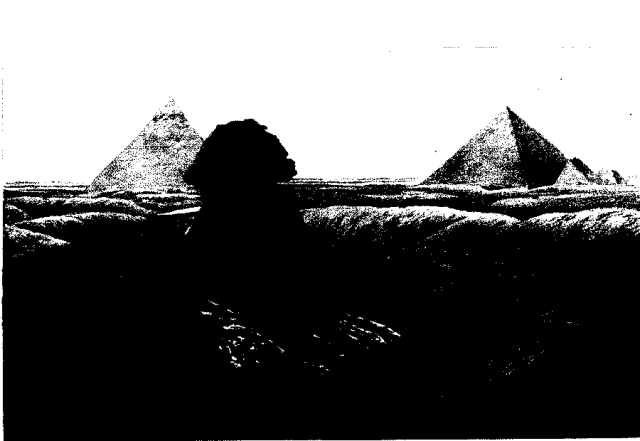
One went to tell unto his Majesty, "Two great Persea trees have grown, as a great marvel for his Majesty, in the night, by the side of the great gate of his Majesty." There was rejoicing for them in all the land, and there were offerings made to them.
Now when the days were multiplied after these things, his Majesty was adorned with a blue crown, with garlands of flowers on his neck; he was upon the chariot of electrum; he went out from the palace to behold the Persea trees: the princess also went out with horses behind Pharaoh. His Majesty sat beneath one of the Persea trees, and it spake thus with his wife:—"Oh thou deceitful one, I am Bata; I am alive, though I have suffered violence. Thou knewest well that the causing of the acacia to be cut down for Pharaoh was to my hurt. I then became an ox, and thou hadst me slain."
Now when the days were multiplied after these things, the princess stood at the table of Pharaoh, and the king was pleased with her. She said to his Majesty, "Swear to me by God, saying, 'That which the princess shall say to me I will obey it for her.' Thus do thou." And he hearkened unto all that she said. She said, "Let these two Persea trees be cut down, and let them be made into goodly timber." He hearkened unto all that she said.
Now when the days were multiplied after these things, his Majesty sent skillful craftsmen, and they cut down the Persea trees of Pharaoh, while the princess, the royal wife, stood by and saw it. A chip flew up and entered into the mouth of the princess; and she perceived that she had conceived, and while her days were being fulfilled Pharaoh did all that was in her heart therein.[82]
Now when the days were multiplied after these things, she bore a male child. One went to tell his Majesty, "There is born to thee a son." They brought him [i. e., the child, to the king], and gave to him a nurse and servants; there were rejoicings in the whole land. The king sat making a good day; they performed the naming of him, his Majesty loved him exceedingly on the instant, the king raised him to be the royal son of Kush.
Now when the days were multiplied after these things, his Majesty made him heir of all the land.
Now when the days were multiplied after these things, when he had fulfilled many years as heir of the whole land, his Majesty flew up to heaven. There was command given, "Let my great nobles of his Majesty be brought before me, that I may make them to know all that has happened to me." And they brought to him his wife, and he argued with her before them, and their case was decided. They brought to him his elder brother; he made him hereditary prince in all his land. He was thirty years King of Egypt, and he died, and his elder brother stood in his place on the day of burial.
Excellently finished in peace, for the Ka of the scribe of the treasury, Kagabu, of the treasury of Pharaoh, and for the scribe Hora, and the scribe Meremapt. Written by the scribe Anena, the owner of this roll. He who speaks against this roll, may Tahuti be his opponent.
Translation of F. Ll. Griffith.
THE STORY OF SETNA
[The beginning of this tale is lost, but it is clear from what remains of it that Setna Kha-em-uast, son of a Pharaoh who may be identified with Rameses II., of the XIXth Dynasty (about 1300 B.C.), was a diligent student of the ancient writings, chiefly for the sake of the occult knowledge which they were supposed to contain. He discovered, or was told of, the existence of a book which Thoth, the god of letters, science and magic, had "written with his own hand," and learned that this book was to be found in the cemetery of Memphis, in the tomb of Na-nefer-ka-ptah, the only son of some earlier Pharaoh. Setna evidently succeeded in finding and entering this tomb, and there he saw the kas or ghosts of Na-nefer-ka-ptah, his wife (and sister) Ahura, and their little boy Merab; and with them was the book. To dissuade Setna from abstracting the book, Ahura tells him how they had become possessed of it, and had paid for it with their earthly lives; and it is with her tale that the papyrus begins. Setna, however, insists upon taking the book; but Na-nefer-ka-ptah challenges him, as a good scribe and a learned man, to a trial of skill in a game, and in the imposition of magical penalties on the loser. Setna agrees; but being worsted, he calls in outside help and succeeds in carrying off the book. Na-nefer-ka-ptah comforts Ahura for its loss by assuring her that Setna shall ignominiously restore it. Setna studies the book with delight; but presently, by the magic power of Na-nefer-ka-ptah, he becomes the victim of an extraordinary hallucination, and the strength of his spirit is broken because (in imagination at least) he is steeped in impurity and crime. When he awakes from this trance, Pharaoh persuades him to return the book to its dead owners. On his return to the tomb, Na-nefer-ka-ptah exacts from him the promise to go to the cemetery of Koptos and bring thence to Memphis the bodies of Ahura and of Merab, which had been buried there, apart from him. Setna duly performs his promise, and so the story ends.