Part 3 — SCENE IN SCHOOL · AN EXERCISE IN COMPOSITION
Reading edition
TABULA ET STILUS
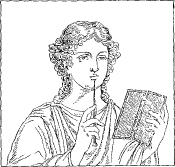
Discipulī. Salvē, magister.
Magister. Vōs quoque omnēs, salvēte. 1Tabulāsne portāvistis et stilōs?
D. Portāvimus.
M. Iam fābulam Aesōpī2 discēmus. Ego legam, vōs in tabulīs scrībite. Et tū, Pūblī, dā mihi ē capsā3 Aesōpī volūmen.4 Iam audīte omnēs: Vulpēs et Ūva.
Vulpēs ōlim famē coācta ūvam dēpendentem vīdit. Ad ūvam saliēbat, sūmere cōnāns. Frūstrā diū cōnāta, tandem īrāta erat et salīre cessāns dīxit: “Illa ūva est acerba; acerbam ūvam 5nihil moror.”
Omnia´ne scrīpsistis, puerī?
D. Omnia, magister.
LXVII. PUBLIUS GOES TO ROME TO FINISH HIS EDUCATION
Iamque Pūblius, 1quīndecim annōs nātus, 2prīmīs litterārum elementīs cōnfectīs, Rōmam petere voluit ut scholās grammaticōrum et philosophōrum frequentāret. Et facillimē patrī3 suō, qui ipse philosophiae studiō tenēbātur, persuāsit. Itaque 4omnibus rēbus ad profectiōnem comparātīs, pater fīliusque equīs animōsīs vectī5 ad magnam urbem profectī sunt. Eōs proficīscentīs Iūlia tōtaque familia vōtīs precibusque prōsecūtae sunt. Tum per loca6 plāna et collis silvīs vestītōs viam ingressī sunt ad Nōlam, quod oppidum eōs hospitiō modicō excēpit. Nōlae7 duās hōrās morātī sunt, quod sōl merīdiānus ārdēbat. Tum rēctā viā8 circiter vīgintī mīlia9 passuum9 Capuam,9 ad īnsignem Campāniae urbem, contendērunt. Eō10 multā nocte dēfessī pervēnērunt. 11Postrīdiē eius diēī, somnō et cibō recreātī, Capuā discessērunt et 13viam Appiam ingressī, quae Capuam tangit et ūsque ad urbem Rōmam dūcit, ante merīdiem Sinuessam pervēnērunt, quod oppidum tangit mare. Inde prīmā lūce proficīscentēs Formiās13 properāvērunt, ubi Cicerō, ōrātor clarissimus, quī forte apud vīllam suam erat, eōs benignē excēpit. Hinc 14itinere vīgintī quīnque mīlium passuum factō, Tarracīnam, oppidum in saxīs altissimīs situm, vīdērunt. Iamque nōn longē aberant palūdēs magnae, quae multa mīlia passuum undique patent. Per eās pedestris via est gravis et in nāve viātōrēs vehuntur. Itaque 15equīs relictīs Lentulus et Pūblius nāvem cōnscendērunt, et, ūnā nocte in trānsitū cōnsūmptā, Forum Appī vēnērunt. Tum brevī tempore Arīcia eōs excēpit. Hoc oppidum, in colle situm, ab urbe Romā sēdecim mīlia passuum abest. Inde dēclivis via ūsque ad latum campum dūcit ubi Rōma stat. Quem ad locum ubi Pūblius vēnit et Rōmam adhūc remōtam, maximam tōtīus orbis terrārum urbem, cōnspēxit, summā admīrātiōne et gaudiō adfectus est. Sine morā dēscendērunt, et, mediō intervāllō quam celerrimē superātō, urbem portā Capēnā ingressī sunt.
LXVIII. PUBLIUS PUTS ON THE TOGA VIRILIS
BULLA
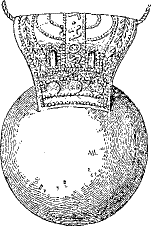
Pūblius iam tōtum annum Rōmae morābātur1 multaque urbis spectācula vīderat et multōs sibi2 amīcōs parāverat. Eī3 omnēs favēbant; 4dē eō omnēs bene spērāre poterant. Cotīdiē Pūblius scholas philosophōrum et grammaticōrum tantō studiō frequentābat 5ut aliīs clārum exemplum praebēret. Saepe erat cum patre in cūriā6; quae rēs effēcit 7ut summōs reī pūblicae virōs et audīret et vidēret. Ubi 8sēdecim annōs natus est, bullam9 auream et togam praetextam mōre Rōmānō dēposuit atque virīlem togam sūmpsit. Virīlis autem toga erat omnīnō alba, sed praetexta clāvum purpureum in margine habēbat. 10Dēpōnere togam praetextam et sūmere togam virīlem erat rēs grātissima puerō Rōmānō, quod posteā vir et cīvis Rōmānus habēbātur.
11Hīs rēbus gestīs Lentulus ad uxōrem suam hās litterās scrīpsit:
12“Mārcus Iūliae suae salūtem dīcit. Sī valēs, bene est; ego valeō. Accēpī tuās litterās. Hās nunc Rōmā per servum fidēlissimum mittō ut dē Pūbliō nostrō quam celerrimē sciās. Nam hodiē eī togam virīlem dedī. Ante lucem surrēxī13 et prīmum bullam auream dē collō eius remōvī. Hāc Laribus14 cōnsecrātā et sacrīs factīs, eum togā virīlī vestīvī. Interim plūrēs amīcī cum multitūdine optimōrum cīvium et honestōrum clientium pervēnerant 15quī Pūblium domō in forum dēdūcerent. Ibi in cīvitātem receptus est et nōmen, Pūblius Cornēlius Lentulus, apud cīvīs Rōmānōs ascrīptum est. Omnēs eī amīcissimī fuērunt et magna16 de eō praedīcunt. Sapientior enim aequālibus17 est et magnum ingenium habet. 18Cūrā ut valeās.”
LXIX. PUBLIUS JOINS CÆSAR’S ARMY IN GAUL
Pūblius iam adulēscēns postquam togam virīlem sūmpsit, aliīs rēbus studēre incēpit et praesertim ūsū1 armōrum sē2 dīligenter exercuit. Magis magisque amāvit illās artīs quae mīlitārem animum dēlectant. Iamque erant 3quī eī cursum mīlitārem praedīcerent. Nec sine causā, quod certē patris īsigne exemplum 4ita multum trahēbat. 5Paucīs ante annīs C. Iūlius Caesar, ducum Rōmānōrum maximus, cōnsul creātus erat et hōc tempore in Galliā bellum grave gerēbat. Atque in exercitū eius plūrēs adulēscentēs mīlitābant, apud quōs erat amīcus quīdam Pūblī. Ille Pūblium crēbrīs litterīs vehementer hortābātur 6ut iter in Galliam faceret. Neque Pūblius recūsāvit, et, multīs amīcīs ad portam urbis prōsequentibus, ad Caesaris castra profectus est. Quārtō diē postquam iter ingressus est, ad Alpīs, montīs altissimōs, pervēnit. Hīs summā difficultāte superātīs, tandem Gallōrum in fīnibus erat. Prīmō autem veritus est ut7 castrīs Rōmānīs adpropinquāre posset, quod Gallī, maximīs cōpiīs coāctīs, Rōmānōs obsidēbant et viās omnīs iam clauserant. Hīs rēbus commōtus Pūblius vestem Gallicam induit nē ā Gallīs caperētur, et ita per hostium cōpiās incolumis ad castra pervenīre potuit. Intrā mūnītiōnes acceptus, ā Caesare benignē exceptus est. Imperātor fortem adulēscentem amplissimīs verbīs laudāvit et eum 8tribūnum mīlītum creāvit.
IMPEDIMENTA
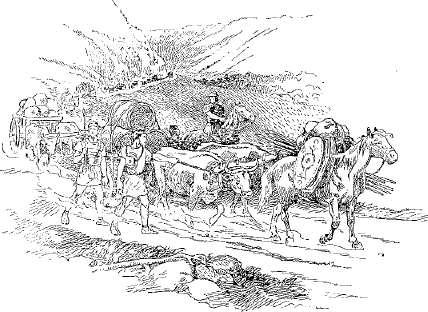
HOW THE ROMANS MARCHED AND CAMPED
Exercitus quī in hostium fīnibus bellum genit multīs perīcuīs circumdatus est. 1Quae perīcula ut vītāret, Rōmāni summam cūram adhībēre solēbant. Adpropinquanteēs cōpiīs hostium agmen ita dispōnēbant 2ut imperātor ipse cum plāribus legiōnibus expedītīs3 prīmum agmen dūceret. Post eās cōpiās impedīmenta4 tōtīus exercitūs conlocābant. 5Tum legiōnēs quae proximē cōnscrīptae erant tōtum agmen claudēbant. Equitēs quoque in omnīs partīs dīmittēbantur quī loca explōrārent; et centuriōnēs praemittēbantur ut locum castrīs idōneum dēligerent. Locus habēbatur idōneus castrīs 6quī facile dēfendī posset et prope aquam esset. Quā dē causā castra7 in colle ab utrāque parte arduō, ā fronte lēniter dēclīvī saepe pōnēbantur; vel locus palūdibus cīnctus vel in flūminis rīpīs situs dēligēbātur. Ad locum postquam exercitus pervēnit, aliī mīlitum 8in armīs erant, aliī castra mūnīre incipiēbant. Nam 9quō tūtiōrēs ab hostibus mīlitēs essent, nēve incautī et imparātī opprimerentur, castra fossā lātā et vāllō altō mūniēbant. In castrīs portae quattuor erant ut ēruptiō mīlitum omnīs in partīs fierī posset. In angulīs castrōrum erant turrēs dē quibus tēla in hostīs coniciēbantur. 10Tālibus in castrīs quālia dēscrīpsimus Pūblius ā Caesare exceptus est.
LXX. THE RIVAL CENTURIONS
CENTURIO
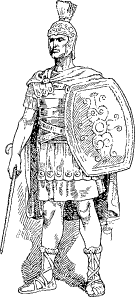
Illīs in castrīs erant duo centuriōnēs,1 fortissimī virī, T. Pullō et L. Vorēnus, quōrum neuter alterī virtūte2 cēdere volēbat. Inter eōs iam multōs annōs īnfēnsum certāmen gerēbātur. Tum dēmum fīnis contrōversiae hōc modō3 factus est. Diē tertiō postquam Pūblius pervēnit, hostēs, maiōribus cōpiīs coāctīs, ācerrimum impetum in castra fēcērunt. Tum Pullō, 4cum Rōmānī tardiōrēs5 vidērentur, “Cūr dubitās,” inquit, “Vorēne? Quam commodiōrem occāsiōnem exspectās? Hic diēs dē virtūte nostrā iūdicābit.” Haec6 cum dīxisset, extrā mūnītiōnēs prōcessit et in eam hostium partem quae cōfertissima 7vidēbātur inrūpit. Neque Vorēnus quidem tum vāllō8 sēsē continet, sed Pullōnem subsequitur. Tum Pullō pīlum in hostīs immittit atque ūnum ex multitūdine prōcurrentem trāicit. Hunc percussum et exanimātum hostēs scūtīs prōtegunt et in Pullōnem omnēs tēla coniciunt. Eius scūtum trānsfīgitur et tēlum in balteō dēfīgitur. Hic cāsus vāgīnam āvertit et dextram manum eius gladium ēdūcere cōnantis9 morātur. Eum ita impedītum hostēs circumsistunt.
Tum vēro 10eī labōrantī Vorēnus, cum sit inimīcus, tamen auxilium dat. Ad hunc cōnfestim 11ā Pullōne omnis multitūdō sē convertit. Gladiō comminus pugnat Vorēnus, atque, ūnō interfectō, reliquōs paulum prōpellit. Sed īnstāns cupidius12 īnfēlīx, 13pede sē fallente, concidit.
Huic rūrsus circumventō auxilium dat Pullō, atque ambō incolumēs, plūribus interfectīs, summā cum laude intrā mūnītiōnēs sē recipiunt. Sic inimīcōrum alter alterī auxilium dedit nec de eōrum virtūte quisquam iūdicāre potuit.
LXXI. THE ENEMY BESIEGING THE CAMP ARE REPULSED
Cum iam sex hōrās pugnatum esset1 ac nōn sōlum vīrēs sed etiam tēla Rōmānōs dēficerent1, atque hostēs ācrius instārent,1 et vāllum scindere fossamque complēre incēpissent,1 Caesar, vir reī mīlitāris perītissimus, suīs imperāvit ut proelium paulisper intermitterent,2 et, signō datō, ex castrīs ērumperent.2 3Quod iussī sunt faciunt, et subitō ex omnibus portīs ērumpunt. Atque tam celeriter mīlitēs concurrērunt et tam propinquī erant hostēs4 ut spatium pīla coniciendī5 nōn darētur. Itaque reiectīs pīlīs 6comminus gladiīs pugnātum est. Diū et audācter hostēs restitērunt et in extrēmā spē salūtis tantam virtūtem praestitērunt ut ā dextrō cornū vehementer 7multitūdine suōrum aciem Rōmanam premerent. 8Id imperātor cum animadvertisset, Pūblium adulēscentem cum equitātū mīsit quī labōrantibus9 auxilium daret. Eius impetum sustinēre nōn potuērunt hostēs10 et omnēs terga vertērunt. Eōs in fugam datōs Pūblius subsecūtus est ūsque ad flūmen Rhēnum, quod ab eō locō quīnque mīlia passuum aberat. Ibi paucī salūtem sibi repperērunt. Omnibus reliquīs interfectīs, Pūblius et equitēs in castra sēsē recēpērunt. Dē hāc calamitāte fīnitimae gentēs cum certiōrēs factae essent, ad Caesarem lēgātōs mīsērunt et sē suaque omnia dēdidērunt.
LXXII. PUBLIUS GOES TO GERMANY · ITS GREAT FORESTS AND STRANGE ANIMALS
Initā aestāte Caesar litterīs certior fīēbat et per explōrātōrēs cognōscēbat plūrīs cīvitātēs Galliae novīs rēbus studēre,1 et contrā populum Rōmānum coniūrāre1 obsidēsque 2inter sē dare,1 atque cum hīs Germānōs quōsdam quoque sēsē coniūnctūrōs esse.1 Hīs litterīs nūntiīsque commōtus Caesar cōnstituit quam celerrimē in Gallōs proficīscī,3 ut eōs inopīnantīs opprimeret, et Labiēnum lēgātum cum duābus legiōnibus peditum et duōbus mīlibus equitum in Germānōs mittere.3 4Itaque rē frūmentāriā comparātā castra mōvit. Ab utrōque5 rēs bene gesta est; nam Caesar tam celeriter in hostium fīnīs pervēnit ut spatium 6cōpiās cōgendī nōn darētur7; et Labiēnus dē Germānīs tam grave supplicium sūmpsit ut nēmō ex eā gente in reliquum tempus Gallīs auxilium dare audēret.7
Hoc iter in Germāniam Pūblius quoque fēcit et, 8cum ibi morārētur, multa mīrābilia vīdit. Praesertim vērō ingentem silvam mīrābātur, quae tantae magnitūdinis esse dīcēbātur 9ut nēmō eam trānsīre posset, nec quisquam scīret aut initium aut fīnem. Quā dē rē plūra cognōverat ā mīlite quōdam quī ōlim captus ā Germānīs multōs annōs ibi incoluit. Ille10 dē silvā dīcēns, “Īnfīnītae magnitūdinis est haec silva,” inquit; “nee quisquam est 11huius Germāniae 12quī initium eius sciat aut ad fīnem adierit. Nāscuntur illīc multa tālia animālium genera quālia reliquīs in locīs nōn inveniuntur. Sunt bovēs quī ūnum13 cornū habent; sunt etiam animālia quae appellantur alcēs. Hae nūllōs crūrum14 articulōs habent. Itaque, sī forte concidērunt, sēsē ērigere nūllō modō possunt. Arborēs habent prō15 cubīlibus; ad eās sē applicant atque ita reclīnātae quiētem capiunt. Tertium est genus eōrum quī ūrī appellantur. Hī sunt paulō minōrēs elephantīs.16 Magna vis eōrum est et magna vēlōcitās. Neque hominī neque ferae parcunt.17”
LXXIII. THE STORMING OF A CITY
Pūblius plūrīs diēs in Germāniā morātus1 in Galliam rediit, et ad Caesaris castra sē contulit. Ille quia molestē ferēbat Gallōs2 eius regiōnis obsidēs dare recūsāvisse et exercituī frūmentum praebēre nōluisse, cōnstituit eīs3 bellum īnferre. Agrīs vāstātīs, vīcīs incēnsīs, pervēnit ad oppidum validissimum quod et nātūrā et arte mūnītum erat. Cingēbātur mūrō vīgintī quīnque pedēs4 altō. Ā lateribus duōsitum, praeruptō fastīgiō ad plānitiem vergēgat; ā quārtō tantum5 latere aditus erat facilis. Hoc oppidum oppugnāre, 6cum opus esset difficillimum, tamen cōnstituit Caesar. Et castrīs mūnītīs Pūbliō negōtium dedit ut rēs 7ad oppugnandum necessāriās parāret.
VINEA
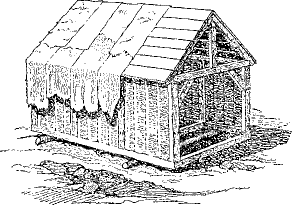
Rōmānōrum autem oppugnātiō est haec.8 Prīmum turrēs aedificantur quibus mīlitēs in summum mūrum ēvādere possint9; vīneae10 fīunt quibus tēctī mīlitēs ad mūrum succēdant; pluteī11 parantur post quōs mīlitēs tormenta12 administrent; sunt quoque arietēs quī mūrum et portās discutiant. Hīs omnibus rēbus comparātīs, deinde 13agger ab eā parte ubi aditus est facillimus exstruitur et cum vīneīs ad ipsum oppidum agitur. Tum turris in aggere prōmovētur; arietibus quī sub vīneīs conlocātī erant mūrus et portae discutiuntur; ballistīs, catapultīs, reliquīsque tormentīs lapidēs et tēla in oppidum coniciuntur. Postrēmō cum iam turris et agger altitūdinem mūrī adaequant et arietēs moenia perfrēgērunt,14 signō datō mīlitēs inruunt et oppidum expugnant.
LXXIV. THE CITY IS TAKEN · THE CAPTIVES ARE QUESTIONED
BALLISTA
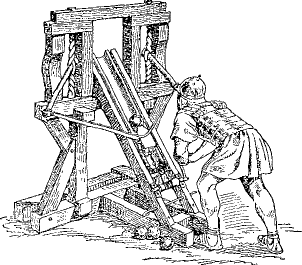
Omnibus rēbus necessāriīs ad oppugnandum ā Pūbliō comparātīs, dēlīberātur in conciliō quod cōnsilium 1oppidī expugnandī ineant.2 Tum ūnus3 ex centuriōnibus, vir reī mīlitāris perītissimus, “Ego suādeō,” inquit, “ut ab eā parte, ubi aditus sit4 facillimus, aggerem exstruāmus5 et turrim prōmoveāmus5 atque ariete admōtō simul mūrum discutere cōnēmur.5” 6Hoc cōnsilium cum omnibus placēret, Caesar concilium dīmīsit. Deinde mīlitēs hortātus ut priōrēs victōriās memoriā7 tenērent, iussit aggerem exstruī, turrim et arietem admovērī. Neque oppidānīs8 cōnsilium dēfuit. Aliī ignem et omne genus tēlōrum dē mūrō in turrim coniēcērunt, aliī ingentia saxa in vīneās et arietem dēvolvērunt. Diū utrimque ācerrimē pugnātum est. Nē vulnerātī quidem pedem rettulērunt. Tandem, 9dē tertiā vigiliā, Pūblius, quem Caesar illī operī10 praefēcerat, nūntiāvit partem11 mūrī ictibus arietis labefactam concidisse. Quā rē audītā Caesar signum dat; mīlitēs inruunt et magnā cum caede hostium oppidum capiunt.
TURRES, ARIETES, VINEA
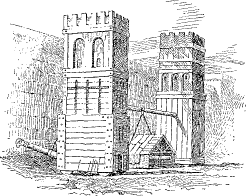
Postrīdiē eius diēī, hōc oppidō expugnātō, 12captīvōrum quī nōbilissimī sunt ad imperātōrem ante praetōrium13 addūcuntur. Ipse, lōrīcā aurātā et paludāmentō purpureō īnsignis, captīvōs per interpretem in hunc modum interrogat:14 Vōs quī estis15?
Interpres. Rogat imperātor quī sītis.
Captīvī. Fīliī rēgis sumus.
Interpres. Dīcunt sē fīliōs esse rēgis.
Imperātor. Cūr mihi tantās iniūriās intulistis?
Interpres. Rogat cūr sibi tantās iniūriās intuleritis.
Captīvī. Iniūriās eī nōn intulimus sed prō patriā bellum gessimus. Semper voluimus Rōmānīs esse amīcī, sed Rōmānī sine causā nōs domō patriāque expellere cōnātī sunt.
Interpres. 16Negant sē iniūriās tibi intulisse, sed prō patriā bellum gessisse. 17Semper sē voluisse amīcōs Rōmānīs esse, sed Rōmānōs sine causā sē domō patriāque expellere cōnātōs esse.
Imperātor. 18Manēbitisne in reliquum tempus in fidē, hāc rebelliōne condōnātā?
Tum vērō captīvī multīs cum lacrimīs iūrāvērunt sē in fidē mānsūrōs esse, et Caesar eōs incolumīs domum dīmīsit.
LXXV. CIVIL WAR BREAKS OUT BETWEEN CÆSAR AND POMPEY · THE BATTLE OF PHARSALIA
Nē cōnfectō1 quidem bellō Gallicō, 2bellum cīvīle inter Caesarem et Pompēium exortum est. Nam Pompēius, quī summum imperium petēbat, senātuī persuāserat ut Caesarem reī pūblicae hostem3 iūdicāret et exercitum eius dīmittī iubēret. Quibus cognitīs rēbus Caesar exercitum suum dīmittere recūsāvit, atque, hortātus mīlitēs ut ducem totiēns victōrem ab inimīcōrum iniūriīs dēfenderent, imperāvit ut sē Rōmam sequerentur. Summā cum alacritāte mīlitēs pāruērunt, et trānsitō Rubicōne4 initium bellī cīvīlis factum est.
Italiae urbēs quidem omnēs ferē 5rēbus Caesaris favēbant et eum benignē excēpērunt. Quā rē commōtus Pompēius ante Caesaris adventum Rōmā excessit et Brundisium6 pervēnit, inde 7paucīs post diēbus cum omnibus cōpiīs ad Ēpīrum mare trānsiit. Eum Caesar cum septem legiōnibus et quīngentīs equitibus secūtus est, et īnsignis inter Caesaris comitātum erat Pūblius.
Plūribus leviōribus proeliīs factīs, tandem cōpiae adversae ad Pharsālum8 in Thessaliā sitam castra posuērunt. Cum Pompeī exercitus esset bis tantus quantus Caesaris, tamen erant multī quī veterānās legiōnēs quae Gallōs et Germānōs superāverant vehementer timēbant. Quōs9 10ante proelium commissum Labiēnus11 lēgātus, quī ab Caesare nūper dēfēcerat, ita adlocūtus est: “12Nōlīte exīstimāre hunc esse exercitum veterānōrum mīlitum. Omnibus interfuī proeliīs13 neque temerē incognitam rem prōnūntiō. Perexigua pars illīus exercitūs quī Gallōs superāvit adhūc superest. Magna pars occīsa est, multī domum discessērunt, multī sunt relictī in Italiā. Hae cōpiae quās vidētis in 14citeriōre Galliā nūper cōnscrīptae sunt.” Haec15 cum dīxisset, iūrāvit sē nisi victōrem in castra nōn reversūrum esse. 16Hoc idem Pompēius et omnēs reliquī iūrāvērunt, et magnā spē et laetitiā, sīcut certam ad victōriam, cōpiae ē castrīs exiērunt.
Item Caesar, animō17 ad dīmicandum parātus, exercitum suum ēdūxit et septem cohortibus 18praesidiō castrīs relictīs cōpiās triplicī aciē īnstrūxit. Tum, mīlitibus studiō pugnae ārdentibus, tubā signum dedit. Mīlitēs prōcurrērunt et pīlīs missīs gladiōs strīnxērunt. Neque vērō virtūs hostibus dēfuit. Nam et tēla missa sustinuērunt et impetum gladiōrum excēpērunt et ōrdinēs cōnservāvērunt. Utrimque diū et ācriter pugnātum est nec quisquam pedem rettulit. Tum equitēs Pompēī aciem Caesaris circumīre cōnātī sunt. Quod19 ubi Caesar animadvertit, tertiam aciem,20 quae ad id tempus quiēta fuerat, prōcurrere iussit. Tum vērō integrōrum impetum21 dēfessī hostēs sustinēre nōn potuērunt et omnēs terga vertērunt. Sed Pompēius dē fortūnīs suīs dēspērāns sē in castra equō contulit, inde mox cum paucīs equitibus effūgit.
LXXVI. THE TRIUMPH OF CAESAR
SIGNIFER
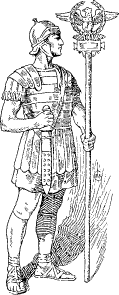
Pompēiō amīcīsque eius superātīs atque omnibus hostibus ubīque victīs, Caesar imperātor Rōmam rediit et 1extrā moenia urbis in campō Mārtiō castra posuit. Tum vērō amplissimīs honōribus adfectus est. Dictātor creātus est, et eī triumphus ā senātū est dēcrētus. 2Quō diē de Gallīs triumphum ēgit, tanta multitūdō hominum in urbem undique cōnflūxit 3ut omnia loca essent cōnferta. Templa patēbant, ārae fūmābant, columnae sertīs ōrnātae erant. 4Cum vērō pompa urbem intrāret, quantus hominum fremitus ortus est! Prīmum per portam ingressī sunt senātus et magistrātūs. Secūtī sunt tībīcinēs, signiferī, peditēs laureā corōnātī canentēs: “Ecce Caesar nunc triumphat, quī subēgit Galliam,” et “Mīlle, mīlle, mīlle, mīlle Gallōs trucīdāvimus.” Multī praedam captārum urbium portābant, arma, omnia bellī īnstrūmenta. Secūtī sunt equitēs, animōsīs atque splendidissimē ōrnātīs equīs vectī, inter quōs Pūblius adulēscēns fortissimus habēbātur. Addūcēbantur taurī, arietēs, 5quī dīs immortālibus immolārentur. Ita longō agmine prōgrediēns exercitus 6sacrā viā per forum in Capitōlium perrēxit.
LICTORES CUM FASCIBUS
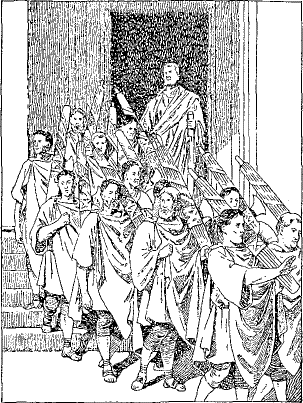
Imperātor ipse cum urbem intrāret, undique laetō clāmōre multitūdinis salūtātus est. Stābat in currū aureō quem quattuor albī equī vehēbant. Indūtus 7togā pictā, alterā manū habēnās et lauream tenēbat, alterā eburneum scēptrum. Post eum servus in currū stāns auream corōnam super caput eius tenēbat. Ante currum miserrimī captīvī, rēgēs prīncipēsque superātārum gentium, catēnīs vīnctī, prōgrediēbantur; et vīgintī quattuor līctōrēs8 laureatās fascīs ferentēs et signiferī currum Caesaris comitābantur. Conclūdit agmen multitūdō captīvōrum, quī, in servitūtem redāctī,9 dēmissō vultū, vīnctīs10 bracchiīs, sequuntur; quibuscum veniunt longissimō ōrdine mīlitēs, etiam hī praedam vel insignia mīlitāria ferentēs.
Caesar cum Capitōlium ascendisset, in templō Iovī Capitōlīnō sacra fēcit. Simul11 captivōrum quī nōbilissimī erant, abductī in carcerem,12 interfectī sunt. Sacrīs factīs Caesar dē Capitōliō dēscendit et in forō mīitibus suīs honōrēs mīlitārīs dedit eīsque pecūniam ex bellī praedā distribuit.
Hīs omnibus rēbus cōnfectīs, Pūblius Caesarem valēre13 iussit et quam celerrimē ad vīllam contendit ut patrem mātremque salūtāret.
15Dē rēbus gestīs P. Cornēlī Lentulī hāctenus.
APPENDIX I
DECLENSIONS, CONJUGATIONS, NUMERALS, ETC.
NOUNS
460. Nouns are inflected in five declensions, distinguished by the final letter of the stem and by the termination of the genitive singular.
First Declension—Ā-stems, Gen. Sing. -ae
Second Declension—O-stems, Gen. Sing. -ī
Third Declension—Consonant stems and I-stems, Gen. Sing. -is
Fourth Declension—U-stems, Gen. Sing. -ūs
Fifth Declension—Ē-stems, Gen. Sing. -ē̆ī
461. FIRST DECLENSION. Ā-STEMS
domina, lady Stem dominā- Base domin-
Singular Plural
TERMINATIONS TERMINATIONS
Nom. domina -a dominae -ae
Gen. dominae -ae dominārum -ārum
Dat. dominae -ae dominīs -īs
Acc. dominam -am dominās -ās
Abl. dominā -ā dominīs -īs
a. Dea and fīlia have the termination -ābus in the dative and ablative plural.
462. SECOND DECLENSION. O-STEMS
a. Masculines in -us
dominus, master Stem domino- Base domin-
Singular Plural
TERMINATIONS TERMINATIONS
Nom. dominus -us dominī -ī
Gen. dominī -ī dominōrum -ōrum
Dat. dominō -ō dominīs -īs
Acc. dominum -um dominōs -ōs
Abl. dominō -ō dominīs -īs
1. Nouns in -us of the second declension have the termination -e´ in the vocative singular, as domine.
2. Proper names in -ius, and filius, end in -ī in the vocative singular, and the accent rests on the penult, as Vergi´lī, fīlī.
b. Neuters in -um
pīlum, spear Stem pīlo- Base pīl-
Singular Plural
TERMINATIONS TERMINATIONS
Nom. pīlum -um pīla -a
Gen. pīlī -ī pīlōrum -ōrum
Dat. pīlō -ō pīlīs -īs
Acc. pīlum -um pīla -a
Abl. pīlō -ō pīlīs -īs
1. Masculines in -ius and neuters in -ium end in -ī in the genitive singular, not in -iī, and the accent rests on the penult.
c. Masculines in -er AND -ir
puer, boy ager, field vir, man
Stems puero- agro- viro-
Bases puer- agr- vir-
Singular TERMINATIONS
Nom. puer ager vir —
Gen. puerī agrī virī -ī
Dat. puerō agrō virō -ō
Acc. puerum agrum virum -um
Abl. puerō agrō virō -ō
Plural
Nom. puerī agrī virī -ī
Gen. puerōrum agrōrum virōrum -ōrum
Dat. puerīs agrīs virīs -īs
Acc. puerōs agrōs virōs -ōs
Abl. puerīs agrīs virīs -īs
463. THIRD DECLENSION.
CLASSIFICATION I. Consonant Stems 1. Stems that add -s to the base to form the nominative singular: masculines and feminines only. 2. Stems that add no termination in the nominitive singular: a. masculines and feminines; b. neuters.
II. I-Stems. Masculines, feminines, and neuters.
464. I. CONSONANT STEMS
1. Nouns that add -s to the base to form the nominative singular: masculines and feminines only
prīnceps, m., chief mīles, m., soldier lapis, m., stone
Bases or Stems prīncip- mīlit- lapid-
Singular TERMINATIONS
Nom. prīnceps mīles lapis -s
Gen. prīn´cipis mīlitis lapidis -is
Dat. prīn´cipī mīlitī lapidī -ī
Acc. prīn´cipem mīlitem lapidem -em
Abl. prīn´cipe mīlite lapide -e
Plural
Nom. prīn´cipēs mīlitēs lapidēs -ēs
Gen. prīn´cipum mīlitum lapidum -um
Dat. prīnci´pibus mīlitibus lapidibus -ibus
Acc. prīn´cipēs mīlitēs lapidēs -ēs
Abl. prīnci´pibus mīlitibus lapidibus -ibus
rēx, m., king iūdex, m., judge virtūs, f., manliness
Bases or Stems rēg- iūdic- virtūt-
Nom. rēx iūdex virtūs -s
Gen. rēgis iūdicis virtū´tis -is
Dat. rēgī iūdicī virtū´tī -ī
Acc. rēgem iūdicem virtū´tem -em
Abl. rēge iūdice virtū´te -e
Plural
Nom. rēgēs iūdicēs virtū´tēs -ēs
Gen. rēgum iūdicum virtū´tum -um
Dat. rēgibus iūdicibus virtū´tibus -ibus
Acc. rēgēs iūdicēs virtū´tēs -ēs
Abl. rēgibus iūdicibus virtū´tibus -ibus
Note. For consonant changes in the nominative singular, cf. § 233. 3.
2. Nouns that have no termination in the nominative singular
a. Masculines and Feminines
cōnsul, m., consul legiō, f., legion ōrdō, m., row pater, m., father
Bases or Stems cōnsul- legiōn- ōrdin- patr-
Singular TERMINATIONS
Nom. cōnsul legiō ōrdō pater —
Gen. cōnsulis legiōnis ōrdinis patris -is
Dat. cōnsulī legiōnī ōrdinī patrī -ī
Acc. cōnsulem legiōnem ōrdinem patrem -em
Abl. cōnsule legiōne ōrdine patre -e
Plural
Nom. cōnsulēs legiōnēs ōrdinēs patrēs -ēs
Gen. cōnsulum legiōnum ōrdinum patrum -um
Dat. cōnsulibus legiōnibus ōrdinibus patribus -ibus
Acc. cōnsulēs legiōnēs ōrdinēs patrēs -ēs
Abl. cōnsulibus legiōnibus ōrdinibus patribus -ibus
Note. For vowel and consonant changes in the nominative singular, cf. § 236. 1-3.
b. Neuters
flūmen, n., river tempus, n., time opus, n., work caput, n., head
Bases or Stems flūmin- tempor- oper- capit-
Singular TERMINATIONS
Nom. flūmen tempus opus caput —
Gen. flūminis temporis operis capitis -is -is
Dat. flūminī temporī operī capitī -ī
Acc. flūmen tempus opus caput —
Abl. flūmine tempore opere capite -e
Plural
Nom. flūmina tempora opera capita -a
Gen. flūminum temporum operum capitum -um
Dat. flūminibus temporibus operibus capitibus -ibus
Acc. flūmina tempora opera capita -a
Abl. flūminibus temporibus operibus capitibus -ibus
Note. For vowel and consonant changes in the nominative singular, cf. § 238. 2, 3.
465. II. I-STEMS
a. Masculines and Feminines
caedēs, f., slaughter hostis, m., enemy urbs, f., city cliēns, m., retainer
Stems caedi- hosti- urbi- clienti-
Bases caed- host- urb- client-
Singular TERMINATIONS
Nom. caedēs hostis urbs cliēns -s, -is, or -ēs
Gen. caedis hostis urbis clientis -is
Dat. caedī hostī urbī clientī -ī
Acc. caedem hostem urbem clientem -em (-im)
Abl. caede hoste urbe cliente -e (-ī)
Plural
Nom. caedēs hostēs urbēs clientēs -ēs
Gen. caedium hostium urbium clientium -ium
Dat. caedibus hostibus urbibus clientibus -ibus
Acc. caedīs, -ēs hostīs, -ēs urbīs, -ēs clientīs, -ēs -īs, -ēs
Abl. caedibus hostibus urbibus clientibus -ibus
1. Avis, cīvis, fīnis, ignis, nāvis, have the abl. sing. in -ī or -e.
2. Turris has accusative turrim and ablative turrī or turre.
b. Neuters
īnsigne, n., decoration animal, n., animal calcar, n., spur
Stems īnsigni- animāli- calcāri-
Bases īnsign- animāl- calcār-
Singular TERMINATIONS
Nom. īnsigne animal calcar -e or —
Gen. īnsignis animālis calcāris -is
Dat. īnsignī animālī calcārī -ī
Acc. īnsigne animal calcar -e or —
Abl. īnsignī animālī calcārī -ī
Plural
Nom. īnsignia animālia calcāria -ia
Gen. īnsignium animālium calcārium -ium
Dat. īnsignibus animālibus calcāribus -ibus
Acc. īnsignia animālia calcāria -ia
Abl. īnsignibus animālibus calcāribus -ibus
466. THE FOURTH DECLENSION. U-STEMS
adventus, m., arrival cornū, n., horn
Stems adventu- cornu-
Bases advent- corn-
Singular TERMINATIONS
MASC. NEUT.
Nom. adventus cornū -us -ū
Gen. adventūs cornūs -ūs -ūs
Dat. adventuī (ū) cornū -uī (ū) -ū
Acc. adventum cornū -um -ū
Abl. adventū cornū -ū -ū
Plural
Nom. adventūs cornua -ūs -ua
Gen. adventuum cornuum -uum -uum
Dat. adventibus cornibus -ibus -ibus
Acc. adventūs cornua -ūs -ua
Abl. adventibus cornibus -ibus -ibus
467. THE FIFTH DECLENSION. Ē-STEMS
diēs, m., day rēs, f. thing
Stems diē- rē-
Bases di- r-
Singular TERMINATIONS
Nom. diēs rēs -ēs
Gen. diēī reī -ē̆ī
Dat. diēī reī -ē̆ī
Acc. diem rem -em
Abl. diē rē -ē
Plural
Nom. diēs rēs -ēs
Gen. diērum rērum -ērum
Dat. diēbus rēbus -ēbus
Acc. diēs rēs -ēs
Abl. diēbus rēbus -ēbus
468. SPECIAL PARADIGMS
deus, m., god domus, f., house vīs, f., strength iter, n., way
Stems deo- domu- vī- and vīri- iter- and itiner-
Bases de- dom- v- and vīr- iter- and itiner-
Singular
Nom. deus domus vīs iter
Gen. deī domūs vīs (rare) itineris
Dat. deō domuī, -ō vī (rare) itinerī
Acc. deum domum vim iter
Abl. deō domō, -ū vī itinere
Plural
Nom. deī, dī domūs vīrēs itinera
Gen. deōrum, deum domuum, -ōrum vīrium itinerum
Dat. deīs, dīs domibus vīribus itineribus
Acc. deōs domōs, -ūs vīrīs, -ēs itinera
Abl. deīs, dīs domibus vīribus itineribus
a. The vocative singular of deus is like the nominative.
b. The locative of domus is domī.
ADJECTIVES
469. FIRST AND SECOND DECLENSIONS. O- AND Ā-STEMS
a. Adjectives in -us
bonus, good Stems bono- m. and n., bona- f. Base bon-
Singular
MASC. FEM. NEUT.
Nom. bonus bona bonum
Gen. bonī bonae bonī
Dat. bonō bonae bonō
Acc. bonum bonam bonum
Abl. bonō bonā bonō
Plural
Nom. bonī bonae bona
Gen. bonōrum bonārum bonōrum
Dat. bonīs bonīs bonīs
Acc. bonōs bonās bona
Abl. bonīs bonīs bonīs
b. Adjectives in -er
līber, free Stems lībero- m. and n., līberā- f. Base līber-
Singular
MASC. FEM. NEUT.
Nom. līber lībera līberum
Gen. līberī līberae līberī
Dat. līberō līberae līberō
Acc. līberum līberam līberum
Abl. līberō līberā līberō
Plural
Nom. līberī līberae lībera
Gen. līberōrum līberārum līberōrum
Dat. līberīs līberīs līberīs
Acc. līberōs līberās lībera
Abl. līberīs līberīs līberīs
pulcher, pretty Stems pulchro- m. and n., pulchrā- f. Base pulchr-
Singular
MASC. FEM. NEUT.
Nom. pulcher pulchra pulchrum
Gen. pulchrī pulchrae pulchrī
Dat. pulchrō pulchrae pulchrō
Acc. pulchrum pulchram pulchrum
Abl. pulchrō pulchrā pulchrō
Plural
Nom. pulchrī pulchrae pulchra
Gen. pulchrōrum pulchrārum pulchrōrum
Dat. pulchrīs pulchrīs pulchrīs
Acc. pulchrōs pulchrās pulchra
Abl. pulchrīs pulchrīs pulchrīs
470. THE NINE IRREGULAR ADJECTIVES
alius, another Stems alio- m. and n., aliā- f. Base ali-
Singular Plural
MASC. FEM. NEUT. MASC. FEM. NEUT.
Nom. alius alia aliud aliī aliae alia
Gen. alīus alīus alīus aliōrum aliārum aliōrum
Dat. aliī aliī aliī aliīs aliīs aliīs
Acc. alium aliam aliud aliōs aliās alia
Abl. aliō aliā aliō aliīs aliīs aliīs
ūnus, one, only Stems ūno- m. and n., ūnā- f. Base ūn-
MASC. FEM. NEUT. MASC. FEM. NEUT.
Nom. ūnus ūna ūnum ūnī ūnae ūna
Gen. ūnīus ūnīus ūnīus ūnōrum ūnārum ūnōrum
Dat. ūnī ūnī ūnī ūnīs ūnīs ūnīs
Acc. ūnum ūnam ūnum ūnōs ūnās ūna
Abl. ūnō ūnā ūnō ūnīs ūnīs ūnīs
a. For the complete list see § 108.
471. ADJECTIVES OF THE THIRD DECLENSION. I-STEMS
I. THREE ENDINGS
ācer, ācris, ācre, keen, eager Stem ācri- Base ācr-
Singular Plural
MASC. FEM. NEUT. MASC. FEM. NEUT.
Nom. ācer ācris ācre ācrēs ācrēs ācria
Gen. ācris ācris ācris ācrium ācrium ācrium
Dat. ācrī ācrī ācrī ācribus ācribus ācribus
Acc. ācrem ācrem ācre ācrīs, -ēs ācrīs, -ēs ācria
Abl. ācrī ācrī ācrī ācribus ācribus ācribus
II. TWO ENDINGS
omnis, omne, every, all Stem omni- Base omn-
Singular Plural
MASC. AND FEM. NEUT. MASC. AND FEM. NEUT.
Nom. omnis omne omnēs omnia
Gen. omnis omnis omnium omnium
Dat. omnī omnī omnibus omnibus
Acc. omnem omne omnīs, -ēs omnia
Abl. omnī omnī omnibus omnibus
III. ONE ENDING
pār, equal Stem pari- Base par-
Singular Plural
MASC. AND FEM. NEUT. MASC. AND FEM. NEUT.
Nom. pār pār parēs paria
Gen. paris paris parium parium
Dat. parī parī paribus paribus
Acc. parem pār parīs, -ēs paria
Abl. parī parī paribus paribus
1. Observe that all i-stem adjectives have -ī in the ablative singular.
This sentence appears to be a footnote, but there is no footnote tag on the page.
472. PRESENT ACTIVE PARTICIPLES
amāns, loving Stem amanti- Base amant-
Singular Plural
MASC. AND FEM. NEUT. MASC. AND FEM. NEUT.
Nom. amāns amāns amantēs amantia
Gen. amantis amantis amantium amantium
Dat. amantī amantī amantibus amantibus
Acc. amantem amāns amantīs, -ēs amantia
Abl. amante, -ī amante, -ī amantibus amantibus
iēns, going Stem ienti-, eunti- Base ient-, eunt-
Nom. iēns iēns euntēs euntia
Gen. euntis euntis euntium euntium
Dat. euntī euntī euntibus euntibus
Acc. euntem iēns euntīs, -ēs euntia
Abl. eunte, -ī eunte, -ī euntibus euntibus
473. REGULAR COMPARISON OF ADJECTIVES
Positive Comparative Superlative
MASC. MASC. AND FEM. NEUT. MASC. FEM. NEUT.
altus (alto-) altior altius altissimus -a -um
līber (lībero-) līberior līberius līberrimus -a -um
pulcher (pulchro-) pulchrior pulchrius pulcherrimus -a -um
audāx (audāci-) audācior audācius audācissimus -a -um
brevis (brevi-) brevior brevius brevissimus -a -um
ācer (ācri-) ācrior ācrius ācerrimus -a -um
474. DECLENSION OF COMPARATIVES
altior, higher
Singular Plural
MASC. AND FEM. NEUT. MASC. AND FEM. NEUT.
Nom. altior altius altiōrēs altiōra
Gen. altiōris altiōris altiōrum altiōrum
Dat. altiōrī altiōrī altiōribus altiōribus
Acc. altiōrem altius altiōrēs altiōra
Abl. altiōre altiōre altiōribus altiōribus
plūs, more
Nom. —— plūs plūrēs plūra
Gen. —— plūris plūrium plūrium
Dat. —— —— plūribus plūribus
Acc. —— plūs plūrīs (-ēs) plūra
Abl. —— plūre plūribus plūribus
475. IRREGULAR COMPARISON OF ADJECTIVES
Positive Comparative Superlative
bonus, -a, -um, good melior, melius, better optimus, -a, -um, best
malus, -a, -um, bad peior, peius, worse pessimus, -a, -um, worst
magnus, -a, -um, great maior, maius, greater maximus, -a, -um, greatest
multus, -a, -um, much ——, plūs, more plūrimus, -a, -um, most
parvus, -a, -um, small minor, minus, smaller minimus, -a, -um, smallest
senex, senis, old senior maximus nātū
iuvenis, -e, young iūnior minimus nātū
vetus, veteris, old vetustior, -ius veterrimus, -a, -um
facilis, -e, easy facilior, -ius facillimus, -a, -um
difficilis, -e, difficult difficilior, -ius difficillimus, -a, -um
similis, -e, similar similior, -ius simillimus, -a, -um
dissimilis, -e, dissimilar dissimilior, -ius dissimillimus, -a, -um
humilis, -e, low humilior, -ius humillimus, -a, -um
gracilis, -e, slender gracilior, -ius gracillimus, -a, -um
exterus, outward exterior, outer, exterior extrēmus extimus outermost, last
īnferus, below īnferior, lower īnfimus īmus lowest
posterus, following posterior, later postrēmus postumus last
superus, above superior, higher suprēmus summus highest
[cis, citrā, on this side] citerior, hither citimus, hithermost
[in, intrā, in, within] interior, inner intimus, inmost
[prae, prō, before] prior, former prīmus, first
[prope, near] propior, nearer proximus, next
[ultrā, beyond] ulterior, further ultimus, furthest
476. REGULAR COMPARISON OF ADVERBS
Positive Comparative Superlative
cārē (cārus), dearly cārius cārissimē
miserē (miser), wretchedly miserius miserrimē
ācriter (ācer), sharply ācrius ācerrimē
facile (facilis), easily facilius facillimē
477. IRREGULAR COMPARISON OF ADVERBS
Positive Comparative Superlative
diū, long, a long time diūtius diūtissimē
bene (bonus), well melius, better optimē, best
male (malus), ill peius, worse pessimē, worst
magnopere, greatly magis, more maximē, most
multum (multus), much plūs, more plūrimum, most
parum, little minus, less minimē, least
saepe, often saepīus saepissimē
478. NUMERALS
The cardinal numerals are indeclinable excepting ūnus, duo, trēs, the hundreds above one hundred, and mīlle used as a noun. The ordinals are declined like bonus, -a, -um.
Cardinals Ordinals
(How many) (In what order)
1, ūnus, -a, -um, one prīmus, -a, -um first
2, duo, duae, duo two secundus (or alter) second
3, trēs, tria three, tertius third,
4, quattuor etc. quārtus etc.
5, quīnque quīntus
6, sex sextus
7, septem septimus
8, octō octāvus
9, novem nōnus
10, decem decimus
11, ūndecim ūndecimus
12, duodecim duodecimus
13, tredecim (decem (et) trēs) tertius decimus
14, quattuordecim quārtus decimus
15, quīndecim quīntus decimus
16, sēdecim sextus decimus
17, septendecim septimus decimus
18, duodēvīgintī (octōdecim) duodēvīcēnsimus
19, ūndēvīgintī (novendecim) ūndēvīcēnsimus
20, vīgintī vīcēnsimus
21, vīgintī ūnus or ūnus et vīgintī, etc. vīcēnsimus prīmus or ūnus et vīcēnsimus, etc.
30, trīgintā trīcēnsimus
40, quadrāgintā quadrāgēnsimus
50, quīnquāgintā quīnquāgēnsimus
60, sexāgintā sexāgēnsimus
70, septuāgintā septuāgēnsimus
80, octōgintā octōgēnsimus
90, nōnāgintā nōnāgēnsimus
100, centum centum
101, centum (et) ūnus, etc. centum (et) ūnus, etc.
120, centum (et) vīgintī centum (et) vīgintī
121, centum (et) vīgintī ūnus, etc. centum (et) vīgintī ūnus, etc.
200, ducentī, -ae, -a ducentī, -ae, -a
300, trecentī trecentī
400, quadringentī quadringentī
500, quīngentī quīngentī
600, sescentī sescentī
700, septingentī septingentī
800, octingentī octingentī
900, nōngentī nōngentī
1000, mīlle mīlle
479. Declension of duo, two, trēs, three, and mīlle, a thousand.
Masc. Fem. Neut. M. and F. Neut. Sing. Plur.
N. duo duae duo trēs trīa mīlle mīlia
G. duōrum duārum duōrum trium trium mīlle mīlium
D. duōbus duābus duōbus tribus tribus mīlle mīlibus
A. duōs or duo duās duo trīs or trēs tria mīlle mīlia
A. duōbus duābus duōbus tribus tribus mīlle mīlibus
Note. Mīlle is used in the plural as a noun with a modifying genitive, and is occasionally so used in the nominative and accusative singular. For the declension of ūnus cf. § 470.
PRONOUNS
480. PERSONAL
ego, I tū, you suī, of himself, etc.
Sing. Plur. Sing. Plur. Sing. Plur.
Nom. ego nōs tū vōs —— ——
Gen. meī nostrum, -trī tuī vestrum, -trī suī suī
Dat. mihi nōbīs tibi vōbīs sibi sibi
Acc. mē nōs tē vōs sē, sēsē sē, sēsē
Abl. mē nōbīs tē vōbīs sē, sēsē sē, sēsē
Note that suī is always reflexive.
481. DEMONSTRATIVE
Demonstratives belong to the first and second declensions, but have the pronominal endings -ī̆us and -ī in the gen. and dat. sing.
ipse, self
Singular Plural
MASC. FEM. NEUT. MASC. FEM. NEUT.
Nom. ipse ipsa ipsum ipsī ipsae ipsa
Gen. ipsī´us ipsī´us ipsī´us ipsōrum ipsārum ipsōrum
Dat. ipsī ipsī ipsī ipsīs ipsīs ipsīs
Acc. ipsum ipsam ipsum ipsōs ipsās ipsa
Abl. ipsō ipsā ipsō ipsīs ipsīs ipsīs
hic, this (here), he
Nom. hic haec hoc hī hae haec
Gen. huius huius huius hōrum hārum hōrum
Dat. huic huic huic hīs hīs hīs
Acc. hunc hanc hoc hōs hās haec
Abl. hōc hāc hōc hīs hīs hīs
iste, this, that (of yours), he
Nom. iste ista istud istī istae ista
Gen. istī´us istī´us istī´us istōrum istārum istōrum
Dat. istī istī istī istīs istīs istīs
Acc. istum istam istud istōs istās ista
Abl. istō istā istō istīs istīs istīs
ille, that (yonder), he
Nom. ille illa illud illī illae illa
Gen. illī´us illī´us illī´us illōrum illārum illōrum
Dat. illī illī illī illīs illīs illīs
Acc. illum illam illud illōs illās illa
Abl. illō illā illō illīs illīs illīs
is, this, that, he
Nom. is ea id iī, eī eae ea
Gen. eius eius eius eōrum eārum eōrum
Dat. eī eī eī iīs, eīs iīs, eīs iīs, eīs
Acc. eum eam id eōs eās ea
Abl. eō eā eō iīs, eīs iīs, eīs iīs, eīs
īdem, the same
Nom. īdem e´adem idem iī´dem eī´dem eae´dem e´adem
Gen. eius´dem eius´dem eius´dem eōrun´dem eārun´dem eōrun´dem
Dat. eī´dem eī´dem eī´dem iīs´dem eīs´dem iīs´dem eīs´dem iīs´dem eīs´dem
Acc. eun´dem ean´dem idem eōs´dem eās´dem e´adem
Abl. eō´dem eā´dem eō´dem iīs´dem eīs´dem iīs´dem eīs´dem iīs´dem eīs´dem
Note. In the plural of is and īdem the forms with two i’s are preferred, the two i’s being pronounced as one.
482. RELATIVE
quī, who, which, that
Singular Plural
MASC. FEM. NEUT. MASC. FEM. NEUT.
Nom. quī quae quod quī quae quae
Gen. cuius cuius cuius quōrum quārum quōrum
Dat. cui cui cui quibus quibus quibus
Acc. quem quam quod quōs quās quae
Abl. quō quā quō quibus quibus quibus
483. INTERROGATIVE
quis, substantive, who, what
Singular Plural
MASC. AND FEM. NEUT. MASC. FEM. NEUT.
Nom. quis quid qui quae quae
Gen. cuius cuius quōrum quārum quōrum
Dat. cui cui quibus quibus quibus
Acc. quem quid quōs quās quae
Abl. quō quō quibus quibus quibus
The interrogative adjective quī, quae, quod, is declined like the relative.
484. INDEFINITES
quis and quī, as declined above,1 are used also as indefinites (some, any). The other indefinites are compounds of quis and quī.
quisque, each
Substantive Adjective
MASC. AND FEM. NEUT. MASC. FEM. NEUT.
Nom. quisque quidque quisque quaeque quodque
Gen. cuius´que cuius´que cuius´que cuius´que cuius´que
Dat. cuique cuique cuique cuique cuique
Acc. quemque quidque quemque quamque quodque
Abl. quōque quōque quōque quāque quōque
485. quīdam, a certain one, a certain
Observe that in the neuter singular the adjective has quoddam and the substantive quiddam.
Singular
MASC. FEM. NEUT.
Nom. quīdam quaedam quoddam quiddam (subst.)
Gen. cuius´dam cuius´dam cuius´dam
Dat. cuidam cuidam cuidam
Acc. quendam quandam quoddam quiddam (subst.)
Abl. quōdam quādam quōdam
Plural
Nom. quīdam quaedam quaedam
Gen. quōrun´dam quārun´dam quōrun´dam
Dat. quibus´dam quibus´dam quibus´dam
Acc. quōsdam quāsdam quaedam
Abl. quibus´dam quibus´dam quibus´dam
486. quisquam, substantive, any one (at all)
MASC. AND FEM. NEUT.
Nom. quisquam quicquam (quidquam)
Gen. cuius´quam cuius´quam
Dat. cuiquam cuiquam
Acc. quemquam quicquam (quidquam)
Abl. quōquam quōquam
487. aliquis, substantive, some one. aliquī, adjective, some
Singular
Substantive Adjective
MASC. AND FEM. NEUT. MASC. FEM. NEUT.
Nom. aliquis aliquid aliquī aliqua aliquod
Gen. alicu´ius alicu´ius alicu´ius alicu´ius alicu´ius
Dat. alicui alicui alicui alicui alicui
Acc. aliquem aliquid aliquem aliquam aliquod
Abl. aliquō aliquō aliquō aliquā aliquō
Plural for both Substantive and Adjective
MASC. FEM. NEUT.
Nom. aliquī aliquae aliqua
Gen. aliquō´rum aliquā´rum aliquō´rum
Dat. ali´quibus ali´quibus ali´quibus
Acc. aliquōs aliquās aliqua
Abl. ali´quibus ali´quibus ali´quibus
a. quis (quī), any one, any, is the least definite (§ 297. b). aliquis (aliquī), some one, some, is more definite than quis. quisquam, any one (at all), and its adjective ūllus, any, occur mostly with a negative, expressed or implied, and in clauses of comparison.
REGULAR VERBS
488. FIRST CONJUGATION. Ā-VERBS. AMŌ
Principal Parts amō, amāre, amāvī, amātus
Pres. Stem amā- Perf. Stem amāv- Part. Stem amāt-
ACTIVE PASSIVE
INDICATIVE
PRESENT
I love, am loving, do love, etc. I am loved, etc.
amō amāmus amor amāmur
amās amātis amāris, -re amāminī
amat amant amātur amantur
IMPERFECT
I loved, was loving, did love, etc. I was loved, etc.
amābam amābāmus amābar amābāmur
amābās amābātis amābāris, -re amābāminī
amābat amābant amābātur amābantur
FUTURE
I shall love, etc. I shall be loved, etc.
amābō amābimus amābor amābimur
amābis amābitis amāberis, -re amābiminī
amābit amābunt amābitur amābuntur
PERFECT
I have loved, loved, did love, etc. I have been (was) loved, etc.
amāvi amāvimus amātus, -a, -um sum amātī, -ae, -a sumus
amāvistī amāvistis es estis
amāvit amāvērunt, -re est sunt
PLUPERFECT
I had loved, etc. I had been loved, etc.
amāveram amāverāmus amātus, -a, -um eram amātī, -ae, -a erāmus
amāverās amāverātis erās erātis
amāverat amāverant erat erant
FUTURE PERFECT
I shall have loved, etc. I shall have been loved, etc.
amāverō amāverimus amātus, -a, -um erō amātī, -ae, -a erimus
amāveris amāveritis eris eritis
amāverit amāverint erit erunt
SUBJUNCTIVE
PRESENT
amem amēmus amer amēmur
amēs amētis amēris, -re amēminī
amet ament amētur amentur
IMPERFECT
amārem amāremus amārer amārēmur
amārēs amārētis amārēris, -re amārēminī
amāret amārent amārētur amārentur
PERFECT
amāverim amāverimus amātus, -a, -um sim amātī, -ae, -a sīmus
amāveris amāveritis sīs sītis
amāverit amāverint sit sint
PLUPERFECT
amāvissem amāvissēmus amātus, -a, -um essem amātī, -ae, -a essēmus
amāvissēs amāvissētis essēs essētis
amāvisset amāvissent esset essent
IMPERATIVE
PRESENT
amā, love thou amāre, be thou loved
amāte, love ye amāminī, be ye loved
FUTURE
amātō, thou shalt love amātor, thou shalt be loved
amātō, he shall love amātor, he shall be loved
amātōte, you shall love ——
amantō, they shall love amantor, they shall be loved
INFINITIVE
Pres. amāre, to love amārī, to be loved
Perf. amāvisse, to have loved amātus, -a, -um esse, to have been loved
Fut. amātūrus, -a, -um esse, to be about to love [amātum īrī], to be about to be loved
PARTICIPLES
Pres. amāns, -antis, loving Pres. ——
Fut. amātūrus, -a, -um, about to love Gerundive1 amandus, -a, -um, to be loved
Perf. —— Perf. amātus, -a, -um, having been loved, loved
GERUND
Nom. —— SUPINE (Active Voice)
Gen. amandī, of loving Acc. [amātum], to love
Dat. amandō, for loving Abl. [amātū], to love, in the loving
Acc. amandum, loving
Abl. amandō, by loving
489. SECOND CONJUGATION. Ē-VERBS. MONEŌ
Principal Parts moneō, monēre, monuī, monitus
Pres. Stem monē- Perf. Stem monu- Part. Stem monit-
ACTIVE PASSIVE
INDICATIVE
PRESENT
I advise, etc., I am advised, etc.
moneō monēmus moneor monēmur
monēs monētis monēris, -re monēminī
monet monent monētur monentur
IMPERFECT
I was advising, etc., I was advised, etc.
monēbam monēbāmus monēbar monēbāmur
monēbās monēbātis monēbāris, -re monēbāminī
monēbat monēbant monēbātur monēbāntur
FUTURE
I shall advise, etc., I shall be advised, etc.
monēbō monēbimus monēbor monēbimur
monēbis monēbitis monēberis, -re monēbiminī
monēbit monēbunt monēbitur monēbuntur
PERFECT
I have advised, I advised, etc. I have been (was) advised, etc.
monuī monuimus monitus, -a, -um sum monitī, -ae, -a sumus
monuistī monuistis es estis
monuit monuērunt, -re est sunt
PLUPERFECT
I had advised, etc., I had been advised, etc.
monueram monuerāmus monitus, -a, -um eram monitī, -ae, -a erāmus
monuerās monuerātis eras eratis
monuerat monuerant erat erant
FUTURE PERFECT
I shall have advised, etc. I shall have been advised, etc.
monuerō monuerimus monitus, -a, -um erō monitī, -ae, -a erimus
monueris monuerītis eris eritis
monuerit monuerīnt erit erunt
SUBJUNCTIVE
PRESENT
moneam moneāmus monear moneāmur
moneās moneātis moneāris, -re moneāminī
moneat moneant moneātur moneantur
IMPERFECT
monērem monērēmus monērer monērēmur
monērēs monērētis monērēris, -re monērēminī
monēret monērent monērētur monērentur
PERFECT
monuerim monuerimus monitus, -a, -um sim monitī, -ae, -a sīmus
monueris monueritis sīs sītis
monuerit monuerint sit sint
PLUPERFECT
monuissem monuissēmus monitus, -a, -um essem monitī, -ae, -a essēmus
monuissēs monuissētis essēs essētis
monuisset monuissent esset essent
IMPERATIVE
PRESENT
monē, advise thou monēre, be thou advised
monēte, advise ye monēminī, be ye advised
FUTURE
monētō, thou shall advise monētor, thou shalt be advised
monētō, he shall advise monētor, he shall be advised
monētōte, you shall advise ——
monentō, they shall advise monentor, they shall be advised
INFINITIVE
Pres. monēre, to advise monērī, to be advised
Perf. monuisse, to have advised monitus, -a, -um esse, to have been advised
Fut. monitūrus, -a, -um esse, to be about to advise [monitum īrī], to be about to be advised
PARTICIPLES
Pres. monēns, -entis, advising Pres. ——
Fut. monitūrus, -a, -um, about to advise Ger. monendus, -a, -um, to be advised
Perf. —— Perf. monitus, -a, -um, having been advised, advised
GERUND
Nom. —— SUPINE (Active Voice)
Gen. monendī, of advising Acc. [monitum], to advise
Dat. monendō, for advising Abl. [monitū], to advise, in the advising
Acc. monendum, advising
Abl. monendō, by advising
490. THIRD CONJUGATION. Ĕ-VERBS. REGŌ
Principal Parts regō, regere, rexī, rēctus
Pres. Stem rege- Perf. Stem rēx- Part. Stem rēct-
ACTIVE PASSIVE
INDICATIVE
PRESENT
I rule, etc. I am ruled, etc.
regō regimus re´gor re´gimur
regis regitis re´geris, -re regi´minī
regit regunt re´gitur regun´tur
IMPERFECT
I was ruling, etc. I was ruled, etc.
regēbam regēbāmus regē´bar regēbā´mur
regēbās regēbātis regēbā´ris, -re regēbā´minī
regēbat regēbant regēbā´tur regēban´tur
FUTURE
I shall rule, etc. I shall be ruled, etc.
regam regēmus re´gar regē´mur
regēs regētis regē´ris, -re regē´minī
reget regent regē´tur regen´tur
PERFECT
I have ruled, etc. I have been ruled, etc.
rēxī rēximus rēctus, -a, -um sum rēctī, -ae, -a sumus
rēxistī rēxistis es estis
rēxit rēxērunt, -re est sunt
PLUPERFECT
I had ruled, etc. I had been ruled, etc.
rēxeram rēxerāmus rēctus, -a, -um eram rēctī, -ae, -a erāmus
rēxerās rēxerātis erās erātis
rēxerat rēxerant erat erant
FUTURE PERFECT
I shall have ruled, etc. I shall have been ruled, etc.
rēxerō rēxerimus rēctus, -a, -um erō rēctī, -ae, -a erimus
rēxeris rēxeritis eris eritis
rēxerit rēxerint erit erunt
SUBJUNCTIVE
PRESENT
regam regāmus regar regāmur
regās regātis regāris, -re regāminī
regat regant regātur regantur
IMPERFECT
regerem regerēmus regerer regerēmur
regerēs regerētis regerēris, -re regerēminī
regeret regerent regerētur regerentur
PERFECT
rēxerim rēxerimus rēctus, -a, -um sim rēctī, -ae, -a sīmus
rēxeris rēxeritis sīs sītis
rēxerit rēxerint sit sint
PLUPERFECT
rēxissem rēxissēmus rēctus, -a, -um essem rēctī, -ae, -a essēmus
rēxissēs rēxissētis essēs essētis
rēxisset rēxissent esset essent
IMPERATIVE
PRESENT
rege, rule thou regere, be thou ruled
regite, rule ye regiminī, be ye ruled
FUTURE
regitō, thou shalt rule regitor, thou shalt be ruled
regitō he shall rule regitor, he shall be ruled
regitōte, ye shall rule ——
reguntō, they shall rule reguntor, they shall be ruled
INFINITIVE
Pres. regere, to rule regī, to be ruled
Perf. rēxisse, to have ruled rēctus, -a, -um esse, to have been ruled
Fut.rēctūrus, -a, -um esse, to be about to rule [rēctum īrī], to be about to be ruled
PARTICIPLES
Pres. regēns, -entis, ruling Pres. ——
Fut. rēctūrus, -a, -um, about to rule Ger. regendus, -a, -um, to be ruled
Perf. —— Perf. rēctus, -a, -um, having been ruled, ruled
GERUND
Nom. —— SUPINE (Active Voice)
Gen. regendī, of ruling Acc [rēctum], to rule
Dat. regendō, for ruling Abl. [rēctū], to rule, in the ruling
Acc. regendum, ruling
Abl. regendō, by ruling
491. FOURTH CONJUGATION. Ī-VERBS. AUDIŌ
Principal Parts audiō, audīre, audīvī, audītus
Pres. Stem audī- Perf. Stem audīv- Part. Stem audīt-
ACTIVE PASSIVE
INDICATIVE
PRESENT
I hear, etc. I am heard, etc.
audiō audīmus au´dior audī´mur
audīs audītis audī´ris, -re audī´minī
audit audiunt audī´tur audiun´tur
IMPERFECT
I was hearing, etc. I was heard, etc.
audiēbam audiēbāmus audiē´bar audiēbā´mur
audiēbās audiēbātis audiēbā´ris, -re audiēbā´minī
audiēbat audiēbant audiēbā´tur audiēban´tur
FUTURE
I shall hear, etc. I shall be heard, etc.
audiam audiēmus au´diar audiē´mur
audiēs audiētis audiē´ris, -re audiē´minī
audiet audient audiē´tur audien´tur
PERFECT
I have heard, etc. I have been heard, etc.
audīvī audīvimus audītus, -a, -um sum audītī, -ae, -a sumus
audīvistī audīvistis es estis
audīvit audīvērunt, -re est sunt
PLUPERFECT
I had heard, etc. I had been heard, etc.
audīveram audīverāmus audītus, -a, -um eram audītī, -ae, -a erāmus
audīverās audīverātis erās erātis
audīverat audīverant erat erant
FUTURE PERFECT
I shall have heard, etc. I shall have been heard, etc.
audīverō audīverimus audītus, -a, -um erō audītī, -ae, -a erimus
audīveris audīveritis eris eritis
audīverit audīverint erit erunt
SUBJUNCTIVE
PRESENT
audiam audiāmus audiar audiāmur
audiās audiātis audiāris, -re audiāminī
audiat audiant audiātur audiantur
IMPERFECT
audīrem audīrēmus audīrer audīrēmur
audīrēs audīrētis audīrēris, -re audīrēminī
audīret audīrent audīrētur audīrentur
PERFECT
audīverim audiverimus audītus, -a, -um sim audītī, -ae, -a sīmus
audīveris audiveritis sīs sītis
audīverit audīverint sit sint
PLUPERFECT
audīvissem audīvissēmus audītus, -a, -um essem audītī, -ae, -a essēmus
audīvissēs audīvissētis essēs essētis
audīvisset audīvissent esset essent
IMPERATIVE
PRESENT
audī, hear thou audīre, be thou heard
audīte, hear ye audīminī, be ye heard
FUTURE
audītō, thou shalt hear audītor, thou shalt be heard
audītō, he shall hear audītor, he shall be heard
audītōte, ye shall hear ——
audiuntō, they shall hear audiuntor, they shall be heard
INFINITIVE
Pres. audīre, to hear audīrī, to be heard
audīvisse, to have heard audītus, -a, -um esse, to have been heard
audītūrus, -a, -um esse, to be about to hear [audītum īrī, to be about to be heard
PARTICIPLES
Pres. audiēns, -entis, hearing Pres. ——
Fut. audītūrus, -a, -um, about to hear Ger. audiendus, -a, -um to be heard
Perf. —— Perf. audītus, -a, -um, having been heard, heard
GERUND
Nom. —— SUPINE (Active Voice)
Gen. audiendī, of hearing Acc. [audītum], to hear
Dat. audiendō, for hearing Abl. [audītu], to hear, in the hearing
Acc. audiendum, hearing
Abl. audiendō, by hearing
492. THIRD CONJUGATION. VERBS IN -IŌ. CAPIŌ
Principal Parts capiō, capere, cēpī, captus
Pres. Stem cape- Perf. Stem cēp- Part. Stem capt-
ACTIVE PASSIVE
INDICATIVE
PRESENT
capiō capimus ca´pior ca´pimur
capis capitis ca´peris, -re capi´minī
capit capiunt ca´pitur capiun´tur
IMPERFECT
capiēbam capiebamus capiē´bar capiēbā´mur
capiēbas capiēbātis capiēba´ris, -re capiēbā´minī
capiēbat capiēbant capiēbā´tur capieban´tur
FUTURE
capiam capiēmus ca´piar capiē´mur
capiēs capiētis capiē´ris, -re capiē´minī
capiet capient capiē´tur capien´tur
PERFECT
cēpī, cēpistī, cēpit, etc. captus, -a, -um sum, es, est, etc.
PLUPERFECT
cēperam, cēperās, cēperat, etc. captus, -a, -um eram, erās, erat, etc.
FUTURE PERFECT
cēperō, cēperis, cēperit, etc. captus, -a, -um erō, eris, erit, etc.
SUBJUNCTIVE
PRESENT
capiam, capiās, capiat, etc. capiar, -iāris, -re, -iātur, etc.
IMPERFECT
caperem, caperēs, caperet, etc. caperer, -erēris, -re, -erētur, etc.
PERFECT
cēperim, cēperis, cēperit, etc. captus, -a, -um sim, sīs, sit, etc.
PLUPERFECT
cēpissem, cēpissēs, cēpisset, etc. captus,-a, -um essem, essēs, esset, etc.
IMPERATIVE
PRESENT
2d Pers. cape capite capere capiminī
FUTURE
2d Pers. capitō capitōte capitor ——
3rd Pers. capitō capiuntō capitor capiuntor
INFINITIVE
Pres. capere capī
Perf. cēpisse captus, -a, -um esse
Fut. captūrus, -a, -um esse [captum īrī]
PARTICIPLES
Pres. capiēns, -ientis Pres. ——
Fut. captūrus, -a, -um Ger. capiendus, -a, -um
Perf. —— Perf. captus, -a, -um
GERUND SUPINE (Active Voice)
Gen. capiendī Acc. [captum]
etc. Abl. [captū]
493. DEPONENT VERBS
Principal Parts I. hortor, hortārī, hortātus sum, urge
II. vereor, verērī, veritus sum, fear
III. sequor, sequī, secūtus sum, follow
IV. partior, partīrī, partītus sum, share, divide
Note. In addition to the passive conjugation, deponent verbs use certain forms from the active. These are marked with a star. Deponent -iō verbs of the third conjugation are inflected like the passive of capiō.
Indicative
Pres. hortor vereor sequor partior
hortāris, -re verēris, -re sequeris, -re partīris, -re
hortātur verētur sequitur partītur
hortāmur verēmur sequimur partīmur
hortāminī verēminī sequiminī partīminī
hortantur verentur sequuntur partiuntur
Impf. hortābar verēbar sequēbar partiēbar
Fut. hortābor verēbor sequar partiar
Perf. hortātus sum veritus sum secūtus sum partītus sum
Plup. hortātus eram veritus eram secūtus eram partītus eram
F. P. hortātus erō veritus erō secūtus erō partītus erō
Subjunctive
Pres. horter verear sequar partiar
Impf. hortārer verērer sequerer partīrer
Perf. hortātus sim veritus sim secūtus sim partītus sim
Plup. hortātus essem veritus essem secūtus essem partītus essem
Imperative
Pres. hortāre verēre sequere partīre
Fut. hortātor verētor sequitor partītor
Infinitive
Pres. hortārī verērī sequī partīrī
Perf. hortātus esse veritus esse secūtus esse partītus esse
Fut. *hortātūrus esse *veritūrus esse *secūtūrus esse *partītūrus esse
Participles
Pres. *hortāns *verēns *sequēns *partiēns
Fut. *hortāturus *veritūrus *secūtūrus *partītūrus
Perf. hortātus veritus secūtus partītus
Ger. hortandus verendus sequendus partiendus
Gerund
*hortandī, etc. *verendī, etc. *sequendī, etc. *partiendī, etc.
Supine
*[hortātus, -tū] *[veritum, -tū] *[secūtum, -tū] *[partītum, -tū]
IRREGULAR VERBS
494. sum, am, be
Principal Parts sum, esse, fuī, futūrus
Pres. Stem es- Perf. Stem fu- Part. Stem fut-
Indicative
Present
SINGULAR PLURAL
sum, I am sumus, we are
es, thou art estis, you are
est, he (she, it) is sunt, they are
Imperfect
eram, I was erāmus, we were
erās, thou wast erātis, you were
erat, he was erant, they were
Future
erō, I shall be erimus, we shall be
eris, thou wilt be eritis, you will be
erit, he will be erunt, they will be
Perfect
fuī, I have been, was fuimus, we have been, were
fuistī, thou hast been, wast fuistis, you have been, were
fuit, he has been, was fuērunt, fuēre, they have been, were
Pluperfect
fueram, I had been fuerāmus, we had been
fuerās, thou hadst been fuerātis, you had been
fuerat, he had been fuerant, they had been
Future Perfect
fuerō, I shall have been fuerimus, we shall have been
fueris, thou wilt have been fueritis, you will have been
fuerit, he will have been fuerint, they will have been
Subjunctive
Present Imperfect
SINGULAR PLURAL SINGULAR PLURAL
sim sīmus essem essēmus
sīs sītis essēs essētis
sit sint esset essent
Perfect Pluperfect
fuerim fuerimus fuissem fuissēmus
fueris fueritis fuissēs fuissētis
fuerit fuerint fuisset fuissent
Imperative
PRESENT FUTURE
2d Pers. Sing. es, be thou 2d Pers. Sing. estō, thou shalt be
2d Pers. Plur. este, be ye 3d Pers. Sing. estō, he shall be
2d Pers. Plur. estōte, ye shall be 3d Pers. Plur. suntō, they shall be
Infinitive Participle
Pres. esse, to be
Perf. fuisse, to have been
Fut. futūrus, -a, -um esse or fore, to be about to be futūrus, -a, -um, about to be
495. possum, be able, can
Principal Parts possum, posse, potuī, ——
Indicative Subjunctive
SINGULAR PLURAL SINGULAR PLURAL
Pres. possum pos´sumus possim possī´mus
potes potes´tis possīs possī´tis
potest possunt possit possint
Impf. poteram poterāmus possem possē´mus
Fut. poterō poterimus —— ——
Perf. potuī potuimus potuerim potuerimus
Plup. potueram potuerāmus potuissem potuissēmus
F. P. potuerō potuerimus —— ——
Infinitive
Pres. posse Perf. potuisse
Participle
Pres. potens, gen. -entis, (adjective) powerful
496. prōsum, benefit
Principal Parts prōsum, prōdesse, prōfuī, prōfutūrus
Pres. Stem prōdes- Perf. Stem prōfu- Part. Stem prōfut-
Indicative Subjunctive
SINGULAR PLURAL SINGULAR PLURAL
Pres. prōsum prō´sumus prōsim prōsī´mus
prōdes prōdes´tis prōsīs prōsī´tis
prōdest prōsunt prōsit prōsint
Impf. prōderam prōderāmus prōdessem prodessē´mus
Fut. prōderō prōderimus —— ——
Perf. prōfuī prōfuimus prōfuerim prōfuerimus
Plup. prōfueram prōfuerāmus prōfuissem prōfuissēmus
F. P. prōfuerō prōfuerimus —— ——
Imperative
Pres. 2d Pers. prōdes, prōdeste Fut. 2d Pers. prōdestō, prōdestōte
Infinitive
Pres. prōdesse Perf. prōfuisse Fut. prōfutūrus, -a, -um esse
Future Participle prōfutūrus, -a, -um
497.
Principal Parts volō, velle, voluī, ——, be willing, will, wish nōlō, nōlle, nōluī, ——, be unwilling, will not mālō, mālle, māluī, ——, be more willing, prefer
Nōlō and mālō are compounds of volō. Nōlō is for ne (not) + volō, and mālō for mā (from magis, more) + volō. The second person vīs is from a different root.
Indicative
SINGULAR
Pres. volō nōlō mālō
vīs nōn vis māvīs
vult nōn vult māvult
PLURAL
volumus nōlumus mālumus
vultis nōn vultis māvul´tis
volunt nōlunt mālunt
Impf. volēbam nōlēbam mālēbam
Fut. volam, volēs, etc. nōlam, nōlēs, etc. mālam, mālēs, etc.
Perf. voluī nōluī māluī
Plup. volueram nōlueram mālueram
F. P. voluerō nōluerō māluerō
Subjunctive
SINGULAR
Pres. velim nōlim mālim
velīs nōlīs mālīs
velit nōlit mālit
PLURAL
velī´mus nōlī´mus mālī´mus
velī´tis nōlī´tis mālī´tis
velint nōlint mālint
Impf. vellem nōllem māllem
Perf. voluerim nōluerim māluerim
Plup. voluissem nōluissem māluissem
Imperative
Pres. —— nōlī nōlīte ——
Fut. —— nōlītō, etc. ——
Infinitive
Pres. velle nōlle mālle
Perf. voluisse nōluisse māluisse
Participle
Pres. volēns, -entis nōlēns, -entis ——
498. ferō, bear, carry, endure
Principal Parts ferō, ferre, tulī, lātus
Pres. Stem fer- Perf. Stem tul- Part. Stem lāt-
Indicative
ACTIVE PASSIVE
Pres. ferō ferimus feror ferimur
fers fertīs ferris, -re ferimimī
fert ferunt fertur feruntur
Impf. ferēbam ferēbar
Fut. feram, ferēs, etc. ferar, ferēris, etc.
Perf. tulī lātus, -a, -um sum
Plup. tuleram lātus, -a, -um eram
F. P. tulerō lātus, -a, -um erō
Subjunctive
Pres. feram, ferās, etc. ferar, ferāris, etc.
Impf. ferrem ferrer
Perf. tulerim lātus, -a, -um sim
Plup. tulissem lātus, -a, -um essem
Imperative
Pres. 2d Pers. fer ferte ferre feriminī
Fut. 2d Pers. fertō fertōte fertor
3d Pers. fertō ferunto fertor feruntor
Infinitive
Pres. ferre ferrī
Perf. tulisse lātus, -a, -um esse
Fut. lātūrus, -a, -um esse ——
Participles
Pres. ferēns, -entis Pres. ——
Fut. lātūrus, -a, -um Ger. ferendus, -a, -um
Perf. —— Perf. lātus, -a, -um
Gerund Supine (Active Voice)
Gen. ferendī Acc. ferendum Acc. [lātum]
Dat. ferendō Abl. ferendō Abl. [lātū]
499. eō, go
Principal Parts eō, īre, iī (īvī), ĭtum (n. perf. part.)
Pres. Stem ī- Perf. Stem ī- or īv- Part. Stem it-
Indicative Subjunctive Imperative
SING. PLUR.
Pres. eō īs it īmus ītis eunt eam 2d Pers. ī īte
Impf. ībam īrem
Fut. ībō —— 2d Pers. ītō 3d Pers. ītō ītōte euntō
Perf. iī (īvī) ierim (īverim)
Plup. ieram (īveram) īssem (īvissem)
F. P. ierō (īverō)
Infinitive Participles
Pres. īre Pres. iēns, gen. euntis (§ 472)
Perf. īsse (īvisse) Fut. itūrus, -a, -um
Fut. itūrus, -a, -um esse Ger. eundum
Gerund Supine
Gen. eundī Acc. [itum]
Dat. eundō Abl. [itū]
Acc. eundum
Abl. eundō
a. The verb eō is used impersonally in the third person singular of the passive, as ītur, itum est, etc.
b. In the perfect system the forms with v are very rare.
500. fīō, passive of faciō; be made, become, happen
Principal Parts fīō, fierī, factus sum
Indicative Subjunctive Imperative
Pres. fīō fīs fit —— —— fīunt fīam 2d Pers. fī fīte
Impf. fīēbam fierem
Fut. fīam ——
Perf. factus, -a, -um sum factus, -a, -um sim
Plup. factus, -a, -um eram factus, -a, -um essem
F. P. factus, -a, -um erō
Infinitive Participles
Pres. fierī Perf. factus, -a, -um
Perf. factus, -a, -um esse Ger. faciendus, -a, -um
Fut. [factum īrī]
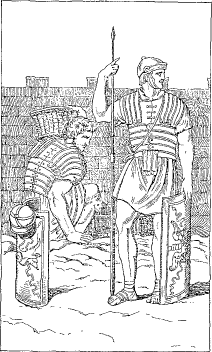
CASTRA MURO FOSSAQUE MUNIUNTUR
APPENDIX II
501. RULES OF SYNTAX
Note. The rules of syntax are here classified and numbered consecutively. The number of the text section in which the rule appears is given at the end of each.
Nominative Case
1. The subject of a finite verb is in the nominative and answers the question Who? or What? § 36.
Agreement
2. A finite verb must always be in the same person and number as its subject. § 28.
3. A predicate noun agrees in case with the subject of the verb. § 76.
4. An appositive agrees in case with the noun which it explains. § 81.
5. Adjectives agree with their nouns in gender, number, and case. § 65.
6. A predicate adjective completing a complementary infinitive agrees in gender, number, and case with the subject of the main verb. § 215. a.
7. A relative pronoun must agree with its antecedent in gender and number; but its case is determined by the way it is used in its own clause. § 224.
Prepositions
8. A noun governed by a preposition must be in the accusative or ablative case. § 52.
Genitive Case
9. The word denoting the owner or possessor of something is in the genitive and answers the question Whose? § 38.
10. The possessive genitive often stands in the predicate, especially after the forms of sum, and is then called the predicate genitive. § 409.
11. Words denoting a part are often used with the genitive of the whole, known as the partitive genitive. § 331.
12. Numerical descriptions of measure are expressed by the genitive with a modifying adjective. § 443.
Dative Case
13. The indirect object of a verb is in the dative. § 45.
14. The dative of the indirect object is used with the intransitive verbs crēdō, faveō, noceō, pāreō, persuādeō, resistō, studeō, and others of like meaning. § 154.
15. Some verbs compounded with ad, ante, con, dē, in, inter, ob, post, prae, prō, sub, super, admit the dative of the indirect object. Transitive compounds may take both an accusative and a dative. § 426.
16. The dative is used with adjectives to denote the object toward which the given quality is directed. Such are, especially, those meaning near, also fit, friendly, pleasing, like, and their opposites. § 143.
17. The dative is used to denote the purpose or end for which; often with another dative denoting the person or thing affected. § 437.
Accusative Case
18. The direct object of a transitive verb is in the accusative and answers the question Whom? or What? § 37.
19. The subject of the infinitive is in the accusative. § 214.
20. The place to which is expressed by ad or in with the accusative. Before names of towns, small islands, domus, and rūs the preposition is omitted. §§ 263, 266.
21. Duration of time and extent of space are expressed by the accusative. § 336.
22. Verbs of making, choosing, calling, showing, and the like, may take a predicate accusative along with the direct object. With the passive voice the two accusatives become nominatives. § 392.
Ablative Case
23. Cause is denoted by the ablative without a preposition. This answers the question Because of what? § 102.
24. Means is denoted by the ablative without a preposition. This answers the question By means of what? or With what? § 103.
25. Accompaniment is denoted by the ablative with cum. This answers the question With whom? § 104.
26. The ablative with cum is used to denote the manner of an action. Cum may be omitted, if an adjective is used with the ablative. This answers the question How? or In what manner? § 105.
27. With comparatives and words implying comparison the ablative is used to denote the measure of difference. § 317.
28. The ablative of a noun or pronoun with a present or perfect participle in agreement is used to express attendant circumstance. This is called the ablative absolute. § 381.
29. 1. Descriptions of physical characteristics are expressed by the ablative with a modifying adjective. § 444.
2. Descriptions involving neither numerical statements nor physical characteristics may be expressed by either the genitive or the ablative with a modifying adjective. § 445.
30. The ablative is used to denote in what respect something is true. § 398.
31. The place from which is expressed by ā or ab, dē, ē or ex with the separative ablative. This answers the question Whence? Before names of towns, small islands, domus, and rūs the preposition is omitted. §§ 264, 266.
32. Words expressing separation or deprivation require an ablative to complete their meaning. This is called the ablative of separation. § 180.
33. The word expressing the person from whom an action starts, when not the subject, is put in the ablative with the preposition ā or ab. This is called the ablative of the personal agent. § 181.
34. The comparative degree, if quam is omitted, is followed by the separative ablative. § 309.
35. The time when or within which anything happens is expressed by the ablative without a preposition. § 275.
36. 1. The place at or in which is expressed by the ablative with in. This answers the question Where? Before names of towns, small islands, and rūs the preposition is omitted. §§ 265, 266.
2. Names of towns and small islands, if singular and of the first or second declension, and the word domus express the place in which by the locative. § 268.
Gerund and Gerundive
37. 1. The gerund is a verbal noun and is used only in the genitive, dative, accusative, and ablative singular. The constructions of these cases are in general the same as those of other nouns. § 406. 1.
2. The gerundive is a verbal adjective and must be used instead of gerund + object, excepting in the genitive and in the ablative without a preposition. Even in these instances the gerundive construction is more usual. § 406. 2.
38. The accusative of the gerund or gerundive with ad, or the genitive with causā, is used to express purpose. § 407.
Moods and Tenses of Verbs
39. Primary tenses are followed by primary tenses, and secondary by secondary. § 358.
40. The subjunctive is used in a dependent clause to express the purpose of the action in the principal clause. § 349.
41. A substantive clause of purpose with the subjunctive is used as object with verbs of commanding, urging, asking, persuading, or advising, where in English we should usually have the infinitive. § 366.
42. Verbs of fearing are followed by a substantive clause of purpose introduced by ut (that not) or nē (that or lest). § 372.
43. Consecutive clauses of result are introduced by ut or ut nōn, and have the verb in the subjunctive. § 385.
44. Object clauses of result with ut or ut nōn are found after verbs of effecting or bringing about. § 386.
45. A relative clause with the subjunctive is often used to describe an antecedent. This is called the subjunctive of characteristic or description. § 390.
46. The conjunction cum means when, since, or although. It is followed by the subjunctive unless it means when and its clause fixes the time at which the main action took place. § 396.
47. When a direct statement becomes indirect, the principal verb is changed to the infinitive, and its subject nominative becomes subject accusative of the infinitive. § 416.
48. The accusative-with-infinitive construction in indirect statements is found after verbs of saying, telling, knowing, thinking, and perceiving. § 419.
49. A present indicative of a direct statement becomes present infinitive of the indirect, a past indicative becomes perfect infinitive, and a future indicative becomes future infinitive. § 418.
50. In an indirect question the verb is in the subjunctive and its tense is determined by the law for tense sequence. § 432.
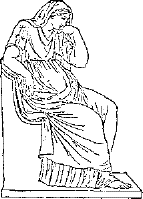
DOMINA
APPENDIX III
REVIEWS1
I. REVIEW OF VOCABULARY AND GRAMMAR THROUGH LESSON VIII
Lesson IX
502. Give the English of the following words:1
Nouns
agricola ancilla aqua casa causa cēna corōna dea domina fābula fera fīlia fortūna fuga gallīna iniūria īnsula lūna nauta pecūnia puella pugna sagitta silva terra tuba via victōria
Adjectives
alta bona clāra grāta lāta longa magna mala nova parva pulchra sōla
Verbs
amat dat est habitat labōrat laudat nārrat necat nūntiat parat portat pugnat sunt vocat
Prepositions Pronouns Adverbs Conjunctions Interrogative Particle
ā or ab ad cum dē ē or ex in mea tua quis cuius cui quem quid cūr deinde nōn ubi et quia quod -ne
503. Give the Latin of the following words:1
Underline the words you do not remember. Do not look up a single word till you have gone through the entire list. Then drill on the words you have underlined.
flight story new lives (verb) away from who why forest wreath deep, high dinner famous cottage battle (noun) trumpet lady, mistress whom island wide tells money calls with your then, in the next place daughter to whom fortune out from labors (verb) gives small in and sailor farmer goddess wild beast praises (verb) alone pleasing prepares are to because arrow my kills girl fights (verb) carries chicken victory land what way bad loves pretty water great is announces injury, wrong where not good maid down from long cause whose
504. Review Questions. How many syllables has a Latin word? How are words divided into syllables? What is the ultima? the penult? the antepenult? When is a syllable short? When is a syllable long? What is the law of Latin accent? Define the subject of a sentence; the predicate; the object; the copula. What is inflection? declension? conjugation? What is the ending of the verb in the third person singular, and what in the plural? What does the form of a noun show? Name the Latin cases. What case is used for the subject? the direct object? the possessor? What relation is expressed by the dative case? Give the rule for the indirect object. How are questions answered in Latin? What is a predicate adjective? an attributive adjective? What is meant by agreement? Give the rule for the agreement of the adjective. What are the three relations expressed by the ablative? What can you say of the position of the possessive pronoun? the modifying genitive? the adjective? What is the base? What is grammatical gender? What is the rule for gender in the first declension? What are the general principles of Latin word order?
505. Fill out the following summary of the first declension:
The First or Ā-Declension 1. Ending in the nominative singular
2. Rule for gender
3. Case terminations a. Singular b. Plural
4. Irregular nouns
Go on to Lesson IX
II. REVIEW OF LESSONS IX-XVII
Lesson XVIII
506. Give the English of the following words:
Nouns of the First Declension
agrī cultūra cōnstantia cōpia dīligentia fāma fēmina galea inopia lacrima lōrīca patria praeda
Nouns of the Second Declension
ager amīcus arma (plural) auxilium bellum carrus castrum cibus cōnsilium domicilium dominus equus fīlius fluvius frūmentum gladius lēgātus līberī magister mūrus numerus oppidānus oppidum pīlum populus praemium proelium puer scūtum servus studium tēlum vīcus vir
Adjectives of the First and Second Declensons
aeger, aegra, aegrum alius, alia, aliud alter, altera, alterum armātus, -a, -um crēber, crēbra, crēbrum dūrus, -a, -um fīnitimus, -a, -um īnfīrmus, -a, -um legiōnārius, -a, -um līber, lībera, līberum mātūrus, -a, -um meus, -a, -um miser, misera, miserum multus, -a, -um neuter, neutra, neutrum noster, nostra, nostrum alter, altera, alterum pulcher, pulchra, pulchrum sōlus, -a, -um suus, -a, -um fīnitimus, -a, -um tuus, -a, -um ūllus, -a, -um ūnus, -a, -um uter, utra, utrum validus, -a, -um vester, vestra, vestrum
Verbs Demonstrative Pronoun Adverbs
arat cūrat dēsīderat mātūrat properat is, ea, id Conjunctions an -que sed iam quō saepe Preposition apud
507. Give the Latin of the following words:
sword corselet man your (plural) hasten but among tear (noun) village strong long for and (enclitic) often want (noun) which (of two) care for or (in a question) whither wagon townsman wretched ripe war number my free (adj.) children wall grain weapon one plow (verb) this or that already helmet river zeal any he son slave your (singular) she woman horse shield (noun) whole it aid (noun) legionary weak arms master (of school) friend neighboring sick lieutenant field report, rumor abode boy his own alone prize (noun) master (owner) carefulness plenty troops plan (noun) people beautiful no (adj.) our battle spear food steadiness fatherland town fort camp neither (of two) much agriculture other the other (of two) hard booty frequent armed
508. Review Questions. How many declensions are there? What three things must be known about a noun before it can be declined? What three cases of neuter nouns are always alike, and in what do they end in the plural? What two plural cases are always alike? When is the vocative singular not like the nominative? What is a predicate noun? With what does it agree? What is an appositive? Give the rule for the agreement of an appositive. How can we tell whether a noun in -er is declined like puer or like ager? Decline bonus, līber, pulcher. How can we tell whether an adjective in -er is declined like līber or like pulcher? Why must we say nauta bonus and not nauta bona? Name the Latin possessive pronouns. How are they declined? With what does the possessive pronoun agree? When do we use tuus and when vester? Why is suus called a reflexive possessive? What is the non-reflexive possessive of the third person? When are possessives omitted? What four uses of the ablative case are covered by the relations expressed in English by with? Give an illustration in Latin of the ablative of manner; of the ablative of cause; of the ablative of means; of the ablative of accompaniment. What ablative regularly has cum? What ablative sometimes has cum? What uses of the ablative never have cum? Name the nine pronominal adjectives, with their meanings. Decline alius, nūllus. Decline is. What does is mean as a demonstrative adjective or pronoun? What other important use has it?
509. Fill out the following summary of the second declension:
The Second or O-Declension 1. Endings in the nominative
2. Rule for gender
3. Case terminations of nouns in -us a. Singular b. Plural
a. The vocative singular of nouns in -us
4. Case terminations of nouns in -um a. Singular b. Plural
5. Peculiarities of nouns in -er and -ir
6. Peculiarities of nouns in -ius and -ium
Go on to Lesson XVIII
III. REVIEW OF LESSONS XVIII-XXVI
Lesson XXVII
510. Give the English of the following words:
Nouns of the First Declension
disciplīna fōrma poena potentia rēgīna superbia trīstitia
Nouns of the Second Declension
lūdus ōrnāmentum sacrum socius verbum
Adjectives of the First and Second Declensions
amīcus antīquus fīnitimus grātus idōneus inimīcus interfectus īrātus laetus molestus perpetuus proximus septem superbus
Adverbs Conjunctions Personal Pronoun
hodiē ibi maximē mox nunc nūper etiam nōn sōlum ... sed etiam ego
Verbs
CONJ. I CONJ. II CONJ. III CONJ. IV
volō, -āre IRREGULAR VERB sum, esse dēleō, -ēre doceō, -ēre faveō, -ēre habeō, -ēre iubeō, -ēre moneō, -ēre moveō, -ēre noceō, -ēre pāreō, -ēre persuādeō, -ēre sedeō, -ēre studeō, -ēre videō, -ēre agō, -ere capiō, -ere crēdō, -ere dīcō, -ere dūcō, -ere faciō, -ere fugiō, -ere iaciō, -ere mittō, -ere rapiō, -ere regō, -ere resistō, -ere audiō, -īre mūniō, -īre reperiō, -īre veniō, -īre
511. Give the Latin of the following words. In the case of verbs always give the first form and the present infinitive.
ancient come resist see be fly I proud word sadness find rule (verb) be eager for not only ... but also seven ally, companion pride fortify send sit also school hear hurl persuade only nearest sacred rite queen flee obey lately constant ornament power make, do injure now annoying lead move soon glad punishment believe advise especially, most of all angry beauty say command (verb) there slain training take have to-day unfriendly drive favor (verb) suitable pleasing teach neighboring destroy friendly seize
512. Review Questions. What is conjugation? Name two important differences between conjugation in Latin and in English. What is tense? What is mood? What are the Latin moods? When do we use the indicative mood? Name the six tenses of the indicative. What are personal endings? Name those you have had. Inflect sum in the three tenses you have learned. How many regular conjugations are there? How are they distinguished? How is the present stem found? What tenses are formed from the present stem? What is the tense sign of the imperfect? What is the meaning of the imperfect? What is the tense sign of the future in the first two conjugations? in the last two? Before what letters is a final long vowel of the stem shortened? What are the three possible translations of a present, as of pugnō? Inflect arō, sedeō, mittō, faciō, and veniō, in the present, imperfect, and future active. What forms of -iō verbs of the third conjugation are like audiō? what like regō? Give the rule for the dative with adjectives. Name the special intransitive verbs that govern the dative. What does the imperative mood express? How is the present active imperative formed in the singular? in the plural? What three verbs have a shortened present active imperative? Give the present active imperative of portō, dēleō, agō, faciō, mūniō.
Go on to Lesson XXVII
IV. REVIEW OF LESSONS XXVII-XXXVI
Lesson XXXVII
513. Give the English of the following words:
Nouns of the First Declension
āla cūra mora porta prōvincia vīta
Nouns of the Second Declension
animus aurum bracchium deus locus mōnstrum nāvigium ōrāculum perīculum ventus vīnum
Adjectives of the First and Second Declensions
adversus attentus cārus commōtus dēfessus dexter dubius maximus perfidus plēnus saevus sinister
Adverbs
anteā celeriter dēnique diū frūstrā graviter ita longē semper subitō tamen tum
Conjunctions
autem sī ubi
Prepositions
dē per prō sine
Verbs
CONJ. I CONJ. II
adpropinquō nāvigō occupō postulō recūsō reportō servō stō superō temptō vāstō vulnerō contineō egeō prohibeō respondeō teneō
CONJ. III IRREGULAR VERB
discēdō gerō interficiō absum
514. Translate the following words. Give the genitive and the gender of the nouns and the principal parts of the verbs.
be away wind through if savage wound (verb) wine delay faithless right seize quickly before, in behalf of battle down from or concerning moreover greatest oracle danger lay waste gate doubtful opposite, adverse demand finally attentive then, at that time weary overcome, conquer boat, ship sail (verb) life save full refuse heavily monster approach nevertheless place be without, lack moved gold restrain, keep from without hold suddenly dear always god hold in, keep afar thus, so, as follows arm (noun) when in vain stand bring back, win before, previously depart, go away province care, trouble kill reply (verb) wing mind, heart left (adj.) bear, carry on try for a long time
515. Give the principal parts and meaning of the following verbs:
sum dō teneō iubeō agō mittō mūniō moveō crēdō rapiō reperiō dēleō resistō audiō moneō capiō doceō regō faveō noceō dīcō pāreō dūcō faciō persuādeō sedeō studeō fugiō veniō iaciō videō absum egeō gerō stō
516. Review Questions. What are the personal endings in the passive voice? What is the letter -r sometimes called? What are the distinguishing vowels of the four conjugations? What forms constitute the principal parts? What are the three different conjugation stems? How may they be found? What are the tenses of the indicative? of the infinitive? What tense of the imperative have you learned? What forms are built on the present stem? on the perfect stem? on the participial stem? What are the endings of the perfect active indicative? What is the tense sign of the pluperfect active? of the future perfect active? How is the present active infinitive formed? the present passive infinitive? How is the present active imperative formed? the present passive imperative? How is the perfect active infinitive formed? the perfect passive infinitive? How is the future active infinitive formed? What is a participle? How are participles in -us declined? Give the rule for the agreement of the participle. How are the perfect, pluperfect, and future perfect passive indicative formed? Conjugate the verb sum in all moods and tenses as far as you have learned it (§ 494). What is meant by the separative ablative? How is the place from which expressed in Latin? Give the rule for the ablative of separation; for the ablative of the personal agent. How can we distinguish between the ablative of means and the ablative of the personal agent? What is the perfect definite? the perfect indefinite? What is the difference in meaning between the perfect indefinite and the imperfect? What two cases in Latin may be governed by a preposition? Name the prepositions that govern the ablative. What does the preposition in mean when it governs the ablative? the accusative? What are the three interrogatives used to introduce yes-and-no questions? Explain the force of each. What words are sometimes used for yes and no? What are the different meanings and uses of ubi?
Go on to Lesson XXXVII
V. REVIEW OF LESSONS XXXVII-XLIV
Lesson XLV
517. Give the English of the following words:
Nouns
FIRST DECLENSION SECOND DECLENSION
rīpa barbarī captīvus castellum impedīmentum
THIRD DECLENSION
animal arbor avis caedēs calamitās calcar caput cīvis cliēns collis cōnsul dēns dux eques fīnis flūmen fōns frāter homō hostīs ignis imperātor īnsigne iter iūdex labor lapis legiō mare māter mēnsis mīles mōns nāvis opus ōrātor ōrdō pater pedes pēs pōns prīnceps rēx salūs sanguis soror tempus terror turris urbs victor virtūs vīs
Adjectives of the First and Second Declensions
barbarus dexter sinister summus
Prepositions Adverbs Conjunctions
in with the abl. in with the acc. trāns cotīdiē numquam nec, neque nec ... nec, or neque ... neque
Verbs
CONJ. I CONJ. III
cessō confirmō oppugnō vetō accipiō incipiō petō ponō vincō vivō
518. Translate the following words. Give the genitive and the gender of the nouns and the principal parts of the verbs:
forbid rank, row brother force across savages horseman never mountain manliness, courage leader put, place time savage, barbarous sister seek captive hindrance, baggage man-of-war judge defeat, disaster fire tree foot soldier receive general highest fountain orator neither ... nor and not left tooth soldier month city victor daily live (verb) conquer consul mother retainer citizen head safety assail, storm begin march decoration bridge bird cease man river work (noun) and ship bank redoubt, fort sea tower drill (verb) legion terror into, to right (adj.) in stone blood labor (noun) king spur chief slaughter strengthen foot enemy animal father
519. Review Questions. Give the conjugation of possum. What is an infinitive? What three uses has the Latin infinitive that are like the English? What is the case of the subject of the infinitive? What is meant by a complementary infinitive? In the sentence The bad boy cannot be happy, what is the case of happy? Give the rule. Decline quī. Give the rule for the agreement of the relative. What are the two uses of the interrogative? Decline quis. What is the base of a noun? How is the stem formed from the base? Are the stem and the base ever the same? How many declensions of nouns are there? Name them. What are the two chief divisions of the third declension? How are the consonant stems classified? Explain the formation of lapis from the stem lapid-, mīles from mīlit-, rēx from rēg-. What nouns have i-stems? What peculiarities of form do i-stems have,—masc., fem., and neut.? Name the five nouns that have -ī and -e in the abl. Decline turris. Give the rules for gender in the third declension. Decline mīles, lapis, rēx, virtūs, cōnsul, legiō, homō, pater, flūmen, opus, tempus, caput, caedēs, urbs, hostis, mare, animal, vīs, iter.
520. Fill out the following scheme:
The Third Declension Gender Endings Masculine Feminine Neuter
Case Terminations I. Consonant Stems a. Masc. and fem. b. Neuters
II. I-Stems a. Masc. and fem. b. Neuters
Irregular Nouns
Go on to Lesson XLV
VI. REVIEW OF LESSONS XLV-LII
Lesson LIII
521. Give the English of the following words:
Nouns
FIRST DECLENSION SECOND DECLENSION
amīcitia hōra littera annus modus nūntius oculus rēgnum signum supplicium, supplicium dare supplicium sūmere dē tergum, tergum vertere vestīgium
THIRD DECLENSION FOURTH DECLENSION
aestās corpus hiems lībertās lūx, prīma lūx nōmen nox pars pāx rūs sōl vōx vulnus adventus cornū domus equitātus exercitus fluctus impetus lacus manus metus portus
FIFTH DECLENSION INDECLINABLE NOUN
aciēs diēs fidēs, in fidem venīre rēs, rēs gestae rēs adversae rēs pūblica rēs secundae spēs nihil
Adjectives
FIRST AND SECOND DECLENSIONS THIRD DECLENSION
dēnsus invīsus mīrus paucī prīmus prīstinus pūblicus secundus tantus vērus ācer, ācris, ācre brevis, breve difficilis, difficile facīlis, facile fortis, forte gravis, grave incolumis, incolume omnis, omne pār, pār vēlōx, vēlōx
Pronouns
PERSONAL DEMONSTRATIVE INTENSIVE INDEFINITE
ego nōs suī tū vōs hic īdem ille iste ipse aliquis, aliquī quīdam quis, quī quisquam quisque
Adverbs Conjunctions Prepositions
nē ... quidem ōlim paene quoque satis vērō itaque nisi ante post propter
Verbs
CONJ. I CONJ. II CONJ. III CONJ. IV
conlocō convocō cremō dēmōnstrō mandō dēbeō exerceō maneō placeō sustineō committō, committere proelium dēcidō ēripiō sūmō, sūmere supplicium dē trādūcō vertō dēsiliō
522. Translate the following words. Give the genitive and the gender of the nouns and the principal parts of the verbs.
if not, unless on account of unharmed public commonwealth leap down, dismount lead across remain call together friendship footprint, trace each fear (noun) hope therefore behind, after so great equal in truth, indeed that (yonder) a certain fall down owe, ought measure, mode eye name wave, billow thing, matter exploits republic prosperity adversity former, old-time all, every any one (at all) this (of mine) heavy, serious hateful, detested true burn snatch from letter punishment inflict punishment on suffer punishment liberty sun sustain take up, assume hour reign, realm messenger part, direction body harbor faith, protection of himself also, too sufficiently burn that (of yours) before you (plur.) light daybreak winter attack line of battle army drill, train join battle house, home midday wonderful brave almost the same some, any if any one self, very not even easy dense point out, explain difficult first arrange, station please year peace back turn the back, retreat night hand, force lake day commit, intrust a few only sharp, eager we turn you (sing.) I signal summer cavalry wound horn, wing country second, favorable short voice formerly, once arrival come under the protection of swift nothing
523. Review Questions. By what declensions are Latin adjectives declined? What can you say about the stem of adjectives of the third declension? Into what classes are these adjectives divided? How can you tell to which of the classes an adjective belongs? Decline ācer, omnis, pār. What are the nominative endings and genders of nouns of the fourth or u-declension? What nouns are feminine by exception? Decline adventus, lacus, cornū, domus. Give the rules for the ordinary expression of the place to which, the place from which, the place in which. What special rules apply to names of towns, small islands, and rūs? What is the locative case? What words have a locative case? What is the form of the locative case? Translate Galba lives at home, Galba lives at Rome, Galba lives at Pompeii. What is the rule for gender in the fifth or ē-declension? Decline diēs, rēs. When is the long ē shortened? What can you say about the plural of the fifth declension? Decline tuba, servus, pīlum, ager, puer, mīles, cōnsul, flūmen, caedēs, animal. How is the time when expressed? Name the classes of pronouns and define each class. Decline ego, tū, is. What are the reflexives of the first and second persons? What is the reflexive of the third person? Decline it. Translate I see myself, he sees himself, he sees him. Decline ipse. How is ipse used? Decline īdem. Decline hic, iste, ille. Explain the use of these words. Name and translate the commoner indefinite pronouns. Decline aliquis, quisquam, quīdam, quisque.
Go on to Lesson LIII
VII. REVIEW OF LESSONS LIII-LX
Lesson LXI
524. Give the English of the following words:
Nouns
FIRST DECLENSION SECOND DECLENSION
aquila fossa aedificium captīvus concilium imperium negōtium spatium vāllum
THIRD DECLENSION
agmen celeritās cīvitās clāmor cohors difficultās explōrātor gēns lātitūdō longitūdō magnitūdō mēns mercātor mīlle mors mulier multitūdō mūnītiō nēmō obses opīniō regiō rūmor scelus servitūs timor vallēs
FOURTH DECLENSION FIFTH DECLENSION
aditus commeātus passus rēs frūmentāria
Adjectives
FIRST AND SECOND DECLENSIONS
aequus bīnī ducentī duo exterus īnferus maximus medius minimus opportūnus optimus pessimus plūrimus posterus prīmus reliquus secundus singulī superus tardus ternī ūnus
THIRD DECLENSION
alacer, alacris, alacre audāx, audāx celer, celeris, celere citerior, citerius difficilis, difficile dissimilis, dissimile facilis, facile gracilis, gracile humilis, humile ingēns, ingēns interior, interius lēnis, lēne maior, maius melior, melius minor, minus nōbilis, nōbile peior, peius ——, plūs prior, prius recēns, recēns similis, simile trēs, tria ulterior, ulterius
Adverbs
ācriter audācter bene facile ferē fortiter magis magnopere maximē melius minimē multum optimē parum paulō plūrimum prope propius proximē quam statim tam undique
Conjunctions Prepositions
atque, ac aut aut ... aut et ... et nam quā dē causā quam ob rem simul atque or simul ac circum contrā inter ob trāns
Verbs
CONJ. I CONJ. II
cōnor hortor moror vexō obtineō perterreō valeō vereor
CONJ. III
abdō cadō cognōscō cōnsequor contendō cupiō currō dēdō dēfendō ēgredior incendō incolō īnsequor occīdō patior premō proficīscor prōgredior quaerō recipiō relinquō revertor sequor statuō subsequor suscipiō trādō trahō
CONJ. III
orior perveniō
525. Translate the following words. Give the genitive and the gender of the nouns and the principal parts of the verbs:
on account of nearly keenly, sharply thousand two opportune remaining above (adj.) next grain supply pace shout (noun) from all sides against around three further line of march manor region fortification eagle almost boldly bravely across between, among hither (adj.) so less more most worst difficulty hostage death command, power captive or and arrive attempt, try length width scout cohort tribe, nation business by a little somewhat crime difficult equal move forward, advance multitude woman desire (verb) give over, surrender kill overtake hasten, strive hide one first second, favorable two hundred former inner middle low outward three by three provisions speed ditch wherefore or therefore for this reason fear (noun) return inquire set out move out, disembark fear (verb) worse greater, larger two by two least (adv.) opinion, expectation approach, entrance trader magnitude, size council, assembly space, room either ... or rise, arise suffer, allow press hard fall surrender set fire to defend possess, hold delay (verb) nearest (adv.) nearer (adv.) better (adj.) well known, noble mild, gentle swift eager low (adj.) slender one by one no one least (adv.) little (adv.) learn, know drag undertake run fix, decide leave abandon be strong receive, recover terrify, frighten dwell state, citizenship valley slavery greatly best of all (adv.) better (adv.) well (adv.) very much much unlike like (adj.) slow very greatly, exceedingly building mind (noun) easily easy recent huge, great bold immediately as soon as for than best (adj.) greatest follow close encourage annoy, ravage hide follow pursue both ... and rampart
526. Review Questions. What is meant by comparison? In what two ways may adjectives be compared? Compare clārus, brevis, vēlōx, and explain the formation of the comparative and the superlative. What are the adverbs used in comparison? Compare brevis by adverbs. Decline the comparative of vēlōx. How are adjectives in -er compared? Compare ācer, pulcher, liber. What are possible translations for the comparative and superlative? Name the six adjectives that form the superlative in -limus. Translate in two ways Nothing is brighter than the sun. Give the rule for the ablative with comparatives. Compare bonus, magnus, malus, multus, parvus, exterus, īnferus, posterus, superus. Decline plūs. Compare citerior, interior, propior, ulterior. Translate That route to Italy is much shorter. Give the rule for the expression of measure of difference. Name five words that are especially common in this construction. How are adverbs usually formed from adjectives of the first and second declensions? from adjectives of the third declension? Compare the adverbs cārē, līberē, fortiter, audācter. What cases of adjectives are sometimes used as adverbs? What are the adverbs from facilis? multus? prīmus? plūrimus? bonus? magnus? parvus? Compare prope, saepe, magnopere. How are numerals classified? Give the first twenty cardinals. Decline ūnus, duo, trēs, mīlle. How are the hundreds declined? What is meant by the partitive genitive? Give the rule for the partitive genitive. What sort of words are commonly used with this construction? What construction is used with quīdam and cardinal numbers excepting mīlle? Give the first twenty ordinals. How are they declined? How are the distributives declined? Give the rule for the expression of duration of time and extent of space. What is the difference between the ablative of time and the accusative of time? What is a deponent verb? Give the synopsis of one. What form always has a passive meaning? Conjugate amō, moneō, regō, capiō, audiō, in the active and passive.
Go on to Lesson LXI
VIII. REVIEW OF LESSONS LXI-LXIX
Lesson LXX
527. Review the vocabularies of the first seventeen lessons. See §§ 502, 503, 506, 507.
528. Review Questions. Name the tenses of the subjunctive. What time is denoted by these tenses? What are the mood signs of the present subjunctive? How may the imperfect subjunctive be formed? How do the perfect subjunctive and the future perfect indicative active differ in form? How is the pluperfect subjunctive active formed? Inflect the subjunctive active and passive of cūrō, dēleō, vincō, rapiō, mūniō. Inflect the subjunctive tenses of sum; of possum. What are the tenses of the participles in the active? What in the passive? Give the active and passive participles of amō, moneō, regō, capiō, audiō. Decline regēns. What participles do deponent verbs have? What is the difference in meaning between the perfect participle of a deponent verb and of one not deponent? Give the participles of vereor. How should participles usually be translated? Conjugate volō, nolō, mālō, fīō.
What is the difference between the indicative and subjunctive in their fundamental ideas? How is purpose usually expressed in English? How is it expressed in Latin? By what words is a Latin purpose clause introduced? When should quō be used? What is meant by sequence of tenses? Name the primary tenses of the indicative and of the subjunctive; the secondary tenses. What Latin verbs are regularly followed by substantive clauses of purpose? What construction follows iubeō? What construction follows verbs of fearing? How is consequence or result expressed in Latin? How is a result clause introduced? What words are often found in the principal clause foreshadowing the coming of a result clause? How may negative purpose be distinguished from negative result? What is meant by the subjunctive of characteristic or description? How are such clauses introduced? Explain the ablative absolute. Why is the ablative absolute of such frequent occurrence in Latin? Explain the predicate accusative. After what verbs are two accusatives commonly found? What do these accusatives become when the verb is passive?
Go on to Lesson LXX
IMPERATOR MILITES HORTATUR
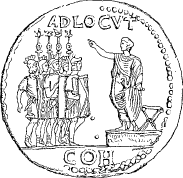
SPECIAL VOCABULARIES
The words in heavy type are used in Cæsar’s “Gallic War.”
LESSON IV, § 39
Nouns dea, goddess (deity) Diā´na, Diana fera, a wild beast (fierce) Lātō´na, Latona sagit´ta, arrow Verbs est, he (she, it) is; sunt, they are necat, he (she, it) kills, is killing, does kill Conjunction1 et, and
Pronouns quis, interrog. pronoun, nom. sing., who? cuius (pronounced co͝oi´yo͝os, two syllables), interrog. pronoun, gen. sing., whose?
LESSON V, § 47
Nouns corō´na, wreath, garland, crown fā´bula, story (fable) pecū´nia, money (pecuniary) pugna, battle (pugnacious) victō´ria, victory Verbs dat, he (she, it) gives nārrat, he (she, it) tells (narrate) Conjunction1 quia or quod, because
Pronoun cui (pronounced co͝oi, one syllable), interrog. pronoun, dat. sing., to whom? for whom?
LESSON VI, § 56
Adjectives bona, good grāta, pleasing magna, large, great mala, bad, wicked parva, small, little pulchra, beautiful, pretty sōla, alone Nouns ancil´la, maidservant Iūlia, Julia Adverbs1 cūr, why nōn, not Pronouns mea, my; tua, thy, your (possesives) quid, interrog. pronoun, nom. and acc. sing., what?
-ne, the question sign, an enclitic (§ 16) added to the first word, which, in a question, is usually the verb, as amat, he loves, but amat´ne? does he love? est, he is; estne? is he? Of course -ne is not used when the sentence contains quis, cūr, or some other interrogative word.
LESSON VII, § 62
Nouns casa, -ae, f., cottage cēna, -ae, f., dinner gallī´na, -ae, f., hen, chicken īn´sula, ae, f., island (pen-insula) Adverbs de-in´de, then, in the next place ubi, where Preposition ad, to, with acc. to express motion toward Verbs ha´bitat, he (she, it) lives, is living, does live (inhabit) laudat, he (she, it) praises, is praising, does praise (laud) parat, he (she, it) prepares, is preparing, does prepare vocat, he (she, it) calls, is calling, does call; invites, is inviting, does invite (vocation)
Pronoun quem, interrog. pronoun, acc. sing., whom?
LESSON VIII, § 69
Nouns Italia, -ae, f., Italy Sicilia, -ae, f., Sicily tuba, -ae, f., trumpet (tube) via, -ae, f., way, road, street (viaduct) Adjectives alta, high, deep (altitude) clāra, clear, bright; famous lāta, wide (latitude) longa, long (longitude) nova, new (novelty)
LESSON IX, § 77
Nouns
bellum, -ī, n., war (re-bel) cōnstantia, -ae, f., firmness, constancy, steadiness dominus, -ī, m., master, lord (dominate) equus, -ī, m., horse (equine) frūmentum, -ī, n., grain lēgātus, -ī, m., lieutenant, ambassador (legate) Mārcus, -ī, m., Marcus, Mark mūrus, -ī, m., wall (mural) oppidānus, -ī, m., townsman oppidum, -ī, n., town pīlum, -ī, n., spear (pile driver) servus, -ī, m., slave, servant Sextus, -ī, m., Sextus Verbs cūrat, he (she, it) cares for, with acc. properat, he (she, it) hastens
LESSON X, § 82
Nouns
amīcus, -ī, m., friend (amicable) Germānia, -ae, f., Germany patria, -ae, f., fatherland populus, -ī, m., people Rhēnus, -ī, m., the Rhine vīcus, -ī, m., village
LESSON XI, § 86
Nouns
arma, armōrum, n., plur., arms, especially defensive weapons fāma, -ae, f., rumor; reputation, fame galea, -ae, f., helmet praeda, -ae, f., booty, spoils (predatory) tēlum, -ī, n., weapon of offense, spear
Adjectives
dūrus, -a, -um, hard, rough; unfeeling, cruel; severe, toilsome (durable) Rōmānus, -a, -um, Roman. As a noun, Rōmānus, -ī, m., a Roman
LESSON XII, § 90
Nouns fīlius, fīlī, m., son (filial) fluvius, fluvī, m., river (fluent) gladius, gladī, m., sword (gladiator) praesidium, praesi´dī, n., garrison, guard, protection proelium, proelī, n., battle Adjectives fīnitimus, -a, -um, bordering upon, neighboring, near to. As a noun, fīnitimī, -ōrum, m., plur., neighbors Germānus, -a, -um, German. As a noun, Germānus, -ī, m., a German multus, -a, -um, much; plur., many
Adverb saepe, often
LESSON XIII, § 95
Nouns
ager, agrī, m., field (acre) cōpia, -ae, f., plenty, abundance (copious); plur., troops, forces Cornēlius, Cornē´lī, m., Cornelius lōrī´ca, -ae, f., coat of mail, corselet praemium, praemī, n., reward, prize (premium) puer, puerī, m., boy (puerile) Rōma, -ae, f., Rome scūtum, -ī, n., shield (escutcheon) vir, virī, m., man, hero (virile)
Adjectives
legiōnārius, -a, -um,1 legionary, belonging to the legion. As a noun, legiōnāriī, -ōrum, m., plur., legionary soldiers līber, lībera, līberum, free (liberty) As a noun. līberī, -ōrum, m., plur., children (lit. the freeborn) pulcher, pulchra, pulchrum, pretty, beautiful Preposition apud, among, with acc. Conjunction sed, but
LESSON XIV, § 99
Nouns
auxilium, auxi´lī, n., help, aid (auxiliary) castrum, -ī, n., fort (castle); plur., camp (lit. forts) cibus, -ī, m., food cōnsilium, cōnsi´lī, n., plan (counsel) dīligentia, -ae, f., diligence, industry magister, magistrī, m., master, teacher1
Adjectives
aeger, aegra, aegrum, sick crēber, crēbra, crēbrum, frequent miser, misera, miserum, wretched, unfortunate (miser)
LESSON XV, § 107
Nouns carrus, -ī, m., cart, wagon inopia, -ae, f., want, lack; the opposite of cōpia studium, studī, n., zeal, eagerness (study) Verb mātūrat, he (she, it) hastens. Cf. properat Adjectives armātus, -a, -um, armed īnfīrmus, -a, -um, week, feeble (infirm) vali´dus, -a, -um, strong, sturdy Adverb iam, already, now
-que, conjunction, and; an enclitic (cf. § 16) and always added to the second of two words to be connected, as arma tēla´que, arms and weapons.
LESSON XVII, § 117
Nouns
agrī cultūra, -ae, f., agriculture domicilīum, domīci´lī, n., dwelling place (domicile) abode fēmina, -ae, f., woman (female) Gallia, -ae, f., Gaul Gallus, -i, m., a Gaul lacrima, -ae, f., tear numerus, -ī, m., number (numeral)
Adjective mātūrus, -a, -um, ripe, mature Verbs arat, he (she, it) plows (arable) dēsīderat, he (she, it) misses, longs for (desire), with acc. Adverb quō, whither Conjunction an, or, introducing the second half of a double question, as Is he a Roman or a Gaul, Estne Romanus an Gallus?
LESSON XVIII, § 124
Nouns lūdus, -ī, m.,school socius, socī, m., companion, ally (social) Adjectives īrātus, -a, -um, angry, furious (irate) laetus, -a, -um, happy, glad (social)
Adverbs
hodiē, to-day ibi, there, in that place mox, presently, soon, of the immediate future nunc, now, the present moment nūper, lately, recently, of the immediate past