PART III
Reading edition
CONSTRUCTIONS
INTRODUCTORY NOTE
The preceding part of this book has been concerned chiefly with forms and vocabulary. There remain still to be learned the forms of the Subjunctive Mood, the Participles, and the Gerund of the regular verb, and the conjugation of the commoner irregular verbs. These will be taken up in connection with the study of constructions, which will be the chief subject of our future work. The special vocabularies of the preceding lessons contain, exclusive of proper names, about six hundred words. As these are among the commonest words in the language, they must be mastered. They properly form the basis of the study of words, and will be reviewed and used with but few additions in the remaining lessons.
For practice in reading and to illustrate the constructions presented, a continued story has been prepared and may be begun at this point (see p. 204). It has been divided into chapters of convenient length to accompany progress through the lessons, but may be read with equal profit after the lessons are finished. The story gives an account of the life and adventures of Publius Cornelius Lentulus, a Roman boy, who fought in Cæsar’s campaigns and shared in his triumph. The colored plates illustrating the story are faithful representations of ancient life and are deserving of careful study.
Reading Selection
LESSON LXI
THE SUBJUNCTIVE MOOD
342. In addition to the indicative, imperative, and infinitive moods, which you have learned, Latin has a fourth mood called the subjunctive. The tenses of the subjunctive are
Present Imperfect Perfect Pluperfect Active and Passive
343. The tenses of the subjunctive have the same time values as the corresponding tenses of the indicative, and, in addition, each of them may refer to future time. No meanings of the tenses will be given in the paradigms, as the translation varies with the construction used.
344. The present subjunctive is inflected as follows:
Conj. I Conj. II Conj. III Conj. IV
Active Voice
SINGULAR
1. a´mem mo´neam re´gam ca´piam au´diam
2. a´mēs mo´neās re´gās ca´piās au´diās
3. a´met mo´neat re´gat ca´piat au´diat
PLURAL
1. amē´mus moneā´mus regā´mus capiā´mus audiā´mus
2. amē´tis moneā´tis regā´tis capiā´tis audiā´tis
3. a´ment mo´neant re´gant ca´piant au´diant
Passive Voice
SINGULAR
1. a´mer mo´near re´gar ca´piar au´diar
2. amē´ris (-re) moneā´ris (-re) regā´ris (-re) capiā´ris (-re) audiā´ris (-re)
3. amē´tur moneā´tur regā´tur capiā´tur audiā´tur
PLURAL
1. amē´mur moneā´mur regā´mur capiā´mur audiā´mur
2. amē´minī moneā´minī regā´minī capiā´minī audiā´minī
3. amen´tur monean´tur regan´tur capian´tur audian´tur
a. The present subjunctive is formed from the present stem.
b. The mood sign of the present subjunctive is -ē- in the first conjugation and -ā- in the others. It is shortened in the usual places (cf. § 12), and takes the place of the final vowel of the stem in the first and third conjugations, but not in the second and fourth.
c. The personal endings are the same as in the indicative.
d. In a similar way inflect the present subjunctive of cūrō, iubeō, sūmō, iaciō, mūniō.
345. The present subjunctive of the irregular verb sum is inflected as follows:
Sing. 1. sim 2. sīs 3. sit Plur. 1. sīmus 2. sītis 3. sint
346. The Indicative and Subjunctive Compared. 1. The two most important of the finite moods are the indicative and the subjunctive. The indicative deals with facts either real or assumed. If, then, we wish to assert something as a fact or to inquire after a fact, we use the indicative.
2. On the other hand, if we wish to express a desire or wish, a purpose, a possibility, an expectation, or some such notion, we must use the subjunctive. The following sentences illustrate the difference between the indicative and the subjunctive ideas.
Indicative Ideas Subjunctive Ideas
1. He is brave Fortis est 1. May he be brave Fortis sit (idea of wishing)
2. We set out at once Statim proficīscimur 2. Let us set out at once Statim proficīscāmur (idea of willing)
3. You hear him every day Cotīdiē eum audīs 3. You can hear him every day Cotīdiē eum audiās (idea of possibility)
4. He remained until the ship arrived Mānsit dum nāvis pervēnit 4. He waited until the ship should arrive Exspectāvit dum nāvis pervenīret1 (idea of expectation)
5. Cæsar sends men who find the bridge Caesar mittit hominēs quī pontem reperiunt 5. Cæsar sends men who are to find (or to find) the bridge Caesar hominēs mittit quī pontem reperiant (idea of purpose)
Note. From the sentences above we observe that the subjunctive may be used in either independent or dependent clauses; but it is far more common in the latter than in the former.
347. EXERCISE
Which verbs in the following paragraph would be in the indicative and which in the subjunctive in a Latin translation?
There have been times in the history of our country when you might be proud of being an American citizen. Do you remember the day when Dewey sailed into Manila Bay to capture or destroy the enemy’s fleet? You might have seen the admiral standing on the bridge calmly giving his orders. He did not even wait until the mines should be removed from the harbor’s mouth, but sailed in at once. Let us not despair of our country while such valor exists, and may the future add new glories to the past.
Reading Selection
LESSON LXII
THE SUBJUNCTIVE OF PURPOSE
348. Observe the sentence
Caesar hominēs mittit quī pontem reperiant, Cæsar sends men to find the bridge
The verb reperiant in the dependent clause is in the subjunctive because it tells us what Cæsar wants the men to do; in other words, it expresses his will and the purpose in his mind. Such a use of the subjunctive is called the subjunctive of purpose.
349. Rule. Subjunctive of Purpose. The subjunctive is used in a dependent clause to express the purpose of the action in the principal clause.
350. A clause of purpose is introduced as follows:
I. If something is wanted, by
quī, the relative pronoun (as above) ut, conj., in order that, that quō (abl. of quī, by which), in order that, that, used when the purpose clause contains a comparative. The ablative quō expresses the measure of difference. (Cf. § 317.)
II. If something is not wanted, by
nē, conj., in order that not, that not, lest
351. EXAMPLES
1. Caesar cōpiās cōgit quibus hostīs īnsequātur Cæsar collects troops with which to pursue the foe
2. Pācem petunt ut domum revertantur They ask for peace in order that they may return home
3. Pontem faciunt quō facilius oppidum capiant They build a bridge that they may take the town more easily (lit. by which the more easily)
4. Fugiunt nē vulnerentur They flee that they may not (or lest they) be wounded
352. Expression of Purpose in English. In English, purpose clauses are sometimes introduced by that or in order that, but much more frequently purpose is expressed in English by the infinitive, as We eat to live, She stoops to conquer. In Latin prose, on the other hand, purpose is never expressed by the infinitive. Be on your guard and do not let the English idiom betray you into this error.
353. EXERCISES
I.
1. Veniunt ut dūcant, mittant, videant, audiant, dūcantur, mittantur, videantur, audiantur.
2. Fugimus nē capiāmur, trādāmur, videāmus, necēmur, rapiāmur, resistāmus.
3. Mittit nūntiōs quī dicant, audiant, veniant, nārrent, audiantur, in conciliō sedeant.
4. Castra mūniunt quō facilius sēsē dēfendant, impetum sustineant, hostīs vincant, salūtem petant.
II. 1. The Helvetii send ambassadors to seek1 peace. 2. They are setting out at daybreak in order that they may make a longer march before night. 3. They will hide the women in the forest (acc. with in) that they may not be captured. 4. The Gauls wage many wars to free1 their fatherland from slavery. 5. They will resist the Romans2 bravely lest they be destroyed.
Reading Selection
LESSON LXIII
INFLECTION OF THE IMPERFECT SUBJUNCTIVE THE SEQUENCE OF TENSES
354. The imperfect subjunctive may be formed by adding the personal endings to the present active infinitive.
Conj. I Conj. II Conj. III Conj. IV
ACTIVE
1. amā´rem monē´rem re´gerem ca´perem audī´rem
2. amā´rēs monē´rēs re´gerēs ca´perēs audī´rēs
3. amā´ret monē´ret re´geret ca´peret audī´ret
1. amārē´mus monērē´mus regerē´mus caperē´mus audīrē´mus
2. amārē´tis monērē´tis regerē´tis caperē´tis audīrē´tis
3. amā´rent monē´rent re´gerent ca´perent audī´rent
PASSIVE
1. amā´rer monē´rer re´gerer ca´perer audī´rer
2. amārē´ris(-re) monērē´ris(-re) regerē´ris(-re) caperē´ris(-re) audīrē´ris(-re)
3. amārē´tur monērē´tur regerē´tur caperē´tur audīrē´tur
1. amārē´mur monērē´mur regerē´mur caperē´mur audīrē´mur
2. amārē´minī monērē´minī regerē´minī caperē´minī audīrē´minī
3. amāren´tur monēren´tur regeren´tur caperen´tur audīren´tur
a. In a similar way inflect the imperfect subjunctive, active and passive, of cūrō, iubeō, sūmō, iaciō, mūniō.
355. The imperfect subjunctive of the irregular verb sum is inflected as follows:
Sing. 1. es´sem Plur. 1. essē´mus
2. es´sēs 2. essē´tis
3. es´set 3. es´sent
356. The three great distinctions of time are present, past, and future. All tenses referring to present or future time are called primary tenses, and those referring to past time are called secondary tenses. Now it is a very common law of language that in a complex sentence the tense in the dependent clause should be of the same kind as the tense in the principal clause. In the sentence He says that he is coming, the principal verb, says, is present, that is, is in a primary tense; and is coming, in the dependent clause, is naturally also primary. If I change he says to he said,—in other words, if I make the principal verb secondary in character,—I feel it natural to change the verb in the dependent clause also, and I say, He said that he was coming. This following of a tense by another of the same kind is called tense sequence, from sequī, “to follow.”
In Latin the law of tense sequence is obeyed with considerable regularity, especially when an indicative in the principal clause is followed by a subjunctive in the dependent clause. Then a primary tense of the indicative is followed by a primary tense of the subjunctive, and a secondary tense of the indicative is followed by a secondary tense of the subjunctive. Learn the following table:
357. Table for Sequence of Tenses
Principal Verb in the Indicative Dependent Verbs in the Subjunctive
Incomplete or Continuing Action Completed Action
P r i m a r y Present Future Future perfect Present Perfect
S e c o n d a r y Imperfect Perfect Pluperfect Imperfect Pluperfect
358. Rule. Sequence of Tenses. Primary tenses are followed by primary tenses and secondary by secondary.
359. EXAMPLES
I. Primary tenses in principal and dependent clauses:
Mittit Mittet Mīserit hominēs ut agrōs vāstent
He sends will send will have sent men that they may in order to to lay waste the fields
II. Secondary tenses in principal and dependent clauses:
Mittēbat Mīsit Mīserat hominēs ut agrōs vāstārent
He was sending sent or has sent had sent men that they might in order to to lay waste the fields
360. EXERCISES
I.
1. Vēnerant ut dūcerent, mitterent, vidērent, audīrent, dūcerentur, mitterentur, vidērentur, audirentur
2. Fugiēbat nē caperētur, trāderētur, vidērētur, necārētur, raperētur, resiteret.
3. Misit nūntiōs quī dīcerent, audīrent, venīrent, nārrārent, audīrentur, in conciliō sedērent.
4. Castra mūnīvērunt quō facilius sēsē dēfenderent, impetum sustinērent, hostīs vincerent, salūtem peterent.
II. 1. Cæsar encouraged the soldiers in order that they might fight more bravely. 2. The Helvetii left their homes to wage war. 3. The scouts set out at once lest they should be captured by the Germans. 4. Cæsar inflicted punishment on them in order that the others might be more terrified. 5. He sent messengers to Rome to announce the victory.
Reading Selection
LESSON LXIV
THE PERFECT AND PLUPERFECT SUBJUNCTIVE SUBSTANTIVE CLAUSES OF PURPOSE
361. The perfect and the pluperfect subjunctive active are inflected as follows:
Conj. I Conj. II Conj. III Conj. IV
Perfect Subjunctive Active
SINGULAR
1. amā´verim monu´erim rē´xerim cē´perim audī´verim
2. amā´veris monu´eris rē´xeris cē´peris audī´veris
3. amā´verit monu´erit rē´xerit cē´perit audī´verit
PLURAL
1. amāve´rimus monue´rimus rēxe´rimus cēpe´rimus audīve´rimus
2. amāve´ritis monue´ritis rēxe´ritis cēpe´ritis audīve´ritis
3. amā´verint monu´erint rē´xerint cē´perint audī´verint
Pluperfect Subjunctive Active
SINGULAR
1. amāvis´sem monuis´sem rēxis´sem cēpis´sem audīvis´sem
2. amāvis´sēs monuis´sēs rēxis´sēs cēpis´sēs audīvis´sēs
3. amāvis´set monuis´set rēxis´set cēpis´set audīvis´set
PLURAL
1. amāvissē´mus monuissē´mus rēxissē´mus cēpissē´mus audīvissē´mus
2. amāvissē´tis monuissē´tis rēxissē´tis cēpissē´tis audīvissē´tis
3. amāvis´sent monuis´sent rēxis´sent cēpis´sent audīvis´sent
a. Observe that these two tenses, like the corresponding ones in the indicative, are formed from the perfect stem.
b. Observe that the perfect subjunctive active is like the future perfect indicative active, excepting that the first person singular ends in -m and not in -ō.
c. Observe that the pluperfect subjunctive active may be formed by adding -issem, -issēs, etc. to the perfect stem.
d. In a similar way inflect the perfect and pluperfect subjunctive active of cūrō, iubeō, sūmō, iaciō, mūniō.
362. The passive of the perfect subjunctive is formed by combining the perfect passive participle with sim, the present subjunctive of sum.
Conj. I Conj. II Conj. III Conj. IV
Perfect Subjunctive Passive
SINGULAR
1. amā´tus sim mo´nitus sim rēc´tus sim cap´tus sim audī´tus sim
2. amā´tus sīs mo´nitus sīs rēc´tus sīs cap´tus sīs audī´tus sīs
3. amā´tus sit mo´nitus sit rēc´tus sit cap´tus sit audī´tus sit
PLURAL
1. amā´tī sīmus mo´nitī sīmus rēc´tī sīmus cap´tī sīmus audī´tī sīmus
2. amā´tī sītis mo´nitī sītis rēc´tī sītis cap´tī sītis audī´tī sītis
3. amā´tī sint mo´nitī sint rēc´tī sint cap´tī sint audī´tī sint
363. The passive of the pluperfect subjunctive is formed by combining the perfect passive participle with essem, the imperfect subjunctive of sum.
Conj. I Conj. II Conj. III Conj. IV
Pluperfect Subjunctive Passive
SINGULAR
1. amātus essem monitus essem rēctus essem captus essem audītus essem
2. amātus essēs monitus essēs rēctus essēs captus essēs audītus essēs
3. amātus esset monitus esset rēctus esset captus esset audītus esset
PLURAL
1. amātī essēmus monitī essēmus rēctī essēmus captī essēmus audītī essēmus
2. amātī essētis monitī essētis rēctī essētis captī essētis audītī essētis
3. amātī essent monitī essent rēctī essent captī essent audītī essent
a. In a similar way inflect the perfect and pluperfect subjunctive passive of cūrō, iubeō, sūmō, iaciō, mūniō.
364. The perfect and pluperfect subjunctive of the irregular verb sum are inflected as follows:
Perfect Pluperfect
fu´erim fue´rimus fuis´sem fuissē´mus
fu´eris fue´ritis fuis´sēs fuissē´tis
fu´erit fu´erint fuis´set fuis´sent
365. A substantive clause is a clause used like a noun, as,
That the men are afraid is clear enough (clause as subject) He ordered them to call on him (clause as object)
We have already had many instances of infinitive clauses used in this way (cf. § 213), and have noted the similarity between Latin and English usage in this respect. But the Latin often uses the subjunctive in substantive clauses, and this marks an important difference between the two languages.
366. Rule. Substantive Clauses of Purpose. A substantive clause of purpose with the subjunctive is used as the object of verbs of commanding, urging, asking, persuading, or advising, where in English we should usually have the infinitive.
EXAMPLES
1. The general ordered the soldiers to run Imperātor mīlitibus imperāvit ut currerent
2. He urged them to resist bravely Hortātus est ut fortiter resisterent
3. He asked them to give the children food Petīvit ut līberīs cibum darent
4. He will persuade us not to set out Nōbīs persuādēbit nē proficīscāmur
5. He advises us to remain at home Monet ut domī maneāmus
a. The object clauses following these verbs all express the purpose or will of the principal subject that something be done or not done. (Cf. § 348.)
367. The following verbs are used with object clauses of purpose. Learn the list and the principal parts of the new ones.
hortor, urge imperō, order (with the dative of the person ordered and a subjunctive clause of the thing ordered done) moneō, advise petō, quaerō, rogō, ask, seek persuādeō, persuade (with the same construction as imperō) postulō, demand, require suādeō, advise (cf. persuādeō)
N.B. Remember that iubeō, order, takes the infinitive as in English. (Cf. § 213. 1.) Compare the sentences
Iubeō eum venīre, I order him to come Imperō eī ut veniat, I give orders to him that he is to come
We ordinarily translate both of these sentences like the first, but the difference in meaning between iubeō and imperō in the Latin requires the infinitive in the one case and the subjunctive in the other.
368. EXERCISES
I. 1. Petit atque hortātur ut ipse dīcat. 2. Caesar Helvētiīs imperāvit nē per prōvinciam iter facerent. 3. Caesar nōn iussit Helvētiōs per prōvinciam iter facere. 4. Ille cīvibus persuāsit ut dē fīnibus suīs discēderent. 5. Caesar prīncipēs monēbit nē proelium committant. 6. Postulāvit nē cum Helvētiīs aut cum eōrum sociīs bellum gererent. 7. Ab iīs quaesīvī nē proficīscerentur. 8. Iīs persuādēre nōn potuī ut domī manērent.
II. 1. Who ordered Cæsar to make the march? (Write this sentence both with imperō and with iubeō.) 2. The faithless scouts persuaded him to set out at daybreak. 3. They will ask him not to inflict punishment. 4. He demanded that they come to the camp. 5. He advised them to tell everything (omnia).
Note. Do not forget that the English infinitive expressing purpose must be rendered by a Latin subjunctive. Review § 352.
Reading Selection
LEGIO ITER FACIT
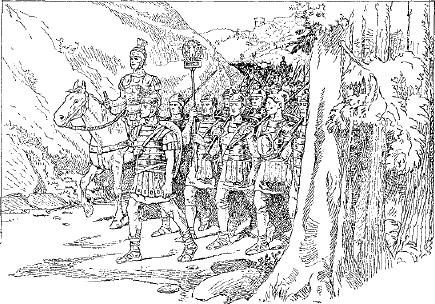
LESSON LXV
THE SUBJUNCTIVE OF POSSUM · VERBS OF FEARING
369. Learn the subjunctive of possum (§ 495), and note especially the position of the accent.
370. Subjunctive after Verbs of Fearing. We have learned that what we want done or not done is expressed in Latin by a subjunctive clause of purpose. In this class belong also clauses after verbs of fearing, for we fear either that something will happen or that it will not, and we either want it to happen or we do not. If we want a thing to happen and fear that it will not, the purpose clause is introduced by ut. If we do not want it to happen and fear that it will, nē is used. Owing to a difference between the English and Latin idiom we translate ut after a verb of fearing by that not, and nē by that or lest.
371. EXAMPLES
timeō timēbō timuerō ut veniat vēnerit
I fear, shall fear, shall have feared, that he will not come, has not come
timēbam timuī timueram ut venīret vēnisset
I was fearing, feared, had feared, that he would not come, had not come
The same examples with nē instead of ut would be translated I fear that or lest he will come, has come, etc.
372. Rule. Subjunctive after Verbs of Fearing. Verbs of fearing are followed by a substantive clause of purpose introduced by ut (that not) or nē (that or lest).
373. EXERCISES
I. 1. Caesar verēbātur ut supplicium captīvōrum Gallīs placēret. 2. Rōmānī ipsī magnopere verēbantur nē Helvētiī iter per prōvinciam facerent. 3. Timēbant ut satis reī frūmentāriae mittī posset. 4. Vereor ut hostium impetum sustinēre possim. 5. Timuit nē impedīmenta ab hostibus capta essent. 6. Caesar numquam timuit nē legiōnēs vincerentur. 7. Legiōnēs pugnāre nōn timuērunt.1
II. 1. We fear that they are not coming. 2. We fear lest they are coming. 3. We feared that they had come. 4. We feared that they had not come. 5. They feared greatly that the camp could not be defended. 6. Almost all feared1 to leave the camp.
Reading Selection
LESSON LXVI
THE PARTICIPLES
374. The Latin verb has the following Participles:1
Conj. I Conj. II Conj. III Conj. IV
ACTIVE
Present amāns loving monēns advising regēns ruling capiēns taking audiēns hearing
Future amātūrus about to love monitūrus about to advise rēctūrus about to rule captūrus about to take audītūrus about to hear
PASSIVE
Perfect amātus loved, having been loved monitus advised, having been advised rēctus ruled, having been ruled captus taken, having been taken audītus heard, having been heard
Future2 amandus to be loved monendus to be advised regendus to be ruled capiendus to be taken audiendus to be heard
a. The present active and future passive participles are formed from the present stem, and the future active and perfect passive participles are formed from the participial stem.
b. The present active participle is formed by adding -ns to the present stem. In -iō verbs of the third conjugation, and in the fourth conjugation, the stem is modified by the addition of -ē-, as capi-ē-ns, audi-ē-ns. It is declined like an adjective of one ending of the third declension. (Cf. § 256.)
amāns, loving
Base amant- Stem amanti-
Singular Plural
MASC. AND FEM. NEUT. MASC. AND FEM. NEUT.
Nom. amāns amāns amantēs amantia
Gen. amantis amantis amantium amantium
Dat. amantī amantī amantibus amantibus
Acc. amantem amāns amantīs or -ēs amantia
Abl. amantī or -e amantī or -e amantibus amantibus
(1) When used as an adjective the ablative singular ends in -ī; when used as a participle or as a substantive, in -e.
(2) In a similar way decline monēns, regēns, capiēns, audiēns.
c. The future active participle is formed by adding -ūrus to the base of the participial stem. We have already met this form combined with esse to produce the future active infinitive. (Cf. § 206.)
d. For the perfect passive participle see § 201. The future passive participle or gerundive is formed by adding -ndus to the present stem.
e. All participles in -us are declined like bonus.
f. Participles agree with nouns or pronouns like adjectives.
g. Give all the participles of the following verbs: cūrō, iubeō, sūmō, iaciō, mūniō.
375. Participles of Deponent Verbs. Deponent verbs have the participles of the active voice as well as of the passive; consequently every deponent verb has four participles, as,
Pres. Act. hortāns, urging
Fut. Act. hortātūrus, about to urge
Perf. Pass. (in form) hortātus, having urged
Fut. Pass. (Gerundive) hortandus, to be urged
a. Observe that the perfect participle of deponent verbs is passive in form but active in meaning. No other verbs have a perfect active participle. On the other hand, the future passive participle of deponent verbs is passive in meaning as in other verbs.
b. Give the participles of cōnor, vereor, sequor, patior, partior.
376. Tenses of the Participle. The tenses express time as follows:
1. The present active participle corresponds to the English present active participle in -ing, but can be used only of an action occurring at the same time as the action of the main verb; as, mīlitēs īnsequentēs cēpērunt multōs, the soldiers, while pursuing, captured many. Here the pursuing and the capturing are going on together.
2. The perfect participle (excepting of deponents) is regularly passive and corresponds to the English past participle with or without the auxiliary having been; as, audītus, heard or having been heard.
3. The future active participle, translated about to, etc., denotes time after the action of the main verb.
377. Review §§ 203, 204, and, note the following model sentences:
1. Mīlitēs currentēs erant dēfessī, the soldiers who were running (lit. running) were weary.
2. Caesar profectūrus Rōmam nōn exspectāvit, Cæsar, when about to set out (lit. about to set out) for Rome, did not wait.
3. Oppidum captum vīdimus, we saw the town which had been captured (lit. captured town).
4. Imperātor trīduum morātus profectus est, the general, since (when, or after) he had delayed (lit. the general, having delayed) three days, set out.
5. Mīlitēs vīctī terga nōn vertērunt, the soldiers, though they were conquered (lit. the soldiers conquered), did not retreat.
In each of these sentences the literal translation of the participle is given in parentheses. We note, however, that its proper translation usually requires a clause beginning with some conjunction (when, since, after, though, etc.), or a relative clause. Consider, in each case, what translation will best bring out the thought, and do not, as a rule, translate the participle literally.
378. EXERCISES
I. 1. Puer timēns nē capiātur fugit. 2. Aquila īrā commōta avīs reliquās interficere cōnāta erat. 3. Mīlitēs ab hostibus pressī tēla iacere nōn potuērunt. 4. Caesar decimam legiōnem laudātūrus ad prīmum agmen prōgressus est. 5. Imperātor hortātus equitēs ut fortiter pugnārent signum proeliō dedit. 6. Mīlitēs hostīs octō milia passuum īnsecūtī multīs cum captīvīs ad castra revertērunt. 7. Sōl oriēns multōs interfectōs vīdit. 8. Rōmānī cōnsilium audāx suspicātī barbaris sēsē nōn commīsērunt. 9. Nāvis ē portū ēgressa nūllō in perīculō erat.
II.3 1. The army was in very great danger while marching through the enemy’s country. 2. Frightened by the length of the way, they longed for home. 3. When the scouts were about to set out, they heard the shouts of victory. 4. When we had delayed many days, we set fire to the buildings and departed. 5. While living at Rome I heard orators much better than these. 6. The soldiers who are fighting across the river are no braver than we.
Reading Selection
LESSON LXVII
THE IRREGULAR VERBS VOLŌ, NŌLŌ, MĀLŌ · THE ABLATIVE WITH A PARTICIPLE, OR ABLATIVE ABSOLUTE
379. Learn the principal parts and conjugation of volō, wish; nōlō (ne + volō), be unwilling; mālō (magis + volō), be more willing, prefer (§ 497). Note the irregularities in the present indicative, subjunctive, and infinitive, and in the imperfect subjunctive. (Cf. § 354.)
a. These verbs are usually followed by the infinitive with or without a subject accusative; as, volunt venīre, they wish to come; volunt amīcōs venīre, they wish their friends to come. The English usage is the same.1
380. Observe the following sentences:
1. Magistrō laudante omnēs puerī dīligenter labōrant, with the teacher praising, or since the teacher praises, or the teacher praising, all the boys labor diligently.
2. Caesare dūcente nēmō prōgredī timet, with Cæsar leading, or when Cæsar leads, or if Cæsar leads, or Cæsar leading, no one fears to advance.
3. Hīs rēbus cognitīs mīlitēs fūgērunt, when this was known, or since this was known, or these things having been learned, the soldiers fled.
4. Proeliō commissō multī vulnerātī sunt, after the battle had begun, or when the battle had begun, or the battle having been joined, many were wounded.
a. One of the fundamental ablative relations is expressed in English by the preposition with (cf. § 50). In each of the sentences above we have a noun and a participle in agreement in the ablative, and the translation shows that in each instance the ablative expresses attendant circumstance. For example, in the first sentence the circumstance attending or accompanying the diligent labor of the boys is the praise of the teacher. This is clearly a with relation, and the ablative is the case to use.
b. We observe, further, that the ablative and its participle are absolutely independent grammatically of the rest of the sentence. If we were to express the thought in English in a similar way, we should use the nominative independent or absolute. In Latin the construction is called the Ablative Absolute, or the Ablative with a Participle. This form of expression is exceedingly common in Latin, but rather rare in English, so we must not, as a rule, employ the English absolute construction to translate the ablative abolute. The attendant circumstance may be one of time (when or after), or one of cause (since), or one of concession (though), or one of condition (if). In each case try to discover the precise relation, and translate the ablative and its participle by a clause which will best express the thought.
381. Rule. Ablative Absolute. The ablative of a noun or pronoun with a present or perfect participle in agreement is used to express attendant circumstance.
Note 1. The verb sum has no present participle. In consequence we often find two nouns or a noun and an adjective in the ablative absolute with no participle expressed; as, tē duce, you (being) leader, with you as leader; patre īnfirmō, my father (being) weak.
Note 2. Be very careful not to put in the ablative absolute a noun and participle that form the subject or object of a sentence. Compare
a. The Gauls, having been conquered by Cæsar, returned home b. The Gauls having been conquered by Cæsar, the army returned home
In a the subject is The Gauls having been conquered by Cæsar, and we translate,
Gallī ā Caesare victi domum revertērunt
In b the subject is the army. The Gauls having been conquered by Cæsar is nominative absolute in English, which requires the ablative absolute in Latin, and we translate,
Gallīs ā Caesare victīs exercitus domum revertit
Note 3. The fact that only deponent verbs have a perfect active participle (cf. § 375. a) often compels a change of voice when translating from one language to the other. For example, we can translate Cæsar having encouraged the legions just as it stands, because hortor is a deponent verb. But if we wish to say Cæsar having conquered the Gauls, we have to change the voice of the participle to the passive because vincō is not deponent, and say, the Gauls having been conquered by Cæsar (see translation above).
382. EXERCISES
I. 1. Māvīs, nōn vīs, vultis, nōlumus. 2. Ut nōlit, ut vellēmus, ut mālit. 3. Nōlī, velle, nōluisse, mālle. 4. Vult, māvultis, ut nōllet, nōlīte. 5. Sōle oriente, avēs cantāre incēpērunt. 6. Clāmōribus audītīs, barbarī prōgredī recūsābant. 7. Caesare legiōnēs hortātō, mīlitēs paulō fortius pugnāvērunt. 8. Hīs rēbus cognitīs, Helvētiī fīnitimīs persuāsērunt ut sēcum iter facerent. 9. Labōribus cōnfectīs, mīlitēs ā Caesare quaerēbant ut sibi praemia daret. 10. Conciliō convocātō, prīncipēs ita respondērunt. 11. Dux plūrīs diēs in Helvētiōrum fīnibus morāns multōs vīcōs incendit. 12. Magnitūdine Germānōrum cognitā, quīdam ex Rōmānis timēbant. 13. Mercātōribus rogātīs, Caesar nihilō plūs reperīre potuit.
II. 1. He was unwilling, lest they prefer, they have wished. 2. You prefer, that they might be unwilling, they wish. 3. We wish, they had preferred, that he may prefer. 4. Cæsar, when he heard the rumor (the rumor having been heard), commanded (imperāre) the legions to advance more quickly. 5. Since Cæsar was leader, the men were willing to make the journey. 6. A few, terrified2 by the reports which they had heard, preferred to remain at home. 7. After these had been left behind, the rest hastened as quickly as possible. 8. After Cæsar had undertaken the business (Cæsar, the business having been undertaken), he was unwilling to delay longer.3
Reading Selection
LESSON LXVIII
THE IRREGULAR VERB FĪŌ · THE SUBJUNCTIVE OF RESULT
383. The verb fīō, be made, happen, serves as the passive of faciō, make, in the present system. The rest of the verb is formed regularly from faciō. Learn the principal parts and conjugation (§ 500). Observe that the i is long except before -er and in fit.
a. The compounds of facio with prepositions usually form the passive regularly, as,
Active cōnficiō, cōnficere, cōnfēcī, cōnfectus
Passive cōnficior, cōnficī, cōnfectus sum
384. Observe the following sentences:
1. Terror erat tantus ut omnēs fugerent, the terror was so great that all fled.
2. Terror erat tantus ut nōn facile mīlitēs sēsē reciperent, the terror was so great that the soldiers did not easily recover themselves.
3. Terror fēcit ut omnēs fugerent, terror caused all to flee (lit. made that all fled).
a. Each of these sentences is complex, containing a principal clause and a subordinate clause.
b. The principal clause names a cause and the subordinate clause states the consequence or result of this cause.
c. The subordinate clause has its verb in the subjunctive, though it is translated like an indicative. The construction is called the subjunctive of consequence or result, and the clause is called a consecutive or result clause.
d. In the last example the clause of result is the object of the verb fēcit.
e. The conjunction introducing the consecutive or result clause is ut = so that; negative, ut nōn = so that not.
385. Rule. Subjunctive of Result. Consecutive clauses of result are introduced by ut or ut nōn and have the verb in the subjunctive.
386. Rule. Object clauses of result with ut or ut nōn are found after verbs of effecting or bringing about.
387. Purpose and Result Clauses Compared. There is great similarity in the expression of purpose and of result in Latin. If the sentence is affirmative, both purpose and result clauses may be introduced by ut; but if the sentence is negative, the purpose clause has nē and the result clause ut nōn. Result clauses are often preceded in the main clause by such words as tam, ita, sic (so), and these serve to point them out. Compare
a. Tam graviter vulnerātus est ut caperētur He was so severely wounded that he was captured
b. Graviter vulnerātus est ut caperētur He was severely wounded in order that he might be captured
Which sentence contains a result clause, and how is it pointed out?
388. EXERCISES
I. 1. Fit, fīet, ut fīat, fīēbāmus. 2. Fīō, fīēs, ut fierent, fierī, fīunt. 3. Fīētis, ut fīāmus, fīs, fīemus. 4. Mīlitēs erant tam tardī ut ante noctem in castra nōn pervenīrent. 5. Sōl facit ut omnia sint pulchra. 6. Eius modī perīcula erant ut nēmō proficīscī vellet. 7. Equitēs hostium cum equitātū nostrō in itinere contendērunt, ita tamen1 ut nostrī omnibus in partibus superiōrēs essent. 8. Virtūs mīlitum nostrōrum fēcit ut hostēs nē ūnum quidem2 impetum sustinērent. 9. Hominēs erant tam audācēs ut nūllō modō continērī possent. 10. Spatium erat tam parvum ut mīlitēs tēla iacere nōn facile possent. 11. Hōc proeliō factō barbarī ita perterritī sunt ut ab ultimīs gentibus lēgātī ad Caesarem mitterentur. 12. Hoc proelium factum est nē lēgātī ad Caesarem mitterentur.
II. 1. It will happen, they were being made, that it may happen. 2. It happens, he will be made, to happen. 3. They are made, we were being made, lest it happen. 4. The soldiers are so brave that they conquer. 5. The soldiers are brave in order that they may conquer. 6. The fortification was made so strong that it could not be taken. 7. The fortification was made strong in order that it might not be taken. 8. After the town was taken,3 the townsmen feared that they would be made slaves. 9. What state is so weak that it is unwilling to defend itself?
Reading Selection
LESSON LXIX
THE SUBJUNCTIVE OF CHARACTERISTIC OR DESCRIPTION · THE PREDICATE ACCUSATIVE
389. Akin to the subjunctive of consequence or result is the use of the subjunctive in clauses of characteristic or description.
This construction is illustrated in the following sentences:
1. Quis est quī suam domum nōn amet? who is there who does not love his own home?
2. Erant quī hoc facere nōllent, there were (some) who were unwilling to do this.
3. Tū nōn is es quī amīcōs trādās, you are not such a one as to, or you are not the man to, betray your friends.
4. Nihil videō quod timeam, I see nothing to fear (nothing of such as character as to fear it).
a. Each of these examples contains a descriptive relative clause which tells what kind of a person or thing the antecedent is. To express this thought the subjunctive is used. A relative clause that merely states a fact and does not describe the antecedent uses the indicative. Compare the sentences
Cæsar is the man who is leading us, Caesar est is quī nōs dūcit (mere statement of fact, no description, with the indicative) Cæsar is the man to lead us, Caesar est is quī nōs dūcat (descriptive relative clause with the subjunctive)
b. Observe that in this construction a demonstrative pronoun and a relative, as is quī, are translated such a one as to, the man to.
c. In which of the following sentences would you use the indicative and in which the subjunctive?
These are not the men who did this These are not the men to do this
390. Rule. Subjunctive of Characteristic. A relative clause with the subjunctive is often used to describe an antecedent. This is called the subjunctive of characteristic or description.
391. Observe the sentences
1. Rōmānī Caesarem cōnsulem fēcērunt, the Romans made Cæsar consul. 2. Caesar cōnsul ā Rōmānīs factus est, Cæsar was made consul by the Romans.
a. Observe in 1 that the transitive verb fēcērunt, made, has two objects: (1) the direct object, Caesarem; (2) a second object, cōnsulem, referring to the same person as the direct object and completing the predicate. The second accusative is called a Predicate Accusative.
b. Observe in 2 that when the verb is changed to the passive both of the accusatives become nominatives, the direct object becoming the subject and the predicate accusative the predicate nominative.
392. Rule. Two Accusatives. Verbs of making, choosing, calling, showing, and the like, may take a predicate accusative along with the direct object. With the passive voice the two accusatives become nominatives.
393. The verbs commonly found with two accusatives are
creo, creāre, creāvī, creātus, choose
appellō, appellāre, appellāvī, appellātus nōminō, nōmināre, nōmināvī, nōminātus vocō, vocāre, vocāvī, vocātus call
faciō, facere, fēcī, factus, make
394. EXERCISES
I. 1. In Germāniae silvis sunt1 multa genera ferārum quae reliquīs in locīs nōn vīsa sint. 2. Erant1 itinera duo quibus Helvētiī domō discēdere possent. 3. Erat1 manus nūlla, nūllum oppidum, nūllum praesidium quod sē armīs dēfenderet. 4. Tōtō frūmentō raptō, domī nihil erat quō mortem prohibēre possent. 5. Rōmānī Galbam ducem creāvērunt et summā celeritāte profectī sunt. 6. Neque erat1 tantae multitūdinis quisquam quī morārī vellet. 7. Germānī nōn iī sunt quī adventum Caesaris vereantur. 8. Cōnsulibus occīsīs erant quī2 vellent cum rēgem creāre. 9. Pāce factā erat nēmō quī arma trādere nōllet. 10. Inter Helvētiōs quis erat quī nōbilior illō esset?
II. 1. The Romans called the city Rome. 2. The city was called Rome by the Romans. 3. The better citizens wished to choose him king. 4. The brave soldier was not the man to run. 5. There was no one 3to call me friend. 6. These are not the men to4 betray their friends. 7. There were (some) who called him the bravest of all.
Reading Selection
Eighth Review, Lessons LXI-LXIX, §§ 527-528
LESSON LXX
THE CONSTRUCTIONS WITH THE CONJUNCTION CUM · THE ABLATIVE OF SPECIFICATION
395. The conjunction cum has the following meanings and constructions:
cum temporal = when, followed by the indicative or the subjunctive cum causal = since, followed by the subjunctive cum concessive = although, followed by the subjunctive
As you observe, the mood after cum is sometimes indicative and sometimes subjunctive. The reason for this will be made clear by a study of the following sentences:
1. Caesarem vīdī tum cum in Galliā eram, I saw Cæsar at the time when I was in Gaul.
2. Caesar in eōs impetum fēcit cum pācem peterent, Cæsar made an attack upon them when they were seeking peace.
3. Hoc erat difficile cum paucī sine vulneribus essent, this was difficult, since only a few were without wounds.
4. Cum prīmī ōrdinēs fūgissent, tamen reliquī fortiter cōnsistēbant, though the front ranks had fled, yet the rest bravely stood their ground.
a. The underlying principle is one already familiar to you (cf. § 389.a). When the cum clause states a fact and simply fixes the time at which the main action took place, the indicative mood is used. So, in the first example, cum in Galliā eram fixes the time when I saw Cæsar.
b. On the other hand, when the cum clause describes the circumstances under which the main act took place, the subjunctive mood is used. So, in the second example, the principal clause states that Cæsar made an attack, and the cum clause describes the circumstances under which this act occurred. The idea of time is also present, but it is subordinate to the idea of description. Sometimes the descriptive clause is one of cause and we translate cum by since; sometimes it denotes concession and cum is translated although.
396. Rule. Constructions with Cum. The conjunction cum means when, since, or although. It is followed by the subjunctive unless it means when and its clause fixes the time at which the main action took place.
Note. Cum in clauses of description with the subjunctive is much more common than its use with the indicative.
397. Note the following sentences:
1. Oppidum erat parvum magnitūdine sed magnum multitūdine hominum, the town was small in size but great in population.
2. Homō erat corpore īnfīrmus sed validus animō, the man was weak in body but strong in courage.
a. Observe that magnitūdine, multitūdine, corpore, and animō tell in what respect something is true. The relation is one covered by the ablative case, and the construction is called the ablative of specification.
398. Rule. Ablative of Specification. The ablative is used to denote in what respect something is true.
399. IDIOMS
aliquem certiōrem facere, to inform some one (lit. to make some one more certain) certior fierī, to be informed (lit. to be made more certain) iter dare, to give a right of way, allow to pass obsidēs inter sē dare, to give hostages to each other
400. EXERCISES
I. 1. Helvētiī cum patrum nostrōrum tempore domō prefectī essent, cōnsulis exercitum in fugam dederant. 2. Cum Caesar in Galliam vēnit, Helvētiī aliōs agrōs petēbant. 3. Caesar cum in citeriōre Gallia esset, tamen dē Helvētiōrum cōnsiliīs certior fīēbat. 4. Cum Helvētiī bellō clārissimī essent, Caesar iter per prōvinciam dare recūsāvit. 5. Lēgātus cum haec audīvisset, Caesarem certiōrem fecit. 6. Cum principēs inter sē obsidēs darent, Rōmānī bellum parāvērunt. 7. Caesar, cum id nūntiātum esset, mātūrat ab urbe proficīscī. 8. Nē virtūte quidem Gallī erant parēs Germānis. 9. Caesar neque corpore neque animō īnfīrmus erat. 10. Illud bellum tum incēpit cum Caesar fuit cōnsul.
Observe in each case what mood follows cum, and try to give the reasons for its use. In the third sentence the cum clause is concessive, in the fourth and sixth causal.
II. 1. That battle was fought at the time when (tum cum) I was at Rome. 2. Though the horsemen were few in number, nevertheless they did not retreat. 3. When the camp had been sufficiently fortified, the enemy returned home. 4. Since the tribes are giving hostages to each other, we shall inform Cæsar. 5. The Gauls and the Germans are very unlike in language and laws.
Reading Selection
LESSON LXXI
VOCABULARY REVIEW · THE GERUND AND GERUNDIVE · THE PREDICATE GENITIVE
401. Review the word lists in §§ 510, 511.
402. The Gerund. Suppose we had to translate the sentence
By overcoming the Gauls Cæsar won great glory
We can see that overcoming here is a verbal noun corresponding to the English infinitive in -ing, and that the thought calls for the ablative of means. To translate this by the Latin infinitive would be impossible, because the infinitive is indeclinable and therefore has no ablative case form. Latin, however, has another verbal noun of corresponding meaning, called the gerund, declined as a neuter of the second declension in the genitive, dative, accusative, and ablative singular, and thus supplying the cases that the infinitive lacks.1 Hence, to decline in Latin the verbal noun overcoming, we should use the infinitive for the nominative and the gerund for the other cases, as follows:
Nom. superāre overcoming to overcome Infinitive
Gen. Dat. Acc. Abl. superandī, of overcoming superandō, for overcoming superandum, overcoming superandō, by overcoming Gerund
Like the infinitive, the gerund governs the same case as the verb from which it is derived. So the sentence given above becomes in Latin
Superandō Gallōs Caesar magnam glōriam reportāvit
403. The gerund2 is formed by adding -ndī, -ndō, -ndum, -ndō, to the present stem, which is shortened or otherwise changed, as shown below:
Paradigm of the Gerund
CONJ. I CONJ. II CONJ. III CONJ. IV
Gen. amandī monendī regendī capiendī audiendī
Dat. amandō monendō regendō capiendō audiendō
Acc. amandum monendum regendum capiendum audiendum
Abl. amandō monendō regendō capiendō audiendō
a. Give the gerund of cūrō, dēleō, sūmō, iaciō, veniō.
b. Deponent verbs have the gerund of the active voice (see § 493). Give the gerund of cōnor, vereor, sequor, patior, partior.
404. The Gerundive. The gerundive is the name given to the future passive participle (§ 374. d) when the participle approaches the meaning of a verbal noun and is translated like a gerund. It is the adjective corresponding to the gerund. For example, to translate the plan of waging war, we may use the gerund with its direct object and say cōnsilium gerendī bellum; or we may use the gerundive and say cōnsilium bellī gerendī, which means, literally, the plan of the war to be waged, but which came to have the same force as the gerund with its object, and was even preferred to it.
405. Compare the following parallel uses of the gerund and gerundive:
Gerund Gerundive
Gen. Spēs faciendī pācem The hope of making peace Spēs faciendae pācis The hope of making peace
Dat. Locus idōneus pugnandō A place suitable for fighting Locus idōneus castrīs pōnendīs A place suitable for pitching camp
Acc. Mīsit equitēs ad īnsequendum He sent horsemen to pursue Mīsit equitēs ad īnsequendōs hostīs He sent horsemen to pursue the enemy
Abl. Nārrandō fābulās magister puerīs placuit The teacher pleased the boys by telling stories Nārrandīs fābulīs magister puerīs placuit The teacher pleased the boys by telling stories
a. We observe
(1) That the gerund is a noun and the gerundive an adjective.
(2) That the gerund, being a noun, may stand alone or with an object.
(3) That the gerundive, being an adjective, is used only in agreement with a noun.
406. Rule. Gerund and Gerundive. 1. The Gerund is a verbal noun and is used only in the genitive, dative, accusative, and ablative singular. The constructions of these cases are in general the same as those of other nouns.
2. The Gerundive is a verbal adjective and must be used instead of gerund + object excepting in the genitive and in the ablative without a preposition. Even in these instances the gerundive construction is more usual.
407. Rule. Gerund or Gerundive of Purpose. The accusative of the gerund or gerundive with ad, or the genitive with causā3 (= for the sake of), is used to express purpose.
Gerund Gerundive
Ad audiendum vēnērunt or Audiendī causā vēnērunt They came to hear Ad urbem videndam vēnērunt or Urbis videndae causā vēnērunt They came to see the city
Note. These sentences might, of course, be written with the subjunctive of purpose,—vēnērunt ut audīrent; vēnērunt ut urbem vidērent. In short expressions, however, the gerund and gerundive of purpose are rather more common.
408. We have learned that the word denoting the owner or possessor of something is in the genitive, as, equus Galbae, Galba’s horse. If, now, we wish to express the idea the horse is Galba’s, Galba remains the possessor, and hence in the genitive as before, but now stands in the predicate, as, equus est Galbae. Hence this is called the predicate genitive.
409. Rule. Predicate Genitive. The possessive genitive often stands in the predicate, especially after the forms of sum, and is then called the predicate genitive.
410. IDIOMS
alīcui negōtium dare, to employ someone (lit. to give business to some one) novīs rēbus studēre, to be eager for a revolution (lit. to be eager for new things) reī mīlitāris perītissimus, very skillful in the art of war sē suaque omnia, themselves and all their possessions
411. EXERCISES
I. 1. Caesar cum in Galliā bellum gereret, militibus decimae legiōnis maximē fāvit quia reī mīlitāris perītissimī erant. 2. Sociīs negōtium dedit reī frumentāriae cūrandae. 3. Lēgāti nōn sōlum audiendī causā sed etiam dicendī causā vēnērunt. 4. Imperātor iussit explōrātōres locum idōneum mūnindō reperīre. 5. Nuper hae gentēs novīs rēbus studēbant; mox iīs persuādēbō ut Caesarī sē suaque omnia dēdant. 6. Iubēre est regīnae1 et pārēre est multitūdinis.4 7. Hōc proeliō factō quīdam ex hostibus ad pācem petendam venērunt. 8. Erant quī arma trādere nōllent. 9. Hostēs tam celeriter prōgressī sunt ut spatium pīla in hostīs iaciendī non darētur. 10. Spatium neque arma capiendī5 neque auxilī petendī2 datum est.
II. 1. These ornaments 6belong to Cornelia. 2. Men very skillful in the art of war were sent 7to capture the town. 3. The scouts found a hill suitable for fortifying very near to the river. 4. Soon the cavalry will come 8to seek supplies. 5. The mind of the Gauls is eager for revolution and for undertaking wars. 6. To lead the line of battle 8belongs to the general. 7. 10Whom shall we employ to look after the grain supply?
Reading Selection
LESSON LXXII
THE IRREGULAR VERB EŌ · INDIRECT STATEMENTS
412. Learn the principal parts and the conjugation of eō, go (§ 499).
a. Notice that ī-, the root of eō, is changed to e- before a vowel, excepting in iēns, the nominative of the present participle. In the perfect system -v- is regularly dropped.
413. Learn the meaning and principal parts of the following compounds of eō with prepositions:
ad´eō, adī´re, ad´iī, ad´itus, go to, visit, with the accusative ex´eō, exī´re, ex´iī, ex´itus, go forth, with ex or dē and the ablative of the place from which in´eō, inī´re, in´iī, in´itus, begin, enter upon, with the accusative red´eō, redī´re, red´iī, red´itus, return, with ad or in and the accusative of the place to which trāns´eō, trānsī´re, trāns´iī, trāns´itus, cross, with the accusative
414. Indirect Statements in English. Direct statements are those which the speaker or writer makes himself or which are quoted in his exact language. Indirect statements are those reported in a different form of words from that used by the speaker or writer. Compare the following direct and indirect statements:
Direct statements 1. The Gauls are brave 2. The Gauls were brave 3. The Gauls will be brave
Indirect statements after a verb in the present tense 1. He says that the Gauls are brave 2. He says that the Gauls were brave 3. He says that the Gauls will be brave
Indirect statements after a verb in a past tense 1. He said that the Gauls were brave 2. He said that the Gauls had been brave 3. He said that the Gauls would be brave
We see that in English
a. The indirect statement forms a clause introduced by the conjunction that.
b. The verb is finite (cf. § 173) and its subject is in the nominative.
c. The tenses of the verbs originally used are changed after the past tense, He said.
415. Indirect Statements in Latin. In Latin the direct and indirect statements above would be as follows:
Direct Statements 1. Gallī sunt fortēs 2. Gallī erant fortēs 3. Gallī erunt fortēs
Indirect Statements 1. Dīcit or Dīxit Gallōs esse fortīs (He says or He said the Gauls to be brave)1 2. Dīcit or Dīxit Gallōs fuisse fortīs (He says or He said the Gauls to have been brave)1 3. Dīcit or Dīxit Gallōs futūrōs esse fortīs (He says or He said the Gauls to be about to be brave)1
Comparing these Latin indirect statements with the English in the preceding section, we observe three marked differences:
a. There is no conjunction corresponding to that.
b. The verb is in the infinitive and its subject is in the accusative.
c. The tenses of the infinitive are not changed after a past tense of the principal verb.
416. Rule. Indirect Statements. When a direct statement becomes indirect, the principal verb is changed to the infinitive and its subject nominative becomes subject accusative of the infinitive.
417. Tenses of the Infinitive. When the sentences in § 415 were changed from the direct to the indirect form of statement, sunt became esse, erant became fuisse, and erunt became futūrōs esse.
418. Rule. Infinitive Tenses in Indirect Statements. A present indicative of a direct statement becomes present infinitive of the indirect, a past indicative becomes perfect infinitive, and a future indicative becomes future infinitive.
Note. When translating into Latin an English indirect statement, first decide what tense of the indicative would have been used in the direct form. That will show you what tense of the infinitive to use in the indirect.
419. Rule. Verbs followed by Indirect Statements. The accusative-with-infinitive construction in indirect statements is found after verbs of saying, telling, knowing, thinking, and perceiving.
420. Verbs regularly followed by indirect statements are:
a. Verbs of saying and telling: dīcō, dīcere, dīxī, dictus, say negō, negāre, negāvī, negātus, deny, say not nūntiō, nūntiāre, nūntiāvī, nūntiātus, announce respondeō, respondēre, respondī, respōnsus, reply
b. Verbs of knowing: cognōscō, cognōscere, cognōvī, cognitus, learn, (in the perf.) know sciō, scīre, scīvī, scītus, know
c. Verbs of thinking: arbitror, arbitrārī, arbitrātus sum, think, consider exīstimō, exīstimāre, exīstimāvī, exīstimātus, think, believe iūdicō, iūdicāre, iūdicāvi, iūdicātus, judge, decide putō, putāre, putāvī, putātus, reckon, think spērō, spērāre, spērāvi, spērātus, hope
d. Verbs of perceiving: audiō, audīre, audīvī, audītus, hear sentiō, sentīre, sēnsī, sēnsus, feel, perceive videō, vidēre, vīdī, vīsus, see intellegō, intellegere, intellēxī, intellēctus, understand, perceive
Learn such of these verbs as are new to you.
421. IDIOMS
postrīdiē eius diēī, on the next day (lit. on the next day of that day) initā aestāte, at the beginning of summer memoriā tenēre, to remember (lit. to hold by memory) per explōrātōrēs cognōscere, to learn through scouts
422. EXERCISES
I. 1. It, īmus, īte, īre. 2. Euntī, iisse or īsse, ībunt, eunt. 3. Eundi, ut eant, ībitis, īs. 4. Nē īrent, ī, ībant, ierat. 5. Caesar per explorātores cognōvit Gallōs flūmen trānsīsse. 6. Rōmānī audīvērunt Helvētiōs initā aestāte dē fīnibus suīs exitūrōs esse. 7. Legātī respondērunt nēminem ante Caesarem illam īnsulam adīsse. 8. Prīncipēs Gallōrum dīcunt sē nūllum cōnsilium contrā Caesaris imperium initūrōs esse. 9. Arbitrāmur potentiam rēgīnae esse maiōrem quam cīvium. 10. Rōmānī negant se lībertātem Gallīs ēreptūrōs esse. 11. Hīs rēbus cognitīs sēnsimus lēgātōs non vēnisse ad pācem petendam. 12. Helvētii sciunt Rōmānōs priōrēs victōriās memoriā tenēre. 13. Sociī cum intellegerent multōs vulnerārī, statuērunt in suōs fīnīs redīre. 14. Aliquis nūntiāvit Mārcum cōnsulem creātum esse.
II. 1. The boy is slow. He says that the boy is, was, (and) will be slow. 2. The horse is, has been, (and) will be strong. He judged that the horse was, had been, (and) would be strong. 3. We think that the army will go forth from the camp at the beginning of summer. 4. The next day we learned through scouts that the enemy’s town was ten miles off.2 5. The king replied that the ornaments belonged to3 the queen.
Reading Selection
TUBA

LESSON LXXIII
VOCABULARY REVIEW · THE IRREGULAR VERB FERŌ · THE DATIVE WITH COMPOUNDS
423. Review the word lists in §§ 513, 514.
424. Learn the principal parts and conjugation of the verb ferō, bear (§ 498).
1. Learn the principal parts and meanings of the following compounds of ferō, bear:
ad´ferō, adfer´re, at´tulī, adlā´tus, bring to; report cōn´ferō, cōnfer´re, con´tulī, conlā´tus, bring together, collect dē´ferō, dēfer´re, dē´tulī, dēlā´tus, bring to; report; grant, confer īn´ferō, īnfer´re, in´tulī, inlā´tus, bring in, bring against re´ferō, refer´re, ret´tulī, relā´tus, bear back, report
425. The dative is the case of the indirect object. Many intransitive verbs take an indirect object and are therefore used with the dative (cf. § 153). Transitive verbs take a direct object in the accusative; but sometimes they have an indirect object or dative as well. The whole question, then, as to whether or not a verb takes the dative, depends upon its capacity for governing an indirect object. A number of verbs, some transitive and some intransitive, which in their simple form would not take an indirect object, when compounded with certain prepositions, have a meaning which calls for an indirect object. Observe the following sentences:
1. Haec rēs exercituī magnam calamitātem attulit, this circumstance brought great disaster to the army. 2. Germānī Gallīs bellum īnferunt, the Germans make war upon the Gauls. 3. Hae cōpiae proeliō nōn intererant, these troops did not take part in the battle. 4. Equitēs fugientibus hostibus occurrunt, the horsemen meet the fleeing enemy. 5. Galba cōpiīs fīlium praefēcit, Galba put his son in command of the troops.
In each sentence there is a dative, and in each a verb combined with a preposition. In no case would the simple verb take the dative.
426. Rule. Dative with Compounds. Some verbs compounded with ad, ante, con, dē, in, inter, ob, post, prae, prō, sub, super, admit the dative of the indirect object. Transitive compounds may take both an accusative and a dative.
Note 1. Among such verbs are1
ad´ferō, adfer´re, at´tulī, adlā´tus, bring to; report ad´sum, ades´se, ad´fuī, adfutū´rus, assist; be present dē´ferō, dēfer´re, dē´tulī, dēlātus, report; grant, confer dē´sum, dees´se, dē´fuī, ——, be wanting, be lacking īn´ferō, īnfer´re, in´tulī, inlā´tus, bring against, bring upon inter´sum, interes´se, inter´fuī, interfutū´rus, take part in occur´rō, occur´rere, occur´rī, occur´sus, run against, meet praefi´ciō, praefi´cere, praefē´cī, praefec´tus, appoint over, place in command of prae´sum, praees´se, prae´fuī, ——, be over, be in command
427. IDIOMS
graviter or molestē ferre, to be annoyed at, to be indignant at, followed by the accusative and infinitive sē cōnferre ad or in, with the accusative, to betake one’s self to alicui bellum īnferre, to make war upon some one pedem referre, to retreat (lit. to bear back the foot)
428. EXERCISES
I. 1. Fer, ferent, ut ferant, ferunt. 2. Ferte, ut ferrent, tulisse, tulerant. 3. Tulimus, ferēns, lātus esse, ferre. 4. Cum nāvigia insulae adpropinquārent, barbarī terrōre commōtī pedem referre cōnātī sunt. 5. Gallī molestē ferēbant Rōmānōs agrōs vastāre. 6. Caesar sociīs imperāvit nē fīnitimis suīs bellum īnferrent. 7. Explorātōrēs, qui Caesarī occurrērunt, dīxērunt exercitum hostium vulneribus dēfessum sēsē in alium locum contulisse. 8. Hostes sciēbant Rōmānōs frūmentō egēre et hanc rem Caesarī summum perīculum adlātūram esse. 9. Impedīmentīs in ūnum locum conlātis, aliquī mīlitum flūmen quod nōn longē aberat trānsiērunt. 10. Hōs rēx hortātus est ut ōrāculum adīrent et rēs audītās ad sē referrent. 11. Quem imperātor illī legiōnī praefēcit? Pūblius illī legiōnī pracerat. 12. Cum esset Caesar in citeriōre Galliā, crēbrī ad eum2 rūmōrēs adferēbantur litterīsque quoque certior fīēbat Gallōs obsidēs inter sē dare.
II. 1. The Gauls will make war upon Cæsar’s allies. 2. We heard that the Gauls would make war upon Cæsar’s allies. 3. Publius did not take part in that battle. 4. We have been informed that Publius did not take part in that battle. 5. The man who was in command of the cavalry was wounded and began to retreat. 6. Cæsar did not place you in command of the cohort to bring3 disaster upon the army.
Reading Selection
LESSON LXXIV
VOCABULARY REVIEW · THE SUBJUNCTIVE IN INDIRECT QUESTIONS
429. Review the word lists in §§ 517, 518.
430. When we report a statement instead of giving it directly, we have an indirect statement. (Cf. § 414.) So, if we report a question instead of asking it directly, we have an indirect question.
Direct Question Indirect Question
Who conquered the Gauls? He asked who conquered the Gauls
a. An indirect question depends, usually as object, upon a verb of asking (as petō, postulō, quaerō, rogō) or upon some verb or expression of saying or mental action. (Cf. § 420.)
431. Compare the following direct and indirect questions:
Direct Indirect
Quis Gallōs vincit? Who is conquering the Gauls? a. Rogat quis Gallōs vincat He asks who is conquering the Gauls
b. Rogavit quis Gallōs vinceret He asked who was conquering the Gauls
Ubī est Rōma? Where is Rome? a. Rogat ubi sit Rōma He asks where Rome is
b. Rogāvit ubi esset Rōma He asked where Rome was
Caesarne Gallōs vīcit? Did Cæsar conquer the Gauls? a. Rogat num Caesar Gallōs vīcerit He asks whether Cæsar conquered the Gauls
b. Rogāvit num Caesar Gallōs vīcisset He asked whether Cæsar had conquered the Gauls
a. The verb in a direct question is in the indicative mood, but the mood is subjunctive in an indirect question.
b. The tense of the subjunctive follows the rules for tense sequence.
c. Indirect questions are introduced by the same interrogative words as introduce direct questions, excepting thatyes-or-no direct questions (cf. § 210) on becoming indirect are usually introduced by num, whether.
432. Rule. Indirect Questions. In an indirect question the verb is in the subjunctive and its tense is determined by the law for tense sequence.
433. IDIOMS
dē tertiā vigiliā, about the third watch iniūriās alicui īnferre, to inflict injuries upon some one facere verba prō, with the ablative, to speak in behalf of in reliquum tempus, for the future
434. EXERCISES
I. 1. Rēx rogāvit quid lēgātī postulārent et cūr ad sē vēnissent. 2. Quaesīvit quoque num nec recentīs iniūriās nec dubiam Rōmānōrum amīcitiam memoriā tenērent. 3. Vidētisne quae oppida hostēs oppugnāverint? 4. Nōnne scītis cūr Gallī sub montem sēse contulerint? 5. Audīvimus quās iniūrias tibi Germānī intulissent. 6. Dē tertiā vigiliā imperātor mīsit hominēs quī cognōscerent quae esset nātūra montis. 7. Prō hīs ōrātor verba fēcit et rogāvit cūr cōnsulēs nāvīs ad plēnem summī perīculī locum mittere vellent. 8. Lēgātīs convocātīs dēmōnstrāvit quid fierī vellet. 9. Nūntius referēbat quid in Gallōrum conciliō dē armīs trādendīs dictum esset. 10. Moneō nē in reliquum tempus peditēs et equitēs trāns flūmen dūcās.
II. 1. What hill did they seize? I see what hill they seized. 2. Who has inflicted these injuries upon our dependents? 3. They asked who had inflicted those injuries upon their dependents. 4. Whither did you go about the third watch? You know whither I went. 5. At what time did the boys return home? I will ask at what time the boys returned home.
Reading Selection
LESSON LXXV
VOCABULARY REVIEW · THE DATIVE OF PURPOSE, OR END FOR WHICH
435. Review the word lists in §§ 521, 522.
436. Observe the following sentences:
1. Explōrātōrēs locum castrīs dēlēgērunt, the scouts chose a place for a camp. 2. Hoc erat magnō impedīmentō Gallīs, this was (for) a great hindrance to the Gauls. 3. Duās legiōnēs praesidiō castrīs relīquit, he left two legions as (lit. for) a guard to the camp.
In each of these sentences we find a dative expressing the purpose or end for which something is intended or for which it serves. These datives are castrīs, impedīmentō, and praesidiō. In the second and third sentences we find a second dative expressing the person or thing affected (Gallīs and castrīs). As you notice, these are true datives, covering the relations of for which and to which. (Cf. § 43.)
437. Rule. Dative of Purpose or End. The dative is used to denote the purpose or end for which, often with another dative denoting the person or thing affected.
438. IDIOMS
cōnsilium omittere, to give up a plan locum castrīs dēligere, to choose a place for a camp alicui magnō ūsuī esse, to be of great advantage to some one (lit. for great advantage to some one)
439. EXERCISES
I. 1. Rogāvit cūr illae cōpiae relictae essent. Respondērunt illās cōpiās esse praesidiō castrīs. 2. Caesar mīsit explōrātōrēs ad locum dēligendum castrīs. 3. Quisque exīstimāvit ipsum nōmen Caesaris magnō terrōrī barbarīs futūrum esse. 4. Prīmā lūce īdem exercitus proelium ācre commīsit, sed gravia suōrum vulnera magnae cūrae imperātōrī erant. 5. Rēx respondit amīcitiam populī Rōmānī sibi ōrnāmentō et praesidiō dēbēre esse. 6. Quis praeerat equitātuī quem auxiliō Caesarī sociī mīserant? 7. Aliquibus rēs secundae sunt summae calamitātī et rēs adversae sunt mīrō ūsuī. 8. Gallīs magnō ad pugnam erat impedīmentō quod equitātus ā dextrō cornū premēbat. 9. Memoria prīstinae virtūtis nōn minus quam metus hostium erat nostrīs magnō ūsuī. 10. Tam dēnsa erat silva ut prōgredī nōn possent.
II. 1. I advise you 1to give up the plan 2of making war upon the brave Gauls. 2. Do you know 3where the cavalry has chosen a place for a camp? 3. The fear of the enemy will be of great advantage to you. 4. Cæsar left three cohorts as (for) a guard to the baggage. 5. In winter the waves of the lake are so great 4that they are (for) a great hindrance to ships. 6. Cæsar inflicted severe5 punishment on those who burned the public buildings.
Reading Selection
LESSON LXXVI
VOCABULARY REVIEW · THE GENITIVE AND ABLATIVE OF QUALITY OR DESCRIPTION
440. Review the word lists in §§ 524, 525.
441. Observe the English sentences
(1) A man of great courage, or (2) A man with great courage (3) A forest of tall trees, or (4) A forest with tall trees
Each of these sentences contains a phrase of quality or description. In the first two a man is described; in the last two a forest. The descriptive phrases are introduced by the prepositions of and with.
In Latin the expression of quality or description is very similar.
The prepositions of and with suggest the genitive and the ablative respectively, and we translate the sentences above
(1) Vir magnae virtūtis, or (2) Vir magnā virtūte (3) Silva altārum arborum, or (4) Silva altīs arboribus
There is, however, one important difference between the Latin and the English. In English we may say, for example, a man of courage, using the descriptive phrase without an adjective modifier. In Latin, however, an adjective modifier must always be used, as above.
a. Latin makes a distinction between the use of the two cases in that numerical descriptions of measure are in the genitive and descriptions of physical characteristics are in the ablative. Other descriptive phrases may be in either case.
442. EXAMPLES
1. Fossa duodecim pedum, a ditch of twelve feet. 2. Homō magnīs pedibus et parvō capite, a man with big feet and a small head. 3. Rēx erat vir summā audāciā or rēx erat vir summae audāciae, the king was a man of the greatest boldness.
443. Rule. Genitive of Description. Numerical descriptions of measure are expressed by the genitive with a modifying adjective.
444. Rule. Ablative of Description. Descriptions of physical characteristics are expressed by the ablative with a modifying adjective.
445. Rule. Genitive or Ablative of Description. Descriptions involving neither numerical statements nor physical characteristics may be expressed by either the genitive or the ablative with a modifying adjective.
446. IDIOMS
Helvētiīs in animō est, the Helvetii intend, (lit. it is in mind to the Helvetians) in mātrimōnium dare, to give in marriage nihil posse, to have no power fossam perdūcere, to construct a ditch (lit. to lead a ditch through)
447. EXERCISES
I. 1. Mīlitēs fossam decem pedum per eōrum fīnīs perdūxērunt. 2. Prīnceps Helvētiōrum, vir summae audāciae, prīncipibus gentium fīnitimārum sorōrēs in mātrimōnium dedit. 3. Eōrum amīcitiam cōnfīrmāre voluit quō facilius Rōmānīs bellum īnferret. 4. Germanī et Gallī nōn erant eiusdem gentis. 5. Omnēs ferē Germānī erant magnīs corporum vīribus.1 6. Gallī qui oppidum fortiter dēfendēbant saxa ingentis magnitūdinis dē mūrō iaciēbant. 7. Cum Caesar ab explōrātōribus quaereret quī illud oppidum incolerent, explōrātōrēs respondērunt eōs esse homines summā virtūte et magnō cōnsiliō. 8. Moenia vīgintī pedum ā sinistrā parte, et ā dextrā parte flūmen magnae altitūdinis oppidum dēfendēbant. 9. Cum Caesar in Galliam pervēnisset, erat rūmor Helvētiīs in animō esse iter per prōvinciam Rōmānam facere. 10. Caesar, ut eōs ab fīnibus Rōmānis prohibēret, mūnītiōnem 2multa mīlia passuum longam fēcit.
II. 1. Cæsar was a general of much wisdom and great boldness, and very skillful in the art of war. 2. The Germans were of great size, and thought that the Romans had no power. 3. Men of the highest courage were left in the camp as (for) a guard to the baggage. 4. The king’s daughter, who was given in marriage to the chief of a neighboring state, was a woman of very beautiful appearance. 5. The soldiers will construct a ditch of nine feet around the camp. 6. A river of great width was between us and the enemy.
Reading Selection
GLADII
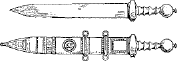
LESSON LXXVII
REVIEW OF AGREEMENT, AND OF THE GENITIVE, DATIVE, AND ACCUSATIVE
448. There are four agreements:
1. That of the predicate noun or of the appositive with the noun to which it belongs (§§ 76, 81).
2. That of the adjective, adjective pronoun, or participle with its noun (§ 65).
3. That of a verb with its subject (§ 28).
4. That of a relative pronoun with its antecedent (§ 224).
449. The relation expressed by the genitive is, in general, denoted in English by the preposition of. It is used to express
1. Possession a. As attributive (§ 38). b. In the predicate (§ 409).
2. The whole of which a part is taken (partitive genitive) (§ 331).
3. Quality or description (§§ 443, 445).
450. The relation expressed by the dative is, in general, denoted in English by the prepositions to or for when they do not imply motion through space. It is used to express
1. The indirect object a. With intransitive verbs and with transitive verbs in connection with a direct object in the accusative (§ 45). b. With special intransitive verbs (§ 154). c. With verbs compounded with ad, ante, con, dē, in, inter, ob, post, prae, prō, sub, super (§ 426).
2. The object to which the quality of an adjective is directed (§ 143).
3. The purpose, or end for which, often with a second dative denoting the person or thing affected (§ 437).
451. The accusative case corresponds, in general, to the English objective. It is used to express
1. The direct object of a transitive verb (§ 37).
2. The predicate accusative together with the direct object after verbs of making, choosing, falling, showing, and the like (§ 392).
3. The subject of the infinitive (§ 214).
4. The object of prepositions that do not govern the ablative (§ 340).
5. The duration of time and the extent of space (§ 336).
6. The place to which (§§ 263, 266).
452. EXERCISES
I. 1. Mīlitēs quōs vīdimus dīxērunt imperium bellī esse Caesaris imperātōris. 2. Helvētiī statuērunt quam1 maximum numerum equōrum et carrōrum cōgere. 3. Tōtīus Galliae Helvētiī plūrimum valuērunt. 4. Multās hōrās ācriter pugnātum est neque quisquam poterat vidēre hostem fugientem. 5. Virī summae virtūtis hostīs decem mīlia passuum īnsecūtī sunt. 6. Caesar populō Rōmānō persuāsit ut sē cōnsulem creāret. 7. Victōria exercitūs erat semper imperātōrī grātissima. 8. Trīduum iter fēcērunt et Genāvam, in oppidum2 hostium, pervēnērunt. 9. Caesar audīvit Germānōs bellum Gallīs intulisse. 10. Magnō ūsuī mīlitibus Caesaris erat quod priōribus proeliīs sēsē exercuerant.
II. 1. One3 of the king’s sons and many of his men were captured. 2. There was no one who wished4 to appoint her queen. 3. The grain supply was always a care (for a care) to Cæsar, the general. 4. I think that the camp is ten miles distant. 5. We marched for three hours through a very dense forest. 6. The plan 5of making war upon the allies was not pleasing to the king. 7. When he came to the hill he fortified it 6by a twelve-foot wall.
LESSON LXXVIII
REVIEW OF THE ABLATIVE
453. The relations of the ablative are, in general, expressed in English by the prepositions with (or by), from (or by), and in (or at). The constructions growing out of these meanings are
I. Ablative rendered with (or by):
1. Cause (§ 102) 2. Means (§ 103) 3. Accompaniment (§ 104) 4. Manner (§ 105) 5. Measure of difference (§ 317) 6. With a participle (ablative absolute) (§ 381) 7. Description or quality (§§ 444, 445) 8. Specification (§ 398)
II. Ablative rendered from (or by):
1. Place from which (§§ 179, 264) 2. Ablative of separation (§ 180) 3. Personal agent with a passive verb (§ 181) 4. Comparison without quam (§ 309)
III. Ablative rendered in (or at):
1. Place at or in which (§§ 265, 266) 2. Time when or within which (§ 275)
454. EXERCISES
I. 1. Gallī locīs superiōribus occupātīs itinere exercitum prohibēre cōnantur. 2. Omnēs oppidānī ex oppidō ēgressī salūtem fugā petere incēpērunt. 3. Caesar docet sē mīlitum vītam suā salūte habēre multō cāriōrem. 4. Cum celerius omnium opīniōne pervēnisset, hostēs ad eum obsidēs mīsērunt 5. Vīcus in valle positus montibus altissimīs undique continētur. 6. Plūrimum inter Gallōs haec gēns et virtūte et hominum numerō valēbat. 7. Secundā vigiliā nūllō certō ōrdine neque imperiō ē castrīs ēgressī sunt. 8. Duābus legiōnibus Genāvae relictīs, proximō diē cum reliquīs domum profectus est. 9. Erant itinera duo quibus itineribus Helvētiī domō exīre possent. 10. Rēx erat summā audāciā et magnā apud populum potentiā. 11. Gallī timōre servitūtis commōtī bellum parābant. 12. Caesar monet lēgātōs ut contineant militēs, nē studiō pugnandī aut spē praedae longius1 prōgrediantur. 13. Bellum ācerrimum ā Caesare in Gallōs gestum est.
II. 1. The lieutenant after having seized the mountain restrained his (men) from battle. 2. All the Gauls differ from each other in laws. 3. This tribe is much braver than the rest. 4. This road is 2ten miles shorter than that. 5. In summer Cæsar carried on war in Gaul, in winter he returned to Italy. 6. At midnight the general set out from the camp with three legions. 7. I fear that you cannot protect3 yourself from these enemies. 8. 4After this battle was finished peace was made by all the Gauls.
LESSON LXXIX
REVIEW OF THE GERUND AND GERUNDIVE, THE INFINITIVE, AND THE SUBJUNCTIVE
455. The gerund is a verbal noun and is used only in the genitive, dative, accusative, and ablative singular. The constructions of these cases are in general the same as those of other nouns (§§ 402; 406.1).
456. The gerundive is a verbal adjective and must be used instead of gerund + object, excepting in the genitive and in the ablative without a preposition. Even in these instances the gerundive construction is more usual (§ 406.2).
457. The infinitive is used:
I. As in English.
a. As subject or predicate nominative (§ 216).
b. To complete the predicate with verbs of incomplete predication (complementary infinitive) (§ 215).
c. As object with subject accusative after verbs of wishing, commanding, forbidding, and the like (§ 213).
II. In the principal sentence of an indirect statement after verbs of saying and mental action. The subject is in the accusative (§§ 416, 418, 419).
458. The subjunctive is used:
1. To denote purpose (§§ 349, 366, 372).
2. To denote consequence or result (§§ 385, 386).
3. In relative clauses of characteristic or description (§ 390).
4. In cum clauses of time, cause, and concession (§ 396).
5. In indirect questions (§ 432).
459. EXERCISES
I. 1. Caesar, cum pervēnisset, militēs hortābātur nē cōnsilium oppidī capiendi omitterent. 2. Rēx, castrīs prope oppidum positīs, mīsit explōrātōrēs quī cognōscerent ubi exercitus Rōmanus esset. 3. Nēmo relinquēbātur quī arma ferre posset. 4. Nūntiī vīdērunt ingentem armōrum multitudinem dē mūrō in fossani iactam esse. 5. Dux suōs trānsīre flūmen iussit. Trānsīre autem hoc flūmen erat difficillimum. 6. Rōmānī cum hanc calamitātem molestē ferrant, tamen terga vertere recūsāvērunt. 7. Hōc rūmōre audītō, tantus terror omnium animōs occupāvit ut nē fortissimī quidem proelium committere vellent. 8. Erant quī putārent tempus annī idōneum nōn esse itinerī faciendō. 9. Tam ācriter ab utraque parte pugnābātur ut multa mīlia hominum occīderentur. 10. Quid timēs? Timeō nē Rōmānīs in animō sit tōtam Galliam superāre et nōbīs iniūriās inferre.
II. 1. Do you not see who is standing on the wall? 2. We hear that the plan of taking the town has been given up. 3. Since the Germans thought that the Romans could not cross the Rhine, Cæsar ordered a bridge to be made. 4. When the bridge was finished, the savages were so terrified that they hid themselves. 5. They feared that Cæsar would pursue them. 6. Cæsar 1asked the traders what the size of the island was. 7. The traders advised him not 2to cross the sea. 8. He sent scouts 3to choose a place for a camp.
READING MATTER
INTRODUCTORY SUGGESTIONS
How to Translate. You have already had considerable practice in translating simple Latin, and have learned that the guide to the meaning lies in the endings of the words. If these are neglected, no skill can make sense of the Latin. If they are carefully noted and accurately translated, not many difficulties remain. Observe the following suggestions:
1. Read the Latin sentence through to the end, noting endings of nouns, adjectives, verbs, etc.
2. Read it again and see if any of the words you know are nominatives or accusatives. This will often give you what may be called the backbone of the sentence; that is, subject, verb, and object.
3. Look up the words you do not know, and determine their use in the sentence from their endings.
4. If you cannot yet translate the sentence, put down the English meanings of all the words in the same order as the Latin words. You will then generally see through the meaning of the sentence.
5. Be careful to
a. Translate adjectives with the nouns to which they belong.
b. Translate together prepositions and the nouns which they govern.
c. Translate adverbs with the words that they modify.
d. Make sense. If you do not make sense, you have made a mistake. One mistake will spoil a whole sentence.
6. When the sentence is correctly translated, read the Latin over again, and try to understand it as Latin, without thinking of the English translation.
The Parts of a Sentence. You will now meet somewhat longer sentences than you have had before. To assist in translating them, remember, first of all, that every sentence conveys a meaning and either tells us something, asks a question, or gives a command. Every sentence must have a subject and a verb, and the verb may always have an adverb, and, if transitive, will have a direct object.
However long a sentence is, you will usually be able to recognize its subject, verb, and object or predicate complement without any difficulty. These will give you the leading thought, and they must never be lost sight of while making out the rest of the sentence. The chief difficulty in translating arises from the fact that instead of a single adjective, adverb, or noun, we often have a phrase or a clause taking the place of one of these; for Latin, like English, has adjective, adverbial, and substantive clauses and phrases. For example, in the sentence The idle boy does not study, the word idle is an adjective. In The boy wasting his time does not study, the words wasting his time form an adjective phrase modifying boy. In the sentence The boy who wastes his time does not study, the words who wastes his time form an adjective clause modifying boy, and the sentence is complex. These sentences would show the same structure in Latin.
In translating, it is important to keep the parts of a phrase and the parts of a clause together and not let them become confused with the principal sentence. To distinguish between the subordinate clauses and the principal sentence is of the first importance, and is not difficult if you remember that a clause regularly contains a word that marks it as a clause and that this word usually stands first. These words join clauses to the words they depend on, and are called subordinate conjunctions. They are not very numerous, and you will soon learn to recognize them. In Latin they are the equivalents for such words as when, while, since, because, if, before, after, though, in order that, that, etc. Form the habit of memorizing the Latin subordinate conjunctions as you meet them, and of noting carefully the mood of the verb in the clauses which they introduce.
HERCULES
THE LABORS OF HERCULES
Hercules, a Greek hero celebrated for his great strength, was pursued throughout his life by the hatred of Juno. While yet an infant he strangled some serpents sent by the goddess to destroy him. During his boyhood and youth he performed various marvelous feats of strength, and on reaching manhood he succeeded in delivering the Thebans from the oppression of the Minyæ. In a fit of madness, sent upon him by Juno, he slew his own children; and, on consulting the Delphic oracle as to how he should cleanse himself from this crime, he was ordered to submit himself for twelve years to Eurystheus, king of Tiryns, and to perform whatever tasks were appointed him. Hercules obeyed the oracle, and during the twelve years of his servitude accomplished twelve extraordinary feats known as the Labors of Hercules. His death was caused, unintentionally, by his wife Deiani´ra. Hercules had shot with his poisoned arrows a centaur named Nessus, who had insulted Deianira. Nessus, before he died, gave some of his blood to Deianira, and told her it would act as a charm to secure her husband’s love. Some time after, Deianira, wishing to try the charm, soaked one of her husband’s garments in the blood, not knowing that it was poisoned. Hercules put on the robe, and, after suffering terrible torments, died, or was carried off by his father Jupiter.
LIII.1 THE INFANT HERCULES AND THE SERPENTS
HERCULES ET SERPENTES
Dī2 grave supplicium sūmmit de malīs, sed iī quī lēgibus3 deōrum pārent, etiam post mortem cūrantur. Illa vīta dīs2 erat grātissima quae hominibus miserīs ūtilissima fuerat. Omnium autem praemiōrum summum erat immortālitās. Illud praemium Herculī datum est.
Herculis pater fuit Iuppiter, māter Alcmēna, et omnium hominum validissimus fuisse dīcitur. Sed Iūnō, rēgīna deōrum, eum, adhūc īnfantem, interficere studēbat; nam eī4 et5 Herculēs et Alcmēna erant invīsī. Itaque mīsit duās serpentīs, utramque saevissimam, quae mediā nocte domum6 Alcmēnae vēnērunt. Ibi Herculēs, cum frātre suō, nōn in lectulō sed in scūtō ingentī dormiēbat. Iam audācēs serpentēs adpropinquāverant, iam scūtum movēbant. Tum frāter, terrōre commōtus, magnā vōce mātrem vocāvit, sed Herculēs ipse, fortior quam frāter, statim ingentīs serpentīs manibus suīs rapuit et interfēcit.
LIV. HERCULES CONQUERS THE MINYÆ
Herculēs ā puerō1 corpus suum gravissimīs et difficillimīs labōribus exercēbat et hōc modō vīrēs2 suās cōnfirmāvit. Iam adulēscēns Thēbīs3 habitābat. Ibi Creōn quīdam erat rēx. Minyae, gēns validissima, erant fīnitimī Thēbānīs, et, quia ōlim Thēbānōs vīcerant, quotannīs lēgātōs mittēbant et vectīgal postulābant. Herculēs autem cōnstituit cīvīs suōs hōc vectīgālī līberāre et dixit rēgī, “Dā mihi exercitum tuum et ego hōs superbōs hostīs superābō.” Hanc condiciōnem rēx nōn recūsāvit, et Herculēs nūntiōs in omnīs partis dīmīsit et cōpiās coēgit.4 Tum tempore opportūnissimō proelium cum Minyīs commīsit. Diū pugnātum est, sed dēnique illī impetum Thēbānōrum sustinēre nōn potuērunt et terga vertērunt fugamque cēpērunt.
HE COMMITS A CRIME AND GOES TO THE DELPHIAN ORACLE TO SEEK EXPIATION
Post hoc proelium Creōn rēx, tantā victōriā laetus, fīliam suam Herculī in mātrimōnium dedit. Thēbīs Herculēs cum uxōre suā diū vīvēbat et ab omnibus magnopere amābātur; sed post multōs annōs subitō 1in furōrem incidit et ipse suā manū līberōs suōs interfēcit. Post breve tempus 2ad sānitātem reductus tantum scelus expiāre cupiēbat et cōnstituit ad ōrāculum Delphicum iter facere. Hoc autem ōrāculum erat omnium clārissimum. Ibi sedēbat fēmina quaedam quae Pȳthia appellābātur. Ea cōnsilium dabat iīs quī ad ōrāculum veniēbant.
HERCULES LEONEM SUPERAT
LV. HERCULES BECOMES SUBJECT TO EURYSTHEUS1 · HE STRANGLES THE NEME´AN LION
Itaque Herculēs Pȳthiae tōtam rem dēmonstrāvit nec scelus suum abdidit. Ubi iam Herculēs fīnem fēcit, Pȳthia iussit eum ad urbem Tīryntha2 discēdere et ibi rēgī Eurystheō sēsē committere. Quae3 ubi audīvit, Herculēs ad illam urbem statim contendit et Eurystheō sē in servitūtem trādidit et dīxit, “Quid prīmum, Ō rēx, mē facere iubēs?” Eurystheus, quī perterrēbātur vī et corpore ingentī Herculis et eum occidī4 studēbat, ita respondit: “Audī, Herculēs! Multa mira5 nārrantur dē leōne saevissimō quī hōc tempore in valle Nemaeā omnia vāstat. Iubeō tē, virōrum omnium fortissimum, illō mōnstrō hominēs līberāre.” Haec verba Herculī maximē placuērunt. “Properābo,” inquit, “et parēbō imperiō6 tuō.” Tum in silvās in quibus leō habitābat statim iter fēcit. Mox feram vīdit et plūrīs impetūs fēcit; frūstrā tamen, quod neque sagittīs neque ūllō aliō tēlō mōnstrum vulnerāre potuit. Dēnique Herculēs saevum leōnem suīs ingentibus bracchiīs rapuit et faucīs eius omnibus vīribus compressit. Hōc modō brevī tempore eum interfēcit. Tum corpus leōnis ad oppidum in umerīs reportāvit et pellem posteā prō7 veste gerēbat. Omnēs autem quō eam regiōnem incolēbant, ubi fāmam dē morte leōnis ingentis accēpērunt, erant laetissimī et Herculem laudābant verbīs amplissimīs.
LVI. SLAYING THE LERNE´AN HYDRA
Deinde Herculēs ab Eurystheō iussus est Hydram occīdere. Itaque cum amīcō Iolāō1 contendit ad palūdem Lernaeam ubi Hydra incolēbat. Hoc autem mōnstrum erat serpēns ingēns quae novem capita habēbat. Mox is mōnstrum repperit et summō2 cum perīculō collum eius sinistrā manū rapuit et tenuit. Tum dextrā manū capita novem abscīdere incēpit, sed frūstrā labōrābat, quod quotiēns hoc fēcerat totiēns alia nova capita vidēbat. Quod3 ubi vīdit, statuit capita ignī cremāre. Hōc modō octō capita dēlēvit, sed extrēmum caput vulnerārī nōn potuit, quod erat immortāle. Itaque illud sub ingentī saxō Herculēs posuit et ita victōriam reportāvit.
LVII. THE ARCADIAN STAG AND THE ERYMANTHIAN BOAR
Postquam Eurystheō mors Hydrae nuntiata est, summus terror animum eius occupavit. Itaque iussit Herculem capere et ad sē reportāre cervum quendam; nam minimē cupīvit tantum virum in rēgnō suō tenēre. Hie autem cervus dīcēbātur aurea cornua et pedēs multō1 celeriōrēs ventō2 habēre. Prīmum Herculēs vestīgia animālis petīvit, deinde, ubi cervum ipsum vīdit, omnibus vīribus currere incēpit. Per plūrimōs diēs contendit nec noctū cessāvit. Dēnique postquam per tōtum annum cucurrerat—ita dīcitur—cervum iam dēfessum cēpit et ad Eurystheum portāvit.
Tum vērō iussus est Herculēs aprum quendam capere quī illō tempore agrōs Erymanthiōs vāstābat et hominēs illīus locī magnopere perterrēbat. Herculēs laetē negōtium suscēpit et in Arcadiam celeriter sē recēpit. Ibi mox aprum repperit. Ille autem; simul atque Herculem vīdit, statim quam3 celerrimē fūgit et metū perterritus in fossam altam sēsē abdidit. Herculēs tamen summā cum difficultāte eum extrāxit, nec aper ūllō modō sēsē līberāre potuit, et vīvus ad Eurystheum portātus est.
LVIII. HERCULES CLEANS THE AUGE´AN STABLES AND KILLS THE STYMPHALIAN BIRDS
Deinde Eurystheus Herculī hunc labōrem multō graviōrem imperāvit. Augēās1 quīdam, quī illō tempore rēgnum Ēlidis2 obtinēbat, tria mīlia boum3 habēbat. Hī4 ingentī stabulō continēbantur. Hoc stabulum, quod per trīgintā annōs nōn pūrgātum erat, Herculēs intrā spatium ūnīus diēī pūrgāre iussus est. llle negōtium alacriter suscēpit, et prīmum labōre gravissimō maximam fossam fōdit per quam flūminis aquam dē montibus ad mūrum stabulī dūxit. Tum partem parvam mūrī dēlēvit et aquam in stabulum immīsit. Hōc modō fīnm operis fēcit ūnō diē facillimē.
Post paucōs diēs Herculēs ad oppidum Stymphālum iter fēcit; nam Eurystheus iusserat eum avis Stymphālidēs occīdere. Hae avēs rōstra ferrea habēbant et hominēs miserōs dēvorābant. Ille, postquam ad locum pervēnit, lacum vīdit in quō avēs incolēbant. Nūllō tamen modō Herculēs avibus adpropinquāre potuit; lacus enim nōn ex aquā sed ē līmō cōnstitit.5 Dēnique autem avēs 6dē aliquā causā perterritae in aurās volāvērunt et magna pars eārum sagittīs Herculis occīsa est.
HERCULES ET TAURUS
LIX. HERCULES CAPTURES THE CRETAN BULL AND CARRIES HIM LIVING TO EURYSTHEUS
Tum Eurystheus iussit Herculem portāre vīvum ex īnsulā Crētā taurum quendam saevissimum. Ille igitur nāvem cōnscendit—nam ventus erat idōneus—atque statim solvit. Postquam trīduum nāvigavit, incolumis īnsulae adpropinquāvit. Deinde, postquam omnia parāta sunt, contendit ad eam regiōnem quam taurus vexābat. Mox taurum vīdit ac sine ūllō metū cornua eius corripuit. Tum ingentī labōre mōnstrum ad nāvem trāxit atque cum hāc praedā ex īnsulā discessit.
THE FLESH-EATING HORSES OF DIOME´DES
Postquam ex īnsulā Crētā domum pervēnit, Hercules ab Eurystheō in Thrāciam missus est. Ibi Diomēdēs quīdam, vir saevissimus, rēgnum obtinēbat et omnīs ā fīnibus suīs prohibēbat. Herculēs iussus erat equōs Diomedis rapere et ad Eurystheum dūcere. Hī autem equī hominēs miserrimōs dēvorābant dē quibus rēx supplicium sūmere cupiēbat. Herculēs ubi pervēnit, prīmum equōs ā rēge postulāvit, sed rēx eōs dēdere recūsāvit. Deinde ille īrā commōtus rēgem occīdit et corpus eius equīs trādidit. Itaque is quī anteā multōs necāverat, ipse eōdem suppliciō necātus est. Et equī, nūper saevissima animālia, postquam dominī suī corpus dēvorāvērunt, mānsuētī erant.
LX. THE BELT OF HIPPOL´YTE, QUEEN OF THE AMAZONS
Gēns Amāzonum1 dīcitur2 omnīnō ex mulieribus fuisse. Hae cum virīs proelium committere nōn verēbantur. Hippolytē, Amāzonum rēgīna, balteum habuit pulcherrimum. Hunc balteum possidēre fīlia Eurystheī vehementer cupiēbat. Itaque Eurystheus iussit Herculem impetum in Amāzonēs facere. Ille multīs cum cōpiīs nāvem cōnscendīt et paucis diēbus in Amāzonum fīnīs pervēnit, ac balteum postulāvit. Eum trādere ipsa Hipporytē quidem cupīvit; reliquīs tamen Amazonibus3 persuādēre nōn potuit. Postrīdiē Herculēs proelium commīsit. Multās hōrās utrimque quam fortissimē pugnātum est Dēnique tamen mulieres terga vertērunt et fugā salūtem petiērunt. Multae autem captae sunt, in quō numerō erat ipsa Hippolytē. Herculēs postquam balteum accēpit, omnibus captīvīs lībertātem dedit.
THE DESCENT TO HADES AND THE DOG CER´BERUS
HERCULES ET CERBERUS

Iamque ūnus modo ē duodecim labōribus relinquēbātur sed inter omnīs hic erat difficillimus. Iussus est enim canem Cerberum4 ex Orcō in lūcem trahere. Ex Orcō autem nēmō anteā reverterat. Praetereā Cerberus erat mōnstrum maximē horribile et tria capita habēbat. Herculēs postquam imperia Eurystheī accēpit, statim profectus est et in Orcum dēscendit. Ibi vērō nōn sine summō periculō Cerberum manibus rapuit et ingentī cum labōre ex Orcō in lūcem et adurbem Eurystheī trāxit.
Sic duodecim laborēs illī5 intrā duodecim annōs cōnfectī sunt. Dēmum post longam vītam Herculēs ā deīs receptus est et Iuppiter fīliō suō dedit immortālitātem.
P. CORNELIUS LENTULUS: THE STORY OF A ROMAN BOY1
LXI. PUBLIUS IS BORN NEAR POMPE´II
P. Cornēlius Lentulus,2 adulēscēns Rōmānus, amplissimā familiā3 nātus est; nam pater eius, Mārcus, erat dux perītissimus, cuius virtūte4 et cōnsiliō multae victōriae reportātae erant; atque mater eius, lūlia, ā clārissimīs maiōribus orta est. Nōn vērō in urbe sed rūrī5 Pūblius nātus est, et cum mātre habitābat in vīllā quae in maris lītore et sub radīcibus magnī montis sita erat. Mōns autem erat Vesuvius et parva urbs Pompēiī octō mīlia6 passuum7 aberat. In Italiā antīquā erant plūrimae quidem villae et pulchrae, sed inter hās omnīs nūlla erat pulchrior quam villa Mārcī Iūliaeque. Frōns vīllae mūrō a maris fluctibus mūniēbātur. Hinc mare et lītora et īnsulae longē lātēque cōnspicī8 ac saepe nāvēs longae et onerāriae poterant. Ā tergō et ab utrōque latere agrī ferācissimī patēbant. Undique erat magna variōrum flōrum cōpia et multa ingentium arborum genera quae aestāte9 umbram dēfessīs agricolīs grātissimam adferēbant. Praetereā erant1 in agrīs stabulīsque multa animālium genera, nōn sōlum equī et bovēs sed etiam rārae avēs. Etiam erat10 magna piscīna plēna piscium; nam Rōmānī piscīs dīligenter colēbant.
PUERI ROMANI
LXII. HIS LIFE ON THE FARM
Huius vīllae Dāvus, servus Mārcī, est vīlicus1 et cum Lesbiā uxōre omnia cūrat. Vīlicus et uxor in casā humilī, mediīs in agrīs sitā, habitant. Ā prīmā lūce ūsque ad vesperum sē2 gravibus labōribus exercent ut omnī rēs bene gerant.3 Plūrima enim sunt officia Dāvī et Lesbiae. Vīlicus servōs regit nē tardī sint4; mittit aliōs quī agrōs arent,4 aliōs quī hortōs inrigent,4 et opera in5 tōtum diem impōnit. Lesbia autem omnibus vestīmenta parat, cibum coquit, pānem facit.
CASA ROMANA

Nōn longē ab hōrum casā et in summō colle situm surgēbat domicilium ipsīus dominī dominaeque amplissimum. Ibi plūrīs annōs6 Pūblius cum mātre vītam fēlīcem agēbat; nam pater eius, Mārcus, in terrīs longinquīs gravia reī pūblicae bella gerēbat nec domum7 revertī poterat. Neque puerō quidem molestum est rūrī8 vīvere. Eum multae rēs dēlectant. Magnopere amat silvās, agrōs, equōs, bovēs, gallīnās, avīs, reliquaque animālia. Saepe plūrīs hōrās9 ad mare sedet quō9 melius fluctūs et nāvīs spectet. Nec omnīnō sine comitibus erat, quod Lȳdia, Dāvī fīlia, quae erat eiusdem aetātis, cum eō adhūc infante lūdēbat, inter quōs cum annīs amīcitia crēscēbat. Lȳdia nūllum alium ducem dēligēbat et Pūblius ab puellae latere rārō discēdēbat. Itaque sub clārō Italiae sōle Pūblius et Lȳdia, amīcī fidēlissimī, per campōs collīsque cotīdiē vagābantur. Modo in silvā fīnitimā lūdebant ubi Pūblius sagittīs10 celeribus avis dēiciēbat et Lȳdia corōnīs variōrum flōrum comās suās ōrnābat; modo aquam et cibum portābant ad Dāvum servōsque dēfessōs quī agrōs colēbant: modo in casā parvā aut hōrās lactās in lūdō cōnsūmēbant aut auxilium dabant Lesbiae, quae cibum virō et servīs parābat vel aliās rēs domesticās agēbat.
LXIII. MARCUS LENTULUS, THE FATHER OF PUBLIUS, IS SHIPWRECKED · JULIA RECEIVES A LETTER FROM HIM
Iam Pūblius1 decem annōs habēbat cum M. Cornēlius Lentulus, pater eius, quī quīnque annōs2 grave bellum in Asiā gerēbat, non sine glōriā domum3 revertēbātur. Namque multa secunda proelia fēcerat, maximās hostium cōpiās dēlēverat, multās urbīs populo4 Rōmānō inimīcās cēperat. Primum nūntius pervēnit quī ā Lentulō5 missus erat6 ut profectiōnem suam nūntiāret. Deinde plūrīs diēs7 reditum virī optimī māter fīliusque exspectābant et animīs8 sollicitis deōs immortālīs frūstrā colēbant. Tum dēmum hās litterās summo cum gaudiō accēpērunt:
9“Mārcus Iūliae suac salūtem dīcit. Sī valēs, bene est; ego valeō. Ex Graeciā, quō10 praeter spem et opīniōnem hodiē pervēnī, hās litterās ad tē scribō. Namque nāvis nostra frācta est; nōs autem—11dīs est gratia—incolumes sumus. Ex Asiae12 portū nāvem lēnī ventō solvimus. Postquam13 altum mare tenuimus 14nec iam ūllae terrae appāruērunt, caelum undique et undique fluctūs, subitō magna tempestās coorta est et nāvem vehementissimē adflīxit. Ventīs fluctibusque adflīctātī15 nec sōlem discernere nec cursum tenēre poterāmus et omnia praesentem mortem intentābant. Trīs diēs16 et trīs noctīs16 sine rēmīs vēlīsque agimur. Quārtō diē17 prīmum terra vīsa est et violenter in saxa, quae nōn longē ā lītore aberant, dēiectī sumus. Tum vērō maiōra perīcula timēbāmus; sed nauta quīdam, vir fortissimus, ex nāve in fluctūs īrātōs dēsiluit 18ut fūnem ad lītus portāret; quam rem summō labōre vix effēcit. Ita omnēs servātī sumus. Grātiās igitur et honōrem Neptūnō dēbēmus, quī deus nōs ē perīculō ēripuit. Nunc Athēnīs19 sum, quō cōnfūgī ut mihi paucās hōrās ad quiētem darem.20 Quam prīmum autem aliam nāvem condūcam ut iter ad Italiam reliquum cōnficiam et domum21 ad meōs cārōs revertar. Salūtā nostrum Pūblium amīcissimē et valētūdinem tuam cūrā dīligenter. 22Kalendīs Mārtiīs.”
LXIV. LENTULUS REACHES HOME · PUBLIUS VISITS POMPEII WITH HIS FATHER
Post paucōs diēs nāvis M. Cornēlī Lentulī portum Mīsēnī1 petiit, quī portus nōn longē ā Pompēiīs situs est; quō in portū classis Rōmānā pōnēbātur et ad pugnās nāvālīs ōrnābātur. Ibi nāvēs omnium generum cōnspicī poterant. Iamque incrēdibilī celeritāte nāvis longa quā Lentulus vehēbātur lītorī adpropinquāvit; nam nōn sōlum ventō sed etiam rēmīs impellēbātur. In altā puppe stābat gubernātor et nōn procul aliquī mīlitēs Rōmānī cum armīs splendidīs, inter quōs clārissimus erat Lentulus. Deinde servī rēmīs contendere cessāvērunt2; nautae vēlum contrāxērunt et ancorās iēcērunt. Lentulus statim ē nāvī ēgressus est et3 ad villam suam properāvit. Eum Iūlia, Pūblius, tōtaque familia excēpērunt. 4Quī complexūs, quanta gaudia fuērunt!
Postrīdiē eius diēī Lentulus fīliō suō dīxit, “Venī, mī Pūblī, mēcum. Pompēiōs iter hodiē faciam. Māter tua suādet5 ut frūctūs et cibāria emam. Namque plūrīs amīcōs ad cēnam vocāvimus et multīs rēbus6 egēmus. Ea hortātur ut quam prīmum proficīscāmur.” “Libenter, mī pater,” inquit Pūblius. “Tēcum esse mihi semper est grātum; nec Pompēiōs umquam vīdī. Sine morā proficīscī parātus sum.” Tum celeriter currum cōnscendērunt et ad urbis mūrōs vectī sunt. Stabiānā portā7 urbem ingressī sunt. Pūblius strātās viās mīrātur et saxa altiōra quae in mediō disposita erant et altās orbitās quās rotae inter haec saxa fēcerant. Etiam strepitum mīrātur, multitūdinem, carrōs, fontīs, domōs, tabernās, forum8 cum statuīs, templīs, reliquīsque aedificiīs pūblicīs.
LXV. A DAY AT POMPEII
Apud forum ē currū dēscendērunt et Lentulus dīxit, “Hīc sunt multa tabernārum genera, mī Pūblī. Ecce, trāns viam est popīna! 1Hoc genus tabernārum cibāria vēndit. Frūctūs quoque ante iānuam stant. Ibi cibāria mea emam.” “Optimē,” respondit Pūblius. “At ubi, mī pater, crūstula emere possumus? Namque māter nōbīs imperāvit 2ut haec quoque parārēmus. Timeō ut3 ista popīna vēndat crūstula.” “Bene dīcis,” inquit Lentulus. “At nōnne vidēs illum fontem ā dextrā ubi aqua per leōnis caput fluit? In illō ipsō locō est taberna pīstōris quī sine dubiō vēndit crūstula.”
Brevī tempore4 omnia erant parāta, iamque 5quīnta hōra erat. Deinde Lentulus et fīlius ad caupōnam properāvērunt, quod famē6 et sitī7 urgēbantur. Ibi sub arboris umbrā sēdērunt et puerō imperāvērunt ut sibi8 cibum et vīnum daret. Huic imperiō9 puer celeriter pāruit. Tum laetī sē10 ex labōre refēcērunt.
Post prandium prefectī sunt ut alia urbis spectācula vidērent. Illō tempore fuērunt Pompēiīs11 multa templa, duo theātra, thermae magnumque amphitheātrum, quae omnia post paucōs annōs flammīs atque incendiīs Vesuvī et terrae mōtū dēlēta sunt. Ante hanc calamitātem autem hominēs 1nihil dē monte veritī sunt. In amphitheātrō quidem Pūblius morārī cupīvit ut spectācula gladiātōria vidēret, quae in13 illum ipsum diem prōscrīpta erant et iam 15rē vērā incēperant. Sed Lentulus dīxit, “Morārī, Pūblī, 16vereor ut possīmus. Iam decima hōra est et via est longa. Tempus suādet ut quam prīmum domum revertāmur.” Itaque servō imperāvit ut equōs iungeret, et sōlis occāsū16 ad vīllam pervēnērunt.