PART II
Reading edition
WORDS AND FORMS
LESSON I
FIRST PRINCIPLES
19. Subject and Predicate. 1. Latin, like English, expresses thoughts by means of sentences. A sentence is a combination of words that expresses a thought, and in its simplest form is the statement of a single fact. Thus,
Galba is a farmer Galba est agricola The sailor fights Nauta pugnat
In each of these sentences there are two parts:
Subject Galba Galba The sailor Nauta Predicate is a farmer est agricola fights pugnat
2. The subject is that person, place, or thing about which something is said, and is therefore a noun or some word which can serve the same purpose.
a. Pronouns, as their name implies (pro, “instead of,” and noun), often take the place of nouns, usually to save repeating the same noun, as, Galba is a farmer; he is a sturdy fellow.
3. The predicate is that which is said about the subject, and consists of a verb with or without modifiers.
a. A verb is a word which asserts something (usually an act) concerning a person, place, or thing.
20. The Object. In the two sentences, The boy hit the ball and The ball hit the boy, the same words are used, but the meaning is different, and depends upon the order of the words. The doer of the act, that about which something is said, is, as we have seen above, the subject. That to which something is done is the direct object of the verb. The boy hit the ball is therefore analyzed as follows:
Subject Predicate
The boy hit the ball (verb) (direct object)
a. A verb whose action passes over to the object directly, as in the sentence above, is called a transitive verb. A verb which does not admit of a direct object is called intransitive, as, I walk, he comes.
21. The Copula. The verb to be in its different forms—are, is, was, etc.—does not tell us anything about the subject; neither does it govern an object. It simply connects the subject with the word or words in the predicate that possess a distinct meaning. Hence it is called the copula, that is, the joiner or link.
22. In the following sentences pronounce the Latin and name the nouns, verbs, subjects, objects, predicates, copulas:
1. America est patria mea America is fatherland my
2. Agricola fīliam amat (The) farmer (his) daughter loves
3. Fīlia est Iūlia (His) daughter is Julia
4. Iūlia et agricola sunt in īnsulā Julia and (the) farmer are on (the) island
5. Iūlia aquam portat Julia water carries
6. Rosam in comīs habet (A) rose in (her) hair (she) has
7. Iūlia est puella pulchra Julia is (a) girl pretty
8. Domina fīliam pulchram habet (The) lady (a) daughter beautiful has
a. The sentences above show that Latin does not express some words which are necessary in English. First of all, Latin has no article the or a; thus agricola may mean the farmer, a farmer, or simply farmer. Then, too, the personal pronouns, I, you, he, she, etc., and the possessive pronouns, my, your, his, her, etc., are not expressed if the meaning of the sentence is clear without them.
LESSON II
FIRST PRINCIPLES (Continued)
23. Inflection. Words may change their forms to indicate some change in sense or use, as, is, are; was, were; who, whose, whom; farmer, farmer’s; woman, women. This is called inflection. The inflection of a noun, adjective, or pronoun is called its declension, that of a verb its conjugation.
24. Number. Latin, like English, has two numbers, singular and plural. In English we usually form the plural by adding -s or -es to the singular. So Latin changes the singular to the plural by changing the ending of the word. Compare
Naut-a pugnat The sailor fights Naut-ae pugnant The sailors fight
25. Rule. Nouns that end in -a in the singular end in -ae in the plural.
26. Learn the following nouns so that you can give the English for the Latin or the Latin for the English. Write the plural of each.
agri´cola, farmer (agriculture)1 aqua, water (aquarium) causa, cause, reason do´mina, lady of the house, mistress (dominate) filia, daughter (filial) fortū´na, fortune fuga, flight (fugitive) iniū´ria, wrong, injury lūna, moon (lunar) nauta, sailor (nautical) puel´la, girl silva, forest (silvan) terra, land (terrace)
27. Compare again the sentences
Nauta pugna-t The sailor fights Nautae pugna-nt The sailors fight
In the first sentence the verb pugna-t is in the third person singular, in the second sentence pugna-nt is in the third person plural.
28. Rule. Agreement of Verb. A finite verb must always be in the same person and number as its subject.
29. Rule. In the conjugation of the Latin verb the third person singular active ends in -t, the third person plural in -nt. The endings which show the person and number of the verb are called personal endings.
30. Learn the following verbs and write the plural of each. The personal pronouns he, she, it, etc., which are necessary in the inflection of the English verb, are not needed in the Latin, because the personal endings take their place. Of course, if the verb’s subject is expressed we do not translate the personal ending by a pronoun; thus nauta pugnat is translated the sailor fights, not the sailor he fights.
ama-t he (she, it) loves, is loving, does love (amity, amiable)
labō´ra-t “ “ “ labors, is laboring, does labor
nūntia-t2 “ “ “ announces, is announcing, does announce
porta-t “ “ “ carries, is carrying, does carry (porter)
pugna-t “ “ “ fights, is fighting, does fight (pugnacious)
31. EXERCISES
I. 1. The daughter loves, the daughters love. 2. The sailor is carrying, the sailors carry. 3. The farmer does labor, the farmers labor. 4. The girl is announcing, the girls do announce. 5. The ladies are carrying, the lady carries.
II. 1. Nauta pugnat, nautae pugnant. 2. Puella amat, puellae amant. 3. Agricola portat, agricolae portant. 4. Fīlia labōrat, fīliae labōrant. 5. Nauta nūntiat, nautae nūntiant. 6. Dominae amant, domina amat.
DOMINA

LESSON III
FIRST PRINCIPLES (Continued)
32. Declension of Nouns. We learned above (§§ 19, 20) the difference between the subject and object, and that in English they may be distinguished by the order of the words. Sometimes, however, the order is such that we are left in doubt. For example, the sentence The lady her daughter loves might mean either that the lady loves her daughter, or that the daughter loves the lady.
1. If the sentence were in Latin, no doubt could arise, because the subject and the object are distinguished, not by the order of the words, but by the endings of the words themselves. Compare the following sentences:
Domina fīliam amat Fīliam domina amat Amat fīliam domina Domina amat fīliam The lady loves her daughter
Fīlia dominam amat Dominam fīlia amat Amat dominam fīlia Fīlia amat dominam The daughter loves the lady
a. Observe that in each case the subject of the sentence ends in -a and the object in -am. The form of the noun shows how it is used in the sentence, and the order of the words has no effect on the essential meaning.
2. As stated above (§ 23), this change of ending is called declension, and each different ending produces what is called a case. When we decline a noun, we give all its different cases, or changes of endings. In English we have three cases,—nominative, possessive, and objective; but, in nouns, the nominative and objective have the same form, and only the possessive case shows a change of ending, by adding ’s or the apostrophe. The interrogative pronoun, however, has the fuller declension, who? whose? whom?
33. The following table shows a comparison between English and Latin declension forms, and should be thoroughly memorized:
English Cases Latin Cases
Declension of who? Name of case and use Declension of domina and translation Name of case and use
S i n g u l a r Who? Nominative— case of the subject do´min-a the lady Nominative— case of the subject
Whose? Possessive— case of the possessor domin-ae the lady’s Genitive— case of the possessor
Whom? Objective— case of the object domin-am the lady Accusative— case of the direct object
P l u r a l Who? Nominative— case of the subject domin-ae the ladies Nominative— case of the subject
Whose? Possessive— case of the possessor domin-ā´rum the ladies’ of the ladies Genitive— case of the possessor
Whom? Objective— case of the object domin-ās the ladies Accusative— case of the direct object
When the nominative singular of a noun ends in -a, observe that
a. The nominative plural ends in -ae.
b. The genitive singular ends in -ae and the genitive plural in -ārum.
c. The accusative singular ends in -am and the accusative plural in -ās.
d. The genitive singular and the nominative plural have the same ending.
34. EXERCISE
Pronounce the following words and give their general meaning. Then give the number and case, and the use of each form. Where the same form stands for more than one case, give all the possible cases and uses.
1. Silva, silvās, silvam. 2. Fugam, fugae, fuga. 3. Terrārum, terrae, terrās. 4. Aquās, causam, lūnās. 5. Fīliae, fortūnae, lūnae. 6. Iniūriās, agricolārum, aquārum. 7. Iniūriārum, agricolae, puellās. 8. Nautam, agricolās, nautās. 9. Agricolam, puellam, silvārum.
LESSON IV
FIRST PRINCIPLES (Continued)
35. We learned from the table (§ 33) that the Latin nominative, genitive, and accusative correspond, in general, to the nominative, possessive, and objective in English, and that they are used in the same way. This will be made even clearer by the following sentence:
Fīlia agricolae nautam amat, the farmer’s daughter (or the daughter of the farmer) loves the sailor
What is the subject? the direct object? What case is used for the subject? for the direct object? What word denotes the possessor? In what case is it?
36. Rule. Nominative Subject. The subject of a finite verb is in the Nominative and answers the question Who? or What?
37. Rule. Accusative Object. The direct object of a transitive verb is in the Accusative and answers the question Whom? or What?
38. Rule. Genitive of the Possessor. The word denoting the owner or possessor of something is in the Genitive and answers the question Whose?
DIANA SAGITTAS PORTAT ET FERAS NECAT
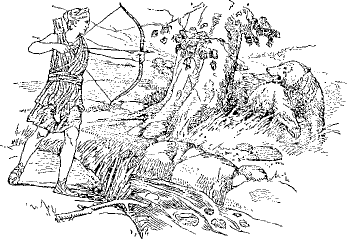
39. EXERCISES
First learn the special vocabulary, p. 283.
I. 1. Diāna est dea. 2. Lātōna est dea. 3. Diāna et Lātōna sunt deae. 4. Diāna est dea lūnae. 5. Diāna est fīlia Lātōnae. 6. Lātōna Diānam amat. 7. Diāna est dea silvārum. 8. Diāna silvam amat. 9. Diāna sagittās portat. 10. Diāna ferās silvae necat. 11. Ferae terrārum pugnant.
For the order of words imitate the Latin above.
II. 1. The daughter of Latona does love the forests. 2. Latona’s daughter carries arrows. 3. The farmers’ daughters do labor. 4. The farmer’s daughter loves the waters of the forest. 5. The sailor is announcing the girls’ flight. 6. The girls announce the sailors’ wrongs. 7. The farmer’s daughter labors. 8. Diana’s arrows are killing the wild beasts of the land.
40. CONVERSATION
Translate the questions and answer them in Latin. The answers may be found in the exercises preceding.
1. Quis est Diāna? 2. Cuius fīlia est Diāna? 3. Quis Diānam amat? 4. Quis silvam amat? 5. Quis sagittās portat? 6. Cuius fīliae labōrant?
LESSON V
FIRST PRINCIPLES (Continued)
41. The Dative Case. In addition to the relationships between words expressed by the nominative, genitive (possessive), and accusative (objective) cases, there are other relationships, to express which in English we use such words as from, with, by, to, for, in, at.1
Latin, too, makes frequent use of such prepositions; but often it expresses these relations without them by means of case forms which English does not possess. One of the cases found in the Latin declension and lacking in English is called the dative.
42. When the nominative singular ends in -a, the dative singular ends in -ae and the dative plural in -īs.
Note. Observe that the genitive singular, the dative singular, and the nominative plural all have the same ending, -ae; but the uses of the three cases are entirely different. The general meaning of the sentence usually makes clear which case is intended.
a. Form the dative singular and plural of the following nouns: fuga, causa, fortūna, terra, aqua, puella, agricola, nauta, domina.
43. The Dative Relation. The dative case is used to express the relations conveyed in English by the prepositions to, towards, for.
These prepositions are often used in English in expressions of motion, such as She went to town, He ran towards the horse, Columbus sailed for America. In such cases the dative is not used in Latin, as motion through space is foreign to the dative relation. But the dative is used to denote that to or towards which a benefit, injury, purpose, feeling, or quality is directed, or that for which something serves or exists.
a. What dative relations do you discover in the following?
The teacher gave a prize to John because he replied so promptly to all her questions—a good example for the rest of us. It is a pleasure to us to hear him recite. Latin is easy for him, but it is very hard for me. Some are fitted for one thing and others for another.
44. The Indirect Object. Examine the sentence
Nauta fugam nūntiat, the sailor announces the flight
Here the verb, nūntiat, governs the direct object, fugam, in the accusative case. If, however, we wish to mention the persons to whom the sailor announces the flight, as, The sailor announces the flight to the farmers, the verb will have two objects:
1. Its direct object, flight (fugam) 2. Its indirect object, farmers
According to the preceding section, to the farmers is a relation covered by the dative case, and we are prepared for the following rule:
45. Rule. Dative Indirect Object. The indirect object of a verb is in the Dative.
a. The indirect object usually stands before the direct object.
46. We may now complete the translation of the sentence The sailor announces the flight to the farmers, and we have
Nauta agricolīs fugam nūntiat
47. EXERCISES
First learn the special vocabulary, p. 283.
Point out the direct and indirect objects and the genitive of the possessor.
I. 1. Quis nautīs pecūniam dat? 2. Fīliae agricolae nautīs pecūniam dant. 3. Quis fortūnam pugnae nūntiat? 4. Galba agricolīs fortunam pugnae nūntiat. 5. Cui domina fābulam nārrat? 6. Fīliae agricolae domina fābulam nārrat. 7. Quis Diānae corōnam dat? 8. Puella Diānae corōnam dat quia Diānam amat. 9. Dea lūnae sagittās portat et ferās silvārum necat. 10. Cuius victōriam Galba nūntiat? 11. Nautae victōriam Galba nūntiat.
Imitate the word order of the preceding exercise.
II. 1. To whom do the girls give a wreath? 2. The girls give a wreath to Julia, because Julia loves wreaths. 3. The sailors tell the ladies2 a story, because the ladies love stories. 4. The farmer gives his (§ 22. a) daughter water. 5. Galba announces the cause of the battle to the sailor. 6. The goddess of the moon loves the waters of the forest. 7. Whose wreath is Latona carrying? Diana’s.
LESSON VI
FIRST PRINCIPLES (Continued)
48. The Ablative Case. Another case, lacking in English but found in the fuller Latin declension, is the ab´la-tive.
49. When the nominative singular ends in -a, the ablative singular ends in -ā and the ablative plural in -īs.
a. Observe that the final -ă of the nominative is short, while the final -ā of the ablative is long, as,
Nom. fīliă Abl. fīliā
b. Observe that the ablative plural is like the dative plural.
c. Form the ablative singular and plural of the following nouns: fuga, causa, fortūna, terra, aqua, puella, agricola, nauta, domina.
50. The Ablative Relation. The ablative case is used to express the relations conveyed in English by the prepositions from, with, by, at, in. It denotes
1. That from which something is separated, from which it starts, or of which it is deprived—generally translated by from.
2. That with which something is associated or by means of which it is done—translated by with or by.
3. The place where or the time when something happens—translated by in or at.
a. What ablative relations do you discover in the following?
In our class there are twenty boys and girls. Daily at eight o’clock they come from home with their books, and while they are at school they study Latin with great zeal. In a short time they will be able to read with ease the books written by the Romans. By patience and perseverance all things in this world can be overcome.
51. Prepositions. While, as stated above (§ 41), many relations expressed in English by prepositions are in Latin expressed by case forms, still prepositions are of frequent occurrence, but only with the accusative or ablative.
52. Rule. Object of a Preposition. A noun governed by a preposition must be in the Accusative or Ablative case.
53. Prepositions denoting the ablative relations from, with, in, on, are naturally followed by the ablative case. Among these are
ā1 or ab, from, away from dē, from, down from ē1 or ex, from, out from, out of cum, with in, in, on
1. Translate into Latin, using prepositions. In the water, on the land, down from the forest, with the fortune, out of the forests, from the victory, out of the waters, with the sailors, down from the moon.
54. Adjectives. Examine the sentence
Puella parva bonam deam amat, the little girl loves the good goddess
In this sentence parva (little) and bonam (good) are not nouns, but are descriptive words expressing quality. Such words are called adjectives,2 and they are said to belong to the noun which they describe.
You can tell by its ending to which noun an adjective belongs. The ending of parva shows that it belongs to puella, and the ending of bonam that it belongs to deam. Words that belong together are said to agree, and the belonging-together is called agreement. Observe that the adjective and its noun agree in number and case.
55. Examine the sentences
Puella est parva, the girl is little Puella parva bonam deam amat, the little girl loves the good goddess
In the first sentence the adjective parva is separated from its noun by the verb and stands in the predicate. It is therefore called a predicate adjective. In the second sentence the adjectives parva and bonam are closely attached to the nouns puella and deam respectively, and are called attributive adjectives.
a. Pick out the attributive and the predicate adjectives in the following:
Do you think Latin is hard? Hard studies make strong brains. Lazy students dislike hard studies. We are not lazy.
56. DIALOGUE
Julia and Galba
First learn the special vocabulary, p. 283.
I. Quis, Galba, est Diāna? G. Diāna, Iūlia, est pulchra dea lūnae et silvārum. I. Cuius fīlia, Galba, est Diāna? G. Lātōnae fīlia, Iūlia, est Diāna. I. Quid Diāna portat? G. Sagittās Diāna portat. I. Cūr Diāna sagittās portat? G. Diāna sagittās portat, Iūlia, quod malās ferās silvae magnae necat. I. Amatne Lātōna fīliam? G. Amat, et fīlia Lātōnam amat. I. Quid fīlia tua parva portat? G. Corōnās pulchrās fīlia mea parva portat. I. Cui fīlia tua corōnās pulchrās dat? G. Diānae corōnās dat. I. Quis est cum fīliā tuā? Estne sōla? G. Sōla nōn est; fīlia mea parva est cum ancillā meā.
a. When a person is called or addressed, the case used is called the voc´ative (Latin vocāre, “to call”). In form the vocative is regularly like the nominative. In English the name of the person addressed usually stands first in the sentence. The Latin vocative rarely stands first. Point out five examples of the vocative in this dialogue.
b. Observe that questions answered by yes or no in English are answered in Latin by repeating the verb. Thus, if you wished to answer in Latin the question Is the sailor fighting? Pugnatne nauta? you would say Pugnat, he is fighting, or Nōn pugnat, he is not fighting.
LESSON VII
THE FIRST OR Ā-DECLENSION
57. In the preceding lessons we have now gone over all the cases, singular and plural, of nouns whose nominative singular ends in -a. All Latin nouns whose nominative singular ends in -a belong to the First Declension. It is also called the Ā-Declension because of the prominent part which the vowel a plays in the formation of the cases. We have also learned what relations are expressed by each case. These results are summarized in the following table:
Case Noun Translation Use and General Meaning of Each Case
Singular
Nom. do´min-a the lady The subject
Gen. domin-ae of the lady, or the lady’s The possessor of something
Dat. domin-ae to or for the lady Expressing the relation to or for, especially the indirect object
Acc. domin-am the lady The direct object
Abl. domin-ā from, with, by, in, the lady Separation (from), association or means (with, by), place where or time when (in, at)
Plural
Nom. domin-ae the ladies The same as the singular
Gen. domin-ā´rum of the ladies, or the ladies’
Dat. domin-īs to or for the ladies
Acc. domin-ās the ladies
Abl. domin-īs from, with, by, in, the ladies
58. The Base. That part of a word which remains unchanged in inflection and to which the terminations are added is called the base.
Thus, in the declension above, domin- is the base and -a is the termination of the nominative singular.
59. Write the declension of the following nouns, separating the base from the termination by a hyphen. Also give them orally.
pugna, terra, lūna, ancil´la, corō´na, īn´sula, silva
60. Gender. In English, names of living beings are either masculine or feminine, and names of things without life are neuter. This is called natural gender. Yet in English there are some names of things to which we refer as if they were feminine; as, “Have you seen my yacht? She is a beauty.” And there are some names of living beings to which we refer as if they were neuter; as, “Is the baby here? No, the nurse has taken it home.” Some words, then, have a gender quite apart from sex or real gender, and this is called grammatical gender.
Latin, like English, has three genders. Names of males are usually masculine and of females feminine, but names of things have grammatical gender and may be either masculine, feminine, or neuter. Thus we have in Latin the three words, lapis, a stone; rūpēs, a cliff; and saxum, a rock. Lapis is masculine, rūpēs feminine, and saxum neuter. The gender can usually be determined by the ending of the word, and must always be learned, for without knowing the gender it is impossible to write correct Latin.
61. Gender of First-Declension Nouns. Nouns of the first declension are feminine unless they denote males. Thus silva is feminine, but nauta, sailor, and agricola, farmer, are masculine.
62. EXERCISES
First learn the special vocabulary, p. 284.
I. 1. Agricola cum fīliā in casā habitat. 2. Bona fīlia agricolae cēnam parat. 3. Cēna est grāta agricolae1 et agricola bonam fīliam laudat. 4. Deinde fīlia agricolae gallīnās ad cēnam vocat. 5. Gallīnae fīliam agricolae amant. 6. Malae fīliae bonās cēnās nōn parant. 7. Fīlia agricolae est grāta dominae. 8. Domina in īnsulā magnā habitat. 9. Domina bonae puellae parvae pecūniam dat.
II. 1. Where does the farmer live? 2. The farmer lives in the small cottage. 3. Who lives with the farmer? 4. (His) little daughter lives with the farmer. 5. (His) daughter is getting (parat) a good dinner for the farmer. 6. The farmer praises the good dinner. 7. The daughter’s good dinner is pleasing to the farmer.
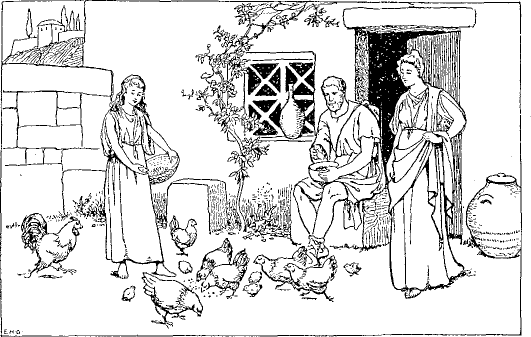
What Latin words are suggested by this picture?
63. CONVERSATION
Answer the questions in Latin.
1. Quis cum agricolā in casā habitat? 2. Quid bona fīlia agricolae parat? 3. Quem agricola laudat? 4. Vocatne fīlia agricolae gallīnās ad cēnam? 5. Cuius fīlia est grāta dominae? 6. Cui domina pecūniam dat?
LESSON VIII
FIRST DECLENSION (Continued)
64. We have for some time now been using adjectives and nouns together and you have noticed an agreement between them in case and in number (§ 54). They agree also in gender. In the phrase silva magna, we have a feminine adjective in -a agreeing with a feminine noun in -a.
65. Rule. Agreement of Adjectives. Adjectives agree with their nouns in gender, number, and case.
66. Feminine adjectives in -a are declined like feminine nouns in -a, and you should learn to decline them together as follows:
Noun Adjective
domina (base domin-), f., lady bona (base bon-), good
Singular TERMINATIONS
Nom. do´mina bona -a
Gen. dominae bonae -ae
Dat. dominae bonae -ae
Acc. dominam bonam -am
Abl. dominā bonā -ā
Plural TERMINATIONS
Nom. dominae bonae -ae
Gen. dominā´rum bonā´rum -ārum
Dat. dominīs bonīs -īs
Acc. dominās bonās -ās
Abl. dominīs bonīs -īs
a. In the same way decline together puella mala, the bad girl; ancil´la parva, the little maid; fortū´na magna, great fortune.
67. The words dea, goddess, and fīlia, daughter, take the ending -ābus instead of -īs in the dative and ablative plural. Note the dative and ablative plural in the following declension:
dea bona (bases de- bon-)
Singular Plural
Nom. dea bona deae bonae
Gen. deae bonae deā´rum bonā´rum
Dat. deae bonae deā´bus bonīs
Acc. deam bonam deās bonās
Abl. deā bonā dea´bus bonīs
a. In the same way decline together fīlīa parva.
68. Latin Word Order. The order of words in English and in Latin sentences is not the same.
In English we arrange words in a fairly fixed order. Thus, in the sentence My daughter is getting dinner for the farmers, we cannot alter the order of the words without spoiling the sentence. We can, however, throw emphasis on different words by speaking them with more force. Try the effect of reading the sentence by putting special force on my, daughter, dinner, farmers.
In Latin, where the office of the word in the sentence is shown by its ending (cf. § 32. 1), and not by its position, the order of words is more free, and position is used to secure the same effect that in English is secured by emphasis of voice. To a limited extent we can alter the order of words in English, too, for the same purpose. Compare the sentences
I saw a game of football at Chicago last November (normal order) Last November I saw a game of football at Chicago At Chicago, last November, I saw a game of football
1. In a Latin sentence the most emphatic place is the first; next in importance is the last; the weakest point is the middle. Generally the subject is the most important word, and is placed first; usually the verb is the next in importance, and is placed last. The other words of the sentence stand between these two in the order of their importance. Hence the normal order of words—that is, where no unusual emphasis is expressed—is as follows:
subject—modifiers of the subject—indirect object—direct object—adverb—verb
Changes from the normal order are frequent, and are due to the desire for throwing emphasis upon some word or phrase. Notice the order of the Latin words when you are translating, and imitate it when you are turning English into Latin.
2. Possessive pronouns and modifying genitives normally stand after their nouns. When placed before their nouns they are emphatic, as fīlia mea, my daughter; mea fīlia, my daughter; casa Galbae, Galba’s cottage; Galbae casa, Galba’s cottage.
Notice the variety of emphasis produced by writing the following sentence in different ways:
Fīlia mea agricolīs cēnam parat (normal order) Mea fīlia agricolīs parat cēnam (mea and cēnam emphatic) Agricolīs fīlia mea cēnam parat (agricolīs emphatic)
3. An adjective placed before its noun is more emphatic than when it follows. When great emphasis is desired, the adjective is separated from its noun by other words.
Fīlia mea casam parvam nōn amat (parvam not emphatic) Fīlia mea parvam casam nōn amat (parvam more emphatic) Parvam fīlia mea casam nōn amat (parvam very emphatic)
4. Interrogative words usually stand first, the same as in English.
5. The copula (as est, sunt) is of so little importance that it frequently does not stand last, but may be placed wherever it sounds well.
69. EXERCISE
First learn the special vocabulary, p. 284.
Note the order of the words in these sentences and pick out those that are emphatic.
1. Longae nōn sunt tuae viae. 2. Suntne tubae novae in meā casā? Nōn sunt. 3. Quis lātā in silvā habitat? Diāna, lūnae clārae pulchra dea, lātā in silvā habitat. 4. Nautae altās et lātās amant aquās. 5. Quid ancilla tua portat? Ancilla mea tubam novam portat. 6. Ubi sunt Lesbia et Iūlia? In tuā casa est Lesbia et Iūlia est in meā. 7. Estne Italia lāta terra? Longa est Italia, nōn lāta. 8. Cui Galba agricola fābulam novam nārrat? Fīliābus dominae clārae fābulam novam nārrat. 9. Clāra est īnsula Sicilia. 10. Quem laudat Lātōna? Lātōna laudat fīliam.
First Review of Vocabulary and Grammar, §§ 502-505
LESSON IX
THE SECOND OR O-DECLENSION
70. Latin nouns are divided into five declensions.
The declension to which a noun belongs is shown by the ending of the genitive singular. This should always be learned along with the nominative and the gender.
71. The nominative singular of nouns of the Second or O-Declension ends in -us, -er, -ir, or -um. The genitive singular ends in -ī.
72. Gender. Nouns in -um are neuter. The others are regularly masculine.
73. Declension of nouns in -us and -um. Masculines in -us and neuters in -um are declined as follows:
dominus (base domin-), m., master pīlum (base pīl-), n., spear
Singular
TERMINATIONS TERMINATIONS
Nom. do´minus1 -us pīlum -um
Gen. dominī -ī pīlī -ī
Dat. dominō -ō pīlō -ō
Acc. dominum -um pīlum -um
Abl. dominō -ō pīlō -ō
Voc. domine -e pīlum -um
Plural
Nom. dominī -ī pīla -a
Gen. dominō´rum -ōrum pīlō´rum -ōrum
Dat. dominīs -īs pīlīs -īs
Acc. dominōs -ōs pīla -a
Abl. dominīs -īs pīlīs -īs
a. Observe that the masculines and the neuters have the same terminations excepting in the nominative singular and the nominative and accusative plural.
b. The vocative singular of words of the second declension in -us ends in -ĕ, as domine, O master; serve, O slave. This is the most important exception to the rule in § 56. a.
74. Write side by side the declension of domina, dominus, and pīlum. A comparison of the forms will lead to the following rules, which are of great importance because they apply to all five declensions:
a. The vocative, with a single exception (see § 73. b), is like the nominative. That is, the vocative singular is like the nominative singular, and the vocative plural is like the nominative plural.
b. The nominative, accusative, and vocative of neuter nouns are alike, and in the plural end in -a.
c. The accusative singular of masculines and feminines ends in -m and the accusative plural in -s.
d. The dative and ablative plural are always alike.
e. Final -i and -o are always long; final -a is short, except in the ablative singular of the first declension.
75. Observe the sentences
Lesbia est bona, Lesbia is good Lesbia est ancilla, Lesbia is a maidservant
We have learned (§ 55) that bona, when used, as here, in the predicate to describe the subject, is called a predicate adjective. Similarly a noun, as ancilla, used in the predicate to define the subject is called a predicate noun.
76. Rule. Predicate Noun. A predicate noun agrees in case with the subject of the verb.
PILA

77. DIALOGUE

LEGATUS CUM PILO ET TUBA
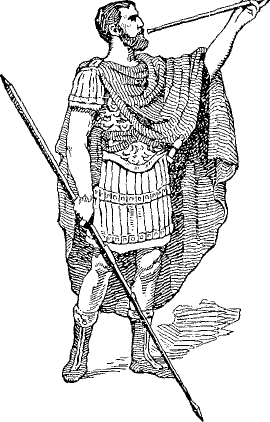
Galba and Marcus
First learn the special vocabulary, p. 285.
G. Quis, Mārce, est lēgātus cum pīlō et tubā? M. Lēgātus, Galba, est Sextus. G. Ubi Sextus habitat?2 M. In oppidō Sextus cum fīliābus habitat. G. Amantne oppidānī Sextum? M. Amant oppidānī Sextum et laudant, quod magnā cum cōnstantiā pugnat. G. Ubi, Mārce, est ancilla tua? Cūr nōn cēnam parat? M. Ancilla mea, Galba, equō lēgātī aquam et frūmentum dat. G. Cūr nōn servus Sextī equum dominī cūrat? M. Sextus et servus ad mūrum oppidī properant. Oppidānī bellum parant.3
habitat he lives he is living he does live
78. CONVERSATION
Translate the questions and answer them in Latin.
1. Ubi fīliae Sextī habitant? 2. Quem oppidānī amant et laudant? 3. Quid ancilla equō lēgātī dat? 4. Cuius equum ancilla cūrat? 5. Quis ad mūrum cum Sextō properat? 6. Quid oppidānī parant?
LESSON X
SECOND DECLENSION (Continued)
79. We have been freely using feminine adjectives, like bona, in agreement with feminine nouns of the first declension and declined like them. Masculine adjectives of this class are declined like dominus, and neuters like pīlum. The adjective and noun, masculine and neuter, are therefore declined as follows:
Masculine Noun and Adjective Neuter Noun and Adjective
dominus bonus, the good master pīlum bonum, the good spear
Bases domin- bon- Bases pīl- bon-
Singular
TERMINATIONS TERMINATIONS
Nom. do´minus bonus -us pīlum bonum -um
Gen. dominī bonī -ī pīlī bonī -ī
Dat. dominō bonō -ō pīlō bonō -ō
Acc. dominum bonum -um pīlum bonum -um
Abl. dominō bonō -ō pīlō bonō -ō
Voc. domine bone -e pīlum bonum -um
Plural
Nom. dominī bonī -ī pīla bona -a
Gen. dominō´rum bonō´rum -ōrum pīlō´rum bonō´rum -ōrum
Dat. dominīs bonīs -is pīlīs bonīs -īs
Acc. dominōs bonōs -ōs pīla bona -a
Abl. dominīs bonīs -īs pīlīs bonīs -īs
Decline together bellum longum, equus parvus, servus malus, mūrus altus, frūmentum novum.
80. Observe the sentences
Lesbia ancilla est bona, Lesbia, the maidservant, is good Fīlia Lesbiae ancillae est bona, the daughter of Lesbia, the maidservant, is good Servus Lesbiam ancillam amat, the slave loves Lesbia, the maidservant
In these sentences ancilla, ancillae, and ancillam denote the class of persons to which Lesbia belongs and explain who she is. Nouns so related that the second is only another name for the first and explains it are said to be in apposition, and are always in the same case.
81. Rule. Apposition. An appositive agrees in case with the noun which it explains.
82. EXERCISES
First learn the special vocabulary, p. 285.
I. 1. Patria servī bonī, vīcus servōrum bonōrum, bone popule. 2. Populus oppidī magnī, in oppidō magnō, in oppidīs magnīs. 3. Cum pīlīs longīs, ad pīla longa, ad mūrōs lātōs. 4. Lēgāte male, amīcī legātī malī, cēna grāta dominō bonō. 5. Frūmentum equōrum parvōrum, domine bone, ad lēgātōs clārōs. 6. Rhēnus est in Germāniā, patriā meā. 7. Sextus lēgātus pīlum longum portat. 8. Oppidānī bonī Sextō lēgātō clārā pecūniam dant. 9. Malī servī equum bonum Mārcī dominī necant. 10. Galba agricola et Iūlia fīlia bona labōrant. 11. Mārcus nauta in īnsulā Siciliā habitat.
II. 1. Wicked slave, who is your friend? Why does he not praise Galba, your master? 2. My friend is from (ex) a village of Germany, my fatherland. 3. My friend does not love the people of Italy. 4. Who is caring for1 the good horse of Galba, the farmer? 5. Mark, where is Lesbia, the maidservant? 6. She is hastening1 to the little cottage2 of Julia, the farmer’s daughter.
LESSON XI
ADJECTIVES OF THE FIRST AND SECOND DECLENSIONS
83. Adjectives of the first and second declensions are declined in the three genders as follows:
Singular
MASCULINE FEMININE NEUTER
Nom. bonus bona bonum
Gen. bonī bonae bonī
Dat. bonō bonae bonō
Acc. bonum bonam bonum
Abl. bonō bonā bonō
Voc. bone bona bonum
Plural
Nom. bonī bonae bona
Gen. bonōrum bonārum bonōrum
Dat. bonīs bonīs bonīs
Acc. bonōs bonās bona
Abl. bonīs bonīs bonīs
a. Write the declension and give it orally across the page, thus giving the three genders for each case.
b. Decline grātus, -a, -um; malus, -a, -um; altus, -a, -um; parvus, -a, -um.
84. Thus far the adjectives have had the same terminations as the nouns. However, the agreement between the adjective and its noun does not mean that they must have the same termination. If the adjective and the noun belong to different declensions, the terminations will, in many cases, not be the same. For example, nauta, sailor, is masculine and belongs to the first declension. The masculine form of the adjective bonus is of the second declension. Consequently, a good sailor is nauta bonus. So, the wicked farmer is agricola malus. Learn the following declensions:
85. nauta bonus (bases naut- bon-), m., the good sailor
Singular Plural
Nom. nauta bonus nautae bonī
Gen. nautae bonī nautārum bonōrum
Dat. nautae bonō nautīs bonīs
Acc. nautam bonum nautās bonōs
Abl. nautā bonō nautīs bonīs
Voc. nauta bone nautae bonī
86. EXERCISES
First learn the special vocabulary, p. 285.
I. 1. Est1 in vīcō nauta bonus. 2. Sextus est amīcus nautae bonī. 3. Sextus nautae bonō galeam dat. 4. Populus Rōmānus nautam bonum laudat. 5. Sextus cum nautā bonō praedam portat. 6. Ubi, nauta bone, sunt arma et tēla lēgātī Rōmānī? 7. Nautae bonī ad bellum properant. 8. Fāma nautārum bonōrum est clāra. 9. Pugnae sunt grātae nautīs bonīs. 10. Oppidānī nautās bonōs cūrant. 11. Cūr, nautae bonī, malī agricolae ad Rhēnum properant? 12. Malī agricolae cum bonīs nautīs pugnant.
II. 1. The wicked farmer is hastening to the village with (his) booty. 2. The reputation of the wicked farmer is not good. 3. Why does Galba’s daughter give arms and weapons to the wicked farmer? 4. Lesbia invites the good sailor to dinner. 5. Why is Lesbia with the good sailor hastening from the cottage? 6. Sextus, where is my helmet? 7. The good sailors are hastening to the toilsome battle. 8. The horses of the wicked farmers are small. 9. The Roman people give money to the good sailors. 10. Friends care for the good sailors. 11. Whose friends are fighting with the wicked farmers?
GALEAE

LESSON XII
NOUNS IN -IUS AND -IUM
87. Nouns of the second declension in -ius and -ium end in -ī in the genitive singular, not in -iī, and the accent rests on the penult; as, fīlī from fīlius (son), praesi´dī from praesi´dium (garrison).
88. Proper names of persons in -ius, and fīlius, end in -ī in the vocative singular, not in -ĕ, and the accent rests on the penult; as, Vergi´lī, O Vergil; fīlī, O son.
a. Observe that in these words the vocative and the genitive are alike.
89. praesidium (base praesidi-), n., garrison fīlius (base fīli-), m., son
Singular
Nom. praesidium fīlius
Gen. praesi´dī fīlī
Dat. praesidiō fīliō
Acc. praesidium fīlium
Abl. praesidiō fīliō
Voc. praesidium fīlī
The plural is regular. Note that the -i- of the base is lost only in the genitive singular, and in the vocative of words like fīlius.
Decline together praesidium parvum; fīlius bonus; fluvius longus, the long river; proelium clārum, the famous battle.
90. EXERCISES
First learn the special vocabulary, p. 285.
I. 1. Frūmentum bonae terrae, gladī malī, bellī longī. 2. Cōnstantia magna, praesidia magna, clāre Vergi´lī. 3. Male serve, Ō clārum oppidum, male fīlī, fīliī malī, fīlī malī. 4. Fluvī longī, fluviī longī, fluviōrum longōrum, fāma praesi´dī magnī. 5. Cum gladiīs parvīs, cum deābus clārīs, ad nautās clārōs. 6. Multōrum proeliōrum, praedae magnae, ad proelia dūra.
Germānia
II. Germānia, patria Germānōrum, est clāra terra. In Germāniā sunt fluviī multī. Rhēnus magnus et lātus fluvius Germāniae est. In silvīs lātīs Germāniae sunt ferae multae. Multi Germāni in oppidīs magnis et in vīcīs parvīs habitant et multī sunt agricolae bonī. Bella Germānōrum sunt magna et clāra. Populus Germāniae bellum et proelia amat et saepe cum finitimīs pugnat. Fluvius Rhēnus est fīnitimus oppidīs1 multīs et clārīs.
LESSON XIII
SECOND DECLENSION (Continued)
91. Declension of Nouns in -er and -ir. In early Latin all the masculine nouns of the second declension ended in -os. This -os later became -us in words like servus, and was dropped entirely in words with bases ending in -r, like puer, boy; ager, field; and vir, man. These words are therefore declined as follows:
92. puer, m., boy ager, m., field vir, m., man
Base puer- Base agr- Base vir-
Singular TERMINATIONS
Nom. puer ager vir ——
Gen. puerī agrī virī -ī
Dat. puerō agrō virō -ō
Acc. puerum agrum virum -um
Abl. puerō agrō virō -ō
Plural
Nom. puerī agrī virī -ī
Gen. puerōrum agrōrum virōrum -ōrum
Dat. puerīs agrīs virīs -īs
Acc. puerōs agrōs virōs -ōs
Abl. puerīs agrīs virīs -īs
a. The vocative case of these words is like the nominative, following the general rule (§ 74. a).
b. The declension differs from that of servus only in the nominative and vocative singular.
c. Note that in puer the e remains all the way through, while in ager it is present only in the nominative. In puer the e belongs to the base, but in ager (base agr-) it does not, and was inserted in the nominative to make it easier to pronounce. Most words in -er are declined like ager. The genitive shows whether you are to follow puer or ager.
93. Masculine adjectives in -er of the second declension are declined like nouns in -er. A few of them are declined like puer, but most of them like ager. The feminine and neuter nominatives show which form to follow, thus,
Masc. Fem. Neut.
līber lībera līberum (free) is like puer
pulcher pulchra pulchrum (pretty) is like ager
For the full declension in the three genders, see § 469. b. c.
94. Decline together the words vir līber, terra lībera, frūmentum līberum, puer pulcher, puella pulchra, oppidum pulchrum
95. Italia1
First learn the special vocabulary, p. 286.
Magna est Italiae fāma, patriae Rōmānōrum, et clāra est Rōma, domina orbis terrārum.2 Tiberim,3 fluvium Rōmānum, quis nōn laudat et pulchrōs fluviō fīnitimōs agrōs? Altōs mūrōs, longa et dūra bella, clārās victōriās quis nōn laudat? Pulchra est terra Italia. Agrī bonī agricolīs praemia dant magna, et equī agricolārum cōpiam frūmentī ad oppida et vīcōs portant. In agrīs populī Rōmānī labōrant multī servī. Viae Italiae sunt longae et lātae. Fīnitima Italiae est īnsula Sicilia.
96. DIALOGUE
Marcus and Cornelius
LEGIONARIUS
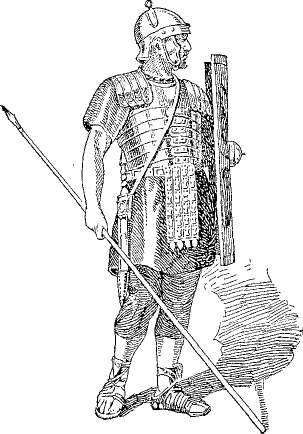
C. Ubi est, Mārce, fīlius tuus? Estne in pulchrā terrā Italiā? M. Nōn est, Cornēlī, in Italiā. Ad fluvium Rhēnum properat cum cōpiīs Rōmānīs quia est4 fāma Novī bellī cum Germānīs. Līber Germāniae populus Rōmānōs Nōn amat. C. Estne fīlius tuus copiārum Rōmānārum lēgātus? M. Lēgātus nōn est, sed est apud legiōnāriōs. C. Quae5 arma portat6? M. Scūtum magnum et lōrīcam dūram et galeam pulchram portat. C. Quae tēla portat? M. Gladium et pīlum longum portat. C. Amatne lēgātus fīlium tuum? M. Amat, et saepe fīliō meō praemia pulchra et praedam multam dat. C. Ubi est terra Germānōrum? M. Terra Germānōrum, Cornēlī est fīnitima Rhēnō, fluviō magnō et altō.
LESSON XIV
THE POSSESSIVE ADJECTIVE PRONOUNS
97. Observe the sentences
This is my shield This shield is mine
In the first sentence my is a possessive adjective; in the second mine is a possessive pronoun, for it takes the place of a noun, this shield is mine being equivalent to this shield is my shield. Similarly, in Latin the possessives are sometimes adjectives and sometimes pronouns.
98. The possessives my, mine, your, yours, etc. are declined like adjectives of the first and second declensions.
Singular
1st Pers. meus, mea, meum my, mine
2d Pers. tuus, tua, tuum your, yours
3d Pers. suus, sua, suum his (own), her (own), its (own)
Plural
1st Pers. noster, nostra, nostrum our, ours
2d Pers. vester, vestra, vestrum your, yours
3d Pers. suus, sua, suum their (own), theirs
Note. Meus has the irregular vocative singular masculine mī, as mī fīlī, O my son.
a. The possessives agree with the name of the thing possessed in gender, number, and case. Compare the English and Latin in
Sextus is calling his boy Julia is calling her boy Sextus Iūlia suum puerum vocat
Observe that suum agrees with puerum, and is unaffected by the gender of Sextus or Julia.
b. When your, yours, refers to one person, use tuus; when to more than one, vester; as,
Lesbia, your wreaths are pretty Girls, your wreaths are pretty Corōnae tuae, Lesbia, sunt pulchrae Corōnae vestrae, puellae, sunt pulchrae
c. Suus is a reflexive possessive, that is, it usually stands in the predicate and regularly refers back to the subject. Thus, Vir suōs servōs vocat means The man calls his (own) slaves. Here his (suōs) refers to man (vir), and could not refer to any one else.
d. Possessives are used much less frequently than in English, being omitted whenever the meaning is clear without them. (Cf. § 22. a.) This is especially true of suus, -a, -um, which, when inserted, is more or less emphatic, like our his own, her own, etc.
99. EXERCISES
First learn the special vocabulary, p. 286.
I. 1. Mārcus amīcō Sextō cōnsilium suum nūntiat 2. Est cōpia frūmentī in agrīs nostrīs. 3. Amīcī meī bonam cēnam ancillae vestrae laudant 4. Tua lōrīca, mī fīlī, est dūra. 5. Scūta nostra et tēla, mī amīce, in castrls Rōmānīs sunt. 6. Suntne virī patriae tuae līberī? Sunt. 7. Ubi, Cornēlī, est tua galea pulchra? 8. Mea galea, Sexte, est in casā meā. 9. Pīlum longum est tuum, sed gladius est meus. 10. Iūlia gallīnās suās pulchrās amat et gallīnae dominam suam amant. 11. Nostra castra sunt vestra. 12. Est cōpia praedae in castrīs vestrīs. 13. Amīcī tuī miserīs et aegrīs cibum et pecūniam saepe dant.
II. 1. Our teacher praises Mark’s industry. 2. My son Sextus is carrying his booty to the Roman camp.1 3. Your good girls are giving aid to the sick and wretched.2 4. There are 3 frequent battles in our villages. 5. My son, where is the lieutenant’s food? 6. The camp is mine, but the weapons are yours.
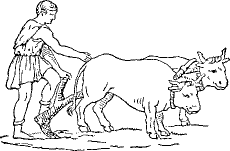
AGRICOLA ARAT
LESSON XV
THE ABLATIVE DENOTING WITH
100. Of the various relations denoted by the ablative case (§ 50) there is none more important than that expressed in English by the preposition with. This little word is not so simple as it looks. It does not always convey the same meaning, nor is it always to be translated by cum. This will become clear from the following sentences:
a. Mark is feeble with (for or because of) want of food b. Diana kills the beasts with (or by) her arrows c. Julia is with Sextus d. The men fight with great steadiness
a. In sentence a, with want (of food) gives the cause of Mark’s feebleness. This idea is expressed in Latin by the ablative without a preposition, and the construction is called the ablative of cause:
Mārcus est īnfīrmus inopiā cibī
b. In sentence b, with (or by) her arrows tells by means of what Diana kills the beasts. This idea is expressed in Latin by the ablative without a preposition, and the construction is called the ablative of means:
Diāna sagittīs suīs ferās necat
c. In sentence c we are told that Julia is not alone, but in company with Sextus. This idea is expressed in Latin by the ablative with the preposition cum, and the construction is called the ablative of accompaniment:
Iūlia est cum Sextō
d. In sentence d we are told how the men fight. The idea is one of manner. This is expressed in Latin by the ablative with cum, unless there is a modifying adjective present, in which case cum may be omitted. This construction is called the ablative of manner:
Virī (cum) cōnstantiā magnā pugnant
101. You are now able to form four important rules for the ablative denoting with:
102. Rule. Ablative of Cause. Cause is denoted by the ablative without a preposition. This answers the question Because of what?
103. Rule. Ablative of Means. Means is denoted by the ablative without a preposition. This answers the question By means of what? With what?
N.B. Cum must never be used with the ablative expressing cause or means.
104. Rule. Ablative of Accompaniment. Accompaniment is denoted by the ablative with cum. This answers the question With whom?
105. Rule. Ablative of Manner. The ablative with cum is used to denote the manner of an action. Cum may be omitted, if an adjective is used with the ablative. This answers the question How? In what manner?
106. What uses of the ablative do you discover in the following passage, and what question does each answer?
The soldiers marched to the fort with great speed and broke down the gate with blows of their muskets. The inhabitants, terrified by the din, attempted to cross the river with their wives and children, but the stream was swollen with (or by) the rain. Because of this many were swept away by the waters and only a few, almost overcome with fatigue, with great difficulty succeeded in gaining the farther shore.
107. EXERCISES
First learn the special vocabulary, p. 286.
I. The Romans prepare for War. Rōmānī, clārus Italiae populus, bellum parant. Ex agrīs suīs, vicīs, oppidīsque magnō studiō virī validī ad arma properant. Iam lēgatī cum legiōnariīs ex Italiā ad Rhēnum, fluvium Germāniae altum et lātum, properant, et servī equīs et carrīs cibum frūmentumque ad castra Rōmāna portant. Inopiā bonōrum tēlōrum īnfirmī sunt Germānī, sed Rōmānī armāti galeīs, lōrīcīs, scūtīs, gladiīs, pīlīsque sunt validī.
II. 1. The sturdy farmers of Italy labor in the fields with great diligence. 2. Sextus, the lieutenant, and (his) son Mark are fighting with the Germans. 3. The Roman legionaries are armed with long spears. 4. Where is Lesbia, your maid, Sextus? Lesbia is with my friends in Galba’s cottage. 5. Many are sick because of bad water and for lack of food. 6. The Germans, with (their) sons and daughters, are hastening with horses and wagons.
LESSON XVI
THE NINE IRREGULAR ADJECTIVES
108. There are nine irregular adjectives of the first and second declensions which have a peculiar termination in the genitive and dative singular of all genders:
Masc. Fem. Neut.
Gen. -īus -īus -īus
Dat. -ī -ī -ī
Otherwise they are declined like bonus, -a, -um. Learn the list and the meaning of each:
alius, alia, aliud, other, another (of several) alter, altera, alterum, the one, the other (of two) ūnus, -a, -um, one, alone; (in the plural) only ūllus, -a, -um, any nūllus, -a, -um, none, no sōlus, -a, -um, alone tōtus, -a, -um, all, whole, entire uter, utra, utrum, which? (of two) neuter, neutra, neutrum, neither (of two)
109. PARADIGMS
Singular
MASC. FEM. NEUT. MASC. FEM. NEUT.
Nom. nūllus nūlla nūllum alius alia aliud
Gen. nūllī´us nūllī´us nūllī´us alī´us alī´us alī´us
Dat. nūllī nūllī nūllī aliī aliī aliī
Acc. nūllum nūllam nūllum alium aliam aliud
Abl. nūllō nūllā nūllō aliō aliā aliō
The Plural is Regular
a. Note the peculiar neuter singular ending in -d of alius. The genitive alīus is rare. Instead of it use alterīus, the genitive of alter.
b. These peculiar case endings are found also in the declension of pronouns (see § 114). For this reason these adjectives are sometimes called the pronominal adjectives.
110. Learn the following idioms:
alter, -era, -erum ... alter, -era, -erum, the one ... the other (of two) alius, -a, -ud ... alius, -a, -ud, one ... another (of any number) aliī, -ae, -a ... aliī, -ae, -a, some ... others
EXAMPLES
1. Alterum oppidum est magnum, alterum parvum, the one town is large, the other small (of two towns).
2. Aliud oppidum est validum, aliud īnfīrmum, one town is strong, another weak (of towns in general).
3. Aliī gladiōs, aliī scūta portant, some carry swords, others shields.
111. EXERCISES
I. 1. In utrā casā est Iūlia? Iūlia est in neutrā casā. 2. Nūllī malō puerō praemium dat magister. 3. Alter puer est nauta, alter agricola. 4. Aliī virī aquam, aliī terram amant. 5. Galba ūnus (or sōlus) cum studiō labōrat. 6. Estne ūllus carrus in agrō meō? 7. Lesbia est ancilla alterīus dominī, Tullia alterīus. 8. Lesbia sōla cēnam parat. 9. Cēna nūllīus alterīus ancillae est bona. 10. Lesbia nūllī aliī virō cēnam dat.
Note. The pronominal adjectives, as you observe, regularly stand before and not after their nouns.
II. 1. The men of all Germany are preparing for war. 2. Some towns are great and others are small. 3. One boy likes chickens, another horses. 4. Already the booty of one town is in our fort. 5. Our whole village is suffering for (i.e. weak because of) lack of food. 6. The people are already hastening to the other town. 7. Among the Romans (there) is no lack of grain.
LESSON XVII
THE DEMONSTRATIVE IS, EA, ID
112. A demonstrative is a word that points out an object definitely, as this, that, these, those. Sometimes these words are pronouns, as, Do you hear these? and sometimes adjectives, as, Do you hear these men? In the former case they are called demonstrative pronouns, in the latter demonstrative adjectives.
113. Demonstratives are similarly used in Latin both as pronouns and as adjectives. The one used most is
is, masculine; ea, feminine; id, neuter
Singular this that Plural these those
114. Is is declined as follows. Compare its declension with that of alius, § 109.
Base e-
Singular Plural
MASC. FEM. NEUT. MASC. FEM. NEUT.
Nom. is ea id eī (or iī) eae ea
Gen. eius eius eius eōrum eārum eōrum
Dat. eī eī eī eīs (or iīs) eīs (or iīs) eīs (or iīs)
Acc. eum eam id eōs eās ea
Abl. eō eā eō eīs (or iīs) eīs (or iīs) eīs (or iīs)
Note that the base e- changes to i- in a few cases. The genitive singular eius is pronounced eh´yus. In the plural the forms with two i’s are preferred and the two i’s are pronounced as one. Hence, pronounce iī as ī and iīs as īs.
115. Besides being used as demonstrative pronouns and adjectives the Latin demonstratives are regularly used for the personal pronoun he, she, it. As a personal pronoun, then, is would have the following meanings:
Sing. Nom. is, he; ea, she; id, it
Gen. eius, of him or his; eius, of her, her, or hers; eius, of it or its
Dat. eī, to or for him; eī, to or for her; eī, to or for it
Acc. eum, him; eam, her; id, it
Abl. eō, with, from, etc., him; eā, with, from, etc., her; eō, with, from, etc., it
Plur. Nom. eī or iī, eae, ea, they
Gen. eōrum, eārum, eōrum, of them, their
Dat. eīs or iīs, eīs or iīs, eīs or iīs, to or for them
Acc. eōs, eās, ea, them
Abl. eīs or iīs, eīs or iīs, eīs or iīs, with, from, etc., them
116. Comparison between suus and is. We learned above (§ 98. c) that suus is a reflexive possessive. When his, her (poss.), its, their, do not refer to the subject of the sentence, we express his, her, its by eius, the genitive singular of is, ea, id; and their by the genitive plural, using eōrum to refer to a masculine or neuter antecedent noun and eārum to refer to a feminine one.
EXAMPLES
Galba calls his (own) son, Galba suum fīlium vocat Galba calls his son (not his own, but another’s), Galba eius fīlium vocat Julia calls her (own) children, Iūlia suōs līberōs vocat Julia calls her children (not her own, but another’s), Iūlia eius līberōs vocat The men praise their (own) boys, virī suōs puerōs laudant The men praise their boys (not their own, but others’), virī eōrum puerōs laudant
117. EXERCISES
First learn the special vocabulary, p. 287.
1. He praises her, him, it, them. 2. This cart, that report, these teachers, those women, that abode, these abodes. 3. That strong garrison, among those weak and sick women, that want of firmness, those frequent plans.
4. The other woman is calling her chickens (her own). 5. Another woman is calling her chickens (not her own). 6. The Gaul praises his arms (his own). 7. The Gaul praises his arms (not his own). 8. This farmer often plows their fields. 9. Those wretched slaves long for their master (their own). 10. Those wretched slaves long for their master (not their own). 11. Free men love their own fatherland. 12. They love its villages and towns.
118. DIALOGUE1
Cornelius and Marcus
M. Quis est vir, Cornēlī, cum puerō parvō? Estne Rōmānus et līber? C. Rōmānus nōn est, Mārce. Is vir est servus et eius domicilium est in silvīs Galliae. M. Estne puer fīlius eius servī an alterīus? C. Neutrīus fīlius est puer. Is est fīlius lēgātī Sextī. M. Quō puer cum eō servō properat? C. Is cum servō properat ad lātōs Sextī agrōs.2 Tōtum frūmentum est iam mātūrum et magnus servōrum numerus in Italiae3 agrīs labōrat. M. Agricolaene sunt Gallī et patriae suae agrōs arant? C. Nōn agricolae sunt. Bellum amant Gallī, nōn agrī cultūram. Apud eōs virī pugnant et fēminae auxiliō līberōrum agrōs arant parantque cibum. M. Magister noster puerīs puellīsque grātās Gallōrum fābulās saepe nārrat et laudat eōs saepe. C. Mala est fortūna eōrum et saepe miserī servī multīs cum lacrimīs patriam suam dēsīderant.
Second Review, Lessons IX-XVII, §§ 506-509
LESSON XVIII
CONJUGATION
THE PRESENT, IMPERFECT, AND FUTURE TENSES OF SUM
119. The inflection of a verb is called its conjugation (cf. § 23). In English the verb has but few changes in form, the different meanings being expressed by the use of personal pronouns and auxiliaries, as, I am carried, we have carried, they shall have carried, etc. In Latin, on the other hand, instead of using personal pronouns and auxiliary verbs, the form changes with the meaning. In this way the Romans expressed differences in tense, mood, voice, person, and number.
120. The Tenses. The different forms of a verb referring to different times are called its tenses. The chief distinctions of time are present, past, and future:
1. The present, that is, what is happening now, or what usually happens, is expressed by the Present Tense
2. The past, that is, what was happening, used to happen, happened, has happened, or had happened, is expressed by the Imperfect, Perfect, and Pluperfect Tenses
3. The future, that is, what is going to happen, is expressed by the Future and Future Perfect Tenses
121. The Moods. Verbs have inflection of mood to indicate the manner in which they express action. The moods of the Latin verb are the indicative, subjunctive, imperative, and infinitive.
a. A verb is in the indicative mood when it makes a statement or asks a question about something assumed as a fact. All the verbs we have used thus far are in the present indicative.
122. The Persons. There are three persons, as in English. The first person is the person speaking (I sing); the second person the person spoken to (you sing); the third person the person spoken of (he sings). Instead of using personal pronouns for the different persons in the two numbers, singular and plural, the Latin verb uses the personal endings (cf. § 22 a; 29). We have already learned that -t is the ending of the third person singular in the active voice and -nt of the third person plural. The complete list of personal endings of the active voice is as follows:
Singular Plural
1st Pers. I -m or -ō we -mus
2d Pers. thou or you -s you -tis
3d Pers. he, she, it -t they -nt
123. Most verbs form their moods and tenses after a regular plan and are called regular verbs. Verbs that depart from this plan are called irregular. The verb to be is irregular in Latin as in English. The present, imperfect, and future tenses of the indicative are inflected as follows:
Present Indicative
SINGULAR PLURAL
1st Pers. su-m, I am su-mus, we are
2d Pers. e-s, you1 are es-tis, you1 are
3d Pers. es-t, he, she, or it is su-nt, they are
Imperfect Indicative
1st Pers. er-a-m, I was er-ā´-mus, we were
2d Pers. er-ā-s, you were er-ā´-tis, you were
3d Pers. er-a-t, he, she, or it was er-a-nt, they were
Future Indicative
1st Pers. er-ō, I shall be er´-i-mus, we shall be
2d Pers. er-i-s, you will be er´-i-tis, you will be
3d Pers. er-i-t, he will be er-u-nt, they will be
a. Be careful about vowel quantity and accent in these forms, and consult §§ 12.2; 14; 15.
124. DIALOGUE
The Boys Sextus and Marcus
First learn the special vocabulary, p. 287.
S. Ubi es, Mārce? Ubi est Quīntus? Ubi estis, amīcī? M. Cum Quīntō, Sexte, in silvā sum. Nōn sōlī sumus; sunt in silvā multī aliī puerī. S. Nunc laetus es, sed nūper nōn laetus erās. Cūr miser erās? M. Miser eram quia amīcī meī erant in aliō vicō et eram sōlus. Nunc sum apud sociōs meōs. Nunc laetī sumus et erimus. S. Erātisne in lūdo hodiē? M. Hodiē nōn erāmus in lūdō, quod magister erat aeger. S. Eritisne mox in lūdō? M. Amīcī meī ibi erunt, sed ego (I) nōn erō. S. Cūr nōn ibi eris? Magister, saepe irātus, inopiam tuam studī dīligentiaeque nōn laudat. M. Nūper aeger eram et nunc īnfīrmus sum.
125. EXERCISE
1. You are, you were, you will be, (sing. and plur.). 2. I am, I was, I shall be. 3. He is, he was, he will be. 4. We are, we were, we shall be. 5. They are, they were, they will be.
6. Why were you not in school to-day? I was sick. 7. Lately he was a sailor, now he is a farmer, soon he will be a teacher. 8. To-day I am happy, but lately I was wretched. 9. The teachers were happy because of the boys’ industry.
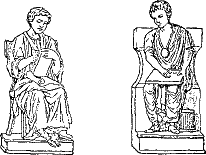
PUERI ROMANI IN LUDO
LESSON XIX
THE FOUR REGULAR CONJUGATIONS · PRESENT ACTIVE INDICATIVE OF AMŌ AND MONEŌ
126. There are four conjugations of the regular verbs. These conjugations are distinguished from each other by the final vowel of the present conjugation-stem.1 This vowel is called the distinguishing vowel, and is best seen in the present infinitive.
Below is given the present infinitive of a verb of each conjugation, the present stem, and the distinguishing vowel.
Conjugation Pres. Infin. Pres. Stem DISTINGUISHING VOWEL
I. amā´re, to love amā- ā
II. monē´re, to advise monē- ē
III. re´gĕre, to rule regĕ- ĕ
IV. audī´re, to hear audi- ī
a. Note that the present stem of each conjugation is found by dropping -re, the ending of the present infinitive.
Note. The present infinitive of sum is esse, and es- is the present stem.
127. From the present stem are formed the present, imperfect, and future tenses.
128. The inflection of the Present Active Indicative of the first and of the second conjugation is as follows:
a´mō, amā´re (love) mo´neō, monē´re (advise)
Pres. Stem amā- Pres. Stem monē- PERSONAL ENDINGS
Sing. 1. a´mō, I love mo´neō, I advise -ō
2. a´mās, you love mo´nēs, you advise -s
3. a´mat, he (she, it) loves mo´net, he (she, it) advises -t
Plur. 1. amā´mus, we love monē´mus, we advise -mus
2. amā´tis, you love monē´tis, you advise -tis
3. a´mant, they love mo´nent, they advise -nt
1. The present tense is inflected by adding the personal endings to the present stem, and its first person uses -o and not -m. The form amō is for amā-ō, the two vowels ā-ō contracting to ō. In moneō there is no contraction. Nearly all regular verbs ending in -eo belong to the second conjugation.
2. Note that the long final vowel of the stem is shortened before another vowel (monē-ō = mo´nĕō), and before final -t (amăt, monĕt) and -nt (amănt, monĕnt). Compare § 12. 2.
129. Like amō and moneō inflect the present active indicative of the following verbs2:
Indicative Present Infinitive Present
a´rō, I plow arā´re, to plow
cū´rō, I care for cūrā´re, to care for
*dē´leō, I destroy dēlē´re, to destroy
dēsī´derō, I long for dēsīderā´re, to long for
dō,3 I give da´re, to give
*ha´beō, I have habē´re, to have
ha´bitō, I live, I dwell habitā´re, to live, to dwell
*iu´beō, I order iubē´re, to order
labō´rō, I labor labōrā´re, to labor
lau´dō, I praise laudā´re, to praise
mātū´rō, I hasten mātūrā´re, to hasten
*mo´veō, I move movē´re, to move
nār´rō, I tell nārrā´re, to tell
ne´cō, I kill necā´re, to kill
nūn´tiō, I announce nūntiā´re, to announce
pa´rō, I prepare parā´re, to prepare
por´tō, I carry portā´re, to carry
pro´perō, I hasten properā´re, to hasten
pug´nō, I fight pugnā´re, to fight
*vi´deō, I see vidē´re, to see
vo´cō, I call vocā´re, to call
130. The Translation of the Present. In English there are three ways of expressing present action. We may say, for example, I live, I am living, or I do live. In Latin the one expression habitō covers all three of these expressions.
131. EXERCISES
Give the voice, mood, tense, person, and number of each form.
I. 1. Vocāmus, properātis, iubent. 2. Movētis, laudās, vidēs. 3. Dēlētis, habētis, dant. 4. Mātūrās, dēsīderat, vidēmus. 5. Iubet, movent, necat. 6. Nārrāmus, movēs, vident. 7. Labōrātis, properant, portās, parant. 8. Dēlet, habētis, iubēmus, dās.
N.B. Observe that the personal ending is of prime importance in translating a Latin verb form. Give that your first attention.
II. 1. We plow, we are plowing, we do plow. 2. They care for, they are caring for, they do care for. 3. You give, you are having, you do have (sing.). 4. We destroy, I do long for, they are living. 5. He calls, they see, we are telling. 6. We do fight, we order, he is moving, he prepares. 7. They are laboring, we kill, you announce.
LESSON XX
IMPERFECT ACTIVE INDICATIVE OF AMŌ AND MONEŌ
132. Tense Signs. Instead of using auxiliary verbs to express differences in tense, like was, shall, will, etc., Latin adds to the verb stem certain elements that have the force of auxiliary verbs. These are called tense signs.
133. Formation and Inflection of the Imperfect. The tense sign of the imperfect is -bā-, which is added to the present stem. The imperfect consists, therefore, of three parts:
Present Stem Tense Sign PERSONAL ENDING
amā- ba- m
loving was I
The inflection is as follows:
Conjugation I Conjugation II
SINGULAR PERSONAL ENDINGS
1. amā´bam, I was loving monē´bam, I was advising -m
2. amā´bās, you were loving monē´bās, you were advising -s
3. amā´bat, he was loving monē´bat, he was advising -t
PLURAL
1. amābā´mus, we were loving monēbā´mus, we were advising -mus
2. amābā´tis, you were loving monēbā´tis, you were advising -tis
3. amā´bant, they were loving monē´bant, they were advising -nt
a. Note that the ā of the tense sign -bā- is shortened before -nt, and before m and t when final. (Cf. § 12. 2.)
In a similar manner inflect the verbs given in § 129.
134. Meaning of the Imperfect. The Latin imperfect describes an act as going on or progressing in past time, like the English past-progressive tense (as, I was walking). It is the regular tense used to describe a past situation or condition of affairs.
135. EXERCISES
I. 1. Vidēbāmus, dēsīderābat, mātūrābās. 2. Dabant, vocābātis, dēlēbāmus. 3. Pugnant, laudābās, movēbātis. 4. Iubēbant, properābātis, portābāmus. 5. Dabās, nārrābant, labōrābātis. 6. Vidēbant, movēbās, nūntiābāmus. 7. Necābat, movēbam, habēbat, parābātis.
II. 1. You were having (sing. and plur.), we were killing, they were laboring. 2. He was moving, we were ordering, we were fighting. 3. We were telling, they were seeing, he was calling. 4. They were living, I was longing for, we were destroying. 5. You were giving, you were moving, you were announcing, (sing. and plur.). 6. They were caring for, he was plowing, we were praising.
136. Ni´obe and her Children
First learn the special vocabulary, p. 287.
Niobē, rēgina Thēbānōrum, erat pulchra fēmina sed superba. Erat superba nōn sōlum fōrmā1 suā marītīque potentiā1 sed etiam magnō līberōrum numerō.1 Nam habēbat2 septem fīliōs et septem fīliās. Sed ea superbia erat rēgīnae3 causa magnae trīstitiae et līberīs3 causa dūrae poenae.
Note. The words Niobē, Thēbānōrum, and marītī will be found in the general vocabulary. Translate the selection without looking up any other words.
LESSON XXI
FUTURE ACTIVE INDICATIVE OF AMŌ AND MONEŌ
137. The tense sign of the Future Indicative in the first and second conjugations is -bi-. This is joined to the present stem of the verb and followed by the personal ending, as follows:
Present Stem Tense Sign PERSONAL ENDING
amā- bi- s
love will you
138. The Future Active Indicative is inflected as follows.
Conjugation I Conjugation II
SINGULAR
1. amā´bō, I shall love monē´bō, I shall advise
2. amā´bis, you will love monē´bis, you will advise
3. amā´bit, he will love monē´bit, he will advise
PLURAL
1. amā´bimus, we shall love monē´bimus, we shall advise
2. amā´bitis will love monē´bitis, you will advise
3. amā´bunt, they will love monē´bunt, they will advise
a. The personal endings are as in the present. The ending -bō in the first person singular is contracted from -bi-ō. The -bi- appears as -bu- in the third person plural. Note that the inflection is like that of erō, the future of sum. Pay especial attention to the accent.
In a similar manner inflect the verbs given in § 129.
139. EXERCISES
I. 1. Movēbitis, laudābis, arābō. 2. Dēlēbitis, vocābitis, dabunt. 3. Mātūrābis, dēsīderābit, vidēbimus. 4. Habēbit, movēbunt, necābit. 5. Nārrābimus, monēbis, vidēbunt. 6. Labōrābitis, cūrābunt, dabis. 7. Habitābimus, properābitis, iubēbunt, parābit. 8. Nūntiābō, portābimus, iubēbō.
II. 1. We shall announce, we shall see, I shall hasten. 2. I shall carry, he will plow, they will care for. 3. You will announce, you will move, you will give, (sing. and plur.). 4. We shall fight, we shall destroy, I shall long for. 5. He will call, they will see, you will tell (plur.). 6. They will dwell, we shall order, he will praise. 7. They will labor, we shall kill, you will have (sing. and plur.), he will destroy.
140. Niobe and her Children (Concluded)
First learn the special vocabulary, p. 288.
Apollō et Diāna erant līberī Lātōnae. Iīs Thēbānī sacra crēbra parābant.1 Oppidānī amābant Lātōnam et līberōs eius. Id superbae rēgīnae erat molestum. “Cūr,” inquit, “Lātōnae et līberīs sacra parātis? Duōs līberōs habet Lātōna; quattuordecim habeō ego. Ubi sunt mea sacra?” Lātōna iīs verbīs2 īrāta līberōs suōs vocat. Ad eam volant Apollō Diānaque et sagittīs3 suīs miserōs līberōs rēgīnae superbae dēlent. Niobē, nūper laeta, nunc misera, sedet apud līberōs interfectōs et cum perpetuīs lacrimīs4 eōs dēsīderat.
Note. Consult the general vocabulary for Apollō, inquit, duōs, and quattuordecim. Try to remember the meaning of all the other words.
LESSON XXII
REVIEW OF VERBS · THE DATIVE WITH ADJECTIVES
141. Review the present, imperfect, and future active indicative, both orally and in writing, of sum and the verbs in § 129.
142. We learned in § 43 for what sort of expressions we may expect the dative, and in § 44 that one of its commonest uses is with verbs to express the indirect object. It is also very common with adjectives to express the object toward which the quality denoted by the adjective is directed. We have already had a number of cases where grātus, agreeable to, was so followed by a dative; and in the last lesson we had molestus, annoying to, followed by that case. The usage may be more explicitly stated by the following rule:
143. Rule. Dative with Adjectives. The dative is used with adjectives to denote the object toward which the given quality is directed. Such are, especially, those meaning near, also fit, friendly, pleasing, like, and their opposites.
144. Among such adjectives memorize the following:
idōneus, -a, -um, fit, suitable (for) amīcus, -a, -um, friendly (to) inimīcus, -a, -um, hostile (to) grātus, -a, -um, pleasing (to), agreeable (to) molestus, -a, -um, annoying (to), troublesome (to) fīnitimus, -a, -um, neighboring (to) proximus, -a, -um, nearest, next (to)
145. EXERCISES
I. 1. Rōmānī terram idōneam agrī cultūrae habent. 2. Gallī cōpiīs Rōmānīs inimīcī erant. 3. Cui dea Lātōna amīca non erat? 4. Dea Lātōna superbae rēgīnae amīca nōn erat. 5. Cibus noster, Mārce, erit armātīs virīs grātus. 6. Quid erat molestum populīs Italiae? 7. Bella longa cum Gallīs erant molesta populīs Italiae. 8. Agrī Germānōrum fluviō Rhēnō fīnitimī erant. 9. Rōmānī ad silvam oppidō proximam castra movēbant. 10. Nōn sōlum fōrma sed etiam superbia rēgīnae erat magna. 11. Mox rēgīna pulchra erit aegra trīstitiā. 12. Cūr erat Niobē, rēgīna Thēbānōrum, laeta? Laeta erat Niobē multīs fīliīs et fīliābus.
II. 1. The sacrifices of the people will be annoying to the haughty queen. 2. The sacrifices were pleasing not only to Latona but also to Diana. 3. Diana will destroy those hostile to Latona. 4. The punishment of the haughty queen was pleasing to the goddess Diana. 5. The Romans will move their forces to a large field1 suitable for a camp. 6. Some of the allies were friendly to the Romans, others to the Gauls.
146. Cornelia and her Jewels
First learn the special vocabulary, p. 288.
Apud antīquās dominās, Cornēlia, Āfricānī fīlia, erat2 maximē clāra. Fīliī eius erant Tiberius Gracchus et Gāius Gracchus. Iī puerī cum Cornēliā in oppidō Rōmā, clārō Italiae oppidō, habitābant. Ibi eōs cūrābat Cornēlia et ibi magnō cum studiō eōs docēbat. Bona fēmina erat Cornēlia et bonam disciplīnam maximē amābat.
Note. Can you translate the paragraph above? There are no new words.
LESSON XXIII
PRESENT ACTIVE INDICATIVE OF REGŌ AND AUDIŌ
147. As we learned in § 126, the present stem of the third conjugation ends in -ĕ, and of the fourth in -ī. The inflection of the Present Indicative is as follows:
Conjugation III Conjugation IV
re´gō, re´gere (rule) au´diō, audī´re (hear)
Pres. Stem regĕ- Pres. Stem audī-
SINGULAR
1. re´gō, I rule au´diō, I hear
2. re´gis, you rule au´dīs, you hear
3. re´git, he (she, it) rules au´dit, he (she, it) hears
PLURAL
1. re´gimus, we rule audī´mus, we hear
2. re´gitis, you rule audī´tis, you hear
3. re´gunt, they rule au´diunt, they hear
1. The personal endings are the same as before.
2. The final short -e- of the stem regĕ- combines with the -ō in the first person, becomes -u- in the third person plural, and becomes -ĭ- elsewhere. The inflection is like that of erō, the future of sum.
3. In audiō the personal endings are added regularly to the stem audī-. In the third person plural -u- is inserted between the stem and the personal ending, as audi-u-nt. Note that the long vowel of the stem is shortened before final -t just as in amō and moneō. (Cf. § 12. 2.)
Note that -i- is always short in the third conjugation and long in the fourth, excepting where long vowels are regularly shortened. (Cf. § 12. 1, 2.)
148. Like regō and audiō inflect the present active indicative of the following verbs:
Indicative Present Infinitive Present
agō, I drive agere, to drive
dīcō, I say dīcere, to say
dūcō, I lead dūcere, to lead
mittō, I send mittere, to send
mūniō, I fortify mūnīre, to fortify
reperiō, I find reperīre, to find
veniō, I come venīre, to come
149. EXERCISES
I. 1. Quis agit? Cūr venit? Quem mittit? Quem dūcis? 2. Quid mittunt? Ad quem veniunt? Cuius castra mūniunt? 3. Quem agunt? Venīmus. Quid puer reperit? 4. Quem mittimus? Cuius equum dūcitis? Quid dīcunt? 5. Mūnīmus, venītis, dīcit. 6. Agimus, reperītis, mūnīs. 7. Reperis, ducitis, dīcis. 8. Agitis, audimus, regimus.
II. 1. What do they find? Whom do they hear? Why does he come? 2. Whose camp are we fortifying? To whom does he say? What are we saying? 3. I am driving, you are leading, they are hearing. 4. You send, he says, you fortify (sing. and plur.). 5. I am coming, we find, they send. 6. They lead, you drive, he does fortify. 7. You lead, you find, you rule, (all plur.).
150. Cornelia and her Jewels (Concluded)
Proximum domicīliō Cornēliae erat pulchrae Campānae domicilium. Campāna erat superba nōn sōlum fōrmā suā sed maximē ōrnāmentīs suīs. Ea1 laudābat semper. “Habēsne tū ūlla ornāmenta, Cornēlia?” inquit. “Ubi sunt tua ōrnāmenta?” Deinde Cornēlia fīliōs suōs Tiberium et Gāium vocat. “Puerī meī,” inquit, “sunt mea ōrnāmenta. Nam bonī līberī sunt semper bonae fēminae ōrnāmenta maximē clāra.”
Note. The only new words here are Campāna, semper, and tū.
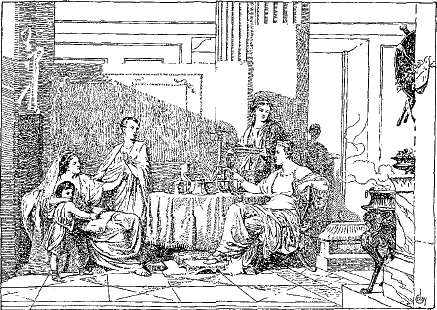
“PUERI MEI SUNT MEA ORNAMENTA”
LESSON XXIV
IMPERFECT ACTIVE INDICATIVE OF REGŌ AND AUDIŌ · THE DATIVE WITH SPECIAL INTRANSITIVE VERBS
151. PARADIGMS
Conjugation III Conjugation IV
SINGULAR
1. regē´bam, I was ruling audiē´bam, I was hearing
2. regē´bās, you were riding audiē´bās, you were hearing
3. regē´bat, he was ruling audiē´bat, he was hearing
PLURAL
1. regēbā´mus, we were ruling audiēbā´mus, we were hearing
2. regēbā´tis, you were ruling audiēbā´tis, you were hearing
3. regē´bant, they were ruling audiē´bant, they were hearing
1. The tense sign is -bā-, as in the first two conjugations.
2. Observe that the final -ĕ- of the stem is lengthened before the tense sign -bā-. This makes the imperfect of the third conjugation just like the imperfect of the second (cf. monēbam and regēbam).
3. In the fourth conjugation -ē- is inserted between the stem and the tense sign -bā- (audi-ē-ba-m).
4. In a similar manner inflect the verbs given in § 148.
152. EXERCISES
I. 1. Agēbat, veniēbat, mittēbat, dūcēbant. 2. Agēbant, mittēbant, dūcēbas, mūniēbant. 3. Mittēbāmus, dūcēbātis, dīcēbant. 4. Mūniēbāmus, veniēbātis, dīcēbās. 5. Mittēbās, veniēbāmus, reperiēbat. 6. Reperiēbās, veniēbās, audiēbātis. 7. Agēbāmus, reperiēbātis, mūniēbat. 8. Agēbātis, dīcēbam, mūniēbam.
II. 1. They were leading, you were driving (sing. and plur.), he was fortifying. 2. They were sending, we were finding, I was coming. 3. You were sending, you were fortifying, (sing. and plur.), he was saying. 4. They were hearing, you were leading (sing. and plur.), I was driving. 5. We were saying, he was sending, I was fortifying. 6. They were coming, he was hearing, I was finding. 7. You were ruling (sing. and plur.), we were coming, they were ruling.
153. The Dative with Special Intransitive Verbs. We learned above (§ 20. a) that a verb which does not admit of a direct object is called an intransitive verb. Many such verbs, however, are of such meaning that they can govern an indirect object, which will, of course, be in the dative case (§ 45). Learn the following list of intransitive verbs with their meanings. In each case the dative indirect object is the person or thing to which a benefit, injury, or feeling is directed. (Cf. § 43.)
crēdō, crēdere, believe (give belief to) faveō, favēre, favor (show favor to) noceō, nocēre, injure (do harm to) pāreō, pārēre, obey (give obedience to) persuādeō, persuādēre, persuade (offer persuasion to) resistō, resistere, resist (offer resistance to) studeō, studēre, be eager for (give attention to)
154. Rule. Dative with Intransitive Verbs. The dative of the indirect object is used with the intransitive verbs crēdō, faveō, noceō, pāreō, persuādeō, resistō, studeō, and others of like meaning.
155. EXERCISE
1. Crēdisne verbīs sociōrum? Multī verbīs eōrum nōn crēdunt. 2. Meī fīnitimī cōnsiliō tuō nōn favēbunt, quod bellō student. 3. Tiberius et Gāius disciplīnae dūrae nōn resistēbant et Cornēliae pārēbant. 4. Dea erat inimīca septem fīliābus rēgīnae. 5. Dūra poena et perpetua trīstitia rēgīnae nōn persuādēbunt. 6. Nūper ea resistēbat et nunc resistit potentiae Lātōnae. 7. Mox sagittae volābunt et līberīs miserīs nocēbunt.
LESSON XXV
FUTURE ACTIVE INDICATIVE OF REGŌ AND AUDIŌ
156. In the future tense of the third and fourth conjugations we meet with a new tense sign. Instead of using -bi-, as in the first and second conjugations, we use -ā-1 in the first person singular and -ē- in the rest of the tense. In the third conjugation the final -ĕ- of the stem is dropped before this tense sign; in the fourth conjugation the final -ī- of the stem is retained.2
157. PARADIGMS
Conjugation III Conjugation IV
SINGULAR
1. re´gam, I shall rule au´diam, I shall hear
2. re´gēs, you will rule au´diēs, you will hear
3. re´get, he will rule au´diet, he will hear
PLURAL
1. regē´mus, we shall rule audiē´mus, we shall hear
2. regē´tis, you will rule audiē´tis, you will hear
3. re´gent, they will rule au´dient, they will hear
1. Observe that the future of the third conjugation is like the present of the second, excepting in the first person singular.
2. In the same manner inflect the verbs given in § 148.
158. EXERCISES
I. 1. Dīcet, dūcētis, mūniēmus. 2. Dīcent, dīcētis, mittēmus. 3. Mūnient, venient, mittent, agent. 4. Dūcet, mittēs, veniet, aget. 5. Mūniet, reperiētis, agēmus. 6. Mittam, veniēmus, regent. 7. Audiētis, veniēs, reperiēs. 8. Reperiet, agam, dūcēmus, mittet. 9. Vidēbitis, sedēbō, vocābimus.
II. 1. I shall find, he will hear, they will come. 2. I shall fortify, he will send, we shall say. 3. I shall drive, you will lead, they will hear. 4. You will send, you will fortify, (sing. and plur.), he will say. 5. I shall come, we shall find, they will send.
6. Who3 will believe the story? I4 shall believe the story. 7. Whose friends do you favor? We favor our friends. 8. Who will resist our weapons? Sextus will resist your weapons. 9. Who will persuade him? They will persuade him. 10. Why were you injuring my horse? I was not injuring your horse. 11. Whom does a good slave obey? A good slave obeys his master. 12. Our men were eager for another battle.
LESSON XXVI
VERBS IN -IŌ OF THE THIRD CONJUGATION · THE IMPERATIVE MOOD
159. There are a few common verbs ending in -iō which do not belong to the fourth conjugation, as you might infer, but to the third. The fact that they belong to the third conjugation is shown by the ending of the infinitive. (Cf. § 126.) Compare
audiō, audī´re (hear), fourth conjugation capiō, ca´pere (take), third conjugation
160. The present, imperfect, and future active indicative of capiō are inflected as follows:
capiō, capere, take
Pres. Stem cape-
Present Imperfect Future
SINGULAR
1. ca´piō capiē´bam ca´piam
2. ca´pis capiē´bās ca´piēs
3. ca´pit capiē´bat ca´piet
PLURAL
1. ca´pimus capiēbā´mus capiē´mus
2. ca´pitis capiēbā´tis capiē´tis
3. ca´piunt capiē´bant ca´pient
1. Observe that capiō and the other -iō verbs follow the fourth conjugation wherever in the fourth conjugation two vowels occur in succession. (Cf. capiō, audiō; capiunt, audiunt; and all the imperfect and future.) All other forms are like the third conjugation. (Cf. capis, regis; capit, regit; etc.)
2. Like capiō, inflect
faciō, facere, make, do fugiō, fugere, flee iaciō, iacere, hurl rapiō, rapere, seize
161. The Imperative Mood. The imperative mood expresses a command; as, come! send! The present tense of the imperative is used only in the second person, singular and plural. The singular in the active voice is regularly the same in form as the present stem. The plural is formed by adding -te to the singular.
Conjugation Singular Plural
I. amā, love thou amā´te, love ye
II. monē, advise thou monē´te, advise ye
III. (a) rege, rule thou re´gite, rule ye
(b) cape, take thou ca´pite, take ye
IV. audī, hear thou audī´te, hear ye
sum (irregular) es, be thou este, be ye
1. In the third conjugation the final -ĕ- of the stem becomes -ĭ- in the plural.
2. The verbs dīcō, say; dūcō, lead; and faciō, make, have the irregular forms dīc, dūc, and fac in the singular.
3. Give the present active imperative, singular and plural, of veniō, dūcō, vocō, doceō, laudō, dīcō, sedeō, agō, faciō, mūniō, mittō, rapiō.
162. EXERCISES
I. 1. Fugient, faciunt, iaciēbat. 2. Dēlē, nūntiāte, fugiunt. 3. Venīte, dīc, faciētis. 4. Dūcite, iaciam, fugiēbant. 5. Fac, iaciēbāmus, fugimus, rapite. 6. Sedēte, reperī, docēte. 7. Fugiēmus, iacient, rapiēs. 8. Reperient, rapiēbātis, nocent. 9. Favēte, resistē, pārēbitis.
10. Volā ad multās terrās et dā auxilium. 11. Ego tēla mea capiam et multās ferās dēlēbō. 12. Quis fābulae tuae crēdet? 13. Este bonī, puerī, et audīte verba grāta magistrī.
II. 1. The goddess will seize her arms and will hurl her weapons. 2. With her weapons she will destroy many beasts. 3. She will give aid to the weak.1 4. She will fly to many lands and the beasts will flee. 5. Romans, tell2 the famous story to your children.
Third Review, Lessons XVIII-XXVI, §§ 510-512
LESSON XXVII
THE PASSIVE VOICE · PRESENT, IMPERFECT, AND FUTURE INDICATIVE OF AMŌ AND MONEŌ
163. The Voices. Thus far the verb forms have been in the active voice; that is, they have represented the subject as performing an action; as,
The lion——> killed——> the hunter
A verb is said to be in the passive voice when it represents its subject as receiving an action; as,
The lion <—— was killed <—— by the hunter
Note the direction of the arrows.
164. Passive Personal Endings. In the passive voice we use a different set of personal endings. They are as follows:
Sing. 1. -r, I Plur. 1. -mur, we
2. -ris, -re, you 2. -minī, you
3. -tur, he, she, it 3. -ntur, they
a. Observe that the letter -r appears somewhere in all but one of the endings. This is sometimes called the passive sign.
165. PARADIGMS
amō, amāre monēo, monēre
Pres. Stem amā- Pres. Stem monē-
Present Indicative PERSONAL ENDINGS
Sing. a´mor, I am loved mo´neor, I am advised -or1
amā´ris or amā´re, you are loved monē´ris or monē´re, you are advised -ris or -re
amā´tur, he is loved monē´tur, he is advised -tur
Plur. amā´mur, we are loved monē´mur, we are advised -mur
amā´minī, you are loved monē´minī, you are advised -mini
aman´tur, they are loved monen´tur, they are advised -ntur
Imperfect Indicative (Tense Sign -bā-)
Sing. amā´bar, I was being loved monē´bar, I was being advised -r
amābā´ris or amābā´re, you were being loved monēbā´ris or monēbā´re, you were being advised -ris or -re
amābā´tur, he was being loved monēbā´tur, he was being advised -tur
Plur. amābā´mur, we were being loved monēbā´mur, we were being advised -mur
amābā´minī, you were being loved monēbā´minī, you were being advised -minī
amāban´tur, they were being loved monēban´tur, they were being advised -ntur
Future (Tense Sign -bi-)
Sing. amā´bor, I shall be loved monē´bor, I shall be advised -r
amā´beris or amā´bere, you will be loved monē´beris or monē´bere, you will be advised -ris or -re
amā´bitur, he will be loved monē´bitur, he will be advised -tur
Plur. amā´bimur, we shall be loved monē´bimur, we shall be advised -mur
amābi´minī, you will be loved monēbi´minī, you will be advised -minī
amābun´tur, they will be loved monēbun´tur, they will be advised -ntur
1. The tense sign and the personal endings are added as in the active.
2. In the future the tense sign -bi- appears as -bo- in the first person, -be- in the second, singular number, and as -bu- in the third person plural.
3. Inflect laudō, necō, portō, moveō, dēleō, iubeō, in the present, imperfect, and future indicative, active and passive.
166. Intransitive verbs, such as mātūrō, I hasten; habitō, I dwell, do not have a passive voice with a personal subject.
167. EXERCISES
I. 1. Laudāris or laudāre, laudās, datur, dat. 2. Dabitur, dabit, vidēminī, vidētis. 3. Vocābat, vocābātur, dēlēbitis, dēlēbiminī. 4. Parābātur, parābat, cūrās, cūrāris or cūrāre. 5. Portābantur, portābant, vidēbimur, vidēbimus. 6. Iubēris or iubēre, iubēs, laudābāris or laudābāre, laudābās. 7. Movēberis or movēbere, movēbis, dabantur, dabant. 8. Dēlentur, dēlent, parābāmur, parābāmus.
II. 1. We prepare, we are prepared, I shall be called, I shall call, you were carrying, you were being carried. 2. I see, I am seen, it was being announced, he was announcing, they will order, they will be ordered. 3. You will be killed, you will kill, you move, you are moved, we are praising, we are being praised. 4. I am called, I call, you will have, you are cared for. 5. They are seen, they see, we were teaching, we were being taught, they will move, they will be moved.
PERSEUS ANDROMEDAM SERVAT
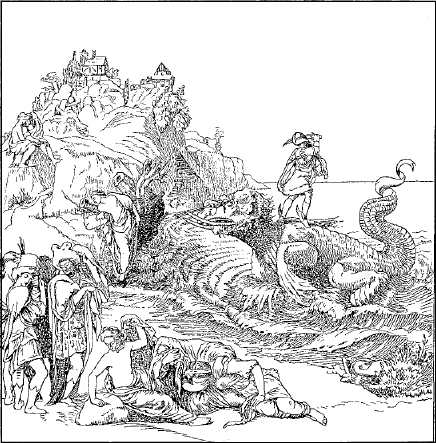
168. Per´seus and Androm´eda
First learn the special vocabulary, p. 288.
Perseus fīlius erat Iovis,2 maximī3 deōrum. Dē eō multās fabulās nārrant poētae. Eī favent deī, eī magica arma et ālās dant. Eīs tēlīs armātus et ālīs frētus ad multās terrās volābat et mōnstra saeva dēlēbat et miserīs īnfīrmīsque auxilium dabat. Aethiopia est terra Āfricae. Eam terram Cēpheus5 regēbat. Eī6 Neptūnus, maximus aquārum deus, erat īrātus et mittit7 mōnstrum saevum ad Aethiopiam. Ibi mōnstrum nōn sōlum lātīs pulchrīsque Aethiopiae agrīs nocēbat sed etiam domicilia agricolārum dēlēbat, et multōs virōs, fēminās, līberōsque necābat. Populus ex agrīs fugiēbat et oppida mūrīs validīs mūniēbat. Tum Cēpheus magnā trīstitiā commōtus ad Iovis ōrāculum properat et ita dīcit: “Amīcī meī necantur; agrī meī vāstantur. Audī verba mea, Iuppiter. Dā miserīs auxilium. Age mōnstrum saevum ex patriā.”
LESSON XXVIII
PRESENT, IMPERFECT, AND FUTURE INDICATIVE PASSIVE OF REGŌ AND AUDIŌ
169. Review the present, imperfect, and future indicative active of regō and audiō, and learn the passive of the same tenses (§§ 490, 491).
a. Observe that the tense signs of the imperfect and future are the same as in the active voice, and that the passive personal endings (§ 164) are added instead of the active ones.
b. Note the slight irregularity in the second person singular present of the third conjugation. There the final -e- of the stem is not changed to -i-, as it is in the active. We therefore have re´geris or re´gere, not re´giris, re´gire.
c. Inflect agō, dīcō, dūcō, mūniō, reperiō, in the present, imperfect, and future indicative, active and passive.
170. EXERCISES
I. 1. Agēbat, agēbātur, mittēbat, mittēbātur, dūcēbat. 2. Agunt, aguntur, mittuntur, mittunt, mūniunt. 3. Mittor, mittar, mittam, dūcēre, dūcere. 4. Dīcēmur, dīcimus, dīcēmus, dīcimur, mūniēbaminī. 5. Dūcitur, dūciminī, reperīmur, reperiar, agitur. 6. Agēbāmus, agēbāmur, reperīris, reperiēminī. 7. Mūnīminī, veniēbam, dūcēbar, dīcētur. 8. Mittiminī, mittitis, mittēris, mitteris, agēbāminī. 9. Dīcitur, dīcit, mūniuntur, reperient, audientur.
II. 1. I was being driven, I was driving, we were leading, we were being led, he says, it is said. 2. I shall send, I shall be sent, you will find, you will be found, they lead, they are led. 3. I am found, we are led, they are driven, you were being led (sing. and plur.). 4. We shall drive, we shall be driven, he leads, he is being led, they will come, they will be fortified. 5. They were ruling, they were being ruled, you will send, you will be sent, you are sent, (sing. and plur.). 6. He was being led, he will come, you are said (sing. and plur.).
171. Perseus and Andromeda (Continued)
First learn the special vocabulary, p. 288.
Tum ōrāculum ita respondet: “Mala est fortūna tua. Neptūnus, magnus aquārum deus, terrae Aethiopiae inimīcus, eās poenās mittit. Sed parā īrātō deō sacrum idōneum et mōnstrum saevum ex patriā tuā agētur. Andromeda fīlia tua est mōnstrō grāta. Dā eam mōnstrō. Servā cāram patriam et vītam populī tuī.” Andromeda autem erat puella pulchra. Eam amābat Cēpheus maximē.
LESSON XXIX
PRESENT, IMPERFECT, AND FUTURE INDICATIVE PASSIVE OF -IŌ VERBS · PRESENT PASSIVE INFINITIVE AND IMPERATIVE
172. Review the active voice of capiō, present, imperfect, and future, and learn the passive of the same tenses (§ 492).
a. The present forms capior and capiuntur are like audior, audiuntur, and the rest of the tense is like regor.
b. In like manner inflect the passive of iaciō and rapiō.
173. The Infinitive. The infinitive mood gives the general meaning of the verb without person or number; as, amāre, to love. Infinitive means unlimited. The forms of the other moods, being limited by person and number, are called the finite, or limited, verb forms.
174. The forms of the Present Infinitive, active and passive, are as follows:
Conj. Pres. Stem Pres. Infinitive Active Pres. Infinitive Passive
I. amā- amā´re, to love amā´rī, to be loved
II. monē- monē´re, to advise monē´rī, to be advised
III. rege- re´gere, to rule re´gī, to be ruled
cape- ca´pere, to take ca´pī, to be taken
IV. audī- audī´re, to hear audīrī, to be heard
1. Observe that to form the present active infinitive we add -re to the present stem.
a. The present infinitive of sum is esse. There is no passive.
2. Observe that the present passive infinitive is formed from the active by changing final -e to -ī, except in the third conjugation, which changes final -ere to -ī.
3. Give the active and passive present infinitives of doceō, sedeō, volō, cūrō, mittō, dūcō, mūniō, reperiō, iaciō, rapiō.
175. The forms of the Present Imperative, active and passive, are as follows:
Active1 Passive
CONJ. SING. PLUR. SING. PLUR.
I. a´mā amā´te amā´re, be thou loved amā´minī, be ye loved
II. mo´nē monē´te monē´re, be thou advised monē´minī, be ye advised
III. re´ge re´gite re´gere, be thou ruled regi´minī, be ye ruled
ca´pe ca´pite ca´pere, be thou taken capi´minī, be ye taken
IV. au´dī audī´te audī´re, be thou heard audī´minī, be ye heard
1. Observe that the second person singular of the present passive imperative is like the present active infinitive, and that both singular and plural are like the second person singular2 and plural, respectively, of the present passive indicative.
2. Give the present imperative, both active and passive, of the verbs in § 174. 3.
176. EXERCISES
First learn the special vocabulary, p. 289.
I. 1. Tum Perseus ālīs ad terrās multās volabit. 2. Mōnstrum saevum per aquās properat et mox agrōs nostrōs vāstābit. 3. Sī autem Cēpheus ad ōrāculum properābit, ōrāculum ita respondēbit. 4. Quis tēlīs Perseī superābitur? Multa mōnstra tēlīs eius superābuntur. 5. Cum cūrīs magnīs et lacrimīs multīs agricolae ex domiciliīs cārīs aguntur. 6. Multa loca vāstābantur et multa oppida dēlēbantur. 7. Mōnstrum est validum, tamen superābitur. 8. Crēdēsne semper verbīs ōrāculī? Ego iīs non semper crēdam. 9. Pārēbitne Cēpheus ōrāculō? Verba ōrāculī eī persuādēbunt. 10. Si nōn fugiēmus, oppidum capiētur et oppidānī necābuntur. 11. Vocāte puerōs et nārrāte fābulam clāram dē mōnstrō saevō.
II. 1. Fly thou, to be cared for, be ye sent, lead thou. 2. To lead, to be led, be ye seized, fortify thou. 3. To be hurled, to fly, send thou, to be found. 4. To be sent, be ye led, to hurl, to be taken. 5. Find thou, hear ye, be ye ruled, to be fortified.
LESSON XXX
SYNOPSES IN THE FOUR CONJUGATIONS · THE ABLATIVE DENOTING FROM
177. You should learn to give rapidly synopses of the verbs you have had, as follows:1
Conjugation I Conjugation II
Indicative
ACTIVE PASSIVE ACTIVE PASSIVE
Pres. a´mō a´mor mo´neō mo´neor
Imperf. amā´bam amā´bar monē´bam monē´bar
Fut. amā´bo amā´bor monē´bo monē´bor
Imperative
Pres. a´mā amā´re mo´nē monē´re
Infinitive
Pres. amā´re amā´rī monē´re monē´rī
Conjugation III Conjugation III (-iō verbs)
Indicative
ACTIVE PASSIVE ACTIVE PASSIVE
Pres. re´gō re´gor ca´piō ca´pior
Imperf. regē´bam regē´bar capiē´bam capiē´bar
Fut. re´gam re´gar ca´piam ca´piar
Imperative
Pres. re´ge re´gere ca´pe ca´pere
Infinitive
Pres. re´gere re´gī ca´pere ca´pī
Conjugation IV
Indicative
ACTIVE PASSIVE
Pres. au´diō au´dior
Imperf. audiē´bam audiē´bar
Fut. au´diam au´diar
Imperative
Pres. au´dī audī´re
Infinitive
Pres. audī´re audī´rī
1. Give the synopsis of rapiō, mūniō, reperiō, doceō, videō, dīcō, agō, laudō, portō, and vary the person and number.
178. We learned in § 50 that one of the three relations covered by the ablative case is expressed in English by the preposition from. This is sometimes called the separative ablative, and it has a number of special uses. You have already grown familiar with the first mentioned below.
179. Rule. Ablative of the Place From. The place from which is expressed by the ablative with the prepositions ā or ab, dē, ē or ex.