PART II (continued 2)
Reading edition
Agricolae ex agrīs veniunt, the farmers come from the fields
a. ā or ab denotes from near a place; ē or ex, out from it; and dē, down from it. This may be represented graphically as follows:
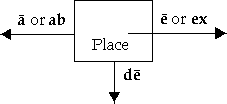
180. Rule. Ablative of Separation. Words expressing separation or deprivation require an ablative to complete their meaning.
a. If the separation is actual and literal of one material thing from another, the preposition ā or ab, ē or ex, or dē is generally used. If no actual motion takes place of one thing from another, no preposition is necessary.
(a) Perseus terram ā mōnstrīs līberat Perseus frees the land from monsters (literal separation— actual motion is expressed)
(b) Perseus terram trīstitiā līberat Perseus frees the land from sorrow (figurative separation— no actual motion is expressed)
181. Rule. Ablative of the Personal Agent. The word expressing the person from whom an action starts, when not the subject, is put in the ablative with the preposition ā or ab.
a. In this construction the English translation of ā, ab is by rather than from. This ablative is regularly used with passive verbs to indicate the person by whom the act was performed.
Mōnstrum ā Perseō necātur, the monster is being slain by (lit. from) Perseus
b. Note that the active form of the above sentence would be Perseus monstrum necat, Perseus is slaying the monster. In the passive the object of the active verb becomes the subject, and the subject of the active verb becomes the ablative of the personal agent, with ā or ab.
c. Distinguish carefully between the ablative of means and the ablative of the personal agent. Both are often translated into English by the preposition by. (Cf. § 100. b.) Means is a thing; the agent or actor is a person. The ablative of means has no preposition. The ablative of the personal agent has ā or ab. Compare
Fera sagittā necātur, the wild beast is killed by an arrow Fera ā Diānā necātur, the wild beast is killed by Diana
Sagittā, in the first sentence, is the ablative of means; ā Diānā, in the second, is the ablative of the personal agent.
182. EXERCISES
First learn the special vocabulary, p. 289.
I. 1. Viri inopiā cibī dēfessī ab eō locō discēdent. 2. Germānī castrīs Rōmānīs adpropinquābant, tamen lēgātus cōpiās ā proeliō continēbat. 3. Multa Gallōrum oppida ab Rōmanīs capientur. 4. Tum Rōmānī tōtum populum eōrum oppidōrum gladiīs pīlīsque interficient. 5. Oppidānī Rōmānīs resistent, sed defessī longō proelīo fugient. 6. Multī ex Galliā fugiēbant et in Germānōrum vicīs habitābant. 7. Miserī nautae vulnerantur ab inimīcīs2 saevīs et cibō egent. 8. Discēdite et date virīs frūmentum et cōpiam vīnī. 9. Cōpiae nostrae ā proeliō continēbantur ab Sextō lēgatō. 10. Id oppidum ab prōvinciā Rōmānā longē aberat.
II. 1. The weary sailors were approaching a place dear to the goddess Diana. 2. They were without food and without wine. 3. Then Galba and seven other men are sent to the ancient island by Sextus. 4. Already they are not far away from the land, and they see armed men on a high place. 5. They are kept from the land by the men with spears and arrows. 6. The men kept hurling their weapons down from the high place with great eagerness.
LESSON XXXI
PERFECT, PLUPERFECT, AND FUTURE PERFECT OF SUM
183. Principal Parts. There are certain parts of the verb that are of so much consequence in tense formation that we call them the principal parts.
The principal parts of the Latin verb are the present, the past, and the past participle; as go, went, gone; see, saw, seen, etc.
The principal parts of the Latin verb are the first person singular of the present indicative, the present infinitive, the first person singular of the perfect indicative, and the perfect passive participle.
184. Conjugation Stems. From the principal parts we get three conjugation stems, from which are formed the entire conjugation. We have already learned about the present stem, which is found from the present infinitive (cf. § 126. a). The other two stems are the perfect stem and the participial stem.
185. The Perfect Stem. The perfect stem of the verb is formed in various ways, but may always be found by dropping -ī from the first person singular of the perfect, the third of the principal parts. From the perfect stem are formed the following tenses:
The Perfect Active Indicative The Pluperfect Active Indicative (English Past Perfect) The Future Perfect Active Indicative
All these tenses express completed action in present, past, or future time respectively.
186. The Endings of the Perfect. The perfect active indicative is inflected by adding the endings of the perfect to the perfect stem. These endings are different from those found in any other tense, and are as follows:
Sing. 1. -ī, I Plur. 1. -imus, we
2. -istī, you 2. -istis, you
3. -it, he, she, it 3. -ērunt or -ēre, they
187. Inflection of sum in the perfect, pluperfect, and future perfect indicative:
Pres. Indic. Pres. Infin. Perf. Indic.
Prin. Parts sum esse fuī
Perfect Stem fu-
Perfect
SINGULAR PLURAL
fu´ī, I have been, I was fu´imus, we have been, we were
fuis´tī, you have been, you were fuis´tis, you have been, you were
fu´it, he has been, he was fuē´runt or fuē´re, they have been, they were
Pluperfect (Tense Sign -erā-)
fu´eram, I had been fuerā´mus, we had been
fu´erās, you had been fuerā´tis, you had been
fu´erat, he had been fu´erant, they had been
Future Perfect (Tense Sign -erā-)
fu´erō, I shall have been fue´rimus, we shall have been
fu´eris, you will have been fue´ritis, you will have been
fu´erit, he will have been fu´erint, they will have been
1. Note carefully the changing accent in the perfect.
2. Observe that the pluperfect may be formed by adding eram, the imperfect of sum, to the perfect stem. The tense sign is -erā-.
3. Observe that the future perfect may be formed by adding erō, the future of sum, to the perfect stem. But the third person plural ends in -erint, not in -erunt. The tense sign is -eri-.
4. All active perfects, pluperfects, and future perfects are formed on the perfect stem and inflected in the same way.
188. DIALOGUE
The Boys Titus, Marcus, and Quintus
First learn the special vocabulary, p. 289.
M. Ubi fuistis, Tite et Quīnte? T. Ego in meō lūdō fuī et Quīntus in suō lūdō fuit. Bonī puerī fuimus. Fuitne Sextus in vīcō hodiē? M. Fuit. Nūper per agrōs proximōs fluviō properābat. Ibi is et Cornēlius habent nāvigium. T. Nāvigium dīcis? Aliī1 nārrā eam fābulam! M. Vērō (Yes, truly), pulchrum et novum nāvigium! Q. Cuius pecūniā2 Sextus et Cornēlius id nāvigium parant? Quis iīs pecūniam dat? M. Amīcī Cornēlī multum habent aurum et puer pecūniā nōn eget. T. Quō puerī nāvigābunt? Nāvigābuntne longē ā terrā? M. Dubia sunt cōnsilia eōrum. Sed hodiē, crēdō, sī ventus erit idōneus, ad maximam īnsulam nāvigābunt. Iam anteā ibi fuērunt. Tum autem ventus erat perfidus et puerī magnō in perīculō erant. Q. Aqua ventō commōta est inimīca nautīs semper, et saepe perfidus ventus nāvigia rapit, agit, dēletque. Iī puerī, sī nōn fuerint maximē attentī, īrātā aquā et validō ventō superābuntur et ita interficientur.
189. EXERCISE
1. Where had the boys been before? They had been in school. 2. Where had Sextus been? He had been in a field next to the river. 3. Who has been with Sextus to-day? Cornelius has been with him. 4. Who says so? Marcus. 5. If the wind has been suitable, the boys have been in the boat. 6. Soon we shall sail with the boys. 7. There3 will be no danger, if we are (shall have been) careful.4
LESSON XXXII
THE PERFECT ACTIVE INDICATIVE OF THE FOUR REGULAR CONJUGATIONS
190. Meanings of the Perfect. The perfect tense has two distinct meanings. The first of these is equivalent to the English present perfect, or perfect with have, and denotes that the action of the verb is complete at the time of speaking; as, I have finished my work. As this denotes completed action at a definite time, it is called the perfect definite.
The perfect is also used to denote an action that happened sometime in the past; as, I finished my work. As no definite time is specified, this is called the perfect indefinite. It corresponds to the ordinary use of the English past tense.
a. Note carefully the difference between the following tenses:
I was finishing used to finish my work (imperfect, § 134)
I finished my work (perfect indefinite)
I have finished my work (perfect definite)
When telling a story the Latin uses the perfect indefinite to mark the different forward steps of the narrative, and the imperfect to describe situations and circumstances that attend these steps. If the following sentences were Latin, what tenses would be used?
“Last week I went to Boston. I was trying to find an old friend of mine, but he was out of the city. Yesterday I returned home.”
191. Inflection of the Perfect. We learned in § 186 that any perfect is inflected by adding the endings of the perfect to the perfect stem. The inflection in the four regular conjugations is then as follows:
Conj. I Conj. II Conj. III Conj. IV
amāvī monuī rēxī cēpī audīvī
I have loved I loved or did love I have advised I advised or did advise I have ruled I ruled or did rule I have taken I took or did take I have heard I heard or did hear
Perfect Stems
amāv- monu- rēx- cēp- audīv-
Singular
1. amā´vī mo´nuī rē´xī cē´pī audī´vī
2. amāvis´tī monuis´tī rēxis´tī cēpis´tī audīvis´tī
3. amā´vit mo´nuit rē´xit cē´pit audī´vit
Plural
1. amā´vimus monu´imus rē´ximus cē´pimus audī´vimus
2. amāvis´tis monuis´tis rēxis´tis cēpis´tis audīvis´tis
3. amāvē´runt or amāvē´re monuē´runt or monuē´re rēxē´runt or rēxē´re cēpē´runt or cēpē´re audīvē´runt or audīvē´re
1. The first person of the perfect is always given as the third of the principal parts. From this we get the perfect stem. This shows the absolute necessity of learning the principal parts thoroughly.
2. Nearly all perfects of the first conjugation are formed by adding -vī to the present stem. Like amāvī inflect parāvī, vocāvī, cūrāvī, laudāvī.
3. Note carefully the changing accent in the perfect. Drill on it.
192. Learn the principal parts and inflect the perfects:
Pres. Indic. Pres. Infin. Perf. Indic.
dō dăre dedī give
dēleō dēlēre dēlēvī destroy
habeō habēre habuī have
moveō movēre mōvī move
pāreō pārēre pāruī obey
prohibeō prohibēre prohibuī restrain, keep from
videō vidēre vīdī see
dīcō dīcere dīxī say
discēdō discēdere discessī depart
dūcō dūcere dūxī lead
faciō facere fēcī make, do
mittō mittere mīsī send
mūniō mūnīre mūnīvī fortify
veniō venīre vēnī come
193. Perseus and Andromeda (Continued)
First learn the special vocabulary, p. 290.
Cēpheus, adversā fortūnā maximē commōtus, discessit et multīs cum lacrimīs populō Aethiopiae verba ōrāculī nārrāvit. Fāta Andromedae, puellae pulchrae, ā tōtō populō dēplōrābantur, tamen nūllum erat auxilium. Deinde Cēpheus cum plēnō trīstitiae animō cāram suam fīliam ex oppidī portā ad aquam dūxit et bracchia eius ad saxa dūra revīnxit. Tum amīcī puellae miserae longē discessērunt et diū mōnstrum saevum exspectāvērunt.
Tum forte Perseus, ālīs frētus, super Aethiopiam volābat. Vīdit populum, Andromedam, lacrimās, et, magnopere attonitus, ad terram dēscendit. Tum Cēpheus eī tōtās cūrās nārrāvit et ita dīxit: “Pārēbō verbīs ōrāculī, et prō patriā fīliam meam dabō; sed sī id mōnstrum interficiēs et Andromedam servābis, tibi (to you) eam dabō.”
LESSON XXXIII
PLUPERFECT AND FUTURE PERFECT ACTIVE INDICATIVE · PERFECT ACTIVE INFINITIVE
194.
Conj. I Conj. II Conj. III Conj. IV
amō moneō regō capiō audiō
Perfect Stems amāv- monu- rēx- cēp- audīv-
Pluperfect Indicative Active
Tense Sign -erā-
SINGULAR
I had loved I had advised I had ruled I had taken I had heard
1. amā´veram monu´eram rē´xeram cē´peram audī´veram
2. amā´verās monu´erās rē´xerās cē´perās audī´verās
3. amā´verat monu´erat rē´xerat cē´perat audī´verat
PLURAL
1. amāverā´mus monuerā´mus rēxerā´mus cēperā´mus audīverā´mus
2. amāverā´tis monuerā´tis rēxerā´tis cēperā´tis audīverā´tis
3. amā´verant monu´erant rē´xerant cē´perant audī´verant
Future Perfect Indicative Active
Tense Sign -eri-
SINGULAR
I shall have loved I shall have advised I shall have ruled I shall have taken I shall have heard
1. amā´verō monu´erō rē´xerō cē´perō audī´verō
2. amā´veris monu´eris rē´xeris cē´peris audī´veris
3. amā´verit monu´erit rē´xerit cē´perit audī´verit
PLURAL
1. amāve´rimus monue´rimus rēxe´rimus cēpe´rimus audīve´rimus
2. amāve´ritis monue´ritis rēxe´ritis cēpe´ritis audīve´ritis
3. amā´verint monu´erint rē´xerint cē´perint audī´verint
1. Observe that these are all inflected alike and the rules for formation given in § 187. 2-4 hold good here.
2. In like manner inflect the pluperfect and future perfect indicative active of dō, portō, dēleō, moveō, habeō, dīcō, discēdō, faciō, veniō, mūniō.
195. The Perfect Active Infinitive. The perfect active infinitive is formed by adding -isse to the perfect stem.
Conj. Perfect Stem Perfect Infinitive
I. amāv- amāvis´se, to have loved
II. monu- monuis´se, to have advised
III. (a) rēx- rēxis´se, to have ruled
(b) cēp- cēpis´se, to have taken
IV. audīv- audīvis´se, to have heard
sum fu- fuis´se, to have been
1. In like manner give the perfect infinitive active of dō, portō, dēleō, moveō, habeō, dīcō, discēdō, faciō, veniō, mūniō.
196. EXERCISES
I. 1. Habuistī, mōvērunt, miserant. 2. Vīdit, dīxeris, dūxisse. 3. Mīsistis, pāruērunt, discesserāmus. 4. Mūnīvit, dederam, mīserō. 5. Habuerimus, dēlēvī, pāruit, fuisse. 6. Dederās, mūnīveritis, vēnerātis, mīsisse. 7. Vēnerās, fēcisse, dederātis, portāveris.
8. Quem verba ōrāculī mōverant? Populum verba ōrāculī mōverant. 9. Cui Cēpheus verba ōrāculī nārrāverit? Perseō Cēpheus verba ōrāculī nārrāverit. 10. Amīcī ab Andromedā discesserint. 11. Mōnstrum saevum domicilia multa dēlēverat. 12. Ubi mōnstrum vīdistis? Id in aquā vīdimus. 13. Quid mōnstrum faciet? Mōnstrum Andromedam interficiet.
II. 1. They have obeyed, we have destroyed, I shall have had. 2. We shall have sent, I had come, they have fortified. 3. I had departed, he has obeyed, you have sent (sing. and plur.). 4. To have destroyed, to have seen, he will have given, they have carried. 5. He had destroyed, he has moved, you have had (sing. and plur.). 6. I have given, you had moved (sing. and plur.), we had said. 7. You will have made (sing. and plur.), they will have led, to have given.
8. Who had seen the monster? Andromeda had seen it. 9. Why had the men departed from1 the towns? They had departed because the monster had come. 10. Did Cepheus obey2 the oracle3? He did.
LESSON XXXIV
REVIEW OF THE ACTIVE VOICE
197. A review of the tenses of the indicative active shows the following formation:
TENSES OF THE INDICATIVE Present = First of the principal parts
Imperfect = Present stem + -ba-m
Future = Present stem + -bō, Conj. I and II -a-m, Conj. III and IV
Perfect = Third of the principal parts
Pluperfect = Perfect stem + -era-m
Future Perfect = Perfect stem + -erō
198. The synopsis of the active voice of amō, as far as we have learned the conjugation, is as follows:
Principal Parts amō, amāre, amāvī
Pres. Stem amā- Perf. Stem amāv-
Indic. Pres. amō Indic. Perf. amāvī
Imperf. amābam Pluperf. amāveram
Fut. amābō Fut. perf. amāverō
Pres. Imv. amā
Pres. Infin. amāre Perf. Infin. amāvisse
1. Learn to write in the same form and to give rapidly the principal parts and synopsis of parō, dō, laudō, dēleō, habeō, moveō, pāreō, videō, dīcō, discēdō, dūcō, mittō, capiō, muniō, veniō.1
199. Learn the following principal parts:2
Pres. Indic. Pres. Infin. Perf. Indic.
Irregular Verbs sum ab´sum dō esse abes´se dare fuī ā´fuī dedī be be away give
Conjugation II contineō doceō egeō faveō iubeō noceō persuādeō respondeō sedeō studeō continēre docēre egēre favēre iubēre nocēre persuādēre respondēre sedēre studēre continuī docuī eguī fāvī iussī nocuī persuāsī respondī sēdī studuī hold in, keep teach need favor order injure persuade reply sit be eager
Conjugation III agō crēdō fugiō iaciō interficiō rapiō resis´tō agere crēdere fugere iacere interficere rapere resis´tere ēgī crēdidī fūgī iēcī interfēcī rapuī re´stitī drive believe flee hurl kill seize resist
Conjugation IV repe´riō reperī´re rep´perī find
200. Perseus and Andromeda (Concluded)
First learn the special vocabulary, p. 290. Read the whole story.
Perseus semper proeliō studēbat3 et respondit,3 “Verba tua sunt maximē grāta,” et laetus arma sua magica parāvit.3 Subitō mōnstrum vidētur; celeriter per aquam properat et Andromedae adpropinquat. Eius amīcī longē absunt et misera puella est sōla. Perseus autem sine morā super aquam volāvit.3 Subitō dēscendit3 et dūrō gladiō saevum mōnstrum graviter vulnerāvit.3 Diū pugnātur,4 diū proelium est dubium. Dēnique autem Perseus mōnstrum interfēcit3 et victōriam reportāvit.3 Tum ad saxum vēnit3 et Andromedam līberāvit3 et eam ad Cēpheum dūxit.3 Is, nūper miser, nunc laetus, ita dīxit3: “Tuō auxiliō, mī amīce, cāra fīlia mea est lībera; tua est Andromeda.” Diū Perseus cum Andromedā ibi habitābat3 et magnopere ā tōtō populō amābātur.3
LESSON XXXV
THE PASSIVE PERFECTS OF THE INDICATIVE · THE PERFECT PASSIVE AND FUTURE ACTIVE INFINITIVE
201. The fourth and last of the principal parts (§ 183) is the perfect passive participle. From it we get the participial stem on which are formed the future active infinitive and all the passive perfects.
1. Learn the following principal parts, which are for the first time given in full:
Conj. Pres. Indic. Pres. Infin. Perf. Indic. Perf. Pass. Part
I. amō amā´-re amā´v-ī amā´t-us
This is the model for all regular verbs of the first conjugation.
II. mo´neō monē´-re mo´nu-ī mo´nit-us
III. regō re´ge-re rēx-ī rēct-us
ca´piō ca´pe-re cēp-ī capt-us
IV. au´diō audī´-re audī´v-ī audī´t-us
2. The base of the participial stem is found by dropping -us from the perfect passive participle.
202. In English the perfect, past perfect, and future perfect tenses of the indicative passive are made up of forms of the auxiliary verb to be and the past participle; as, I have been loved, I had been loved, I shall have been loved.
Very similarly, in Latin, the perfect, pluperfect, and future perfect passive tenses use respectively the present, imperfect, and future of sum as an auxiliary verb with the perfect passive participle, as
Perfect passive, amā´tus sum, I have been or was loved Pluperfect passive, amā´tus eram, I had been loved Future perfect passive, amā´tus erō, I shall have been loved
1. In the same way give the synopsis of the corresponding tenses of moneō, regō, capiō, and audiō, and give the English meanings.
203. Nature of the Participle. A participle is partly verb and partly adjective. As a verb it possesses tense and voice. As an adjective it is declined and agrees with the word it modifies in gender, number, and case.
204. The perfect passive participle is declined like bonus, bona, bonum, and in the compound tenses (§ 202) it agrees as a predicate adjective with the subject of the verb.
Examples in Singular Vir laudātus est, the man was praised, or has been praised Puella laudāta est, the girl was praised, or has been praised Cōnsilium laudātum est, the plan was praised, or has been praised
Examples in Plural Virī laudātī sunt, the men were praised, or have been praised Puellae laudātae sunt, the girls were praised, or have been praised Cōnsilia laudāta sunt, the plans were praised, or have been praised
1. Inflect the perfect, pluperfect, and future perfect indicative passive of amō, moneō, regō, capiō, and audiō (§§ 488-492).
205. The perfect passive infinitive is formed by adding esse, the present infinitive of sum, to the perfect passive participle; as, amā´t-us (-a, -um) esse, to have been loved; mo´nit-us (-a, -um) esse, to have been advised.
1. Form the perfect passive infinitive of regō, capiō, audiō, and give the English meanings.
206. The future active infinitive is formed by adding esse, the present infinitive of sum, to the future active participle. This participle is made by adding -ūrus, -a, -um to the base of the participial stem. Thus the future active infinitive of amō is amat-ū´rus (-a, -um) esse, to be about to love.
a. Note that in forming the three tenses of the active infinitive we use all three conjugation stems:
Present, amāre (present stem), to love Perfect, amāvisse (perfect stem), to have loved Future, amātūrus esse (participial stem), to be about to love
1. Give the three tenses of the active infinitive of laudō, moneō, regō, capiō, audiō, with the English meanings.
207. EXERCISES
I. 1. Fābula Andromedae nārrāta est. 2. Multae fābulae ā magistrō nārrātae sunt. 3. Ager ab agricolā validō arātus erat. 4. Agrī ab agricolīs validīs arātī erant. 5. Aurum ā servō perfidō ad domicilium suum portātum erit. 6. Nostra arma ā lēgātō laudāta sunt. Quis vestra arma laudāvit? 7. Ab ancillā tuā ad cēnam vocātae sumus. 8. Andromeda mōnstrō nōn data est, quia mōnstrum ā Perseō necātum erat.
II. 1. The provinces were laid waste, the field had been laid waste, the towns will have been laid waste. 2. The oracles were heard, the oracle was heard, the oracles had been heard. 3. The oracle will have been heard, the province had been captured, the boats have been captured. 4. The fields were laid waste, the man was advised, the girls will have been advised. 5. The towns had been ruled, we shall have been captured, you will have been heard.
LESSON XXXVI
REVIEW OF PRINCIPAL PARTS · PREPOSITIONS YES-OR-NO QUESTIONS
208. The following list shows the principal parts of all the verbs you have had excepting those used in the paradigms. The parts you have had before are given for review, and the perfect participle is the only new form for you to learn. Sometimes one or more of the principal parts are lacking, which means that the verb has no forms based on that stem. A few verbs lack the perfect passive participle but have the future active participle in -ūrus, which appears in the principal parts instead.
Irregular Verbs
sum absum dō1 esse abesse dare fuī āfuī dedī futūrus āfutūrus datus be be away give
Conjugation I
portō portāre portāvī portātus carry
So for all verbs of this conjugation thus far used.
Conjugation II
contineō dēleō doceō egeō faveō iubeō moveō noceō pāreō persuādeō prohibeō respondeō sedeō studeō videō continēre dēlēre docēre egēre favēre iubēre movēre nocēre pārēre persuādēre prohibēre respondēre sedēre studēre vidēre continuī dēlēvī docuī eguī fāvī iussī mōvī nocuī pāruī persuāsī prohibuī respondī sēdī studuī vīdī contentus dēlētus doctus —— fautūrus iussus mōtus nocitūrus —— persuāsus prohibitus respōnsus -sessus —— vīsus hold in, keep destroy teach lack favor order move injure obey persuade (from) restrain, keep reply sit be eager see
Conjugation III
agō crēdō dīcō discēdō dūcō faciō2 fugiō iaciō interficiō mittō rapiō resistō agere crēdere dīcere discēdere dūcere facere fugere iacere interficere mittere rapere resistere ēgī crēdidī dīxī discessī dūxī fēcī fūgī iēcī interfēcī mīsī rapuī restitī āctus crēditus dictus discessus ductus factus fugitūrus iactus interfectus missus raptus —— drive believe say depart lead make flee hurl kill send seize resist
Conjugation IV
mūniō reperiō veniō mūnīre reperīre venīre mūnīvī rep´perī vēnī mūnītus repertus ventus fortify find come
209. Prepositions. 1. We learned in §§ 52, 53 that only the accusative and the ablative are used with prepositions, and that prepositions expressing ablative relations govern the ablative case. Those we have had are here summarized. The table following should be learned.
ā or ab, from, by cum, with dē, down from, concerning ē or ex, out from, out of prō, before, in front of; for, in behalf of sine, without
2. Prepositions not expressing ablative relations must govern the accusative (§ 52). Of these we have had the following:
ad, to apud, among per, through
There are many others which you will meet as we proceed.
3. The preposition in when meaning in or on governs the ablative; when meaning to, into, against (relations foreign to the ablative) in governs the accusative.
210. Yes-or-No Questions. Questions not introduced by some interrogative word like who, why, when, etc., but expecting the answer yes or no, may take one of three forms:
1. Is he coming? (Asking for information. Implying nothing as to the answer expected.) 2. Is he not coming? (Expecting the answer yes.) 3. He isn´t coming, is he? (Expecting the answer no.)
These three forms are rendered in Latin as follows:
1. Venitne? is he coming? 2. Nōnne venit? is he not coming? 3. Num venit? he isn´t coming, is he?
a. -ne, the question sign, is usually added to the verb, which then stands first.
b. We learned in § 56. b that yes-or-no questions are usually answered by repeating the verb, with or without a negative. Instead of this, ita, vērō, certē, etc. (so, truly, certainly, etc.) may be used for yes, and nōn, minimē, etc. for no if the denial is emphatic, as, by no means, not at all.
211. EXERCISES
First learn the special vocabulary, p. 290.
I. 1. Nōnne habēbat Cornēlia ōrnāmenta aurī? Habēbat. 2. Num Sextus lēgātus scūtum in dextrō bracchiō gerēbat? Nōn in dextrō, sed sinistrō in bracchiō Sextus scūtum gerēbat. 3. Frūstrā bella multa ab Gallīs gesta erant. 4. Ubi oppidum ā perfidō Sextō occupātum est, oppidānī miserī gladiō interfectī sunt. 5. Id oppidum erat plēnum frūmentī. 6. Nōnne Sextus ab oppidānīs frūmentum postulāvit? Vērō, sed iī recūsāvērunt frūmentum dare. 7. Cūr oppidum ab Sextō dēlētum est? Quia frūmentum recūsātum est. 8. Ea victōria nōn dubia erat. 9. Oppidānī erant dēfessī et armīs egēbant. 10. Num fugam temptāvērunt? Minimē.
II. 1. Where was Julia standing? She was standing where you had ordered. 2. Was Julia wearing any ornaments? She had many ornaments of gold. 3. Did she not attempt flight when she saw the danger? She did. 4. Who captured her? Galba captured her without delay and held her by the left arm. 5. She didn´t have the lady’s gold, did she? No, the gold had been taken by a faithless maid and has been brought back.
Fourth Review, Lessons XXVII-XXXVI, §§ 513-516
LESSON XXXVII
CONJUGATION OF POSSUM · THE INFINITIVE USED AS IN ENGLISH
212. Learn the principal parts of possum, I am able, I can, and its inflection in the indicative and infinitive. (Cf. § 495.)
a. Possum, I can, is a compound of potis, able, and sum, I am.
213. The Infinitive with Subject Accusative. The infinitive (cf. § 173) is a verbal noun. Used as a noun, it has the constructions of a noun. As a verb it can govern a case and be modified by an adverb. The uses of the infinitive are much the same in Latin as in English.
1. In English certain verbs of wishing, commanding, forbidding, and the like are used with an object clause consisting of a substantive in the objective case and an infinitive, as, he commanded the men to flee. Such object clauses are called infinitive clauses, and the substantive is said to be the subject of the infinitive.
Similarly in Latin, some verbs of wishing, commanding, forbidding, and the like are used with an object clause consisting of an infinitive with a subject in the accusative case, as, Is virōs fugere iussit, he commanded the men to flee.
214. Rule. Subject of the Infinitive. The subject of the infinitive is in the accusative.
215. The Complementary Infinitive. In English a verb is often followed by an infinitive to complete its meaning, as, the Romans are able to conquer the Gauls. This is called the complementary infinitive, as the predicate is not complete without the added infinitive.
Similarly in Latin, verbs of incomplete predication are completed by the infinitive. Among such verbs are possum, I am able, I can; properō, mātūrō, I hasten; temptō, I attempt; as
Rōmānī Gallōs superāre possunt, the Romans are able to (or can) conquer the Gauls Bellum gerere mātūrant, they hasten to wage war
a. A predicate adjective completing a complementary infinitive agrees in gender, number, and case with the subject of the main verb.
Malī puerī esse bonī nōn possunt, bad boys are not able to (or cannot) be good.
Observe that bonī agrees with puerī.
216. The Infinitive used as a Noun. In English the infinitive is often used as a pure noun, as the subject of a sentence, or as a predicate nominative. For example, To conquer (= conquering) is pleasing; To see (= seeing) is to believe (= believing). The same use of the infinitive is found in Latin, especially with est, as
Superāre est grātum, to conquer is pleasing Vidēre est crēdere, to see is to believe
a. In the construction above, the infinitive often has a subject, which must then be in the accusative case, as
Galbam superāre inimīcōs est grātum multīs, for Galba to conquer his enemies is pleasing to many
b. An infinitive used as a noun is neuter singular. Thus, in the sentence superāre est grātum, the predicate adjective grātum is in the neuter nominative singular to agree with superāre the subject.
217. EXERCISES
First learn the special vocabulary, p. 291.
I. 1. Magister lūdī līberōs cum dīligentiā labōrāre iussit. 2. Egēre cibō et vinō est virīs molestum. 3. Virī armātī vetuērunt Gallōs castra ibi pōnere. 4. Estne lēgātus in castellō an in mūrō? Is est prō portā. 5. Ubi nostrī1 fugere incēpērunt, lēgātus ab vestrīs1 captus est. 6. Gallī castellum ibi oppugnāverant ubi praesidium erat īnfīrmum. 7. Aliī pugnāre temptābant, aliī portās petēbant. 8. Fēminae prō domiciliīs sedēbant neque resistere validīs Gallīs poterant. 9. Bellum est saevum, nec īnfīrmīs nec miserīs favet. 10. Sed virī arma postulābant et studēbant Gallōs dē mūrīs agere. 11. Id castellum ab Gallīs occupārī Rōmānīs nōn grātum erit. 12. Gallī ubi ā Rōmānīs victī sunt, esse līberī2 cessāvērunt. 13. Diū sine aquā vīvere nōn potestis.
II. 1. The girl began daily to carry water from the river to the gates. 2. The Gauls had pitched their camp in a place suitable for a battle. 3. For a long time they tried in vain to seize the redoubt. 4. Neither did they cease to hurl weapons against3 the walls. 5. But they were not able to (could not) take the town.
218. The Faithless Tarpe´ia
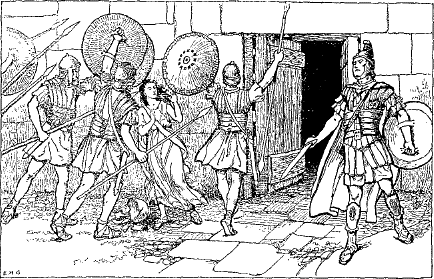
Sabīnī ōlim cum Rōmānīs bellum gerēbant et multās victōriās reportāverant. Iam agrōs proximōs mūrīs vāstābant, iam oppidō adpropinquābant. Rōmānī autem in Capitōlium fūgerant et longē perīculō aberant. Mūrīs validīs et saxīs altīs crēdēbant. Frūstrā Sabīnī tēla iaciēbant, frūstrā portās dūrās petēbant; castellum occupāre nōn poterant. Deinde novum cōnsilium cēpērunt.4
Tarpēia erat puella Rōmāna pulchra et superba. Cotīdiē aquam cōpiīs Rōmānīs in Capitōlium portābat. Eī5 nōn nocēbant Sabīnī, quod ea sine armīs erat neque Sabīnī bellum cum fēminīs līberīsque gerēbant. Tarpēia autem maximē amābat ōrnāmenta aurī. Cotīdiē Sabīnōrum ōrnāmenta vidēbat et mox ea dēsīderāre incipiēbat. Eī ūnus ex6 Sabīnīs dīxit, “Dūc cōpiās Sabīnās intrā portās, Tarpēia, et maxima erunt praemia tua.”
TARPEIA PUELLA PERFIDA
LESSON XXXVIII
THE RELATIVE PRONOUN AND THE INTERROGATIVE PRONOUN
219. Sentences are simple, compound, or complex.
a. A simple sentence is a sentence containing but one statement, that is, one subject and one predicate: The Romans approached the town.
b. A compound sentence is a sentence containing two or more independent statements: The Romans approached the town | and | the enemy fled.
Note. An independent statement is one that can stand alone; it does not depend upon another statement.
c. A complex sentence is a sentence containing one independent statement and one or more dependent statements: When the Romans approached the town | the enemy fled.
Note. A dependent or subordinate statement is one that depends on or qualifies another statement; thus the enemy fled is independent, and when the Romans approached the town is dependent or subordinate.
d. The separate statements in a compound or complex sentence are called clauses. In a complex sentence the independent statement is called the main clause and the dependent statement the subordinate clause.
220. Examine the complex sentence
The Romans killed the men who were taken
Here are two clauses:
a. The main clause, The Romans killed the men
b. The subordinate clause, who were taken
The word who is a pronoun, for it takes the place of the noun men. It also connects the subordinate clause who were taken with the noun men. Hence the clause is an adjective clause. A pronoun that connects an adjective clause with a substantive is called a relative pronoun, and the substantive for which the relative pronoun stands is called its antecedent. The relative pronouns in English are who, whose, whom, which, what, that.
221. The relative pronoun in Latin is quī, quae, quod, and it is declined as follows:
Singular Plural
MASC. FEM. NEUT. MASC. FEM. NEUT.
Nom. quī quae quod quī quae quae
Gen. cuius cuius cuius quōrum quārum quōrum
Dat. cui cui cui quibus quibus quibus
Acc. quem quam quod quōs quās quae
Abl. quō quā quō quibus quibus quibus
1. Review the declension of is, § 114, and note the similarity in the endings. The forms quī, quae, and quibus are the only forms showing new endings.
Note. The genitive cuius and the dative cui are pronounced co͝oi´yo͝os (two syllables) and co͝oi (one syllable).
222. The Relative Pronoun is translated as follows:1
Masc. and Fem. Neut.
Nom. who, that which, what, that
Gen. of whom, whose of which, of what, whose
Dat. to or for whom to or for which, to or for what
Acc. whom, that which, what, that
Abl. from, etc., whom from, etc., which or what
a. We see from the table above that quī, when it refers to a person, is translated by some form of who or by that; and that when it refers to anything else it is translated by which, what, or that.
223. Note the following sentences:
The Romans killed the men who were taken The Romans killed the woman who was taken Rōmānī interfēcērunt virōs quī captī sunt Rōmānī interfēcērunt fēminam quae capta est
In the first sentence who (quī) refers to the antecedent men (virōs), and is masculine plural. In the second, who (quae) refers to woman (fēminam), and feminine singular. From this we learn that the relative must agree with its antecedent in gender and number. In neither of the sentences are the antecedents and relatives in the same case. Virōs and fēminam are accusatives, and quī and quae are nominatives, being the subjects of the subordinate clauses. Hence
224. Rule. Agreement of the Relative. A relative pronoun must agree with its antecedent in gender and number; but its case is determined by the way it is used in its own clause.
225. Interrogative Pronouns. An interrogative pronoun is a pronoun that asks a question. In English the interrogatives are who? which? what? In Latin they are quis? quid? (pronoun) and quī? quae? quod? (adjective).
226. Examine the sentences
a. Who is the man? Quis est vir? b. What man is leading them? Quī vir eōs dūcit?
In a, who is an interrogative pronoun. In b, what is an interrogative adjective. Observe that in Latin quis, quid is the pronoun and quī, quae, quod is the adjective.
227. 1. The interrogative adjective quī, quae, quod is declined just like the relative pronoun. (See § 221.)
2. The interrogative pronoun quis, quid is declined like quī, quae, quod in the plural. In the singular it is declined as follows:
Masc. and Fem. Neut.
Nom. quis, who? quid, what? which?
Gen. cuius, whose? cuius, whose?
Dat. cui, to or for whom? cui, to or for what or which?
Acc. quem, whom? quid, what? which?
Abl. quō, from, etc., whom? quō, from, etc., which or what?
Note. Observe that the masculine and feminine are alike and that all the forms are like the corresponding forms of the relative, excepting quis and quid.
228. EXERCISES
I. 1. Quis est aeger? Servus quem amō est aeger. 2. Cuius scūtum habēs? Scūtum habeō quod lēgātus ad castellum mīsit. 3. Cui lēgātus suum scūtum dabit? Fīliō meō scūtum dabit. 4. Ubi Germānī antīquī vīvēbant? In terrā quae est proxima Rhēnō Germānī vīvēbant. 5. Quibuscum2 Germānī bellum gerēbant? Cum Rōmānīs, qui eōs superāre studēbant, Germānī bellum gerēbant. 6. Quī virī castra pōnunt? Iī sunt virī quōrum armīs Germānī victī sunt. 7. Quibus tēlīs cōpiae nostrae eguērunt? Gladiīs et telīs nostrae cōpiae eguērunt. 8. Ā quibus porta sinistra tenēbātur? Ā sociīs porta sinistra tenēbātur. 9. Quae prōvinciae ā Rōmānīs occupātae sunt? Multae prōvinciae ā Rōmānīs occupātae sunt. 10. Quibus virīs deī favēbunt? Bonīs virīs deī favēbunt.
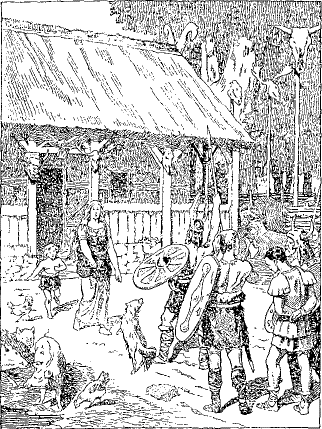
GERMANI ANTIQUI
II. 1. What victory will you announce? 2. I will announce to the people the victory which the sailors have won. 3. The men who were pitching camp were eager for battle. 4. Nevertheless they were soon conquered by the troops which Sextus had sent. 5. They could not resist our forces, but fled from that place without delay.
229. The Faithless Tarpeia (Concluded)3
Tarpēia, commōta ōrnamentīs Sabīnōrum pulchrīs, diū resistere nōn potuit et respondit: “Date mihi4 ōrnāmenta quae in sinistrīs bracchīs geritis, et celeriter cōpiās vestrās in Capitōlium dūcam.” Nec Sabīnī recūsāvērunt, sed per dūrās magnāsque castellī portās properāvērunt quō5 Tarpēia dūxit et mox intrā validōs et altōs mūrōs stābant. Tum sine morā in6 Tarpēiam scūta graviter iēcērunt; nam scūta quoque in sinistrīs bracchiīs gerēbant. Ita perfida puella Tarpēia interfecta est; ita Sabīnī Capitōlium occupāvērunt.
LESSON XXXIX
THE THIRD DECLENSION · CONSONANT STEMS
230. Bases and Stems. In learning the first and second declensions we saw that the different cases were formed by adding the case terminations to the part of the word that did not change, which we called the base. If to the base we add -ā in the first declension, and -o in the second, we get what is called the stem. Thus porta has the base port- and the stem portā-; servus has the base serv- and the stem servo-.
These stem vowels, -ā- and -o-, play so important a part in the formation of the case terminations that these declensions are named from them respectively the Ā- and O-Declensions.
231. Nouns of the Third Declension. The third declension is called the Consonant or I-Declension, and its nouns are classified according to the way the stem ends. If the last letter of the stem is a consonant, the word is said to have a consonant stem; if the stem ends in -i-, the word is said to have an i-stem. In consonant stems the stem is the same as the base. In i-stems the stem is formed by adding -i- to the base. The presence of the i makes a difference in certain of the cases, so the distinction is a very important one.
232. Consonant stems are divided into two classes:
I. Stems that add -s to the base to form the nominative singular.
II. Stems that add no termination in the nominative singular.
CLASS I
233. Stems that add -s to the base in the nominative singular are either masculine or feminine and are declined as follows:
prīnceps, m., chief mīles, m., soldier lapis, m., stone
Bases or Stems prīncip- mīlit- lapid-
Singular TERMINATIONS M. AND F.
Nom. prīnceps mīles lapis -s
Gen. prīn´cipis mīlitis lapidis -is
Dat. prīn´cipī mīlitī lapidī -ī
Acc. prīn´cipem mīlitem lapidem -em
Abl. prīn´cipe mīlite lapide -e
Plural
Nom. prīn´cipēs mīlitēs lapidēs -ēs
Gen. prīn´cipum mīlitum lapidum -um
Dat. prīnci´pibus mīlitibus lapidibus -ibus
Acc. prīn´cipēs mīlitēs lapidēs -ēs
Abl. prīnci´pibus mīlitibus lapidibus -ibus
rēx, m., king iūdex, m., judge virtūs, f., manliness
Bases or Stems rēg- iūdic- virtūt-
Nom. rēx iūdex virtūs -s
Gen. rēgis iūdicis virtū´tis -is
Dat. rēgī iūdicī virtū´tī -ī
Acc. rēgem iūdicem virtū´tem -em
Abl. rēge iūdice virtū´te -e
Plural
Nom. rēgēs iūdicēs virtū´tēs -ēs
Gen. rēgum iūdicum virtū´tum -um
Dat. rēgibus iūdicibus virtū´tibus -ibus
Acc. rēgēs iūdicēs virtū´tēs -ēs
Abl. rēgibus iūdicibus virtū´tibus -ibus
1. The base or stem is found by dropping -is in the genitive singular.
2. Most nouns of two syllables, like prīnceps (prīncip-), mīles (mīlit-), iūdex (iūdic-), have i in the base, but e in the nominative.
a. lapis is an exception to this rule.
3. Observe the consonant changes of the base or stem in the nominative:
a. A final -t or -d is dropped before -s; thus mīles for mīlets, lapis for lapids, virtūs for virtūts.
b. A final -c or -g unites with -s and forms -x; thus iūdec + s = iūdex, rēg + s = rēx.
4. Review § 74 and apply the rules to this declension.
In like manner decline dux, ducis, m., leader; eques, equitis, m., horseman; pedes, peditis, m., foot soldier; pēs, pedis, m.,foot.
234. EXERCISES
First learn the special vocabulary, p. 291.
I. 1. Neque peditēs neque equitēs occupāre castellum Rōmānum poterant. 2. Summā virtūte mūrōs altōs cotīdiē oppugnābant. 3. Pedes mīlitum lapidibus quī dē mūrō iaciēbantur saepe vulnerābantur. 4. Quod novum cōnsilium dux cēpit? 5. Is perfidam puellam pulchrīs ōrnāmentīs temptāvit. 6. Quid puella fēcit? 7. Puella commōta aurō mīlitēs per portās dūxit. 8. Tamen praemia quae summō studiō petīverat nōn reportāvit. 9. Apud Rōmānōs antīquōs Tarpēia nōn est laudāta.
II. 1. What ship is that which I see? That (illud) ship is the Victory. It is sailing now with a favorable wind and will soon approach Italy. 2. The judges commanded the savages to be seized and to be killed. 3. The chiefs of the savages suddenly began to flee, but were quickly captured by the horsemen. 4. The king led the foot soldiers to the wall from which the townsmen were hurling stones with the greatest zeal.
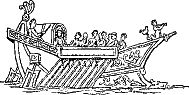
NAVIGIUM
LESSON XL
THE THIRD DECLENSION · CONSONANT STEMS (Continued)
CLASS II
235. Consonant stems that add no termination in the nominative are declined in the other cases exactly like those that add -s. They may be masculine, feminine, or neuter.
236. PARADIGMS
Masculines and Feminines
cōnsul, m., consul legiō, f., legion ōrdō, m., row pater, m., father
Bases or Stems cōnsul- legiōn- ōrdin- patr-
Singular TERMINATIONS M. AND F.
Nom. cōnsul legiō ōrdō pater —
Gen. cōnsulis legiōnis ōrdinis patris -is
Dat. cōnsulī legiōnī ōrdinī patrī -ī
Acc. cōnsulem legiōnem ōrdinem patrem -em
Abl. cōnsule legiōne ōrdine patre -e
Plural
Nom. cōnsulēs legiōnēs ōrdinēs patrēs -ēs
Gen. cōnsulum legiōnum ōrdinum patrum -um
Dat. cōnsulibus legiōnibus ōrdinibus patribus -ibus
Acc. cōnsulēs legiōnēs ōrdinēs patrēs -ēs
Abl. cōnsulibus legiōnibus ōrdinibus patribus -ibus
1. With the exception of the nominative, the terminations are exactly the same as in Class I, and the base or stem is found in the same way.
2. Masculines and feminines with bases or stems in -in- and -ōn- drop -n- and end in -ō in the nominative, as legiō (base or stem legiōn-), ōrdō (base or stem ōrdin-).
3. Bases or stems in -tr- have -ter in the nominative, as pater (base or stem patr-).
4. Note how the genitive singular gives the clue to the whole declension. Always learn this with the nominative.
237. EXERCISES
First learn the special vocabulary, p. 291.
I. 1. Audīsne tubās, Mārce? Nōn sōlum tubās audiō sed etiam ōrdinēs militum et carrōs impedīmentōrum plēnōs vidēre possum. 2. Quās legiōnēs vidēmus? Eae legiōnēs nūper ex Galliā vēnērunt. 3. Quid ibi fēcērunt? Studēbantne pugnāre an sine virtūte erant? 4. Multa proelia fēcērunt1 et magnās victōriās et multōs captīvōs reportāvērunt. 5. Quis est imperātor eārum legiōnum? Caesar, summus Rōmānōrum imperātor. 6. Quis est eques quī pulchram corōnam gerit? Is eques est frāter meus. Eī corōna ā cōnsule data est quia summā virtūte pugnāverat et ā barbarīs patriam servāverat.
II. 1. Who has seen my father to-day? 2. I saw him just now (nūper). He was hastening to your dwelling with your mother and sister. 3. When men are far from the fatherland and lack food, they cannot be restrained2 from wrong3. 4. The safety of the soldiers is dear to Cæsar, the general. 5. The chiefs were eager to storm a town full of grain which was held by the consul. 6. The king forbade the baggage of the captives to be destroyed.
LESSON XLI
THE THIRD DECLENSION · CONSONANT STEMS (Concluded)
238. Neuter consonant stems add no termination in the nominative and are declined as follows:
flūmen, n., river tempus, n., time opus, n., work caput, n., head
Bases or Stems flūmin- tempor- oper- capit-
Singular TERMINATIONS
Nom. flūmen tempus opus caput —
Gen. flūminis temporis operis capitis -is -is
Dat. flūminī temporī operī capitī -ī
Acc. flūmen tempus opus caput —
Abl. flūmine tempore opere capite -e
Plural
Nom. flūmina tempora opera capita -a
Gen. flūminum temporum operum capitum -um
Dat. flūminibus temporibus operibus capitibus -ibus
Acc. flūmina tempora opera capita -a
Abl. flūminibus temporibus operibus capitibus -ibus
1. Review § 74 and apply the rules to this declension.
2. Bases or stems in -in- have -e- instead of -i- in the nominative, as flūmen, base or stem flūmin-.
3. Most bases or stems in -er- and -or- have -us in the nominative, as opus, base or stem oper-; tempus, base or stem tempor-.
239. EXERCISES
First learn the special vocabulary, p. 292.
I. 1. Barbarī ubi Rōmam cēpērunt, maxima rēgum opera dēlēvērunt. 2. Rōmānī multās calamitātēs ā barbarīs accēpērunt. 3. Ubi erat summus terror apud oppidānōs, animī dubiī eōrum ab ōrātōre clarō cōnfīrmāti sunt. 4. Rōma est in rīpīs fiūminis magnī. 5. Ubi Caesar imperātor mīlitēs suōs arma capere iussit, iī ā proeliō continērī nōn potuērunt. 6. Ubi proelium factum est, imperātor reperīrī nōn potuit. 7. Imperātor sagittā in capite vulnerātus erat et stāre nōn poterat. 8. Eum magnō labōre pedes ex proeliō portāvit. 9. Is bracchiīs suīs imperātōrem tenuit et eum ex perīculīs summīs servāvit. 10. Virtūte suā bonus mīles ab imperātōre corōnam accēpit.
II. 1. The consul placed a crown on the head of the victor. 2. Before the gates he was received by the townsmen. 3. A famous orator praised him and said, “By your labors you have saved the fatherland from disaster.” 4. The words of the orator were pleasing to the victor. 5. To save the fatherland was a great task.
CORONA

LESSON XLII
REVIEW LESSON
240. Review the paradigms in §§ 233, 236, 238; and decline all nouns of the third declension in this selection.
Terror Cimbricus1
Ōlim Cimbrī et Teutonēs, populī Germāniae, cum fēminīs līberīsque Italiae adpropinquāverant et cōpiās Rōmānās maximō proeliō vīcerant. Ubi fuga legiōnum nūntiāta est, summus erat terror tōtīus Rōmae, et Rōmānī, graviter commōtī, sacra crēbra deīs faciēbant et salūtem petēbant.
Tum Mānlius ōrātor animōs populī ita cōnfīrmāvit:—“Magnam calamitātem accēpimus. Oppida nostra ā Cimbrīs Teutonibusque capiuntur, agricolae interficiuntur, agrī vāstantur, cōpiae barbarōrum Rōmae adpropinquant. Itaque, nisi novīs animīs proelium novum faciēmus et Germānōs ex patriā nostrā sine morā agēmus, erit nūlla salūs fēminīs nostrīs līberīsque. Servāte līberōs! Servāte patriam! Anteā superātī sumus quia imperātōrēs nostrī fuērunt īnfīrmī. Nunc Marius, clārus imperātor, quī iam multās aliās victōriās reportāvit, legiōnēs dūcet et animōs nostrōs terrōre Cimbricō līberāre mātūrābit.”
Marius tum in Āfricā bellum gerēbat. Sine morā ex Āfricā in Italiam vocātus est. Cōpiās novās nōn sōlum tōtī Italiae sed etiam prōvinciīs sociōrum imperāvit.2 Disciplīnā autem dūrā labōribusque perpetuīs mīlitēs exercuit. Tum cum peditibus equitibusque, quī iam proeliō studēbant, ad Germānōrum castra celeriter properāvit. Diū et ācriter pugnātum est.3 Dēnique barbarī fūgērunt et multī in fugā ab equitibus sunt interfectī. Marius pater patriae vocātus est.
LESSON XLIII
THE THIRD DECLENSION · I-STEMS
241. To decline a noun of the third declension correctly we must know whether or not it is an i-stem. Nouns with i-stems are
1. Masculines and feminines:
a. Nouns in -ēs and -īs with the same number of syllables in the genitive as in the nominative. Thus caedēs, caedis, is an i-stem, but mīles, mīlitis, is a consonant stem.
b. Nouns in -ns and -rs.
c. Nouns of one syllable in -s or -x preceded by a consonant.
2. Neuters in -e, -al, and -ar.
242. The declension of i-stems is nearly the same as that of consonant stems. Note the following differences:
a. Masculines and feminities have -ium in the genitive plural and -īs or -ēs in the accusative plural.
b. Neuters have -ī in the ablative singular, and an -i- in every form of the plural.
243. Masculine and Feminine I-Stems. Masculine and feminine i-stems are declined as follows:
caedēs, f., slaughter hostis, m., enemy urbs, f., city cliēns, m., retainer
Stems caedi- hosti- urbi- clienti-
Bases caed- host- urb- client-
Singular TERMINATIONS M. AND F.
Nom. caedēs hostis urbs cliēns1 -s, -is, or -ēs
Gen. caedis hostis urbis clientis -is
Dat. caedī hostī urbī clientī -ī
Acc. caedem hostem urbem clientem -em (-im)
Abl. caede hoste urbe cliente -e (-ī)
Plural
Nom. caedēs hostēs urbēs clientēs -ēs
Gen. caedium hostium urbium clientium -ium
Dat. caedibus hostibus urbibus clientibus -ibus
Acc. caedīs, -ēs hostīs, -ēs urbīs, -ēs clientīs, -ēs -īs, -ēs
Abl. caedibus hostibus urbibus clientibus -ibus
1. avis, cīvis, fīnis, ignis, nāvis have the ablative singular in -ī or -e.
2. turris has accusative turrim and ablative turrī or turre.
244. Neuter I-Stems. Neuter i-stems are declined as follows:
īnsigne, n., decoration animal, n., animal calcar, n., spur
Stems īnsigni- animāli- calcāri-
Bases īnsign- animāl- calcār-
Singular TERMINATIONS
Nom. īnsigne animal calcar -e or—
Gen. īnsignis animālis calcāris -is
Dat. īnsignī animālī calcārī -ī
Acc. īnsigne animal calcar -e or—
Abl. īnsignī animālī calcārī -ī
Plural
Nom. īnsignia animālia calcāria -ia
Gen. īnsignium animālium calcārium -ium
Dat. īnsignibus animālibus calcāribus -ibus
Acc. īnsignia animālia calcāria -ia
Abl. īnsignibus animālibus calcāribus -ibus
1. Review § 74 and see how it applies to this declension.
2. The final -i- of the stem is usually dropped in the nominative. If not dropped, it is changed to -e.
3. A long vowel is shortened before final -l or -r. (Cf. § 12. 2.)
245. EXERCISES
First learn the special vocabulary, p. 292.
I. 1. Quam urbem vidēmus? Urbs quam vidētis est Rōma. 2. Cīvēs Rōmānī urbem suam turribus altīs et mūrīs longīs mūnīverant. 3. Ventī nāvīs longās prohibēbant fīnibus hostium adpropinquāre. 4. Imperātor a clientibus suīs calcāria aurī et alia īnsignia accēpit. 5. Mīlitēs Rōmānī cum hostibus bella saeva gessērunt et eōs caede magnā superāvērunt. 6. Alia animālia terram, alia mare amant. 7. Nāvēs longae quae auxilium ad imperātōrem portābant ignī ab hostibus dēlētae sunt. 8. In eō marī avis multās vīdimus quae longē ā terrā volāverant. 9. Nōnne vīdistis nāvīs longās hostium et ignīs quibus urbs nostra vāstābātur? Certē, sed nec caedem cīvium nec fugam clientium vīdimus. 10. Avēs et alia animālia, ubi ignem vīdērunt, salūtem fugā petere celeriter incēpērunt. 11. Num. iūdex in peditum ōrdinibus stābat? Minimē, iūdex erat apud equitēs et equus eius īnsigne pulchrum gerēbat.
NAVES LONGAE
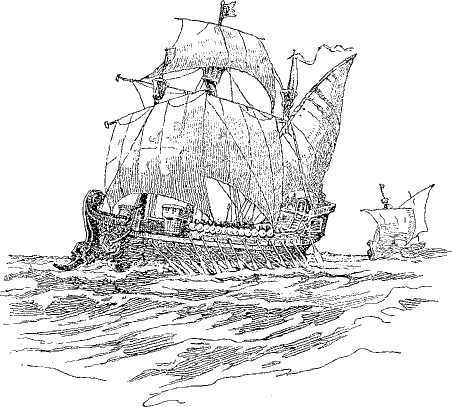
II. 1. Because of the lack of grain the animals of the village were not able to live. 2. When the general2 heard the rumor, he quickly sent a horseman to the village. 3. The horseman had a beautiful horse and wore spurs of gold. 4. He said to the citizens, “Send your retainers with horses and wagons to our camp, and you will receive an abundance of grain.” 5. With happy hearts they hastened to obey his words.3
LESSON XLIV
IRREGULAR NOUNS OF THE THIRD DECLENSION · GENDER IN THE THIRD DECLENSION
246. PARADIGMS
The “Stems” are missing in the printed book. They have been supplied from the inflectional table in the Appendix.
vīs, f., force iter, n., march
Stems vī- and vīri- iter- and itiner-
Bases v- and vīr- iter- and itiner-
Singular
Nom. vīs iter
Gen. vīs (rare) itineris
Dat. vī (rare) itinerī
Acc. vim iter
Abl. vī itinere
Plural
Nom. vīrēs itinera
Gen. vīrium itinerum
Dat. vīribus itineribus
Acc. vīrīs, or -ēs itinera
Abl. vīribus itineribus
247. There are no rules for gender in the third declension that do not present numerous exceptions.1 The following rules, however, are of great service, and should be thoroughly mastered:
1. Masculine are nouns in -or, -ōs, -er, -ĕs (gen. -itis).
a. arbor, tree, is feminine; and iter, march, is neuter.
2. Feminine are nouns in -ō, -is, -x, and in -s preceded by a consonant or by any long vowel but ō.
a. Masculine are collis (hill), lapis, mēnsis (month), ōrdō, pēs, and nouns in -nis and -guis—as ignis, sanguis (blood)—and the four monosyllables
dēns, a tooth mōns, a mountain pōns, a bridge fōns, a fountain
3. Neuters are nouns in -e, -al, -ar, -n, -ur, -ŭs, and caput.
248. Give the gender of the following nouns and the rule by which it is determined:
animal calamitās flūmen lapis nāvis
avis caput ignis legiō opus
caedēs eques īnsigne mare salūs
calcar fīnis labor mīles urbs
249. EXERCISES
First learn the special vocabulary, p. 292.
I. The First Bridge over the Rhine. Salūs sociōrum erat semper cāra Rōmānīs. Ōlim Gallī, amīcī Rōmānōrum, multās iniūriās ab Germānīs quī trāns flūmen Rhēnum vivēbant accēperant. Ubi lēgātī ab iīs ad Caesarem imperātōrem Rōmānum vēnērunt et auxilium postulāvērunt, Rōmānī magnīs itineribus ad hostium fīnīs properāvērunt. Mox ad rīpās magnī flūminis vēnērunt. Imperātor studēbat cōpiās suās trāns fluvium dūcere, sed nūllā viā2 poterat. Nūllās nāvīs habēbat. Alta erat aqua. Imperātor autem, vir clārus, numquam adversā fortūnā commōtus, novum cōnsilium cēpit. Iussit suōs3 in4 lātō flūmine facere pontem. Numquam anteā pōns in Rhēnō vīsus erat. Hostēs ubi pontem quem Rōmānī fēcerant vīdērunt, summō terrōre commōtī, sine morā fugam parāre incēpērunt.
II. 1. The enemy had taken (possession of) the top of the mountain. 2. There were many trees on the opposite hills. 3. We pitched our camp near (ad) a beautiful spring. 4. A march through the enemies’ country is never without danger. 5. The time of the month was suitable for the march. 6. The teeth of the monster were long. 7. When the foot soldiers4 saw the blood of the captives, they began to assail the fortifications with the greatest violence.5
Fifth Review, Lessons XXXVII-XLIV, §§ 517-520
LESSON XLV
ADJECTIVES OF THE THIRD DECLENSION · I-STEMS
250. Adjectives are either of the first and second declensions (like bonus, aeger, or līber), or they are of the third declension.
251. Nearly all adjectives of the third declension have i-stems, and they are declined almost like nouns with i-stems.
252. Adjectives learned thus far have had a different form in the nominative for each gender, as, bonus, m.; bona, f.; bonum, n. Such an adjective is called an adjective of three endings. Adjectives of the third declension are of the following classes:
I. Adjectives of three endings— a different form in the nominative for each gender.
II. Adjectives of two endings— masculine and feminine nominative alike, the neuter different.
III. Adjectives of one ending— masculine, feminine, and neuter nominative all alike.
253. Adjectives of the third declension in -er have three endings; those in -is have two endings; the others have one ending.
CLASS I
254. Adjectives of Three Endings are declined as follows:
ācer, ācris, ācre, keen, eager
Stem ācri- Base ācr-
Singular Plural
MASC. FEM. NEUT. MASC. FEM. NEUT.
Nom. ācer ācris ācre ācrēs ācrēs ācria
Gen. ācris ācris ācris ācrium ācrium ācrium
Dat. ācrī ācrī ācrī ācribus ācribus ācribus
Acc. ācrem ācrem ācre ācrīs, -ēs ācrīs, -ēs ācria
Abl. ācrī ācrī ācrī ācribus ācribus ācribus
CLASS II
255. Adjectives of Two Endings are declined as follows:
omnis, omne, every, all1
Stem omni- Base omn-
Singular Plural
MASC. AND FEM. NEUT. MASC. AND FEM. NEUT.
Nom. omnis omne omnēs omnia
Gen. omnis omnis omnium omnium
Dat. omnī omnī omnibus omnibus
Acc. omnem omne omnīs, ēs omnia
Abl. omnī omnī omnibus omnibus
CLASS III
256. Adjectives of One Ending are declined as follows:
pār, equal
Stem pari- Base par-
Singular Plural
MASC. AND FEM. NEUT. MASC. AND FEM. NEUT.
Nom. pār pār parēs paria
Gen. paris paris parium parium
Dat. parī parī paribus paribus
Acc. parem pār parīs, ēs paria
Abl. parī parī paribus paribus
1. All i-stem adjectives have -ī in the ablative singular.
2. Observe that the several cases of adjectives of one ending have the same form for all genders excepting in the accusative singular and in the nominative and accusative plural.
3. Decline vir ācer, legiō ācris, animal ācre, ager omnis, scūtum omne, proelium pār.
257. There are a few adjectives of one ending that have consonant stems. They are declined exactly like nouns with consonant stems.
258. EXERCISES
First learn the special vocabulary, p. 293.
I. The Romans invade the Enemy’s Country. Ōlim peditēs Rōmānī cum equitibus vēlōcibus in hostium urbem iter faciēbant. Ubi nōn longē āfuērunt, rapuērunt agricolam, quī eīs viam brevem et facilem dēmōnstrāvit. Iam Rōmānī moenia alta, turrīs validās aliaque opera urbis vidēre poterant. In moenibus stābant multī prīncipēs. Prīncipēs ubi vīdērunt Rōmānōs, iussērunt cīvīs lapidēs aliaque tēla dē mūrīs iacere. Tum mīlitēs fortēs continērī ā proeliō nōn poterant et ācer imperātor signum tubā darī iussit. Summā vī omnēs mātūrāvērunt. Imperātor Sextō lēgātō impedīmenta omnia mandāvit. Sextus impedīmenta in summō colle conlocāvit. Grave et ācre erat proelium, sed hostēs nōn parēs Rōmānīs erant. Aliī interfectī, aliī captī sunt. Apud captīvōs erant māter sororque rēgis. Paucī Rōmānōrum ab hostibus vulnerātī sunt. Secundum proelium Rōmānīs erat grātum. Fortūna fortibus semper favet.
II. 1. Some months are short, others are long. 2. To seize the top of the mountain was difficult. 3. Among the hills of Italy are many beautiful springs. 4. The soldiers were sitting where the baggage had been placed because their feet were weary. 5. The city which the soldiers were eager to storm had been fortified by strong walls and high towers. 6. Did not the king intrust a heavy crown of gold and all his money to a faithless slave? Yes, but the slave had never before been faithless.
AQUILA LEGIONIS

LESSON XLVI
THE FOURTH OR U-DECLENSION
259. Nouns of the fourth declension are either masculine or neuter.
260. Masculine nouns end in -us, neuters in -ū. The genitive ends in -ūs.
a. Feminine by exception are domus, house; manus, hand; and a few others.
PARADIGMS
The “Stems” are missing in the printed book. They have been supplied from the inflectional table in the Appendix.
adventus, m., arrival cornū, n., horn
Stems adventu- cornu-
Bases advent- corn-
Singular TERMINATIONS
MASC. NEUT.
Nom. adventus cornū -us -ū
Gen. adventūs cornūs -ūs -ūs
Dat. adventuī (ū) cornū -uī (ū) -ū
Acc. adventum cornū -um -ū
Abl. adventū cornū -ū -ū
Plural
Nom. adventūs cornua -ūs -ua
Gen. adventuum cornuum -uum -uum
Dat. adventibus cornibus -ibus -ibus
Acc. adventūs cornua -ūs -ua
Abl. adventibus cornibus -ibus -ibus
1. Observe that the base is found, as in other declensions, by dropping the ending of the genitive singular.
2. lacus, lake, has the ending -ubus in the dative and ablative plural; portus, harbor, has either -ubus or -ibus.
3. cornū is the only neuter that is in common use.
261. EXERCISES
First learn the special vocabulary, p. 293.
I. 1. Ante adventum Caesaris vēlōcēs hostium equitēs ācrem impetum in castra fēcērunt. 2. Continēre exercitum ā proeliō nōn facile erat. 3. Post adventum suum Caesar iussit legiōnēs ex castrīs dūcī. 4. Prō castrīs cum hostium equitātū pugnātum est. 5. Post tempus breve equitātus trāns flūmen fūgit ubi castra hostium posita erant. 6. Tum victor imperātor agrōs vāstāvit et vīcōs hostium cremāvit. 7. Castra autem nōn oppugnāvit quia mīlitēs erant dēfessī et locus difficilis. 8. Hostēs nōn cessāvērunt iacere tēla, quae paucīs nocuērunt. 9. Post adversum proelium principēs Gallōrum lēgātōs ad Caesarem mittere studēbant, sed populō persuādēre nōn poterant.
II. 1. Did you see the man-of-war on the lake? 2. I did not see it (fem.) on the lake, but I saw it in the harbor. 3. Because of the strong wind the sailor forbade his brother to sail. 4. Cæsar didn´t make an attack on the cavalry on the right wing, did he? 5. No, he made an attack on the left wing. 6. Who taught your swift horse to obey? 7. I trained my horse with my (own) hands, nor was the task difficult. 8. He is a beautiful animal and has great strength.
LESSON XLVII
EXPRESSIONS OF PLACE · THE DECLENSION OF DOMUS
262. We have become thoroughly familiar with expressions like the following:
Galba ad (or in) oppidum properat Galba ab (dē or ex) oppidō properat Galba in oppidō habitat
From these expressions we may deduce the following rules:
263. Rule. Accusative of the Place to. The place to which is expressed by ad or in with the accusative. This answers the question Whither?
264. Rule. Ablative of the Place from. The place from which is expressed by ā or ab, dē, ē or ex, with the separative ablative. This answers the question Whence? (Cf. Rule, § 179.)
265. Rule. Ablative of the Place at or in. The place at or in which is expressed by the ablative with in. This answers the question Where?
a. The ablative denoting the place where is called the locative ablative (cf. locus, place).
266. Exceptions. Names of towns, small islands,1 domus, home, rūs, country, and a few other words in common use omit the prepositions in expressions of place, as,
Galba Athēnās properat, Galba hastens to Athens Galba Athēnīs properat, Galba hastens from Athens Galba Athēnīs habitat, Galba lives at (or in) Athens Galba domum properat, Galba hastens home Galba rūs properat, Galba hastens to the country Galba domō properat, Galba hastens from home Galba rūre properat, Galba hastens from the country Galba rūrī (less commonly rūre) habitat, Galba lives in the country
a. Names of countries, like Germānia, Italia, etc., do not come under these exceptions. With them prepositions must not be omitted.
267. The Locative Case. We saw above that the place-relation expressed by at or in is regularly covered by the locative ablative. However, Latin originally expressed this relation by a separate form known as the locative case. This case has been everywhere merged in the ablative excepting in the singular number of the first and second declensions. The form of the locative in these declensions is like the genitive singular, and its use is limited to names of towns and small islands, domī, at home, and a few other words.
268. Rule. Locative and Locative Ablative. To express the place in which with names of towns and small islands, if they are singular and of the first or second declension, use the locative; otherwise use the locative ablative without a preposition; as,
Galba Rōmae habitat, Galba lives at Rome Galba Corinthī habitat, Galba lives at Corinth Galba domī habitat, Galba lives at home
Here Rōmae, Corinthī, and domī are locatives, being singular and of the first and second declensions respectively. But in
Galba Athēnīs habitat, Galba lives at Athens, Galba Pompēiīs habitat, Galba lives at Pompeii
Athēnīs and Pompēiīs are locative ablatives. These words can have no locative case, as the nominatives Athēnae and Pompēiī are plural and there is no plural locative case form.
269. The word domus, home, house, has forms of both the second and the fourth declension. Learn its declension (§ 468).
270. EXERCISES
First learn the special vocabulary, p. 293.
I. 1. Corinthī omnia īnsignia aurī ā ducibus victōribus rapta erant. 2. Caesar Genāvam exercitum magnīs itineribus dūxit. 3. Quem pontem hostēs cremāverant? Pontem in Rhēnō hostēs cremāverant. 4. Pompēiīs multās Rōmānōrum domōs vidēre poteritis. 5. Rōmā cōnsul equō vēlōcī rūs properāvit. 6. Domī cōnsulis hominēs multī sedēbant. 7. Imperātor iusserat lēgātum Athēnās cum multīs nāvibus longīs nāvigāre. 8. Ante moenia urbis sunt ōrdinēs arborum altārum. 9. Propter arborēs altās nec lacum nec portum reperīre potuimus. 10. Proeliīs crēbrīs Caesar legiōnēs suās quae erant in Galliā exercēbat. 11. Cotīdiē in locō idoneō castra pōnēbat et mūniēbat.
II. 1. Cæsar, the famous general, when he had departed from Rome, hastened to the Roman province on a swift horse.2 2. He had heard a rumor concerning the allies at Geneva. 3. After his arrival Cæsar called the soldiers together and commanded them to join battle. 4. The enemy hastened to retreat, some because3 they were afraid, others because3 of wounds. 5. Recently I was at Athens and saw the place where the judges used to sit.4 6. Marcus and Sextus are my brothers; the one lives at Rome, the other in the country.
DAEDALUS ET ICARUS
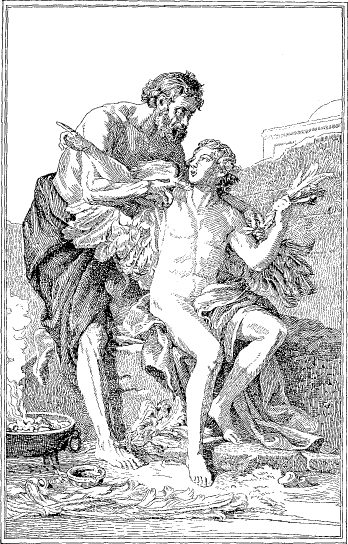
271. Daed´alus and Ic´arus
Crēta est īnsula antīqua quae aquā altā magnī maris pulsātur. Ibi ōlim Mīnōs erat rēx. Ad eum vēnit Daedalus quī ex Graeciā patriā fugiēbat. Eum Mīnōs rēx benignīs verbīs accēpit et eī domicilium in Crētā dedit. 5Quō in locō Daedalus sine cūrā vīvebat et rēgī multa et clāra opera faciēbat. Post tempus longum autem Daedalus patriam cāram dēsīderāre incēpit. Domum properāre studēbat, sed rēgī persuādēre nōn potuit et mare saevum fugam vetābat.
LESSON XLVIII
THE FIFTH OR Ē-DECLENSION · THE ABLATIVE OF TIME
272. Gender. Nouns of the fifth declension are feminine except diēs, day, and merīdiēs, midday, which are usually masculine.
273. PARADIGMS
The “Stems” are missing in the printed book. They have been supplied from the inflectional table in the Appendix.
diēs, m., day rēs, f. thing
Stems diē- rē-
Bases di- r-
Singular TERMINATIONS
Nom. diēs rēs -ēs
Gen. diēī reī -ē̆ī
Dat. diēī reī -ē̆ī
Acc. diem rem -em
Abl. diē rē -ē
Plural
Nom. diēs rēs -ēs
Gen. diērum rērum -ērum
Dat. diēbus rēbus -ēbus
Acc. diēs rēs -ēs
Abl. diēbus rēbus -ēbus
1. The vowel e which appears in every form is regularly long. It is shortened in the ending -eī after a consonant, as in r-ĕī; and before -m in the accusative singular, as in di-em. (Cf. § 12. 2.)
2. Only diēs and rēs are complete in the plural. Most other nouns of this declension lack the plural. Aciēs, line of battle, and spēs, hope, have the nominative and accusative plural.
274. The ablative relation (§ 50) which is expressed by the prepositions at, in, or on may refer not only to place, but also to time, as at noon, in summer, on the first day. The ablative which is used to express this relation is called the ablative of time.
275. Rule. The Ablative of Time. The time when or within which anything happens is expressed by the ablative without a preposition.
a. Occasionally the preposition in is found. Compare the English Next day we started and On the next day we started.
276. EXERCISES
First learn the special vocabulary, p. 294.
I. Galba the Farmer. Galba agricola rūrī vīvit. Cotīdiē prīmā lūce labōrāre incipit, nec ante noctem in studiō suō cessat. Merīdiē Iūlia fīlia eum ad cēnam vocat. Nocte pedēs dēfessōs domum vertit. Aestāte fīliī agricolae auxilium patrī dant. Hieme agricola eōs in lūdum mittit. Ibi magister pueris multās fābulās dē rēbus gestīs Caesaris nārrat. Aestāte fīliī agricolae perpetuīs labōribus exercentur nec grave agrī opus est iīs molestum. Galba sine ūllā cūrā vivit nec rēs adversās timet.
II. 1. In that month there were many battles in Gaul. 2. The cavalry of the enemy made an attack upon Cæsar’s line of battle. 3. In the first hour of the night the ship was overcome by the billows. 4. On the second day the savages were eager to come under Cæsar’s protection. 5. The king had joined battle, moved by the hope of victory. 6. That year a fire destroyed many birds and other animals. 7. We saw blood on the wild beast’s teeth.
277. Daed´alus and Ic´arus (Continued)
Tum Daedalus gravibus cūrīs commōtus fīliō suō Īcarō ita dixit: “Animus meus, Īcare, est plēnus trīstitiae nec oculī lacrimīs egent. Discēdere ex Crētā, Athēnās properāre, maximē studeō; sed rēx recūsat audīre verba mea et omnem reditūs spem ēripit. Sed numquam rēbus adversīs vincar. Terra et mare sunt inimīca, sed aliam fugae viam reperiam.” Tum in artīs ignōtās animum dīmittit et mīrum capit cōnsilium. Nam pennās in ōrdine pōnit et vērās ālās facit.
LESSON XLIX
PRONOUNS CLASSIFIED · PERSONAL AND REFLEXIVE PRONOUNS
278. We have the same kinds of pronouns in Latin as in English. They are divided into the following eight classes:
1. Personal pronouns, which show the person speaking, spoken to, or spoken of; as, ego, I; tū, you; is, he. (Cf. § 279. etc.)
2. Possessive pronouns, which denote possession; as, meus, tuus, suus, etc. (Cf. § 98.)
3. Reflexive pronouns, used in the predicate to refer back to the subject; as, he saw himself. (Cf. § 281.)
4. Intensive pronouns, used to emphasize a noun or pronoun; as, I myself saw it. (Cf. § 285.)
5. Demonstrative pronouns, which point out persons or things; as, is, this, that. (Cf. § 112.)
6. Relative pronouns, which connect a subordinate adjective clause with an antecedent; as, quī, who. (Cf. § 220.)
7. Interrogative pronouns, which ask a question; as, quis, who? (Cf. § 225.)
8. Indefinite pronouns, which point out indefinitely; as, some one, any one, some, certain ones, etc. (Cf. § 296.)
279. The demonstrative pronoun is, ea, id, as we learned in § 115, is regularly used as the personal pronoun of the third person (he, she, it, they, etc.).
280. The personal pronouns of the first person are ego, I; nōs, we; of the second person, tū, thou or you; vōs, ye or you. They are declined as follows:
Singular
FIRST PERSON SECOND PERSON
Nom. ego, I tū, you
Gen. meī, of me tuī, of you
Dat. mihi, to or for me tibi, to or for you
Acc. mē, me tē, you
Abl. mē, with, from, etc., me tē, with, from, etc., you
Plural
Nom. nōs, we vōs, you
Gen. nostrum or nostrī, of us vestrum or vestrī, of you
Dat. nōbīs, to or for us vōbīs, to or for you
Acc. nōs, us vōs, you
Abl. nōbīs, with, from, etc., us vōbīs, with, from, etc., you
1. The personal pronouns are not used in the nominative excepting for emphasis or contrast.
281. The Reflexive Pronouns. 1. The personal pronouns ego and tū may be used in the predicate as reflexives; as,
videō mē, I see myself vidēmus nōs, we see ourselves
vidēs tē, you see yourself vidētis vōs, you see yourselves
2. The reflexive pronoun of the third person (himself, herself, itself, themselves) has a special form, used only in these senses, and declined alike in the singular and plural.
Singular and Plural
Gen. suī Acc. sē
Dat. sibi Abl. sē
Examples Puer sē videt, the boy sees himself Puella sē videt, the girl sees herself Animal sē videt, the animal sees itself Iī sē vident, they see themselves
a. The form sē is sometimes doubled, sēsē, for emphasis.
3. Give the Latin for
I teach myself We teach ourselves
You teach yourself You teach yourselves
He teaches himself They teach themselves
282. The preposition cum, when used with the ablative of ego, tū, or suī, is appended to the form, as, mēcum, with me; tēcum, with you; nōbīscum, with us; etc.
283. EXERCISES
First learn the special vocabulary, p. 294.
I. 1. Mea māter est cāra mihi et tua māter est cāra tibi. 2. Vestrae litterae erant grātae nōbis et nostrae litterae erant grātae vōbīs. 3. Nūntius rēgis quī nōbīscum est nihil respondēbit. 4. Nūntiī pācem amīcitiamque sibi et suīs sociīs postulāvērunt. 5. Sī tū arma sūmēs, ego rēgnum occupābō. 6. Uter vestrum est cīvis Rōmānus? Neuter nostrum. 7. Eō tempore multī supplicium dedērunt quia rēgnum petierant. 8. Sūme supplicium, Caesar, dē hostibus patriae ācribus. 9. Prīmā lūce aliī metū commōtī sēsē fugae mandāvērunt; aliī autem magnā virtūte impetum exercitūs nostrī sustinuērunt. 10. Soror rēgis, ubi dē adversō proeliō audīvit, sēsē Pompēiīs interfēcit.
II. 1. Whom do you teach? I teach myself. 2. The soldier wounded himself with his sword. 3. The master praises us, but you he does not praise. 4. Therefore he will inflict punishment on you, but we shall not suffer punishment. 5. Who will march (i.e. make a march) with me to Rome? 6. I will march with you to the gates of the city. 7. Who will show us1 the way? The gods will show you1 the way.
Daed´alus and Ic´arus (Concluded)
284. Puer Īcarus ūnā2 stābat et mīrum patris opus vidēbat. Postquam manus ultima3 ālīs imposita est, Daedalus eās temptāvit et similis avī in aurās volāvit. Tum ālās umerīs fīlī adligāvit et docuit eum volāre et dīxit, “Tē vetō, mī fīlī, adpropinquāre aut sōlī aut marī. Sī fluctibus adpropinquāveris,4 aqua ālīs tuīs nocēbit, et sī sōlī adpropinquāveris,4 ignis eās cremābit.” Tum pater et filius iter difficile incipiunt. Ālās movent et aurae sēsē committunt. Sed stultus puer verbīs patris nōn pāret. Sōlī adpropinquat. Ālae cremantur et Īcarus in mare dēcidit et vitam āmittit. Daedalus autem sine ūllō perīculō trāns fluctūs ad īnsulam Siciliam volāvit.
LESSON L
THE INTENSIVE PRONOUN IPSE AND THE DEMONSTRATIVE ĪDEM
285. Ipse means -self (him-self, her-self, etc.) or is translated by even or very. It is used to emphasize a noun or pronoun, expressed or understood, with which it agrees like an adjective.
a. Ipse must be carefully distinguished from the reflexive suī. The latter is always used as a pronoun, while ipse is regularly adjective. Compare
Homō sē videt, the man sees himself (reflexive) Homō ipse perīculum videt, the man himself (intensive) sees the danger Homō ipsum perīculum videt, the man sees the danger itself (intensive)
286. Except for the one form ipse, the intensive pronoun is declined exactly like the nine irregular adjectives (cf. §§ 108, 109). Learn the declension (§ 481).
287. The demonstrative īdem, meaning the same, is a compound of is. It is declined as follows:
Singular Plural
MASC. FEM. NEUT. MASC. FEM. NEUT.
Nom. īdem e´adem idem iī´dem eī´dem eae´dem e´adem
Gen. eius´dem eius´dem eius´dem eōrun´dem eārun´dem eōrun´dem
Dat. eī´dem eī´dem eī´dem iīs´dem eīs´dem iīs´dem eīs´dem iīs´dem eīs´dem
Acc. eun´dem ean´dem idem eōs´dem eās´dem e´adem
Dat. eī´dem eī´dem eī´dem iīs´dem eīs´dem iīs´dem eīs´dem iīs´dem eīs´dem
a. From forms like eundem (eum + -dem), eōrundem (eōrum + -dem), we learn the rule that m before d is changed to n.
b. The forms iīdem, iīsdem are often spelled and pronounced with one ī.
288. EXERCISES
First learn the special vocabulary, p. 295.
I. 1. Ego et tū1 in eādem urbe vīvimus. 2. Iter ipsum nōn timēmus sed ferās saevās quae in silvā dēnsā esse dīcuntur. 3. Ōlim nōs ipsī idem iter fēcimus. 4. Eō tempore multās ferās vīdimus. 5. Sed nōbīs nōn nocuērunt. 6. Caesar ipse scūtum dē manibus mīlitis ēripuit et in ipsam aciem properāvit. 7. Itaque mīlitēs summā virtūte tēla in hostium corpora iēcērunt. 8. Rōmānī quoque gravia vulnera accēpērunt. 9. Dēnique hostēs terga vertērunt et ommīs in partīs2 fūgērunt. 10. Eādem hōrā litterae Rōmam ab imperātōre ipsō missae sunt. 11. Eōdem mēnse captīvī quoque in Italiam missī sunt. 12. Sed multī propter vulnera iter difficile trāns montīs facere recūsābant et Genāvae esse dīcēbantur.
II. 1. At Pompeii there is a wonderful mountain. 2. When I was in that place, I myself saw that mountain. 3. On the same day many cities were destroyed by fire and stones from that very mountain. 4. You have not heard the true story of that calamity, have you?3 5. On that day the very sun could not give light to men. 6. You yourself ought to tell (to) us that story.
289. How Horatius held the Bridge4
Tarquinius Superbus, septimus et ultimus rēx Rōmānōrum, ubi in exsilium ab īrātīs Rōmānīs ēiectus est, ā Porsenā, rēge Etrūscōrum, auxilium petiit. Mox Porsena magnīs cum cōpiīs Rōmam vēnit, et ipsa urbs summō in perīculō erat. Omnibus in partibus exercitus Rōmānus victus erat. Iam rēx montem Iāniculum5 occupāverat. Numquam anteā Rōmānī tantō metū tenēbantur. Ex agrīs in urbem properābant et summō studiō urbem ipsam mūniēbant.
LESSON LI
THE DEMONSTRATIVE PRONOUNS HIC, ISTE, ILLE
290. We have already learned the declension of the demonstrative pronoun is and its use. (Cf. Lesson XVII.) That pronoun refers to persons or things either far or near, and makes no definite reference to place or time. If we wish to point out an object definitely in place or time, we must use hic, iste, or ille. These demonstratives, like is, are used both as pronouns and as adjectives, and their relation to the speaker may be represented graphically thus:

a. In dialogue hic refers to a person or thing near the speaker; iste, to a person or thing near the person addressed; ille, to a person or thing remote from both. These distinctions are illustrated in the model sentences, § 293, which should be carefully studied and imitated.
291. Hic is declined as follows:
Singular Plural
MASC. FEM. NEUT. MASC. FEM. NEUT.
Nom. hic haec hoc hī hae haec
Gen. huius huius huius hōrum hārum hōrum
Dat. huic huic huic hīs hīs hīs
Acc. hunc hanc hoc hōs hās haec
Abl. hōc hāc hōc hīs hīs hīs
a. Huius is pronounced ho͝o´yo͝os, and huic is pronounced ho͝oic (one syllable).
292. The demonstrative pronouns iste, ista, istud, and ille, illa, illud, except for the nominative and accusative singular neuter forms istud and illud, are declined exactly like ipse, ipsa, ipsum. (See § 481.)
293. MODEL SENTENCES
Is this horse (of mine) strong? Estne hic equus validus?
That horse (of yours) is strong, but that one (yonder) is weak Iste equus est validus, sed ille est īnfīrmus
Are these (men by me) your friends? Suntne hī amīcī tuī?
Those (men by you) are my friends, but those (men yonder) are enemies Istī sunt amīcī meī, sed illī sunt inimīcī
294. EXERCISES
First learn the special vocabulary, p. 295.
I. A German Chieftain addresses his Followers. Ille fortis Germānōrum dux suōs convocāvit et hōc modō animōs eōrum cōnfirmāvit. “Vōs, quī in hīs fīnibus vīvitis, in hunc locum convocāvī1 quia mēcum dēbētis istōs agrōs et istās domōs ab iniūriīs Rōmānōrum liberāre. Hoc nōbīs nōn difficile erit, quod illī hostēs hās silvās dēnsās, ferās saevās quārum vestīgia vident, montēs altōs timent. Sī fortēs erimus, deī ipsī nōbīs viam salūtis dēmonstrābunt. Ille sōl, istī oculī calamītātēs nostrās vīdērunt.1 Itaque nōmen illīus reī pūblicae Rōmānae nōn sōlum nōbis, sed etiam omnibus hominibus quī lībertātem amant, est invīsum. Ad arma vōs vocō. Exercēte istam prīstinam virtūtem et vincētis.”
II. 1. Does that bird (of yours)2 sing? 2. This bird (of mine)2 sings both3 in summer and in winter and has a beautiful voice. 3. Those birds (yonder)2 in the country don´t sing in winter. 4. Snatch a spear from the hands of that soldier (near you)2 and come home with me. 5. With those very eyes (of yours)2 you will see the tracks of the hateful enemy who burned my dwelling and made an attack on my brother. 6. For (propter) these deeds (rēs) we ought to inflict punishment on him without delay. 7. The enemies of the republic do not always suffer punishment.
HORATIUS PONTEM DEFENDIT
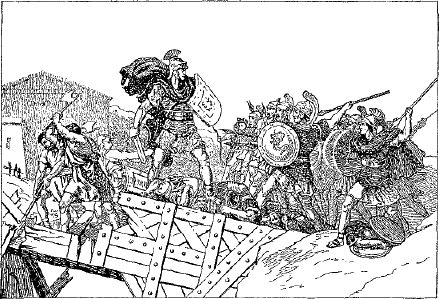
295. How Horatius held the Bridge (Continued)
Altera urbis pars mūrīs, altera flūmine satis mūnīrī vidēbātur. Sed erat pōns in flūmine quī hostibus iter paene dedit. Tum Horātius Cocles, fortis vir, magnā vōce dīxit, “Rescindite pontem, Rōmānī! Brevī tempore Porsena in urbem cōpiās suās trādūcet.” Iam hostēs in ponte erant, sed Horātius cum duōbus (cf. § 479) comitibus ad extrēmam pontis partem properāvit, et hi sōli aciem hostium sustinuērunt. Tum vērō cīvēs Rōmānī pontem ā tergō rescindere incipiunt, et hostēs frūstrā Horātium superāre temptant.
LESSON LII
THE INDEFINITE PRONOUNS
296. The indefinite pronouns are used to refer to some person or some thing, without indicating which particular one is meant. The pronouns quis and quī, which we have learned in their interrogative and relative uses, may also be indefinite; and nearly all the other indefinite pronouns are compounds of quis or quī and declined almost like them. Review the declension of these words, §§ 221, 227.
297. Learn the declension and meaning of the following indefinites:
Masc. Fem. Neut.
quis quid, some one, any one (substantive)
quī qua or quae quod, some, any (adjective), § 483
aliquis aliquid, some one, any one (substantive), § 487
aliquī aliqua aliquod, some, any (adjective), § 487
quīdam quaedam quoddam, quiddam, a certain, a certain one, § 485
quisquam quicquam or quidquam (no plural), any one (at all) (substantive), § 486
quisque quidque, each one, every one (substantive), § 484
quisque quaeque quodque, each, every (adjective), § 484
Transcriber’s Note: In the original text, the combined forms (masculine/feminine) were printed in the “masculine” column.
Note. The meanings of the neuters, something, etc., are easily inferred from the masculine and feminine.
a. In the masculine and neuter singular of the indefinites, quis-forms and quid-forms are mostly used as substantives, quī-forms and quod-forms as adjectives.
b. The indefinites quis and quī never stand first in a clause, and are rare excepting after sī, nisi, nē, num (as, sī quis, if any one; sī quid, if anything; nisi quis, unless some one). Generally aliquis and aliquī are used instead.
c. The forms qua and aliqua are both feminine nominative singular and neuter nominative plural of the indefinite adjectives quī and aliquī respectively. How do these differ from the corresponding forms of the relative quī?
d. Observe that quīdam (quī + -dam) is declined like quī, except that in the accusative singular and genitive plural m of quī becomes n (cf. § 287. a): quendam, quandam, quōrundam, quārundam; also that the neuter has quiddam (substantive) and quoddam (adjective) in the nominative and accusative singular. Quīdam is the least indefinite of the indefinite pronouns, and implies that you could name the person or thing referred to if you cared to do so.
e. Quisquam and quisque (substantive) are declined like quis.
f. Quisquam, any one (quicquam or quidquam, anything), is always used substantively and chiefly in negative sentences. The corresponding adjective any is ūllus, -a, -um (§ 108).
298. EXERCISES
First learn the special vocabulary, p. 295.
I. 1. Aliquis dē ponte in flūmen dēcidit sed sine ūllō perīculō servātus est. 2. Est vērō in vītā cuiusque hominis aliqua bona fortūna. 3. Nē mīlitum quidem1 quisquam in castrīs mānsit. 4. Sī quem meae domī vidēs, iubē eum discēdere. 5. Sī quis pontem tenet, nē tantus quidem exercitus capere urbem potest. 6. Urbs nōn satis mūnīta erat et merīdiē rēx quīdam paene cōpiās suās trāns pontem trādūxerat. 7. Dēnique mīles quīdam armātus in fluctūs dēsiluit et incolumis ad alteram rīpam oculōs vertit. 8. Quisque illī fortī mīlitī aliquid dare dēbet. 9. Tanta vērō virtūs Rōmānīs semper placuit. 10. Ōlim Corinthus erat urbs satis magna et paene par Rōmae ipsī; nunc vērō moenia dēcidērunt et pauca vestīgia urbis illīus reperīrī possunt. 11. Quisque lībertātem amat, et aliquibus vērō nōmen rēgis est invīsum.
II. 1. If you see a certain Cornelius at Corinth, send him to me. 2. Almost all the soldiers who fell down into the waves were unharmed. 3. Not even at Pompeii did I see so great a fire. 4. I myself was eager to tell something to some one. 5. Each one was praising his own work. 6. Did you see some one in the country? I did not see any one. 7. Unless some one will remain on the bridge with Horatius, the commonwealth will be in the greatest danger.
299. How Horatius held the Bridge (Concluded)
Mox, ubi parva pars pontis mānsit, Horātius iussit comitēs discēdere et sōlus mīrā cōnstantiā impetum illius tōtius exercitūs sustinēbat. Dēnique magnō fragōre pōns in flūmen dēcīdit. Tum vērō Horātius tergum vertit et armātus in aquās dēsiluit. In eum hostēs multa tēla iēcērunt; incolumis autem per fluctūs ad alteram rīpam trānāvit. Eī propter tantās rēs gestās populus Rōmānus nōn sōlum alia magna praemia dedit sed etiam statuam Horāti in locō pūblicō posuit.
Sixth Review, Lessons XLV-LII, §§ 521-523
LESSON LIII
REGULAR COMPARISON OF ADJECTIVES
300. The quality denoted by an adjective may exist in either a higher or a lower degree, and this is expressed by a form of inflection called comparison. The mere presence of the quality is expressed by the positive degree, its presence in a higher or lower degree by the comparative, and in the highest or lowest of all by the superlative. In English the usual way of comparing an adjective is by using the suffix -er for the comparative and -est for the superlative; as, positive high, comparative higher, superlative highest. Less frequently we use the adverbs more and most; as, positive beautiful, comparative more beautiful, superlative most beautiful.
In Latin, as in English, adjectives are compared by adding suffixes or by using adverbs.
301. Adjectives are compared by using suffixes as follows:
Positive Comparative Superlative
clārus, -a, -um (bright) (Base clār-) clārior, clārīus (brighter) clārissimus, -a, -um (brightest)
brevis, breve (short) (Base brev-) brevior, brevius (shorter) brevissimus, -a, -um (shortest)
vēlōx (swift) (Base veloc-) vēlōcior, vēlōcius (swifter) vēlōcissimus, -a, -um (swiftest)
a. The comparative is formed from the base of the positive by adding -ior masc. and fem., and -ius neut.; the superlative by adding -issimus, -issima, -issimum.
302. Less frequently adjectives are compared by using the adverbs magis, more; maximē, most; as, idōneus, suitable; magis idōneus, more suitable; maximē idōneus, most suitable.
303. Declension of the Comparative. Adjectives of the comparative degree are declined as follows:
Singular Plural
MASC. AND FEM. NEUT. MASC. AND FEM. NEUT.
Nom. clārior clārīus clāriōrēs clāriōra
Gen. clāriōris clāriōris clāriōrum clāriōrum
Dat. clāriōrī clāriōrī clāriōribus clāriōribus
Acc. clāriōrem clārius clāriōrēs clāriōra
Abl. clāriōre clāriōre clāriōribus clāriōribus
a. Observe that the endings are those of the consonant stems of the third declension.
b. Compare longus, long; fortis, brave; recēns (base, recent-), recent; and decline the comparative of each.
304. Adjectives in -er form the comparative regularly, but the superlative is formed by adding -rimus, -a, -um to the nominative masculine of the positive; as,
Positive Comparative Superlative
ācer, ācris, ācre (Base acr-) ācrior, ācrius ācerrimus, -a, -um
pulcher, pulchra, pulchrum (Base pulchr-) pulchrior, pulchrius pulcherrimus, -a, -um
līber, lībera, līberum (Base līber-) līberior, līberius līberrimus, -a, -um
a. In a similar manner compare miser, aeger, crēber.
305. The comparative is often translated by quite, too, or somewhat, and the superlative by very; as, altior, quite (too, somewhat) high; altissimus, very high.
306. EXERCISES
First learn the special vocabulary, p. 296.
I. 1. Quid explōrātōrēs quaerēbant? Explōrātōrēs tempus opportūnissimum itinerī quaerēbant. 2. Mediā in silvā ignīs quam crēberrimōs fēcimus, quod ferās tam audācis numquam anteā vīderāmus. 3. Antīquīs temporibus Germānī erant fortiōrēs quam Gallī. 4. Caesar erat clārior quam inimīcī1 quī eum necāvērunt. 5. Quisque scūtum ingēns et pīlum longius gerēbat. 6. Apud barbarōs Germānī erant audācissimī et fortissimī. 7. Mēns hominum est celerior quam corpus. 8. Virī aliquārum terrārum sunt miserrimī. 9. Corpora Germānōrum erant ingentiōra quam Rōmānōrum. 10. Ācerrimī Gallōrum prīncipēs sine ūllā morā trāns flūmen quoddam equōs vēlōcissimōs trādūxērunt. 11. Aestāte diēs sunt longiōrēs quam hieme. 12. Imperātor quīdam ab explōrātōribus dē recentī adventū nāvium longārum quaesīvit.
II. 1. Of all birds the eagle is the swiftest. 2. Certain animals are swifter than the swiftest horse. 3. The Roman name was most hateful to the enemies of the commonwealth. 4. The Romans always inflicted the severest2 punishment on faithless allies. 5. I was quite ill, and so I hastened from the city to the country. 6. Marcus had some friends dearer than Cæsar.3 7. Did you not seek a more recent report concerning the battle? 8. Not even after a victory so opportune did he seek the general’s friendship.
N.B. Beginning at this point, the selections for reading will be found near the end of the volume. (See p. 197.)
LESSON LIV
IRREGULAR COMPARISON OF ADJECTIVES · THE ABLATIVE WITH COMPARATIVES WITHOUT QUAM
307. The following six adjectives in -lis form the comparative regularly; but the superlative is formed by adding -limus to the base of the positive. Learn the meanings and comparison.
Positive Comparative Superlative
facilis, -e, easy facilior, -ius facillimus, -a, -um
difficilis, -e, hard difficilior, -ius difficillimus, -a, -um
similis, -e, like similior, -ius simillimus, -a, -um
dissimilis, -e, unlike dissimilior, -ius dissimillimus, -a, -um
gracilis, -e, slender gracilior, -ius gracillimus, -a, -um
humilis, -e, low humilior, -ius humillimus, -a, -um
308. From the knowledge gained in the preceding lesson we should translate the sentence Nothing is brighter than the sun
Nihil est clārius quam sōl
But the Romans, especially in negative sentences, often expressed the comparison in this way,
Nihil est clārius sōle
which, literally translated, is Nothing is brighter away from the sun; that is, starting from the sun as a standard, nothing is brighter. This relation is expressed by the separative ablative sōle. Hence the rule
309. Rule. Ablative with Comparatives. The comparative degree, if quam is omitted, is followed by the separative ablative.
310. EXERCISES
First learn the special vocabulary, p. 296.
I. 1. Nēmō mīlitēs alacriōrēs Rōmānīs vīdit. 2. Statim imperātor iussit nūntiōs quam celerrimōs litterās Rōmam portāre. 3. Multa flūmina sunt lēniōra Rhēnō. 4. Apud Rōmanōs quis erat clārior Caesare? 5. Nihil pulchrius urbe Rōmā vīdī. 6. Subitō multitūdo audacissima magnō clamōre proelium ācrius commīsit. 7. Num est equus tuus tardus? Nōn vērō tardus, sed celerior aquilā. 8. Ubi Romae fuī, nēmō erat mihi amicior Sextō. 9. Quaedam mulierēs cibum mīlitibus dare cupīvērunt. 10. Rēx vetuit cīvis ex urbe noctū discēdere. 11. Ille puer est gracilior hāc muliere. 12. Explōrātor duās (two) viās, alteram facilem, alteram difficiliōrem, dēmōnstrāvit.
II. 1. What city have you seen more beautiful than Rome? 2. The Gauls were not more eager than the Germans. 3. The eagle is not slower than the horse. 4. The spirited woman did not fear to make the journey by night. 5. The mind of the multitude was quite gentle and friendly. 6. But the king’s mind was very different. 7. The king was not like (similar to) his noble father. 8. These hills are lower than the huge mountains of our territory.
Reading Selection
ARMA ROMANA
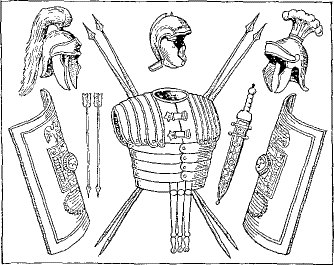
LESSON LV
IRREGULAR COMPARISON OF ADJECTIVES (Continued)
311. Some adjectives in English have irregular comparison, as good, better, best; many, more, most. So Latin comparison presents some irregularities. Among the adjectives that are compared irregularly are
Positive Comparative Superlative
bonus, -a, -um, good melior, melius optimus, -a, -um
magnus, -a, -um, great maior, maius maximus, -a, -um
malus, -a, -um, bad peior, peius pessimus, -a, -um
multus, -a, -um, much ——, plūs plūrimus, -a, -um
multī, -ae, -a, many plūrēs, plūra plūrimī, -ae, -a
parvus, -a, -um, small minor, minus minimus, -a, -um
312. The following four adjectives have two superlatives. Unusual forms are placed in parentheses.
exterus, -a, -um, outward (exterior, -ius, outer) extrēmus, -a, -um (extimus, -a, -um) outermost, last
īnferus, -a, -um, low īnferior, -ius, lower īnfimus, -a, -um īmus, -a, -um lowest
posterus, -a, -um, next (posterior, -ius, later) postrēmus, -a, -um (postumus, -a, -um) last
superus, -a, -um, above superior, -ius, higher suprēmus, -a, -um summus, -a, -um highest
313. Plūs, more (plural more, many, several), is declined as follows:
Singular Plural
MASC. AND FEM. NEUT. MASC. AND FEM. NEUT.
Nom. —— plūs plūrēs plūra
Gen. —— plūris plūrium plūrium
Dat. —— —— plūribus plūribus
Acc. —— plūs plūrīs, -ēs plūra
Abl. —— plūre plūribus plūribus
a. In the singular plūs is used only as a neuter substantive.
314. EXERCISES
First learn the special vocabulary, p. 296.
I. 1. Reliquī hostēs, quī ā dextrō cornū proelium commīserant, dē superiōre locō fūgērunt et sēsē in silvam maximam recēpērunt. 2. In extrēmā parte silvae castra hostium posita erant. 3. Plūrimī captīvī ab equitibus ad Caesarem ductī sunt. 4. Caesar vērō iussit eōs in servitūtem trādī. 5. Posterō diē magna multitūdō mulierum ab Rōmānīs in valle īmā reperta est. 6. Hae mulierēs maximē perterritae adventū Caesaris sēsē occīdere studēbant. 7. Eae quoque plūrīs fābulās dē exercitūs Rōmānī sceleribus audīverant. 8. Fāma illōrum mīlitum optima nōn erat. 9. In barbarōrum aedificiīs maior cōpia frūmentī reperta est. 10. Nēmō crēbrīs proeliīs contendere sine aliquō perīculō potest.
II. 1. The remaining women fled from their dwellings and hid themselves. 2. They were terrified and did not wish to be captured and given over into slavery. 3. Nothing can be worse than slavery. 4. Slavery is worse than death. 5. In the Roman empire a great many were killed because they refused to be slaves. 6. To surrender the fatherland is the worst crime.
Reading Selection
LESSON LVI
IRREGULAR COMPARISON OF ADJECTIVES (Concluded) · ABLATIVE OF THE MEASURE OF DIFFERENCE
315. The following adjectives are irregular in the formation of the superlative and have no positive. Forms rarely used are in parentheses.
Comparative Superlative
citerior, hither (citimus, hithermost)
interior, inner (intimus, inmost)
prior, former prīmus, first
propior, nearer proximus, next, nearest
ulterior, further ultimus, furthest
316. In the sentence Galba is a head taller than Sextus, the phrase a head taller expresses the measure of difference in height between Galba and Sextus. The Latin form of expression would be Galba is taller than Sextus by a head. This is clearly an ablative relation, and the construction is called the ablative of the measure of difference.
Examples Galba est altior capite quam Sextus Galba is a head taller (taller by a head) than Sextus. Illud iter ad Italiam est multō brevius That route to Italy is much shorter (shorter by much)
317. Rule. Ablative of the Measure of Difference. With comparatives and words implying comparison the ablative is used to denote the measure of difference.
a. Especially common in this construction are the neuter ablatives
eō, by this, by that hōc, by this multō, by much nihilō,1 by nothing paulō, by a little
318. EXERCISES
First learn the special vocabulary, p. 297.
I. 1. Barbarī proelium committere statuērunt eō magis quod Rōmānī īnfīrmī esse vidēbantur. 2. Meum cōnsilium est multō melius quam tuum quia multō facilius est. 3. Haec via est multō lātior quam illa. 4. Barbarī erant nihilō tardiōrēs quam Rōmānī. 5. Tuus equus est paulō celerior quam meus. 6. Iī quī paulō fortiōrēs erant prohibuērunt reliquōs aditum relinquere. 7. Inter illās cīvitātēs Germānia mīlitēs habet optimōs. 8. Propior via quae per hanc vallem dūcit est inter portum et lacum. 9. Servī, quī agrōs citeriōrēs incolēbant, priōrēs dominōs relinquere nōn cupīvērunt, quod eōs amābant. 10. Ultimae Germāniae partēs numquam in fidem Rōmānōrum vēnērunt. 11. Nam trāns Rhēnum aditus erat multō difficilior exercituī Rōmānō.
II. 1. Another way much more difficult (more difficult by much) was left through hither Gaul. 2. In ancient times no state was stronger than the Roman empire. 3. The states of further Gaul did not wish to give hostages to Cæsar. 4. Slavery is no better (better by nothing) than death. 5. The best citizens are not loved by the worst. 6. The active enemy immediately withdrew into the nearest forest, for they were terrified by Cæsar’s recent victories.
Reading Selection
LESSON LVII
FORMATION AND COMPARISON OF ADVERBS
319. Adverbs are generally derived from adjectives, as in English (e.g. adj. sweet, adv. sweetly). Like adjectives, they can be compared; but they have no declension.
320. Adverbs derived from adjectives of the first and second declensions are formed and compared as follows:
Positive Comparative Superlative
Adj. Adv. cārus, dear cārē, dearly cārior cārius cārissimus cārissimē
Adj. Adv. pulcher, beautiful pulchrē, beautifully pulchrior pulchrius pulcherrimus pulcherrimē
Adj. Adv. līber, free līberē, freely līberior līberius līberrimus līberrimē
a. The positive of the adverb is formed by adding -ē to the base of the positive of the adjective. The superlative of the adverb is formed from the superlative of the adjective in the same way.
b. The comparative of any adverb is the neuter accusative singular of the comparative of the adjective.
321. Adverbs derived from adjectives of the third declension are formed like those described above in the comparative and superlative. The positive is usually formed by adding -iter to the base of adjectives of three endings or of two endings, and -ter to the base of those of one ending;1 as,
Positive Comparative Superlative
Adj. Adv. fortis, brave fortiter, bravely fortior fortius fortissimus fortissimē
Adj. Adv. audāx, bold audācter, boldly audācior audācius audācissimus audācissimē
322. Case Forms as Adverbs. As we learned above, the neuter accusative of comparatives is used adverbially. So in the positive or superlative some adjectives, instead of following the usual formation, use the accusative or the ablative singular neuter adverbially; as,