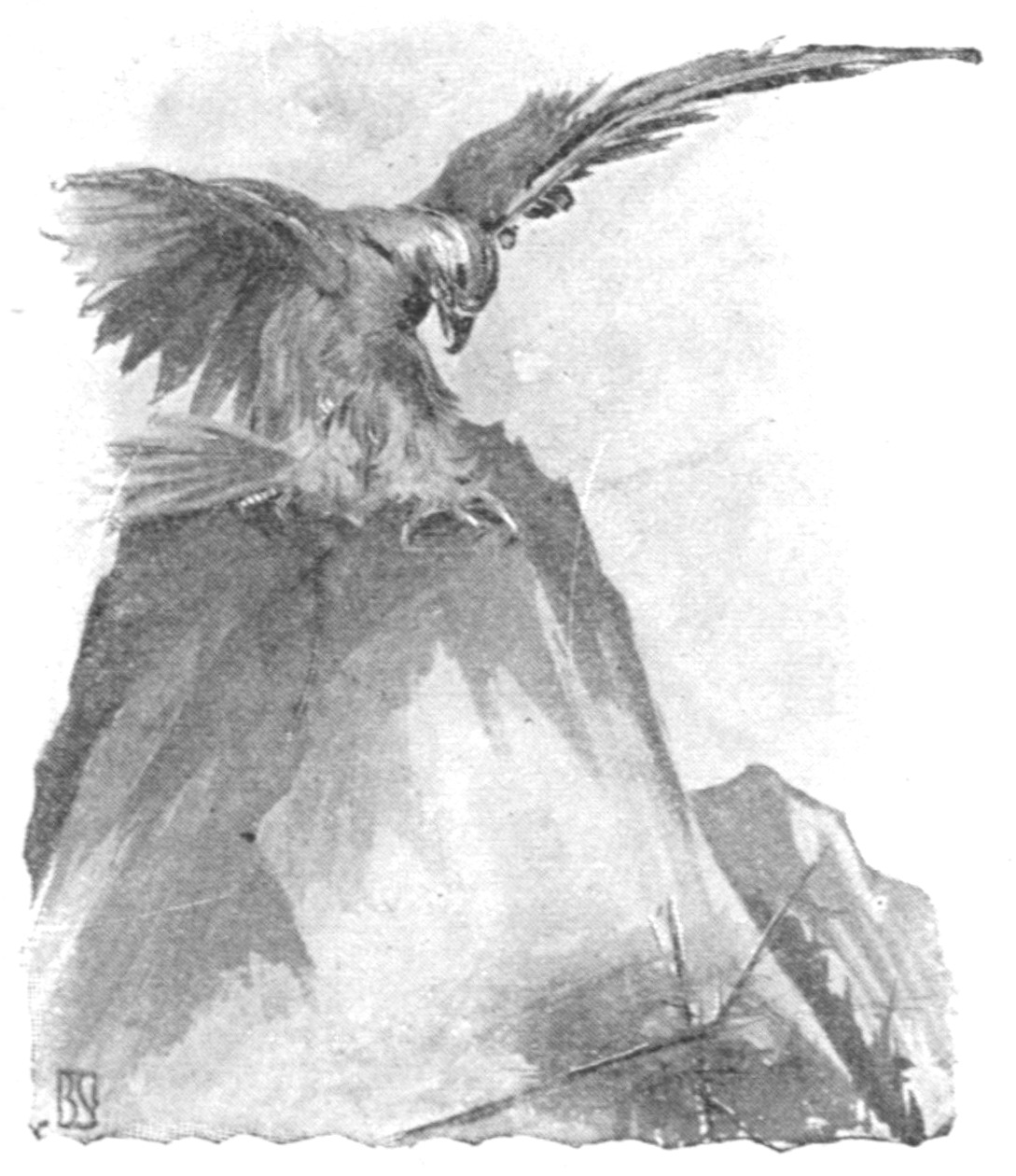
Canto Third
Charles Godfrey Leland translation
THE MASTER AND THE ANIMALS
I
KULÓSKAP AND THE LOONS
[Micmac and Passamaquoddy]
Kulóskap umimat netinniaspʾnil Winpeul kʾchi mteolinul.[24]
While the Master was pursuing Winpe the giant magician, One day at Uktukâmkw He saw afar in the distance Over the silent water, Far away in the sunset, Kwîmûŭk (the Loons) a-flying. Thence did their chief in a circle Lead them around the lake; Yet ever drawing nearer To the Home of Beasts and Men; And as he came, the Master Said: “What is thy will, O Kwîmû?”
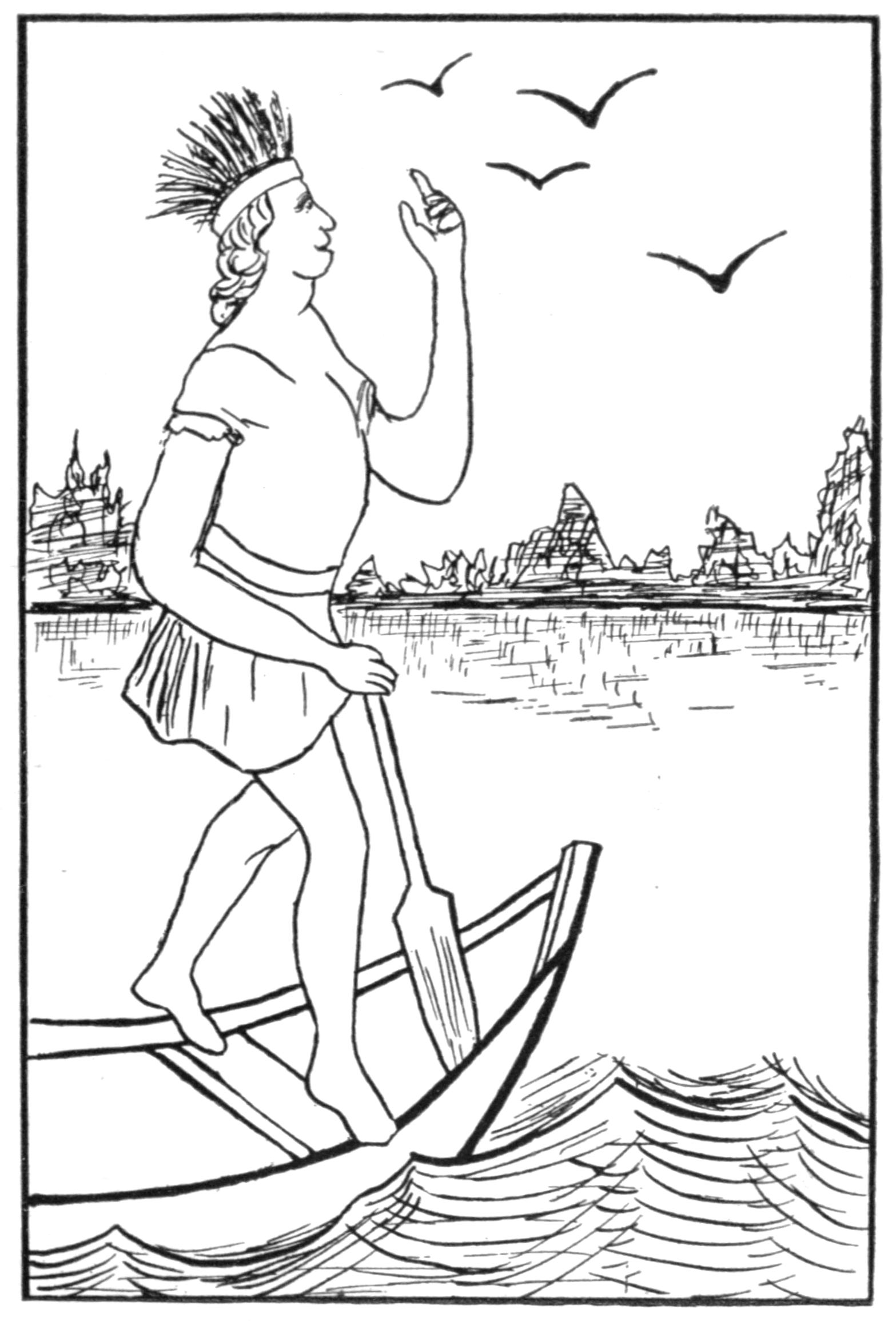
Kulóskap and the Loons
To whom the Loon replied “I fain would be thy servant, Thy servant and thy friend.” Then the Master taught them a cry, A strange long cry like the howl Of a dog when he calls to the moon, Or when, far away in the forest, He seeks to find his master; And told them when they required him To utter this long strange cry. Now it came to pass long after The Master in Uktâkŭmkûk (The which is Newfoundland) Came to an Indian village And all who dwelt therein Were Kwîmûŭk, who had been Loons in the time before; And now they were very glad As men to see once more The Master who had blessed them When they were only birds; Therefore he made them his huntsmen, Also his messengers; Hence comes that in all the stories Which are told of the mighty Master The Loons are ever his friends; And the Indians when they hear The cry of the Loons, exclaim: “Kwîmû elkomtûejul Kulóskapŭl,” “The Loon is calling Kulóskap,” the Master.
FOOTNOTES:
II
KULÓSKAP AND THE BEAVER
[Micmac]
Kulóskap naga Kwâbît.[25]
Over all the land Of the Wabanaki, The Land of the Break of Day, There is never a place Where the hand of Kulóskap Made not a mark. It is seen on hills and rivers, On the great roads through mountains, As well as on mighty rocks Which once were living monsters. Such is the wonderful highway Running along the river Called Herbert—the road which is named By white men the Boar’s Back, By Indians Onwokun, Which is their word for Causeway. The tale is told of Kulóskap That, once while travelling To visit Partridge Island And then Cape Blomidon, His friends were tired of rowing, Tired of travel by water, And wished to cross by land; And, while they all were resting, The Master, raising his magic Unto a mighty deed To be spoken of forever, Went away for a little time And cast up a giant ridge, A wide and beautiful level Over great bogs and streams, And across this they travelled Rejoicing, to await him. And yet again the Master Did a very wondrous deed; For it came to pass in those days That the beavers had built a dam From Âûkogegéchk or Blomidon, Even unto the opposite shore, And thereby made a pond Which filled up all the valley. Now in those times the beavers Were beasts of monstrous size, And the Master, though kind of heart, Seems to have had indeed But little love for them Since the day when young Kwâbîtsis, The son of the Great Beaver, Tempted Malsum to slay his brother In the very early time. Now to this very day They find the bones of these beavers; There are many on Unamagik, Their teeth are six inches wide, There are no such beavers to-day! And these are indeed the bones Of the beavers who built the dam Across at Cape Blomidon And crossed the Annapolis Valley. Now the Master would fain go hunting, And thereby do a deed Which should equal the great whale-fishing Of Kitpûsiigʾnâû. So he cut the great dam near the shore, And he bade the boy Marten watch; For he said, “I greatly suspect That there is a little beaver Who is hiding hereabouts.” And when the dam was cut From where it joined the shore, There was a mighty rush, And the roar of many waters, So that the beaver dam, Which was made of giant trees Deftly fastened together, Swung full around to the westward; And yet it did not break Away from the other shore. Therefore the end of it lodged With a great split therein When the flood had found a passage; And the whole may be seen there still, To this very day, even, As it is seen by all Of those who pass up the bay; And still this point, Cape Split, Is called by the Micmacs Plîgun Which means the opening Or cleft of a beaver dam. Then to frighten the Beaver The Master threw at it Several handfuls of earth, Which falling to eastward Of what is called Partridge Island, Became the Five Islands, and The pond which was left behind Became the Basin of Minas. Yet another tradition tells That after cutting the dam The Master sat and watched, And yet no Beaver came forth, For Kwâbît had escaped by a hole Which led back to the other side; Kulóskap then tore up A rock and he threw it Very far indeed, One hundred and fifty miles, To frighten the Beaver back; But over the Grand Falls Kwâbît had gone in haste And so for the time escaped; Yet the stone remaineth there As a wonder to this day. However, others declare That by this rock the Beaver Was killed while swimming away; For thus the tale was told By a Penobscot woman As she sat weaving a basket, A basket or abaznoda Of that sweet-scented grass Which Indians dearly love. Kulóskap gave the names To everything on earth; He first made man and woman Bestowing on them life; He also made the winds To make the waters move; The Turtle was his uncle, Tiakēūch the Mink Was his adopted son, While Mūnŭmkwech, the Woodchuck— She was his grandmother. The Beaver built a dam The greatest ever seen.
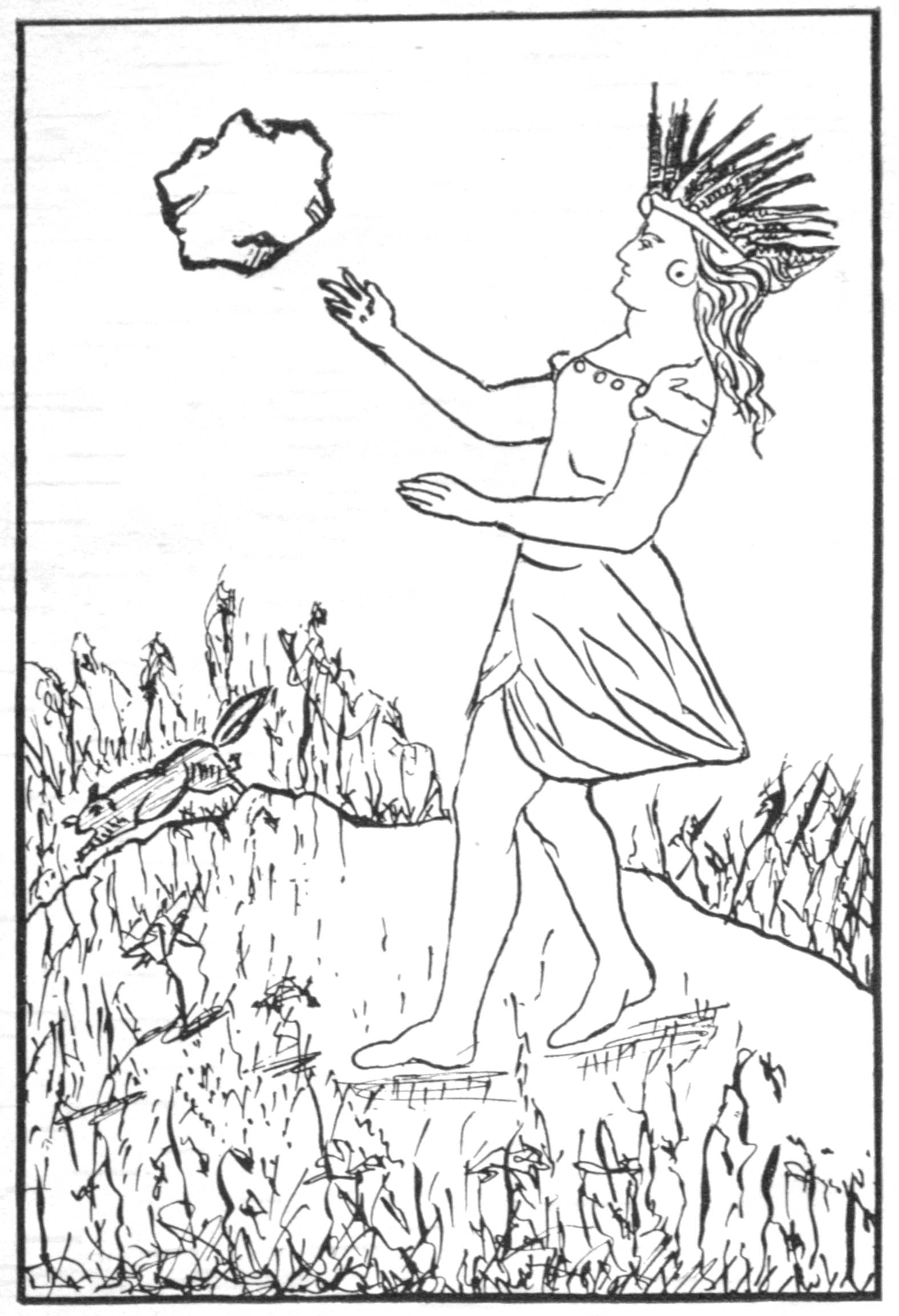
Kulóskap and the Beaver
Kulóskap turned it away, And killed the Beaver, too; At Mûschik he killed a moose; The bones are there e’en now, At Bar Harbor, turned to stone. The entrails of the moose, Across the bay he cast Unto his dogs, and they, Which were also turned to stone, To this day may be seen there, As I have seen them myself; And there, too, in the rock Are the prints of his arrow and bow.
FOOTNOTES:
III
THE SABLE AND THE SERPENT
[Passamaquoddy]
Kulóskap wtiwaspʾnil nequt Otloketmul nʾmokswesul.[26]
All of the olden time, All in a year it befell That Kulóskap had a foe: A very evil man, A very sinful beast, A very vile magician, Who after he had tried A hundred tricks in vain Took on the form of a snake, A serpent of awful size, In hope to kill the Lord. Now the Master had a boy His faithful servitor, Nʾmokswes or the Sable; A boy of elfin kind Who played the magic flute Wherewith he could entice All birds and animals To come to him, when they Once heard its wondrous sound. It happened on a time When Kulóskap was afar, The Sable broke his flute, And, deeply crushed with grief, Would not return again, But wandered far away Into the wilderness. And all of this the Lord Knew well—for by his art He knew when aught went wrong Pertaining to himself. Then, when returned, he asked The old, old grandmother Where Sable was? but she Could only weep. And then, The Master said: “I’ll roam Forever if I must, But I will find the boy.” So he went forth, resolved, Following Sable’s trail, And tracked him through the snow, Three days and nights, and then Heard some one sing afar; It was the magic song Which sorcerers only sing When in the direst need, And death is drawing near. So, circling round the place, Kulóskap looked adown, And saw a lodge, and heard The voice distinctly sound, As he grew nearer; it Was Sable’s wondrous voice; Then heard him sing a curse Against all serpent kind, And he was wandering About the place to seek A stick, extremely straight. The Master understood What this all meant: how that Sable had been enticed Into the wilderness By Atoʾsis the Snake, And that the Serpent-chief Was in the lodge, and he Had sent the Sable forth To seek a long straight rod For evil magic deeds. Then, softly singing, he Bade Sable disobey, And get a crooked stick, As twisted as could be, And told him carefully What more he was to do. Then Sable found in fact A very rugged rod, As twisted as a worm, When it is wounded; then As he came in, the Snake Cried out, amazed and wroth, “How hast thou dared to bring To me a stick like that?” But Sable, answering, Replied, “It is not straight, But what is crookedest May be the straightest made, And I do know a charm Whereby this may be done; I will but heat this stick A little in the fire, And sing the proper spell And then it shall be straight.” Now Atoʾsis the Snake, Like all the crafty folk, Was very curious And so looked closely on. But Sable, when the stick Was burning, or red hot, Thrust it into his eyes; (It had a forked end) Utterly blinding him; Then headlong rushed away. The serpent followed him, But, even as he left The wigwam, there he met The Master, who forthwith Struck him a mighty blow And slew him out of hand; Of old times this befell— And thus my story ends.
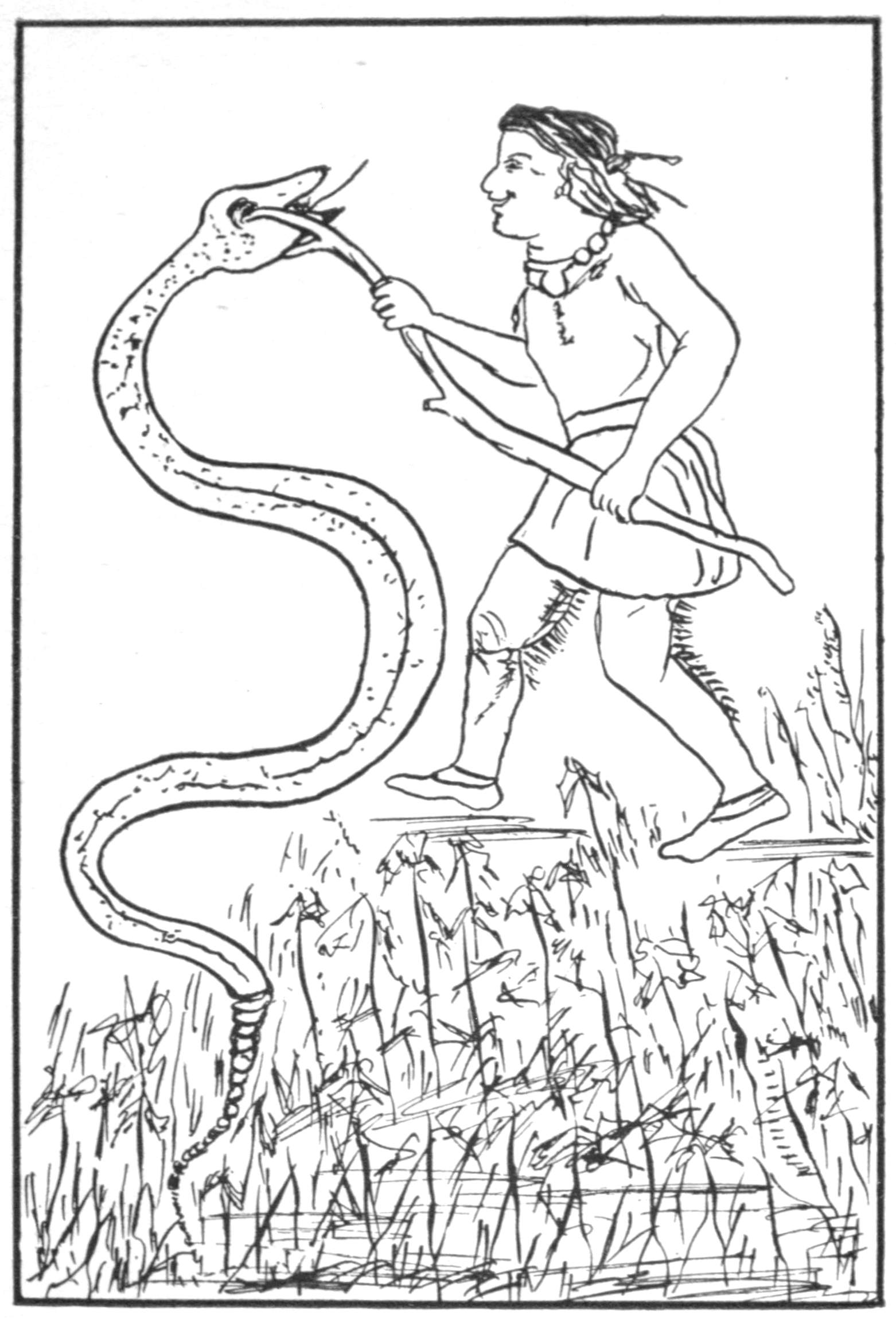
The Sable and the Serpent
FOOTNOTES:
IV
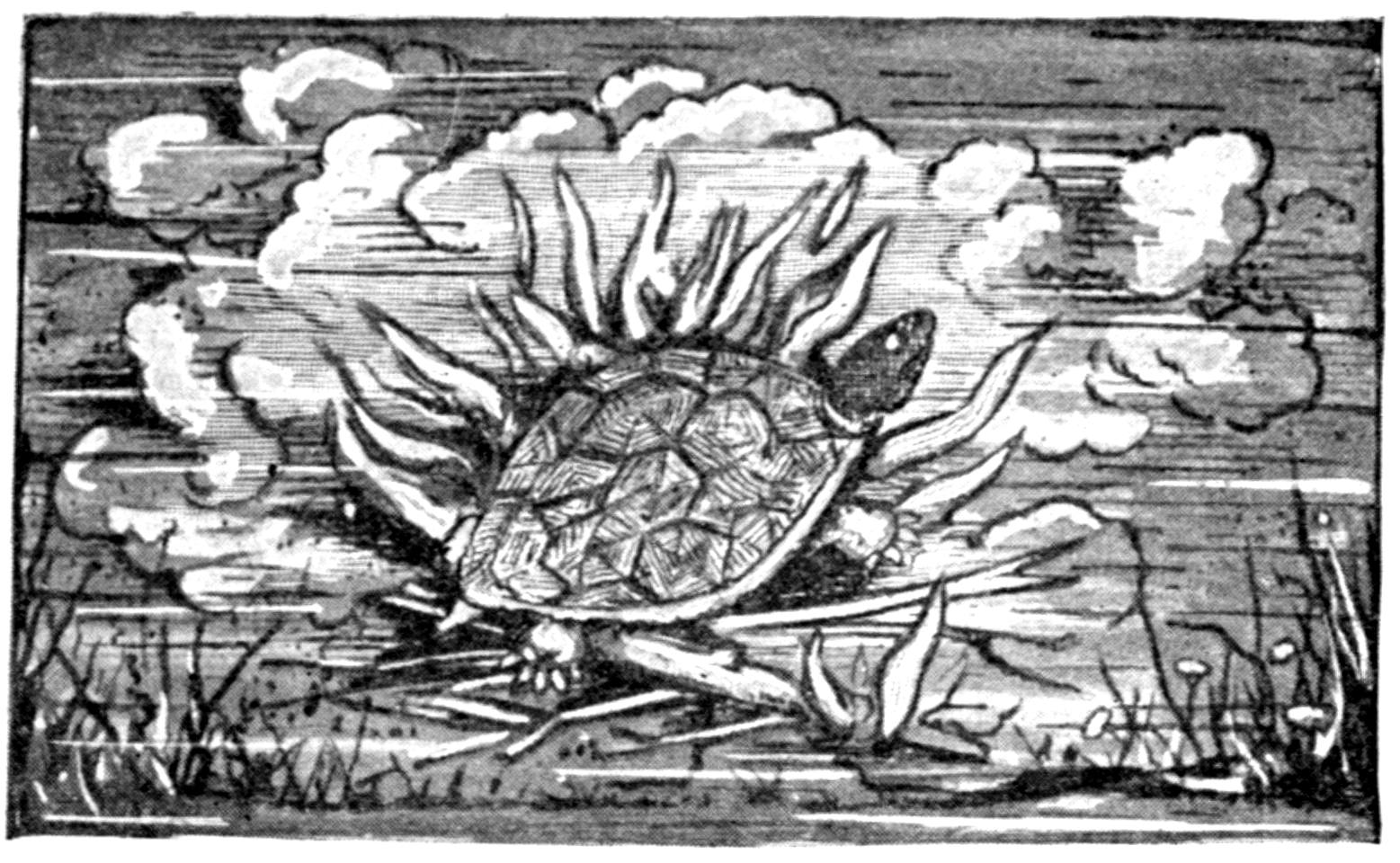
KULÓSKAP AND THE TURTLE
[Micmac and Passamaquoddy]
Nekke meiawet nektuk Piliomeskasik ktakʾmigw otlian Pikto.[27]
When the Master left Uktâkumkûk, Called by the English Néwfoundlánd, He went to Piktook or Pictou, Which means “the rising of bubbles,” Because at that place the water Is ever strangely moving. There he found an Indian village And in the village a man Whom he loved through all his life. Yet it was not because this man, Whose name in Micmac is Mikchik And in our Passamaquoddy Chikwenóchk “the Turtle,” Was great or well favored or rich; He was truly none of these, Being very poor and lazy, No longer young or lively, Nor in any way clever or wise. It is said he was the uncle Of Kulóskap, but many declare It was only by adoption.[28] However, he always bore His trials with such good nature, His wants with such merry patience, That the Master took strangely to him With most unwonted affection, As if he had determined To make of the idler a man; Which verily came to pass Quite soon, and very quaintly, As you shall presently hear. When he came to Piktook, A town of a hundred wigwams, Kulóskap being a handsome And very stately warrior With the air of a great chief, Was greatly admired by all, Especially the women; So that every one felt honored Whose wigwam he deigned to enter; Yet he saw the folk very seldom, And dwelt with old uncle Mikchik Delighting in his fancies, Quaint ways and old time stories, Very old songs of the fathers; Such things were the joy of his heart. Now ’twas the time for holding The great and yearly feast With dancing and merry games; But Kulóskap cared not to go As guest or as performer. However, he asked his uncle, “Wilt thou not go to the feast? All the fair girls of the forest, All the beautiful matrons, All the bewitching widows From far and wide will be there; Why hast thou never married? There are many nice women a-waiting, ’Tis evil living alone.” Thus answered Uncle Turtle: “I am poor and old and homely, With no garments fit for a feast; Therefore ’tis better for me To smoke my pipe at home.” “Well, if that be the only hindrance, Uncle,” replied the Master, “I can turn tailor I trow, And fit you to a turn— Fit you as if by magic, Or in fact by magic itself; Therefore have thou no care As to your face or outside, For to him who hath the art ’Tis as easy to make a man over As any suit of clothes.” “That may be true, my nephew,” Quoth Turtle, “but what say you, As to the making over The inside of a mortal?” “By Kwâbît the immortal Beaver!” Replied the Master, laughing, “That is something harder to do, Else I were not at work So long in this world of ours. Yet, ere I leave this town For you I will do that also. As for this present sport, Do but put on this belt.” And when he wore the girdle Mikchik became so young And so bewitchingly handsome That never a man or woman In the land had seen the like; And as the Master arrayed him In garments of great splendor, He also gave him his word That, as a man, he ever Should be of men the comeliest, And as animal, hardest to kill, Most vital and enduring, As it truly came to pass. So Mikchik went to the feast. Now the chieftain of the Piktook Had three very beautiful daughters, And of the three, the youngest Was the loveliest in the land. On her the old-young turtle Cast his experienced eyes With a boy-like, innocent look, And said, “I think that damsel Would exactly suit my complaint, And therefore I think I will take her!” Now all the young men in Piktook Were of just the same opinion, And all were firmly resolved To kill the one who should win her. So the next day the Master, Taking a bunch of wâbab, That is, of the finest wampum, Went to the chief of the Piktook Proposing that his uncle Should marry the youngest daughter. And truly the chief was willing, While the mother at once cried, “Yes!” To such a grand proposal; So, without loss of time, The maiden swept out a wigwam, And made a bed of sprays, Or of leaves, upon the floor, Spreading out a great white bear skin As a cover over all. Then with Mikchik and the Master They had dried meat for supper, And so the pair were wed. Now the Turtle seemed very lazy, And for days after they were married While other men were hunting He lounged about at home Smoking over the fire, Till one frosty, sunny morning, His wife said to him, “Mikchik, If this goes on much longer We two must certainly starve.” So he put on his snow-shoes, Taking his bow and arrows, And she followed silently after To see what he would do. But in truth he did very little, For he had not gone far forward Ere he tripped and fell rolling over. And the wife, returning disgusted, Said in a rage to her mother: “He is not in the least a hunter. He can’t even walk on snow-shoes.” But the mother said: “Be patient, There is more in him than you dream.” One day it came to pass That the Master said to Mikchik “To-morrow will be held The very great yearly ball-play And you must share in the game. It will be sore for you, A game of life and death, For all the young men who live here Are your enemies, and will seek To slay you in the rush By crowding close together, And trampling you under foot. But when they do this, ’twill be Close by the Sagamore’s lodge, And that you may escape them I give you, Uncle, the power To jump twice over the roof; But if they chance to bring it To a third attempt, ’twill be A very terrible thing for you, And yet it must come to pass; ‘No honey without a sting; No chase, no venison.’” And all of it came to pass As the Master had foretold; For the young men of the village All joined to kill the Turtle, And to escape them, Mikchik Jumped, when beset, so high Over the Sagamore’s lodge That he looked like an eagle flying. But when for a third time he Attempted another leap, His scalp-lock caught on a pole, And there he hung a-dangling In the smoke which rose from below. Then Kulóskap, who was sitting On a skin in the tent beneath, Said: “Uncle the hour is come, Now will I make thee Sagem, Grand Sagamore of the Tortoise, The chief of the Lenni Lenâbe; Thou shalt bear up a great nation Which shall rest upon thy shell!” Then he smoked Mikchik so long That his skin became a shell, A very hard round shell, And the marks of the smoke from the pipe May be seen thereon to-day. And of all his entrails he left But one which was very short, And then indeed Mikchik Seeing himself so reduced Cried out, “Beloved nephew, You will kill me certainly!” But the Lord replied, “Far from it, I am giving you longer life— A longer life than is given To any other on earth; From this time forth, my uncle, You may pass through a glowing fire, And never feel its breath, You may live on land or in water, Nay, though your head be cut off It will live for nine days after, And even so long shall beat Your heart when cut from your body.” Whereat Mikchik rejoiced. And this came, indeed, betimes, And not before it was needed; For on the very next day All of the men went hunting, And the Master warned the Turtle That they would attempt his life. So the men all went before, While the Turtle toiled slowly behind them; But when they saw him no more, He made a magic flight Far over their heads, and deep In the forest he slew a moose, He drew it upon the track Which he knew that they soon must take; And when his foes came up, There he sat on the moose Smoking, and waiting for them. Now Kulóskap the Wise Had unto them foretold That on that day they would see Some one come out as first Who they thought would be last of all. And when this came to pass, They were more enraged than before, And so they planned again To kill Mikchik, but his nephew Who was on the point of leaving The village and all therein, Told him how it would be. “First of all, my uncle, They will build a mighty fire, And throw you into the flame, But endure it, and with joy; For by my magic power I will see that it does no harm. Only beg as a dying favor Not to be cast into water, Into the water to drown, Beg and implore and entreat them To spare thee that terrible torture, Yes, fight to the bitter end; So will they certainly do it, And so it shall come to pass.” Then he bade farewell to the Turtle, And they built up a blazing fire And threw him at once into it; Wherein, being very lazy, He turned over and went to sleep, And when the fire burned low He called for more wood to rebuild it Because it was bitterly cold. Then they all called out, “Let us drown him!” But hearing this, as in terror He implored them not to do it. “Cut me to pieces,” he said, “Burn me again, or stab me, But do not, I beg you, throw me Into the water to drown!” Therefore they swore they would drown him, And dragged him down to the shore; He screamed like a mad magician, And fought like a wolverine, Tearing up trees and roots, Rending the rocks like a tempest; Yet at length they overpowered him, And took him in a canoe To the middle of the lake And throwing him in they watched him, Watched him as he was sinking Till he vanished far down below; And thinking him surely dead Returned to their homes rejoicing. Now on the next day at noon There was a glowing sunshine, And something was seen basking Upon a great flat rock About a mile from the shore. So two of the younger men Took a canoe and went forth To see what this might be. And when they came to the rock Just hanging over the water, Whom should they see but Mikchik A-dozing in the sunlight! But, seeing them coming to take him, He only said “Good-bye!” And rolled over into the lake Wherein it is said he is living Unto this very day. So in memory of this thing, All turtles in swamps or rivers When they see a man a-coming Tip-tilt them into the water With a plump! which means “Good-bye!”— Or which sounds like it in Indian[29]— As their ancestor did of yore. The Turtle lived with his wife Happily, long and contented. Then it happened in after years That Kulóskap came one day To visit his uncle, and saw A babe which uttered a word. As ’twere in a childish cry: “Knowest thou what he is saying?” Inquired the Master smiling. “Truly not I,” said Mikchik, “For I deem it is in the language Which is spoken by the demons Or spirits of the air, Which ’tis said no mortal knoweth.” “Well, I think,” replied Kulóskap, “That he is talking of eggs For he cries ‘Huwâh, Huwâh’ As if he were trying to say Wâhwun—which means an egg In the Passamaquoddy tongue.” “But where are eggs to be found?” Inquired the uncle amazed. “Seek in the sand,” said the Master, Where he sought and found full many And greatly he marvelled at them. In memory of which and the Master, All the female turtles Lay eggs to this very day. L.
FOOTNOTES:
V
HOW MIKCHIK THE TURTLE WAS FALSE TO THE MASTER
[Passamaquoddy]
Kulóskap meiawet.[30]
Kulóskap the Master Was lord of beasts and men Even the one as the other He ruled them one and all. Great indeed was his army His tribe indeed was the whole. In it the Golden Eagle Was a leading chief who married A female Caribou; And the Turtle, Kulóskap’s uncle, Married the only daughter Of the Eagle and Caribou. Of these things are many traditions, Many and very long, Which are told by the fire in winter; Old people knew these stories, The younger now forget them And the wisdom in them all. It is said that Mikchik the Turtle Was ever loved by his nephew, While another tradition tells That he was false to the Master: I know not how it may be, I can only tell the story As it was told to me. When the Turtle married, The Master bade him make A splendid feast, and for this He gave him wonderful power. Then he bade him go down to a point Of very great rocks by the sea Where whales were always found, And told him to bring a whale, And gave him the might to do so. But he set an appointed mark Or space, and said that he must not Go even an inch beyond it: So the Turtle went down to the sea, And caught a monstrous whale, And bore it up to the camp; It all seemed very easy, But he quite forgot that the power Was given him by the Master; So he took it all as his own. Like all men of his kind He was very vain and curious. So to see what would come of it He went beyond the mark While carrying the whale, And doing this he lost The strength on him bestowed; And sank beneath his burden Crushed by the mighty whale. Then many ran to the Master Saying that Turtle was dead, But he answered “Cut up the whale For the dead will soon revive.” So they cut it up and cooked it; And when the feast was ready, The Turtle came yawning on, And stretching out his leg Cried out: “How tired I am! Truly, I think I must Have overslept myself!” Then all men feared the Lord, For now they knew him a spirit, A spirit of terrible power. However it came to pass That the Turtle grew mightily All in his own conceit, And thought he could take the place Of the Master and reign in his stead; So he called together a council Of all the beasts, to find How Kulóskap might be slain. Greatly the Great One laughed When he had learned all this And little did he care. And knowing all that passed In their evil hearts, he went Disguised as an agèd squaw Into the Council Lodge. There were two witches there, The Porcupine and Toad, Bearing the human form; Of them he humbly asked How the Master was to die, And to him the Toad replied, “Well! What is that to thee? And what hast thou to do With such a thing as this?” “Truly I meant no harm,” Was all the Master said. And then he softly touched The tip of either’s nose. And rising, went his way. But when the witches looked At one another—both Screamed out in dire dismay For neither had a nose! Their faces were smooth and flat; So it came that the Porcupine And Toad, are to this day Noseless among the beasts. So the Council came to an end. L.
FOOTNOTES:
VI
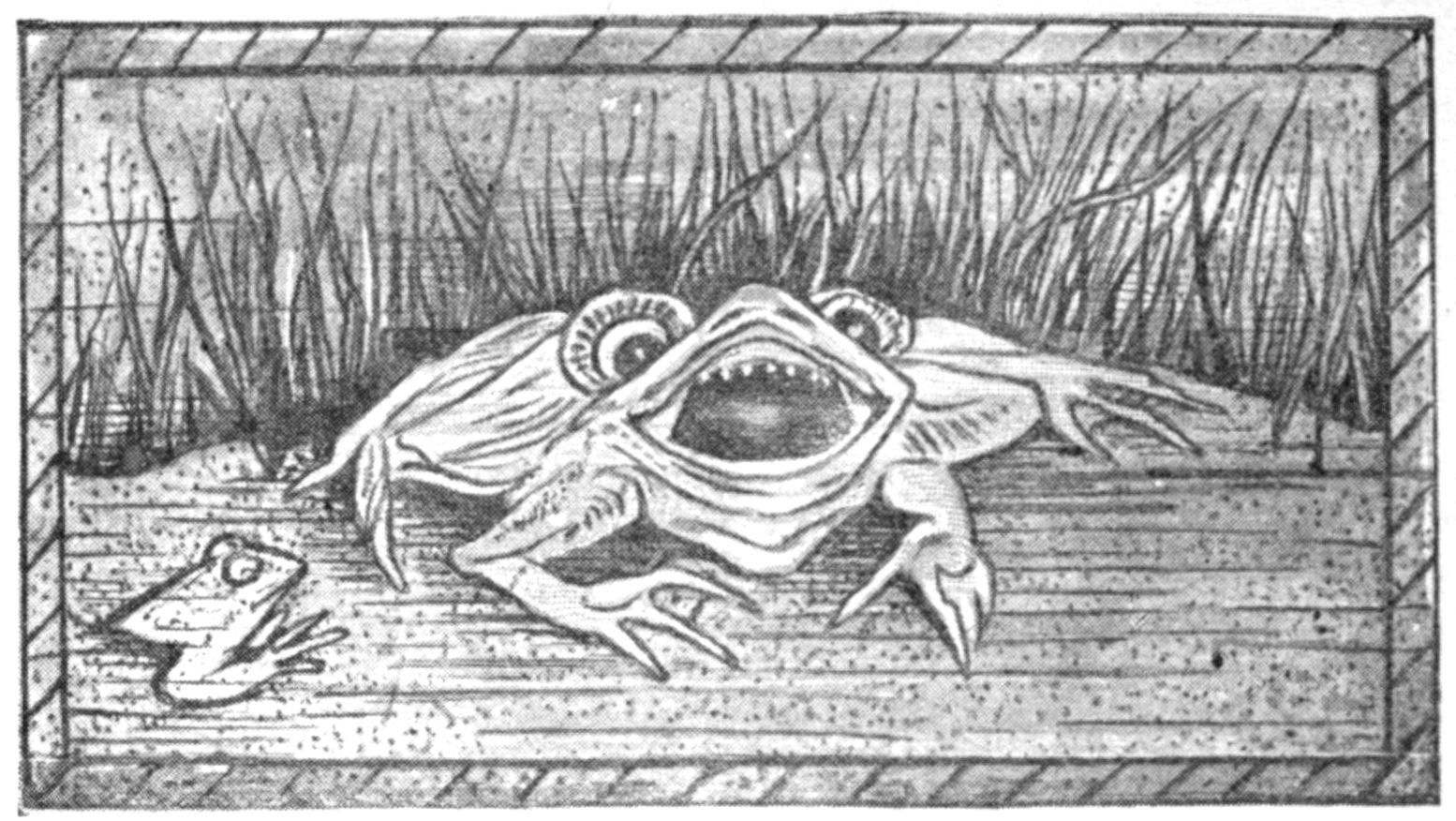
HOW KULÓSKAP CONQUERED AKLIBIMO, THE GREAT BULLFROG
[Passamaquoddy]
Piʾchce uskichinwi otenesis Pakichiotote pemtanikek.[31]
Long, long ago, Far, far away in the mountains An Indian village stood, Little known to other men; All lived therein at their ease, The men did well in their hunting The women worked at home, And all went well—save in one thing And that one thing was this: That the town lay by a brook And except in the stream there was not A single drop of water In all the country round Save in the puddles of rain. No one of all these Indians Had ever found a spring, Yet they all were very fond Of a drink of good, clear water And that in their brook was good. So over it they grew dainty And were very proud of it. But after a time they saw That the brook was running low, Not only in summer time, But in autumn after the rains; And as the water fell Their spirits, too, sank low; But day by day it grew less, Until its bed was as dry As a dead bone is, which lies In the ashes of a fire. Now they had sometime heard That, far away in the hills Where none of them had been, There was another village Upon this very stream; But what kind of people dwelt Therein, no one could say; So, thinking that these folk Knew something about the drought, They sent a man to look Into the thing. Three days Onward and upward he went, Till on the third he came Unto the village where He found a solid dam Built over the rivulet So that no water could pass, But all was kept in a pond. Then, asking the village folk Why they had done this evil, Since ’twas of no use to them, They said: “Go ask our chief, It was he who ordered it.” And when the messenger came To see the Sagamore, Behold, there lay before him, Lazily in the mud, A creature who was more Of monster than of man— Though truly in human form— For he was immense in size, In measure like a giant, Fat, bloated, at all points Most brutal to behold; His great, round, yellow eyes Stuck from his head as knots Or knobsticks from a pine. His mouth with stringy lips Went well from ear to ear; His feet were broad and flat, With toes immensely long— He was marvellous to behold! And unto him the man Set forth his just complaint, To which the brute at first Made no reply beyond A most uncivil grunt And a croak, but he said at last In a loud, bellowing voice, Such as we sometimes hear At night from pond or pool: “Do as you choose, “Do as you choose, “Do as you choose! “What do I care? “What do I care? “What do I care? “If you want water, “If you want water, “If you want water, “Go somewhere else.” Then the messenger told How his people were pining Near dead of their thirst, Which seemed hugely to please The monster, who grinned for joy, Till at last he rose to his feet. And, making a single spring Of many rods to the dam, Took an arrow and bored a hole So that a little water Just trickled out, and then cried: “Up and begone, “Up and begone, “Up and begone!” Then the messenger returned In sorrow to his people, Bringing them little joy, And for a very few days There was a little water, Then it stopped and they suffered again. Now these good Indians, who Were the honestest fellows alive, Best natured in all the world, And never harmed any one Except their enemies, Were in a pickle indeed; For sad it is to have Nothing but water to drink; But to want even that When one is raging with thirst Is worse than waiting for dinner When we have no dinner to wait for. Now this the Lord Kulóskap, Who was merciful in heart And knew all that was passing In the hearts of his Indian children, Observed, and pitying them Came to them all at once; For he ever came as the wind And no man e’er wist how. Now, just before he came, These honest Indians Had in a council resolved To send their boldest man Though ’twere to certain death, Even unto the village Where dwelt the evil chief Who built the cursèd dam Which kept the water with which They slaked their thirst when they Could get it—that is to say, Whenever the water was running. And when he got there, the brave Was either to obtain That the water-dam be cut, Or, failing, do something desperate— They knew not exactly what; But it was expected by all That if he were refused He would paint the village with care Of a deep vermilion hue, Leaving on every lodge Blood, and in this intent, Should, armed at every point, Go with his tomahawk, His axe and scalping-knife Singing his death-song, too, As he went on his way; And they were all agog. Now the Master was greatly pleased When he observed all this, For nothing delighted him more Than plucky, desperate deeds; So he resolved that he Would see to this thing himself. Therefore he came to them— The people of the town Which was then so high and dry— Looking so terribly fierce That in all the land there was none Who was half so horrible; For he seemed to be ten feet high, With a hundred wonderful plumes, Feathers of red and black, From his scalp-lock uprising; His face fresh-painted like blood, Green rings around his eyes, While a very large clam-shell hung From either ear, and behind, A great spread eagle, which Was awful to behold, Flapped wings at every step; So that the hearts of all Beat as he entered the village, For as simple Indians, they Accounted that this must be Either Lox, the Wolverine, Or Michihant the Devil Himself in person, who Had turned to Indian form. And the squaws declared that they Had ne’er seen aught so fine, Such a lovely, lovable man! Then the Master having heard The whole of their terrible tale, Bade them cheer up, for he Would soon set all to rights. So without delay he went Straight up the bed of the brook, And coming to the town Sat down, and bade a boy Bring him some water to drink; To which the boy replied That not a drop could be had In that town unless ’twere given Out by the chief himself. “Then go to your Sagamore,” Said the Master, “and bid him hurry, Or verily I will know The reason why I wait.” And when the boy had gone There was no reply before An hour, when the boy returned, During which time the Master Sat on a log and smoked. Then at last the messenger Came with a little cup Which was only just half full Of water, extremely foul. Then the Master rose and said: “Now I will go to your chief, And I think that he soon will give Far better water than this!” And having come to the chief He said, “Now give me to drink And that of the best, at once, Thou villainous Thing of Mud!” Then the Sagamore in a rage Bellowed: “Begone and find Thy water where thou canst;” When Kulóskap thrust his spear At once into the beast, Into his belly, lo! Gushed forth a mighty stream, For it was all the water Which should have run in the brook— He had taken it all to himself! Then the Master, rising high As any giant pine, Caught the monster in his hand, And crumpled in his back With a mighty grip—and lo! It was the Bull-Frog! Then He hurled him with contempt Into the stream to follow The current ever on. And ever since that time The Bull-Frog’s back has borne Those crumpled wrinkles which Are in the lower part: These are the print-marks made By the Master’s awful squeeze. Kulóskap then returned Unto the town, but there Found not a living soul, For a marvellous thing had come To pass while he was gone; A thing which shall be heard In every Indian’s speech Through all the ages, as ’Tis told by all to-day. For as these people were, As I said, good simple folk, They had talked together, just As boys do at their play, When they are hungry, thus: “What would you like to have?” When another will reply: “Truly, I’d like to eat A good hot venison steak, With maple sugar and bear’s oil;” “Nay, give me for my part Some succotash and honey.” Even so these villagers said: “Suppose you really had All the cold sparkling water There is in the world, what then Would you do with it?” One replied, “I would live in the soft smooth mud, And always be wet and cool.” To which another said, That he would plunge from the rocks And dive in the deep cold stream, Aye drinking as he dived. And the third said: “I would be washed Up and down with the rippling waves, Living at will on land, Or in the water;” Then The fourth said: “None of you Know how to wish, and I Will teach you how. I’d live In water all the time. And forever swim in it!” Now it chanced that these things were said In the hour when, while it passes Over the world, all the wishes Which are uttered by men are granted. And so it was with these Indians; For the first became a leech, The second a spotted frog, The third a crab which is washed Up and down with the tide, And the fourth a fish which swims A-drinking ever more. Ere this, there had been in the world None of the creatures which dwell In the water, but now they were there Of every kind. And the river Came rushing and roaring on, And they all went headlong down Into the endless ocean, To be washed into many lands, And places all over the world, Forever and ever more.
FOOTNOTES:
VII
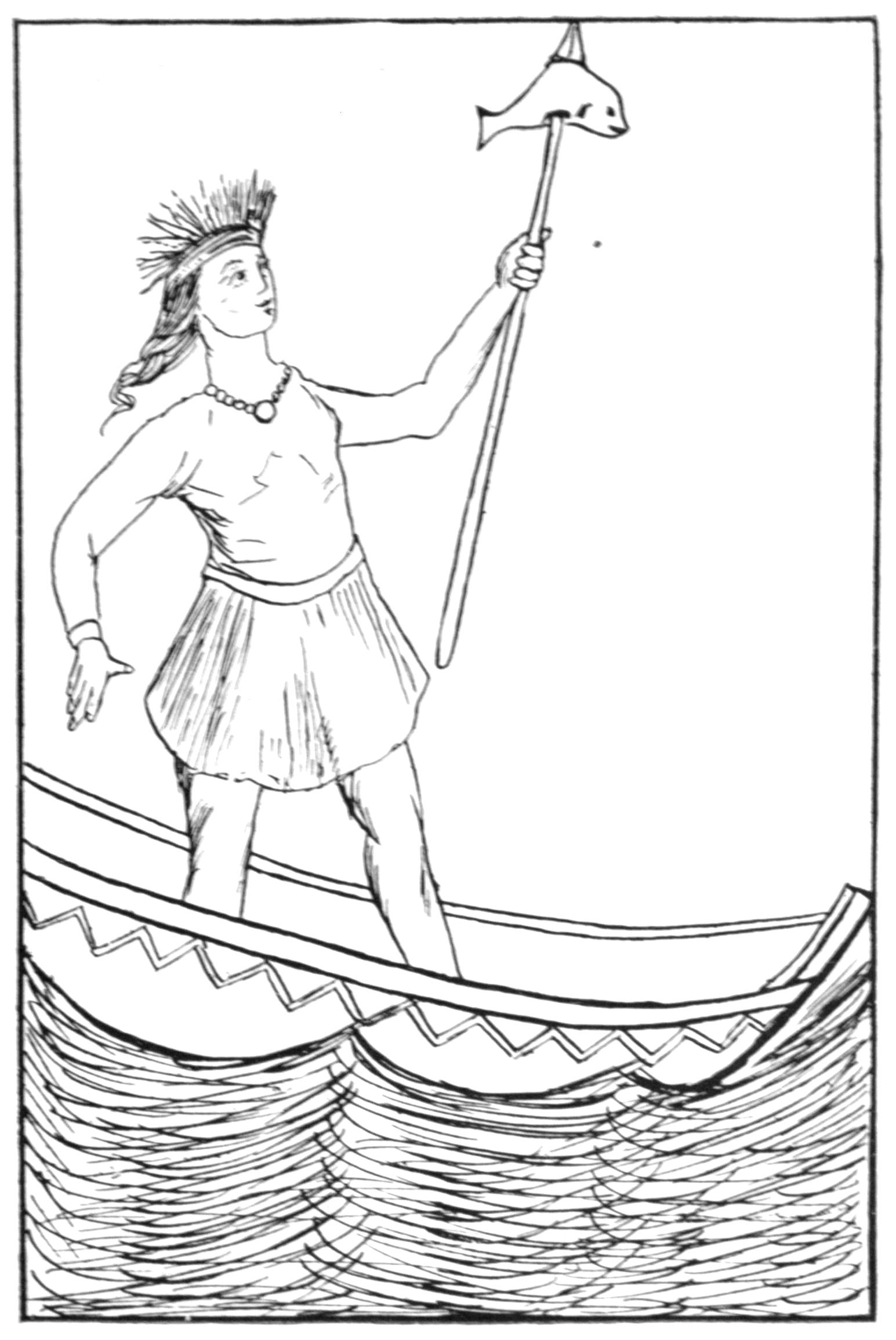
HOW KULÓSKAP WENT WHALE-FISHING
[Micmac]
Piche Kulóskap pechian Machieswi menikok.[32]
All of the olden time! The Master Kulóskap came To Pulowechē Munígû, That is to Partridge Island. And on the isle he met With Kitpûsâgunâû, Whose mother had been slain By a fearful cannibal giant: Therefore, like Kulóskap, He warred through all his life Upon the monstrous race; From which it came to pass That they were loving friends, Which did not hinder them From a hearty, merry strife In which they barely missed Taking each other’s lives In the most good-natured way As ye shall hear anon. Now being on the isle, The Lord of Men and Beasts Was entertained as guest By Kitpûsâgunâû, Born after his mother’s death. And, as the night came on, The host said to the Lord. “Let us go forth to sea In my canoe, and catch Some whales by torch light.” So Kulóskap, nothing loath, Consented, for he was A mighty fisherman, Like all the Wabanaki Who live along the shore. Now when they came to the beach There were many mighty rocks Lying scattered here and there. Then Kitpûsâgunâû, Lifting the largest of them, Put it upon his head, And it became a canoe. Then picking up another It turned to a paddle; next A long and narrow piece Which he split away from a rock Was changed to a fishing spear; And then Kulóskap asked “Who shall sit in the stern And paddle; and who shall take The spear?” The other said “That will I do.” And so The Master paddled; ere long The canoe passed o’er a whale. A monster of a fish; There was not his like in the sea. But he who held the spear Sent it down into the waves As if ’twere a thunderbolt; And as the handle rose He snatched it up, and so The mighty fish was caught; And as Kitpûsâgunâû Whirled it on high, the whale Loud roaring touched the clouds; Then taking it from the spear He tossed it into the barque As if it had been a trout. And both the giants laughed; And the sound of their laugh was heard All over the land afar, The Wabanaki land. So, being at home, the host Took up a knife of stone Splitting the whale in two, And threw one half to his guest. And they roasted each his piece, Over the fire and ate it.
How Kulóskap Went Whale-Fishing
Now the Master, having marked The light which was in the heaven Long after the sun went down, Said, “The sky is red, and the night I think will be bitter cold.” And the other understood That by his magic power The Lord would bring a frost And make it cold indeed; So he made the Marten bring All the wood that lay without, With the fresh oil of a porpoise Which he multiplied ten times By sorcery; and then They sat them down and smoked, And sang old songs and told Tales of the early time. But ever the cold came on, And at midnight, when the fire And fuel were all burnt out, The Marten froze to death, And then the grandmother. But still the giants smoked on, And laughed and talked as before. Then the rocks all round without Split with the awful cold. The great trees in the forest Were rent with frost, and the sound Was like thunder above, but still The Master and “He who was born After his mother’s death.” Kitpûsâgunâû, Laughed on, and so they sat Until the sun arose. And then Kulóskap said Unto the grandmother: “Nugumích, nemchaase!” “O grandmother, arise.” And then unto the boy “Abistaneûch, nemchaase!” “Marten, arise!” and both Awoke to life once more. Then as the day was fair They went into the woods To seek for game, yet found Full little. All they got Was one small beaver, so The Master said: “My friend, You may keep all of that.” Then Kitpûsâgunâû Fastened it to his knee Where it dangled like a mouse. But as the giant went On through the woods, and on, The beaver ever grew Larger and larger still, Till ’twas of monstrous size; Then he who bore it, took A mighty sapling. This He twisted to a withe And with it, to his waist He tied the beaver fast; But still it grew apace Till, trailing after him, It tore down all the trees, So that the giant left A clean fair road behind. Then when the night came on They fished for whales again, And feasted as before And had the cold again; So, even as before, The grandmother lay dead Of cold, with Marten, too. Then Kitpûsâgunâû Yielded unto the spell, And Kulóskap sat alone, Alone as conqueror. But when the sun arose He brought them back to life; And, laughing heartily, Said merrily, “Good-bye!” To Kitpûsâgunâû.[33] L.
FOOTNOTES:
VIII
KULÓSKAP AND WUCHOʿSEN, THE WIND-EAGLE
[Passamaquoddy]
Wuchoʿsen nit kininagwʾsit Kʾchî plakʾn potowatak pemlamsuk.[34]
Wuchoʿsen the Giant Eagle, The Bird-Who-Blows-the-Winds, Lives far away in the North, Ever sitting on a rock Which is at the end of the sky; Because when he flaps his wings The wind blows over the earth, Men gave him the name of old. When Kulóskap lived among men, He often in his canoe Went forth to kill the wild-fowl, Ducks or swans or brant, Which swim upon the sea. One day the tempest roared, The waves were as high as hillocks, Even Kulóskap the Lord Cared not to face the storm; So then he said to himself: “Wuchoʿsen has made this mischief And all to show his power, So now he shall feel mine!” He turned him to the North, It was long ere he came to the end; There on a moss-grown rock He found a great White Bird, The Eagle of the Wind. “Grandfather!” said the God, “Thou takest no compassion Upon us Kosesak— That is, ’thy suffering children’— For thou hast raised this storm. It is too terrible! Be easier with thy wings!” The Giant Bird replied: “Even from the earliest time, And from the earliest days, Ere aught beside on earth Had ever uttered word, I moved my wings and spoke In Wind unto the World; For mine was the first Voice E’er heard in life or time, Therefore I’ll ever speak, And ever move my wings, At freedom, as I will.” Then Kulóskap the God, Arose in all his might, Tremendous—for he rose Up to the clouds above— And took the Giant Bird As if he were a duck, And, tying fast his wings, Cast him afar, adown Into a deep dark cleft Between the splintered rocks, And left him lying there. Then all the Indians Could go in their canoes As freely as they chose For many days and months. But then as time went by, They noted day by day That all the waters grew So stagnant and so foul That even the Master found He could not row his bark; All was so thick and dead, And rottenness and slime Crept into all the world. And then he thought upon The Giant Bird, and went To find him, far away. As he had left him, so He found him, for the Bird, The Spirit of Air, Can never truly die. And so he picked him up, And then with care untied One single wing, but left The other tightly bound. And since that time the Wind Has never been so wild As ’t ever was of yore. L.