Canto Fourth
Charles Godfrey Leland translation
THE MASTER AND THE SORCERERS
I
KULÓSKAP AND WINPE; OR, THE MASTER’S FIRST VICTORY
[Micmac]
Piʾche ktagudimol.[35]
All in the olden time, Or in the first of all, Of all things here on earth, Men were as animals And animals as men. But how this mystery was, No one can understand, Though some explain it thus: As Man was made the first, All creatures first were men, But as they gave themselves To this or that desire Like that of animals, And all their souls to it, So were they changed to brutes. Yet ere this came to pass There was a middle time When they could change their forms To beasts or men at will; Yet more and more and more Even as men, they showed In all, the Animal. Then Kulóskap the Great Lived on a wooded isle With many Indians Whose names and natures, too, Were all of beasts and birds. These men, and most of all The one called Pulowech, The Partridge, had attained To certain magic power. These, as they found him great, Grew jealous of the Lord, He who was ever Man; And so they all resolved To leave him in the isle. But with them take away His grandmother, likewise Marten, the boy, who served The Master in his lodge. In Micmac Marten’s name Is Abistanēūch; he Was of the Elfin kind, One who could change his form To what he pleased. For all Relating to the Lord Was wonderful and strange. This Marten ever ate From a small dish of bark Called Witchkwîdlakunchich. Whene’er he left this plate Kulóskap always knew The place where it was laid, And by a glance thereat Could tell whate’er had happed Unto his family. Kulóskap had, beside, A wondrous magic belt Which gave him endless strength And untold mystic power. Yet to increase his might, Even he, the Lord of Men, Must often all alone, Dwell in the wilderness, And fast and pray and dream, Until by penance strong He gained once more his power. Among his enemies Who dwelt upon the isle, Was one named Winpe, who Of all was terrible; So he and all the rest, With Marten as a slave, Likewise the grandmother, One day when Kulóskap Was hunting in the North Got into their canoes With all their worldly gear, And sailed, far, far away. Now when the Lord returned And saw that all were gone, He sought and found the dish Which Marten had concealed, And on it read the truth: How he had been deceived And whither all had fled. Now, it is said, the Lord To gain tremendous power, Or such grand mastery As man had never won, Went to the wilderness, And there for seven years So trained his mighty mind By penance into will, That when the time was o’er He knew that he had won, And that no thing on earth No sorcerer nor fiend, Giant nor devil grim, Could now resist his power. So when the time had come He called his dogs, and went Down to the shore and looked Far o’er the rolling sea, And sang the magic song Which all the Whales obey. Soon in the distance rose A small dark spot, which grew In size as it drew near. ’Twas but a little whale; It came unto the Lord, But he was now a giant; He stepped upon the whale. It sank beneath his feet; He laughed and said, “Begone! Thou art too small for me!” He sang again the song, But now with all his power; And then there came the Queen Of all the whales, and she Was as a giantess Even among her kind; She bore him easily Unto Kespūgitk, then She paused and said, “O Lord! I dare not further go, For I shall run ashore.” And this he wished because He would not wet his feet, And so he lied and said: “The land is far away.” So she went boldly on, Till she beheld below, The bottom of the sea With many shells on it; And then she said in fear: “The land, does it not seem To thee like a bow-string?” “No!” He answered, “Land is far.” The water grew so shoal That soon she heard the song Of many Clams, who lay Deep shelled below the sand. They were the enemies Of Kulóskap the Man, Their only enemy, And so they sang to her: “Hasten and throw him off, And drown him in the sea.” But great Putúp the whale Who did not know their tongue, Asked what the words might mean? And he replied in song “They tell you to make haste; Nenagimk, ’to hurry’; To hurry, to hurry along, Away—as fast as you can.” The whale like lightning flew Until she found herself High up upon the shore, Then she, too, cried in woe: “Alas, alas! Nujich! My grandchild, you have been My death at last—for now I cannot leave the land; I shall swim in the sea no more!” But Kulóskap answered her: “Nʾgumi, have no fear! You shall not suffer, for You shall swim in the sea once more.” Then with a push of his bow Against her head, he sent The whale into the sea, Into the deep once more. And then the whale rejoiced, But ere she went she said: “O darling grandson mine! O Master! Hast thou not Tobacco in thy pouch, Therewith a pipe to spare?” And he replied, “Ah yes! I see you want a smoke, I have what you require.” He gave the whale a pipe, Tobacco and a light And so she sailed away Rejoicing as she went, A-smoking as she swam; While Kulóskap, the Lord, Leaning upon his bow Beheld the long low cloud Which trailed behind her, till She vanished far away. So to this very day, The Indians, when they see A whale who blows, cry out: “Behold, it smokes a pipe, The pipe of Kulóskap.” And so the Lord went on, Meeting at every step Adventures wild and strange; Witches and sorcerers Sought to delay his steps, Until at last he came To Uktâkumkuk, or Néwfoundland, where his foes Had been, then fled away. Again he sang his song, And once again a whale Carried him far away, Away unto the North; And now he found indeed That he had gained his end, Since by the shore he saw A wigwam, and therein His sorrowing grandmother And Marten well-nigh dead; Winpe the sorcerer Had treated them full ill. Greatly did they rejoice To see their Lord once more; And then Kulóskap said: “When Winpe shall return Do all that’s in your power To irritate the man To make him mad with wrath; So shall he lose his power, For anger weakeneth will.” They did what he required When Winpe came again, Till in a roaring rage He sought to take their lives; When lo! before their eyes The Master stood and gazed In aspect terrible, Upon his angry foe. Winpe fell back a pace To gain once more his power; It came and it was great. With all his evil will The sorcerer raised his strength And as it came he grew In giant stature, till His head was o’er the pines; And truly in those days The pines were higher far Than those we have to-day:
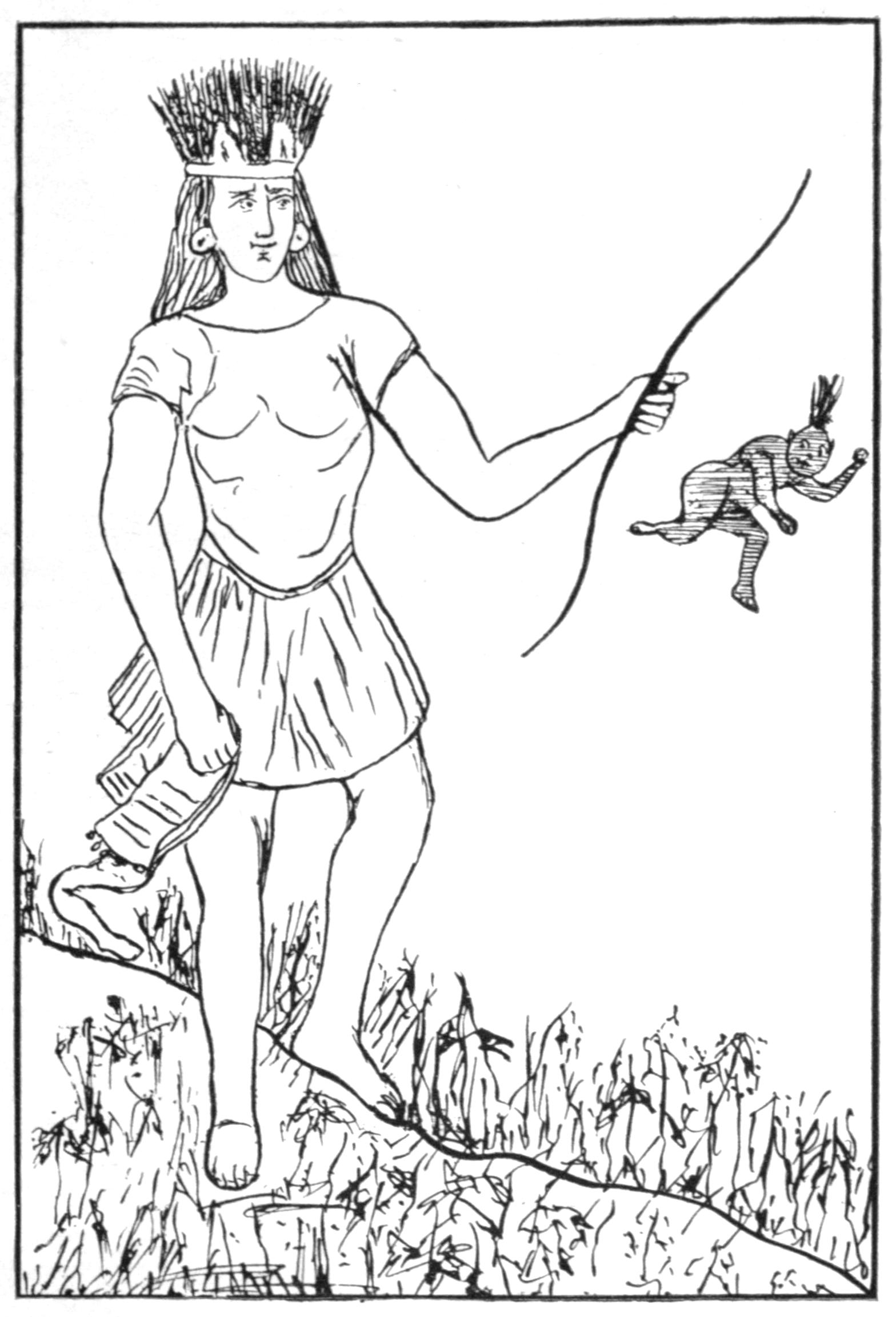
Kulóskap and Winpe
But Kulóskap the Great The Lord of Men and Beasts, Laughed as the thunder roars. And grew until his head Was far above the clouds, Until he reached the stars, And ever higher still, Till Winpe seemed to be A child beneath his feet. Then, holding him in scorn, Kulóskap the great lord Smote Winpe with his bow As one might strike a dog; Down fell the sorcerer dead!
FOOTNOTES:
II
HOW A WITCH SOUGHT TO CAJOLE THE MASTER
[Micmac]
Kes saak.[36]
This is a story of the olden time. It chanced that great Kulóskap met a witch, An evil being who had made herself Look like a fair young girl, and that so well By all the deepest art of sorcery, That she was sure the Lord could never see Through her disguise—wherein she was a fool, Because he read her at a single glance. She bade him take her out in his canoe; So forth they sailed over a summer sea With a sweet breeze. The witch upon the way Sought to beguile the Lord with loving words To which he made no answer, knowing well What kind of passenger he had on board. And so she played all her cajoleries, While he remained as grim as any bear, Replying with a growl to loving words; Till in a rage she changed her melody Into the curse which raises up the storm As if to show defiance of his power. And it was terrible when the wind howled Over the waves which madly rose and fell Like great white wolves a-jumping while they run; And the red lightnings flashed, while the great sea Grew dark as if to show their fire the more. And then the Master was enraged indeed, That a vile witch should dare to play such tricks With him, the mighty Lord of Beasts and Men; And, driving the canoe unto the beach, He leaped ashore, and giving it a push He sent it headlong out to sea again, And cried: “Sail with the devil if you will, But ne’er on earth again in human form!” Then she in terror cried: “What must I be? Oh, Master, say what shape shall I assume?” And he replied: “Whatever form you please— That grace alone I give thee.” In despair She plunged into the deep and there became The wĕbĕtumekw, a ferocious shark Which has upon its back a mighty fin Like a great sail when swimming in the sea. So the canoe and witch were changed as one To the great evil fish, and to this day The Indians when they see it, ever cry: “Behold the girl, who in the olden time Was punished by the Master.” That is all! L.
FOOTNOTES:
III
HOW KULÓSKAP FOUGHT THE GIANT SORCERERS AT SACO
[Passamaquoddy]
Yut nʾkani aknodʾmâgon uch Kulóskap.[37]
This is a tale of Kulóskap, An old one. There was a father Who had three sons and a daughter, And all were Mteolinwuk, That is, they were magicians Of terrible power, and giants; They ate men, women, and children; Yea, they did everything That was wicked and horrible; And the land grew tired of them And of all their abominations. Yet when this family Was young, Kulóskap had been Ever and truly their friend; He had made their father his father, The brothers his brothers, the sister His sister by adoption, As Indians often do. But, as they all grew older, And the Master began to hear On every side of their sins. He said: “I will go among them And find if this be true; If it be so, they shall die— I will not spare one of those Who oppress and devour mankind, I care not who he may be.” This evil family dwelt Near the place that now is Saco, Upon the sandy field Which is in the Intervale, Or the summer bed of the river, Among the White Mountains, which lie Between Kèzitwâzuch, Or Mount Kearsarge the mighty, And Kchibenabesk The towering rock, and near Wʾnâgʾmeswuk Wigît The Home of the Water Elves. Now the old man, the father Of all these evil sorcerers, Had only one eye, and he Was half gray like a stony mountain; Then the Master made himself Like to the hoary old fellow; There was not between them The difference of a hair. So having taken this form He entered into the wigwam And sat by the agèd man. Then the murdering brothers Who never spared a soul, Hearing that some one was talking, Peeped slyly in, and seeing A stranger so like their father That they knew not which was which, Said: “This is a great magician, But he shall be tried ere he goes, And that right bitterly.” Then the giantess sister took The tail of a whale, and cooked it, And gave it to the stranger That he might eat it, when Just as it lay before him On the platter, and on his knees, The elder brother entered And saying: “This is too good For a beggar like you,” took it Away to his own wigwam. And then the Master said: “That which was given to me Is mine—so I take it again.” And sitting still he willed Or wished for it to return. And lo! the dish came flying Again into his lap! And he ate from it, undisturbed. Then the brothers said: “This truly Is a very great magician, But he shall be tried ere he goes, And that right bitterly!” When he had eaten, they brought A mighty bone; the jaw Of a whale, and the elder brother With great ado, and using Both arms and all his strength, Bent it a little, and proudly He held it to the Master Who with the thumb and finger Of his right hand alone, Snapped it like a green twig, And crumbled it to powder. Then the brothers said again: “This is truly a great magician, But he shall be tried ere he goes, And that right bitterly.”
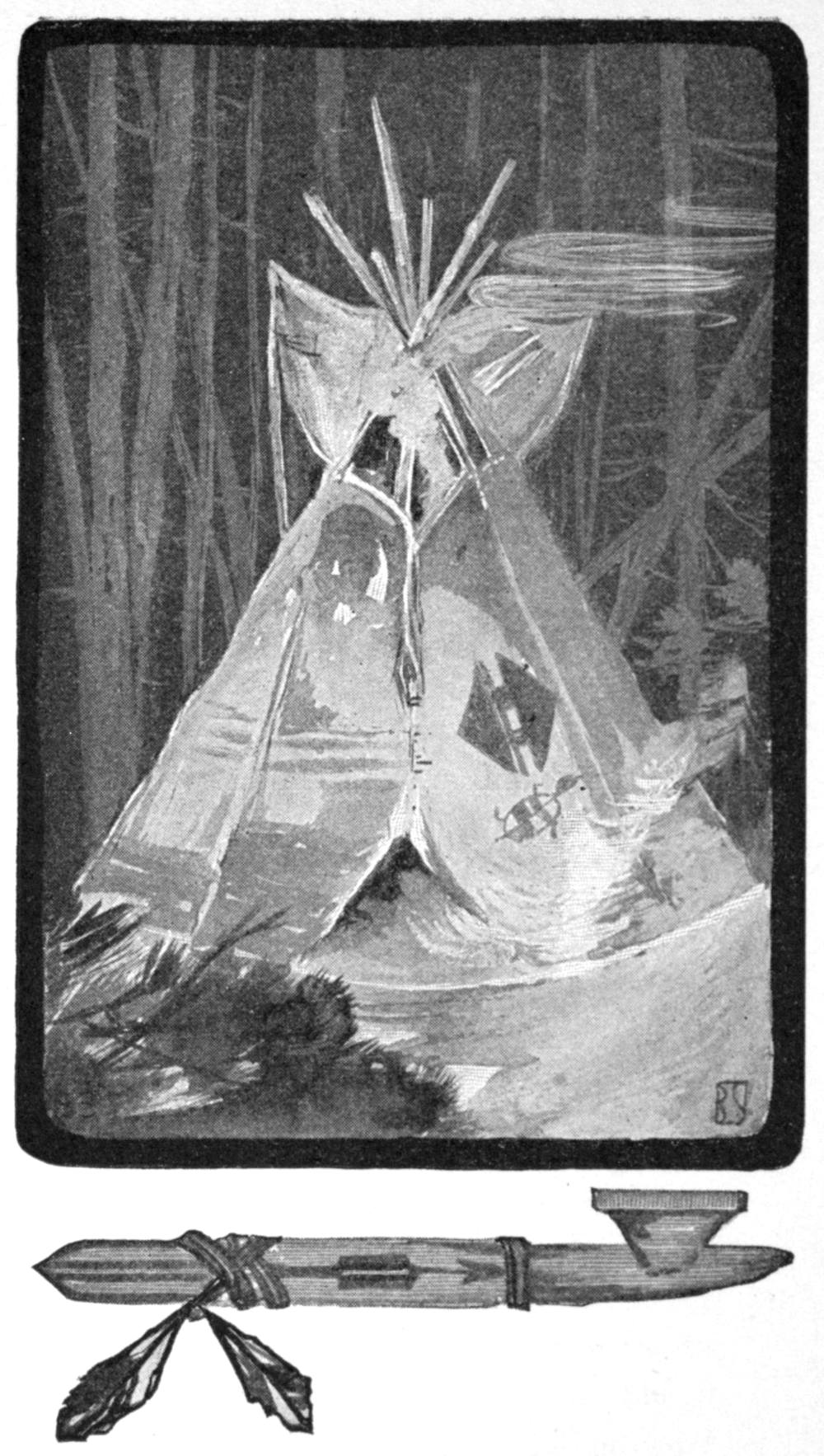
Then they brought an enormous pipe Full of the strongest tobacco;
Then they brought an enormous pipe Full of the strongest tobacco; No man, not even a sorcerer Could have smoked such fearful stuff. And as it was passed around All of them smoked. The brothers Blew the smoke through their nostrils As if it were light as air. But the Master filled it full And, lighting it, burned all The tobacco into ashes At one puff, with a single pull! Blowing all the smoke through his nose Even as they had done. Then they said and now in anger: “This is truly a great magician; But he shall be tried ere he goes”— They never said it again! Yet still they tried to smoke. They shut the door of the wigwam Hoping to smother him. But he puffed and puffed away As if he had been on the top Of a mountain in a breeze, Till one said: “This is idle, Let us go and play at ball!” The place where they were to play Was the sandy stony plain Which lies on the bend of the river. And so the game began. Kulóskap discovered That the ball with which they played Was a hideous human skull, A living thing which snapped at His heels. Had the Master been As other men, the monster Would have bitten a foot away. Then he laughed aloud, and said: “So this is your style of foot-ball! Well and good! But let us all play With our own balls.” He stepped Up to a tree by the river, And broke off a hole or knot And it turned to a living skull, But one which was ten times greater, And ten times more terrible Than that which the sorcerers used. And the three brothers ran Before it as it chased them As rabbits are chased by a lynx; They were entirely beaten. Then Kulóskap stamped in the sand, And the waters rose and came rushing Fearfully from the mountains Adown the river bed; The whole land rang with their roar. Then the Master sang the song, The magic song which changes All creatures to other forms, Which changed the Three and their father Into the Chinames, A fish which is long and broad As a man, and they all went headlong Down in the flood to the ocean Where they must dwell forever And are caught unto this day. These three magicians wore Each one a collar of wampum Of purple beads and white, Wherefore the Chinames Has exactly round its neck Or below its head, the same, Distinctly marked and clear; They were mighty men in their day And great Mteolinwuk, But were tried before they went And that most bitterly. Yes indeed, Nsîwes, my brother, This story is really true, For Kulóskap was very great In his day—and a day will come When I myself shall go to him. L.
FOOTNOTES:
IV
HOW THE MASTER SHOWED HIMSELF A GREAT SMOKER
[Passamaquoddy]
Piʿche Kulóskap kʾchî skitap.[38]
Kulóskap the Great, Lord of Beasts and Men, Was ever a boon companion And a right valiant smoker. In all the world was no man Who loved a well-filled pipe Of good and fragrant tobacco So heartily as he did. Now in that happy time, The sun shone warmer and brighter, The summers were far longer In the land of the Wabanaki Than they truly are to-day. And the Indians raised tomáwe, That is to say, tobacco, Far better than the best Which ever is seen to-day. And they found a mighty solace In burning the gold-brown leaves. There came one day to the Master A great and evil magician Who sought to take his life, As the Master at once perceived; For he read the thoughts of men As though they were strings of wampum— Seeing deep into every heart. Now this evil magician thought, By first amazing the Master Through some wonderful trick, to weaken The will which gave him strength; As they say a fish is frightened When he sees that his foe swims faster, And is too much alarmed to fight. So the sorcerer sat to smoke With a pipe whose bowl was bigger Than the head of any man, With a stem full ten feet long; But ever that of Kulóskap Grew to the size of a pumpkin, And then like the ten-foot boulder Which lies on the beach at Rye; And the smoke which rose from his puffing Was like that of a forest fire. Then the sorcerer filled his pipe Afresh with strong tobacco, Such as would kill if they breathed it A porcupine or a toad. And at one pull he burned it Leaving no spark behind; And at one whiff he sent it Out in one great round ball; Then sat and looked at the Master. And then the Lord Kulóskap, Whose pipe was many times greater, Also sent his tobacco Out in a puff as round— Out in a mighty ball As hard as any flint, And, blowing it on the ground Which was of granite rock, Split it asunder, so That a valley yawned between them. Then they both sat in silence Until the Master said: “Do that—and then take my life.” But the wizard could do no more, And returned in shame and anger To the evil ones who had sent him. L.
FOOTNOTES:
V
KULÓSKAP AND THE WITCH
[Passamaquoddy and Micmac]
Nequt Kulóskap meiaoet Pechian kʾtakʾmikomnok. Nit kʾmʾtkinansnok Neke bʾsʾnboek kʾchî Kiwaʿkwik.[39]
When Kulóskap the Master Came into this world of ours, Or the Land of the Wabanaki, It was full of giants and monsters, Sorcerers, dwarfs and demons, Mighty beasts and men, Fiends and the Indian devils, And, worst of all, the witches, And worst among them Pûjinskwes, A word which means “The Pitcher.” She could be fair when she would, Fair as a rosy sky With stars still beaming in it In very early dawn; Or terrible as a storm, When it howls among the mountains, And lightens in the midnight. Now while the Master was young, And had not gained the power Which he won in riper age, Pûjinskwes sought his love. But he knew that she was evil, So he fled away from her wooing, And the wild-cat witch pursued him. It was a dreadful flight, Since to make their steps the longer Both took the giant form, Took it by magic power. It was an awful storm, A terrible storm in winter When the wind is chasing the clouds; It was like a frightful tempest In summer when the lightning Chases after the thunder. Deep lay the snow on the earth; Therefore they both wore snow-shoes; But, when they came to the shore, Kulóskap leaped from the mainland Over the sea between To the island of Grand Manan; And so he escaped from the sorceress; For the shoes which the Master wore Were round and out of the common; While those of the witch were long, Long it is said and pointed, And the marks of the two are still To be seen deep pressed in the rocks By the shore to this very day. But for days and years thereafter Pûjinskwes sought to slay him, And she had terrible power, The might of the Evil Witches Which came from the early time. Now ’tis the greater part Of the Indian art of magic To know what our foes are planning, Planning and plotting against us, And all their tricks and devices Which they scheme in the darkened paths, The darkened paths of Evil. In knowing this, Kulóskap Was the greatest and the first, And, knowing new arts of magic, Went far beyond them all. For before his time all sorcerers Went every one his way Unheeding the ways of others, Even in wickedness. But Kulóskap first of all Threw out his soul unto others To find what others knew. When the Lord was on the warpath Seeking the sorcerer Winpe Who had carried away his household, He came to Ogomkeok Where he found a great birch wigwam, And, in the wigwam seated Bending over a fire, A strange old woman—a horror Of all old hags and ugliest— Trembling in every limb, As if death stood at her elbow, Dirty, ragged and loathsome, He never had seen the like. Then looking up at the Master With bleared and pitiful stare, She begged him to bring some fire-wood Which he did indeed, while knowing Who it was who was so disguised, For he knew it was Pûjinskwes And he laughed at her in his heart. Then she said to him, “O stranger, As thou art a man of mercy, Pray free me from the waagûkw From the monstrous terrible vermin Which madden me by their bites!” Now all the waagûkw were devils, The spirits of every poison, Which she thought had such a power As must even kill the Master. But he foreseeing this Had taken as he came Cranberries from a swamp, And bidding her bend over, He took the imps from her hair, And every one as he took it Turned into a porcupine, Or else a terrible toad. When she asked him, “Have you found one?” And, “I have,” replied the Master; Then, “Crush it,” was her answer, So then he crushed a berry, And Pûjinskwes, hearing the sound, Thought to herself: “The poison Which is now upon his fingers Will soon be in his heart, And death will follow after.” But Kulóskap put the devils One by one as he found them Under a wooden platter Which was lying close beside him. And as he did this he chanted A song which put her to sleep, A song of wonderful power. So she slept until the morrow And when she awoke, the Master Was far away, and her devils, Porcupines, toads and all, Were swarming over the floor, For they had upset the platter. Then she was filled with fury To think he despised her so That he had not even cared To kill her while a-sleeping. Then she burst forth in madness, Wild as the Indian devil Forth in her own true figure As beautiful as sin, Wild as the wolverine; And gathering up her imps, And summoning all her power Of magic by fiercer will, Went forth to meet the Master. Onward he went to the North Till he came to a pass in the hills. It was a great ravine Wherein two monstrous beasts Waylaid all travellers And tore them limb from limb. Straight at his dogs they flew; He did but touch the dogs, And speak a word of power, When up they grew to size Stupendous, so they seized The beasts e’en as the wolf Seizes a rabbit. Then The fight was at an end. These dogs had been so trained That when called off they fought More fiercely than before, And when told not to bite They ever bit the more. Soon he came to the top Of a high hill, and looking Afar o’er all the land Beheld, away in the distance, A wigwam, and knew in his heart That an enemy dwelt therein; And coming to it he found An old woman with two fair daughters. But he knew at a glance that the mother Was a witch among the witches, And the one who sought his life. The girls came to him greeting With fond and pleasing glances, Asking if he was hungry, And offering him a dainty: The entrails of a bear Which, when turned and smoked and seasoned, Are deemed by all delicious. They are a common gift Of Indian girls to their lovers, For, when cast around the neck As a necklace, it means “I love you.” But these had been enchanted, Poisoned by magic spells; Had the Master taken them then He would have lost his power. Little they knew of the magic, The new and wonderful magic Of reading the thoughts of men, Which the Lord had brought into the land, Unknown to the witches of yore; So as they came wooing round him With smiles and wanton glances, He smiled, as if all he wanted Of them, was to be won! So he took the gift which they offered, But, instead of putting it on, Cried out to his dogs, “Cuss! cuss!” Which in Micmac means “Stop, stop!” But which they had been trained to believe Was, “Hie at them!” They flew at the witches When both flashed up like fire In the terrible form of devils, As flaming female fiends. Then came an awful tumult Such as never before was seen In the land of the Wabanâki; All the earth and rocks around Were rent in the dreadful tumult And all the while the Master Cried merrily to his dogs: “Stop, stop! These are my sisters, Let them alone! Be quiet!” But the more he bade them be peaceful The more they attacked the witches And drove them at last away. Then the Master entered the wigwam Where Pûjinskwes sat waiting, Waiting for him as dead, Waiting for him as food. So he said to her while smiling, “Grandmother, are you hungry? Do you love the links of a bear? Then here are some.” He threw them Around her neck and she died, Died and became a devil. Yet the sorcerers when devils Ever rise to life again; Ever rise to work men mischief, For evil can never die. Then the Master kept on his way Till he met the giant Winpe— The evil sorcerer Winpe Whom he slew in terrible battle. This is the song of the Micmacs, Of the Master’s earlier deeds.
FOOTNOTES:
VI
KULÓSKAP AND THE WITCH CALLED “THE PITCHER”
[Passamaquoddy]
Uskijinwi otenesis.[40]
There was an Indian village Wherein dwelt many people, Who were all of the Pogumʾk Or of the Black Cat totem; And wisest and bravest among them Was Kulóskap the chief; And when he went forth a-hunting With the tumʾhîgʾn (tomahawk), The knife and bow and arrow, He slew the moose and the bear; So he gave meat to the poor, So he fed all the tribe, Yet, though he was chief of the Black Cats, He was by his mother a Bear. Pûjinskwes the witch and devil Was also one of the Black Cats; She was woman or man as she listed, But in those days she lived as a man; And, because she hated the chieftain, She thought how she might kill him, And take his place in the tribe. One day when all the people Were packing to travel away To another place for summer, Pûjinskwes asked the chief To go with him (or her, As you may choose to take it), Adown to the water side To seek for the eggs of the gull. Then both in a canoe Went far away, and still farther, Till they came to a lonely island. And while Kulóskap was seeking For eggs along the seaside She stole away in silence, Away in the agwedʾn That is, in the birch-canoe. And as she paddled away She sang in the Indian tongue: “Nikedha pogumʾk mʾneʿnuk Petesinel sagʾmawiw!”[41] “I have left the Black Cat on an island, I shall be the chieftain now.” So she returned to the village; Next day they all departed, There was not one of them left, Save the one who was worth them all. Then at night they camped, and expected The chief who w’ould come to them, And then the evil Pitcher Ruled them as Sagamore. Now for thirty days Kulóskap Who had well-nigh lost his power Of magic, as all magicians Are often all exhausted, Remembered that his friend The Fox was mteolin, With all the strength of sorcery. And still the mighty Master Could sing the wonderful song Which is heard to any distance, Away over forests and mountains, Over the rolling rivers. So he sang and the Fox soon heard it, And he travelled by night and day Until he came to the ocean, And swam to the lonely isle. “Now swim with me to the mainland,” Said the Fox unto the Master. “Brother, I cannot do it For all my power is gone.” “Hold to my tail” said the Fox, “Be of good faith, my brother, We soon shall gain the shore.” “But remember,” said the Fox, “While we are in the water Thou must keep thine eyes fast shut. All depends upon that, On that alone and thy faith.” So all went well for a time, But anon the chief grew weary, And opening one eye a little It seemed to him that truly They were not ten feet from the shore, And being of little faith He thought—for he spoke not aloud: “We shall never get to land:” But the Fox who read his thought, Replied, “Do not believe it, I will that we reach the shore.” But the journey lasted long, For what seemed unto the Master To be ten feet, was really Ten miles—and the wind was high, And the waves were wild and beat them, For the witch had raised a storm; And it was late in the evening Before they reached the land. “And now my elder brother,” Said the Fox, “you may go your way.” He went and came to the camp Where he had left his people. There all was silent and sad, The ashes were cold on the hearths, In the deserted homes, In the lonely, silent wigwams; So he followed the tracks of the Indians, And in a day came near them. The first whom he overtook Was his mother bearing his brother; Nʾmokswes, that is the Sable, Or as others say the Marten. She bore him on her back, The child’s back lay against her, So that, while she looked forward, He could only look behind. As Kulóskap peered from a thicket, Smiling to see the boy, The Sable cried: “Oh, my brother Is coming to us at last!” And she turned her head, yet saw nothing, For the Master hid his head Quickly behind a tree. But the infant cried again: “Indeed and truly, mother, I saw my brother there!” And this time glancing quickly She caught a sight of the Master, And they all laughed for joy. Then the mother threw Nʾmokswes Like a stick down into the leaves, But the Master bade him rise And run to the camp with speed. “And when you are there,” he said, “Build up a mighty fire, A fire of hemlock bark, And take the Pitcher’s babe, Whom she so dearly loves, And has given to you to tend, And throw it into the fire; Then run to me for your life, For verily thou wilt be In direst need to do it.” And as he had commanded It was done. When the fire was hot Nʾmokswes threw the imp, The child of an evil mother, Into the roaring flames, And it was burned to death. Then the sorceress who was maddened, As you may well believe, With rage, pursued the Sable, Even as a starving wolf Chases a rabbit in winter: Nʾmokswes in great fear Cried, “Oh my elder brother!” And the sorceress yelled: “Call out! Call loudly as you can! For to save your life you must run As far as the distant island Where I left him long ago.” But at the word the Master Stepped forward, and as he faced her Said: “He need not run so far.” Then, seeing him, fear came o’er her, But laughing aloud to hide it, She said: “I only chased him In sport, for I truly love him.” But the Master answered grimly, “I know thee and thy love, And also all thy tricks, Thou who art truly a devil.” Then feeling that his power Of magic was returning, He used his mighty will, And the will awoke to might, And before his breath the sorceress Was driven backward lightly, Like a leaf before the wind Till her back was against a tree; Then he said to her, “Remain Ever attached to the bark,” And so indeed she remained, Though not as the Master meant. Then the Master and his brother Together went to the camp; Great was the joy when he came. The Pitcher had a hatchet, And so with much ado She cut herself (or himself), In time away from the tree. The Black Cats heard her chopping, Pounding and chopping all night; And wondered what it might be. She came to them in the morning, But a fragment from the tree Ever adhered to her back: So they laughed at her in scorn, And sang together these words: “He who made the chief Stay on a distant island, Is now stuck by the chief Fast with his back to a tree.” It is said she turned to a toad Which bears to this day on its back A hump, or the piece of wood Which was carried away from the tree. Though another legend has it That, as during all her life She had tormented men With her insatiate longing, She was changed to a mosquito Which preys on them in the night, The blood-thirsty stinging Tʾsiso Ever a-stinging and singing: “Give me thy life and blood.” It is said it was at Fresh-Water, After she left Bar Harbor, That she changed into the insect Which ever will bear her name. Pûjinskwes had many children Whose fathers were giants and monsters, Sorcerers and demons, But, as they all were hideous, She stole from the Indian women Their fairest babes, and pretended That they were all her own. Among these was a comely youth, And as he grew older he wondered That most of his brothers and sisters Were dark and like the devils While he, and a few, were fair. So one day he asked Pûjinskwes Why it was? She answered laughing: “The dark were born in the darkness, But thou, my son, by day.”
FOOTNOTES:
VII
HOW KULÓSKAP SAILED THROUGH THE CAVERN OF DARKNESS
[Micmac]
Nʾkani bʾmaoinnoak itmok niktuk iloiknuk wesisek Kulóskap honichan uch negum Naga honosokoan nihit Piliomeskasik ktakʾmigw.[42]
It is told in old traditions, And even in them with a difference, According to the nations In which these songs are sung, That “in these olden times,” Kulóskap’s seven neighbors, That is, seven beasts of the forest, Stole his family from him And that he long pursued them Even to Néwfoundlánd. When he came there it was night, And, finding Marten alone, He took him into the forest, Bidding him seek for game, Putting his belt on the boy; Which gave him such magic power That he killed both moose and bear, And brought all gayly home. Now it came to pass in the morning, That old Dame Kâkâgûch, The meddling and spying Crow, Observed that meat was drying In the smoke of the Master’s wigwam. This news she spread abroad, Adding that trouble was coming, For the Master must have returned. Then a great fear came upon them, They sat every man in his wigwam, Waiting for death in silence For they knew the Master had come. But when he had slain Winpe And saw them sitting in silence, Frightened like so many rabbits Before a hungry wild-cat, He laughed aloud and forgave them; For he was noble and generous, And cared for no small foe. And as they were very hungry, For he had come in a time When all of them were starving. He fed them all with venison; So sorrow left the wigwams. But as they had left him of old, He left them in turn and departed. Ere they had known his power, They had left him alone to die; Now that they knew his power, They feared they should die without him. But he left them to go their path And turned his steps toward others. Then, having made a canoe, The Master and his mother, Dame Bear, and Marten, his brother, Went forth on a mighty river Which was in its beginning Both broad and beautiful. So they sailed away down the stream Till they came to mighty cliffs Which ever grew higher and closer, Till they met in an arch overhead, But the river ran on beneath them, And ever far underground, Deep into earth and deeper, Till it dashed into roaring rapids Among rocks and wild ravines; Then under cataracts, So horrible that death Seemed to come and go as they darted With every plunge and motion Headlong in their canoe.
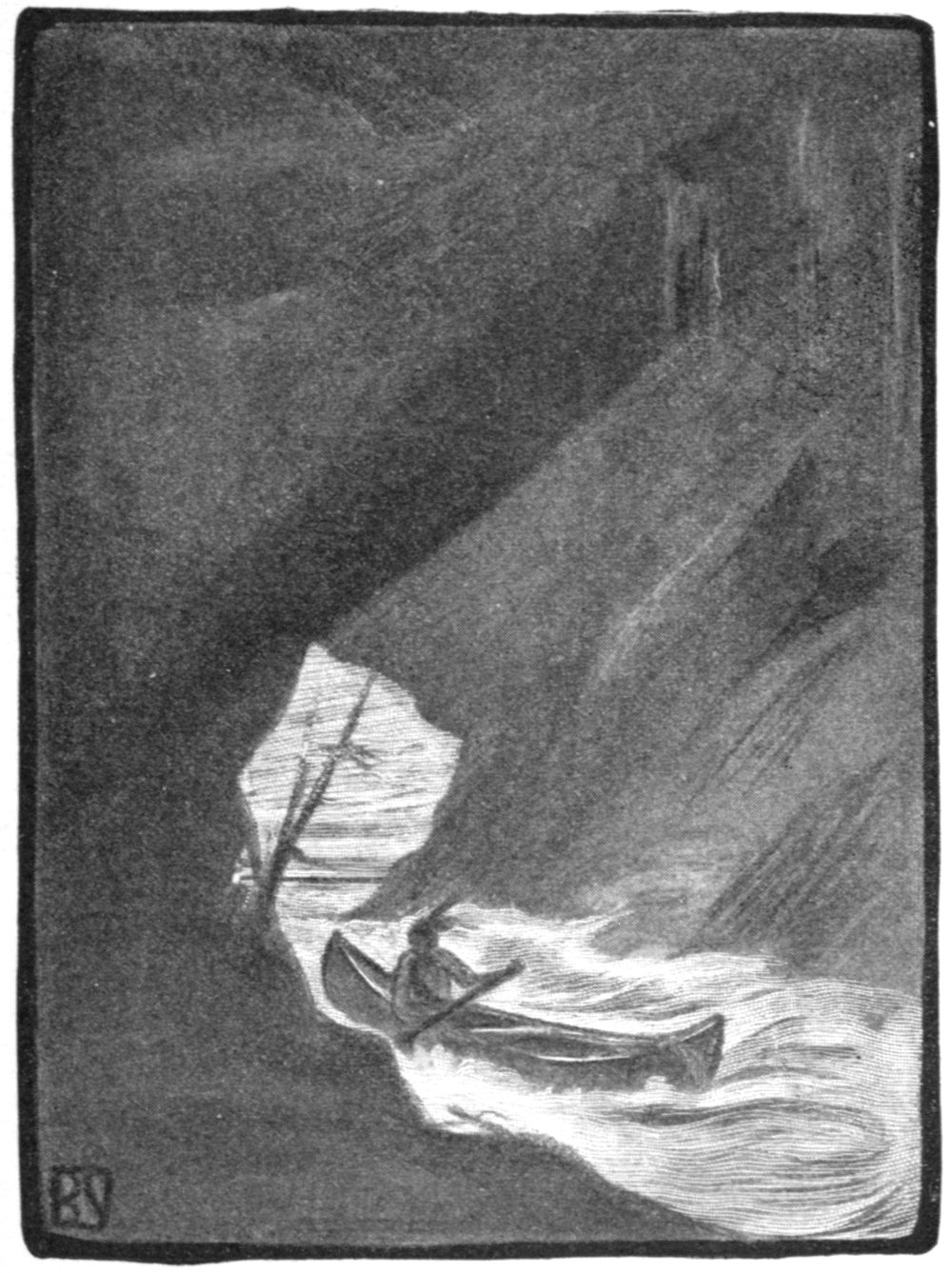
But the Master with silent soul Ever sang the songs of magic.
Narrower grew the water, More dreadful still the current, And fear came over the mother And then on the brother Marten, Till of that fear they died. But the Master with silent soul Ever sang the songs of magic, The awful incantations, Till he had passed the darkness And came again into sunlight, The bright and beautiful day. He found upon the bank A lonely deserted wigwam, Therein he carried the dead, And, laying them down, he said: “Nemchaase!” that is, “Arise!” And behold they both arose, And thought they had only slept. Then the Master found by this trial He had gained his greatest power. L.
FOOTNOTES:
VIII
HOW THE MASTER FOUND THE SUMMER
[Passamaquoddy]
Piche pamaosoinnoak wiwikitopʾnik Mequatoekak ospassio.[43]
In the long time ago, When people ever lived In the red morning light Or ever the day of man had come; Before the sun had risen And ere the Eastern land Was peopled as to-day, Kulóskap, the great lord, Went far into the North Where all was snow and ice. He came to a great lodge Wherein he found a giant, Truly a wondrous one The greatest of his race, For he was Winter. When The Indian god came in, He sat in silence down; Then gave as welcoming A pipe unto his guest; And as they smoked, the host Told stories to the chief— Tales of the olden time, In the old giant tongue. A charm was in the words, The enchantment of the frost, And so the giant talked on, Freezing with every word, Until Kulóskap fell Into a sleep like death. Six months he silent lay, Even as the bear or toad Lies quietly till spring: Then, when the charm was gone, The Indian god awoke, Woke with his might renewed. Homeward he turned his way Unto the glowing South. At every step his foot Met with the growing grass, Warm breezes greeted him, And many a forest flower Rose up and talked in song. He came into a dell Deep in the greenwood shade, Where many little fays, Fair little sun-ray elves, Were dancing in their joy. And their sweet fairy queen, Bright Summer, led the round— Summer most beautiful Of beings ever born. He caught fair Summer up, And, by a crafty trick, He kept her as his own; For, as he fled away, And as the elves pursued, He let behind him trail A long and slender cord Cut from a moose-hide. All Pulled gayly at the end; But as he ran, he let The cord run out, and they Were ever left behind, Because by magic power The moose-cord had no end! Even so the Lord escaped The Fairies of the Light, The Ladies of the Dawn! Again as he returned He came unto the lodge Where grim old Winter lay, Who gayly welcomed him, Hoping to freeze the god Again into sleep, and hold Him very sternly there, Forever in his power. But hidden in his breast Kulóskap held the charm Of a great victory, For he had Summer there; Even as now to you I sing the summer song! They sat them down and smoked. This time the Master told Tales of the ancient time In the old giant tongue Once spoken by the gods— Magic and wonder tales. This time he had the power; His spell was mightiest, And his strange wizardry The stronger of the two. Ere long the hut grew warm And then down Winter’s cheeks, His cheeks of hard gray stone, The melting ice-drops ran, Till he and all his home Fell down, and in a flood As water rushed away Adown between the rocks Into the roaring sea! Then everything awoke. The seeds and wildflowers grew. The snow in rivers ran Bearing away the leaves Left from the Fall before; The fairies all came out And then Kulóskap turned Again unto the South, Leaving his captive there; Summer was in the land. L.
FOOTNOTES:
IX
HOW KULÓSKAP LEFT THE WORLD
[Passamaquoddy and Micmac]
Yut negum tan Kulóskap Udelinaktamnes uskitkamigw.[44]
When the great Kulóskap, The Lord of Beasts and Men, By power, for all his people And for the world, had subdued All of the evil things Which cursed the early time, Giants and sorcerers, Witches and devils dire, Fiends and every horror, All were silenced then. The ice-hearted Kiwakʿw Wandered no longer free In the green wilderness, And the mighty bird Kullû, Great as a hundred eagles, No longer scared the Indian As it spread its mighty wings Like a cloud ’twixt earth and the sun. Evil beasts, devils and serpents Were found no more in the land, And the world at last knew peace; For the Master had taught to man All that should make him happy; But all were in turn ungrateful, And, while they feared the Master, Grew every day more wicked, Forgetting him in their hearts; And sin roared in the land. Now when the ways of men And of beasts became so evil, So false, proud and ferocious, Kulóskap as their lord Was angered at their sin, Yet bore it as a god Till all his love was gone; As oil spreads over the sea Till all is thinned away. Then he sent messengers forth Inviting all to a feast, The richest ever known By the great Lake Minas shore, On the silver water’s edge; And all the beasts of the wood, The fathers of all the tribes, Came to the feast in state, Came at the call, to revel; But the Lord had little to say. Solemn and grim was the banquet, All knew that the chief was going, And knew, too, why he would leave them. And when the feast was over, Kulóskap, the Lord of all living, Entered his great canoe And sailed away over the water, The shining waves of Minas; And they looked in silence at him Until they could see him no more. Yet, after they ceased to behold him, They still heard his voice in song, The wonderful voice of the Master! But the sounds grew fainter and fainter And softer in the distance, Till at last they died away. Then over them all was silence, Till a wonder came to pass; For all the beasts, who, before Had spoken but one common language, Now talked in different tongues; Each with a tongue of his own Understood the others no more. So they parted from one another And fled to the sea or the forest; And, since that day of the parting, They never have met in council, And never again will meet Till the day when all sins and sorrows Will be in full forgiven, Forgiven and forgotten, And their Lord the great Kulóskap Shall return to restore to his children The age of sunshine and plenty; When all shall dwell together In peace and joy forever; Till then the world will mourn. And ’tis said that, when the Master Had left Acadia, The bird who most had loved him, The great white Snowy Owl Went far into the North, Into the deep dark forest, Where to this day his children Sing to the night “Kūkuʿskūūs!” Which means in Indian, “I am sorry, oh, I am sorry!” And the loons who had been his huntsmen, Go up and down by the waters, Over the snow-topped mountains, Across the rushing rivers, Through dale and wood and valley, Seeking in vain for their master, The Lord whom they cannot meet; Ever wailing, wailing sadly, Because they find him not. L.
FOOTNOTES:
X
THE MASTER AND THE FINAL DAY
[Passamaquoddy]
Kulóskap mech pʾmaoso?[45]
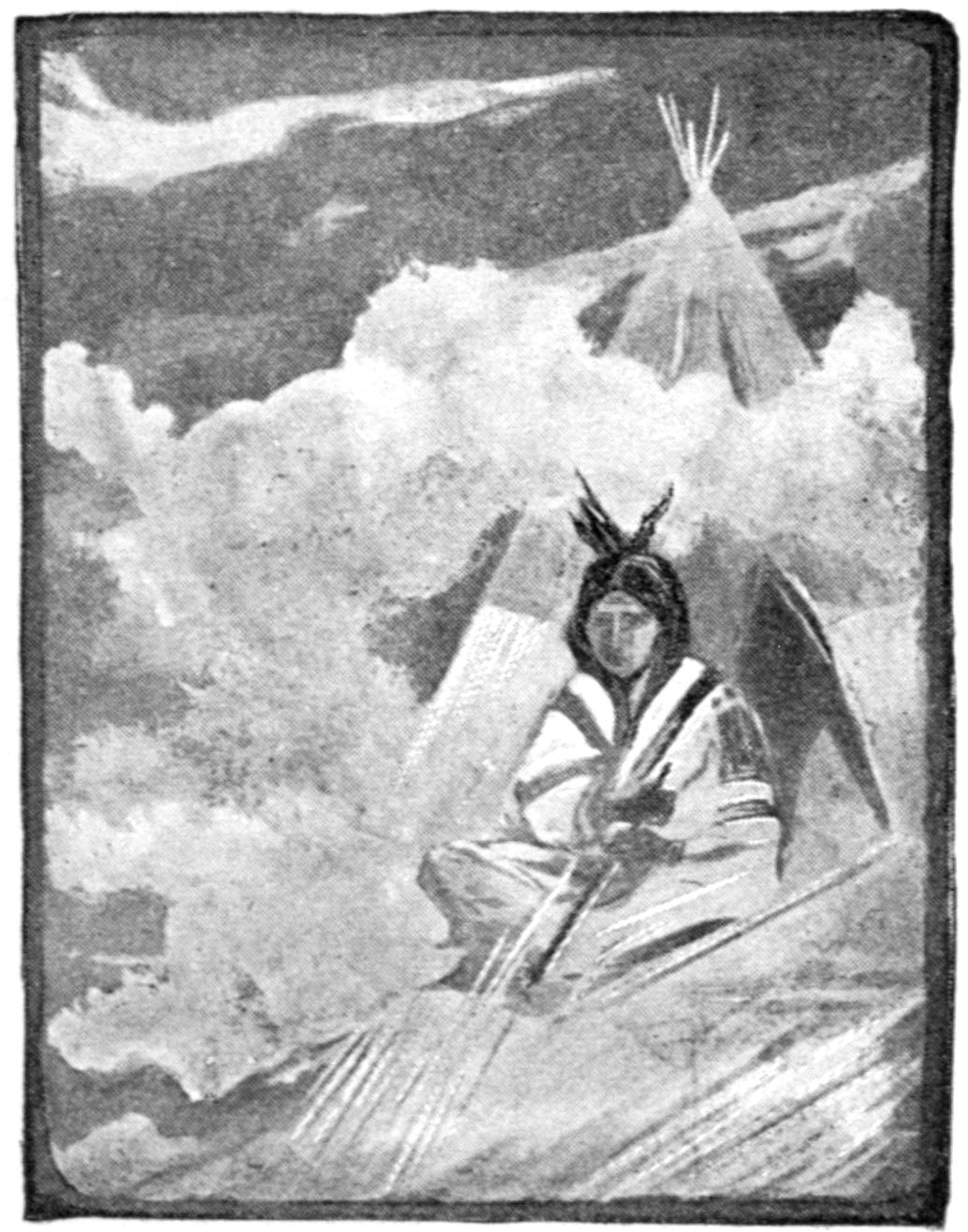
“Is Kulóskap living yet?” Yes, far away, but no one knoweth where— Beyond the mountains or above the skies, Where in the autumn’s lengthening twilight shades, He smokes his tūmʾhîgʾnpowâgon, His ancient tomahawk-pipe, Making the brown air Of the pleasant Indian summer. Some say that he sailed away In his marvellous stone canoe, Afar beyond the sea, To the country of the East; Some that he went to the West; And ’tis said that in days of old There were men who knew where he dwelt, And, making a pilgrimage Could get from him what they sought. And they say that, even now, If you travel ever on, Travel in perfect faith, You’ll find at last the Kchi Sagem, That is the great Sagamore The greatest of all lords. “Is Kulóskap living yet?” Yes, he lives in a very great wigwam, A wigwam very long— That is, a council lodge— Where he always is making arrows; And all one side of the lodge Is full of arrows now, All closely packed together, Even as your fingers lie. When all the lodge shall be full The god will come forth to battle, And till then no mortal being May ever enter the wigwam. “On whom will war be made?” He will make it on all mankind, He will end all life that endures, For the world will pass away When that battle shall come to an end. I know not when it will be, To-morrow it may come Or hundreds of years away. “Are any to be saved By any one, in that hour?” That is beyond my ken, All I have heard is this: That the world will pass away In roaring fire and flame, While all the sea will rise Hot boiling into mist, And that the good with it Will rise on high to heaven; It may perhaps be so; I’ve only heard it told, Just heard it—and no more. L.
FOOTNOTES:
PART SECOND
Witchcraft Lore