Canto Second
Charles Godfrey Leland translation
THE MASTER’S KINDNESS TO MAN
I
WHAT KULÓSKAP DID FOR THE INDIANS
[Passamaquoddy]
Piche mesogw Kulóskap nemiquosikw.[17]
In the very olden time Before Kulóskap the Master, The Lord of Beasts and Men, Had come into the world, Or man was by him instructed, All lived in wonderful darkness; Men could not even see To slay their enemies; But the Lord brought light unto them, The daybreak and the dawn. Therefore, for this his people Are known as the Wabanaki, The Men of the Early Dawn. And many a thing he taught them: The noble art of hunting, How to build huts and canoes, And weirs to catch the fishes, And how to trap the beaver, And net the shad and salmon. Before he came they knew not How to make nets or weapons; Then he, the Mighty Master, Showed them the hidden virtues Of plants and roots and blossoms, And all the herbs which Indians Could use for any purpose; And also every creature, Beasts, birds, and all the fishes, All things which could be eaten Or serve for joy to man. Then, pointing to the heaven, He taught the names of the stars, With all the wonderful stories, The very old traditions, Of all that the planets had been. He greatly loved mankind, And wherever he might be, Though afar in the wilderness, He never was far away, Away from his Indian children. He dwelt in a lonely land, But whoever went to seek him The Master ever found. L.
FOOTNOTES:
II
HOW KULÓSKAP GRANTED GIFTS AND FAVORS TO MANY INDIANS
[Micmac and Passamaquoddy]
Long ere Kulóskap the Master Had left the land and his people, And before he had ceased to wander In the ways of man, he called The loons his faithful servants, And bade them make it known That for many years to come He would still remain on earth, And that whoever would seek him Might have one wish full granted, Whatever that wish might be. Although the journey was long And the trials were terrible Which all must endure who would find The Lord of Men and Beasts, There were many who ventured on The wonderful pilgrimage. Now you may hear what happened To several of these seekers, Even as I heard the tales From a Passamaquoddy Sénap. When all the land had heard That the Master would grant a wish To any who would seek him, Three Indians resolved That they would try this thing. One was a Milicete Who came from near St. John, And the other two were Penobscots From Oldtown, that is in Maine. And they went upon the journey And found that the path was long, And the way was very hard; Their sufferings were great, It was well nigh seven years Before they saw the Lord. But while it was yet three months Ere they came unto his dwelling, They heard the bark of his dogs, And, as day by day they drew nearer The sound grew louder and louder, Till after many trials Led by the bay of the hounds They found the mighty one, The Lord of Men and Beasts, And he made them very welcome And entertained them all. Then in due time he asked them What was it they desired. And then the first replied—An honest simple man Who was of but little account Among the Indian people Because he hunted badly— He prayed that he might excel In killing or catching game; Then the Master gave him a flute, Or the magic pipe which pleases The ear of everyone, And has the power to bring By wonderful fascination All animals to that piper Who plays it in their haunts. He thanked the Lord and left. Now the second of the three, A reckless amorous youth Yet who never could succeed In winning women’s love, When asked what he would have Said: “I would win my way To many maidens’ hearts!” And being questioned, “How many?” Replied, “I would know no limit. Let there be only enough, And more than enough beside.” Thereat the Master frowned, But, smiling anew, he gave him A bag which was tightly tied, And said to him, “Do not open Till you shall have reached your home.” So he thanked the Lord and left.
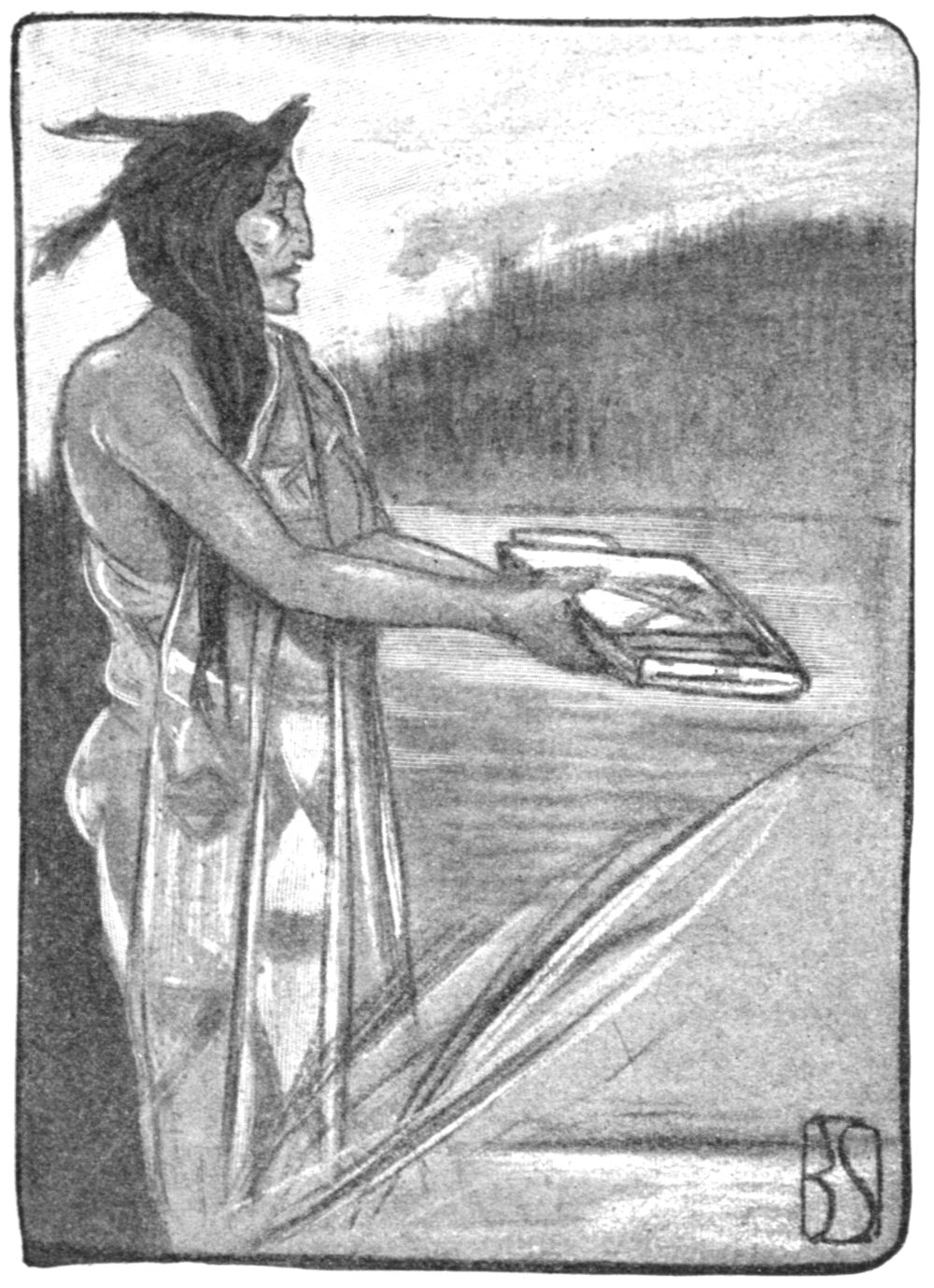
But, smiling anew, he gave him A bag which was tightly tied.
Now the third who had come with these Was a gay and handsome youth, Yet very foolish withal Since he cared for nothing whatever Save to make the Indians laugh, And to cut a figure with jests At every gathering. He, being asked what he sought, Replied that he fain would have The power to make a sound Which when uttered would startle all, And make them laugh indeed As they never had laughed before. This was a wondrous cry Which the sorcerers of yore Uttered to gladden hearts, But now that the art is lost. That is indeed the cause That our times are so sorrowful, Since that magic, merry cry Is heard no more in the land. And unto him likewise The Master was truly kind Sending Marten into the woods To seek for a certain root Which, when eaten by any one, Conferred the mystic power Of making the wondrous sound. But when it was bestowed He was warned not to touch The root till he reached his home. It had taken them seven years To reach the Master’s lodge, But seven days were enough To tread the path to their huts— That is, for him who got there, For indeed there was only one, And that was the hunter, who With his marvellous pipe in his pocket, And never a care in his heart, Trudged on well satisfied To think that all his life He never should want a joint Of venison in his cabin Or a bear-skin to lie upon, As indeed he never did. Now the one who so loved women And never had won a wife, Was wild with wistfulness And great anxiety. Therefore he could not wait, And he had not gone very far Into the woods, ere he Sat down and opened the bag. There was a whirr as of wings And they came flying forth By hundreds round his head Like beautiful white doves Swarming all about— Wonderful lovely girls With large black burning eyes, And torrents of flowing hair. Wild with passion the witches Threw their fair arms around him And kissed him as he responded To their ardent, fond embraces. But ever more and more They came, more glowing with love, Till he bade them give way for a space, Till he bade them let him be; But they only pressed the more. So, panting, crying for breath, And smothered in love, he died, And those who came that way Found him a silent corpse, But what became of the witches Kulóskap only can tell! Now the third went merrily on, Tramping along through the woods, When it flashed upon his mind In an instant, that Kulóskap Had bestowed on him a gift; And, without the slightest heed To what the Master had said Of waiting till he got home, He took out the magic root And ate it, then and there; When all at once he found He could utter the magic cry Which startles all who hear it, Inspiring them to joy And making them laugh aloud; Then, as it rang afar O’er many a forest dale Waking the ringing echo Of the far-distant hill, Until it was answered by A solemn snowy owl, He felt that he had won A wondrous power indeed; So he walked gayly on O’er many a hill and dale, Whistling or trumpeting As happy as a bird. But he ere long began To weary of himself, When, seeing in a glade A deer, he bent his bow; When, just as he would shoot, The wild unearthly sound Broke out, despite himself, Even like a demon warble, The deer took flight and fled; And the young man cursed aloud! And when he reached the town Half dead with hunger, he Indeed was little worth To make the others laugh, Though for a time he did, Which somewhat cheered his heart, But, as the days went on, They wearied of the sound, And, when they saw him come, Turned off another way; Which vexed him to the heart, So that one day he went Alone into the woods And there he slew himself. The dark and evil demon, The sprite of the night-air, Pʾmûla named by some, From whom the gift had come, Swooped down from clouds on high, And bore his soul away To the dwelling place of darkness And men heard of him no more. Now ’tis a thing well known To all the Indians Who keep the holy faith Of the good olden time, That there are wondrous dwellers Deep in the silent woods, Such as the elves and fairies Who are called by different names; In Micmac Wigŭladŭmūchŭk But by the Passamaquoddy Wʾnâgʾméswuk. They Can work strange deeds and sing Such songs of magic power As charm the wildest beasts And tame the wolf and bear And soothe the wolverine. From them and them alone Are brought the magic pipes, Or flutes, which sometimes pass To sorcerers or great braves. When these are played upon Women who hear the tone Are all bewitched with love, And the moose and caribou Follow the winning sound, Yes, even to their death; And when the forest elves Are pleased with anyone They make of him an elf E’en like unto themselves. Back in the olden time There was an Indian town In which dwelt two young men, Kekwâjû the Badger, And the other Kâktugwââsis, The Little Thunder. They Chanced to hear that Kulóskap Would give to anyone Whatever he desired: And so they went their way On the long pilgrimage For many years, until They reached the wondrous isle Where the great Master dwelt, Where first they met Dame Bear, Then Marten, and at last The mighty Lord himself Who welcomed them with grace. Then all sat down to a meal, But all that was placed before them Was one small dish of meat, A very tiny morsel. Then the elder of the pilgrims, A reckless jolly fellow, Thinking it was a joke And that he was mocked for sport, Cut off nearly all the meat, And ate it. Then what was left Grew at once to its former size; So it went on, and all Ate all that they desired, And found the food of the best, And when the meal was over The dish was as full as before. Now of these two, the Badger Had set his heart on becoming A wigʾladʾmûch or fairy, Which would give him magic power While the other wished to win A very beautiful girl, The daughter of a chief, A most powerful Sagamore, Who set such cruel tasks To all who came to woo her That all who had made the trial Thus far had come to their deaths. Then the Master took the Badger Who sought initiation Into the occult art, And by a wondrous trick Covered him all with filth And put him to utter shame Then led him down to the river Where he washed him clean, and gave him A beautiful change of clothing. And, combing his hair, placed on it A fillet of wondrous virtue; For when he had bound it on He became a wigʾladʾmûch A fairy and enchanter, No longer a common mortal, But one of the elfin world.[18] And as he wished to excel In magic song and music, The Master gave him a flute, Which would charm all living beings; And, singing, he bade him join In the air, and as he did so, He found he knew all the art; And from that day, thereafter, He had a wondrous voice. Now to seek the beautiful girl It was needful that the lover Should sail far over the sea; And during this adventure The Būʾūin or magician Was charged to take all care Of Kâktugwââs, the Thunder; And therefore he begged the Master To lend him his canoe, To which Kulóskap answered, “I will gladly lend it to thee If thou’lt honestly return it When thou needest it no more. For I tell thee in very truth I never yet did intrust it To any mortal man But what in the end I had to Go after it myself.” Then the Badger solemnly swore That, as he was an honest Indian, He would, when the need was over, Indeed return the canoe. For never in all his life Had he stolen any Kwédŭn (Canoe) nor borrowed anything Without returning it promptly. But when they came to the bay There was no canoe to be seen, But not very far away, There arose a little island Of granite which was covered With pine-trees, tall and waving. “See—that is my canoe!” The Master said to them smiling, And when he took them on it They found that it was indeed A great and large canoe With lofty masts, and sails— So the two went forth rejoicing. Then they sailed on and came To a large and beautiful island Where they carefully hid the canoe. Ere long they came to a village That of the Sagamore, The father of the girl For whom many had lost their lives. And, having come to his wigwam, They entered and were welcomed And placed on the seat of honor, And sat at the evening meal. Now ’tis of old the custom When an Indian seeks a wife, Be it from her father or friends, He makes small ado about it, And only utters two words Which mean in the Micmac language: “I am tired of living alone.” And the Sagamore hearing this, Consented that Little Thunder Should marry her whom he sought, But on several conditions— The first that he should slay And bring to him the head Of a certain horrible monster, Like to a wingless dragon, The dreadful and horned Chipíchkâm. So this was agreed upon, Then the strangers went to their cabin And all the world to sleep. All save the wise Būʾūin Who soon arose from his bed, And went alone and afar, Till he came to the den of the monster In a gaping gulf in the ground. Over the hole he laid A mighty log, and began The magic dance round the den; Then the serpent or great Chipíchkâm, Hearing the call, came forth, Putting out his head from the hole, And weaving it about After the manner of snakes. While he was doing this, He rested his head for an instant On the over-arching log, When, with a blow of his hatchet The Indian severed the neck; Then, taking the head by one Of its shining yellow horns, He bore it to his friend Who gave it in the morning Unto the chief, who said: “This time I fear indeed, That I must lose my child, Yet thou hast more to do.” More indeed, for the chief Said, “Look at yonder hill, I fain would see my son Coast down it on a sled.” Now the hill was indeed a mountain. Its sides were very steep, Ragged with rocks and holes And terrible with trees And rough with snow and ice. Then they brought out two toboggans, One for the strangers. This The Badger should direct; While on the other sat Two great and powerful men, And these were Būʾūinuk Or sorcerers who were skilled In sledding, and they hoped To see the others soon Fall out upon the ground, And then to run over them. And at the word they went Flying at fearful speed Adown the mountain side, And ever faster still As if to headlong death. Soon he who sought the girl Went whirling from his sled, And the two sorcerers howled In triumph an hurrah! For they knew not that this was done By their enemy that he Might get them before his sledge. Then he put forth his arm, And seizing the younger man Turned for a pace aside, And then again shot on. Then the sorcerers stopped, Thinking that those before Were checked and at an end; When lo! their enemy In his sled shot over their heads, And over a mighty wall Of ice, as a bird might fly High above all in the air; Then, touching the ground once more, Ran with tremendous speed, First down into the vale, Then up, and ever up Upon the opposite hill Where the village stood, till it struck The wigwam of the chief, Ripping it all in two. Again the Sagamore said: “This time I fear indeed That I must lose my child: Yet thou hast more to do!” Yes, and far more to do: For then the Sagamore said: “I have a runner here, A man so fleet of foot That never in his life Has he been overcome, And thou must strive with him And gain the victory Ere thou canst win thy wife.” So then the race was set, And Thunder should compete, But at the time his friend Lent him the magic pipe Which gave him wondrous power Over all dark sorcery Such as Būʾūinuk use And witches dark and vile. Now when the pair had met The youth said: “Who art thou?” And the sorcerer replied: “I am the Wegaduskʾ;” Which means the Northern Lights, “But tell me who art thou?” “I am Wosogwoesk, Chain-lightning is my name,” The Thunder answering said. And, as the race was run All in the early morn, Then in an instant both No longer were in sight. They were far, far away Beyond the distant hills; Then, waiting, all sat still, Till long before the noon Chain-lightning came again; He showed no weariness, Nor was he out of breath, Yet had gone through the world. Then all sat still again Till evening, when they saw The Northern Light return Completely, sadly tired; He quivered and he shook As beaten by fatigue, Yet for all that the Light Had not been through the world, For, coming to the south, The heat had sent him home. Again the Sagamore said, “This time I fear again That I must lose my child, Yet thou hast more to do.” The Sagamore had a man Whom none could overcome In swimming of all kinds, Or diving in the sea; With him the youth must strive. And when they met, the Badger Asked him, “What is thy name?” And he replied, “I am Ukchigʾmûech (Sea Duck), But tell me who art thou?” He answerèd “The Kwîmû,” That is, “the Loon,” and then They dived from a high rock Deep down into the sea. Ere long the Sea Duck rose Again to get his breath, But long the Indians Waited and watched until They saw the Loon again. An hour passed, and then Another hour, before He rose from the deep sea. But when at last he came, The Sagamore sadly said, “This is the end of all Our weary work, for now, I have truly lost my child!” Yet it was not the end Of all the curious deeds Which they beheld, before The strangers took their leave. For, when the wedding came In the evening of that day, There was a general dance, A wild festivity, At which the wizard bold Astonished every one; For as he danced around On the hard beaten floor, They saw his feet sink in Deeper at every step, And ever deeper still As the strange dance went on, Still ploughing up the ground In ridges rough and high, Forming a trench, until His head and nothing more Could from without be seen. That ended all the dance, Since no one after him Save wizards or a witch Could dance on such a floor. The bridegroom and the bride, With them the wizard bold, Then entered the canoe And sailed away toward home; Yet they had more to meet, And trials to endure, Though of no dangerous kind; ’Tis said they were but jests Played by the Master’s skill. For they had not gone far, When right before their path They saw an awful storm Coming to meet them. He Who had the elfin power Knew that it had been raised By sorcery, because The tempests which are due To hidden magic power Are ever worst of all. So without fear he rose And sang the sorcerer’s song, And, filling lungs and cheeks With air, he blew against The rising hurricane, Wind against wind until He blew the wind away, Then all the mighty flood Was smooth as smooth could be: So they sailed ever on Over a sunlit sea, And yet it was not long Ere the elf-gifted one Saw rising ’mid the waves A dark and curious form, That of a monstrous beast Fast-coming as a foe, And then they knew it was The Giant Beaver, called Kwâbît, in fearful rage; But when the mighty one Saw this, he sailed direct Even at the monster’s jaws, And, coming to him, said: “Lo, I am the great foe Of all thy race and called The Beaver-Hunter; I, Am he who butchers them; Full many a one ere now Has perished by my hand.”[19] Kwâbît had placed himself Under the water, with His tail upraised above The level of the waves, That he might sink the barque With one tremendous blow, As is the Beaver’s way; But he of magic power With well directed stroke Of the tumîhîgʾn, or His tomahawk, then cut The body from the tail, Leaving the Beaver dead; Then blithely sailed away. Yet had they not gone far When coming round a point They saw another beast, Also of giant size, Waiting to be their death; Abúkchelû the Skunk, A thing which many dread More than a raging wolf; And he, too, had his tail Uplifted in the air; But, ere the brute could make His hideous attack, The wary gifted one Caught up his hunting spear, And, hurling it with haste, So pierced Abúkchelû, That father of the skunks, That down he fell and died. Thrice did he kick in pain Before he passed away. So then the gifted one, Stepping upon the shore, Took up a long dead pine Which lay upon the shore, And, as he stuck its point Into Abúkchelû, Lifted him high in air, And, fastening the tree Firmly into the ground, Left him, and said with scorn, Even as he turned away; “Just show your tail now, there!” And ever they sailed on Over the silver sea, O’er blue and dancing waves, Till home they came with joy, And at the landing place They saw the Master stand; And his first words were, “Well! I see, my friends, that you Have brought me my canoe All safely back again.” And they replied, “We have.” And gayly he inquired “Has all gone well with you?” And when he thus had said, He laughed and let them know ’Twas he in all their trials And triumphs who had worked And brought it all to pass. Then to the gifted one He said, “Now go in peace Thy way with these thy friends; Lead ever happy lives There in the elfin world Deep in the forest-shades, Far in the silent land Of flowers and mystery. But of this thing be sure, If any care should come Unto you, think of me And I will give you aid.” They rose and went their way.
FOOTNOTES:
III
KULÓSKAP AND THE FOOL
[Micmac]
Kes saak: Nigumaach ut Agunudumâkun Klûskâbel.[20]
“Of the old times the tale is, A story of Kulóskap,” Unto whom there went full many When they heard that all could have Whatever they desired; And truly he gave them all Whate’er it was they asked for, But whether they got their wish Depended on the wisdom Which they showed when it was won. Now the Master liked it not If, when he had plainly told What it was that one must do, That man should double on him Or quibble, or disobey. So then it came to pass That a certain fool of the kind Who never can do aught Without a twist or a turn In his own peculiar way, Went a long journey to ask A favor of the Lord. His trials were many and sore; He came unto a chain Of mountains exceeding high, In a dark and lonely land Wherein no sound was heard; And the ascent was hard As climbing a slippery pole. And the going down Or descent on the other side Was more ungrateful still, For ’twas all a precipice With broken, crumbly edge Which overhung a gulf; Yet it was worse beyond. For there the road led on Between the hideous heads Of two great serpents, which Did almost touch their lips, And darted terrible tongues At those who went between. And yet again ’twas worse When the way passed under a wall, The awful Wall of Death Which hung like a dreadful cloud Over a dismal plain, Rising and falling at times; Yet when, no one could know. So those who were beneath When it fell and struck the ground Were ever crushed to death. Yet he escaped all this And came to the Master’s home Where he was well received, And dwelt for many days; And when the Master asked What ’twas that he would have? He answered, “If my Lord Will give me a medicine Which will cure me of every ill, I shall be well content.” And he asked for nothing more. Then the Master gave to him A little package, and said: “Herein is that which thou seek’st But I charge thee solemnly That thou lettest not thine eyes Behold what is therein, Till thou shalt have reached thy home.” So he thanked the Lord, and left. Yet he was not far away Ere he longed to open the gift, And test the medicine, And still more the Master’s truth. And so he said to himself: “If this be all deceit, It was very shrewdly planned, To bid me not open it Until I should be at home. Tush! If the medicine Is really what I required It cannot lose its power. In truth I will test it now.” So he opened it—when lo! All that which was therein Fell to the ground and spread As water, everywhere, And then like a summer mist As quickly melted away. So when he returned to his home He was mocked by one and all.
FOOTNOTES:
IV
THE THREE BROTHERS WHO BECAME TREES
[Passamaquoddy and Micmac]
Nequt nikt nsapihioak udelabasinia unachihonamihánia Kelhosilichil naga omsnamnia eli-bawatmotit uch negum.[21]
There were three brothers, who Had made the pilgrimage To seek the Lord of Life, And win their wishes. One Was wondrous great and tall, The tallest in the land; Of this he was right proud, For he was one of those Who slyly put soft clay Into their moccasins That they may be admired By folk of lesser size, And win the love of squaws. And his hair was plastered up To stand on high, and on The summit of it was A very long turkey tail; But what this man desired Was to be taller still. The second brother asked That he might ever live Where he might behold the land And all the beauty of it, And do naught else save rest In peace forever more. And the third one asked to live Unto a great old age, And ever be in health Till he should pass away. Now when they came to the isle They found three lodges there, And in two of them were men Who are not spoken of In any of the tales Which I have ever heard: In one dwelt Kulpujot— A wondrous one indeed! For there is not a bone in him, Yet every spring and autumn He is “rolled over with hand-spikes” By order of the Lord; And this is what his name Means in the Micmac tongue. In the autumn he is turned Over towards the West, But in spring towards the East; And the meaning of it all Is the seasons of the year As they follow in their course. He with his breath alone Can sweep all armies forth, And with his looks alone Perform most wondrous things; This means what weather can do With sunshine, frost and ice, Which are felt in everything. And in the other dwelt Kuhkw, which in Micmac means, The Earthquake. This great man Can pass beneath the ground, And make the mountains shake, And tremble by his power. Now when the Lord had heard What it was that they desired, He bade the Earthquake come And put them with their feet Fast planted in the ground. And when ’twas done, the three At once were turned to trees; To pines, as one tale tells, Or cedars, as some say; In either case each man Received what he required. Thus, he who would be tall Became exceeding great, For his head rose o’er the wood Even as a giant pine; Nor was the top-feather forgotten; It waves in the wind to this hour. And on a summer day Who listens in a pine wood, May hear the trees a murmuring In the soft Indian tongue All of the olden time: (“Î nĭl etuchi nek mʾkilaskîtap Î nĭl etuchi nek mʾkiluskíjin”) “Oh, I’m such a great man! Oh, I’m such a big Indian!” And the second brother, who wished To remain in peace in the land, So stays, for while his roots Are in the ground he must do so; And the third, who fain would live To the end in perfect health, Unless they’ve cut him down Is standing as of yore.
FOOTNOTES:
V
KULÓSKAP AND THE WISE WISHERS
[Micmac]
Kes saak; kes saak.[22]
All of the olden time. Now when ’twas noised abroad That whoever sought the Master Could obtain the wish of his heart, There were three men who said: “Let us seek the Lord and see If this be truly so.” So they left their home in the spring When the bluebird began his song, And walked till the autumn frosts, And then into the winter, Ever steadily onward Till the next midsummer came; And being in a forest They found a winding path Which they followed till they came To a very beautiful river Which led to a great fair lake; And still they kept to the path, Yet where it failed, the trees Were blazed, or the bark removed On the side of the trunk, but ever Opposite to the place Where the wigwam or village lies Towards which the pathway leads, So the mark can aye be seen As the traveller goes to the goal, But not while leaving it. Then after a time they came To a long point of land Which ran into the lake, Where, having climbed a hill, They saw in the distance smoke; Guided by this they came To a large and beautiful hut; And entering it they found, Seated upon the right, A handsome stately man Like a chief of middle age, And on the left a woman, So old and so decrepit That it seemed as if a century Or more had made her life; And opposite the door Was a mat which seemed to show That some other had there a place. And the Master made them welcome And spoke as if he were Well pleased to see them there, But asked not whence they came, Or whither they were going, As others are wont to do. Ere long they heard the sound As of a paddle outside, And the noise of a canoe When it is drawn ashore. Then in there came a youth Of beautiful form and features, Well clad and bearing weapons As if returned from the chase; Who addressed the woman Kejû! Which is in the Micmac, “Mother;” And told her he had game. So then, with sore ado, For she was very weak, The old dame tottered out And brought in one by one Four beavers; but she had Such trouble to cut them up, That the elder of the pilgrims Said to the youngest, “Nchígŭnŭm! My brother—do thou the work.” And so they supped on beaver, And then they stayed for a week, Resting themselves in comfort, For all were sadly worn, And also utterly ragged; But then there came to pass A wonderful thing which showed That they were in fairy land, For the master said to the youth, “Go wash the mother’s face!” He did so—when all her wrinkles Vanished, and she became Very young and fair: The travellers had never In all their lives beheld A maid so beautiful: Her hair, once white and scanty, Now hung to her very feet, It was as dark and glossy As any blackbird’s breast; And, clad in fine array, She showed a tall lithe form, Graceful, in all points perfect. Then the travellers said to themselves, “Truly this Sagamore is A very great magician.” With him they all walked forth To see the place where he dwelt, They never had felt the sunshine So soft and so sweetly tempered By a cooling gentle breeze; For all in that land was fair, And day by day grew fairer To all who dwelt therein: Tall trees, with richest leafage And many fragrant flowers, Grew everywhere in groves Without any lower limbs, And clear of underbrush, Wide as a forest; yet The eye could pierce the distance In any or every way. Now when for the first time They felt that they had come Into another life, An ever-enchanted land, The Master gently questioned And asked them whence they came, And what it was they sought; They said they sought Kulóskap, And he answered, “I am he!” Then they were awed by his presence, For now a wondrous glory And majesty showed in him. For as the woman had changed, So he, and he seemed divine. Then the elder pilgrim said: “Lo, I am a wicked man Accursed with furious moods, Given to wrath and reviling; Yet I would fain be gentle, Pious and meek and good.” And the second said: “I am poor, My life is very hard, And, though I toil unceasing, I can barely make a living, And I would fain be rich.” And the third replied, “Though proud, I am of low estate, Being despised and scorned, While I long to be respected And loved by every one.” And to all of these the Master Made answer, “So shall it be!” Then, taking from his belt His powerful upsinai, That is his medicine-bag, He gave unto each Indian A little box and bade him Keep it well closed, nor heed it Till he should reach his home. Then he led them to the wigwam And gave them all new garments, Exceedingly rich apparel, The like of which the pilgrims Had never seen before. Then, when it was time to depart, Since they knew not the way Unto their home, he rose And went with them for a distance. A year had they been in coming, But having put on his belt He led them and they followed, Till, ere the afternoon, He took them to the top Of a lofty mountain, from which Afar off they beheld Another, whose outline blue Rose lofty o’er the plain. Yet it seemed so far away They thought ’twould be a week Ere they should gain its top, But the Master led them on, And in the afternoon Of the day when they first beheld it, Lo, they were on the summit! And looking from this afar, All seemed familiar to them: The plains and hills and river, And wood and dale and valley— It was their native land! “And there,” said the Master to them “There lies your village home.” So he left them on the mountain, And they went on their way. Before the sun had set They were among their people, Each by his wigwam fire; At first sight no one knew them, Because of a wondrous change; The like of their fair attire Had never in those days Been seen by any man. But when they made themselves known, All gathered round to behold them, In wonder or silent awe, Or to listen to their adventures, And truly all were amazed. Then each man opened his box, And found therein an unguent Exceedingly rich and fragrant, With which they rubbed themselves From head to foot completely. And always from that day The three smelt so divinely That all who could draw near them Were ever in delight; And happy were the Indians Who could get a single whiff Of that celestial fragrance Spread by them all around! Now he who had been despised For his deformity, Leanness, weakness, and meanness, Became as grand and stately, As beautiful and graceful, As the fairest pine of the forest; There was in all the land No man so much admired, And his people were proud of him. He who desired abundance, Had it in fullest measure, The wild deer came to his arrows, The fish leaped into his nets; As he gave freely to all, All gave as freely to him. And he who had been wicked, Hasty and wild and cruel, Became as meek and gentle, Calm and ever forbearing Making others like himself; He had ever a blessing on him, As there ever is upon those Who make their wishes with wisdom, For such folk shall be happy Unto the end of their days.
FOOTNOTES:
VI
HOW KULÓSKAP WAS CONQUERED BY THE BABE
[Penobscot]
Yut nit nekani agnodʾmâgon uch Kulóskap Elakʾnotmotits piʾche.[23]
All of the olden time. They tell this tale Of great Kulóskap. He had conquered all Of his worst enemies, even the Kiwaʾkw Who were ice-giant ghouls, and over them, Mʾdeolinʾwak or sorcerers And Pʾmûla the night air’s evil spirit, And every manner of uncanny ghosts, Grim witches, devils, goblins, cannibals, And the dark demons of the forest shade. And now he paused, and, thinking o’er his deeds, Long wondered if his work was at an end. This thought unto a certain wife he told— A clever woman with a ready tongue— And she replied: “O Master—not so fast! For One there still remains whom no man yet Has ever overcome in any strife Or got the better of in any way; And who will ever, as I oft have heard, Remain unconquered to the end of time.” “And who is he?” inquired the Lord, amazed. “It is the mighty Waʾsis,” she replied: “And there he sits before you on the floor! And mark my words—if you do trouble him, He’ll cause you greater trouble in the end!” Now Waʾsis was the Baby. And he sat Upon the floor, in baby peace profound Sucking a piece of maple sugar sweet; Greatly content and troubling nobody. Now as the mighty Lord of Men and Beasts Had never married, nor had had a child, The art of nursing or of managing Such little ones was all unknown to him; And therefore he was sure, as all such folk Invariably are, be they or maids Or blooming bachelors, that he at least Knew all about it and would have his way, And make the young obey him. So the Lord Turned to the babe with a bewitching smile, And bade the little creature come to him; Back smiled the baby, but it did not budge. And then the Master spoke in sweeter tone, Making his voice like that of summer birds, And all to no avail; for Waʾsis sat, And, sucking at his sugar silently, Looked at Kulóskap with untroubled eyes. So then the Lord as in great anger frowned And ordered Waʾsis in an awful voice To crawl to him at once. And baby burst Into wild tears, and high he raised his voice Unto a squall tremendous—yet for all Did never move an inch from where he sat. Then, since he could do only one thing more, The Master had recourse to sorcery And used the awful spells, and sang the songs Which raise the dead and scare the devils wild And send the witches howling to their graves, And make the forest pines bend low to earth. And Waʾsis looked at him admiringly And seemed to find it interesting, quite; Yet, peacefully as ever kept his place. So, in despair, Kulóskap gave it up, And Waʾsis, ever sitting on the floor In the warm sunshine, went “Goo! goo!” and crowed; That was his infant crow of victory. Now to this very day, whene’er you see A baby well contented, crying “Goo!” Or crowing in this style, know that it is Because he then remembers in great joy How he in strife, all in the olden time, Did overcome the Master, conqueror Of all the world. For that, of creatures all, Or beings which on earth have ever been Since the beginning, Baby is alone The never yielding and invincible. L.