Canto First
Charles Godfrey Leland translation
CREATION LEGENDS
I
THE BIRTH OF KULÓSKAP, THE LORD OF BEASTS AND MEN, AND THE DEATH OF MALSUM THE WOLF
[Passamaquoddy]
Yut nit nʾkani akʾnodʾmâgon Uch Kulóskap elaknotmot its piche.[13]
Wonderful traditions Of the olden time; Very old indeed, Ere the world began: The great lord Kulóskap Who in after days Was worshipped everywhere By the Wabanaki Or Children of the Dawn, Was as yet unborn, Living as a twin With another named Malsumsis—the Wolf. Wolf, the lesser one, As his brother was good So was this one bad; One, the Lord of Light, One, of Darkness dire. Now ere they were born, The two a council held That they might decide How they would be born. And Kulóskap said: “I shall be content If I may come to life Even as others come.” But Malsum, the Wolf, Said: “Just as you will; But I am too great E’er to see the light As common creatures do; I will burst to light Rending everything E’en through death to life.” So it came to pass Kulóskap, the Lord, Came in peace to light; Malsum kept his word, And the mother died. So the two grew up, Till one day the Wolf, Who knew that both were given Strange mysterious lives Charmed ’gainst everything Save one concealèd death, Asked of the elder what His hidden bane might be? Then the wise Kulóskap Thought how when he was born Malsumsis in his pride Had slain his mother; And he said: “If Wolf knew The secret of my life, That life would soon be o’er.” And therefore he agreed To tell Malsum the Wolf The secret of his death, If he the younger born Would tell him in return The secret of his own. Therefore the elder said, To test his brother’s truth: “The feather of an owl Is the one thing on earth Which e’er can end my life.” In sooth, this was a lie Although no evil one, And yet from uttering it Kulóskap got his name Which means the Liar, or, As Indians mean the word: A wise and crafty man. And then it came to pass That in the after-days Kwâbîtsis the son Of the Great Beaver, or As others tell the tale Miʿko the squirrel, or else The very devil himself Who dwelt within his heart, Tempted Malsum to slay His brother Kulóskap; For in those early days All men were wicked—all Lived but in evil deeds. So Malsum took his bow And, stealing through the woods Into his dark retreat, Shot Koʿkoʿkhas, the owl, And with his feathers struck Kulóskap while asleep. Up leaped the Lord enraged, Yet even in his wrath He spoke right craftily: “Thou ever evil One! Thou murderer of all! Know that no feather can E’er take my life. ’Tis by A pine-root and a blow That I am doomed to die, By that, and that alone.” So on another day When both together went A-hunting in the woods Kulóskap laid him down To sleep upon the leaves Where all was very still; Then Malsum, ever bent On evil and on death, With a great pine-tree root Smote with his giant strength His brother on the head. Up leapt the Lord again Unharmèd as before, And drove the Wolf away, Away in bitter scorn, Away into the woods. Then sitting by a brook He saw the flowering rush, Or cat-tail, in the stream— Of all the plants on earth The weakest, softest thing— And said unto himself, Although he spoke aloud: “What soul would ever dream That in that plant abides The secret of my death?” The Beaver who lay hid Deep down among the reeds. Heard what the Lord had said, And hastening to Malsumsis Told him the whole. For this Malsum had freely sworn To give the Beaver aught Or all that he might wish. But when the Beaver asked For wings, that he might fly Even as pigeons do, Malsum replied in scorn, And laughing from his heart: “Thou with a sorry tail Like any rugged rasp, What need hast thou of wings! Mud-scraper! Get thee gone!” In a bitter rage Forth the Beaver ran, Ran by night and day, Till he found the Lord, Kulóskap the Wise, Unto whom he told All that he had done, Sorrowing that he Had so evil been, Sorrowing that he Had ever heard and told The secret of his life. Then in sorrow too, And yet in anger grim, Up the Lord arose, Rose all in his might, And plucking up a fern, Sought in the deep dark wood For Malsumsis the Wolf: And having found him there Smote him a single blow; Down fell the demon dead. Then Kulóskap sang a song, Lamenting for the dead; Though ever unto him He had so evil been, And as a bitter foe Had sought to end his life; Sung over him a song, Then homewards went his way. L.
FOOTNOTES:
II
THE CREATION OF MAN AND THE ANIMALS
[Passamaquoddy and Micmac]
Kulóskap nitamk naga nit kʾchi pechies Yut kilun kʾmʾt-kinansnok.[14]
Kulóskap was first, First and greatest, To come into our land— Into Nova Scotia, Canada, Into Maine, into Wabanaki, The land of sunrise, or light. There were no Indians like us, Here in those early days; Only far in the West Lived red men strange and wild. First born were the Miʿkumwessuk The fairies of the forest, The Wʾnâgʾmeswuk, elves, The little men, dwellers in rocks. Thus it was Kulóskap the Great Made man: He took his arrows And shot at a tree—the ash, Known as the basket-tree.
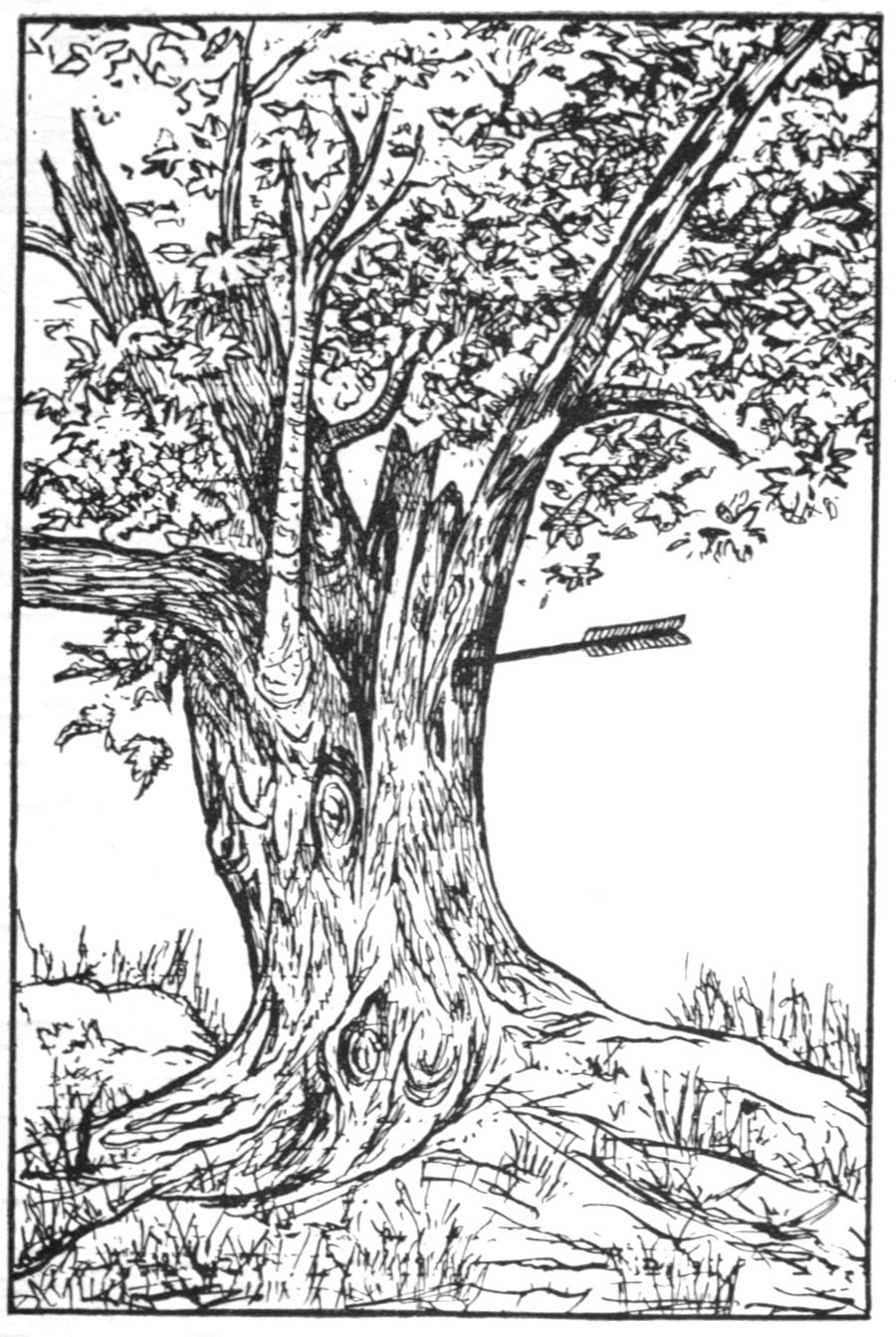
The Creation of Man
From the hole made by the arrow Came forth new forms, and these Were the first of human kind. And so the Lord gave them a name Meaning “those born from trees.” Kulóskap the Lord of Light Made all the animals. First, he created All of giant size; Such was the beginning. Then he said to Teâm, the Moose, Who was tall as the Kiwaʿkw, The colossal giant of the mountain, The awful king of the forest, The lord of the roaring river: “What wouldst thou do, Teâm, Shouldst thou see man a-coming?” Answered the monstrous Teâm, “I would tear the trees down on him.” Then the Lord Kulóskap Saw that the Moose was too strong; So he made him smaller and weaker So that the Indians could kill him. Even so with the Squirrel Who was as large in those days As the great wolf in our time; “What would you do, Sâkskadu?” Asked the Lord of Beasts and Men, “If you should meet an Indian?” “I would scratch up trees by their roots That they might fall upon him.” Answered the Squirrel undaunted. “Thou also art far too strong,” Replied the mighty Master; So he smoothed him down in his hands, And, as he was smoothed, the Squirrel Grew ever smaller and smaller, Till he was as we see him now. Then he asked the Great White Bear: “And thou, Kʾchî Mūʾūin! What wouldst thou do if ever A man should come in thy way?” And the Bear replied: “I would eat him.” Then the Master bade him go And live among rocks and ice, Very far away in the North, Where he would see no Indians. And there he is ever in snow. So Kulóskap the Great, Lord of all things that are, Did question all the beasts, Changing their size or strength, Or measuring out their lives, According to their answers. He took the Loon for his hunter To serve him as a dog; But the Loon was often absent, Not to be found when wanted; So he took in his place two Wolves, One black, the other white; And these wild dogs are his messengers Who bear to him tidings of all. Many years ago, Yet still within our time, Very far to the North, An Indian in his canoe Was about to cross a bay To a distant place; When, just before he launched, There came in haste a stranger Followed by two great dogs, Who asked to be taken over. “You may come,” replied the Indian, “Come over the bay and welcome, But what will you do with your dogs? For we cannot take them with us!” The stranger replied, “They may go Around by land and meet us.” “That cannot be,” said the other, “No dogs could run such a distance, Not even in weeks of running.” But as there was no answer He paddled, saying nothing, Over the bay to the landing, And there the dogs were waiting! But when he turned his head He found the stranger had vanished, And then he said to himself: “Now have I seen Kulóskap, The Lord of Beasts and Men.” And yet at a later day At a place afar in the North, There were many Indians assembled When there came a strange commotion. The ground was heaving and rumbling, The rocks were shaking and falling, And even the boldest among them Felt faint at heart with terror; When lo, they saw before them The Lord of all, Kulóskap! And he said to them: “Lo, I am here, And when you feel the ground Trembling again as to-day, Then know that I have returned.” So it is that man will know When the last great war shall be, The war of the Final Day! For then Kulóskap the Lord Will make the plain and the mountains Shake with an awful noise. The Beaver had been the foe Of the Lord in the beginning; Hence it came that Kulóskap slew Full many of the tribe. Away up in the Tobaic Are two salt water rocks— That is, they stand by the ocean Near a fresh water stream— A spot which to the Beaver Had ever been forbidden. But one day when far away, So far that none could see Who had not the magic vision, Kulóskap saw the Beaver Defying his injunction, And drinking from the stream. Then with his might, in anger, The god tore up a rock And hurled it at the Beaver. It was many leagues away, The Beaver deftly dodged it— Few beasts are so quick at dodging— But when another boulder Came after the first one, Kwâbît Ran deep into a mountain From which he came forth no more. But the rocks which the Master threw, And the mountain and the fountain, Are shown unto this day; And the Indians say in reverence; “Kulóskap once was here!”
FOOTNOTES:
III
THE ORIGIN OF THE RATTLESNAKES
[Passamaquoddy]
Ntʾladwewâgʾnuk aʿtosis yut the snake.[15]
You know Aʿtosis, the Snake? Truly all snakes are evil, But worst among them all Is the Rattlesnake their master. Well! In the olden time, The Rattlesnakes were Indians, And they were very saucy: Men said they were all face, And never could be frozen; They could not be put down by much, And they rose for very little. When the Great Flood was coming, Kulóskap the awful prophet, Gave them full warning of it. They answered, “They did not care.” He told them that the water Would rise o’er the heads of all; They said, “Should this come to pass, We shall all be very wet.” He bade them be good and quiet, And pray to escape from drowning; They whooped and hurrahed to mock him. He said, “The Great Flood is coming!” They gave three cheers for the Flood. Then he added, “’Twill drown you all!” The Indians whooped again, And got out all their rattles, Which were made of turtle shell Containing little pebbles, And rattled with all their might In a daring dance to the Flood. Yes, ’twas a rattling dance! The rain began to fall, But the Indians danced on. The thunder roared, and they answered With rattles and with war-cries The Indians danced on. To the flash and crash of lightning Amid the rising waters The Indians danced on! Then Kulóskap was angry Yet in the rising flood He did not drown a soul, But for their arrogance Changed all to serpent form— That of the Rattlesnake, Which crawls about the rocks, And so unto this day, Whene’er they see a man, They lift their heads and hiss; And move them up and down— That is the way snakes dance, Shaking their rattles, too, As we do when we dance. How do you like the sound? L.
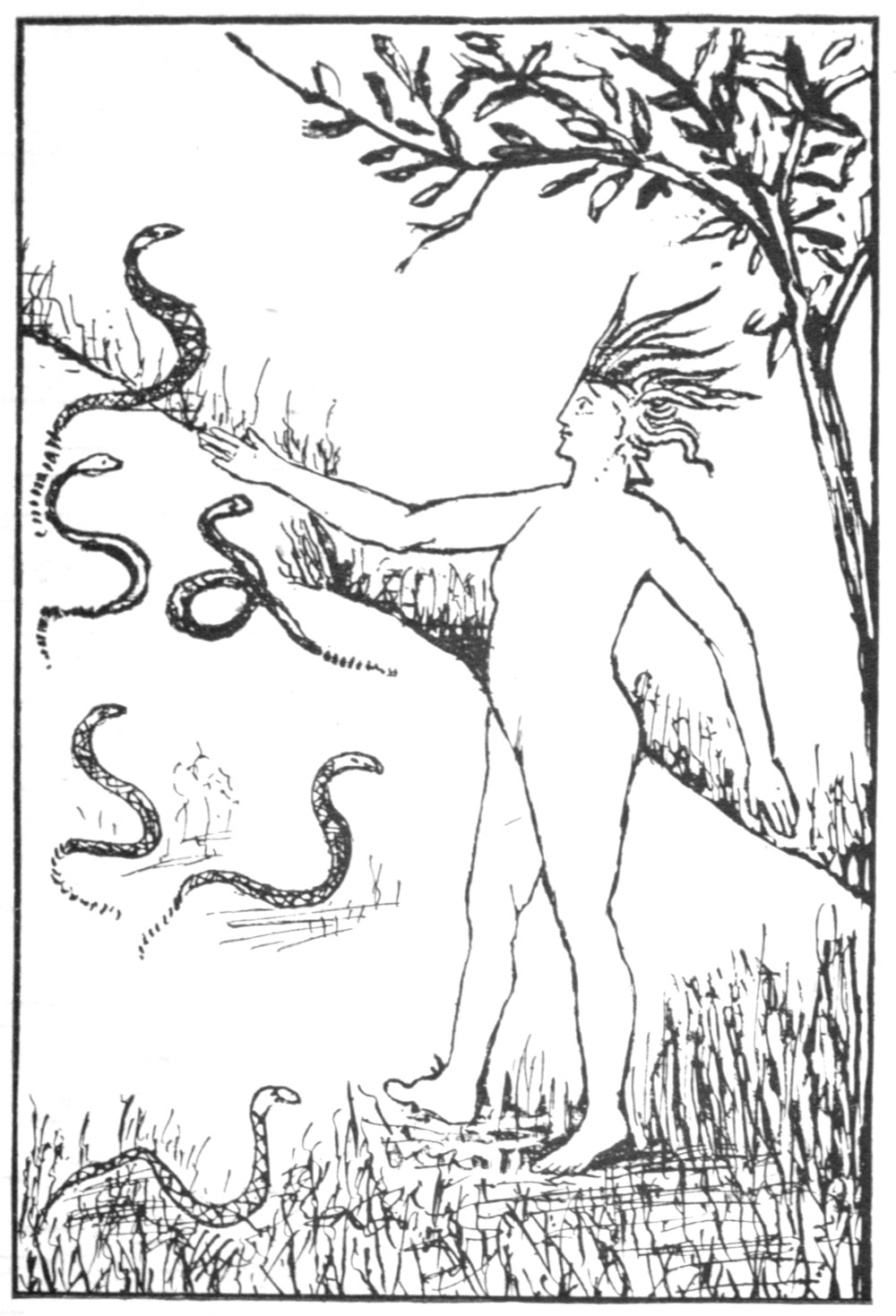
The Origin of the Rattlesnakes
FOOTNOTES:
IV
HOW KULÓSKAP NAMED THE ANIMALS, AND DISCOVERED THAT MAN WAS THE LORD OF THEM ALL
[Passamaquoddy]
Wut ktagʾnodʾmul uch Kulóskap.[16]
This is an ancient tale of the Lord, Told ’mid the tales of the spirit time, How the Master of Beasts and Men Was born in the Sunrise land, The land of the Wabanaki; Though other traditions tell That he came from across the ocean In a great stone canoe, A barque which was all of granite, Covered with trees for masts. When the great Lord of All, The Chief of Beasts and Men, Descended from this ark, He went into the land Of the Wabanaki, The children of the Light; And calling all the Beasts Gave unto each a name: Unto the Bear, Mūūin; And as he gave it, asked: “Oh Bear, what would’st thou do, If thou should’st meet a man?” To which Mūūin replied Simply and honestly: “I fear him and should run.” “Well spoken,” said the Lord, “Man should be feared by all.” Now at that time, Miʿko, The Squirrel, was as great, Or, some say, far more great Than even the Northern Bear; So the Lord Kulóskap Took Miʿko ’neath his hands, And softly smoothed him down; And as he felt the touch Miʿko grew less and less, And dwindled until he Was what we see him now. Howbeit in later days, Miʿko was Kulóskap’s dog, And, when the Master willed, He oft grew large again Touched by the Master’s hand, And slew his fiercest foes. But, being asked what he Would do if chased by Man, Miʿko at once exclaimed: “I would climb up a tree As fast as legs could run.” “Well answered,” said the Lord, “And therefore, I ordain That from this day henceforth Thou and thy kind at large Shall ever dwell in trees.” The Moose was standing by, Intently looking on, With great, soft, staring eyes, Attending to it all With deepest interest. Calling then Kchi Mūs, Big Moose, the Master said: “But say what would’st thou do If thou should’st meet with Man?” “In faith,” replied Kchi Mūs, “I’d canter through the woods Fast as my legs would fly.” “Well spoken,” said the god, “So shalt thou ever live In shade and forests wild.” The Beaver being asked What he would do, replied That he would seek a stream Ere he would face mankind. So the great Lord perceived That of all creatures born Who walked upon the earth The first and best was Man. L.