THE WHOPPER THAT GEORGE WASHINGTON TOLD
Reading edition
Several times during the host’s narrative the Imp glanced in the direction of his young friend to see whether the little fellow appeared surprised at anything he heard. The child gave no signs, however, to indicate that he had any doubt as to the perfect accuracy of the tale, in which he was deeply interested, being visibly affected toward the end, when his eyes were filled with tears. The Imp concluded that the flower was working splendidly, and making the little boy quite sensible in his way of seeing things.
After a moment or two of meditation into which all three had fallen when the story was finished, the little boy said,
“That Wollerp did a fine thing for the country, didn’t he?”
“Yes, indeed,” said the host, “and it was appreciated, too. As you go through Chymerline you’ll notice a monument on the village green; the road goes right past it. It was put there by the road commissioners in honour of the noble martyr who saved them the 84trouble of doing their duty. You see, people used to try to follow the curious windings of the neck, just for fun, until it got to be a kind of national game. Expeditions started out continually, until finally ‘Hunting the Head’ became a perfect fad. They had little wollerps with long necks to play with indoors, and they’d tangle the necks up on dining tables, and then try to follow them with little pointers until they came to the end. Of course, all this travelling outside made a beaten track, and the track developed into a path, and the path into a road, and the road into this beautiful endless highway which is the pride of the Kingdom and the delight of tourists.
“I remember the day I first got here. It was the afternoon of the Fourth of July, 1776, and everyone was saying a little poem. Some had gone crazy trying to learn to say it. I didn’t know what it meant until I heard the old road legend. This is how it went:—
“Said an imp as he buttoned his shoes,
‘I will follow that neck into Snooze,’
And he giggled with glee,
‘What a lark it would be,
I believe it would banish the blues!’
“And taking his suitcase, said he,
‘Now promise, don’t worry for me,
85For I never shall flinch,
It’s a regular cinch,
And as easy as easy can be.’
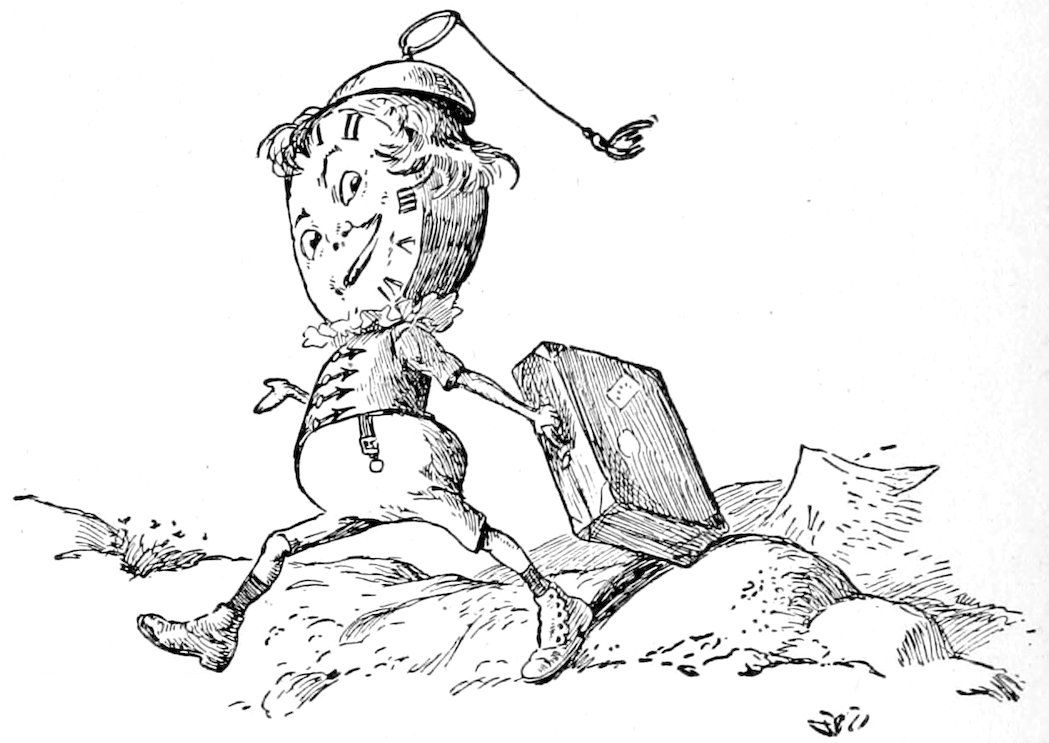
“But when he arrived at the Ku-
Peremaliganundi of Soo,
He had to go back
On account of the crack
In the Nickuberamelegoo!
In the Nick, in the Nick, in the—”
“Don’t you think we’d better have dinner?” asked the host, rising. “It’s long past time.”
The little boy did think so, and had thought so for an hour or more, so he answered that he was perfectly agreeable, and they all went into the dining-room where they were soon seated before a steaming tankard of frizzled strikers with daybreak sauce.
“When is it going to be night?” asked the little boy, as they finished. For he knew they must have been in Tockerlore for sometime, and yet it was neither darker nor lighter than when they had passed the frontier.
“Why, it’s night now, I suppose,” said the landlord, “it’s never dark here, you know; the light always remains as you see it now. Would you like to go to bed?”
“If you don’t mind,” said the little boy.
86“Mind! Why, certainly I don’t mind. You’ve no objection to your friend’s sitting up with me a while, have you?”
“Oh, certainly not, not at all, but would someone be good enough to help me undo the buttons? I don’t want to trouble you, but you know I always have nurse to help me when I go to bed.”
So they both fell to and helped him undo the buttons, and then the host showed him to his room. He felt a little homesick as he curled himself up in the strange bed, and wished that he had his Teddy bear to talk with and tell things to. However, as he couldn’t do that, he did the next best thing, and talked to himself, which, as even grown up people know, is one of the greatest pleasures in the whole world.
“If that Imp were only fond of school and knew something about history; if he really cared for them, how nice it would be, for I suppose he’ll stay here all the rest of his life. I don’t suppose he ever had a governess to tell him things—it isn’t his fault. How many things Father Time must know! Just to think how that landlord saw the Declaration of Independence signed, maybe! I wonder if it was signed after lunch. I think the host’s badge said 4 P. M. Anyway, if he didn’t see it signed he saw some of the excitement after it was signed. Maybe he saw Benjamin Franklin. I wonder if he’ll tell about it while I’m asleep. I wonder what that place was where the young Imp had to go 87back; I suppose they all laughed at him when they saw him come walking in. It served him right; he was too sure. I wonder what that Nickub—that Nickuber—I wonder what that name was.” But while he tried to think of it he fell fast asleep.
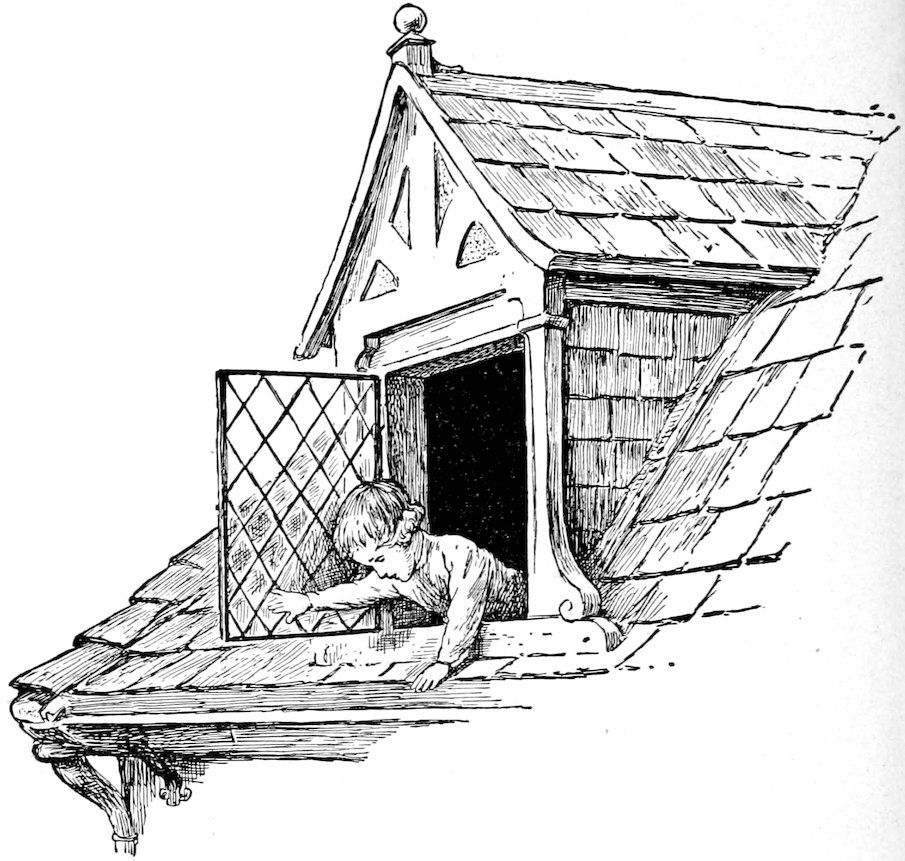
When he awoke he knew it must be morning, for he heard voices in the yard beneath his window. There seemed to be several voices and all of them were very loud and angry in tone. Some were saying, “No, he didn’t!” Others were calling, “Yes, he did!” And still others were exclaiming, “Don’t you believe a word of it.” Then all the voices would be heard together in excited argument, and it sounded as if the owners of these voices might resort to blows at any minute if the matter under discussion were not settled very soon. Finally the little boy heard someone shout,
“Go on with what you were saying.”
“I intend to,” another voice answered.
“If it’s the truth, we want to hear it.”
“You’re going to hear it.”
“He’d better look out!”
“Who had?”
“You had.”
“Me?”
“Yes, you.”
“Don’t you believe in free speech?”
“Not that kind.”
“Go on, tell the rest of it.”
88“We’d like to see you do it!”
“You’ll hear me do it.”
“He knows what he’s talking about.”
“He thinks he does, anyway.”
“Go on, tell it!”
“Where did I leave off—oh, I know—
“He did not always justify
The view that you have taken,
And when you say he couldn’t lie—
Why, simply, you’re mistaken.
“And now, in view of all this talk
I think it only proper
To say that on a certain day
I heard him tell a whopper!”
“A whopper, did you really say?”
“We can’t believe it—name the day!”
“’Twas just before I came away,—
I heard him tell a whopper!”
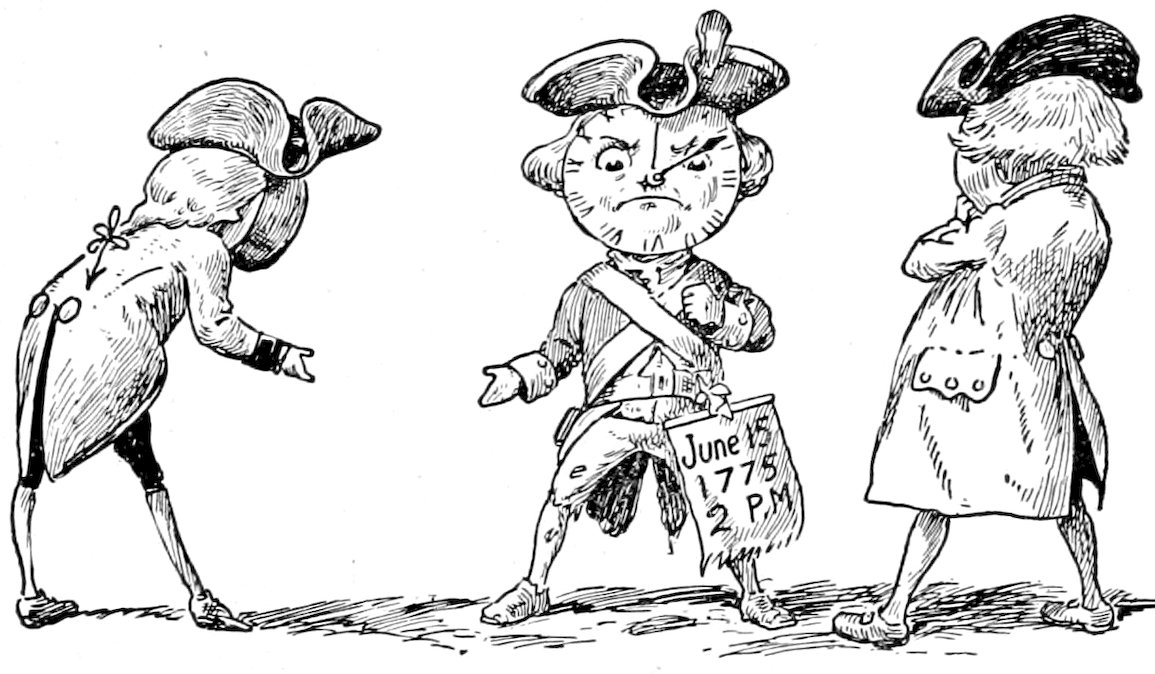
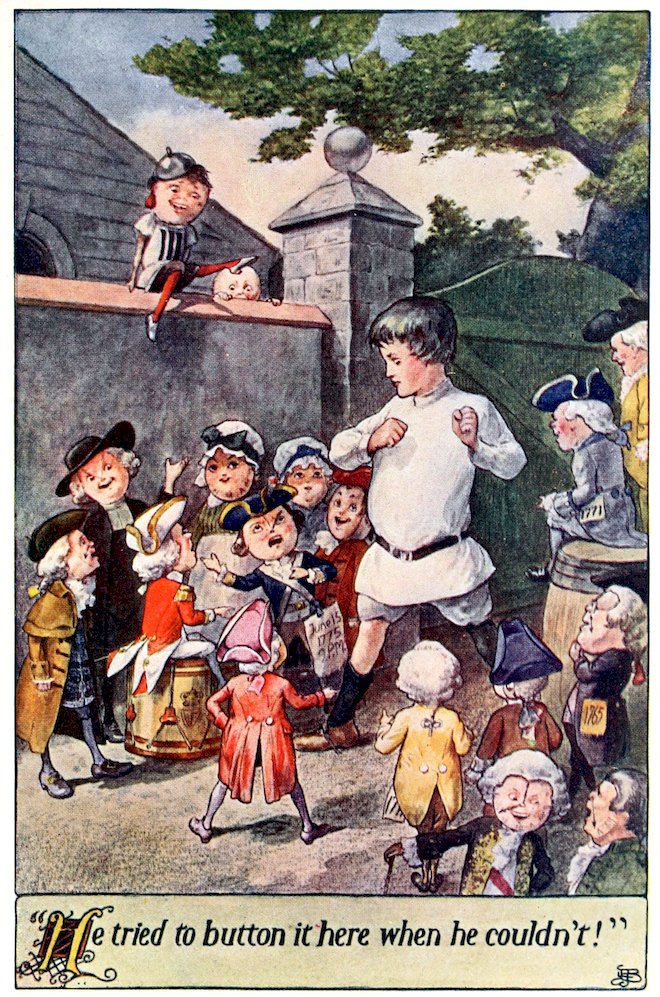
At this the little boy, who had risen and begun to dress, threw open the window and gazed on the assemblage below. On the fence sat his friend, Mr. Three O’clock, swinging his legs and laughing uproariously 89as if the disclosure which had just been made pleased him greatly. There were several little imps about the yard, all in colonial costume, some standing, others sitting, and in the centre stood the imp who had experienced such difficulty in telling his story. He had on a ragged Continental uniform, and his badge said “June 15, 1775. 2 P. M.” Altogether, he was very defiant looking and out of patience.
“Good morning,” said the little boy.
“How do you do,” said the Continental Imp.
“I am very well, thank you; what is the trouble?”
“No trouble at all; who are you?”
“I’m a little boy visiting Minutel. May I ask you what the quarrelling was about? Did you say someone told a whopper?”
“That’s exactly what I said.”
“You ought not to say it unless you’re sure it’s true. May I ask who you said it about: who it was 90that told the whopper? It wasn’t my friend, was it?”
“No.”
“May I ask who it was?”
“You may; it was George Washington.”
The little boy started. “Oh, that is a dreadful thing to say about George Washington. I’m sure that George Washington never told a whopper; you know all the school books—”
“Now you see how much good the school books are!” said Mr. Three O’clock, from the fence. “Ha, ha, ha!”
The little boy gave an indignant look at his hilarious friend, for it was no laughing matter, and continued his conversation with the Continental Imp.
“How do you know he told a whopper?”
“I heard him.”
“With your own ears?”
“Yes, whose ears do you suppose I heard him with?”
The little boy felt to make sure his flower was safely fastened in his buttonhole, for he did not know what 91the conversation might lead to, and he wanted to be perfectly reasonable.
“I beg your pardon,” said he, “but are you sure it was a w-h-o-p-p-e-r?” He was gaping as he said this, and it stretched the word out a little.
“Positive,” said the Continental Imp.
“Perhaps it was a small whopper?”
“There is no such thing.”
“Or a middle-sized one?”
“No such thing.”
“Oh, I’m sure there must be some mistake, for I’m sure that a wh-a-a-a-aap-” and he gaped so that he couldn’t finish the word. “Just wait a minute,” said he, “and I’ll come down there.”
In less than a minute the little boy came out into the yard arranging the belt of his Russian suit.
“I have couldn’t all the didn’ts that I buttoned, but I didn’t the couldn’ts that I didn’t when I buttoned the didn’ts,” said he, “and I hope you will excuse me.”
“Go back to bed,” said Mr. Three O’clock, “you’re not awake yet.”
“I am awake,” said the little boy.
“He said he couldn’t the didn’ts,” observed one imp.
“No, he didn’t, he said he didn’t the buttons that he couldn’t,” said another.
“He said he buttoned the couldn’ts when he didn’t,” called a third.
92“I didn’t,” said the little boy, “how could I?”
“Well, how could you didn’t if you couldn’t?”
“He said he buttoned the didn’ts.”
“He didn’t.”
“He said he couldn’t the didn’ts that he buttoned when he didn’t the buttons—what did you say?”
“Now wait a minute,” said the little boy. “How easily you get into a quarrel! I will tell you just what I said. I said that I buttoned all the buttons that I could button, but that I didn’t button the buttons that I couldn’t button. There!”
“Talk about whoppers!” said the Continental Imp. “Well, now what is it you want to know? Let’s get through with it.”
“I want,” said the little boy, “to know when George Washington told a whopper.”
“On the 15th of June, 1775, at 2 P. M., just after they made him commander of the army.”
“Would you mind telling me what the whopper was? You know all the stories say that George Washington couldn’t—”
“Oh, yes,” said the Continental Imp, smiling at Mr. Three O’clock, “we understand, of course, that George Washington couldn’t if he didn’t and that if he didn’t—”
“He didn’t,” shouted the little boy, stamping his foot. “What was the whopper?”
“He said, right in my hearing,” said the Continental 93Imp, “that he wasn’t fit for the exalted position. There!”
“Well?” said the little boy.
“Well, he was, that’s all,” replied the Continental Imp.
“You mean,” said the little boy, “that you think that was a whopper?”
“Well, it certainly wasn’t true, was it?”
“N-no, perhaps not, but he—well, it wasn’t a whopper.”
“He said he wasn’t fit for the position when he was, and he said he couldn’t win the war, and he did.”
Here the Continental Imp looked toward Mr. Three O’clock, who was still sitting on the fence, and said,
“What do you think about that?”
“Do I understand you to say that George Washington said he wouldn’t win the war?” asked Mr. Three O’clock.
“Yes.”
“Well, then, I think that, as a gentleman, he should have kept his word.”
“That is perfectly ridiculous!” said the little boy. “If he hadn’t won the war there wouldn’t be any America, and if there wasn’t any America there wouldn’t be any Tockerlore, and where would you all be, I’d like to know?”
“You don’t think Tockerlore is in America, do you?” asked one.
94“Where is it, then?”
“It’s right here where Father Time put it.”
“He didn’t,” said the little boy, whose patience was almost exhausted.
“He tried to button it here when he couldn’t, so he didn’t!” roared the Continental Imp.
“He couldn’t,” said the little boy, white with rage.
“Well, then, if he couldn’t, he probably didn’t!” yelled Mr. Three O’clock.
“He didn’t, he couldn’t!” screamed the little boy, quite beside himself. “And if I say he didn’t, he couldn’t, and don’t say that he couldn’t when he buttoned the couldn’ts to the didn’ts, if he didn’t the couldn’ts when the buttons didn’t—!!!”
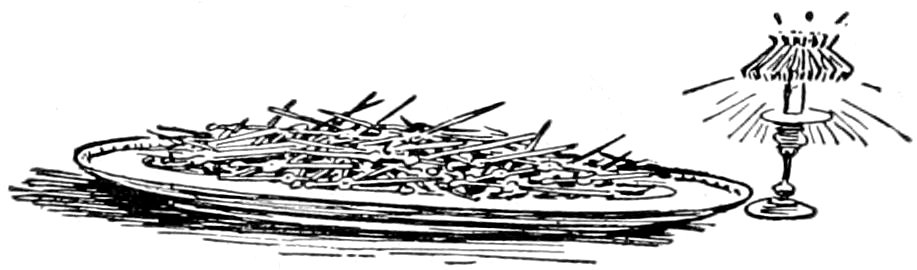
“Come to breakfast!” called the genial host, standing in the doorway and smiling broadly at the little boy. So they all scampered in to the dining-room, where a large platter of delicate little second hands (done, of course, to a turn), with delicious eight day gravy, was awaiting them.
95
97