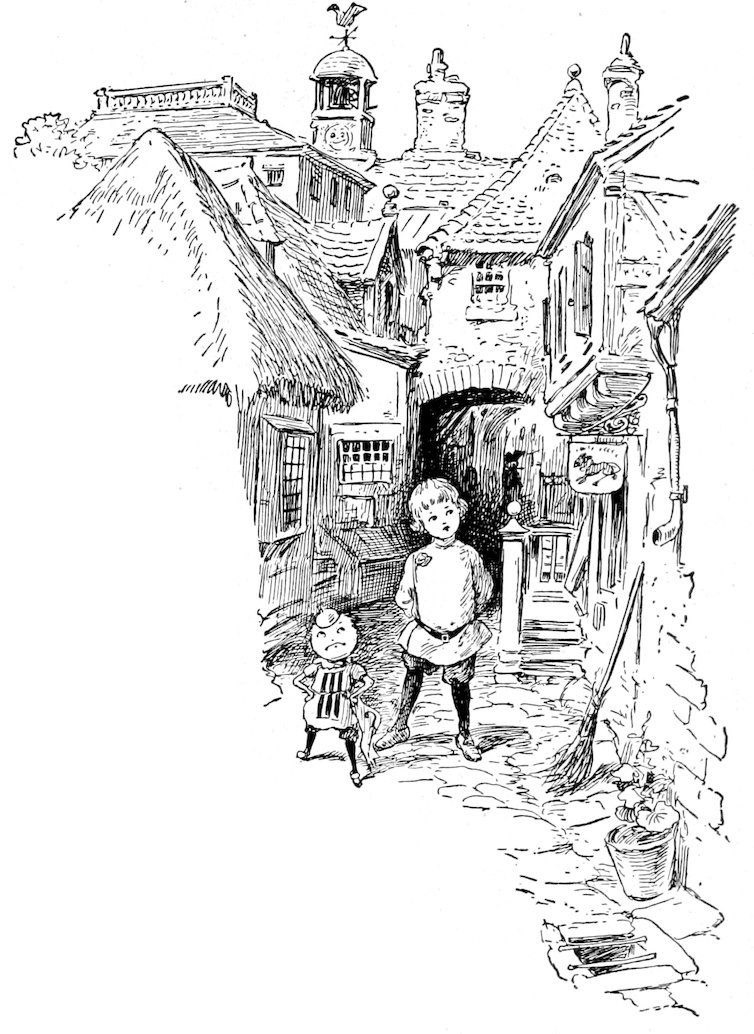
THE MAGICAL FLOWER
Reading edition
As the little boy glanced about the scene
Which he’d just arrived to explore,
A curious sight it met his gaze,
And he scanned it o’er and o’er;
’Twas the beautiful, winding country road
Extending through Tockerlore.
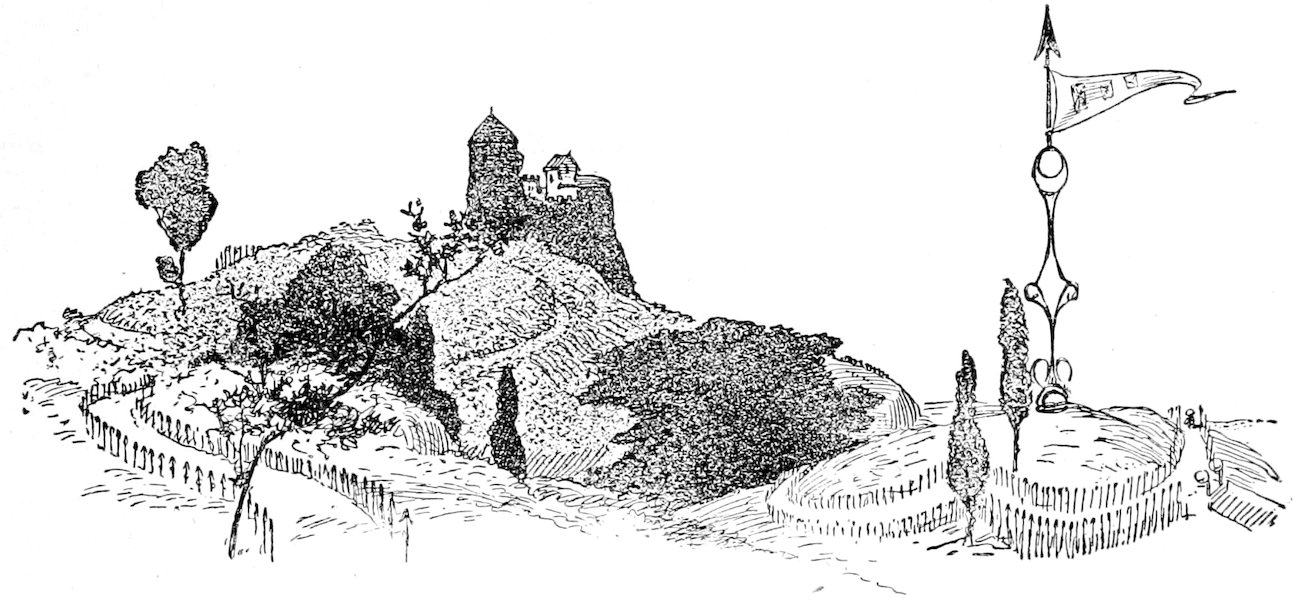
48They stood on the edge of a rocky shelf
Surveying the beautiful land,
And no matter where his eyes would turn
The road was on every hand,
And he noticed the distant towns it touched
And the rivers that it spanned
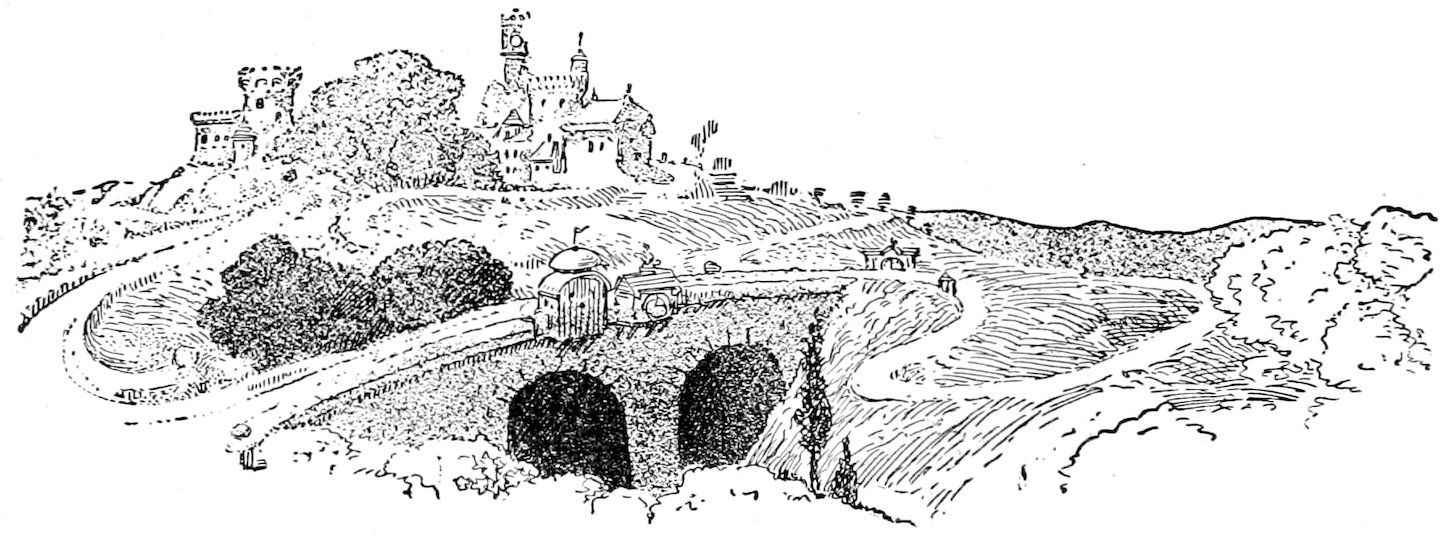
And looking afar from the rocky height,
He remarked to the Imp, “It seems
Like places they have in fairy books,
And the things you see in dreams;
And is that the village of Minutel,
Where the little white light gleams?”
And turning his wondering eyes above
To the beautiful fleecy sky,
He saw how the floating clouds were formed
Like mystical clocks on high,
And he thought as he saw them passing there
How the time was fleeting by.
49And still as he paused on the mighty cliff
And noted those clouds pass o’er,
His ears caught a smothered rolling sound
Like the distant thunder’s roar,
And he said, “They’re winding the clock-clouds up
In the land of Tockerlore.”
The Imp laid his hand on the little boy,
And he said, “We shall have to strive
To follow that road to Minutel,
Or we never shall arrive.
How nice, when you follow its winding way,
To think it was once alive!
“Now watch what you’re doing, and step right down,
Holding fast to those slender trees;
When we’re off this hill, we’ll be all right,
And can find the—”
50“Wait a minute!” said the little boy. “Did you say that the road was once alive! Or didn’t you say that?”
“Yes, I did, and you shouldn’t interrupt.
“And can find the road with ease;
And we’ll see the garden of Minutel,
Where they make the scented breeze.
“There, now what is it?”
“Well, I thought it seemed funny that—I didn’t see how a road—Well, nothing.”
“Go on,” said the Imp, “I’m listening.”
“Well, would you mind telling me about how the road was alive—if it wouldn’t be too much trouble?”
“Oh, there’s an old legend they tell in Minutel—I’ve no doubt you’ll hear it; we’ll ask when we get there. Minutel is a queer little place, full of folk-lore. Those gardens I spoke of are called the Fields of Fragrant Flowers; they are a reservoir.”
“A what?”
“A reservoir, supplying fragrance to the whole kingdom. The delightful scent from the flowers is carried through pipes into Tickerleen and the smaller places. You’ll notice the little registers in the streets which open and close. Just see how beautiful the view is now—look over there—”
51And he pointed off to a distant spot,
Where some clustering steeples rose
Like stately ghosts in the soft, clear air,
And said to the child, “Now those
Are within the City of Tickerleen
Where each tired hour goes.”
But while he was speaking, a scented breeze
From the region of Minutel
Bore a sound the child had often heard
And seemed to remember well;
’Twas the steady tick of the old hall clock,
And a faintly chiming bell.
It was wafted up from the lowlands fair,
Where the flickering light was seen.
“Look there!” said the Imp, “you’ll see it move;
It’s skirting that long ravine;
’Tis the clock-work train leaving Minutel
On its way to Tickerleen.
“And that means, in plain language, that we’ve missed it! And there won’t be another till that gets back, for there’s only one train. There, that’s the last you’ll see of it, for it’s gone behind the mountains. It’ll be in Chymerline before you and I get to Minutel. Now, step down this way.”
“That’s too bad,” said the little boy, as he stepped 52down, “but we can wait in Minutel, can’t we? We’ll want to see the village anyway, I suppose.”
“Yes, but I don’t know how long we’ll have to wait. Minutel is an old-fashioned place, filled with queer, old hours,—Pilgrim hours, and Puritan hours, and that sort; there’s not much to do there unless you want to listen to their prosy chaff.”
“Oh, I’ve heard about the Pilgrims landing on Plymouth Rock, and I like stories of that kind,” said the boy. “Do you suppose the hour is there who saw them land?”
“Yes, I suppose so—Look out, don’t fall!”
“Is the train usually on time?” asked the little boy.
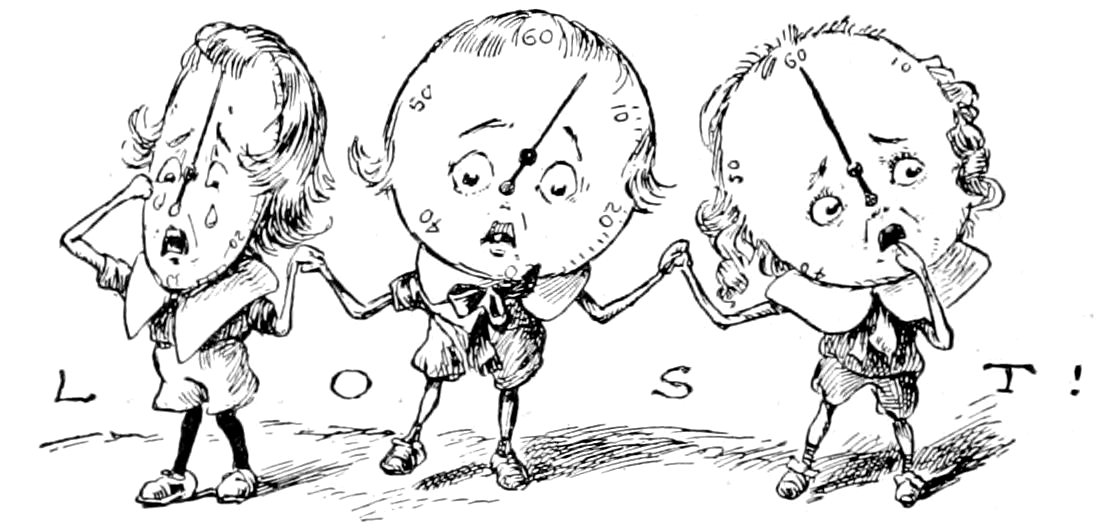
“Yes, always,—except once I believe it lost three minutes, but the engineer got them back again.”
“Made them up, you mean?”
“No, he lost them somewhere between Snooze and Tickerleen, so he advertised in the Tickerleen papers and some one who had picked them up returned them.”
“What!” said the little boy, standing stark still 53and staring at the Imp. “Do you mean that those minutes were brought back to him?”
“Yes; what a curious little boy you are! You seem to think that nobody is honest. First Father Time is suspected of stealing mountains. Then you seem to be surprised that there is a single person in the whole great city of Tickerleen honourable enough to return three little golden minutes which he knew didn’t belong to him!”
“It isn’t that,” said the little boy, as they picked their way along down into the valley from the rocky ledge, “but it seems so funny—oh, well, I suppose things are different here.”
Soon they found themselves on level ground and hastened across some wide meadow land where they found a part of the road they had seen from the hill, and falling into it they saw at once how it led out of the valley up into Minutel, which was on the side of a mountain, not very far up.
“Wasn’t that a funny song?” said the little boy, as he trudged along up the winding road, watching the ground beneath him lest it should come to life again and shake him off. “I don’t think I ever heard such an odd song; it was meant to be funny, wasn’t it?”
“What song was that?”
“The song the minstrels were singing as we came in.”
54“I thought it was beautiful and stirring,” said the Imp.
“I thought it was funny about the ships being tied to the barnyard door.”
“O-oh, I don’t know, I suppose they must be tied somewhere; it’s just a matter of taste.”
“And the cod-fish coming out of his hole in the rain!”
“Yes,” said the Imp, “I’ll admit that was rather strange.”
“I’m glad that you agree with me at last,” said the little boy, “for I was beginning to think that nothing would ever seem strange to you.”
“Yes, that was strange,” said the Imp, “I can’t understand it.”
“And the cod liver oil part—the bowl of cod liver oil, you know. I thought that was odd.”
“Yes,” said the Imp, “that was the queerest part.”
“Ha, ha!” laughed the little boy.
“Very strange!” said the Imp.
The little boy seemed to be quite encouraged that he and his guide had come to an agreement about something at last, and he laughed uproariously as he thought over the rest of the minstrels’ song.
“The idea of his taking cod liver oil for his health and then coming out in the rain!” said the Imp. “I should think that he would have had better sense; that was a strange thing to do, I’ll admit.”
55The little boy’s face became very serious again as he heard this, and a look of disappointment was plainly visible in his big eyes.
“I didn’t mean that his coming out was strange, but his having a hole; I thought that was queer.”
The Imp stopped in the middle of the road, and looked at the little boy in utter astonishment. The poor little fellow was quite uncomfortable at being so sternly scrutinized, but he could only stand still too, and wait. Then the Imp spoke very slowly as if he wanted to make sure that the little boy understood every word,
“If you were taking medicine in such a quantity as that cod-fish—that is, if you were taking a whole bowl of something for your health—I ask you if you would come out in a rain storm. Now answer!”
“No, I wouldn’t, but—”
“No, you wouldn’t, of course you wouldn’t! Then it was strange for him to come out and do it, wasn’t it?”
“Yes, it was, but—”
“There is no ‘but’ about it; it was a foolhardy and absurd thing to do, and it was strange, as you said yourself.”
The little boy was about to speak when he changed his mind and decided that it was of no use. But he resolved to ask Father Time a few questions if His 56Majesty was willing to give him an audience when they got to the royal city.
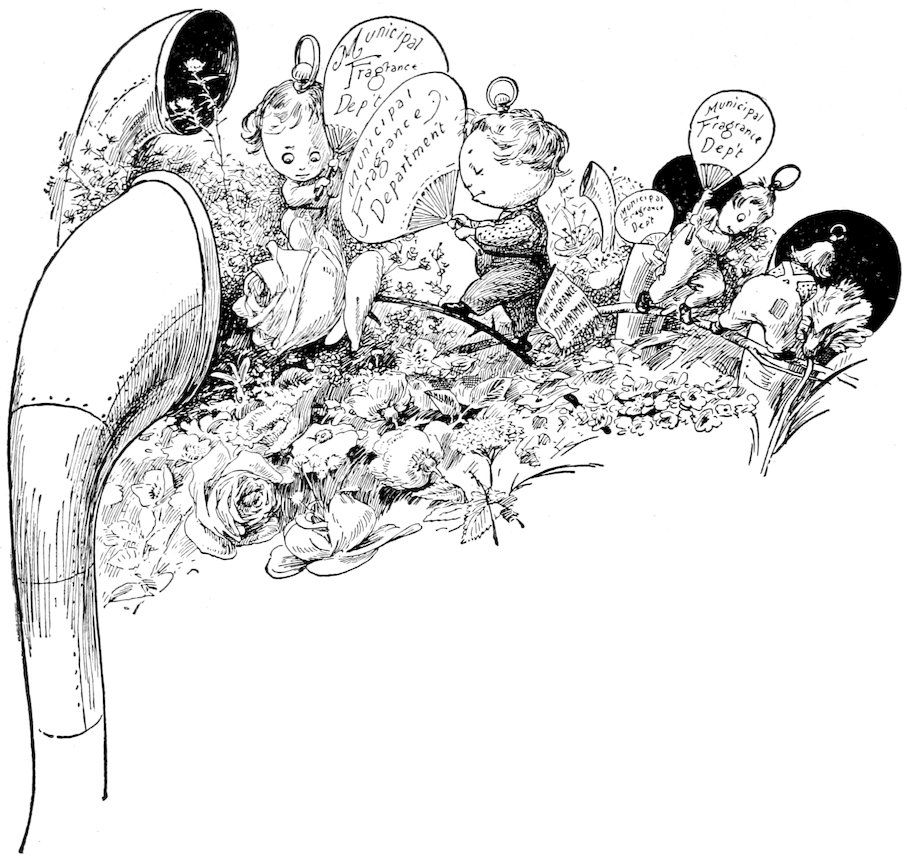
Soon they reached the Fields of Fragrant Flowers, which were just outside of the village. Many little imps were here, roaming about amid a veritable forest of fragrant plants, and fanning the air into large funnels which rose here and there among the flowers, and which looked like the pipes the little boy had seen on the big ocean liner on which his parents had taken him abroad, and which he had been told were for the purpose of carrying air down into the staterooms below.
They sat on the fence a while to rest and watch the imps who were wandering here and there and 57fanning vigorously. Now and then a head would peer up from the clustering plants and take a peep at the little boy and then disappear again. Finally the little fellow noticed that many of the imps were stopping their work and joining a group where an animated conversation seemed to be going on. He watched them eagerly, supposing that something queer must have happened, and that perhaps one of them had been too stubborn to admit its queerness, and the rest were arguing with him. At last, to his great surprise, one of the little imps came running through the flowers till he almost reached the fence, where he stood and beckoned to the little boy to come inside.
“Shall I go?” said the little boy.
“Certainly,” said his friend, “they won’t hurt you.”
“I suppose they must have been talking about me; don’t you think so?” said the child.
“I shouldn’t be surprised,” responded his guide. “You’d better go in and see what they want.”
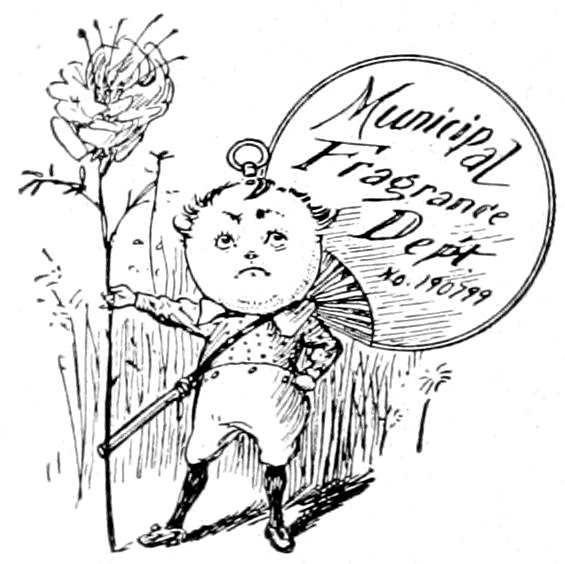
The little boy jumped down from the fence and hastened through the flowers till he reached the Imp, who, he now saw, was smaller than his travelling companion, but whose fan was perfectly gigantic. He wore a badge which said “Municipal Fragrance Department,” with a number underneath the words.
“What is it you want?” asked the little boy.
“Come back here; we want to speak with you,” 58said the Imp. So the little boy followed him back to the corner where the rest of the Municipal Fragrance Department workers were standing.
“How do you do?” said one of them.
“I’m very well,” said the little boy, “except my eyes hurt me. What do you want to see me about?”
“Where do you come from—the earth?”
“Yes, I’m here to see the Land of Tockerlore.”
“Who is your friend?”
“His name is Three O’clock. He invited me; wasn’t it all right?”
“Oh, yes, there are a good many Three O’clocks here; one comes about every day. Have you seen anything strange, unusual?”
The little boy looked back toward the fence to make sure his friend could not overhear the conversation. There was no danger of this, however, for his friendly guide was swinging his legs and singing a boisterous song about what an unpleasant thing school was.
“He’s very prejudiced against schools,” said the little boy. “I don’t know why, I’m sure. No, I haven’t seen anything so very strange, but he tells me strange things. I don’t know what to think of them; I don’t want to be impolite with him.”
“No, certainly not,” said the group, “you are quite right.”
“What did I tell you?” said one imp.
59“I thought he wouldn’t understand,” said another.
“Didn’t I say we ought to set him right?” said a third.
“It is just as I suspected,” observed a fourth. “There ought to be some one out on the frontier to inform visitors; they get all confused before they’re in the land. I’m glad we called him in,” and he looked about at the others as if he thought they ought to thank him for his thoughtfulness.
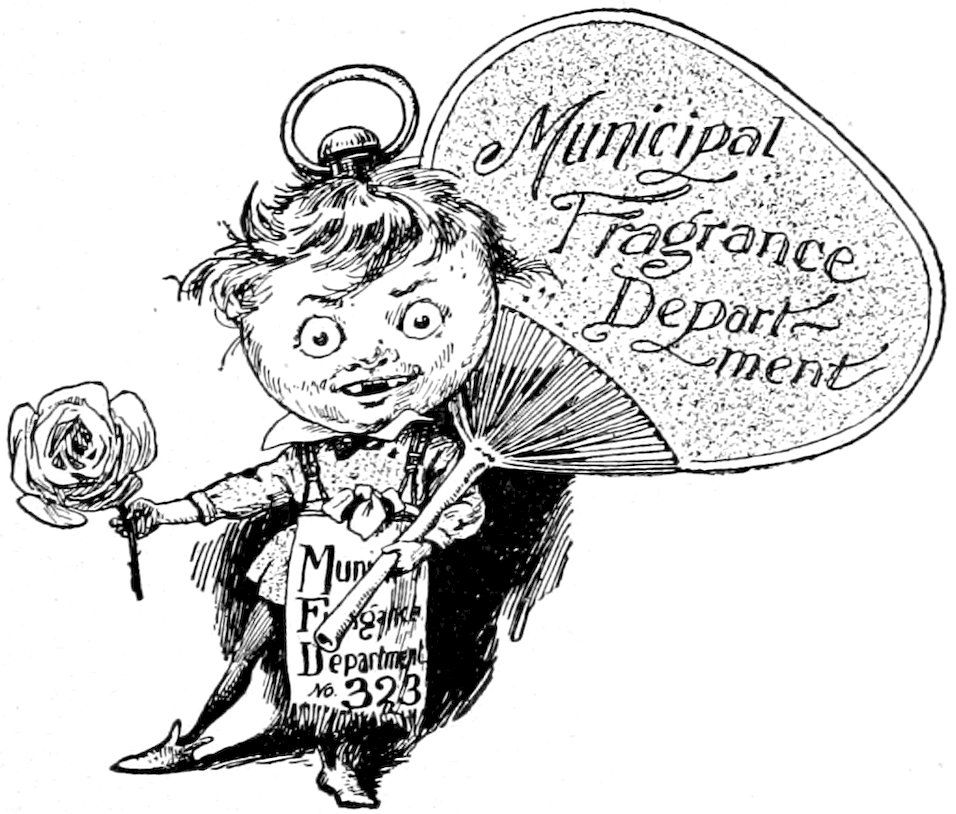
“My dear little boy,” said one of the imps, “there is nothing strange about Tockerlore, but the Earth, where you come from, is a queer place. Consequently, when you come here things appear strange when they really are not so. Scarcely a week passes but some visitor goes by here—invited, I suppose, by a friendly hour—and we always notice how surprised he seems to be. Now if you will just let me pin this flower on your blouse, it will set you right until you get to Tickerleen, where you won’t need it. They have so much fragrance there from the pipes that you won’t need any flower, but Minutel has no municipal supply, and only gets what fragrance the free air supplies, and that isn’t much. Now run along—you 60came up through the Snooze Valley from the frontier, didn’t you?”
“Yes, was that the Snooze Valley?” said the child.
“That was the Snooze Valley. Good-bye.”
“Good-bye,” said the little boy, “and I thank you—I really thank you very much if it will make me see things right.”
The imps all nodded as he ran away, and as he and his friend proceeded along the road, he turned and saw that they were all at work again, fanning with all their might and main. He explained to the Imp what they had done, and the Imp seemed to think it was a good idea.
“I only hope it will work,” said he, “for you are the strangest child I ever knew.”
61
63