MR. THREE O’CLOCK’S AWFUL CONFESSION
Reading edition
And now could be heard in the village street
A monotonous calling sound,
And many a drowsy sluggard rose
From a slumber all profound;
’Twas the village crier of Minutel
On his early morning round.
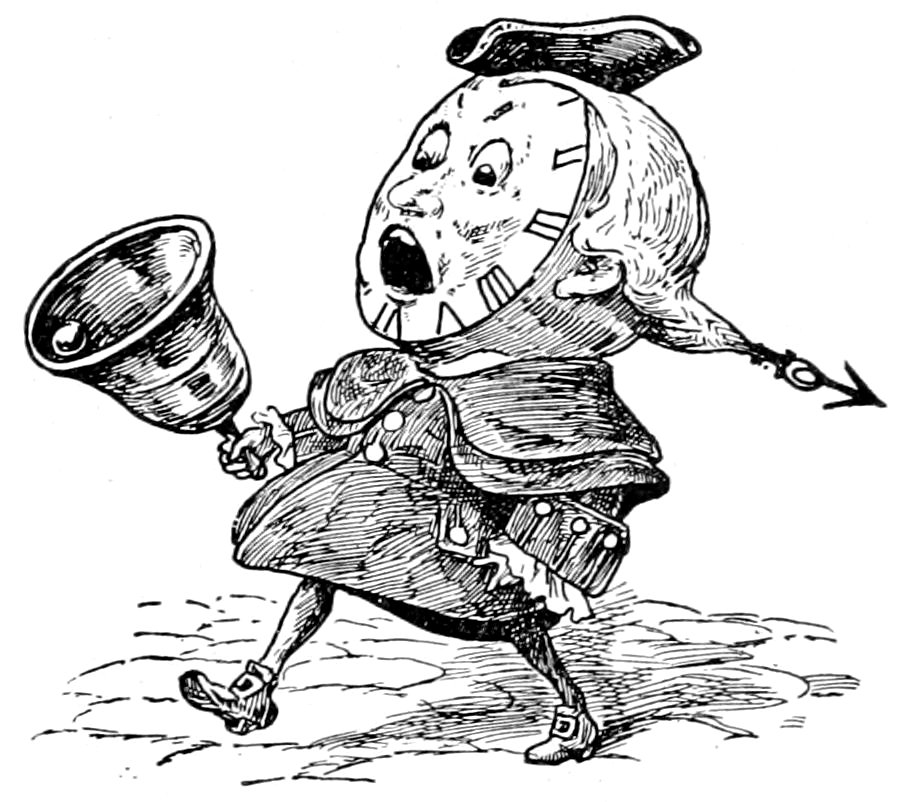
“Be up and astir!” they could hear him cry,
As he paused at each door to knock,
And hearing no sound, would bang and call,
And angrily try each lock.
98“Did ye sleep like this in ye olden time,
When ye lived inside the clock?”
For the old-fashioned hours in Minutel,
Regarding their duties as through,
Would frequently lie asleep all day,
At least, till their time was due;
For example, the “Twelves” would rise at noon,
But the “Twos” would sleep till two.
“You are up betimes,” said the genial host,
As he ladled the breakfast out,
“And to-day, I expect, you’ll see the town
By wandering all about.
Will you have your ticklets, my honoured guest,
With twinkling sauce, or without?
“These ticklets were made in Seventy-six,
They are nice as a second course.
Just hear the crier along the street;
He’s turning them out by force!
May I trouble you, Mr. Three O’clock,
To pass the twinkling sauce?”
“How luscious and rich,” said the little boy,
“Is this ‘pendulum shake’ with ice.”
“Ha, ha!” said the host, “Indeed it is,
But think of the dreadful price
99To bring it a couple of billion miles!
These hunting case flips are nice.
“Won’t you have this dickery dock croquette,
The only one left on the plate?
That soft whipped cream which you see inside
Was whipped in Seventeen eight.
Ah, the rod, little boy, was seldom spared
At that very early date.”
“Yes, indeed,” said the host, as he wiped his mouth, and folded his calendar-page napkin, “yes, indeed, they seldom spared the rod in those good old days in your world. That’s why the children grew up so good, I suppose, and that is probably why the good old cooking was so much better than the cooking of to-day. Such mashings as the potatoes and turnips got, such unmerciful beatings as the poor little eggs had to undergo; it’s no wonder that few eggs were bad! And how they used to whip the cream—no wonder it was good; if you were whipped as much as this cream was, you’d be good; they whipped it till it was white in the face.”
“I am good,” said the little boy. “Did you say that in Minutel they do the same things they used to do when they lived in the world?”
“Don’t you be afraid,” said the Continental Imp. “They’ll not hurt you.”
100“No indeed,” said Mr. Three O’clock, as they all rose, “we’ll stay together and protect ourselves.”
“By the way,” said the Continental Imp, “do you know, I believe I’ll run up to Tickerleen when you go; it’s too slow and old-fashioned for me here. I wonder if you’d have any objection to my going along?”
By this time, they had come out of the house and were looking about them to determine which way they would go. The host said he would lock up the inn for the day and join them. The other imps, whom the kindly landlord had invited to breakfast out of the goodness of his heart, scampered off about their business, and the little boy, the host, the Continental Imp, and Mr. Three O’clock proceeded leisurely along the road.
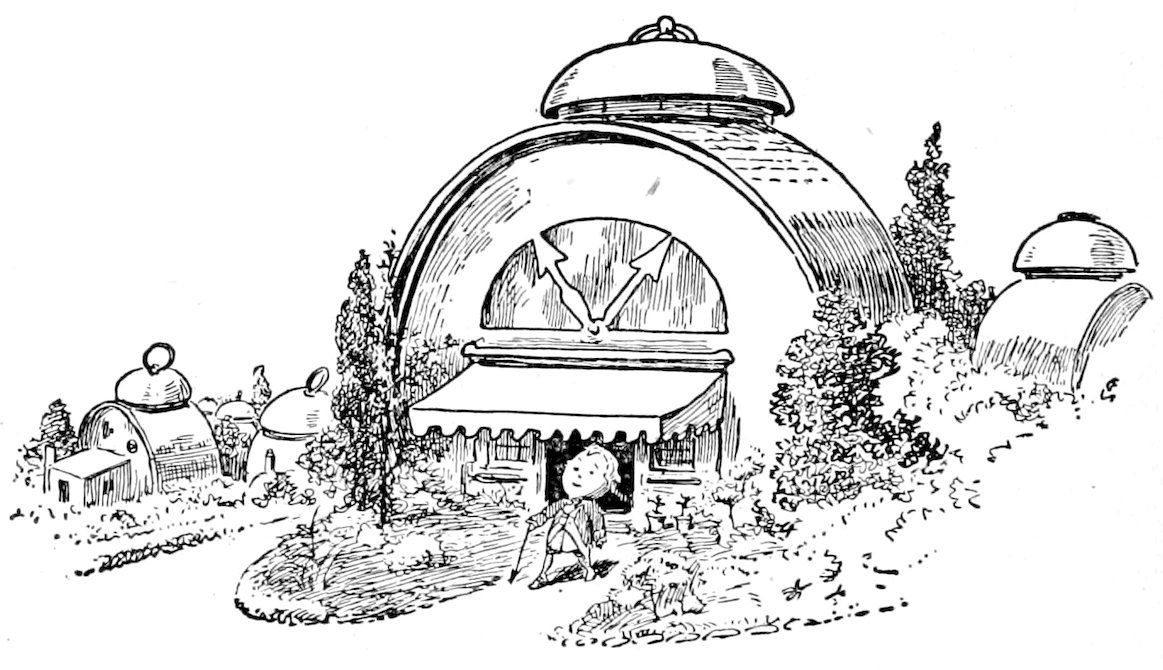
All through the beautiful little village of Minutel were the houses where the old-fashioned hours lived. They were queer houses with domes, and from a distance they looked like so many alarm clocks with the alarm bells up on top. There was a low, drowsy ticking in the air all the time which the little boy couldn’t locate. He heard it clearly enough, yet it seemed 101to be far away—or rather, it seemed to be all about, like the very breeze. Every now and then the church bell would chime, which the little boy fancied to be a clock striking the hour, and he pictured to himself the village of Minutel as a huge clock with the church bell as a striker to notify each hour when it was time to get out, just as the real striker did on the real clock.
The host and the Continental Imp pointed out to the newly arrived pair the homes of the principal hours. The little boy was interested to see the house where the hour lived who saw the Pilgrim Fathers land, and also the hour which had the pleasure of witnessing the arrival of Columbus on the shores of the western world. He also gazed for sometime at the house where the host told him the hour resided which had seen George Washington chop down the cherry tree.
“That hour,” said the Continental Imp, “is the greatest bore in Minutel; he’s always telling what he saw, and nobody cares anything about it.”
“You know all about it, I suppose,” said the little boy.
“Yes, I know all about it; he claims that George Washington never told a lie simply on the strength of his having told the truth on one particular occasion when he was a little boy. I don’t deny that he told the truth about the cherry tree, but I do say that on the 15th of June, 1775, I heard him tell a whop—”
“Stop!” said the little boy.
102“per. There!”
“I wish you wouldn’t say that,” said the little boy, “because I don’t consider that that was a whopper.”
“Yes, it was,” said Mr. Three O’clock, “and I agree with our Continental friend here that the hour you’re speaking of—that Cherry Tree Hour—is a bore.”
“How do you know he’s a bore when you’ve never met him?” said the little boy.
At this Mr. Three O’clock turned very white and seemed quite uncomfortable.
“I don’t see how you know anything about this land, anyway,” persisted the little boy. “You’ve never been here before.”
“Yes, how is that?” asked the Continental Imp; “of course, you’re right, but I don’t see how you know that you’re right.”
“My understanding,” said the host, “is that you just arrived—it seems rather unusual—have you any explanation?”
There was a pause after this, and Mr. Three O’clock looked very confused. Finally he looked all about him, and said, “Shh-h!”
“What is it?” asked the little boy.
“He said, ‘Shh-h,’” said the host.
“I know he did,” said the Continental Imp.
“There is a mystery about my life,” said Mr. Three O’clock, speaking in an impressive whisper, 103“a mystery which I cannot reveal. But under my light and airy nature, there is a burden on my soul. Do not force me to reveal it!”
“I am sure you may confide in me,” said the little boy. “What is the trouble? You seemed so free and happy when you came out of the clock. I hope—Oh, I hope that you have never done anything wrong!”
“Alas!” said Mr. Three O’clock, “I am not what you think I am—I have a past!”
“Have you it with you?” asked the Continental Imp.
“Suppose you let us see it,” said the host.
“Tell us all about it,” said the little boy, soothingly, “and then you will feel better. Maybe you are not as bad as you think you are. Tell us, anyway.”
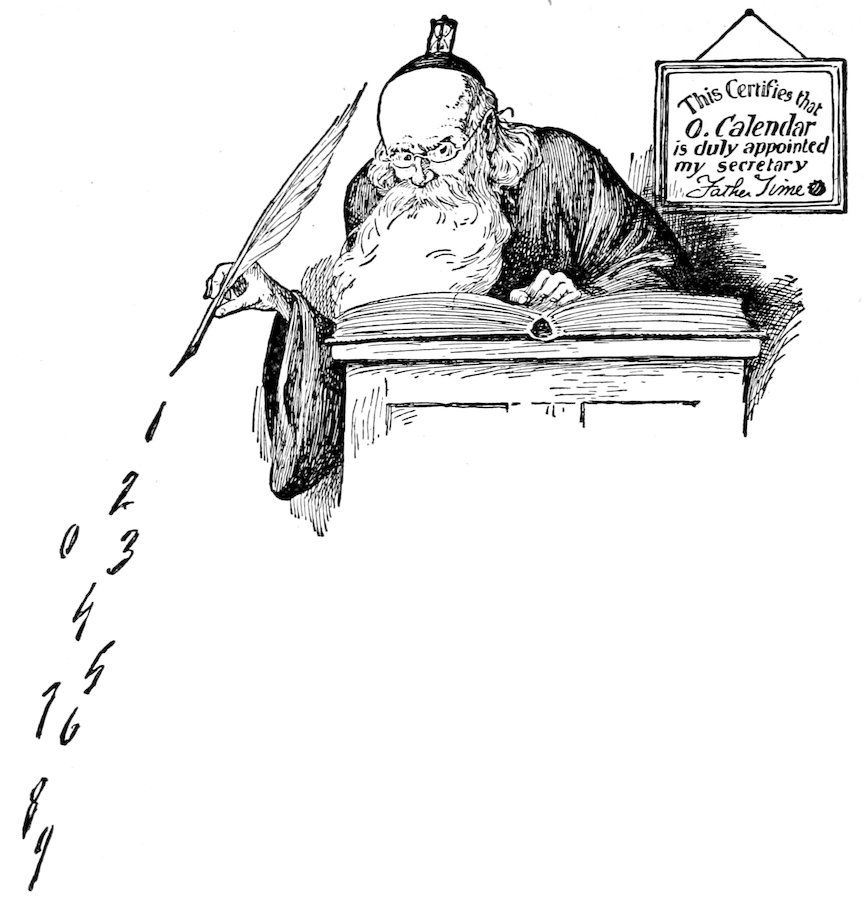
“I suppose I might as well,” sighed poor little Mr. Three O’clock, “for Father Time’s secretary, Old Calendar, will only find it out when I apply for my date badge, and the whole thing will be made public. They have a great system; they say the red tape in the government offices is longer and more tangled than the Wollerp’s neck! Try not to think ill of me, and as we walk along I’ll tell you my sad tale.”
They all looked very grave as they paced along in silence and waited for the culprit to begin. The poor little imp who had recently danced and laughed so happily experienced a great deal of difficulty in starting and several times began with, “’Twas in a little district—” 104and had to break off again. Finally he succeeded in conquering his feelings, and told the following extraordinary tale:
“’Twas in a little district school,
Which I remember well;
A hundred restless little boys
Were waiting for the bell.
’Twas just about a year ago
This awful thing befell!
“The scene was in a country town;
The teacher, she was new.
It lacked an hour of closing time,
And tasks were nearly through.
And high upon the schoolroom wall
The clock was striking Two.
105“Two hundred eyes were on that clock
To watch the minutes flee;
One hundred weary little boys
Were waiting there for me;
For, in pursuance of the rule,
They always closed at Three.
“Before me, in the old round clock,
Dragged out the hour Two—
The slowest hour in all the day,
As every urchin knew.
The tempter whispered in my ear,
‘I’ll tell you what you do!’
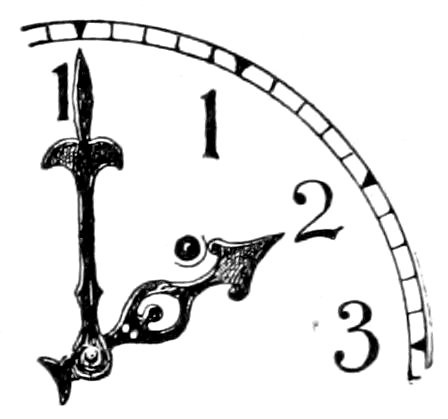
“I listened to his wicked voice,
And sought the hand at Two.
I had no business to go out
Till Two O’clock was through;
Another hour yet must pass
Before my time was due.
“But there upon the figure Two
I straightway took my stand,
While just above me, moving down,
I saw the Minute Hand.
Alas, alas, he did not know
The scheme that I had planned!
106
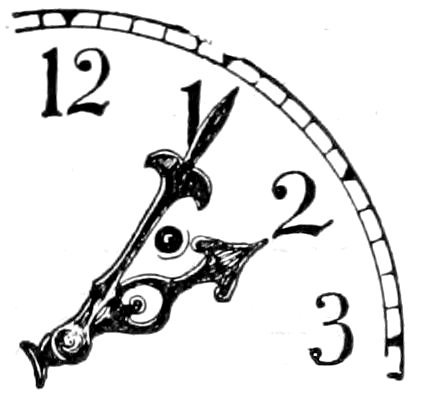
“How innocent he seemed to me,
As slowly down he stole.
I watched him pass the figure One,
And then the winding hole.
Ah, would that they who clean the clock
Could cleanse my guilty soul!
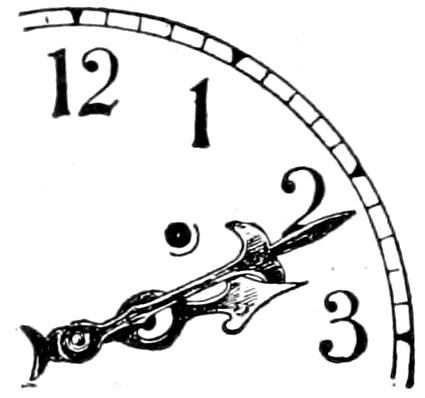
“Past figure Two the two hands met.
My time had come at last!
Together they must pass to Three
(I see you stand aghast),
Yes, yes, I will confess it all;
I fixed those two hands fast!!
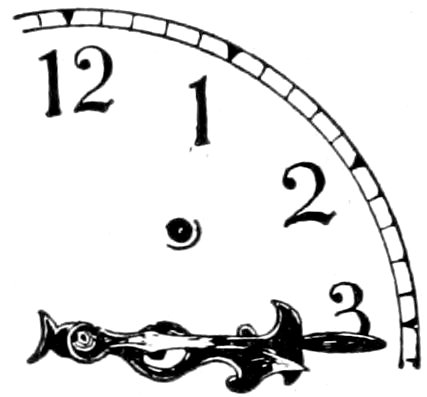
“In just five little minutes more,
Those children heard with glee
The teacher, glancing at the clock,
Exclaim, ‘Why, goodness me!
’Twas Two O’clock a moment since,
But now ’tis after Three!’
“In just one minute more, my friends,
In just one minute more,
The scuffling sound of many feet
Was heard upon the floor,
And full a hundred happy boys
Were romping through the door.
107
“But now the thought of what I’d done
Came home with dreadful force;
An exile, I, before my time!
And, stricken with remorse,
I could not then undo the deed
And had but one recourse.
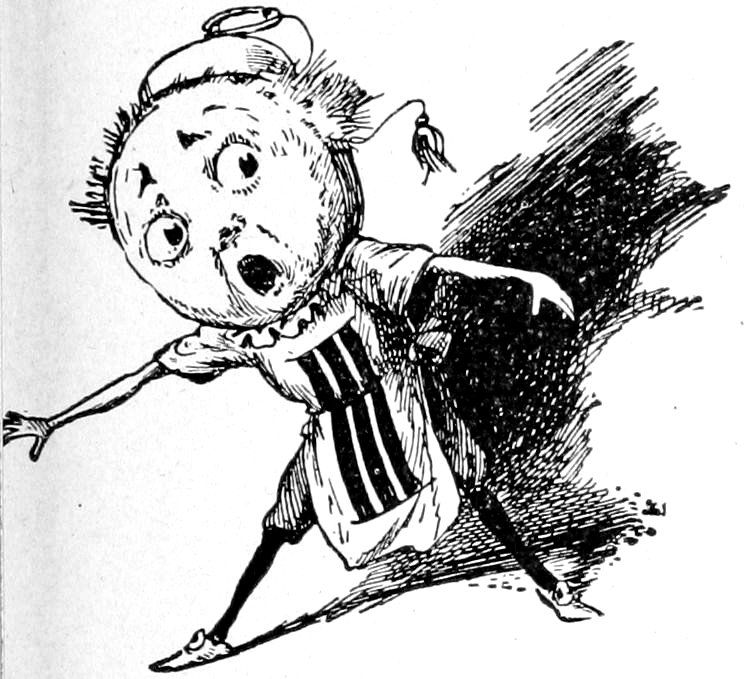
“One frightened glance about I gave,
And then resolved to flee.
But, glancing upward at the clock,
I sank upon my knee.
For, lo, ten thousand Minute Hands
Were pointing down at me!
“One desperate dash, with hidden face,
And I had passed the door,
And closed it fast to keep those hands
From pointing at me more;
I dragged my heavy, guilty soul
To merry Tock-Tock-k-k-k-el—”
“We understand,” said the host, “don’t try to finish.”
“There’s only one syllable more, and I want to s-s-s-ay it!” said the poor, little Imp, “it’s lore. There!”
There was a moment of silence after this pitiful narrative, during which the poor, little Imp turned away 108and wept copiously. They all respected his feelings, and no one spoke until his little fit of sorrow and remorse had passed, when he faced about and began to put away a little chamois handkerchief which had been the receptacle of his tears.
“It was a pen-wipe-ipe-ipe-ipe-er,” said he, trying in vain to control himself. “I picked it up-up-p-p after the little boys had gone out, and I have kept it ever since as a bub-bub-bb-bub-b-bub—”
“He means a memento,” said the host.
“No, he doesn’t,” said the Continental Imp, “he’s trying to say something that begins with ‘bub.’”
“As a bub-bub-bub-b-bub-b-b—” cried the poor little Imp.
“Perhaps he means to say memento,” suggested the little boy. “You know, if you try to say memento when you’re crying hard, you will say it through your nose and it will sound like ‘bubento.’”
“No, I think he means bubble,” said the host.
“As a bub-bub-ba-ba-a-dge of my shame!” said the poor little Imp, at last.
“Well, it wasn’t memento,” said the Continental Imp.
“No, and it wasn’t bubble either,” said the little boy, and then, turning to his little friend, he said,
“Don’t feel so bad; I am sure you didn’t mean to do anything wrong. You must cheer up and be happy again just as you were on the journey here.”
109“I wouldn’t worry,” said the Continental Imp. “You were just a little fast, that’s all. There are many human beings worse than you and faster than you too who get credit. Take George Washington—look at that whop—”
“Don’t, please,” said the little boy.
“per,” said the Continental Imp.
“Yes,” said poor little Three O’clock, “but that whop-op-op-op-p—”
“Don’t,” said the little boy. “There isn’t any use in talking about that now. Tell us how you happened to get back to the world again.”
“Remorse!” said the poor little Imp. “I applied for my date badge at Old Calendar’s office, but they were suspicious—said I arrived too soon—and wouldn’t give it to me. So I wandered about the land, an outcast, for an hour without a badge is always looked on with discredit. Other hours asked me what I had seen and I could not tell them. ‘Begone!’ they would then say, ‘thou idle hour that saw no deed accomplished, no duty done, no heroism performed in the great world; where hast thou been?’ Wherever I went I was stared at and shamed and shunned. I heard the hours tell what they had seen, but had nothing to tell myself. You see, our lives in the world are short; each one has but sixty minutes in which to build his character, and therefore a whole life may be ruined by one bad deed. You know, an hour’s standing here 110depends on what he has seen during his working life. In my wanderings I met the glorious hour that watched Abraham Lincoln sign the paper which freed the slaves.
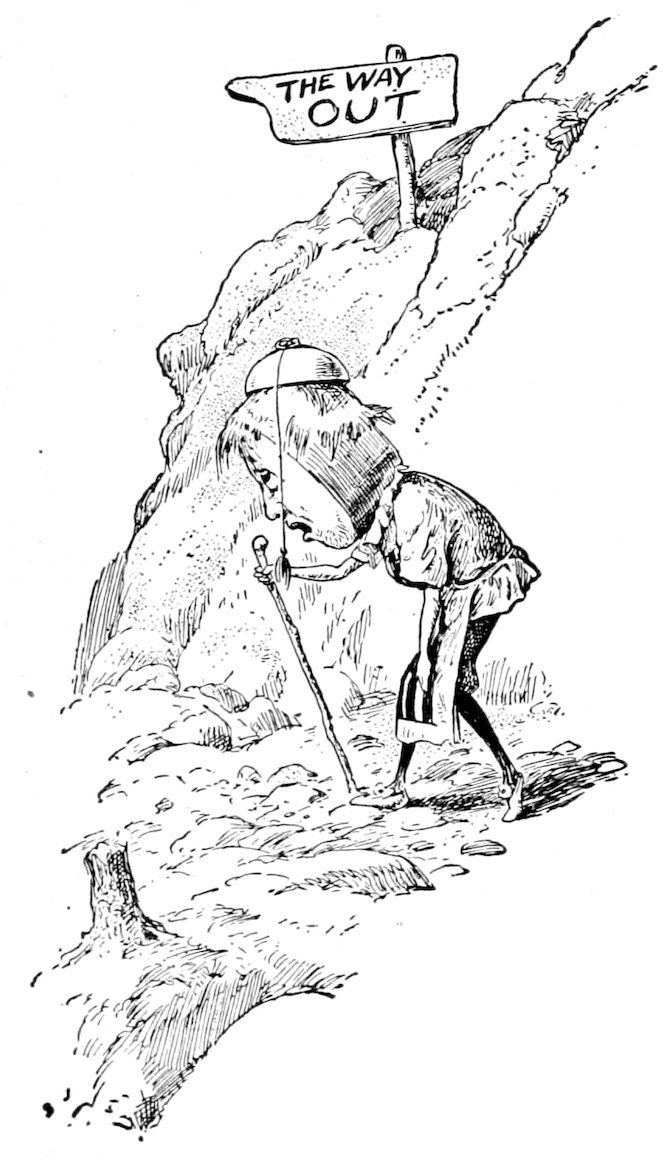
“‘Ah,’ said I, without thinking, ‘I, too, freed some slaves.’ And then he asked me how, and I told him by a wrong I had committed, and this got about and I was asked to leave Chymerline, where I had met him. Then, I dared not look behind me, for I always saw hundreds of long, thin Minute Hands pointing at me and reminding me of my crime. Alas, how dearly was the liberty of those little boys purchased! At last, weary and lonely and penitent, I sought the frontier, succeeded in passing the minstrel guards, and found my way back into the world. I never went to the little country town again, but wandered into the great city and succeeded in getting into the big, handsome clock in your father’s house. I found, to my delight, that the clock had once lost an hour, and I resolved to make that hour up and come forth again unstained and having done my duty. That is the story of my sad life.”
“You see,” said the little boy, seriously, 111“all that came from your disliking school so—I noticed that fact when I first met you. But come, try to forget all about it now and we will walk along.”
The little boy had meant to ask a few questions about how the big hall clock had become slow, and how it could be put right again in the manner described, but he thought it would be wiser to change the subject altogether, as his little friend seemed to be feeling so sorrowful. So he began to ask who the various little alarm-clock houses belonged to, and was especially interested to hear of all the wonderful and famous things which their little occupants had once seen. Each appeared to have seen just one thing, and the little boy was informed that each hour usually made a practice of telling his own particular story and never got tired of repeating it. He was on the point of asking if each hour knew of all the things which had happened all over the world at that particular time, but he saw at once that this question might lead to a very complicated explanation, and would probably result in a quarrel, which he always dreaded.
“Surely,” said he, to himself, “an hour which saw Columbus land could well afford to go without knowing anything else.”
The Continental Imp explained to him how many hours who arrived on particularly auspicious days, and who had seen exceptionally great things, were swelled 112up with importance, like the host, who had arrived on the Fourth of July, 1776, and had undoubtedly seen Benjamin Franklin, who was very much in evidence on that day.
So they ambled along, through the pleasant, hazy village until soon they came upon a sheet of water which was very rough and which, the host said, was called the Hour Glass Lake because it consisted really of two sheets of water joined together by a little strait through which the water ran, so that the whole thing had not a little the appearance of an hour-glass with the sand running through it. The road ran straight down to the banks of the water and the little boy could see how it came right down to the shore on the opposite side also. He thought how it marked the aimless wanderings of the poor, lost Wollerp while he was hunting for himself, and he wondered if the lake was there then, and if so, how the poor little creature had crossed it.
Down at the shore was a curious boat which looked like the long box of a hall clock, and into this they all stepped for a row over to the other side. The little boy tried to talk as they rowed him across the lake, but the water was so rough that he could not talk properly, and he held on with all his might as the little craft rose and fell on the tumultuous waves.
“Do you suppose,” said he, “that we shall be able 113to start for Tickerleen in the morning? I want very much to
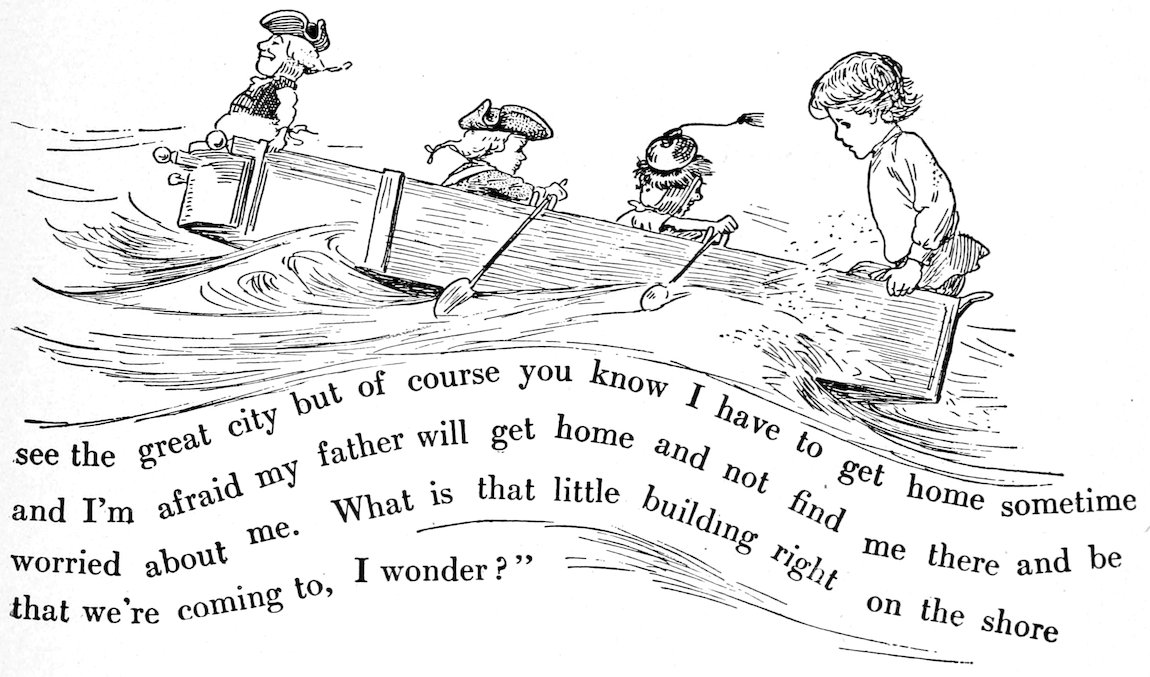
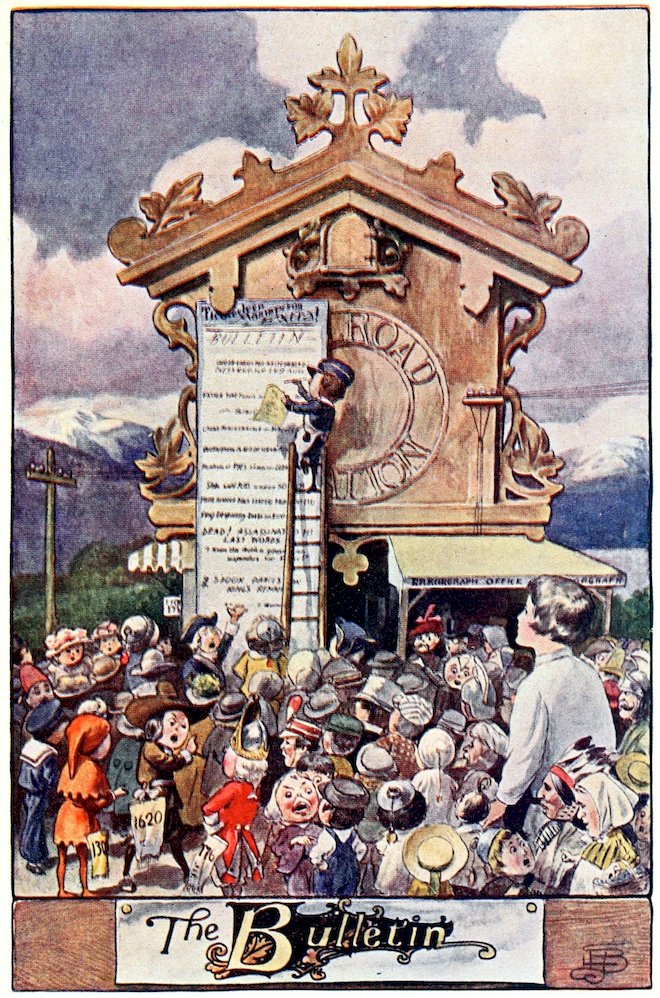
“That,” said the host, “is the station where you’ll take the train for Tickerleen in the morning. Hello, there seems to be a crowd there; there must be something the matter! Row a little faster, and we’ll see what the trouble is! They seem to be all reading the bulletin.”
So the Continental Imp and Mr. Three O’clock, who were rowing, made haste, and soon the party had 114landed and were hastening up the road in the direction of a queer, little cottage building with a roof and doors like a cuckoo clock, and about which fully a hundred imps were congregated, all talking in a most excited fashion. When they got a little nearer they could see that upon the outer wall hung a large placard, with a heading which said,
TICKERLEEN MAINSPRING. EXTRA!!!
and it was evidently the information on this sheet which had created all the excitement.
“What do you suppose it can be?” asked the little boy.
“News from the capital. I suppose the old Duke is at it again,” said the Continental Imp.
“I don’t understand,” said the little boy.
“Why, it’s the Mainspring’s local bulletin,” said the host. “The Mainspring can’t run down, you know—ha, ha, ha—so they have the news sent up by the errorgraph.”
They hastened on as fast as they could to the little building, and sure enough, there stood a cuckoo in the doorway, calling,
“Tick-tick-tickerleen—
Tickerleen Extra!”
and the crowd was all excitement.
115“Isn’t it dreadful!” some were saying.
“Things must be in a pretty state at court,” others observed.
“She shouldn’t have left it for the king to do; she should have stayed at home and done it herself,” one persisted.
The party elbowed their way right down to the front of the crowd, as newcomers are expected to do, till they reached a position where the words of the bulletin were quite legible.
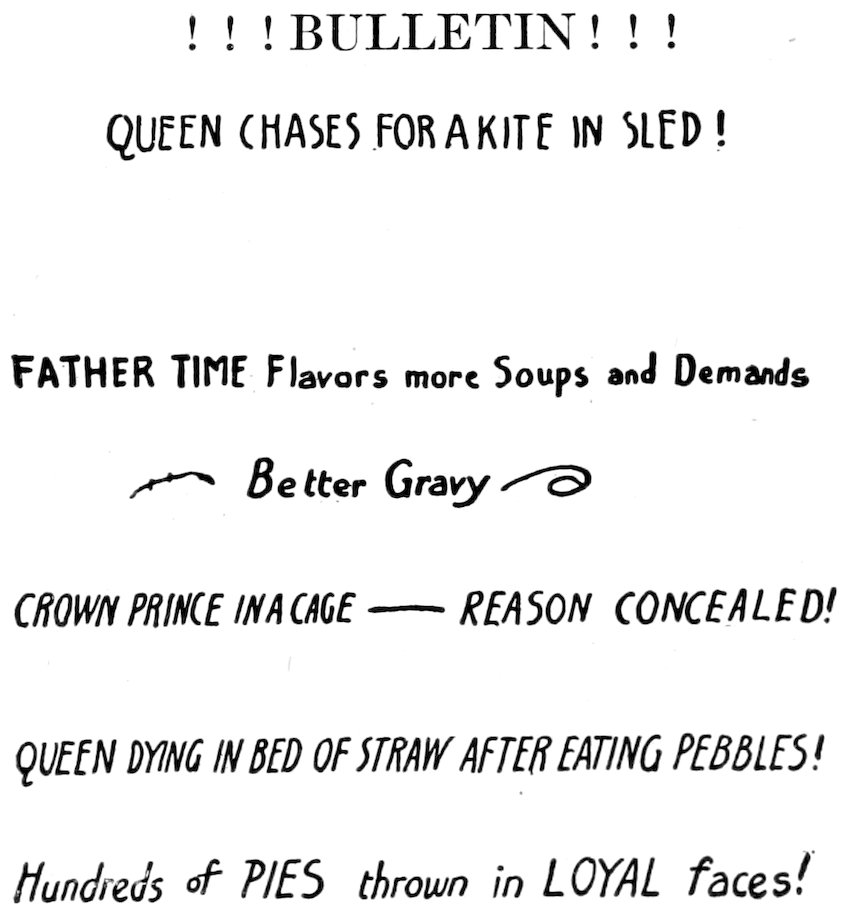
“Read it,” said Mr. Three O’clock. So the host, who was a little to the front, read the following startling announcement.
116
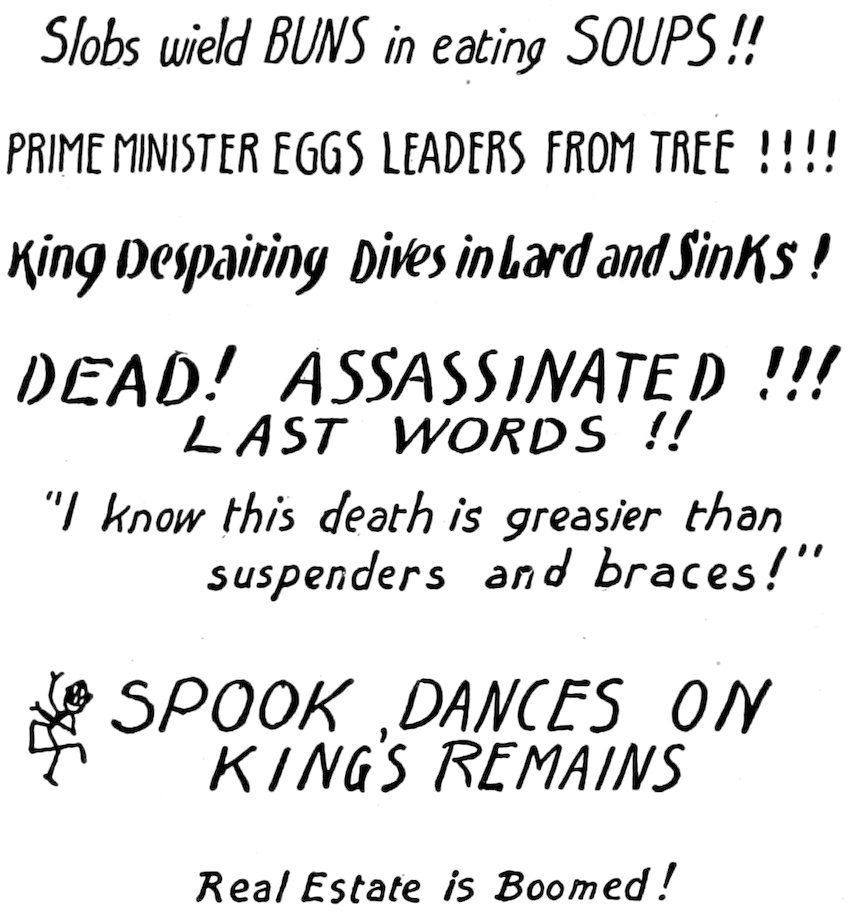
Instantly when the host finished reading the little boy felt in his buttonhole for his wonderful flower, and then gave one despairing cry—for it was gone. He looked all about on the ground, but it was nowhere to be seen. He had evidently dropped it from the boat while leaning over the edge in his fit of sea sickness.
“Will you please read that bulletin again?” he said to the host, and the host read it again, very slowly and carefully. Then the little boy looked again for his treasured flower, but it had disappeared, and he was all bewildered and confused. Meanwhile, his three companions were discussing the news from Tickerleen with great earnestness.
117“Of course,” said the Continental Imp, “if the Queen goes out sleighing, leaving the soups unflavoured, why, many will use buns, that’s obvious. There’s more or less flavouring in a bun, you know.”
“It’s a natural consequence,” said the host. “Take my own soups, for instance—”
“Why, certainly,” said Mr. Three O’clock. “I don’t blame the King at all, but it’s awful to think of his dying that way; he probably was about to get some of the lard for flavouring. I don’t believe he meant to kill himself. You couldn’t make me think so!”
The little boy listened to this conversation with an expression of great wonder, for, to be sure, the news from the capitol was unusual.
“What do you think about it?” asked Mr. Three O’clock.
“Isn’t it unusual?” said the little boy.
“Certainly,” answered his friend, “most extras are unusual in the news they give. You don’t suppose things like this happen every day, do you? This is dreadful—dreadful!”
“Do you think it really happened?” asked the little boy, whereupon a dozen imps turned and stared at him with contempt.
“Happened!” said Mr. Three O’clock. “Why, of course, it happened! Do you think the Mainspring lies?”
“It seems to me,” said the little boy, in the host’s 118ear, “that it is just a little—well, just a little bit crazy, you know; but, of course, I may be mistaken. I wish I had my flower!”
“Crazy?” said the host. “But wait! There goes an imp up the ladder again! See there, he’s crossing out that first line. It was a mistake, after all! Now see what he puts in its place.”
“You see,” said the little boy, as he watched the Imp on the ladder, drawing a line through the first announcement. “I knew it must be wrong. Now he’s going to correct it, and it will be sensible.”
“Wait!” said Mr. Three O’clock.
“Watch!” said several others.
“See there!” said the little boy. “He has put something in place of it. Now it will be all right. Will you read it, Mr. Host, please?”
The dextrous little imp came down the ladder and disappeared into the Errorgraph Office in the station, and the host read aloud:
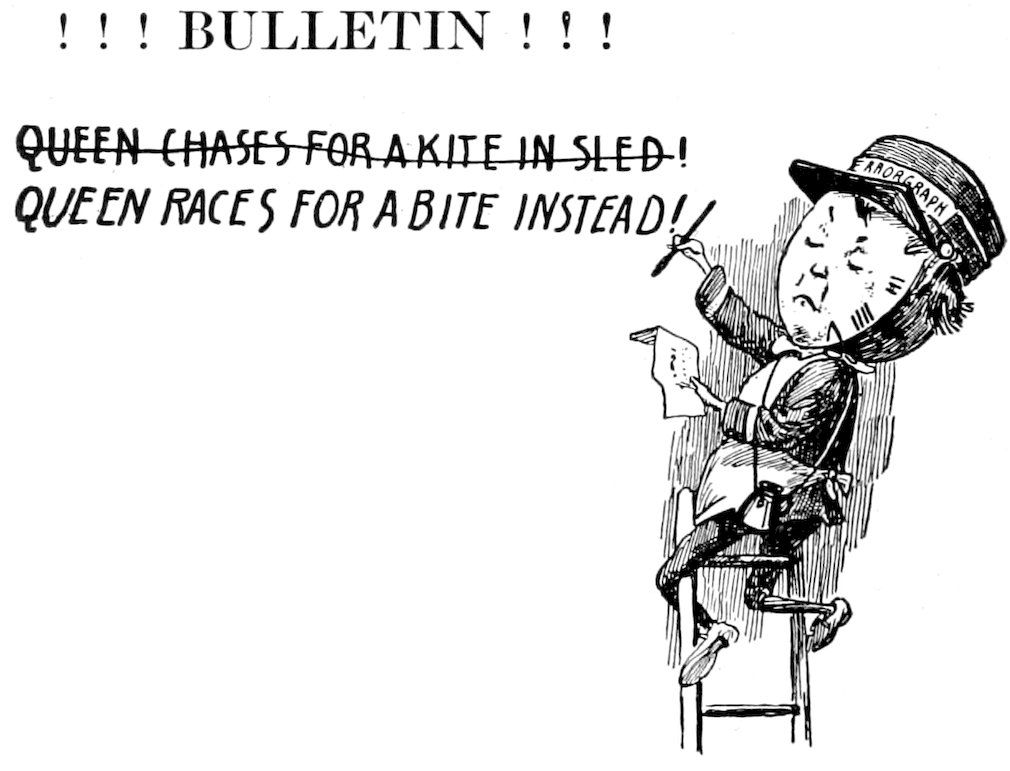
“That is crazy!” said the little boy. “It’s perfectly crazy and I know it is. The Queen wouldn’t—she couldn’t—”
119“She couldn’t and she wouldn’t and she didn’t!” laughed the Continental Imp.
“She buttoned the didn’ts to the—Oh, see there!” called Mr. Three O’clock. “He’s coming out to change it again, maybe. There he goes up the ladder!”
“Good,” said the little boy. “He’ll get it right at last.”
The little bulletin imp came dancing down the ladder and the little boy, with a merry, hopeful face, turned to his good friend, the host, and said:
“Now he’s fixed it so that it’s all right. Would you mind reading it just this once more?”
So the host read, in a loud and very serious voice:
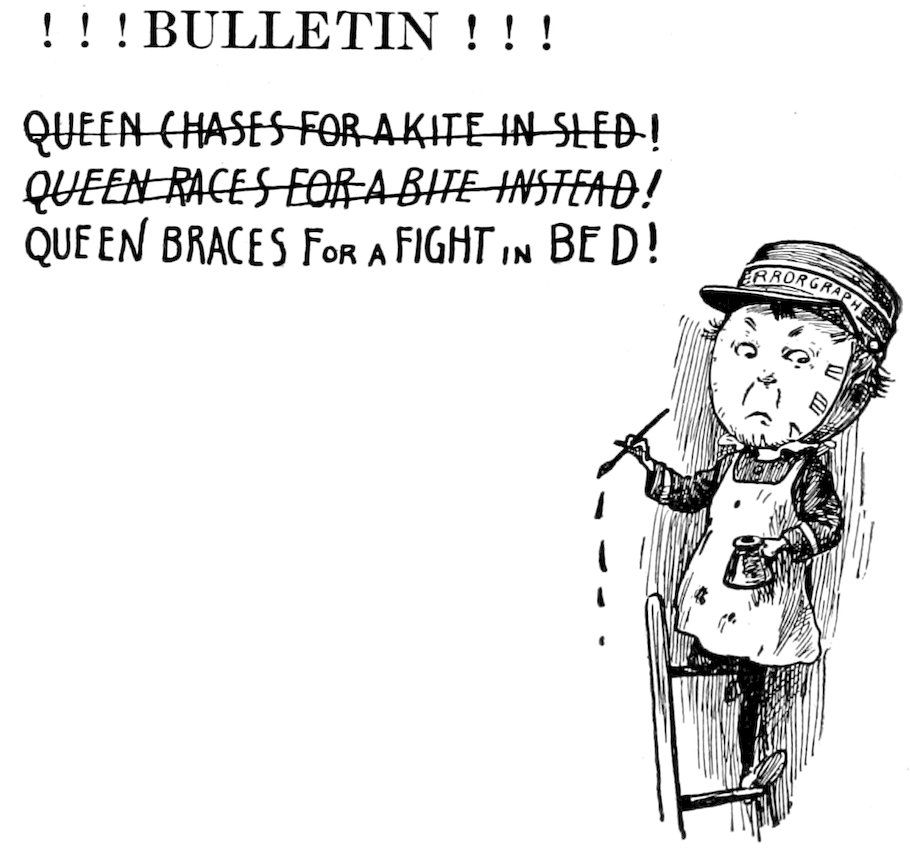
This was too much for the poor little boy. His hand went unconsciously to his buttonhole in one last desperate hope of finding his precious flower, and then, with a piercing shriek and a long gasp, he reeled and fell fainting to the ground, his hat blowing off and landing a foot or so from his outstretched form, so that he presented the appearance of an enormous exclamation mark.
121
123