FATHER TIME GIVES HIS OPINION
Reading edition
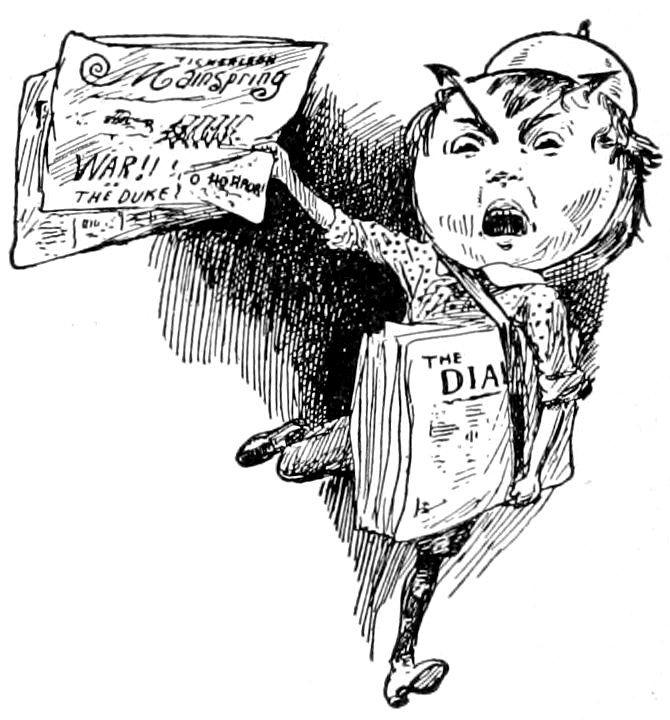
“Tickerleen Mainspring! All the latest news from the Duke’s camp! Get the Alarm! Here’s the Alarm! Ye-e-e-e-extra! Ye-e-e-e-extra! Royal City Dial! Get the Dial! Here’s the Mainspring! Here’s the Dial! Here’s the Alarm, Mister!”
“Goodness gracious!” said the little boy, as he stood in the Tickerleen station with his three friends. “I never saw anything like this! Please give me a chance to stretch myself after that long ride.”
“Tickerleen Dial! Tickerleen Mainspring! Daily Alarm!” shouted a score of grimy-faced little imps, unheedful of his request.
“Tick—”
“Get away!” said Mr. Three O’clock. “He doesn’t want to be bothered with you; get away!”
“Who is he?” asked one of the news imps of Mr. Three O’clock.
“He’s a little boy from the Earth, visiting—” but that was all he had a chance to say. The news that a little boy from the Earth was visiting Tickerleen spread like wildfire, and in less than a minute the little fellow 170was the centre of a wild, scrambling crowd of imps which actually filled the large cuckoo-clock station to its utmost capacity. They crowded and pushed and elbowed as if the poor little boy were the old Duke Procrastinate himself descending upon the royal city, or maybe the Duke of Limabean, or some other famous Tockerlorish celebrity. And how they talked and yelled and contradicted each other in their anxiety to tell the startled little boy all that they knew!
“I’m the hour that saw Julius Cæsar killed!”
“I’m the hour that saw Charles the First beheaded!”
“That’s nothing! I saw the French Revolution!”
“No, you didn’t! You only saw a part of it!”
“Well, I saw the worst part of it!”
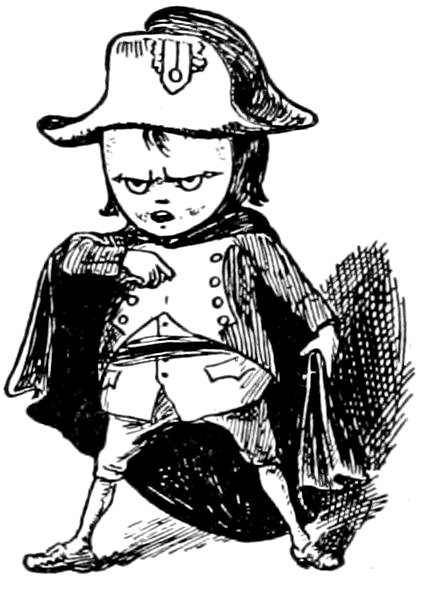
“I saw Shakespeare!”
“I saw William Tell!”
“I saw them building the pyramids!”
“Who? Shakespeare and William Tell?”
“No, the Egyptians!”
“Well, why didn’t you say so?”
“I saw Napoleon drink a cup of tea!”
“Wonderful!”
“I’m the hour just before William the Conqueror landed!”
“I’m the hour just after he landed!”
“I’m the second hour just before he landed!”
“I’m the hour that came before that one!”
“I saw Socrates drink poison!”
171“So did I!”
“That’s not true! One of you is wrong!”
“No, we’re not. He began to drink it at one minute before three and finished one minute after three. I saw it just as I was coming in!”
“And I saw it just before I went out!”
“I’m the hour that saw—”
Suddenly, the Continental Imp, who had been holding himself in with the greatest difficulty, stalked boldly into the crowd, shouting at the top of his voice,
“I’m the hour that heard George Washington tell a Whopper!”
“Please don’t!” said the little boy.
“Let’s get out of here,” suggested the kindly host.
“This reminds me of the day the Declaration of Independence was signed—I never saw such excitement.”
It was with the greatest difficulty that the four visitors made their way out of the beautiful Cuckoo-Clock Station, for a large crowd of hours followed them to the very door shouting about what they had seen in the little boy’s ear until he was nearly deaf with the noise. But the surprise which he had just experienced was nothing to the one which awaited him when they reached the outside of the station, for scarcely had they stepped out into the beautiful, soft gray, perfumed atmosphere when Mr. Three O’clock gave a sudden start, and shrieked,
“The pies!”
172And then holding his little hand before him as children are taught to do when they speak pieces in school, he said,
“The pies! The pies! The custard pies!
About which I have raved!
How sweet the sight unto my eyes,
Those scores on scores of custard pies;
From north to south, from east to west,
They tell a tale of indigest
ion, caused by actions most unwise
In eating of the custard pies
With which the streets are paved.”
As soon as he had finished, the good host, who had been looking admiringly on the vast array of pastry which appeared on every hand, began,
“The pies! The yellow custard pies!
Oh, why were they not saved?
That yellow custard, rich and thick,
It might have made a million sick;
They seem to crowd at every step,
And tell a tale of weird dyspep
sia, causing dreams of grim surprise
Induced by eating custard pies,
With which the streets are paved.”
173Scarcely had he spoken the last word when the Continental Imp, who would not be outdone, stepped forward, and drawing his sword as if he intended to carve the pies for himself and friends, said, in a tremendous voice,
“The pies! The pies! The custard pies!
Which I have always craved!
I see them all about the town,
Those heavy crusts so nice and brown,
They tell of many a little pill
And sleepless nights of awful bil
iousness, with loud, despairing cries,
All caused by eating custard pies!
And as along the street I hop,
So very fast I cannot stop,
I hope that if I go ker-flop,
You’ll bear me to some druggist shop,
And tell them that—”
“Stop!” said the little boy, trembling with excitement.
“What’s the matter?” asked the Continental Imp.
“A great deal is the matter,” said the little boy. “I know what was coming; shop and flop and stop and hop all rhyme with whop! You were going to say something about George Washington’s telling a whop—”
174“I was merely going to ask you,” said the Continental Imp, contemptuously,
“To bear me to some druggist shop,
And tell them that I heard a wh—”
“Stop!” shrieked the little boy, stamping his foot.
“I will not!” said the Imp. “I am a Continental Hour, and I believe in life, liberty, and saying what you please.”
“And tell them that I heard a wh—”
“Stop!” screamed the little boy again.
“And tell them that I heard a wh—”
“Stop!”
“—isk broom was very good to get the custard off after it is dry. There!”
“Now, you see, you were too hasty,” said Mr. Three O’clock to the little boy. “Let’s go away from here; we’ll be surrounded by famous hours again if we don’t look out!”
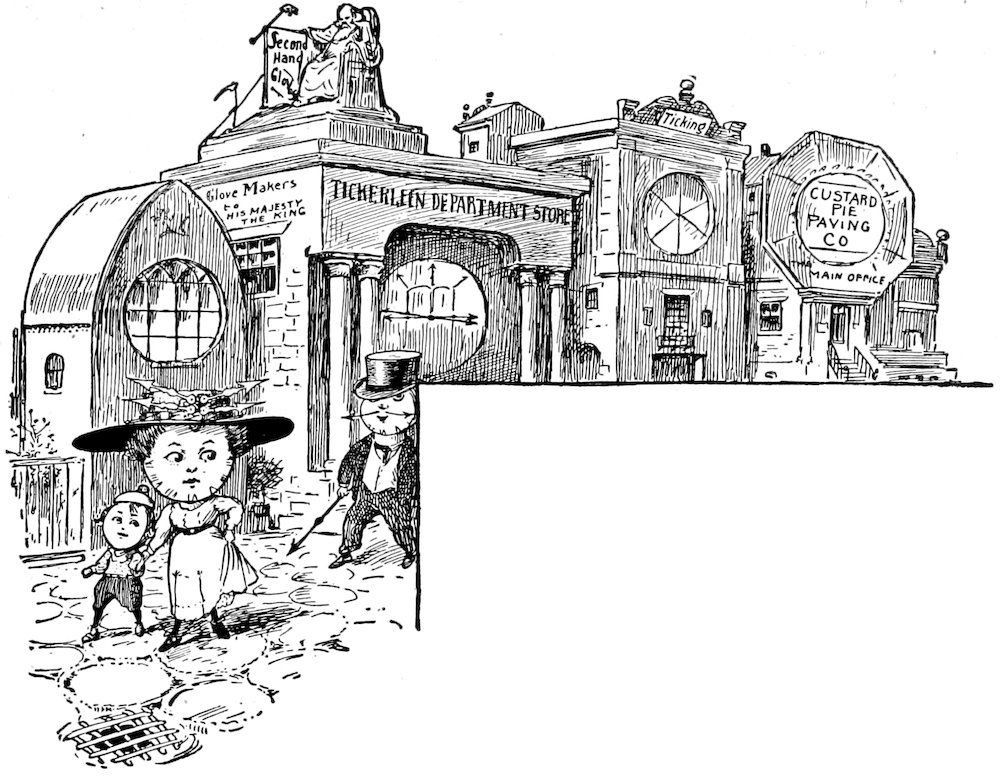
So they made their way up the street, walking very carefully on the edges of the crusts, and keeping clear of the custard. The boy wondered a little why they used custard pies for paving the streets, and ventured to ask Mr. Three O’clock about it.
“Don’t you like custard pies?” asked his friend.
“Certainly,” said the little boy.
175
“Well, then,” answered his friend. “What would you have them use? Mince?”
“No,” said the little boy, “but—”
“There isn’t any ‘but’ about it. You admit yourself that custard pies are very nice.”
The little boy thought it would be of no use to press the argument, nor was it necessary, for soon he began to feel that the beautiful, fragrant air was affecting him strangely. It came up out of little registers here and there in the streets, which looked like the open work crust on cranberry pies, being all crisscrossed with nice, white pie crust. As they picked their way along, the little boy saw many strange things—things which he could not explain nor understand—yet they did not seem queer to him now. He very soon became accustomed to the custard pie streets and thought they were 176splendid. He saw houses in the shapes of all sorts of clocks,—hall clocks, alarm clocks, cuckoo clocks, mantel piece clocks, boudoir clocks,—but even this did not seem strange. “What a fine house a clock makes!” he would say to himself.
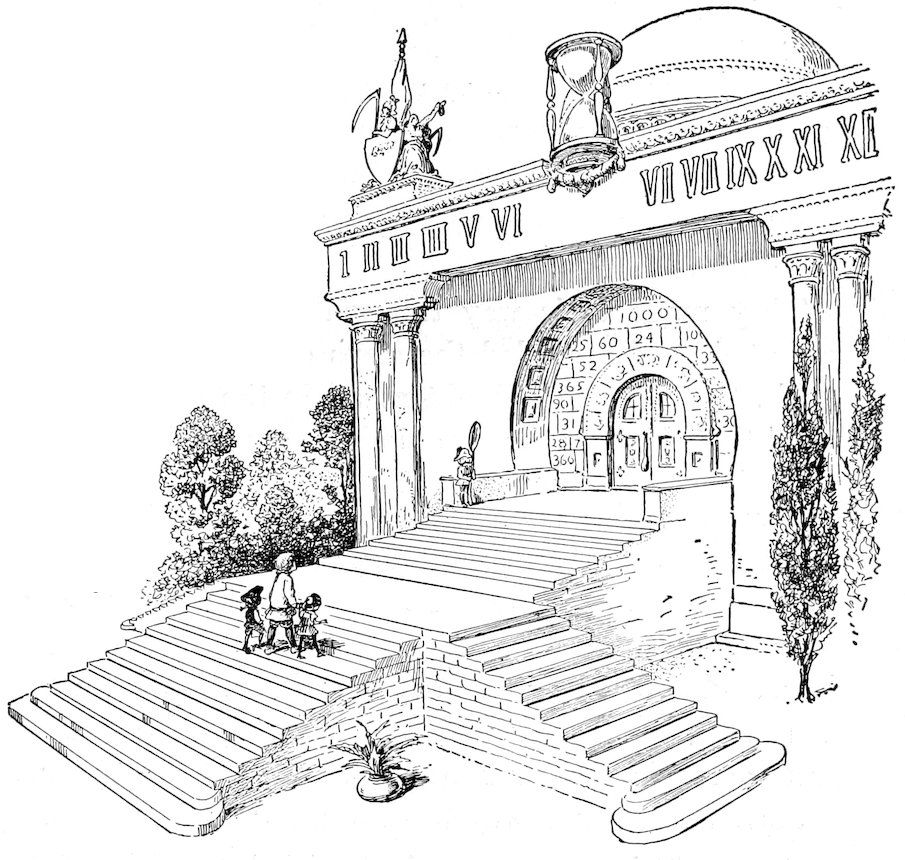
So they picked their way along through the streets of the royal city until they came in sight of a beautiful park surrounded by a picket fence made of pretty hour hands, and in the centre stood a magnificent marble clock, much larger than the little boy’s own home—and as for beauty, there was no comparison!
The gate posts which supported the dazzling gate in this picket fence of hour hands, surrounding the fairy park, were in the form of tremendous clock keys, and the gate, itself, which was of solid gold, was enamelled with thirty-one numbers in little squares, so as to present the appearance of an enormous monthly page from some giant calendar. As they drew nearer to the beautiful park, the little boy could see more distinctly the gorgeous marble clock edifice which stood towering in the centre, and which was approached by a beautiful path of fine, red hour-glass sand, bordered with century plants. All through this fairy park stood bronze statues here and there, similar in design to those ornaments which are often seen on large clocks, and on the enormous marble edifice itself stood a huge hour-glass, of glittering gold. As the party drew still nearer, the little boy could see that there was no face in the clock, 177but that the large opening was used for the main doorway and was approached by a series of wide, marble steps.
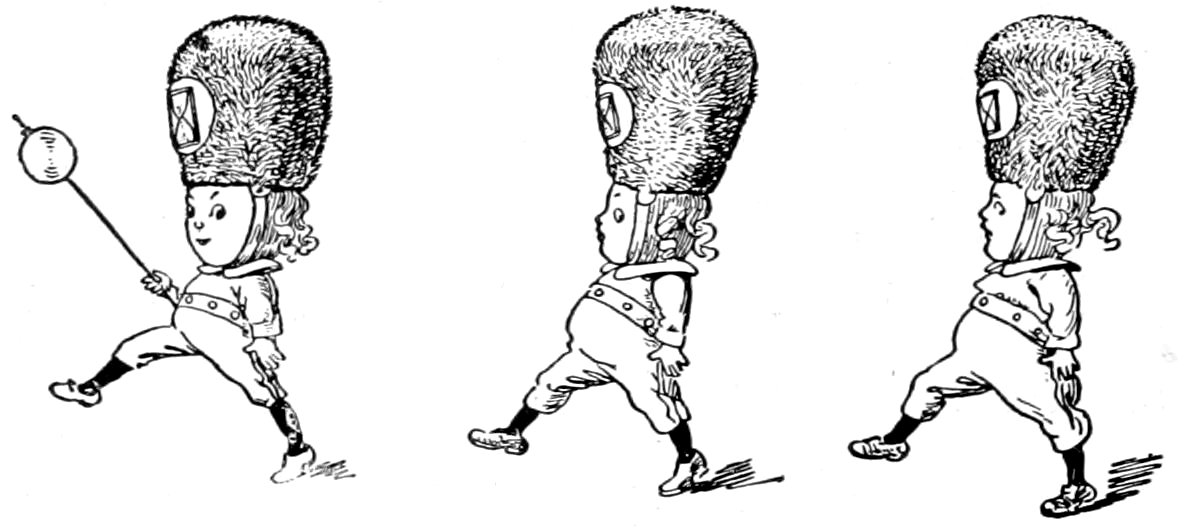
They picked their way along the pie crusts very carefully, and soon passed through the gateway of the park where the little boy noticed several soldier-imps, of the famous National Guard, each one armed with a golden table spoon, just as Mr. Three O’clock had described them in his hilarious song.
“Why do they carry table spoons?” whispered the little boy.
178“Sh! to eat the enemy with,” replied Mr. Three O’clock.
This explanation would have seemed very queer to the little boy a while before, but now it did not appear in the least strange. The more he breathed of the fragrant air, the more perfectly natural did everything about him seem to be.
They made their way through the fairy park unmolested, and ascended the steps of the great marble clock. There was no doubt at all in the little fellow’s mind that this was the royal palace, and such indeed it was. He felt a little nervous at the thought that he was actually going to meet Father Time face to face, and had some misgiving lest the mighty king would be so enraged at his presumption as to cut his head off with the imperial scythe. But it was too late now to turn back; they were right on the steps of the royal palace, and surely that, of all places, was no place to stand and think. But he did linger a moment outside the massive circular doorway to examine the numbers and designs which were carved in the beautiful, white marble.
Some of the marble blocks had the number “60” graven in them, others the number “24,” and still others, the number “365.” But the thing which interested him most was a long, golden rope hanging from the door, which on closer inspection he saw to be wrought into the shape of a lamb’s tail.
179“Just give that three shakes, will you?” said the host, as the little boy was examining it.
The little boy did so, and instantly the large door opened and they entered the palace of the king.
“Step lively, please,” said a guard who stood in the spacious hall.
“Is he an hour that saw a policeman?” whispered the little boy to Mr. Three O’clock.
“I don’t know who he is or what he saw, but he sounds like a car conductor, doesn’t he?” answered his friend.
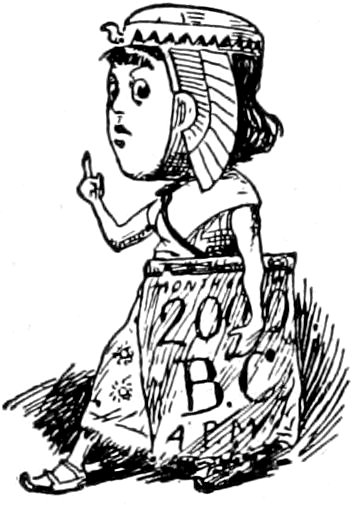
They walked along the hall until they reached an open door leading into a beautifully decorated room with a throne, where a large crowd of hours was standing. They entered and the little boy became interested in reading the badges of the various Hour-Imps. They seemed to bear all the famous dates of history, though he recognized only a very few. Some of them bore the letters “B. C.” and, of course, the little fellow knew that the wearer of these badges had actually seen things which took place before the time when Christ lived. They had scarcely been in the room a minute when the little boy noticed that all eyes were upon him. Then some one asked him who he was.
“I am a little boy from the Earth—” but that is all 180he had a chance to say. Instantly there was a scramble to get near him and scores of voices were raised for his especial benefit. Modern hours, ancient hours, Dark Ages hours, hours that had seen good things, and bad things, and great things, and little things, all clustered about, yelling their life stories into the little boy’s ear, much to the amusement of his three friends. And the hours did not respect each other either; far from it! An hour who had seen King Solomon take a walk was jostled about and finally knocked down by a half dozen of modern and mediæval hours who had no respect for age. It made no difference what famous thing an hour might have seen, they treated each other all alike, for every one seemed the equal of every one else, except those who had nothing to tell, and most of those were with the old Duke Procrastinate, who, the little boy learned, was encamped outside the city, waiting for a good opportunity to descend on the imperial palace.
While they were thus clustering about the little boy and making a dreadful noise with their shouting, a voice called, “Silence!” And in an instant not a sound could be heard. The guard who had spoken waited patiently for a minute, and then walked on tip-toe over toward the wall where a little metal contrivance hung, and, putting his ear to it, listened attentively.
“What is he doing?” asked the little boy.
“He’s trying the stillometer,” said the host.
181“The what?” asked the little fellow.
“Sh! the stillometer.”
“What’s it for?”
“To see how quiet it is.”
“Can’t he tell without that?”
“Oh, he can in a general way, but not exactly, not with accuracy,” answered the host. “You see, there’s a piece of felt on the bottom of the instrument, and when he presses that little button the pin falls, and if he hears the pin fall—”
“The King! The King!” called several voices, and in another instant every hour in the room was on his knees, except one who remained standing to unfurl a large flag. The little boy was very much impressed with this beautiful display of patriotism and homage, though he trembled visibly at the thought of seeing the great ruler. Suddenly the assemblage began to sing.
“Let the flag of the kingdom, so graceful and fair,
Be raised while its citizens sing,
‘Hurrah! Tempus Fugit!’ the national air,
And kneel to our glorious king!
“All hail to the monarch of monarchs, supreme,
As the beautiful flag is unfurled,
Beloved of his subjects—although it would seem,
Detested all over the world!”
182As soon as the singing ceased, a procession of tiny imps marched into the room and took their places about the royal throne.
“Are they hours?” asked the little boy, of the host, who stood nearest him.
“Sh!” said the host. “No, they are not hours; they are jiffies. The King will enter presently.”
Scarcely had he said the words when the principal jiffy shouted in a shrill voice,
“His Imperial Highness, the Monarch of Monarchs!”
“All hail!” cried the hours, and there was another little pause, after which the head jiffy pulled aside a curtain and said, in an impressive voice,
“His August Majesty, Father Time!”
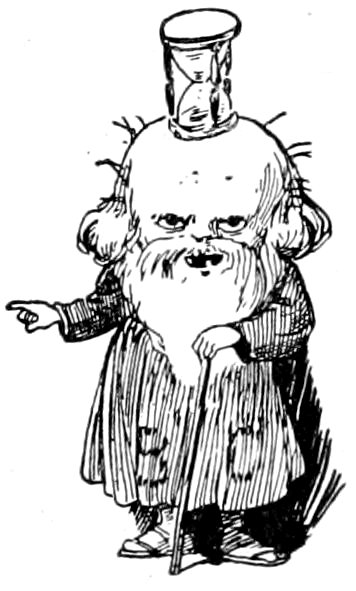
and scarcely had he uttered the last word when a little, wizened, old gentleman, wearing a long, white beard and a white robe, and carrying a magnificent golden scythe, toddled into the room with a quick, short step, 183smiling pleasantly through his deep wrinkles to right and left, and ascended the throne with the agility of a boy. He had a funny twinkle in his eye, had old Father Time, as if he enjoyed playing jokes on people, and seeing them confused and perturbed. He had a firm mouth, also, had old Father Time, as if he were not in the habit of changing his mind, and were accustomed to demanding his rights and having his own way. The little boy did not dare to open his lips nor to move an inch to ask any questions, but he thought to himself that the mighty King, considering his age and fame, was very kindly looking, and he wondered if he was any relation to Santa Claus.
“Well, well, well, to be sure, to be sure; this is very gratifying,” said the King, as he seated himself, arranging his robes, and handing his golden scythe to the nearest jiffy in attendance. “And I wish I had a few moments to listen to your applause, but tide and myself, as you all know, cannot wait, and the clock goes right on while you are applauding. Now, who is this, pray?”
The little boy trembled very much as he realized that the great King was speaking of him, but there was nothing to do but step right up to the throne, for that seemed to be what His Majesty expected. So he walked right up and said, bravely,
“I am a little boy from the World.”
“Ah yes, to be sure,” said His Majesty. “They don’t like me very well there.”
184“I like you, Your Majesty,” said the little boy.
“Well, that’s very nice, isn’t it,” said the King, “and I like little boys, too.” He was about to say more when suddenly the door opened, and an attendant rushed in and kneeling before the throne, said,
“Your Majesty, the Duke approaches the city!”
“At last!” said the King, with a smile. “Let every hour take his post then, and be ready.”
It was perfectly evident that precious moments were never allowed to be wasted at the royal court. There was no discussing the startling news, no waiting, and planning, and suggesting, and giving and taking of orders; nothing but an immediate obedience to the King’s wish. No one asked any questions, no one hesitated, but every hour-imp in the room filed through the doorway, and even the little jiffy pages marched out, leaving the mighty King all alone, save for the presence of the little boy. As the little fellow watched the crowd of subjects surging through the door to take their allotted places in defence of the Royal Palace, he noticed his three friends among them. His first thought was to run after them, but something made him feel as if he must wait in the throne room. He saw the genial host, of whom he had grown so fond, passing out, followed by little Mr. Three O’clock, who in turn, was followed by the Continental Imp, who had drawn his Continental sword, and was talking in a very animated way to several hours who were clustering about him as 185he stalked through the door. They seemed to be all listening to the Continental Imp with the greatest attention, and the last word the little boy heard as the door closed was the full word “Whopper,” and he knew that his little friend was telling his new acquaintances the dreadful story about George Washington.
When they were all gone, the little boy glanced in the direction of the throne, and saw that His Majesty was getting ready to leave the room himself. The little fellow did not know what he had better do. He had remained, hoping to speak privately with the mighty King of kings, but now that the opportunity was at hand, he was afraid. He looked toward the door, then toward the throne, and then toward the door again, and then toward the imperial scythe, which was now hanging on the wall, as if he feared that the King might chop his head off with it if he dared to speak uninvited in the royal presence. Then he remembered how the King had said that he was not accustomed to waiting for anything, and he decided that if he were going to speak at all he had better do it at once. So he approached very quietly, and as he did so, he noticed that His Majesty was smiling and settling down in his great chair as though willing to listen. There was a long lock of white hair hanging down over the King’s forehead which interested the little boy a great deal.
“I wonder if that can be his forelock which people are always taking him by—if I thought it would be all 186right I would pull it, for there is no use of standing here like this and doing nothing.” So after hesitating a little he approached very respectfully and gave old Father Time’s forelock a good pull. The mighty monarch started and the little boy was very much frightened at what he had done, until Father Time said good naturedly, “Don’t be afraid, little man, that is what it is for, to be sure—I keep it there to encourage promptness, you know. Now what can I do for you, little man? Take a seat down there on that step and let me hear what you have to say, for soon I shall be passing—in fact I’m passing now, so be quick.”
The little boy lost no time, but began in a very low and respectful tone:
“May I say a word to you,
Father Time?
Just a little word or two,
Father Time?
While you’re sitting all alone,
May I climb up on your throne,
Just as if I were your own,
Father Time?
“I have often heard it told,
Father Time,
That you’re very, very old,
Father Time;
187Is it true, what people say,
That the world might pass away,
But that you would always stay,
Father Time?
“That you always travel fast,
Father Time,
That you’re sure to win at last,
Father Time,
That you sometimes will retreat,
When a sturdy foe you meet,
But have never known defeat,
Father Time?
“All about throughout your land,
Father Time,
There are foes on every hand,
Father Time,
And the Duke, with rank and file,
Is, perhaps, within a mile,
Yet you only sit and smile,
Father Time.
“Oh, my mother knows you well,
Father Time,
For I heard my father tell,
Father Time,
188When her birthday did occur,
How polite and good you were,
In the way you treated her,
Father Time.
“And he says that people do,
Father Time,
Tell some whoppers about you,
Father Time,
And he says that you’re a foe
To some people that you know—
Do you treat all ladies so,
Father Time?
“Do you hear that dreadful roar,
Father Time?
It is almost at the door,
Father Time!
Can you turn the foe away?
You are laughing—won’t you say,
Do you think we’ll win the day,
Father Time?
“And if I help you win,
Father Time,
Keep the Duke from getting in,
Father Time,
189If I help to keep you free,
Will Your Majesty agree
To be always good to me,
Father Time?”
The King, who had listened with great good humour as the little fellow sat on the top step of the royal throne, bent down until his aged face was very near to that of the little boy, and said, slowly,
“I am not troubled in the least
About what I have learned;
In fact, I’m rather glad of it,
As far as that’s concerned.
“I’ve seen this Duke prepare for war,
Then talk, and wait, and linger,
So when he says he’ll vanquish me,
I simply snap my finger!
“I know the threats against my life
This foolish Duke has made,
And all I have to say is this,—
I’m not a bit afraid.
“I am not much at making boasts,
But I should like to state
Among my victims I include
The greatest of the great.
190
“Napoleon fought in many wars,
And seldom failed to win;
He conquered everything, and then,
I calmly conquered him.
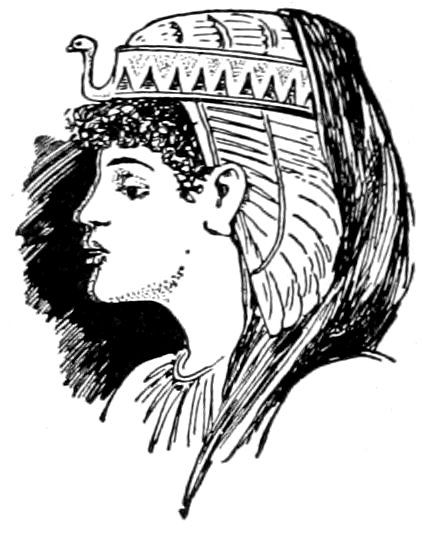
“And Cleopatra, tall and fair,
And beautiful to see;
She captured every one she saw—
That is, excepting me.
“‘You think,’ said I, ‘to capture me,
But that you’ll never do;
Instead, oh Cleopat,’ said I,
‘I think I’ll capture you.’
“She smiled, and said, ‘Good Father Time,
Just kindly show me how.’
I smiled, and stepping up, I placed
A wrinkle on her brow.
“I am not much at making boasts,
But I should like to state
Among my conquests I can name
The greatest of the great.
“I am not full of pompous claims,
But modest, calm and quiet;
And that’s the reason when I win,
They usually deny it.
191“So let the old Duke make his threats;
His chance is very slim,
For I, who conquered Greece and Rome,
Am not afraid of him.
“I am not much at making boasts,
As I’ve already said,
And yet throughout your world, I’m held
In universal dread.”
“I guess that is because you conquer so many people in my world, isn’t it?” asked the little boy, timidly.
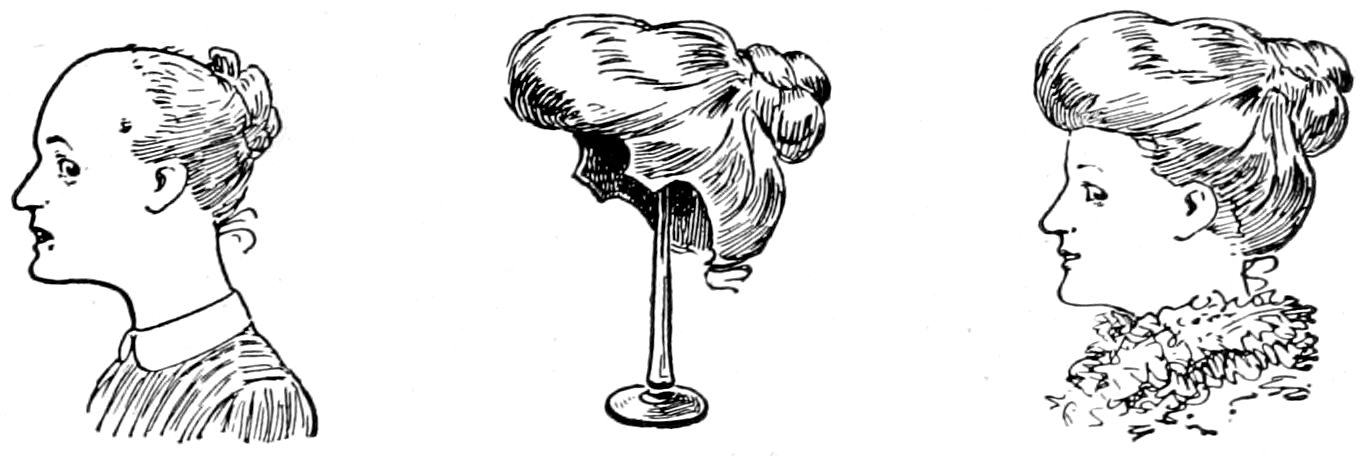
“I am always very good to little boys,” said the great monarch, “and to many grown people too, but it always makes me angry to be snubbed, as I am in your world, no matter where I go. People deny my presence right to my face; they tell their friends they have never seen me when they’ve known me well for years. They even get wigs and things to try to disguise themselves so that I will not know them, and I a king!”
“I am very sorry,” said the little boy, “that people in 192my world are so impolite. I should think they would like you.”
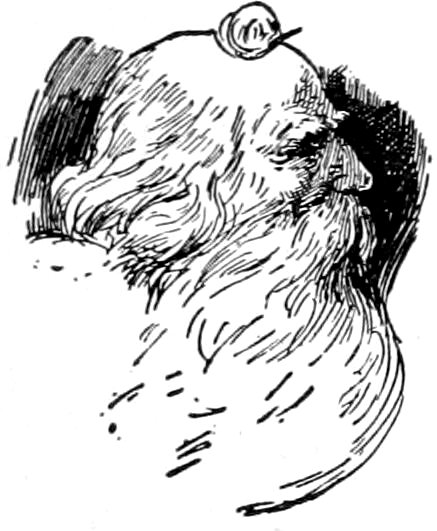
“Well, they generally do for a while when they’re young, but it doesn’t last long; they just make a convenience of me, you know,—or try to. I once knew a young man who wanted me to help him on to twenty-one years so that he could have a fortune, and my, wasn’t he pleasant! Invited me right in and got suggestions from me, urged me on, told me I wasn’t fast enough for him, grew whiskers,—bah! Then, when he got to be a fine, elderly gentleman, I called on him one day to talk about old times, and what did he do?”
“I don’t know—I really don’t.”
“Why, he didn’t even recognize me—or said he didn’t! Wouldn’t have anything to do with me!”
“What did you do with him?” asked the little boy.
“Do with him? I just gave him the gout to remember me by, ha, ha, ha, ha, ha! Look out, don’t get too near that scythe!”
“And girls?” said the little boy.
“Yes, it’s the same with girls, only worse; all like me and want me to help them get to be young ladies; then begin to snub me!”
“I am really very sorry,” said the little boy, “that you are not popular.”
“Popular! Well, I should think I’m not! But I don’t care!”
193“You don’t think that I am so unkind, do you?” said the little boy, anxiously.
“No, indeed I don’t,” answered the King, in a kindly manner. “And I suppose you’re going to stay a while with us, eh?”
“I must go home sometime,” said the little boy.
“That’s too bad, for I should like to have you stay right here, but you’ll stay a while at least, and give me an opportunity to show you that in Tockerlore we know how to be polite and hospitable. Now, I’ll tell you what I’m going to do; I’m going to give you a position—just a temporary position, you know—of high honour. How would you like that?”
“I would like it,” said the little boy.
“Very well, then, I want you to go out and visit the old Duke Procrastinate’s camp as a spy, and find out just what he really means to do, and come back and tell me. These newspapers—well, you can’t believe a word they say. The Mainspring says one thing, and the Alarm rings with another, and so on. Now, I want to know whether the old Duke really intends to do anything or not, and I want you to go and find out, and come back here and let me know; do you understand?”
The little boy knew perfectly well that there was no time to stand and talk about it, that the King was in a hurry, and that he would have to make up his mind at once. Then, besides, he remembered how kind the great King had been to his mother, and how badly 194treated the kindly monarch was whenever he came to the world. He felt very much ashamed of the people who had treated old Father Time with such neglect and disdain, and he felt that now was his chance to help repay the good King for all his kindness, especially to his own dear mother. So he answered that he would go to the Duke’s camp, and the King told him to be off. He meant to ask for a few directions, but seeing that His Majesty was in a great hurry, he decided to find his way to the old Duke’s camp as best he could.
As he passed out through the big circular doorway, he paused a moment, wondering where his three friends were, when suddenly an imp came running up to him, and said, all out of breath,
“Are you the little boy from the World?”
“Yes,” said the little fellow. “What is it?”
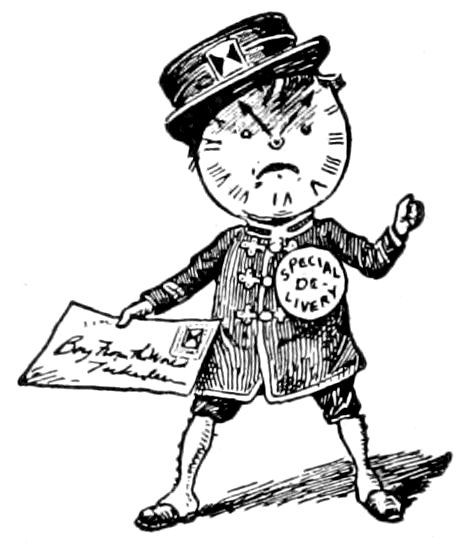
“Here is a letter for you,” said the imp, “which came in care of the Royal Palace: it comes from Minutel.”
The little boy thanked him, and taking the letter, opened it, and read,
“Dear little boy from the World:
“We hope you will excuse us for the delay, but in picking up the words to the verse, some were lost and very hard to find, as they had been kicked all about. This is the way they are supposed to go.
195“We hope you are enjoying yourself at Tickerleen. If your friend, Mr. Three O’clock, is with you, please tell him that there is a Mr. Nine O’clock here who says that school is a very fine place, particularly for little boys, and he wants to fight a duel with your friend. Here are the words properly arranged,
“Every second week,
In the days antique,
They would hold a public flogging on the chance,
chance,
chance,
“Of preventing crime,
By a stroke in time,
And a timely little spanking in advance,
vance,
vance.”
“Well,” said the little boy, as he put the letter from Minutel into his pocket, and hurried out of the palace, “I am glad they got the verse picked up and put together at last, though I don’t just like what it says. I shouldn’t like to have lived in those days; it’s bad enough to spank at all without doing it beforehand! But it was very kind of the old-fashioned hours to pick up the verse and send it to me.”
He was pausing on the palace steps trying to locate the gate through which he and his friends had entered, 196intending to go out the same way and hasten to the old Duke’s camp.
But suddenly he noticed that the road did not lie as it had lain when he entered. It was now all wound up tight like a mainspring, with a little minute hand fence separating the coils from each other.
“I suppose I will have to begin right here at the palace,” said he, “and go round and round and round and round until I come to the gate, and there may be miles and miles before I get to it! It’s too bad, but there’s no help for it. I suppose they’ve been winding up the city on account of the war.”
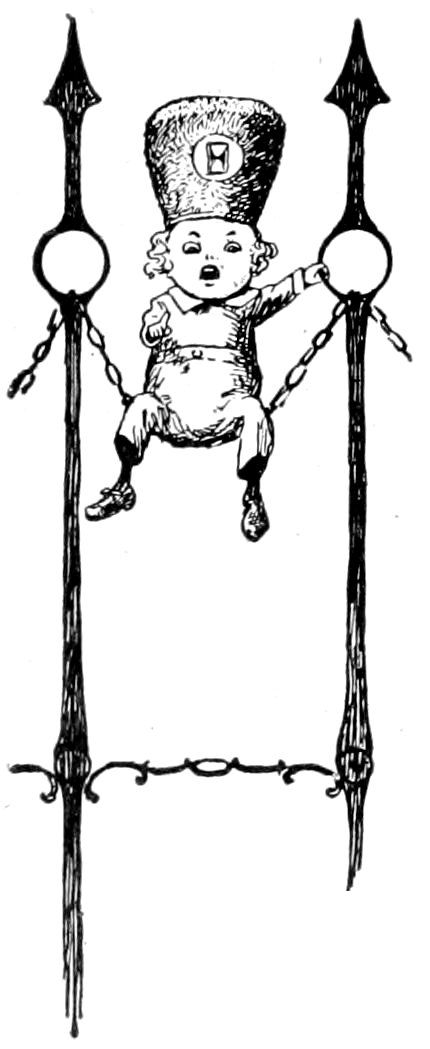
This, indeed, seemed the only way to get out except to take a short cut by climbing over no end of fences and running the risk of being stopped by the jiffies who were sitting here and there on the minute hand posts or swinging on the chain. So he stepped into the road and began to run as fast as he could, inscribing a wider circle each time he went around, and getting farther and farther away from the palace in the centre all the time.
“Oh, dear, how dizzy I am getting!” said he, after he had run around several times. “I can hardly see where I am going. I feel like a top!”
“How do you know how a top feels?” called one of the jiffies, as he passed. “Step lively, please, and don’t talk so much!”
197After a time, the little fellow, quite giddy, began to slacken his speed a little, for he felt that he could not go on at that rate.
“Step lively, please!” said a jiffy, as the little boy went past, and the poor little fellow started in again with all his might and main.
“If they wind this road up any tighter,” said he, breathing heavily, “I’ll be squeezed to death, and—”
“Step lively, please!” called a jiffy, and the poor little fellow, panting for breath, started around again at full speed.
“I simply can’t keep this up,” he said to himself, finally. “I shall have to go slower; I don’t believe I’m half way to the gate, and I think there must be enough of this road—”
“Step lively, please!” called another jiffy, and the poor little fellow started and hastened on. He was now so dizzy that he could hardly stand up, but he ran along and round and round and round as fast as his little legs would carry him. As he looked across the road, he could see the large gate not far away, but this made no difference, for there were, it seemed to him, miles and miles of road wound up ahead of him. On, on, on he ran until finally, quite exhausted, he went reeling headlong into one of the minute hand posts.
“Step lively, please,” said a jiffy who was sitting on the adjoining post. “Father Time permits no delays, you know; come, step lively!”
198The little boy dared not disobey, so he let go of the post, and went staggering round again, though he scarcely knew what he was doing.
“Step lively, please,” he heard every now and then, though each time he heard it, it was less distinct. First it sounded like, “Ste—li—e-ease;” then it sounded like, “Ste—li-e-e-e-e-e—” until finally he ceased to hear it altogether. And still he went spinning round and round and round. He was going so fast now and knew so little about what he was doing that he could not have stopped even if he had dared. On, on, on, and round, round, round, he went until at length he came reeling and staggering through the great gateway.
“Here’s your chance!” called a quick, high-pitched voice, as he reached wildly for one of the gate posts, caught it and went wheeling about. The poor little fellow could only stare for a moment, and then say, “Wha-a-a-a-t?”
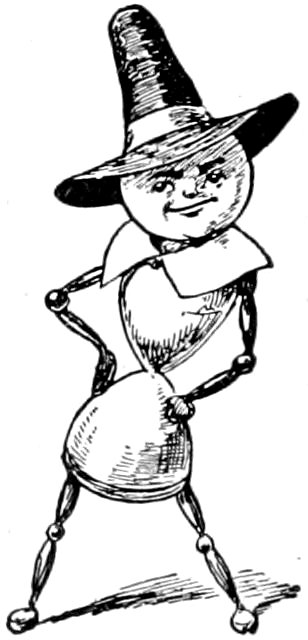
“I say, here’s your chance,” said a little, wiry man about a foot high who had evidently been standing in the road at the entrance to the royal park.
“Chance to what?” inquired the little boy, when he was able to speak.
“What’s the matter with you?” piped the small man, indignantly. “Here’s your chance, I say.”
199“My chance?” said the little boy.
“Well, it isn’t mine,” said the little man, with rather a sarcastic air. “If it isn’t yours I don’t know how you came by it; you certainly dropped it.”
“I dropped it?” said the little boy.
“Yes, you dropped it; what’s the matter with you?”
“Nothing, only how could I drop a chance?”
“Did you never drop a hint?”
“Yes,” said the little boy, “but—”
“No ‘but’ about it; it’s a question of telling the truth, that’s all,” said the little man, in a rage. “I don’t care what you drop!”
“Suppose we drop the subject,” said the little boy, “but wait, I beg your pardon!” The little fellow, suddenly recollecting, began to fumble in his pocket, and pulling out the paper from Minutel, began to study it carefully.
“Yes,” said he, finally, “you are right; I have lost my last ‘chance’; I had three, and I have lost my ‘antique’ and I have lost a ‘week.’”
“You had better not let that get to the king! Weeks are precious things here.”
“And I’ve lost a ‘second’; I’ve lost the ‘second week,’” said the little boy. “There’s not much left; I’ve lost ‘time,’ and let me see—yes, I ought to have a ‘flogging.’”
“Perhaps you will be able to find your treasures,” said the little man, “if you will go back over the road 200again; your antique and your week and your second; as for the flogging, I suppose I could accommodate you with that if you really feel so—”
“You needn’t trouble,” said the little boy. “What is your name?”
“Say it.”
“I don’t know it,” said the little boy.
“Every one knows it,” roared the little man.
“I am not every one,” shouted the little boy.
“I will tell you before you can say it,” yelled the little man.
“I suppose you will,” said the little boy, “for I don’t know it.”
“You must learn to say it quick,” said the little man. “It’s Jack Robinson; you’ve heard of me, I guess. People do things faster than they can say my name, you know.”
The little boy studied him very carefully, and then said,
“Are you any relation to Boo?”
“He’s my brother. Listen.
“No matter what the thing may be
That you have planned to do,
You’ll do it quicker if you say,
‘Jack Robinson’—or ‘Boo’!”
“I’ve often heard of doing things quicker than one 201can say Boo,” said the little boy, “and I think I’ve heard of you too,—but more especially of your brother.”
“He’s home—sick,” said the little man, who talked very rapidly.
“Oh, that is too bad! What is the matter with him?”
“He was struck—struck with a thought. He was coming through Calendar Row and it struck him in the brain. He fainted before he could say his own name.”
“He is not in any danger, is he?” asked the little boy, seriously.
“Well, that’s hard to say,” answered Jack Robinson. “They can’t seem to get the thought out of his brain; it stayed there, you know. And then he’s so impatient—expects to get well quicker than he can say his name.”
The little boy took several stimulating whiffs of the magical air, for he was becoming a little puzzled.
“Do either you or your brother know the famous Duke Procrastinate?”
“No, he has no use for us—says our names are too short, especially my brother’s; he never used our names. I’m on my way to the palace now to see if the King wants me. He might want to go after the Duke quicker than he could say ‘Jack Robinson,’ you know, and he’d like to have me on the spot. I always encourage haste, you know. Ha, ha, ha!”
“I guess your brother is better for making people act 202quickly than you are; he has such a very short name,” said the little boy.
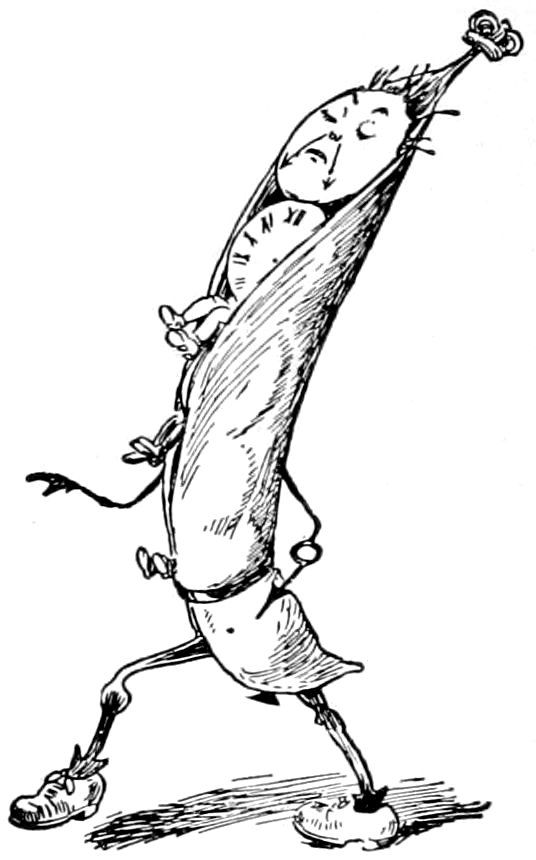
“Yes, he had it made to order—it just suits the purpose. He wanted one that could be said quickly, and that had a nice, soft sound. So he offered a prize for the best suggestion and the Duke of Limabean sent in ‘Boo,’ and my brother accepted it before he could say it; he didn’t know what it was until afterwards.”
“Is the Duke of Limabean an hour?”
“Well, not exactly, he’s an association of hours, you know; he’s a day. All the hours from one day got together and said, ‘Let’s organize and be somebody.’ So they did, and he’s the result.”
“Why do they call him the Duke of Limabean?”
“Because he stalks about so. Did you see the Queen?”
“No,” said the little boy.
“She’s ill, you know,” ran on the little man.
“Seriously ill?”
“Well, rather—yes. She was standing on ceremonies, fell off, and broke her word and one of her resolutions.”
“Her word?” said the little boy. “Could one do that by falling?”
“Well, that would depend on how one fell and what one fell into.”
203“Yes, I suppose so,” said the little boy, thoughtfully. “What did the queen fall into?”
“She fell into a deep sleep; a hundred yards deep, I think it was, and when they fished her out, her word was broken. They said she would have fallen right to the bottom, but she reached a conclusion about half way down and clung to it. When they got her out, she let the resolution go, but kept her broken word.”
“Kept her word after she broke it? Wasn’t it droll about her breaking her word that way—just a little odd?”
“No,” said the little man, rapidly. “Didn’t you drop some words? Of course, you did, and some of them may be broken. I must be off now. Good-bye.” And he was gone before the little boy could say Jack Robinson.
“Do you know who he reminds me of?” said the little boy to himself. He asked the question several times without receiving an answer (he was still a little dizzy from his run), and then realizing how impolite it was not to reply to a perfectly civil question, he said,
“No, who does he remind you of?”
“Why, he reminds me just a little of Mr. Three O’clock,” he answered. And then recollecting his errand he walked quickly out of the great gateway of the Palace Park, saying Jack Robinson and Boo as he ran along in order to encourage himself to speed as rapidly as possible.
205
207