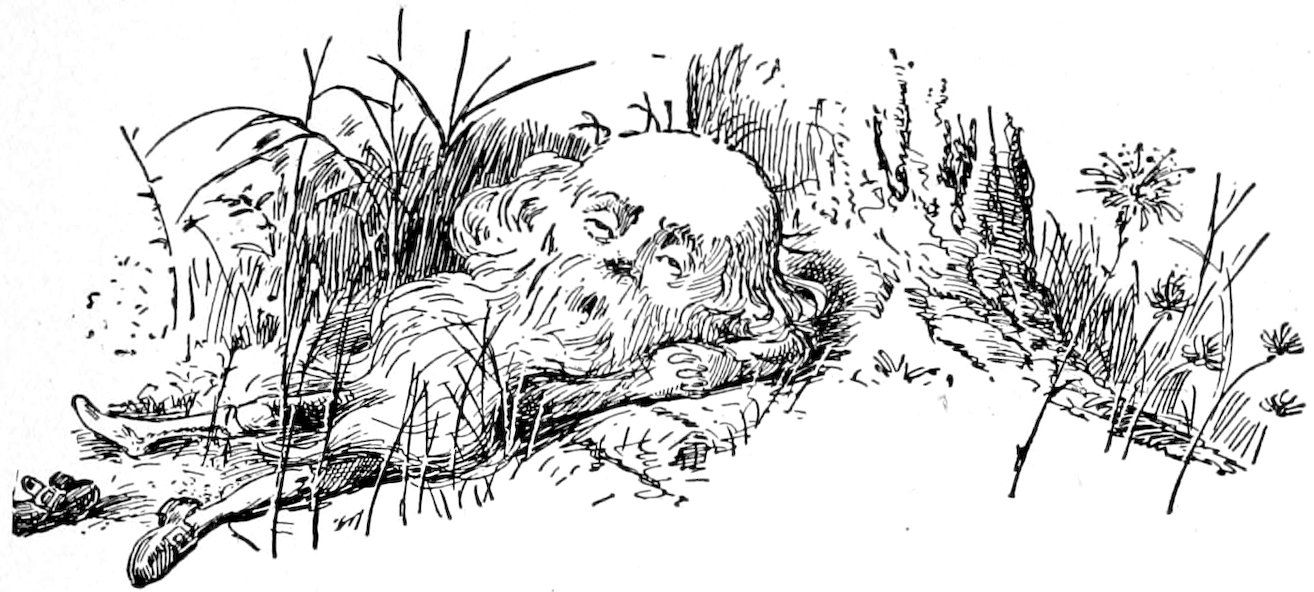
THE MIGHTY DUKE PROCRASTINATE
Reading edition
Through the beautiful, yellow, custard streets,
On the edge of the pie-crusts, brown,
The little boy made his lonely way
From the palace of the Crown,
Till he came to a tower, tall and grim
On the outskirts of the town.
And he sat on a rock to rest a while,
And he noted the tower’s height,
When, near its summit, he plainly saw
A spot that was large and bright,
Like a target fixed to the shiny wall,
Or a window, round and white.
“Now I wonder what,” said the little boy,
“This curious tower is for;
It must be used to protect the town
In case of a sudden war,
And perhaps it is filled with soldier hours
Of the Land of Tockerlore.
208“Yes, I know it is, for I hear a sound
From that towering wall so thick,
As if they were drilling in it now,
And all of them marching quick;
Yes, I’m sure that it’s full of soldier hours,
For now I can hear them tick!”
And his eyes turned back to the threatened town,
Which he’d promised to help defend,
And he said, “I really, truly wish
That this war was at an end,
For I’m very lonely in Tockerlore
And I haven’t got a friend.
“I was fond of that Continental Imp,
Except for his terrible boast,
And I liked that little Three O’clock,
But the one I liked the most—
And I only wish I could see him now—
Was my special friend, the host.”
But he bent his steps o’er the winding road
And farther and farther away
Along the path of the Wollerp’s neck,
Till he saw with great dismay
The actual camp of the dawdling Duke
And his indolent array.
209It was pitched in a most delightful nook,
As the little boy might have guessed,
With modern improvements all about,
And you simply can’t suggest
A convenience the Duke had not secured,
Conducive to perfect rest!
For beneath the spreading and graceful trees
He could see, through the soft, gray air,
A number of rockers strewn about
With a hammock here and there,
And the indolent Duke, himself, reposed
In a gorgeous Morris chair.
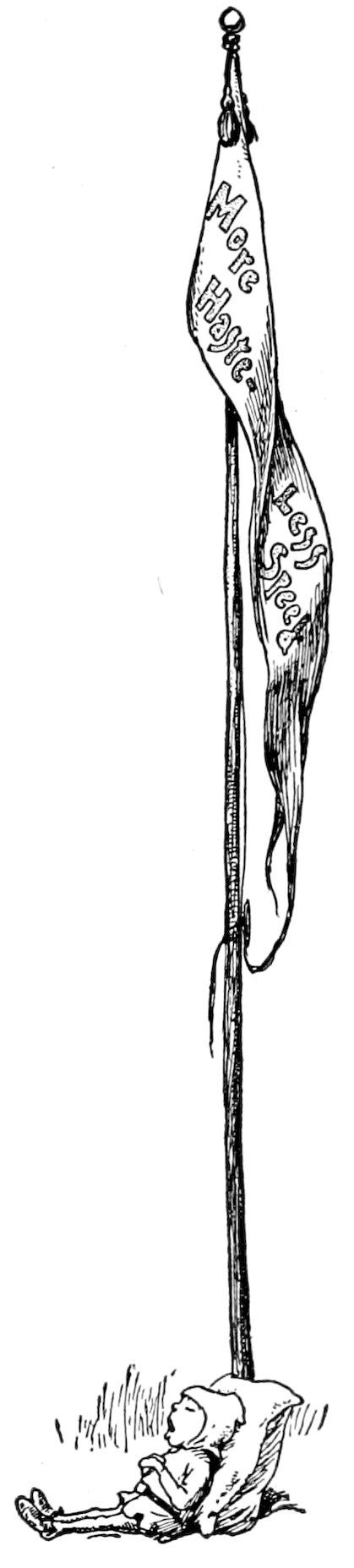
And up from the midst of this pleasing camp
Rose a pole with a hanging rag
On which were the words, “More haste—less speed;”
’Twas Procrastination’s flag;
And it gave no heed to the cheering breeze,
But could only droop and sag.
And the leaves, they rustled; the boughs, they bent,
And the breezes, they blew away,
But the drooping rag upon its pole
Hung lifeless, as if to say,
“Oh, breezes, don’t bother me, please, just now,
I’ll see you some other day.”
210And the miserable hours from sleepy Snooze,—
All fallen from grace, you know,—
Who had played their parts within the world
(In clocks that were always slow),
Who had lost their sense of self-respect
A number of years ago,
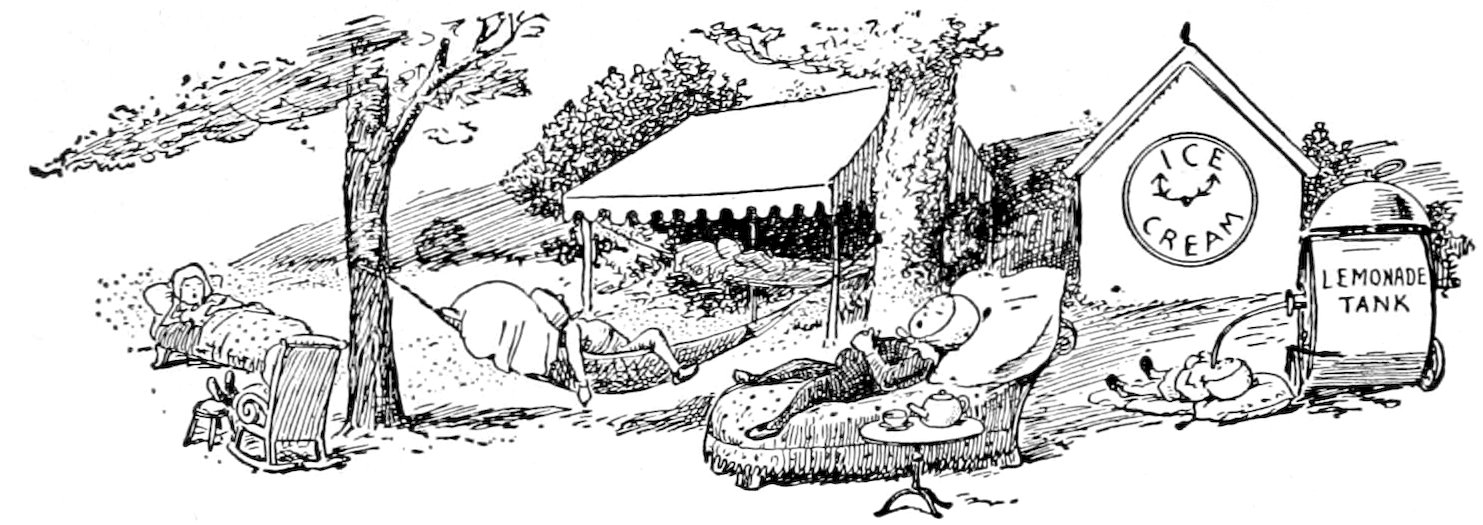
Were lying about in the old Duke’s camp
Quite as pleasantly as you please,
And some of them lolled in steamer chairs,
And all of them took their ease
(It was probably all they meant to take,
Excepting the cooling breeze).
And the mighty Duke in his Morris chair,
Was delivering quite a speech
To the faithful hours that moped about
(He was quite a hand to preach),
And the little boy heard these precepts, wise,
And he made a note of each:
211“Do not march without a reason,
Decked in martial style,
Fight no battles out of season;
Wait a while!
“When they say the future’s coming
(Claimed, I think, by some),
Simply answer, gayly humming,
‘Let it come!’
“When you’re told the days are fleeting,
Don’t be indiscreet,
Simply say to such a greeting,
‘Let them fleet!’
“Let them call us idle traitors
From the town of Snooze,
Let them call us dawdlers, waiters,
If they choose.
“Do not heed their loud reviling,
Made in flippant style,
When they say we’re time-beguiling,
Simply smile.
“When they say we are not steady,
Ask us when we go,
Tell them, ‘When we’re good and ready,’
Then they’ll know.
212“When they claim the King is waiting,
Tell us we are late,
Say that while we are debating,
He must wait.
“Let them say we are not zealous,
That delays are bad,
And no matter what they tell us,
Don’t be mad!”
The little boy had been standing behind a tree not far away from the camp listening to these bits of advice. But suddenly realizing that, as a representative of old Father Time, he should allow not a single precious moment to escape, he advanced from his place of concealment and walked toward the spot where the Duke and his army were resting.
“It is rather funny,” said he, as he walked along. “I don’t know just what to do when I get there. They will see at once that I’m not an Imp-hour and, of course, they’ll wonder who I am. I don’t just like to tell them I’m a spy; it might annoy them. Perhaps they’ll hang me like Nathan Hale; I wish I could meet the hour that saw them hang Nathan Hale!”
By this time he had almost reached the camp. There was no fragrance in the breeze now, for he was quite a distance from the city, and he began to wonder a little whether the old Duke, himself, were some disreputable hour with a questionable record. Things began to seem a little odd again. “But I am glad,” thought he, “that Mr. Three O’clock is not here to explain things, for he would only make them worse.”
213He was now close enough to see the Hour-imps very plainly, and he walked bravely toward the camp resolved to get the information that Father Time had sent him for and to carry it back to the King, even if he were killed while at the Duke’s camp. Then he realized that he couldn’t exactly do that. “But anyway,” thought he, “if they decide to kill me they might not be in a hurry about it. They might put it off from day to day and I could escape.”
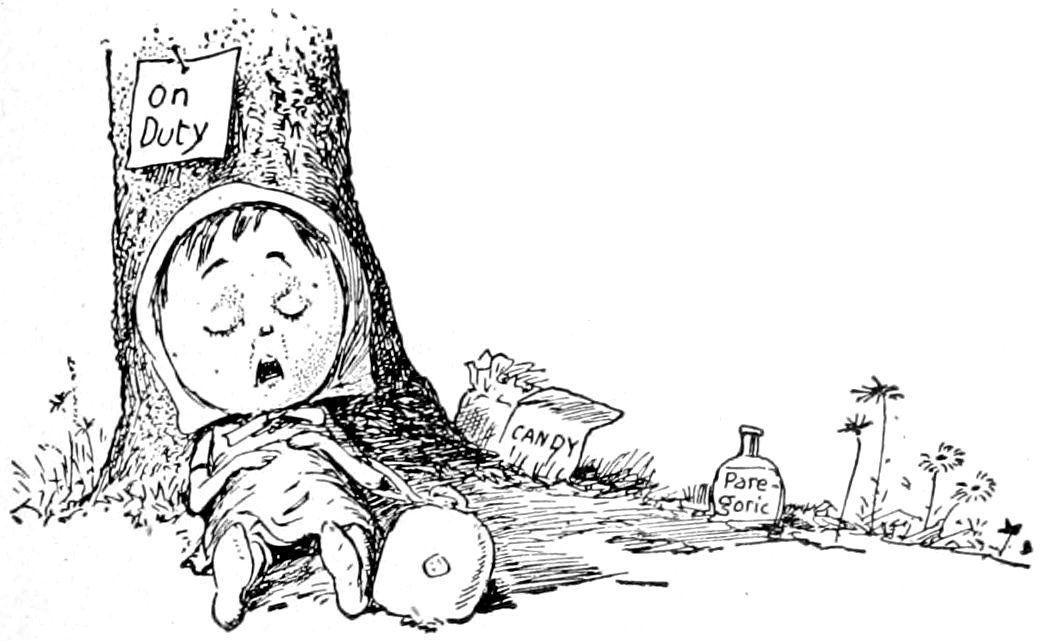
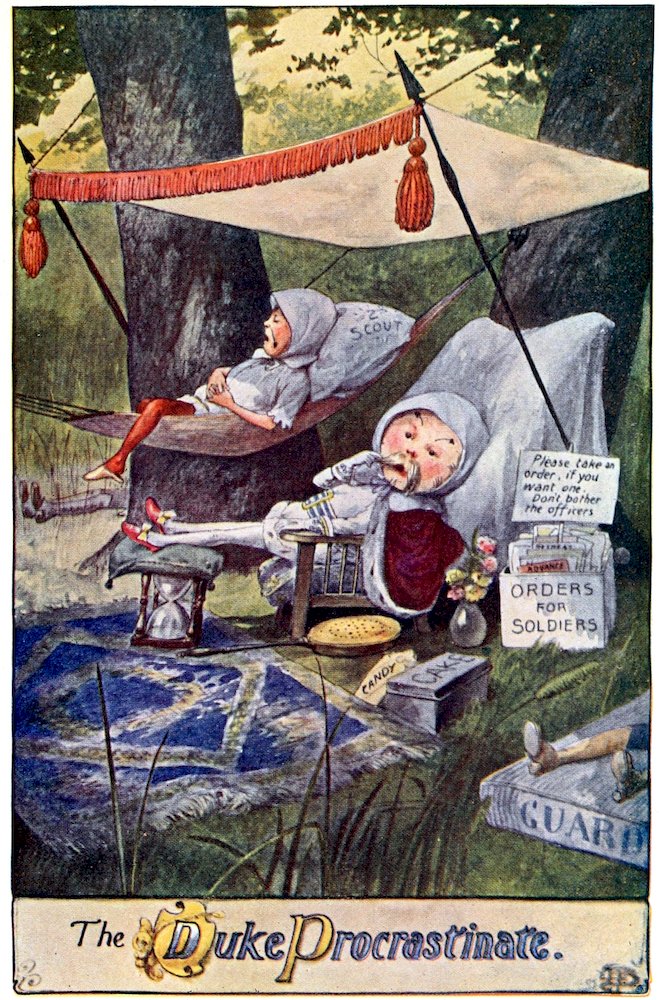
So he came nearer and nearer, until finally he found himself pushing through the tall grass amid which the Army of Procrastination was gathered. He marched boldly past hammocks and steamer chairs, from which the Hour-imps stared at him, until he reached the beautiful, soft-cushioned Morris chair in which the mighty Duke was reclining. The renowned leader of the Army of Procrastination had on a spotless nightcap, and carried a polished, brass warming-pan in his belt. His feet were raised, in order that he might recline with the greater comfort, and rested upon an hour-glass which had no sand in it. He was, perhaps, a trifle larger than the hours who made up his loyal 214following, but otherwise he was a perfect Hour-imp in appearance, with a face like the face of a clock, his two little twinkling eyes representing the two holes in which the key is placed to wind the clock.
“How do you do?” said the little boy.
“I’m very well, thank you,” said the Duke of Procrastination.
“I suppose you wonder who I am,” said the little boy.
“I haven’t had time to wonder,” drawled the Duke. “Could you wait a little?”
“Certainly,” said the little boy, “but I don’t want to trouble you.”
“Not at all,” replied the Duke. “I’m in no hurry. Won’t you sit down?”
“Thank you,” said the little boy. “I am just a little tired from walking through the long grass.”
“Yes,” said the Duke, smiling. “We always let the grass grow under our feet, you know. Now, I believe I am beginning to wonder just a little who you are—suppose you tell me. Or would you rather wait until later?”
By this time a number of curious imps had left their resting places and came yawning and straggling toward the Duke’s chair for a better inspection of the strange visitor. Some of them sat down in the long grass, others leaned against trees, and all listened, as the little fellow said,
215“I am a little boy from the World—from Tickerleen, and I’d like to know when you’re coming to attack the city, if you wouldn’t mind telling me.”
“You represent one of the Tickerleen papers, I suppose,” said the Duke, eying him critically.
“No, I don’t; I’m just visiting Tickerleen from the World, if you must know; and His Majesty sent me here to find out what you are going to do. I hope you are not displeased. You know, Father Time is fond of little boys.”
“Oh, yes, but he’ll go back on you some day—when you need him most. He never thinks of any one but himself,” replied the Duke. “But I’m not displeased with you; oh, dear, no, not at all; you’re welcome.”
“Well, then,” said the little fellow, “would you mind telling me—”
“No, not to-day,” said the duke. “To-morrow morning, if all goes well, I will issue a statement, and you are welcome to stay here and make yourself at home until then.”
There was nothing for the little boy to do but to wait, for he saw that the Duke was inflexible. So he spent the rest of the day chatting pleasantly with the Duke’s hours, and asking them what they had seen in the World. Nearly every one of them said that nothing whatever of interest had happened during his time of duty in the World. A good many of them came from the Dark Ages when nothing had taken place to amount to anything, 216anyway. Altogether, they were an uninteresting and tedious set compared with the hours of Minutel, and the little boy was very glad when the next day came and he was told that the Duke was about to deliver his proclamation before the entire army. It was quite late in the afternoon when the proclamation was actually read by the Duke, for he had put off the reading eleven times during the day. At last, he appeared before his assembled troops, and the little boy, who had secured a very good position in front, listened with great attention to the proclamation, which was as follows:
“I really don’t see the occasion
For suddenly starting away;
A thing like a city’s invasion
Will certainly keep for a day.
“This life in the woods is delicious,
And surely it’s none of our fault
That the weather is hardly propitious
For making a sudden assault.
“Then what is the need of advancing,
With heavens beclouded and drear?
Our camp is secure and entrancing—
We’ll wait till the weather is clear.”
“Then let us not fidget and flurry,
Nor think of the future and worry,
217And let us not be in a hurry,
But wait till the weather is clear!”
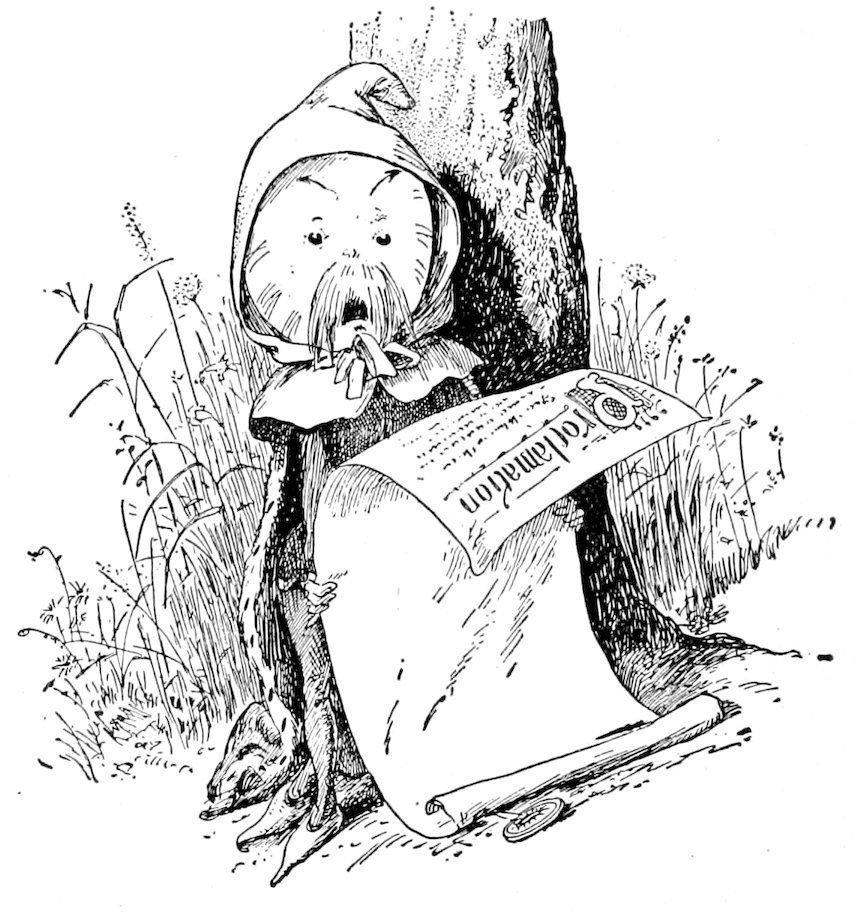
The last words which the Duke uttered before he sat down were the words, “We’ll wait till the weather is clear,” the remainder being a response from his trusty followers who always cheered him and nodded approvingly when he spoke, frequently to the extent of voicing their sentiments whenever the Duke paused for a moment.
219
221