VIEWS AND PRACTICE OF A PRACTICAL FARMER.
Reading edition
BY F. E. GOTT, SPENCERPORT, N. Y.
Having been a practical farmer all my life, with considerable experience in the care of stock and dairying, I give you the result of my experience. The system of management which would be profitably adopted by one would be utterly impracticable for another. In my own case I have about one acre of land, one half of which I set apart for production of food for my cow, while the remainder is occupied by the buildings in part, and the rest is devoted to the culture of small fruits. Without this land I should be obliged to hire my cow pastured through the summer, at a cost of about fifty cents per week, which I am now able to save by practising a system of soiling. The advantages of which are numerous.
PROFIT IN BUYING PART OF THE FEED.
I am aware that the amount of land which I have devoted to this purpose is inadequate. One acre would be none too much to supply a cow with food through the year, but I can realize more profit by purchasing a portion of the necessary food and devoting part of my land to the culture of small fruits, the amount of money received from the sales of which, will more than pay for the feed that I could raise on the same land.
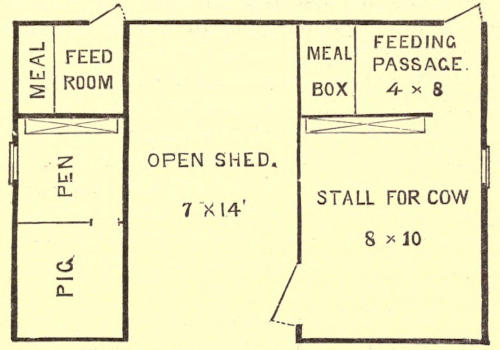
Fig. 19.—PLAN OF COW-SHED, ETC.
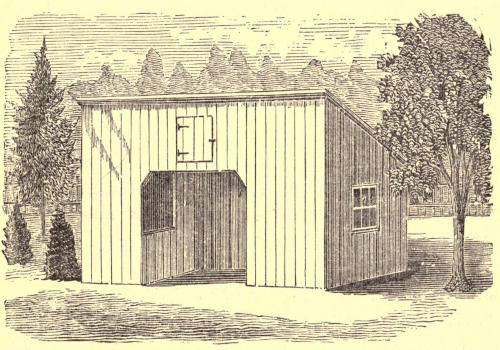
Fig. 20.—PERSPECTIVE VIEW.
My barn (figs. 19 and 20) is inexpensive, yet it answers every purpose. It consists of a box-pen for the cow, an open shed and a pig-sty, the whole covered by one roof, and occupying a space twenty feet in length by fourteen feet in breadth. It is constructed of hemlock lumber. The posts on the front are twelve feet in hight, while those on the back side are eight. It is boarded vertically and battened on the sides, and the roof is also covered with rough boards, laid on double, breaking joints so that no water can leak through. The box for the cow is eight feet by ten, and is six feet and four inches high in the clear. Adjoining this is a feeding passage four feet by eight. The arrangement of doors is shown in the accompanying sketch. The middle portion of the building is an open shed, and is seven feet wide by fourteen feet long. It is used principally for storing dry muck and also as a cover for the manure pile. Adjoining the open shed is the pig-pen. While the partition between the cow-stall and shed is carried up to the floor above, making a tight box stall, that between the pig-sty and shed is only built four feet from the ground, leaving the upper part open. A floor is laid at a hight of six feet ten inches from the ground, which provides storage room for hay above. I would suggest, as an improvement to this plan, that the whole be built two feet higher, making the long posts fourteen feet instead of twelve, and the short ones ten instead of eight, thereby securing more room above. There would then be sufficient room for the storage of over two thousand pounds of clover hay. Of course the provision I have made for a pig is outside of the question under consideration, but in view of the fact that wherever a cow is kept, a pig may also be profitably raised and fattened on the skim-milk and much that would otherwise be wasted, and at the same time increase greatly the value of the manure heap, I think such provision should be made, especially as the cost of such an addition to the cow’s shed is but little. In case it is not desirable to keep a pig, the space may be used as a calf-pen or for the storage of straw. The cost of the building which I have described should not exceed fifty dollars.
The only way to secure a good cow, is to keep trying until we get such a cow as we want and then hold on to her. We may have to change several times before we can bring this about, but there is no infallible rule for selecting a good cow. Were I to select one for myself, I should select one not over five years old, of gentle, quiet disposition, with a large barrel; one whose udder is large and well formed, with teats set well apart, of good size, and projecting slightly outward from each other, and with large milk veins.
The method which I have adopted in the management of my cow, has this in its favor, that it has been highly and uniformly profitable to me.
MANAGING THE MANURE PILE.
I shall first present my mode of making manure, and of applying the same. The prevalent idea among those who keep a single cow or other domestic animal is, that the manure, instead of being saved and protected from loss with the greatest care, is a nuisance, which should be summarily disposed of. It is an established fact that the liquid portion of the excrement nearly, if not quite, equals in value the solid portion, and in order to save both we must provide some means by which the liquid and volatile portions of the manure may be prevented from going to waste. This is best accomplished by means of absorbents, and there is nothing better or cheaper for this purpose than dried muck or earth, a good supply of which should be constantly kept under cover where it is easily accessible. Fortunately I am so situated that I can obtain a supply quite easily. There is within half a mile from my place a large tract of swamp land, from which I can obtain, for a low price, all the “muck” I need. Every fall, I store away under my shed a sufficient quantity to last me through the winter. This had previously been thrown into piles and dried. It is quite essential that it should be thoroughly dried, so that it will readily absorb the liquid manure, and this may be accomplished by piling and allowing it to be exposed to sun and air for six months or a year before wanted for use. The bottom of the stall is covered with ten or twelve inches of the dry muck, over which I scatter a light covering of cut straw or sawdust, so as to secure a clean bed, and prevent the particles of dirt and muck from sticking to the cow and dropping from thence into the pail. The dry earth readily absorbs the liquid droppings and whenever it becomes saturated with the same, may be removed, together with the manure and soiled straw, to a pile beneath the covered shed, when a fresh supply of dry muck, enough to replace that which was removed is carried in and the whole is again covered with the cut straw. An occasional sprinkling of plaster (gypsum) is applied both to the litter in the stall and to the manure heap, which prevents any loss of ammonia, and hence all unpleasant odors are avoided. Whenever a forkful of manure is put on the pile, it is immediately covered with muck. Twice each year this is hauled on to the land. Manure thus treated will not waste, either by the leaching out of soluble matter, by the escape of ammonia, or by fire-fanging. And as there is no coarse material, such as long straw or corn stalks mingled with it, it is always in a suitable condition to use. If dry earth or muck cannot be obtained, cut straw or sawdust may be substituted. But earth, being an excellent deodorizer itself, and containing, as it does, much valuable fertilizing matter, is much to be preferred.
If artificial fertilizers are used, they may at any time be mixed with the compost heap. Also, when a pig is kept, its pen should be cleaned daily and the litter, mingled with the general pile, will add greatly to its value. Common salt may occasionally be added to the compost heap with advantage, but ashes never, as they tend to liberate the ammonia and thereby cause waste.
YARD ROOM AND EXERCISE.
It is not necessary to have a large yard connected with the stable, as a cow is seldom inclined to exercise her locomotive powers more than is required to secure her food, and if this is placed before her at suitable times and in sufficient quantity to supply her demands, she will remain perfectly contented in an enclosure twenty feet square. In planning our buildings let us bear in mind that sunlight is essential to perfect health. Therefore we should have the yard on the sunny side of the building. At the same time we should see that there is a shady corner, where the cow may take herself during intense heat. A hint in this direction is sufficient. Nothing can be more cruel than to force any dumb animal to stand exposed to the rays of an August mid-day sun, or where she is tormented nearly to death by flies. Yet we often see just such inhuman neglect on the part of those who should know better.
Although in many respects desirable, a pasture lot is not absolutely essential, and in the case of the villager, whose land is measured by feet instead of acres, it must be dispensed with. Hence we have recourse to what is termed the soiling system, which is simply cultivating such crops as will produce a succession of green food throughout the season, and placing the same before the cow in such quantities and at such times as she may require, instead of allowing her to tramp around after her feed, and thereby waste more than she eats. It requires some skill and judgment to carry out this plan successfully, but wherever it has bean practised judiciously and intelligently, the results have been uniformly satisfactory. As to what amount of land is required in order to keep a cow through the year, I will not pretend to say; nor do I think it advisable to try to produce the entire amount of food required for a full year’s sustenance.
HAY.
I know that for me it is far better to purchase what hay will be needed to feed through the winter than to attempt to grow it. Besides, our village lots are much too small to be profitably converted into hay fields, and even if there should be more land than is necessary to furnish the soiling crops for summer feeding, it is usually much better economy to employ the same in the cultivation of small fruits, which, as I have before stated, more than pays for what hay is required, besides supplying us with many luxuries.
In my own case, I have set apart one-half of an acre from which to supply the cow with food during a period extending from May first to November first. Now this will be entirely insufficient, except under the very best cultivation and management, which, of course, I am bound to bestow upon it. That it is sufficient, with proper care, I have repeatedly proved. Such results could hardly be expected, however, from land which has received no previous preparation, and is worn, wormy, and weedy. Let us assume, then, that our half acre is in a good, fair state of productiveness. To produce a continuous supply of wholesome fodder, I find a system of rotation must be practised, and have subdivided my half acre into four equal parts, containing each one-eighth of an acre, or twenty square rods. These I shall designate as plots one, two, three, and four. Plot one is at the present time in clover, having been seeded one year ago, and will be ready for use about June. Plot two was sown to winter rye last October, and will be seeded down with clover this spring. From this patch of rye I shall obtain the earliest feed, and will begin using it about May first. Plot three will be sown with corn, drilled thickly in rows two and a half feet apart, which, if sown as soon as danger from frost is past, will be ready for use about August first. Plot four will be sown to mangels or sugar beets. I prefer the latter, and this is the only crop cultivated for winter use. Both this crop and the corn are planted with a garden seed drill, while the rye is sown broadcast. On the first of May I begin cutting the rye. Up to this time the cow has been fed on clover, hay, and grain.
I calculate to have the cow drop her calf at about April first. To this end I have her served about June twenty-fifth. Of course, we cannot always have our own way in this matter, but, accident excepted, we can usually manage so as to approximate the time. During a period of a few days subsequent to parturition, I feed quite sparingly—however, allowing her all the long hay she will eat, together with a peck of beets twice a day, but no grain of any kind, this reduced ration being necessary to avoid the danger which might result from the too abundant secretion of milk at this time, which high feeding would tend to produce. If at the end of the fifth day after calving, no bad results have occurred, such as milk fever, and there is little or no caking of the bag, I begin to gradually increase the feed, until, at the tenth day, I reach the normal standard, which is as follows:
DAILY FEEDING.
At half-past five A. M. I feed her four quarts of a mixture consisting of one part each of corn meal and oat meal, and two parts of bran. Four quarts of this is mixed with a heaping half bushel of cut (chaffed) hay, moistened but not soaked. While she is occupied in eating, I clean the manure from the stable, remove all dirt from her udder, and any that would be likely to drop into the pail while milking. Sometimes a sponge and water are required to accomplish this, but usually an old piece of a blanket kept for the purpose is all that is necessary. I then milk and carry the milk directly to the house before it has time to cool or absorb odors, which, even with the utmost care and cleanliness cannot be entirely avoided. After breakfast, I give the cow a peck of sliced beets, on which has been sprinkled about a dessert spoonful of salt, which completes her breakfast. At this time it is a very good plan to use the curry comb or card for ten or fifteen minutes, though I must confess that I sometimes neglect this part of the programme: still I think that my cow gets far more indulgence in this direction than most cows in the neighborhood. After she has finished eating, if the weather is not too unfavorable, I allow her to run out in the yard, where, at noon, I give her just as much long hay as she will eat up clean, and no more.
There is at all times plenty of fresh water in the yard, to which she can help herself whenever she so desires; otherwise she would need to have it supplied to her at least twice a day, but not immediately before or after a feed of grain. At half-past five in the afternoon she receives the same amount of food, and prepared in the same manner as in the morning. This method is continued until the crop of rye is large enough for use. All changes from dry to green feed must be made gradually, if we would avoid loss. By this time our supply of roots will be exhausted, but the green food, in a measure, takes the place of them. I continue to give the same amount of grain throughout the summer as I did through the month of April, and also to mix it with chaffed hay slightly moistened, as this insures the complete mastication and thorough intermingling with the saliva, which is so essential to perfect digestion and assimilation. As the supply of green food increases, I diminish the quantity of chaffed hay until but one-half the former amount is used, which quantity is continued through the soiling season. The one-eighth acre of rye will last until about June fifteenth, at which time the red clover will be large enough to feed. We should not change abruptly from one kind of green food to another, but increase the one and diminish the other gradually until the change is complete. To ascertain the exact amount needed for a feed of this kind, as well as of the other green crops, requires some judgment on the part of the feeder; but a very safe rule is to feed just such an amount as the cow will eat clean, and no more. We cannot specify exactly what would be a proper amount in every case, neither can we spend time to weigh each ration, but, by observing carefully, we are enabled to determine very closely. I find that my cow will eat, besides her other feed, a good armful of green fodder three times a day. I always cut a day’s supply on the afternoon preceding, and allow it to remain in the swath, where it will wilt, and a portion of the water evaporate, thereby rendering it more wholesome than when fed immediately after cutting, and I think my cow relishes it better. By the fifteenth or twentieth of July the clover will have become so ripe as to necessitate the cutting and curing of any that may be left at that time. It may still be fed, however, for a few days, or until the sowed corn becomes large enough to take its place, which is generally about the first of August. This crop, and the second cutting of the clover, will complete the course, and will furnish feed until well along into October, or the first of November, after which I depend on purchased food.
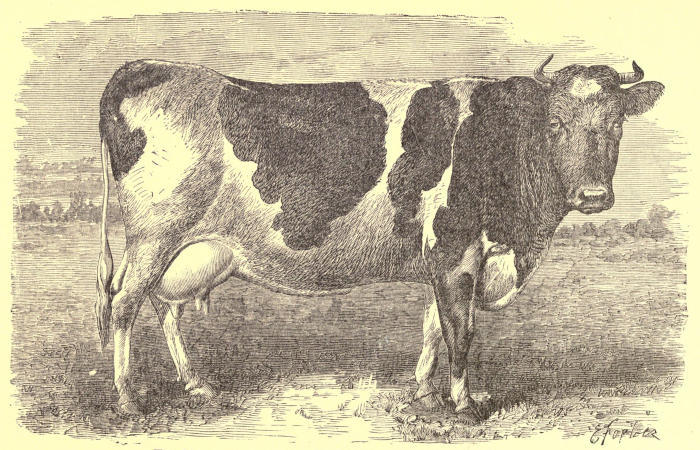
Fig. 21.—THE DUTCH (HOLSTEIN) COW “CROWN PRINCESS.”
WINTER FEED AND TREATMENT.
If not previously done, I now procure three thousand pounds of the best early cut clover hay. As my shed is not sufficiently large to store away this amount, I am obliged to stack part of it. I also procure bran and meal. The amount of these which I require for a year’s supply is: of bran, one thousand pounds; of corn meal, one thousand pounds; and of oat meal, seven hundred and fifty pounds. These amounts, well mixed together, will furnish a feed of eight quarts per day, which amount is diminished during the period in which the cow is dry, and is sometimes increased, if by any means other food is short. It is not advisable to procure all this feed at once, for, if stored, it would be quite likely to heat and mould before it could be used, besides being subject to loss from rats and other vermin. I therefore procure one-sixth of this amount, or two months’ supply at a time, and I have often found it convenient and profitable to buy the corn and oats and have them ground myself. The course pursued in feeding from November first until February fifteenth, at which time the cow becomes dry, is similar to that which I have described for the month of April. It is better to dry off the cow four, five, or even six weeks prior to calving. Sometimes, in order to do this, it will be necessary to omit the grain and diminish the quantity of roots for a few days, but after she becomes quite dry I resume feeding as before, except perhaps to lessen the amount of grain until within a few days of calving, when I omit the grain entirely until, as I have before stated, the danger from milk fever, etc., is past.
CALVING.
Some people continue to milk their cows until within a very short time of calving. This is very poor economy. The milk at such times is thin and insipid, and unfit for food. I have never found any “preparatory treatment” of the cow prior to parturition, such as physicing, etc., to be necessary; but place her on short rations for a few days—administering, as one writer terms it, “judicious starvation.” The feed of roots is continued, as they exert a laxative effect on the bowels and tissues, thereby obviating the necessity of giving a huge dose of Epsom Salts. In an experience of fifteen years, by following this plan of restricting the diet, I have not had a case of milk fever, apoplexy, or retention of placenta, and but one case which called for assistance, and this was due wholly to an accident. When a single cow is kept, she is, of course, exempt from the ill consequences which so often result from crowding and fighting with other cows, and, if kindly treated and provided with comfortable accommodations for feeding and shelter, she will seldom have any trouble. But cases where assistance is indispensable do sometimes occur, even under the best management, the most frequent of which is the retention of the placenta or after-birth. If, at the end of twenty-four hours, the cow has not “cleaned,” it is then time to undertake the removal of the placenta. This can be accomplished by carefully introducing the right arm of a man having a small hand, which should previously be well greased, into the cavity of the uterus, when the connecting attachments will readily be found and may be separated, after which the whole may be brought away. These attachments are often quite numerous, and care should be taken that all are detached, and that the whole of the after-birth is removed, as serious results sometimes occur when a portion of it is retained.
If, from any cause, the fœtus has got into an unnatural position, or shows any other presentation than that of the two fore feet and muzzle, natural labor may be rendered impossible, and assistance will be required in order to set matters right. There are several abnormal positions in which the calf may be presented, while there are but two positions in which delivery is practicable. In the natural position the two fore feet and nose are the parts which make their first appearance. When this is the case we may generally conclude that our services will not be required. If, on the other hand, there is any alteration of this position, either by the absence of the head or of one or both feet, or if, when labor pains have continued for some time, there is no presentation at all, it will be necessary to investigate the cause. The owner’s duty, in cases of this nature, will be to restore it, by judicious manipulation, to its normal position, or to such a position as will render delivery practicable. If, from the nature of the case, the fore legs and nose of the fœtus cannot be brought into such a position, we must endeavor to bring up the hind legs and deliver it in that position. It frequently occurs in this position, as well as sometimes in the natural one, that traction will have to be applied. In such cases it should be applied simultaneously with the throes of the cow. In rare cases it becomes necessary to amputate portions of the fœtus and bring them away separately, which operation should be left to the veterinary surgeon. In fact, whenever assistance is required, it is better to employ the services of a competent surgeon, if such can be obtained. But where professional assistance cannot be obtained, it is much better to use one’s own judgment than to depend on the village cow doctor, who is usually one of the most ignorant persons in the community. Happily, cases requiring any assistance, where a single cow is kept, are rare.
For Mamitis or garget I have given successfully the following powder twice daily: Pulverized Digitalis, one drahm; Nitre, one ounce; Cream of Tartar, one-half ounce; mix and give in the feed. If the bag is caked and hard, let the calf run with the cow for a few days.
I do not consider it profitable to raise the calf, therefore I dispose of it as soon as possible. There are always plenty of farmers or farmers’ boys who are glad to buy a good calf to raise, and will willingly pay one or two dollars for the same, and take it right away. I prefer to raise and fatten a pig instead.
ACCIDENTS AND FAILURES.
It is no more than fair for me to say concerning my plan of feeding, that I have occasionally been obliged to modify some of the details, on account of unfavorable circumstances. For instance, I have been forced to cut grass from the highway in front of my house, to supply a deficiency in some crop, caused by unfavorable weather, or some accident or other. In the spring of 1878, my clover failed to catch, leaving me to make up for the loss of that crop as well as I could. It was certainly most unfortunate, inasmuch as it seriously interfered with the whole system of rotation. To carry out the plan of soiling successfully requires considerable time and labor. And on the whole, unless one has plenty of the former at his disposal, and a good wholesome inclination for the latter, he could do full as well to adopt the old time practice of having his cow pastured by the week, in which case no other labor than milking would be required, while, if she were allowed a feed of meal or bran at the time of milking, night and morning, very satisfactory results would be obtained.
ONE YEAR’S RESULTS.
To show what I have accomplished by it, I will give an account of the products of my cow “Polly,” for the year ending April first, 1880, together with a statement of the actual expenses of her keeping. Besides what was used in a family of four, I have sold one hundred and sixty-nine pounds of butter, at an average of twenty cents per pound, which amounts to thirty-three dollars and eighty cents; eight hundred and twenty-eight quarts of milk, at six cents per quart, forty-nine dollars and sixty-eight cents; eighteen quarts of butter-milk, at three cents per quart, fifty-four cents; eleven quarts of sour milk, at two cents, twenty-two cents; one calf, four days old, one dollar and seventy-five cents; total, eighty-five dollars and ninety-nine cents. To this I may add one hundred and twenty pounds of butter consumed at home, twenty-four dollars, and about two hundred and thirty quarts of milk, worth thirteen dollars and eighty cents; making in all, one hundred and twenty-three dollars and seventy-nine cents. The cost of feed was as follows: One thousand pounds bran, nine dollars and sixty cents; one thousand pounds corn meal, eleven dollars and fifty cents; seven hundred and fifty pounds of oatmeal, nine dollars and eighty five cents; three thousand pounds clover hay, thirteen dollars and fifty cents; two hundred pounds rye straw, one dollar and fifty cents; muck, two dollars; total, forty-seven dollars and ninety-five cents; leaving a balance of seventy-five dollars and eighty-four cents. As I keep a horse, I have the necessary tools for cultivating the land myself, I have not added the cost of cultivation as an item in the expense column, and perhaps it may be said that I should also have added interest on land and buildings. As an offset to these, I would call attention to the valuable pile of manure, and furthermore I have made no account of a large amount of skim-milk, on which I raised a pig. This pig was fed nothing but sour milk, and a very few small potatoes, until about four weeks prior to butchering, when he was “finished off” on corn meal. He weighed, after being dressed, December twenty-eighth, two hundred and seventy-eight pounds. The profits from this cow would undoubtedly have been larger had I sold all the milk, instead of making butter out of a part of it, but I did not make mere profit my sole object in the matter. I wished to supply my family with those necessary luxuries which, I believe, are rendered even sweeter by the consciousness of their being the products of our own labor. The pleasure which I have taken in caring for my pet cow, and in providing for her wants, and the pride I feel in exhibiting both my cow and the delicious rich milk and yellow butter, with which she so bountifully supplies us, amply repays me for my part of the labor. I have made no account of using concentrated food, such as oil-cake and cotton-seed meal, for the reason that I have had very little experience in the use of them. Whenever an animal has become thin and poor, these articles of food may be used to advantage to increase the flesh and bring the animal into good condition. But I never let my cow get poor, and I find that good hay, with corn, oats, and bran, answers every purpose, and is fully adequate to all her requirements. My system of rotation is as follows: The one-eighth acre of clover sod of the preceding year is well manured either during the winter or in the spring, and well fitted up and sown to beets or mangels. This crop occupies the land during the whole season. The same plot is again plowed the next spring for sowed corn. After this crop is off it is again manured and sown to rye, and the following spring is again seeded to clover. It is kept in clover one year, yielding two crops during the season, after which it is treated as before. Each of the four plots undergoes the same treatment; thus a complete rotation is established.