PERMANENT GRASS AS SOILING CROP.
Reading edition
BY P. S. NORRIS, ANGELICA, N. Y.
The keeping of one cow seems to be generally regarded as a matter of so little importance, and one so simple in its nature, that even persons of low intelligence can scarcely fail of success. But to keep a cow in such a manner as to receive the greatest return for the least possible expense in labor and money, requires the most careful study of the nature and habits, endurance, needs, and the productive capabilities of the animal, and involves scientific principles which are deeper and broader than those generally applied to the keeping of stock of any kind.
If the average quantity of milk be ten quarts per day during the year, and the expense twenty cents per day, the milk will cost two cents per quart, and if the milk is worth three cents per quart, there is a net profit of fifty per cent upon the cost of keeping, or ten cents per day. But if the quantity of milk be eight quarts per day, and the expense twelve cents, the milk will cost only one and a half cents per quart, or twelve cents per day. Then three cents per quart for the milk will leave an actual profit of one hundred per cent upon the cost of keeping, or twelve cents per day.
One acre, and even something less, put in good condition, well fertilized and properly seeded, will be ample for a pasture, and will furnish plenty of nutritious feed, upon which, with proper care, the cow will yield an abundant flow of rich and delicious milk; while one-third of an acre of similar soil will produce sufficient hay for the winter. The pasture should be divided into two parts, the cow to be kept a few days in each alternately, with plenty of pure water and shade. Where land is high, as it always is in towns and villages of any size, the practice of “soiling,” as it is usually termed, is the most profitable way to keep a cow. For this purpose, a small yard, some twenty to thirty feet square, perhaps, or of such size as can be afforded, may be provided, containing an open shed—the more open the better for the summer—only so that it will shelter the animal from the heat of the sun and the storms. The yard and shed should be kept as clean and dry as possible, or the cow will become ill. Plenty of pure water is indispensable at all times. A comfortable place for the cow to lie down is very important. Sawdust, forest leaves, old straw, or other convenient and cheap litter will answer for bedding; or, if the ground be smooth, clean and dry, that may be sufficient. The manure is to be carefully collected and placed under another shed, or other convenient place under shelter provided for the purpose, and, to prevent bad odors, the heap should receive, once in two or three days, a light covering of muck, leaves, sods, weeds dug up in the garden or elsewhere, or fine earth—almost anything that will rot—and thus not only prevent the unpleasantness and unhealthfulness of such odors, and the loss that would result from their escape, but add largely to the size and value of the manure heap. Now, have about two-thirds of an acre of land, highly manured, and, with the exception of about fourteen square rods, well seeded with a variety of nutritious grasses. This quantity of land, if properly enriched and cultivated, will keep a cow the year round, and keep her well, without purchasing any feed. A good rack or other arrangement in the shade is necessary, in which to feed, so that nothing shall be wasted. Then, quite early in the season, the grass upon this rich soil will be large enough to be cut and fed to the cow. While the ground is sufficiently moist, in the fore part of the season, the grass will grow very rapidly, and, when the soil becomes a little too dry, about half a bushel of plaster, or twice as much lime, or two or three bushels of wood ashes, scattered upon it, will usually renew the vigor and freshness of the crop, which may be repeated with benefit two or three times before the end of the growing season. Another excellent fertilizer, which may be applied during the summer, is the waste water from the house, such as soap suds, dish water, and any other slops that are to be thrown away. These should all be saved and scattered upon the grass from pails, if no better method is ordinarily practicable, and it will pay a person many times over for the trouble. A light top-dressing of manure from the cow-yard or shed will be necessary every year, or every second year certainly, applied in the fall, or early in the spring.
As soon as the grass has fairly got into blossom, it should be immediately cut and well-cured for winter use, unless it may be necessary to save a small quantity to feed until that portion which was first cut for the cow shall be ready to cut again. Grass should never be allowed to stand until the seed has formed, as just previous to that time it is more nutritious than at any other period. Hay cut thus early will make much more and better milk, and keep a cow in better condition than that which is cut later. A portion of the grass can be mown a second time for hay, and still leave enough for green feed until foddering time. The exact proportion of the crop to be made into hay must, of course, depend upon circumstances. All that is not needed for summer use should be cured for winter, and the quantity will, generally, be sufficient, if, indeed, there is not an overplus, as will quite likely occur in many cases.
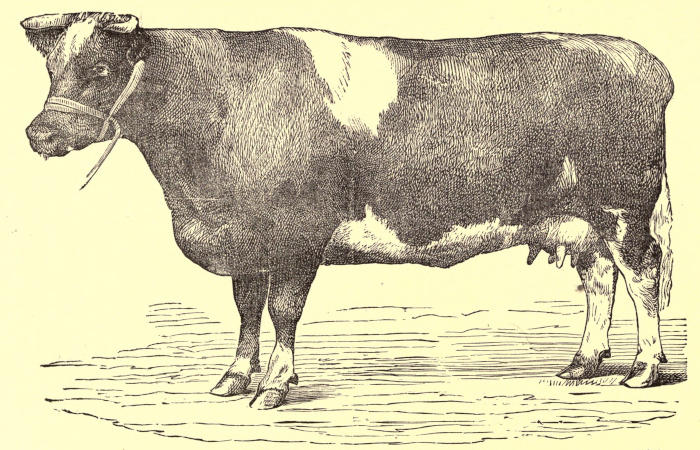
Fig. 22.—SHORTHORN COW “COLD CREAM.”
BEST KINDS OF GRASSES.
It is important to know what kinds of grasses are best adapted to the production of milk and butter, for both summer and winter feeding; and upon this depends, in a great measure, the profits to be realized. The practice of seeding with a single kind of grass, or even with a mixture of clover and timothy, is not a good one. Four of the most nutritious and productive kinds of grass, including timothy, white clover, and such other varieties as are well adapted to the particular nature and condition of the soil, are none too many to be sown together, for pasture or meadow. Five quarts of timothy, three of white clover, six of orchard grass, and three of red-top (if the ground is quite moist), or other grass suited to the soil, are about the proper quantities and proportions for general use, on an acre of land. Such a mixture, upon a rich soil, will produce fully twice as much feed as any one kind upon the same soil. White clover produces a greater quantity and better quality of milk and butter than any of the other varieties of grass, and the quantity of feed produced by such a mixture, will astonish any person not acquainted with the facts. Besides producing much more abundantly, they furnish something of a variety of feed, which is greatly beneficial in the manufacture of both milk and flesh. Weeds injure the flavor of milk and butter, and should never be in the food for cows. An acre of rich soil, well seeded with a good selection and variety of perennial grasses, will produce six tons of well-cured hay in one season; by mowing twice, and, by early cutting, this can be done without difficulty. In my own experience, the first mowing has given at the rate of full four tons per acre, and the second, somewhat injured by drouth, two tons. Some writers recommend the sowing of one or more of the rank growing annuals, as being more productive; but a careful consideration of the subject, accompanied by experiments, discloses the fact that the extra expense of preparing the ground and seeding annually, overbalances any increased quantity of feed produced, especially when the coarser and less nutritious nature of the feed is taken into the account. There is nothing suited to this climate and latitude, that will answer a better purpose as food for stock, than such perennials as timothy, red-top, orchard-grass, blue-grass, the clovers, etc., when sown upon a rich soil, thick enough to completely cover the ground and to insure fine, soft hay, when cut at the proper time and well cured. I have omitted red clover in the mixture of grasses, because soils adapted to that variety will produce white clover equally as well, and in about the same quantity, while the white gives a much better flavor to milk and butter, and an increased quantity. Blue-grass, either green or cured, is excellent feed for cattle, but is unprofitable on account of the small product, and that coming only in the fore part of the season, falling, as it does, just at the time when fresh feed is most needed. Red and white clover may be advantageously mixed with the true grasses, in many localities where the soil is suitable, though the clovers are likely to “run out” in a couple of years, and leave their places to be filled with inferior fodder plants.
MILKING THREE TIMES A DAY.
During the heat of summer, the cow should be milked three times a day, at regular intervals—about five o’clock in the morning, one in the afternoon, and at nine in the evening. The quantity of milk and butter is considerably increased, and the quality improved, by this practice. The milk is injured by remaining in the udder through the heat of the day, and the cow is made uncomfortable, which, of necessity, diminishes her usefulness. When cows are milked but twice a day in hot weather, the udder becomes too much heated and feverish, and the milk is in a similar condition—the cream seems to be melted, the milk soon becomes sour, the cream does not rise well, and the butter is soft and oily. These difficulties, almost universally attending butter-making at this time of the year, are mostly overcome by the practice of milking three times a day, and the cow being near at hand, it is a small matter.
The length of time a cow should be milked, will depend on her capabilities for giving milk a longer or shorter time. Some will give milk the year round, while others will “go dry” three or four months, or longer, in spite of all efforts to keep them in milk a longer period. But, as a rule, it is better for a cow to go dry some eight weeks, giving time for fleshing up a little, and gaining strength for another season. The cow will be more vigorous, and the flow of milk more abundant afterward.