THE COW IN THE MIDDLE STATES.
Reading edition
BY W. L. BATTLES, GIRARD, PA.
Instead of writing on how a cow might be kept, I propose simply to tell just how we manage our cow, what we feed her, how we procure that food; in fact everything relating to her care, so that any one can go and do likewise.
“Spot,” we call her, for she has a beautiful white spot in her forehead, is not a Jersey, for we can not afford to buy one at the prices at which they are held with us; nor is she a thorough-bred of any kind; yet she is a good cow, of medium size, fills a twelve-quart pail each night and morning, when her milk is in good flow, that raises a thick coat of rich cream, which, after been churned, furnishes all the butter needed for a family of six, and some to spare. Our place is small, only two acres, and a portion of this is covered by the dwelling, barn, poultry-house, etc. The fruit garden occupies about one-fourth of an acre, and from this portion nothing is grown to furnish food for “Spot.” Adjoining the barn there is half an acre of the land in good grass, or mostly clover, and every spring a quart of clover seed is sown, so as fast as the old plants die out, young ones take their places. A bushel of land plaster is sown on this when the grass begins to start in the spring. This plot produces a very heavy growth of grass and clover, enabling us to cut it three times each season; about the first of June, August, and of October. A coat of fine manure is always spread over the ground immediately after each mowing. The grass is mostly cured, and makes fine hay for winter feeding. Occasionally a small portion of the crop is used green for soiling. Besides the land occupied by buildings, fruit garden, and clover plot, there remains about one acre, which we call the garden. Here are grown all the vegetables for the family’s use, besides some to sell. About one-fourth of it is planted to Early Rose potatoes, and as soon as these are sufficiently ripe for use or market, they are dug, and sweet corn, in drills, for fodder, is sown upon the land. Another fourth of an acre is planted to sugar beets; the ground being very rich, the yield is always large; this last season (1879), though very dry, I harvested one hundred and seventy-eight bushels. Our cow is very fond of the beets, and I think there is nothing better to keep up a flow of milk, and they give it no bad flavor, as do turnips. An additional fourth of an acre is planted to sweet, or evergreen, corn; as fast as the corn is picked for use or market, the green stalks are cut up, run through the cutting-box, and every particle of them consumed. As soon as the corn is all harvested, the ground it occupied is thoroughly fitted and manured, and then sown to winter rye, to be used for soiling the next spring, after which the ground is again prepared for corn. The remaining fourth acre is devoted to early peas, beans, cabbages and other garden vegetables. As soon as one crop is off, the ground is prepared, and something else is almost always planted or sown; consequently, on the most of this acre, two crops are produced each season, except where sugar-beets are grown, or late cabbages, which require the whole season to mature. With the clover on the half acre, and the forage crop and roots on the acre, we have not only had sufficient food for the cow the entire season, but have also kept our family horse, with the exception of one load of oat-straw purchased for three dollars, to mix in with the fodder corn; this is hard to cure sufficiently to keep bright and sweet through the winter, but by mixing a layer of corn-fodder, and a layer of straw, it all comes out nice and bright. Besides keeping both horse and cow, we have marketed from this little farm, in berries, vegetables, butter, eggs, poultry, and one fat hog, weighing, dressed, over three hundred pounds, four hundred and sixty-eight dollars’ worth of the above produce, keeping enough for our own use, and salting down one barrel of pork.
THE BARN.
The barn is twenty-five by thirty feet, with the stable on the south side. The stall for “Spot” is five feet wide, and the floor on which she stands is five feet long, with a manger two feet wide in front, one and a half high next to the cow, and three feet next to the barn floor. She is fastened with a wide strap around her neck, attached to a chain eighteen inches long, which is fastened to a staple driven into a post at the corner of the stall adjoining the manger; this gives her room to turn her head so as to lick any portion of her body. The floor is made of two-inch plank, battened on the under side with thin boards, raised from the ground ten inches in rear and one foot in front; all the droppings and urine fall into the four-foot alley behind. This alley has a clay floor beaten perfectly solid and level. Next to the stable door is a large bin, ten by seven feet, for storing road-dust or muck; at the other end of the stable is another bin, ten by eleven feet, for storing leaves for bedding. My great object is not only to make “Spot” comfortable, and have her stable free from all bad odors, but to save all the manure, both liquid and solid. The best absorbent is dried muck, pulverized, or road-dust from clayey roads. As it is easier to procure the latter, I generally make use of that, and always keep from two to three inches of it in the alley; this effectually absorbs all the liquid portions and all offensive odors. Twice each day, this is thrown out through a window closed by a sliding shutter in the rear of the stall, under a shed, where it remains until wanted for use. In the fall, I go to the woods and procure a sufficient quantity of leaves to last until spring; a liberal use of these not only makes a nice, soft, clean bed, but largely increases the quantity of manure. The stable opens into a small yard, across one corner of which runs a small brook. Each morning, the cow is permitted to go out and drink; if the weather is pleasant, she is allowed to remain out an hour for exercise. She is let out the same at night, after sunset in warm weather, so that she will not be annoyed by flies. The barn is well-battened, and is warm in winter; it is well ventilated by two windows, but these, in summer, are darkened by blinds, with wide slats, to keep out flies.
SYSTEM OF FEEDING.
Each morning, while “Spot” is eating her breakfast, she is well curried with a curry comb or card, and if any filth is observed on her bag or teats (which is very seldom), they are carefully washed off, if in winter, with warm water. She is never scolded nor whipped; consequently she never kicks over the pail, or holds up her milk. She is fed in winter with a peck of sugar-beets cut up, both morning, noon, and night; also, a bushel of cut feed, either corn-stalks or clover hay, wet with a pailful of hot water, with two quarts of “sugar meal,” or bran, thoroughly mixed together, with a little salt sprinkled over it. I generally use what is known here as “sugar meal” to mix with her feed; it is corn meal from the factory after the sugar or glucose has been extracted; it costs from ten cents to twelve and a half cents per bushel, and I prefer it to bran, and “Spot” likes it very much. We consider her a machine for converting the food we give her into milk, and the more we can get her to eat and digest, the more milk is obtained, and the greater the profit. It is a good plan to change the food occasionally, substituting carrots for beets, clover hay for corn fodder, for brutes, like mankind, are fond of a variety. There are root-cutters that can be procured for cutting up roots, but I have always used a common spade, ground sharp, and an empty flour barrel to hold the beets. It takes but a few minutes to cut up a mess of beets in that way.
MANURE.
With a bin of road-dust, and one of leaves, a winter’s supply of litter is secured, and it is surprising what a pile of manure we have in the spring. Another valuable source of manure is the pigsty, with plenty of leaves for a warm bed, and sufficient road-dust to absorb all the liquids, it is astonishing how clean our pigs are, and the sty is free from all bad odors; the big potatoes and mammoth beets, show the richness of the pig-pen fertilizer. I think our fifty hens pay for all their food with the droppings the poultry-house furnishes. The roosts are over a slanting platform, which is kept covered with road-dust both summer and winter; the droppings fall on this floor, and roll down into a large box twelve feet long, three feet wide, and three feet deep. The dust the chickens work down with the droppings is sufficient to absorb all the ammonia and preserve all the fertilizing qualities of this most valuable guano. A large box of road-dust is always kept in the water-closet, a liberal use of which furnishes a quantity of most valuable fertilizer, besides freeing the closets from all noxious smells. The wash water and slops from the kitchen are utilized by being thrown on a pile of sods and other rubbish, which are forked over, and as soon as decayed, carted to the manure pile. From so many sources we are enabled to give our small farm a most liberal supply of manure each spring and fall, so that even with the double cropping most of it gets, it continues to improve, and yields more bountifully each succeeding season.
CROPS AND TILLAGE.
In the cultivation of sugar beets, the ground is first manured heavily, plowed deep, and thoroughly pulverized with the cultivator, then marked out in rows with a garden plow, two feet apart. Manure from the poultry-house is scattered in each furrow, which should be lightly covered with soil, so the seed will not come in contact with it; drop the seeds about six inches apart, covering lightly with the garden rake. When the leaves are about four inches long, thin out to one plant in a place, and fill any vacancies with the plants pulled out. Hoe them thoroughly, destroying all weeds, which can easily be done by cultivating each time before hoeing, with an arrow cultivator. Keep the ground mellow, and cultivate three or four times, after which they will take care of themselves and soon cover the ground. With ground in good condition, and a fair season, six hundred to eight hundred bushels per acre can be easily produced. Let them grow until frost comes, when they should be dug with a garden fork, the tops cut off, and stored for winter. Those to be used before the first of March, are stored in the cellar, the others are buried in a long pit, digging out a shallow place, piling up the roots about three feet high, and three feet wide, covering well with straw and sufficient soil to keep them from freezing, putting in a drain-tile about every four feet in the top of the pile, with one end to project a little through the covering, for ventilation. If the weather becomes very cold, lay a turf over the tile, and remove when pleasant. I grow carrots after the same plan, and store in like manner. I prefer beets, as they are so much larger, it is less trouble to gather and take care of them, and the crop is generally larger, still I always grow some carrots for a change. I plant sweet corn in drills, always put some fertilizer along the furrow, dropping the kernels about eight inches apart, with the rows three feet wide, I commence planting soon after May first, and continue at intervals until about July first, so I can have a fresh supply for use, and market, all the season. The sweet corn being grown on the plot sown to winter rye, for soiling, enables us to cut some portions of it twice, before the ground is needed for corn. When sowing corn for fodder, which is done as soon as we commence digging the early potatoes, I sow it in drills two feet apart, and drop the kernels about one inch apart in the drills, manure from the pigsty is first dropped in the furrow, and covered with soil at least two inches deep, or the corn will not come up. This fertilizer is so strong, if properly used it causes a most extraordinary growth of stalks. While the corn is small, cultivate it two or three times with a narrow cultivator, when it will take care of itself, and there will be a surprising growth of stalks; I have them often six feet high. Just before time for frosts, cut with a scythe, and set up in small bunches bound around the top, and leave to cure until cold weather. When it is to be put in the mow, spread alternately a layer of stalks, and a layer of straw, and it will keep bright and sweet until wanted. The rye for spring soiling is sown when the sweet corn is picked, and stalks removed, in drills about ten inches apart. Fine manure is spread on the ground after plowing, and thoroughly mixed with the surface soil; one or two hoeings being given to keep the ground mellow; to destroy any weeds that may make their appearance. By May first, the early sown rye will cover the ground with a dense growth, at least four feet high, furnishing a large quantity of most nutritious green food. On those portions of the plot where the latest corn is to be planted, two or three cuttings are made; this gives most excellent food for the cow, and the quantity grown on this fourth of an acre will surprise any one who has never tried it. There is quite a plot of early peas, and as soon as the last picking occurs, while the vines are green, they are pulled and fed to “Spot,” who relishes them very much. Turnips, or corn, are at once sown on the ground where the peas were.
When our early cabbages are taken up, all the leaves, and much of the stalks, are turned into milk by taking them to the cow’s manger, and the ground at once planted, or sown, to something that will make more food. The beet, carrot, and turnip tops, and late cabbage leaves, make quite a quantity of feed late in the fall, if care is taken in saving and preserving them. Possibly there may be some better forage crop than “evergreen,” or sugar corn; I think another fall I will try the Minnesota Amber Sugar Cane, in a small way. I tried Pearl Millet, in one row, this season; it tillered, or spread wonderfully, but did not do so well as the corn, as the stalks were small, and the millet makes such a feeble growth, at first, it requires the whole season to produce as much fodder as I get from corn sowed the fourth of July.
CALVING.
I generally manage to have the cow come in about the first of September; by that means the six weeks time she is allowed to go dry, occurs during the warmest portion of the summer, viz., in July and August, when, with the facilities the person who keeps but one cow possesses, it is difficult to make good butter. This is also the season when butter most generally sells the lowest.
The calf is taught to drink after it is a week or ten days old, and fed on a porridge made from skim-milk and wheat middlings, or shorts; by the time it is six weeks or two months old it will be well fattened, and can be sold to the butcher for veal, at a good price, for at that season of the year veal is scarce and in demand. The cow being in full flow of milk all winter, when butter is most always high, will pay a good profit for her feed and care. A couple of weeks prior to the time the calf should be born, I make a box stall on the barn floor, and permit the cow to run loose in it until the calf is taken away to learn to drink. During this time she should have a good bed of leaves, and the stall be cleaned each night and morning. So far at such times I have experienced no difficulty, or trouble; should any occur, it is better to apply to an experienced person, than to try and “doctor” her yourself. After the calf is born, I feed the cow on warm slops a day or two, permitting the calf to suck until the swelling has gone from her bag, and it has assumed its natural condition. Then, as before stated, teach it to drink, which can easily be done by inserting the finger in its mouth, and putting its head in the dish, cautiously withdrawing the finger a few times, and in a short time you will have no difficulty, as it will help itself.
In conclusion, I can say I have tried to state just how our cow is managed and kept. I presume there can be improvements made on our system. I shall be glad to take advantage of the experience of others, at any and all times. No record is kept of the milk obtained, or of the butter made. We know we always have plenty for the family’s use, and considerable to spare. Bread and milk furnish the children half their food a portion of the time. Pure milk and plenty of fresh fruits, in abundance, we consider afford one of the principal reasons why our family is so healthy, and we have so few doctor’s bills to pay.
From our acre and a half, all the food has been grown for both cow and horse, except the three dollars expended for straw. The “sugar meal” given the cow has not cost five dollars during the past year. It is safe to say, that one half, and probably more, of the clover, corn fodder, green rye, etc., has been fed to the horse. Consequently the keeping of the cow can all be credited to the small area of about three-fourths of an acre of land, in addition to an outlay of not exceeding seven dollars for meal, bran, and straw. This land, about one half of it, has also produced, in addition, full crops for the use of the family, or market, while the sour milk and buttermilk have largely assisted in making six hundred pounds of pork. The calf, at less than two months of age, was sold for eight dollars, which more than paid for the extra feed bought for the cow. The family which has never kept a cow can hardly realize the satisfaction and benefits derived from such a source. Children, whose appetites are often capricious, will almost always relish a cup of cool milk. Cream, for our coffee at breakfast, is much enjoyed by all, but realized by few, and what can be more delicious than a nice dish of strawberries smothered in rich yellow cream. When we consider the small expense, the little trouble and care, contrasted with the great benefits derived, it is, so to speak, surprising that any family should rest satisfied without possessing a cow.
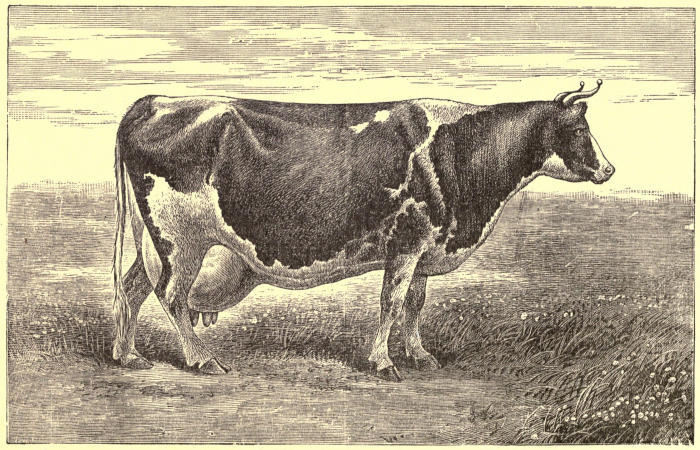
Fig. 2.—THE AYRSHIRE COW “OLD CREAMER.”