A WOMAN’S SUCCESS AND EXPERIENCE.
Reading edition
BY MRS. MARY L. TAYLOR, NORTH VERNON, INDIANA.
My success in keeping the family cow is mainly due to the superior sense of that animal in coming into being in a latitude where a cow can live with as little care and protection, and where the face of unplowed and unharrowed nature furnishes as much food for her as any other; latitude thirty-nine.
My cow is a scrub—cost twenty dollars; had her calf on the fourteenth of February, 1879, and we complimented the saint on whose day she came by calling her Valentine.
HOW WE MANAGED THE CALF.
I put the calf in a pen made in the fence corner and covered with a few old boards, and let the cow in to her every night—first taking from the cow what milk we needed for our family of four persons. I left her with the calf all night, and in the morning milked what the calf had left for me. This was not much after the first two weeks, and after two more weeks I only wasted my time at milking in the morning. I parted with the calf at three months old for eight dollars, and laid this sum by as my capital to draw against for the cow’s winter keeping.
My farm is half an acre in extent, and all of it, except the space occupied by the cottage and a small garden, is lawn, and is well set in Blue-grass, with a sprinkling of Orchard-grass.
SUMMER MANAGEMENT.
I sold my lawn mower and put a short rope around my cow’s horns. To this I fastened the chain of an old chain-pump. The pump had served its day, and was now laid aside. This old pump-chain was about sixteen feet long, and through the end of it I stuck an old iron garden stake into the ground, and staked my cow out on the lawn. In the chain I put rings one yard apart, and by running my garden stake through a ring nearer or farther from the rope around the cow’s horns, I could give her a larger or smaller circle to graze on, and so let her eat very near to evergreens and other shrubbery without danger of having them injured. She pulled up the stake several times at first, but the remedy for this came of itself. In my desire to make her very secure, I had tied the rope around her horns too tightly and made her head sore. She ceased pulling, and though her head soon got well, she has never since pulled up the stake; so that my mistake in fastening the rope, though it caused me self-reproaches at the time, really proved a blessing in the end, for had she formed the habit of pulling the stake up, I should have been forced to discontinue staking her out for fear of her destroying the shrubbery. My cow seems to have a spite at shrubbery proportioned to its beauty, and this spite seems intensified against such plants as she cannot eat. A young cedar, for instance, she will never pass without trying to demolish it with her horns. By means of the rings in my chain, I could stake her so that she could eat up to the edge of an evergreen without being able to touch it with her horns, and I found the horns the only part that the shrubbery had to fear, for she never yet has tried to destroy anything with her heels.
My lawn, under the care of this new one-cow lawn-mower, became the admiration and envy of the whole neighborhood. The chickens followed her and scattered her droppings, so that the lawn was always clean. I found it a great improvement on the old hand lawn-mower, and much less labor, for the staking out was far less trouble than running the mower. Besides, I sold the old machine for almost half the price I paid for the cow. But, strange as it seems to me now, I at first felt a little ashamed of my new mower, for I got in the practice of staking the cow on the front lawn at night, and moving her to the back lawn early in the morning.
She did her work so silently in the darkness that my neighbors wondered much that in so well-kept a lawn they never heard the click of the lawn-mower.
We have no storms in the summer in this latitude from which a cow needs any more protection than a tree affords. When it rained I milked her under the shelter of a beech.
In June, I rented a one-quarter acre lot for two dollars, and for one dollar hired it plowed and laid off in furrows a little over two feet apart. In these furrows I dropped corn, the grains two to four inches apart. I hired it plowed once with a shovel plow. This cost seventy-five cents. At the first frost, I had it cut and put up in small shocks. A woman that does washing for me, and occasionally chores about the house, did this at forty cents a day. She was several days at it, but during the time performed other work about the house. I think she spent about two solid days on it. This corn-fodder, with few large ears on it, but a great many nubbins, made my fodder and grain for the cow for the winter. Later in the fall, when the corn-stalks were thoroughly cured, I had them placed against poles set on crotches around the place where the cow was sheltered during the winter. The stalks were leaned against the poles from both sides, and made a sloping roof both ways, so as to shed snow and rain. From these poles I gave the cow an armful of this corn and fodder night and morning, and though the snow did sometimes lodge on them, and make my mittens cold, I could generally find a spot on one side or the other that was clear of snow. This work of putting up the fodder for winter use cost about two dollars.
My cow had been used to “slops” and meal, and did not take kindly to whole corn at first. I was advised to husk the corn, and get it ground; but by feeding her a few small or broken, or soft ears from my hand, she soon became eager for it, and has learned to grind it as well as the mill, and at less cost of going to and from, to say nothing of the toll. But even if she was not as good a corn crusher as the mill-stones, there would be no loss, for my fowls follow her faithfully, and pick up every broken grain that is dropped; so the miller’s toll that I save keeps me in chickens and eggs. Now that the cow had come to eat whole corn, I was told that she would muss over the fodder, hunting for the nubbins, and waste the stalks; but by sprinkling a little brine on the stalks when she became dainty, I found I could make her eat them as closely as was desirable.
A WINTER SHELTER.
I had no stable. The cow stood out in all the storms until late in December. The hair grew very thick, almost like a buffalo robe, and she did not seem to mind the cold. There was an old chicken house on the place, standing on posts about five feet high. It was in a hollow, and was sheltered by evergreens on the north and west. As I pulled up her stake one night in a drizzle to let her go under the tree where I milked her, she started on the gallop for this house, and from that time it was her winter couch. There I milked and fed her. I tied the chain around one of the corner posts, so as to leave her the choice of the shelter of the building or of exposure to the storm at her discretion, and I must say that she often surprised me by seeming as fond as a child of standing out in the rain. Under this coop I fed her fodder; the stalks she left, littered down her bed, and I had more manure in the spring than I had ever had before. A boy spread it from a wheelbarrow at twenty-five cents a day. The spring before I paid fifty cents a load for the manure, and two dollars and fifty cents a day for the hauling.
ABOUT SALTING.
I never fed the cow any salt for health during the summer, but she kept healthy, and the butter came. In the fall, I began feeding her the house slops, night and morning, and when she did not eat them freely I put a little salt in. When I thought she was not eating her fodder up clean enough, I would sprinkle on a little brine with an old broom. I never fed salt for her good, but sometimes for mine. In the fall, when I wanted her to eat up weeds before they went to seed, I used occasionally to sprinkle with brine such spots as I wanted eaten off closely. I never could make my old lawn-mower cut off weeds any closer than grass, but this new lawn-mower would eat these weed patches to the collars of the roots.
My cow became used to this kind of life, makes me no trouble, has furnished the milk and butter for our family of four the whole year, and some butter to send to my friends, and a little to sell. I have fodder enough from my quarter acre to keep her until grass is abundant, and have one dollar and twenty cents of the price of my calf still on hand.
I might go on and tell you how I used to buy hay at a high price for wintering my cow, and quantities of bran, brewers’ grains and corn-meal; how the hay always made her costive and hide-bound, and how she never ate it with half the relish which she does the corn fodder; how I found it an unladylike act to raise my foot and force the garden stake into the ground, and so contrived a smaller iron that I could more gracefully plant, and that no unruly cow ever could pull up; how with this new stake I can safely leave her on the lawn all night with the fullest confidence of finding her in the morning just where I left her, how when at first the cow got loose and wandered to the garden, I discovered that the taste of the butter was disagreeably affected by her eating certain herbs, and how it was very pleasantly flavored by others; how I am cultivating these herbs to make the sweetest and most golden butter; how—but dear me! for a one-cow story it is already too long.
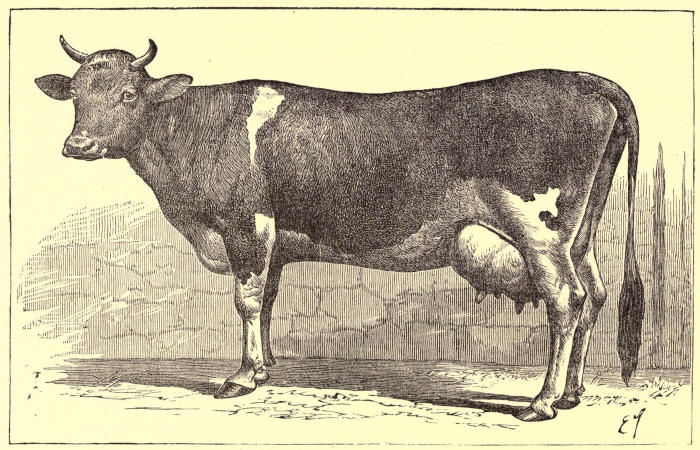
Fig. 23.—THE JERSEY COW “ABBIE.”