JERUSALEM ARTICHOKES AS COW-FEED.
Reading edition
BY CHRISTOPHER SHEARER, TUCKERTON, PA.
Butter and milk are not only luxuries, but in many families they are indispensable necessaries of life. In this article my principal purpose is to show how a cow can be kept with the greatest economy of land and labor. I consider these the essential points in the discussion. Where hay is dear and pasture scarce, a man who lives by the labor of his hands, cannot ordinarily afford to purchase the necessary food for a cow; and if he has only an acre or two of land at his disposal, he finds it more profitable to raise other products. Ordinarily it requires the yield of several acres of land to support a cow. But I propose to show that this can be done on less than one acre, by raising the proper crops, and treating the soil to the best advantage. A cow of ordinary size will consume about eleven thousand pounds of hay, or its equivalent, in a year. The equivalent of this amount of hay is—in potatoes, thirty thousand eight hundred pounds, or five hundred and thirteen bushels, and in Indian corn, seven thousand seven hundred pounds, or one hundred and thirty-seven bushels. These quantities cannot be raised on one acre, and if we examine the tables of equivalents of food, we find that most of the grasses, grains, and roots, are objectionable on account of unproductiveness, want of sufficient nutritive qualities, or of the labor that the cultivation of them requires.
VALUE OF ARTICHOKES.
There is, however, a root, or tuber, an acre of which affords enough nourishment to sustain two cows, with less labor than is employed in raising an acre of potatoes—and that root is the Jerusalem Artichoke (Helianthus tuberosus). We can depend upon an average yield of from one thousand to one thousand two hundred bushels of these tubers from an acre of land rich enough to produce fifty bushels of corn. Pound for pound they are equal in nutritive qualities to potatoes. One cow can therefore be subsisted a year on five hundred or six hundred bushels of the tubers, a quantity that can be raised on half an acre of land. But since these roots do not keep over summer, and as the cow will not thrive on them alone, it is necessary to supplement them with dry fodder during winter, and to subsist her on other forage during summer. With the aid of this plant, three-quarters of an acre of land under high cultivation, will nourish a cow during the whole year, and the soil will become rich without any other manure than that derived from the cow. This can be done with little expense, and with no more labor than is involved in ordinary farm culture. It is necessary to begin operations on the farm in most sections of the Middle States, a little earlier than the first of May.
A cow can be subsisted to the best advantage on a small patch of land, by feeding her Jerusalem Artichokes and a little hay or other dry fodder through the winter and part of spring, and soiling her with green rye, clover, and green-corn fodder, the rest of the year. Three-quarters of an acre will, under judicious treatment, yield enough of these products to maintain a cow during the year. If the soil be not in good condition to begin with, that quantity of land may, for a year or two, be insufficient for the purpose, and it will then be necessary to supply the deficiency from other sources; but by proper management the land will, in a few years, be converted into a garden that will afford abundant nourishment for the cow, without pasture or outside aid either in food or manure.
Suppose that a man owns a cow of medium size, or a little larger, that he has three-quarters of an acre of land, that one-third of it, namely, one-quarter of an acre, is in clover, that the remainder is ready for the plow, and that it is early spring-time of the year, he should go to work at once and manure the land liberally, for he will be well repaid for the expense, in the superior productiveness of the soil. All the land, excepting the clover, should be plowed, and one-sixth of the land, that is one-eighth of an acre, should be sowed with oats, with about one-half bushel of seed. One quart of clover seed, and one pint of timothy seed should be sown on the oats. The oats are raised only during the first year, rye being substituted in after years, and the timothy is added for the purpose of increasing the hay-crop in the second year. One-third of the land (one-quarter of an acre) should be planted in Jerusalem Artichokes, early in the season. This root should be planted in hills, three feet apart each way, and cultivated flat, both ways. As the land increases in fertility in future years, the hills may be set a little farther apart. The patch should be stirred two or three times with the cultivator while the plants are young, and afterwards kept clear of weeds with the hoe. The weeds require but little attention after the plant has attained a fair growth. One tuber, or piece of tuber, of about the size of a hen’s egg, is sufficient for a hill, the seed being covered to the depth of two or three inches with earth.
As soon as the season is far enough advanced, one-sixth of the plot (one-eighth of an acre) should be planted in sweet corn. One half of the corn should be set out very early, and the rest about four weeks later, so as to extend its growth, and consequently its availability as green fodder, over a longer period. The furrows should be three feet apart, and the corn planted in drills, [sixteen to twenty kernels to the foot—Ed.] Afterwards the corn should be cultivated two or three times, and kept clear of weeds. When the corn fodder is all disposed of, the corn patch should be plowed, and seeded with about a peck of rye, and a pint of timothy seed, and in the following spring a quart of clover seed should be sown upon the rye. These crops will give the land a complete rotation every six years. The following diagram indicates the proper succession of the crops and shows the plot of land divided into six equal parts, containing one-eighth of an acre each:
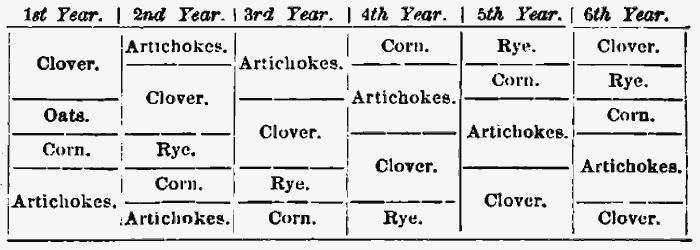
Clover occupies two parts, rye one part, and Jerusalem Artichokes two parts every year. Clover follows rye; rye follows corn; corn follows artichokes; and artichokes follow clover. Every year one-half of the clover, namely, the two-year-old clover patch, is plowed, and planted in artichokes. The latter must be planted anew, and not be allowed to grow as a “volunteer crop,” but must be regularly cultivated, and all the plants that come up between the hills destroyed.
The manure derived from the cow during the winter, should be spread in spring on the land intended for corn and artichokes, and plowed down, and that made in summer should be applied to the rye and clover patches in fall. Ashes and a moderate quantity of lime, spread on the clover patch early in spring, will be beneficial, and a peck of gypsum scattered on the young and growing clover, will answer an excellent purpose as a healthy stimulant of its growth.
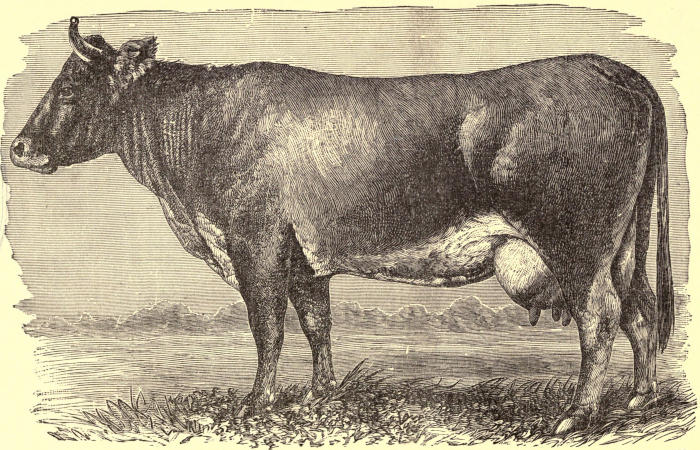
Fig. 16.—SWISS COW “GENEVA.”
The spring time of the first year must be tided over with hay until the clover is large enough for soiling. Green clover is then fed to the cow until the oats are sufficiently advanced. The oats are then used as long as they are fit for the purpose, cutting them a second time as far as practicable, and the residue, if any, is cured for hay before it gets too ripe for that purpose. The same course is pursued with the rye in the following years. The clover should be cut for hay rather early, in order to get it in the best possible condition, and to insure a good second, and perhaps a third crop. All the aftermath not used in soiling, should be converted into hay. When the oats are exhausted, clover is fed until the corn fodder is large enough for use. This is fed until the ears make their appearance, and what is then left is cut and cured for dry fodder during winter. After the green corn fodder is all consumed, there will be a growth of new clover in the oats stubble the first year, and in the rye stubble in after years, with which the cow is soiled until the artichokes are ready to feed, and if any of the new clover is left by that time, it is made into hay. The artichokes are fed raw; in winter, with hay and other dry fodder, and as long as they last in spring.
In the second year soiling begins with rye, and continues afterwards through the season the same as the first year, and a like course is followed in succeeding years.
FEEDING ARTICHOKES.
The artichokes will grow until frost kills the stalks, and a patch of one-quarter of an acre, when the soil is in good condition, will yield a yearly average of between two hundred and fifty and three hundred bushels of them. They can be fed before they are quite ripe, in which case the cow will eat up the whole plant—root, stalk, and branch. She must not have access to a heap of the tubers, lest she surfeit and seriously injure herself. As long as the whole plant is fed, she should not be allowed more at a time than she will eat up clean, for if she gets more she will eat the tubers, and refuse the stalks. In fact she will prefer these tubers at all times to any other food. She should therefore receive a certain allowance, say a peck or a little more, three times a day, so that she will eat up the stalks, and also a small portion of other forage with them. In winter and spring she will consume a bushel or more of the raw tubers a day, together with eight or ten pounds of hay or other dry food. Her ration of artichokes should never be so large that she will reject other food.
Artichokes can be fed for about eight months of the year, say from the first of October to the first of June, during which time the cow will consume two hundred and forty bushels, or more, of them. These, with the hay and other dry fodder, will keep her in excellent condition, and produce an abundance of good milk without additional food. One ton of hay or other dry fodder, in connection with the artichokes, will last during the said eight months, affording the cow eight or nine pounds a day. Three quarters of a ton may suffice, but she should not have less than this. If the crop of hay and other dry fodder exceeds a ton, it may all be fed during the first year, or a part of it may be kept over for the ensuing year. In stowing away the hay, ten or twelve quarts of salt should be scattered through a ton of it, to impart a relish. In addition to this, the cow should receive two or three ounces of salt daily, and plenty of pure fresh water.
HARVESTING ARTICHOKES.
The artichokes should remain in the ground in autumn as long as the weather permits, and be fed out of the field during that time, and just before the earth is permanently frost-bound, enough of them should be dug up to last over winter; and, since frost does not injure them, the rest should be left in the ground until the following spring. A good way to keep them in winter, is to place them on the ground in the field in shallow layers, covering them lightly with the stalks of the artichoke, or with straw, and then with a little earth. If the rain wets them it will not injure them. It is advisable always to keep a considerable quantity of them in the stable or cellar for convenience of feeding. In the ensuing spring, they are again fed out of the field until it is time to plow the land, when all the tubers not yet disposed of, are taken up and kept in the cellar or stable.
THE STALKS
of the Jerusalem Artichoke furnish excellent material for litter for the cow. They grow to a hight of from eight to ten feet, are composed almost entirely of pith, and are so fragile that they can easily be broken into fragments. As many of them should be stowed in the stable as it will contain, and the rest, if any, should be stacked outside. Before bedding the cow with them, it is advisable to crush them with a mallet on a block prepared for the purpose. This labor will require but a few minutes daily to provide sufficient litter, and will make a comfortable bed for the cow, absorbing and retaining the liquid manure. The stalks cannot be used for fodder after being frost-killed.
If the food of the cow should at any time run short the deficiency must be supplied, for it will not do to stint her, and if it is ever found necessary to change or modify her diet, it should be done.
I have allowed three-quarters of an acre for the sustenance of the cow, and this will be sufficient, but only on condition that the land is in good heart. If the land is poor at the start, it will be safer to begin with more, and afterwards to reduce the quantity to three-quarters of an acre, as the soil increases in fertility. The value of clover as a renovator of the soil is well known, but the Jerusalem Artichoke is equally efficacious, if fed on the farm, for it attracts its nitrogen to a great extent from the atmosphere. The dairy-farm now under discussion possesses all the advantages that can be derived from these plants as fertilizers, and as the other crops raised on it do not injuriously exhaust the soil, being cut before they produce their seed, the land will improve indefinitely in fertility.
THE CALF AND THE CARE OF IT.
Since the plants here recommended for the nourishment of the cow, afford the best milk-producing food the whole year round, the time of calving may be left to the option of the owner, for it will not affect the quantity of milk that the cow gives. If the milk is mostly needed in summer, the cow should calve in spring, and if it be desirable to have more milk in winter, she should calve in autumn. I might add, that if the butter, or a part of it, is to be sold, it will be more profitable to have the calf in fall than in any other season, because butter brings the highest prices in winter.
The disposal of the calf depends on circumstances, of which the owner is the best judge. If he concludes to keep it on account of the value of the breed, or for any other reason, he should raise it by hand, not allowing it to suck more than three days at furthest. For the first few days it should receive only the fresh milk of the cow; afterwards it may be fed on warm fresh milk, skim-milk, buttermilk, whey, and hay-tea, until it is old enough to subsist on solid food. Fresh milk should be the leading diet in the beginning, and should be gradually diminished in quantity as the calf increases in strength. Hay-tea is made by pouring boiling water on hay, and letting it steep for about two hours. If the calf is not to be raised, it ought to be sold before it is a week old, because the milk that it drinks before it is ready for the shambles, is worth more than the price it will bring. If a purchaser for the calf cannot be found while it is so young, it is most profitable to kill it, and bury it in the compost heap, as soon as the milk of the cow is fit to use. I simply state this as a fact, without recommending it to be done, for it is cruel work; but so is any butchering, and if the calf is to be killed, it really matters not how soon it is done. The sooner it is removed from the cow the less she will grieve for its loss.
CALVING.
The cow should be milked as long as her milk is good, or until she runs dry, which may in some cases be six or eight weeks of calving (in others not at all.) Her rations should be curtailed a little for a short time before that period, in order to carry her safely through the crisis. After she has the calf, she may receive warm bran-mashes for a day or two, containing a little of her own milk, and should not be fully fed for the first few days. This treatment is all that is required before and after the period of calving. The cow will generally pass through this event in safety, without assistance. Should there, however, be a false presentation, or other difficulty of parturition, the best thing the owner can do, if he has no experience in the matter, is to call to his aid a veterinary surgeon, or a neighbor who knows what course to pursue in such cases.
As long as the cow is fresh, and yields a large flow of milk, she should be milked three times a day, early in the morning, at noon, and late in the evening; afterwards two milkings daily, will be sufficient. She should be fed, watered, milked, carded, and led out of and into the stable, at the same hours every day. She should not be beaten, or pelted, or harshly spoken to or dealt with in any manner. Kind and considerate treatment inspires her with confidence and contentment, makes her the pet and delight of the household, and is rewarded by an abundance of wholesome milk. But there are many matters of detail in keeping a cow, which it is impossible to notice in a limited essay like this. If the owner desires to be fully informed on the subject, he will do well to purchase a few books that treat upon the subject.
The stable for the cow should be warm, dry, well ventilated, and large enough to contain two or three tons of hay and litter, together with other material to be described hereafter, besides a stall for the cow, and room for the calf. If the owner of the cow has a stable that fulfils these requirements, it will answer his purpose if he makes a proper stall in it. If he has no stable, and cannot afford the expense of building a good one, he must at least have a proper stall to save the manure of the cow, and to shelter her from the inclemency of the weather. A stable that will fully answer this purpose, should be at least fourteen feet square, and about twelve feet high to the eaves, and should have a loft for storing hay. The annexed figures represent such a structure in outline:
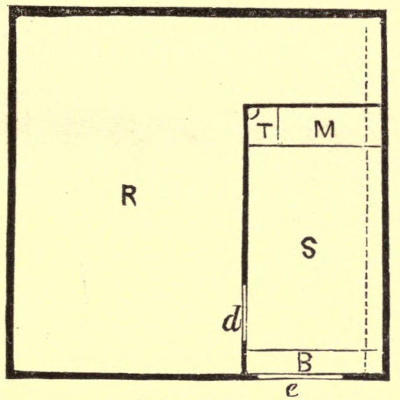
Fig. 17.
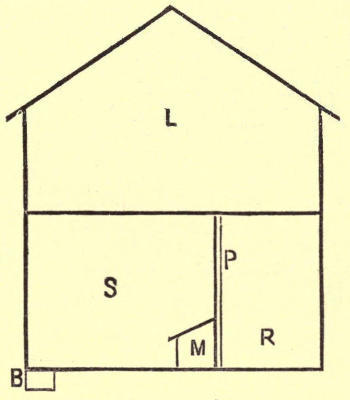
Fig. 18.
Figure 17 is a ground plan, and shows that the lower story is divided into two parts, S, representing the stall, and R, all the remaining portion below. The stall is ten feet long, and should be five, or nearly five feet wide; M, represents the manger, which is about two feet deep, eighteen inches wide, and in length equal to the width of the stall. The cow is tied to the manger with a halter or chain; T, is a trough in the manger for feeding roots, salt, etc., and is about one foot wide, eight inches deep, and in length equal to the width of the manger. The floor of the stall should slope a little to the rear, and must be water-tight, so as to conduct the urine of the cow into the brine-pit, B. The floor may be composed of cement, or of two-inch plank closely fitted together. The brine-pit, B, consists of a water-tight box made of plank, and should be about one foot wide, six inches deep, and in length equal to the width of the stall. This pit is sunk into the ground so that its top is on a level with the floor, in order that it may receive all the liquid discharges of the cow that are not absorbed by the litter. If the floor is laid in cement the pit may be made of the same material. The object of the brine-pit is to save the liquid manure; to accomplish which the latter must be retained by some absorbent. Dry earth is used for this purpose. At first the bottom of the pit is covered with dry earth, and as soon as this is moist, more earth is added until the pit is full of the saturated substance, when the latter is thrown upon the compost heap, and the same process repeated. A door is placed at e, for admitting the cow, and carrying away the manure. The partition between S and R may be made of boards or rails, and need not be over four feet high.
The division, R, is used for keeping litter, dry earth, artichoke roots, green fodder, and the calf. It should have a door at some convenient place for entrance from the outside, and a window with a glass-frame, preferably on the south side. It is in communication with the stall by means of a gate at d.
Figure 18 is a view of the gable-end, L, representing the loft for storing hay and other dry fodder. The loft has a shutter in one of the gable-ends or sides, and a ladder or steps running up to it from within, for convenience of feeding. P, is a post in the corner of the manger. The other letters in figure 18 indicate the same parts as in figure 17.
The cow-yard will be large enough if it contains an area of two square rods; but it can be made somewhat larger with advantage. It ought to adjoin the stable so as to give the cow direct access to the stall; and ought to be shaded by trees in order to afford shelter to the cow from the direct rays of the sun in summer. The cow should be kept in the yard only a part of the day, and the rest of the time she should be in the stall. The stall-door should be left open when she is in the yard, so that she can enter the stable at will. Some manure will be lost by suffering her to run in the yard; but the benefit that she will derive from it, in health and contentment, will more than compensate for the loss.
MAKING AND SAVING MANURE.
The compost heap may be kept in the cow-yard, and must be in the shade. It should, therefore, be placed on the north side of the stable, and trees should be planted east and west of it. It must not be under cover nor washed by running water, nor receive the water from the roof of the stable; but the rain should fall on it directly from the skies to promote decomposition, and to prevent the escape of its volatile constituents. The manure of the stall, and the saturated earth of the brine pit, are mixed together to form the compost heap, and all the refuse material of the farm, garden, and yard, should be thrown on it. It ought to be kept in a compact body, level on top, and protected by boards on the sides to prevent it from spreading. No ashes or lime should ever be applied to it.
Regarding the material for absorbing the liquid excretions of the cow, nothing better can be found than prepared muck; but as this is seldom obtainable, the scrapings of the streets of a city, or even of a public road, may be used instead. If these cannot be had, the surface soil of the dairy farm answer the purpose. Whatever substance is employed must be thoroughly dried. The middle of summer is the proper time to prepare it. About four cart loads of it, as dry as they can be made, should be kept in the stable, or in some other place where it is not liable to attract moisture; and that amount will last the year round.
CONCLUSIONS ABOUT ARTICHOKES.
I have now given my instructions for keeping a cow, and it is evident from what I have written, that the Jerusalem Artichoke is my main dependence for her support. The other points that I have touched upon, are of minor importance, when compared with the value that I have attached to this plant. My own experience with the plant satisfies me that I have not overstated its merits. On rich land a single stalk will produce from a peck to half a bushel of the tubers. Last year was an exceptionably unfavorable one in this locality, on account of drouth in summer and fall; and yet the artichokes that I planted between the trees in my peach orchard yielded abundantly. I have fattened cattle on them without any additional food excepting a little hay, until they were fit for the butcher; and my horses thrive on them when fed in connection with hay, doing full work without grain. A brother of mine planted artichokes in a field that had been in cultivation for more than a century, and yet in spite of the drouth, of indifferent culture without manure, and of an early frost that prematurely killed the plants, the yield amounted to between five hundred and six hundred bushels to the acre.
RURAL ECONOMY.
Boussingault in his “Rural Economy,” pp. 159-160 says: “The Jerusalem Artichoke rises to a hight of from nine to ten feet; it flowers late, and I have not yet seen it ripen its seeds. It is propagated by the tubers which it produces, and which are regarded, for good reason, a most excellent food for cattle.... There are few plants more hardy and so little nice about the soil as the Jerusalem Artichoke; it succeeds everywhere with the single condition that the ground be not wet.... Of all the plants that engage the husbandman, the Jerusalem Artichoke is that which produces the most at the least expense of manure and manual labor. Kade states that a square patch of Jerusalem Artichokes in a garden was still in full productive vigor at the end of thirty-three years, throwing out stems from seven to ten feet in length, although for a very long time the plant had neither received any care or any manure. I could quote many examples of the great reproductive power of the Helianthus; I can affirm, nevertheless, that in order to obtain abundant crops, it is necessary to afford a little manure.... Schwertz estimates the mean quantity of dry leaves and stems at three tons, one cwt., one quarter and fifteen pounds per acre.”
Again, p. 401—“Experiment with horses.—Jerusalem potatoes are held excellent food for the horse; they are eaten greedily, and he thrives on them. In this second experiment 30.8 pounds of Jerusalems cut into slices were substituted for eleven pounds of hay, the same theoretical equivalents being assumed for them as for the common potato. The ration now consisted of hay, eleven pounds; straw, five and a half pounds; oats, seven and a half pounds, and Jerusalem potatoes, 30.8 pounds. Having been accustomed to this regimen for some days, the teams were weighed, and having gone on for eleven days, they were weighed again:
Team No. 1. No. 2. Both Teams. Mean per horse.
In eleven days, gain 55 loss 33 gain 22 gain .9
“A result which leads to the conclusion that the equivalent assumed for the Jerusalem potato was correct; the animals had done their work, and gained one with another nine-tenths of a pound in weight.”
Again, p. 406.—“One hundred pounds of good meadow-hay may be taken, as ascertained by experiment, to be equivalent to
280 of Potatoes, by analysis equal to 315
280 of Jerusalems, ” ” 311
400 of Beets, ” ” 548
400 of Swedes (too little), ” ” 676
400 of Carrots, ” ” 382
Again, p. 415.—“One thousand parts (by weight) of the forage gathered at Bechelbroun in its ordinary state contained:
Mineral Substances. Azote. Phos. Acid. Lime. Bone Earth.
Potatoes, 9.64 3.70 1.09 .17 .33
Beet, 7.70 2.10 .46 .54 .95
Turnip, 5.70 1.30 .35 .62 .72
Jerusalems, 12.47 3.75 1.35 .29 .53
Again, p. 449.—“Seventh experiment—with a cow two hundred and ninety days after calving.—In this trial the ration consisted of Jerusalem potatoes equivalent to thirty-three pounds of hay, under which the milk may be said to have remained stationary, though it was above rather than under the six pints per diem, as in the sixth experiment,” (with Irish potatoes).
I consider, therefore, that, according to experiment and analysis, the Jerusalem Artichoke is fully equal to the potato as food for stock, and greatly superior to beets, turnips, and carrots. In the regimen that I have prescribed for the cow, I have given the Jerusalem Artichoke the preference over all other roots, because I deem it superior to them in all respects. It contains more nutriment than any of them, excepting the potato; it is less exhaustive of the soil, and more efficacious in improving it; it produces a larger crop; it is less liable to failure in adverse weather; it keeps better and with less care; it is eaten with a greater relish by stock; and it requires less labor in cultivating, harvesting, and feeding it. Analysis has shown that it contains its carbonaceous principles in the form of sugar instead of starch, 14.8 parts of uncrystallizable sugar having been found in one hundred parts of the tuber. It has no starch cells to be broken up by boiling, in order to make it a digestible aliment; and how large soever the tubers may be, they can be fed without being cut into slices, on account of their fragility and brittleness, being masticated by the cow without difficulty or danger of choking.
The Jerusalem Artichoke is little known and cultivated in this country, and its merits are not fully appreciated anywhere. The reason probably is because there is but a limited demand for it in the market. But it should not be neglected on that account; for it is not the less valuable, because the profits derived from it are indirect. It should never be raised as a volunteer crop, as is too often the case, but should be regularly planted and worked like other products. I have discussed this plant as advantageous food for “one” cow, and I may add that it is equally meritorious for any number of cows. But its advantages do not stop here. Horses, cattle, sheep, and swine, thrive and fatten on it, and the millions of acres of exhausted and deteriorated lands, that descend as a profitless inheritance from generation to generation in the Eastern and Southern States, can be improved and kept fertile, with profit to the farmer during the process of renovation, without the aid of artificial fertilizers or imported manures, by feeding the tubers of the Jerusalem Artichoke to stock on the farm.