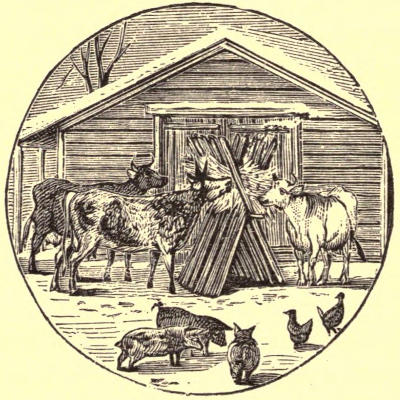
KEEPING A COW ON CAPE COD.
Reading edition
BY M. T. T. NICKERSON, SOUTH DENNIS, MASS.
We live in a section of country where nature has not been lavish with her gifts. Our soil is sandy and only produces paying crops by high cultivation. Farming with us comes near to being one of the lost arts. We are not tillers of the soil. Living, as we do, within sound of the Atlantic surf, as it beats its everlasting measure upon our coast, we, from associations of birth and early training, plow the Ocean for a living, the furrows frequently stretching from pole to pole, or to the opposite side of the globe. Few, very few, keep cows. A large proportion of our people do not keep any, and it is not common to find many that have more than one.
We keep a good grade Jersey, and will give our way of keeping one cow, having learned long ago, that stock of any kind paid for good care. Keeping a lot of cattle or hogs, or poultry, and simply feeding what we happen to have, or what we can buy cheap, leaving them to shift for themselves in cold and stormy weather, or giving them wet uncomfortable stables, always results in disease to the stock and loss to the owner.
We sow as early in the spring as the ground is in condition to work, forty rods with a mixture of oats and peas, and forty rods in spring rye. We commence cutting our oats and peas as soon as the peas begin to bloom. Where we have a good stand, a rod per day, divided in three feeds, morning, noon, and night, is generally enough. As soon as we have cut about ten rods we plow under the stubble, and plant Early Minnesota Sweet Corn—rows two and one half feet apart—hills two feet in the rows, leaving two and three stalks in a hill. The next ten rods we serve in the same manner. If our rye is now grown enough to cut with profit we commence feeding it, and cut the balance of our oats and peas, and cure them for winter.
If our rye is not fit to cut for soiling, we continue to use our oats and peas until it is, and then cure for winter what is left. As soon as the last of our oats are off, we plant about four rods with beets (mangel wurzel). We prefer the Globe varieties, as the yield is better on our soil. The balance of our oat-and-pea ground we sow with Hungarian grass.
As soon as we have cut ten rods of our rye, we manage as with our oats, turn under the stubble and again plant sweet corn. The earlier the variety the better. We prefer the Early Minnesota. As soon as we have cleared off the next ten rods of our rye, we plant from two to four rods with turnips. The balance we sow with a mixture of Hungarian and the earliest “Canada Gray” pea. We now feed our rye until our first planting of corn and Hungarian will do to feed, when we turn under the rest of the rye stubble (curing what is left of the rye for winter), sow half with Hungarian and the balance we sow (not plant) with sweet corn. As soon as our first planting of corn is cut up, we sow two or three rows broadcast with flat turnips, some of the strap-leaved varieties, hoeing or raking them in by hand. We continue to plant or sow some quick-growing variety of corn, peas, grass, grain, or roots, even when it is very doubtful if we shall receive any return for our time and work; but we frequently get a fair yield from our third planting. I presume a great many will be sceptical in regard to this “third crop business.” It must be remembered that our first sowing is made very early in the spring, and that we do not wait until any of our forage crops mature, but we cut them long before they would be ripe, thereby shortening the time of their growth and leaving the ground to be planted with something else.
The above is no iron rule, but subject to great variations. Our plan is to sow as early as possible in the spring with the earliest maturing grass or grain we can get, and from the time we commence cutting until there is no possibility of getting any return. We sow and plant wherever we have a few rods of bare ground, as soon as any of our crops are maturing or there is something coming forward to take its place. We cut and cure what is left for winter. We advise close seeding in all cases, roots, of course, excepted.
COW KEPT ON HALF AN ACRE.
If the season is favorable, we manage to keep our one cow nicely on half an acre, or rather on the fodder grown on half an acre. But sometimes, on account of drouth or late frost, we are obliged to buy a little hay in the spring.
It is impossible for us to say how much feed must be bought. We generally have a bag of corn (two bushels), and a bag of oats (two and a half bushels), ground together, feeding from two to four quarts a day, according to the amount of roots used, and the season of the year, feeding meal very sparingly in summer. We frequently reserve two or three rods in the spring for early turnips, to be fed when large enough for profit, but always feed turnips immediately after milking to prevent flavoring the milk. We generally have a few cabbage plants started to set where the corn misses, or the beets or turnips fail to come up, or in any corner or by-place where there is room for a cabbage to grow. Sometimes we reserve a few rods for cabbages late in the season, as we find them excellent for a change of feed either winter or summer. We advise, in all cases, the use of the earliest varieties of grass, grain, or vegetables, as we cannot afford the time and ground occupied by some of the larger and taller growing varieties, being convinced, from actual experience, that two and three crops of early varieties, although small, are more profitable than one crop of the larger late varieties.
THE STABLE AND THE MANURE CELLAR
The stable for our cow is a shed nine by sixteen, built on the south side of our carriage and wagon house. One-half of the shed is partitioned off and enclosed for winter use or stormy weather; the other half of the shed is open on the south side, and our yard is about sixteen by thirty, including the shed. We think it would be better to have it larger, but we get along with it nicely. We find the best way to dispose of her manure is to have a small cellar underneath the stable, with cemented bottom and sides, so as to be water tight, the stable to have a tight floor with a gutter behind the cow to receive the droppings and urine, with a scuttle or trap door in the gutter to let it all go into the cellar. For bedding, we use forest leaves, and use them liberally. Where forest leaves cannot be obtained, any refuse hay or straw will answer, but the cow as well as the horse should have plenty of good dry bedding. To mix with the urine and droppings of the cow, we put into the cellar, sea-weed, muck, turf, slops from the house, and soap suds, or anything we think will make good compost. We gather up the droppings from the yard and throw them into the cellar. We keep our yard well laid with forest leaves. If those are not available, we use the next best thing we can get. In the fall, when we cart the manure out of the cellar, we gather up what has accumulated in the yard and put it into the cellar. In this way we save all of the manure, and in excellent condition. Now, to make it better and save the labor of pitching it over, we keep a pig where he can have access to the cellar, and if not disposed to work, we keep him on short feed and scatter corn in the cellar, so that in order to get it, he will have to root the whole mass over in good shape.
We cart our manure out in the fall, distributing it over our land as evenly as possible, and plow it under as deep as we can. We do not sow anything for next year’s use, as we think we get a better return from our land to sow early in the spring and continue it through the summer. It is a mistaken idea, or rather a grave blunder, to undertake to grow good crops of anything without the liberal use of manures. As soon as our land will do to work in the spring, we sow our oats, peas, and rye, giving a top dressing of guano, superphosphates, or bone meal, which we repeat with each successive sowing, also giving each hill of corn and rows of beets and turnips a small quantity. We alternate the top dressings, that is, if we use superphosphate the first sowing, we use ground bone or guano the second, and vice versa, as we find the continuous use of any one kind of manure or fertilizer is as injurious as continuous planting of corn or potatoes, without rotating with something else.
BARRELS FOR KEEPING ROOTS.
We have a way of our own for keeping our roots in the absence of a vegetable cellar, or when we do not want them in the house cellar. We take any old barrels and set them in the ground, the chiner just coming to the top of the ground (we do not want a head in either end of the barrels). Into these headless barrels we put our beets, turnips, cabbage, etc. As the weather grows cold we cover the barrels with some loose boards. Whenever it is cold enough to freeze hard, we throw over them enough hay or straw to keep out the wet. By this method we can, with very little trouble at any time, get out a barrel or part of a barrel of roots. In this way the roots keep in fine condition. Late in the spring, turnips and beets will be as brittle and good as when pulled in the fall. Our subject is “keeping one cow,” but any one that feels disposed to try it, will find the above a very fine way to keep turnips, beets, cabbage, or celery, for family use.
We prefer to have our cow calve about the first of April, as we then have time to make veal of the calf before we begin to make grass butter. There is generally, in any place, a better demand for milk through the winter, and better prices, hence if one wishes to sell milk and buy butter, it would perhaps be better to have her calve in the fall.
We hardly feel competent to advise, if help is needed in calving. As her time of calving draws nigh, we give our cow extra care and attention. If the bowels are kept in a healthy condition, we apprehend there is rarely trouble, from the fact that our cows have always calved without the need of help.
If there is ready sale for milk at paying prices, we would dispose of the calf in some way, when it is a few days old, but if milk is not salable at good prices, it is better to let the calf have the milk until from four to six weeks old, and then if the butcher will not give us a fair price for it, we get some one to dress it for us, and sell it among our neighbors, who are generally glad to buy it. In that way we get from eight to twelve dollars for our calf. We think it as well for the cow to keep the calf for that length of time. It seems to satisfy a necessity of her nature to have her baby suck and draw its nourishment from her. We know of no better picture of contentment than to see an old cow suckling her calf after being away from it all day.
We advise regular hours of milking night and morning, and kind, gentle treatment, carding in winter, cleanliness and thorough ventilation of stable at all times. In summertime, if confined in a yard, a thin sheet to keep off the flies will be found very comfortable for the cow, and profitable to the owner. I presume some will ridicule the idea of blanketing the cow, but why not as well as the horse? Again, if confined in a yard, she should have plenty of clean pure water, and plenty of shade. Keeping a cow, with us, is not altogether a matter of fancy or pleasure, but of convenience, economy, comfort, profit, and health, in having pure sweet milk and fresh butter.