THE ROMANCE OF THE SWAN’S NEST
Reading edition
By Elizabeth Barrett Browning
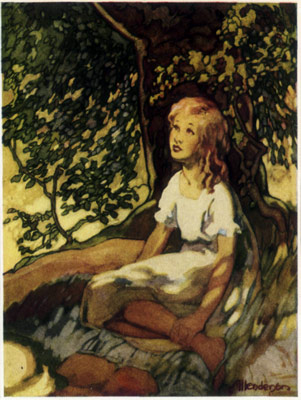
Little Ellie sits alone ’Mid the beeches of a meadow, By a stream-side on the grass, And the trees are showering down Doubles of their leaves in shadow, On her shining hair and face.
She has thrown her bonnet by, And her feet she has been dipping In the shallow water’s flow; Now she holds them nakedly In her hands, all sleek and dripping, While she rocketh to and fro.
Little Ellie sits alone, And the smile she softly uses Fills the silence like a speech, While she thinks what shall be done, And the sweetest pleasure chooses For her future within reach.
Little Ellie in her smile Chooses, “I will have a lover, Riding on a steed of steeds: He shall love me without guile, And to him I will discover The swan’s nest among the reeds.
“And the steed shall be red roan, And the lover shall be noble, With an eye that takes the breath. And the lute316-1 he plays upon Shall strike ladies into trouble, As his sword strikes men to death.
“And the steed it shall be shod All in silver, housed in azure;316-2 And the mane shall swim the wind; And the hoofs along the sod Shall flash onward, and keep measure, Till the shepherds look behind.
“But my lover will not prize All the glory that he rides in, When he gazes in my face. He will say, ‘O Love, thine eyes Build the shrine my soul abides in, And I kneel here for thy grace!’
“Then, aye, then shall he kneel low, With the red-roan steed anear him, Which shall seem to understand, Till I answer, ‘Rise and go! For the world must love and fear him Whom I gift with heart and hand.’
Little Ellie Sits Alone
“Then he will arise so pale, I shall feel my own lips tremble With a yes I must not say: Nathless317-3 maiden-brave, ‘Farewell,’ I will utter, and dissemble— ‘Light to-morrow with to-day!’
“Then he’ll ride among the hills To the wide world past the river, There to put away all wrong, To make straight distorted wills, And to empty the broad quiver Which the wicked bear along.
“Three times shall a young foot page Swim the stream, and climb the mountain, And kneel down beside my feet: ‘Lo! my master sends this gage,317-4 Lady, for thy pity’s counting. What wilt thou exchange for it?’
“And the first time I will send A white rosebud for a guerdon—317-5 And the second time, a glove; But the third time—I may bend From my pride, and answer—‘Pardon, If he comes to take my love.’
“Then the young foot page will run— Then my lover will ride faster, Till he kneeleth at my knee: ‘I am a duke’s eldest son! Thousand serfs do call me master,— But, O Love, I love but thee!’”...
Little Ellie, with her smile Not yet ended, rose up gayly, Tied the bonnet, donned the shoe, And went homeward, round a mile, Just to see, as she did daily, What more eggs were with the two.
Pushing through the elm-tree copse, Winding up the stream, light-hearted, Where the osier pathway leads, Past the boughs she stoops, and stops. Lo! the wild swan had deserted, And a rat had gnawed the reeds!
Ellie went home sad and slow. If she found the lover ever, With his red-roan steed of steeds, Sooth I know not; but I know She could never show him—never, That swan’s nest among the reeds.
Mrs. Browning tells us very little of Ellie directly, yet she leaves us with a charming picture of an innocent, imaginative, romantic child. Ellie has been reading or listening to tales of knight-errantry, and her mind is full of them, so that the “sweetest pleasure ... for her future” is a lover riding straight out of one of the romances. That she is only a child, with a child’s ideas, we may see from the fact that she can think, in her simplicity, of no greater reward for her noble lover than a sight of the swan’s nest among the reeds, of which she alone knows.
Mrs. Browning’s purpose in writing this little story in verse was to show us how suddenly and how rudely unpleasant facts can break in upon our dreams. Ellie could never show her lover the swan’s nest, as she had planned; and we are left with the feeling that she never found the lover of whom she dreamed—that all of her dream proved as false as the beautiful thought about the swan’s nest.