THE RETREAT OF CORTES63-*
Reading edition
THE RETREAT OF CORTES63-*
By William H. Prescott
There was no longer any question as to the expediency of evacuating the capital. The only doubt was as to the time of doing so, and the route. The Spanish commander called a council of officers to deliberate on these matters. It was his purpose to retreat on Tlascala, and in that capital to decide according to circumstances on his future operations. After some discussion, they agreed on the causeway of Tlacopan as the avenue by which to leave the city. It would, indeed, take them back by a circuitous route, considerably longer than either of those by which they had approached the capital. But, for that reason, it would be less likely to be guarded, as least suspected; and the causeway itself, being shorter than either of the other entrances, would sooner place the army in comparative security on the mainland.
There was some difference of opinion in respect to the hour of departure. The daytime, it was argued by some, would be preferable, since it would enable them to see the nature and extent of their danger, and to provide against it. Darkness would be much more likely to embarrass their own movements than those of the enemy, who were familiar with the ground. A thousand impediments would occur in the night, which might prevent them acting in concert, or obeying, or even ascertaining, the orders of the commander. But, on the other hand, it was urged that the night presented many obvious advantages in dealing with a foe who rarely carried his hostilities beyond the day. The late active operations of the Spaniards had thrown the Mexicans off their guard, and it was improbable they would anticipate so speedy a departure of their enemies. With celerity and caution, they might succeed, therefore, in making their escape from the town, possibly over the causeway, before their retreat should be discovered; and, could they once get beyond that pass of peril, they felt little apprehension for the rest.
The general had already superintended the construction of a portable bridge to be laid over the open canals in the causeway. This was given in charge to an officer named Magarino, with forty soldiers under his orders, all pledged to defend the bridge to the last extremity. The bridge was to be taken up when the entire army had crossed one of the breaches, and transported to the next. There were three of these openings in the causeway, and most fortunate would it have been for the expedition, if the foresight of the commander had provided the same number of bridges. But the labor would have been great, and the time was short.
At midnight the troops were under arms, in readiness for the march. Mass was performed by Father Olmedo, who invoked the protection of the Almighty through the awful perils of the night. The gates were thrown open, and, on the first of July, 1520, the Spaniards for the last time sallied forth from the walls of the ancient fortress, the scene of so much suffering and such indomitable courage.
The night was cloudy, and a drizzling rain, which fell without intermission, added to the obscurity. The great square before the palace was deserted, as, indeed, it had been since the fall of Montezuma. Steadily, and as noiselessly as possible, the Spaniards held their way along the great street of Tlacopan, which so lately had resounded to the tumult of battle. All was now hushed in silence; and they were only reminded of the past by the occasional presence of some solitary corpse, or a dark heap of the slain, which too plainly told where the strife had been hottest. As they passed along the lanes and alleys which opened into the great street, or looked down the canals, whose polished surface gleamed with a sort of ebon lustre through the obscurity of the night, they easily fancied they discerned the shadowy forms of their foe lurking in ambush, and ready to spring on them. But it was only fancy; and the city slept undisturbed even by the prolonged echoes of the tramp of horses, and the hoarse rumbling of the artillery and baggage trains. At length, a lighter space beyond the dusky line of buildings showed the van of the army that it was emerging on the open causeway. They might well have congratulated themselves on having thus escaped the dangers of assault in the city itself, and that a brief time would place them in comparative safety on the opposite shore. But the Mexicans were not all asleep.
As the Spaniards drew near the spot where the street opened on the causeway, and were preparing to lay the portable bridge across the uncovered breach which now met their eyes, several Indian sentinels, who had been stationed at this, as at the other approaches to the city, took alarm and fled, rousing their countrymen by their cries. The priests, keeping their night watch on the summit of the teocallis, instantly caught the tidings and sounded their shells, while the huge drum in the desolate temple of the war-god sent forth those solemn tones, which, heard only in seasons of calamity, vibrated through every corner of the capital. The Spaniards saw that no time was to be lost. The bridge was brought forward and fitted with all possible expedition. Sandoval was the first to try its strength, and, riding across, was followed by his little body of cavalry, his infantry, and Tlascalan allies, who formed the first divisions of the army. Then came Cortes and his squadrons, with the baggage, ammunition wagons, and a part of the artillery. But before they had time to defile across the narrow passage, a gathering sound was heard, like that of a mighty forest agitated by the winds. It grew louder and louder, while on the dark waters of the lake was heard a plashing noise, as of many oars. Then came a few stones and arrows striking at random among the troops. They fell every moment faster and more furious, till they thickened into a terrible tempest, while the very heavens were rent with the yells and war cries of myriads of combatants, who seemed all at once to be swarming over land and lake!
The Spaniards pushed steadily on through this arrowy sleet, though the barbarians, dashing their canoes against the sides of the causeway, clambered up and broke in upon their ranks. But the Christians, anxious only to make their escape, declined all combat except for self-preservation. The cavaliers, spurring forward their steeds, shook off their assailants, and rode over their prostrate bodies, while the men on foot with their good swords or the butts of their pieces drove them headlong again down the sides of the dike.
But the advance of several thousand men, marching, probably, on a front of not more than fifteen or twenty abreast, necessarily required much time, and the leading files had already reached the second breach in the causeway before those in the rear had entirely traversed the first. Here they halted, as they had no means of effecting a passage, smarting all the while under unintermitting volleys from the enemy, who were clustered thick on the waters around this second opening. Sorely distressed, the vanguard sent repeated messages to the rear to demand the portable bridge. At length the last of the army had crossed, and Magarino and his sturdy followers endeavoured to raise the ponderous frame-work. But it stuck fast in the sides of the dike. In vain they strained every nerve. The weight of so many men and horses, and above all of the heavy artillery, had wedged the timbers so firmly in the stones and earth, that it was beyond their power to dislodge them. Still they laboured amidst a torrent of missiles, until, many of them slain, and all wounded, they were obliged to abandon the attempt.
The tidings soon spread from man to man, and no sooner was their dreadful import comprehended, than a cry of despair arose, which for a moment drowned all the noise of conflict. All means of retreat were cut off. Scarcely hope was left. The only hope was in such desperate exertions as each could make for himself. Order and subordination were at an end. Intense danger produced intense selfishness. Each thought only of his own life. Pressing forward, he trampled down the weak and the wounded, heedless whether it were friend or foe. The leading files, urged on by the rear, were crowded on the brink of the gulf. Sandoval, Ordaz, and the other cavaliers dashed into the water. Some succeeded in swimming their horses across. Others failed, and some, who reached the opposite bank, being overturned in the ascent, rolled headlong with their steeds into the lake. The infantry followed pell-mell, heaped promiscuously on one another, or struck down by the war clubs of the Aztecs; while many an unfortunate victim was dragged half-stunned on board their canoes, to be reserved for a protracted, but more dreadful death.
BATTLE ON THE CAUSEWAY
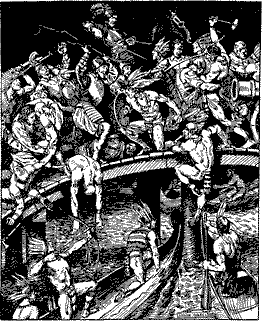
The carnage raged fearfully along the length of the causeway. Its shadowy bulk presented a mark of sufficient distinctness for the enemy’s missiles, which often prostrated their own countrymen in the blind fury of the tempest. Those nearest the dike, running their canoes alongside, with a force that shattered them to pieces, leaped on the land, and grappled with the Christians, until both came rolling down the side of the causeway together. But the Aztec fell among his friends, while his antagonist was borne away in triumph to the sacrifice. The struggle was long and deadly. The Mexicans were recognized by their white cotton tunics, which showed faint through the darkness. Above the combatants rose a wild and discordant clamor, in which horrid shouts of vengeance were mingled with groans of agony, with invocations of the saints and the Blessed Virgin, and with the screams of women; for there were several women, both natives and Spaniards, who had accompanied the Christian camp. Among these, one named Maria de Estrada is particularly noticed for the courage she displayed, battling with broadsword and target like the staunchest of the warriors.
The opening in the causeway, meanwhile, was filled up with the wreck of matter which had been forced into it, ammunition wagons, heavy guns, bales of rich stuffs scattered over the waters, chests of solid ingots, and bodies of men and horses, till over this dismal ruin a passage was gradually formed, by which those in the rear were enabled to clamber to the other side. Cortes, it is said, found a place that was fordable, where, halting, with the water up to his saddle girths, he endeavoured to check the confusion, and lead his followers by a safer path to the opposite bank. But his voice was lost in the wild uproar, and finally, hurrying on with the tide, he pressed forward with a few trusty cavaliers, who remained near his person, to the van; but not before he had seen his favorite page, Juan de Salazar, struck down, a corpse, by his side. Here he found Sandoval and his companions, halting before the third and last breach, endeavouring to cheer on their followers to surmount it. But their resolution faltered. It was wide and deep; though the passage was not so closely beset by the enemy as the preceding ones. The cavaliers again set the example by plunging into the water. Horse and foot followed as they could, some swimming, others with dying grasp clinging to the manes and tails of the struggling animals. Those fared best, as the general had predicted, who traveled lightest; and many were the unfortunate wretches, who, weighed down by the fatal gold which they loved so well, were buried with it in the salt floods of the lake. Cortes, with his gallant comrades, Olid, Morla, Sandoval, and some few others, still kept in the advance, leading his broken remnant off the fatal causeway. The din of battle lessened in the distance; when the rumor reached them, that the rearguard would be wholly overwhelmed without speedy relief. It seemed almost an act of desperation; but the generous hearts of the Spanish cavaliers did not stop to calculate danger, when the cry for succour reached them. Turning their horses’ bridles, they galloped back to the theatre of action, worked their way through the press, swam the canal, and placed themselves in the thick of the mêlée on the opposite bank.
The first grey of the morning was now coming over the waters. It showed the hideous confusion of the scene which had been shrouded in the obscurity of night. The dark masses of combatants, stretching along the dike, were seen struggling for mastery, until the very causeway on which they stood appeared to tremble, and reel to and fro, as if shaken by an earthquake; while the bosom of the lake, as far as the eye could reach, was darkened by canoes crowded with warriors, whose spears and bludgeons, armed with blades of “volcanic glass,” gleamed in the morning light.
The cavaliers found Alvarado unhorsed, and defending himself with a poor handful of followers against an overwhelming tide of the enemy. His good steed, which had borne him through many a hard fight, had fallen under him. He was himself wounded in several places, and was striving in vain to rally his scattered column, which was driven to the verge of the canal by the fury of the enemy, then in possession of the whole rear of the causeway, where they were reinforced every hour by fresh combatants from the city. The artillery in the earlier part of the engagement had not been idle, and its iron shower, sweeping along the dike, had mowed down the assailants by hundreds. But nothing could resist their impetuosity. The front ranks, pushed on by those behind, were at length forced up to the pieces, and, pouring over them like a torrent, overthrew men and guns in one general ruin. The resolute charge of the Spanish cavaliers, who had now arrived, created a temporary check, and gave time for their countrymen to make a feeble rally. But they were speedily borne down by the returning flood. Cortes and his companions were compelled to plunge again into the lake, though all did not escape. Alvarado stood on the brink for a moment, hesitating what to do. Unhorsed as he was, to throw himself into the water, in the face of the hostile canoes that now swarmed around the opening, afforded but a desperate chance of safety. He had but a second for thought. He was a man of powerful frame, and despair gave him unnatural energy. Setting his long lance firmly on the wreck which strewed the bottom of the lake, he sprung forward with all his might, and cleared the wide gap at a leap! Aztecs and Tlascalans gazed in stupid amazement, exclaiming, as they beheld the incredible feat, “This is truly the Tonatiuh,—the child of the Sun!”—The breadth of the opening is not given. But it was so great, that the valorous Captain Diaz, who well remembered the place, says the leap was impossible to any man. Other contemporaries, however, do not discredit the story. It was, beyond doubt, a matter of popular belief at the time; it is to this day familiarly known to every inhabitant of the capital; and the name of the Salto de Alvarado, “Alvarado’s Leap,” given to the spot, still commemorates an exploit which rivaled those of the demi-gods of Grecian fable.
Cortes and his companions now rode forward to the front, where the troops, in a loose, disorderly manner, were marching off the fatal causeway. A few only of the enemy hung on their rear, or annoyed them by occasional flights of arrows from the lake. The attention of the Aztecs was diverted by the rich spoil that strewed the battle-ground; fortunately for the Spaniards, who, had their enemy pursued with the same ferocity with which he had fought, would, in their crippled condition, have been cut off, probably, to a man. But little molested, therefore, they were allowed to defile through the adjacent village of Popotla.
THEY DRAGGED THEIR FEEBLE LIMBS WITH DIFFICULTY
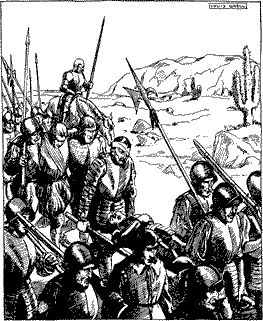
The Spanish commander there dismounted from his jaded steed, and sitting down on the steps of an Indian temple, gazed mournfully on the broken files as they passed before him. What a spectacle did they present! The cavalry, most of them dismounted, were mingled with the infantry, who dragged their feeble limbs along with difficulty; their shattered mail and tattered garments dripping with the salt ooze, showing through their rents many a bruise and ghastly wound; their bright arms soiled, their proud crests and banners gone, the baggage, artillery, all, in short, that constitutes the pride and panoply of glorious war, forever lost. Cortes, as he looked wistfully on their thinned and disordered ranks, sought in vain for many a familiar face, and missed more than one dear companion who had stood side by side with him through all the perils of the Conquest. Though accustomed to control his emotions, or, at least, to conceal them, the sight was too much for him. He covered his face with his hands, and the tears which trickled down revealed too plainly the anguish of his soul.
The chief of the Aztecs, Montezuma, determined not to offer serious opposition to the Spaniards, but Cortes was distrustful of the Aztecs, and managed to secure possession of Montezuma, whom he kept as a hostage. Called from the city of Mexico by an expedition which had been sent against him from Cuba, Cortes returned as soon as possible, only to find that the Aztecs had adopted a more aggressive policy. His men were surrounded and attacked as soon as they entered the city, and the attacks were kept up from day to day. Finally, when Montezuma died, it became clear to Cortes that a longer stay in the city would be impossible. This extract from Prescott’s The Conquest of Mexico tells the story of the retreat.