Act 4 — Scene I.—Before Prospero’s Cell.
Reading edition
Enter Prospero, Ferdinand, and Miranda. Prospero speaks.
If I have too austerely punish’d you, Your compensation makes amends; for I Have given you here a thread of mine own life, Or that for which I live; who once again I tender to thy hand: all thy vexations Were but my trials of thy love, and thou Hast strangely stood the test: here, afore Heaven, I ratify this my rich gift. O Ferdinand, Do not smile at me that I boast her off, For thou shalt find she will outstrip all praise And make it halt behind her.
Ferd. I do believe it Against an oracle.
Pros. Then, as my gift, and thine own acquisition Worthily purchased, take my daughter, thou. Sit, then, and talk with her; she is thine own.— What, Ariel! my industrious servant, Ariel!
Enter Ariel.
Ari. What would my potent master? Here I am.
Pros. Thou and thy meaner fellows your last service Did worthily perform; and I must use you In such another trick. Go bring the rabble, O’er whom I give thee power, here, to this place: Incite them to quick motion; for I must Bestow upon the eyes of this young couple Some vanity437-1 of mine art: it is my promise, And they expect it from me.
Ari. Presently?
Pros. Ay, with a twink.437-2
Ari. Before you can say Come and Go, And breathe twice, and cry So, so. Each one, tripping on his toe, Will be here with mop437-3 and mow.437-4 Do you love me, master?—no? [Exit.
Pros. Now come, my Ariel! bring a corollary,437-5 Rather than want a spirit: appear, and pertly!437-6 No tongue; all eyes; be silent.
[Soft music.
Enter Iris.437-7
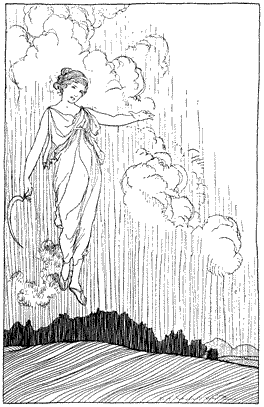
Iris. Ceres,437-8 most bounteous lady, thy rich leas Of wheat, rye, barley, vetches, oats, and peas; Thy turfy mountains, where live nibbling sheep, And flat meads thatch’d with stover,438-9 them to keep; Thy banks with peonéd438-10 and twillèd438-11 brims, Which spongy438-12 April at thy best betrims, To make cold nymphs chaste crowns;438-13 and thy brown groves, Whose shadow the dismissed bachelor loves, Being lass-lorn;438-14 thy pole-clipt vineyard;438-15 And thy sea-marge, steril, and rocky-hard, Where thou thyself dost air;—the Queen o’ the Sky,438-16 Whose watery arch438-17 and messenger am I, Bids thee leave these, and with her sovereign Grace, Here on this grass-plot, in this very place, To come and sport. Her peacocks438-18 fly amain: Approach, rich Ceres, her to entertain.
Enter Ceres.
Cer. Hail, many-color’d messenger, that ne’er Dost disobey the wife of Jupiter;438-19 Who, with thy saffron wings, upon my flowers Diffusest honey-drops, refreshing showers; And with each end of thy blue bow dost crown My bosky440-20 acres and my unshrubb’d down,440-21 Rich scarf to my proud Earth;—why hath thy Queen Summon’d me hither, to this short-grass’d green?
CERES ENTERS, AT IRIS’ CALL
Iris. A contract of true love to celebrate; And some donation freely to estate On the bless’d lovers.
Cer. Tell me, heavenly Bow, If Venus440-22 or her son, as thou dost know, Do now attend the Queen? Since they did plot The means that dusky Dis440-23 my daughter got,440-24 Her and her blind boy’s440-25 scandal’d company I have forsworn.
Iris. Of her society Be not afraid: I met her deity Cutting the clouds towards Paphos,440-26 and her son Dove-drawn with her.
Cer. Here, Queen of highest state, Great Juno comes; I know her by her gait.440-27
Enter Juno.440-28
Juno. How does my bounteous sister? Go with me To bless this twain, that they may prosperous be, And honour’d in their issue.
Song.
Juno. Honour, riches, marriage-blessing, Long continuance, and increasing, Hourly joys be still upon you! Juno sings her blessings on you.
Cer. Earth’s increase, and foison plenty,441-29 Barns and garners never empty; Vines with clustering bunches growing; Plants with goodly burden bowing; Spring come to you at the farthest In the very end of harvest!441-30 Scarcity and want shall shun you; Ceres’ blessing so is on you.
Ferd. This is a most majestic vision, and Harmonious charmingly. May I be bold To think these spirits?441-31
Pros. Spirits, which by mine art I have from their confines call’d to enact My present fancies.
Ferd. Let me live here ever; So rare a wonder’d442-32 father and a wife Make this place Paradise. [Juno and Ceres whisper, and send Iris on employment.
Pros. Sweet, now, silence! Juno and Ceres whisper seriously; There’s something else to do: hush, and be mute, Or else our spell is marr’d.
Iris. You nymphs, call’d Naiads, of the winding brooks, With your sedge crowns and ever-harmless looks, Leave your crisp442-33 channels, and on this green land Answer our summons; Juno does command: Come, temperate nymphs, and help to celebrate A contract of true love; be not too late.—
Enter certain Nymphs.
You sun-burn’d sicklemen,442-34 of August weary, Come hither from the furrow, and be merry: Make holiday; your rye-straw hats put on, And these fresh nymphs encounter every one In country footing.
Enter certain Reapers, properly habited: they join with the Nymphs in a graceful dance; towards the end whereof Prospero starts suddenly, and speaks; after which, to a strange, hollow, and confused noise, they heavily vanish.
Pros. [Aside.] I had forgot that foul conspiracy Of the beast Caliban and his confederates Against my life: the minute of their plot Is almost come.—[To the Spirits.] Well done; avoid;443-35 no more!
Ferd. This is most strange: your father’s in some passion That works him strongly.
Mira. Never till this day Saw I him touch’d with anger so distemper’d.
Pros. You do, my son, look in a moved sort, As if you were dismay’d: be cheerful, sir. Our revels now are ended. These our actors, As I foretold you, were all spirits, and Are melted into air, into thin air: And, like the baseless fabric of this vision, The cloud-capp’d towers, the gorgeous palaces, The solemn temples, the great globe itself, Yea, all which it inherit, shall dissolve, And, like this insubstantial pageant faded, Leave not a rack443-36 behind. We are such stuff As dreams are made on,443-37 and our little life Is rounded443-38 with a sleep. Sir, I am vex’d; Bear with my weakness; my old brain is troubled: Be not disturb’d with my infirmity: If you be pleased, retire into my cell, And there repose: a turn or two I’ll walk, To still my beating mind.
Ferd. Mira. We wish you peace.
Pros. [To Ariel.] Come with a thought!— I thank ye.444-39 [Exeunt Ferd. and Mira.]—Ariel, come!
Re-enter Ariel.
Ari. Thy thoughts I cleave to: what’s thy pleasure?
Pros. Spirit, We must prepare to meet with444-40 Caliban.
Ari. Ay, my commander: when I presented Ceres, I thought t’ have told thee of it; but I fear’d Lest I might anger thee.
Pros. Well, say again, where didst thou leave these varlets?
Ari. I told you, sir, they were red-hot with drinking; So full of valour, that they smote the air For breathing444-41 in their faces; beat the ground For kissing of their feet; yet always bending Towards their project. Then I beat my tabor; At which, like unback’d444-42 colts, they prick’d their ears, Advanced444-43 their eyelids, lifted up their noses As they smelt music: so I charm’d their ears, That, calf-like, they my lowing follow’d through Tooth’d briers, sharp furzes, pricking goss, and thorns, Which enter’d their frail shins: at last I left them I’ the filthy-mantled445-44 pool beyond your cell, There dancing up to th’ chins, that445-45 the foul lake O’erstunk their feet.
Pros. This was well done, my bird. Thy shape invisible retain thou still: The trumpery in my house, go bring it hither, For stale445-46 to catch these thieves.
Ari. I go, I go. [Exit.
Pros. A devil, a born-devil,445-47 on whose nature Nurture can never stick;445-48 on whom my pains, Humanely taken, all are lost, quite lost; And as with age his body uglier grows, So his mind cankers.445-49 I will plague them all, Even to roaring.—
Re-enter Ariel loaden with glistering apparel, &c.
Come, hang them on this line.445-50
Prospero and Ariel remain invisible. Enter Caliban, Stephano, and Trinculo, all wet.
Cal. Pray you, tread softly, that the blind mole may not Hear a foot fall: we now are near his cell.
Steph. Monster, your fairy, which you say is a harmless fairy, has done little better than play’d the Jack with us.446-51
Trin. Monster, I do smell all horse-stale; at which my nose is in great indignation.
Steph. So is mine.—Do you hear, monster? If I should take a displeasure against you, look you,—
Trin. Thou wert but a lost monster.
Cal. Nay, good my lord, give me thy favour still. Be patient, for the prize I’ll bring thee to Shall hoodwink this mischance:446-52 therefore speak softly; All’s hush’d as midnight yet.
Trin. Ay, but to lose our bottles in the pool,—
Steph. There is not only disgrace and dishonour in that, monster, but an infinite loss.
Trin. That’s more to me than my wetting: yet this is your harmless fairy, monster.
Steph. I will fetch off my bottle, though I be o’er ears for my labour.
Cal. Pr’ythee, my King, be quiet. See’st thou here? This is the mouth o’ the cell: no noise, and enter. Do that good mischief which may make this island Thine own for ever, and I, thy Caliban, For aye thy foot-licker.
Steph. Give me thy hand. I do begin to have bloody thoughts.
Trin. O King Stephano! O peer!446-53 O worthy Stephano! look what a wardrobe here is for thee!
Cal. Let it alone, thou fool; it is but trash.
Trin. O, ho, monster! we know what belongs to a frippery.447-54—O King Stephano!
Steph. Put off that gown, Trinculo; by this hand, I’ll have that gown.
Trin. Thy Grace shall have it.
Cal. The dropsy drown this fool!—what do you mean, To dote thus on such luggage? Let’s along, And do the murder first: if he awake, From toe to crown he’ll fill our skins with pinches; Make us strange stuff.
Steph. Be you quiet, monster.—Mistress line, is not this my jerkin? Now is the jerkin under the line:447-55 now, jerkin, you are like to lose your hair, and prove a bald jerkin.
Trin. Do, do; we steal by line and level,447-56 an’t like your Grace.
Steph. I thank thee for that jest; here’s a garment for’t: wit shall not go unrewarded while I am king of this country. Steal by line and level is an excellent pass of pate;448-57 there’s another garment for’t.
Trin. Monster, come, put some lime448-58 upon your fingers, and away with the rest.
STEPHANO AND TRINCULO QUARREL
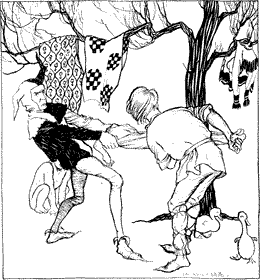
Cal. I will have none on’t: we shall lose our time, And all be turn’d to barnacles,448-59 or to apes With foreheads villainous low.
Steph. Monster, lay-to your fingers: help to bear this away, where my hogshead of wine is, or I’ll turn you out of my kingdom: go to, carry this.
Trin. And this.
Steph. Ay, and this.
A noise of hunters heard. Enter divers Spirits in shape of hounds, and hunt them about; Prospero and Ariel setting them on.
Pros. Hey, Mountain, hey!
Ari. Silver! there it goes, Silver!
Pros. Fury, Fury! there, Tyrant, there! hark! hark!— [Cal., Steph. and Trin. are driven out. Go charge my goblins that they grind their joints With dry convulsions; shorten up their sinews With aged cramps; and more pinch-spotted make them Than pard or cat-o’-mountain.449-60
Ari. Hark, they roar!
Pros. Let them be hunted soundly. At this hour Lie at my mercy all mine enemies: Shortly shall all my labours end, and thou Shalt have the air at freedom: for a little Follow, and do me service. [Exeunt.