THE KNICKERBOCKER HISTORY OF NEW YORK
Reading edition
By Washington Irving
INTRODUCTORY NOTE
A History of New York by Diedrich Knickerbocker was published in 1809. Nearly forty years later Washington Irving, the real author, says it was his purpose in the history to embody the traditions of New York in an amusing form, to illustrate its local humors, customs and peculiarities in a whimsical narrative, which should help to bind the heart of the native inhabitant to his home. He adds:
“In this I have reason to believe I have in some measure succeeded. Before the appearance of my work the popular traditions of our city were unrecorded; the peculiar and racy customs and usages derived from our Dutch Progenitors were unnoticed, or regarded with indifference, or adverted to with a sneer. Now they form a convivial currency, and are brought forward on all occasions: they link our whole community together in good humor and good fellowship; they are the rallying-points of home feeling, the seasoning of our civic festivities, the staple of local tales and local pleasantries; and are so harped upon by our writers of popular fiction that I find myself almost crowded off the legendary ground which I was the first to explore by the host who have followed in my footsteps.
“I dwell on this head because, at the first appearance of my work, its aim and drift were misapprehended by some of the descendants of the Dutch worthies, and because I understand that now and then one may still be found to regard it with a captious eye. The far greater part, however, I have reason to flatter myself, receive my good-humored picturings in the same temper in which they were executed; and when I find, after a lapse of nearly forty years, this haphazard production of my youth still cherished among them; when I find its very name become a ‘household word’ and used to give the home stamp to everything recommended for popular acceptation, such as Knickerbocker societies; Knickerbocker insurance companies; Knickerbocker steamboats; Knickerbocker omnibuses; Knickerbocker bread; and Knickerbocker ice; and when I find New Yorkers of Dutch descent priding themselves upon being ‘genuine Knickerbockers,’ I please myself with the persuasion that I have struck the right chord; that my dealings with the good Dutch times, and the customs and usages derived from them, are in harmony with the feelings and humors of my townsmen; that I have opened a vein of pleasant associations and quaint characteristics peculiar to my native place, and which its inhabitants will not willingly suffer to pass away; and that, though other histories of New York may appear of higher claims to learned acceptation, and may take their dignified and appropriate rank in the family library, Knickerbocker’s history will still be received with good-humored indulgence, and be thumbed and chuckled over by the family fireside.”
To give color to his fancy, Irving created the fanciful character of Diedrich Knickerbocker, whom he describes as follows:
“He was a small, brisk-looking old gentleman, dressed in a rusty black coat and a pair of olive velvet breeches and a small cocked hat. He had a few gray hairs plaited and clubbed behind. The only piece of finery which he bore about him was a bright pair of square silver shoe buckles, and all his baggage was contained in a pair of saddle bags which he carried under his arm.”
He was “a very worthy good sort of an old gentleman, though a little queer in his ways. He would keep in his room for days together, and if any of the children cried or made a noise about his door he would bounce out in a great passion, with his hands full of papers and say something about ‘deranging his ideas’.”
According to the tale which Irving invented he resided for some time at the Independent Columbian Hotel, and from this place he disappeared, leaving his bills unpaid. However, in the saddle bag which he didn’t take from his room the landlord found the manuscript of the History of New York, and published it in order to secure pay for the old gentleman’s board.
The book met with marked success, and shortly after its publication a large part of New York was laughing at its humorous details, and Irving’s estimate of its popularity as given above was modest indeed.
The history consists of eight books, the first of which, in irony of some histories which had previously been published, gives a description of the world and a history of its creation, and in brief, the story of Noah and the discovery of America, and a dissertation on the origin of the American Indian.
The second book contains an account of Hudson’s discovery of the river that bears his name and of the settlement of New Amsterdam.
A book is given to each of the first two Dutch governors, and three books to the rule of Peter Stuyvesant. The history then terminates with the surrender of New Amsterdam to the British.
The selections which appear here have been chosen for their rich humor rather than for their historical value, although, in his quaint way, Irving gives us a picture of the early Dutch settlers that is in many respects remarkably true to life. His exaggerations are usually so noticeable that it is not difficult to separate truth from fiction.
THE FOUNDING OF NEW AMSTERDAM
It was some three or four years after the return of the immortal Hendrick that a crew of honest, Low Dutch colonists set sail from the city of Amsterdam for the shores of America.
The ship in which these illustrious adventurers set sail was called the Goede Vrouw, or Good Woman, in compliment to the wife of the president of the West India Company, who was allowed by everybody (except her husband) to be a sweet-tempered lady. It was in truth a most gallant vessel, of the most approved Dutch construction, and made by the ablest ship carpenters of Amsterdam, who it is well known always model their ships after the fair forms of their countrywomen. Accordingly, it had one hundred feet in the beam, one hundred feet in the keel, and one hundred feet from the bottom of the sternpost to the tafferel.
The architect, who was somewhat of a religious man, far from decorating the ship with pagan idols, such as Jupiter, Neptune, or Hercules (which heathenish abominations I have no doubt occasion the misfortunes and shipwreck of many a noble vessel)—he, I say, on the contrary, did laudably erect for a head a goodly image of Saint Nicholas, equipped with a low, broad-brimmed hat, a huge pair of Flemish trunk hose, and a pipe that reached to the end of the bow-sprit. Thus gallantly furnished, the stanch ship floated sideways, like a majestic goose, out of the harbor of the great city of Amsterdam, and all the bells that were not otherwise engaged rang a triple bobmajor on the joyful occasion.
The voyage was uncommonly prosperous, for, being under the especial care of the ever-revered Saint Nicholas, the Goede Vrouw seemed to be endowed with qualities unknown to common vessels. Thus she made as much leeway as headway, could get along very nearly as fast with the wind ahead as when it was apoop, and was particularly great in a calm; in consequence of which singular advantages she made out to accomplish her voyage in a very few months, and came to anchor at the mouth of the Hudson a little to the east of Gibbet Island.
Here, lifting up their eyes, they beheld, on what is at present called the Jersey shore, a small Indian village, pleasantly embowered in a grove of spreading elms, and the natives all collected on the beach gazing in stupid admiration at the Goede Vrouw. A boat was immediately dispatched to enter into a treaty with them, and, approaching the shore, hailed them through a trumpet in the most friendly terms; but so horribly confounded were these poor savages at the tremendous and uncouth sound of the Low Dutch language that they one and all took to their heels, and scampered over the Bergen hills; nor did they stop until they had buried themselves, head and ears, in the marshes on the other side, where they all miserably perished to a man, and their bones, being collected and decently covered by the Tammany Society of that day, formed that singular mound called Rattlesnake Hill which rises out of the center of the salt marshes a little to the east of the Newark causeway.
Animated by this unlooked-for victory, our valiant heroes sprang ashore in triumph, took possession of the soil as conquerors in the name of their High Mightinesses the Lords States General, and, marching fearlessly forward, carried the village of Communipaw by storm, notwithstanding that it was vigorously defended by some half a score of old squaws and pappooses. On looking about them they were so transported with the excellencies of the place that they had very little doubt the blessed Saint Nicholas had guided them thither as the very spot whereon to settle their colony. The softness of the soil was wonderfully adapted to the driving of piles; the swamps and marshes around them afforded ample opportunities for the constructing of dykes and dams; the shallowness of the shore was peculiarly favorable to the building of docks—in a word this spot abounded with all the requisites for the foundation of a great Dutch city. On making a faithful report, therefore, to the crew of the Goede Vrouw, they one and all determined that this was the destined end of their voyage. Accordingly they descended from the Goede Vrouw, men, women, and children, in goodly groups, as did the animals of yore from the ark, and formed themselves into a thriving settlement, which they called by the Indian name Communipaw.
The crew of the Goede Vrouw being soon reinforced by fresh importations from Holland, the settlement went jollily on, increasing in magnitude and prosperity. The neighboring Indians in a short time became accustomed to the uncouth sound of the Dutch language, and an intercourse gradually took place between them and the newcomers.
A brisk trade for furs was soon opened: the Dutch traders were scrupulously honest in their dealings, and purchased by weight, establishing it as an invariable table of avoirdupois that the hand of a Dutchman weighed one pound and his foot two pounds.
It is true the simple Indians were often puzzled by the great disproportion between bulk and weight, for let them place a bundle of furs, never so large, in one scale, and a Dutchman put his hand or foot in the other, the bundle was sure to kick the beam—never was a package of furs known to weigh more than two pounds in the market of Communipaw!
The Dutch possessions in this part of the globe began now to assume a very thriving appearance, and were comprehended under the general title of Nieuw Nederlandts, on account, as the sage Vander Douck observes, of their great resemblance to the Dutch Netherlands; which indeed was truly remarkable, excepting that the former were rugged and mountainous, and the latter level and marshy. About this time the tranquility of the Dutch colonists was doomed to suffer a temporary interruption. In 1614, Captain Sir Samuel Argal, sailing under a commission from Dale, governor of Virginia, visited the Dutch settlements on Hudson River and demanded their submission to the English crown and Virginian dominion. To this arrogant demand, as they were in no condition to resist it, they submitted for the time, like discreet and reasonable men.
Oloffe Van Kortlandt, a personage who was held in great reverence among the sages of Communipaw for the variety and darkness of his knowledge, had originally been one of a set of peripatetic philosophers who had passed much of their time sunning themselves on the side of the great canal of Amsterdam in Holland, enjoying, like Diogenes, a free and unencumbered estate in sunshine. His name Kortlandt (Shortland or Lackland) was supposed, like that of the illustrious Jean Sansterre, to indicate that he had no land; but he insisted, on the contrary, that he had great landed estates somewhere in Terra Incognita, and he had come out to the New World to look after them. He was the first great land speculator that we read of in these parts.
Like all land speculators, he was much given to dreaming. Never did anything extraordinary happen to Communipaw but he declared that he had previously dreamt it, being one of those infallible prophets who predict events after they have come to pass.
As yet his dreams and speculations had turned to little personal profit, and he was as much a lackland as ever. Still, he carried a high head in the community; if his sugar-loaf hat was rather the worse for wear, he set it off with a taller cock’s tail; if his shirt was none of the cleanest, he pulled it out the more at the bosom; and if the tail of it peeped out of a hole in his breeches, it at least proved that it really had a tail and was not mere ruffle.
The worthy Van Kortlandt urged the policy of emerging from the swamps of Communipaw and seeking some more eligible site for the seat of empire. Such, he said, was the advice of the good Saint Nicholas, who had appeared to him in a dream the night before, and whom he had known by his broad hat, his long pipe, and the resemblance which he bore to the figure on the bow of the Goede Vrouw.
This perilous enterprise was to be conducted by Oloffe himself, who chose as lieutenants or coadjutors Mynheers Jacobus Van Zandt, Abraham Hardenbroeck, and Winant Ten Broeck—three indubitably great men, but of whose history, although I have made diligent inquiry, I can learn but little previous to their leaving Holland.
Had I the benefit of mythology and classic fable, I should have furnished the first of the trio with a pedigree equal to that of the proudest hero of antiquity. His name, Van Zandt—that is to say, from the sand, or, in common parlance, from the dirt—gave reason to suppose that, like Triptolemus, the Cyclops, and the Titans, he had sprung from Dame Terra, or the earth! This supposition is strongly corroborated by his size, for it is well known that all the progeny of mother earth were of a gigantic stature; and Van Zandt, we are told, was a tall, raw-boned man, above six feet high, with an astonishingly hard head.
Of the second of the trio but faint accounts have reached to this time, which mention that he was a sturdy, obstinate, worrying, bustling little man, and, from being usually equipped in an old pair of buckskins, was familiarly dubbed Hardenbroeck; that is to say, Tough Breeches.
Ten Broeck completed this junto of adventurers. It is a singular but ludicrous fact—which, were I not scrupulous in recording the whole truth, I should almost be tempted to pass over in silence as incompatible with the gravity and dignity of history—that this worthy gentleman should likewise have been nicknamed from what in modern times is considered the most ignoble part of the dress; but in truth the small-clothes seem to have been a very dignified garment in the eyes of our venerated ancestors.
The name of Ten Broeck, or, as it was sometimes spelled, Tin Broeck, has been indifferently translated into Ten Breeches and Tin Breeches. Certain elegant and ingenious writers on the subject declare in favor of Tin, or rather Thin, Breeches; whence they infer that the original bearer of it was a poor but merry rogue, whose galligaskins were none of the soundest, and who, peradventure, may have been the author of that truly philosophical stanza:
“Then why should we quarrel for riches, Or any such glittering toys? A light heart and thin pair of breeches Will go through the world, my brave boys!”
The more accurate commentators, however, declare in favor of the other reading, and affirm that the worthy in question was a burly, bulbous man, who, in sheer ostentation of his venerable progenitors, was the first to introduce into the settlement the ancient Dutch fashion of ten pair of breeches.
Such was the trio of coadjutors chosen by Oloffe the Dreamer, to accompany him in this voyage into unknown realms; as to the names of his crews, they have not been handed down by history.
And now the rosy blush of morn began to mantle in the east, and soon the rising sun, emerging from amid golden and purple clouds, shed his blithesome rays on the tin weathercocks of Communipaw. It was that delicious season of the year when Nature, breaking from the chilling thralldom of old winter, like a blooming damsel from the tyranny of a sordid old father, threw herself, blushing with ten thousand charms, into the arms of youthful spring. Every tufted copse and blooming grove resounded with the notes of hymeneal love. The very insects, as they sipped the dew that gemmed the tender grass of meadows, joined in the joyous epithalamium, the virgin bud timidly put forth its blushes, “the voice of the turtle was heard in the land,” and the heart of man dissolved away in tenderness.
No sooner did the first rays of cheerful Phœbus dart into the windows of Communipaw than the little settlement was all in motion. Forth issued from his castle the sage Van Kortlandt, and, seizing a conch-shell, blew a far-resounding blast, that soon summoned all his lusty followers. Then did they trudge resolutely down to the waterside, escorted by a multitude of relatives and friends, who all went down, as the common phrase expresses it, “to see them off.”
The good Oloffe bestowed his forces in a squadron of three canoes, and hoisted his flag on board a little round Dutch boat, shaped not unlike a tub, which had formerly been the jolly-boat of the Goede Vrouw. And now, all being embarked, they bade farewell to the gazing throng upon the beach, who continued shouting after them even when out of hearing, wishing them a happy voyage, advising them to take good care of themselves, not to get drowned, with an abundance other of those sage and invaluable cautions generally given by landsmen to such as go down to the sea in ships and adventure upon the deep waters. In the meanwhile, the voyagers cheerily urged their course across the crystal bosom of the bay and soon left behind them the green shores of ancient Pavonia.
They coasted by Governor’s Island, since terrible from its frowning fortress and grinning batteries. They would by no means, however, land upon this island, since they doubted much it might be the abode of demons and spirits, which in those days did greatly abound throughout this savage and pagan country.
Just at this time a shoal of jolly porpoises came rolling and tumbling by, turning up their sleek sides to the sun and spouting up the briny element in sparkling showers. No sooner did the sage Oloffe mark this than he was greatly rejoiced. “This,” exclaimed he, “if I mistake not, augurs well; the porpoise is a fat, well-conditioned fish, a burgomaster among fishes; his looks betoken ease, plenty, and prosperity; I greatly admire this round fat fish, and doubt not but this is a happy omen of the success of our undertaking.” So saying, he directed his squadron to steer in the track of these alderman fishes.
Turning, therefore, directly to the left, they swept up the strait vulgarly called the East River. And here the rapid tide which courses through this strait, seizing on the gallant tub in which Commodore Van Kortlandt had embarked, hurried it forward with a velocity unparalleled in a Dutch boat navigated by Dutchmen; insomuch that the good Commodore, who had all his life long been accustomed only to the drowsy navigation of canals, was more than ever convinced that they were in the hands of some supernatural power, and that the jolly porpoises were towing them to some fair haven that was to fulfill all their wishes and expectations.
Thus borne away by the resistless current, they doubled that boisterous point of land since called Corlear’s Hook, and leaving to the right the rich winding cove of the Wallabout, they drifted into a magnificent expanse of water, surrounded by pleasant shores whose verdure was exceedingly refreshing to the eye. While the voyagers were looking around them on what they conceived to be a serene and sunny lake, they beheld at a distance a crew of painted savages busily employed in fishing, who seemed more like the genii of this romantic region, their slender canoe lightly balanced like a feather on the undulating surface of the bay.
At sight of these the hearts of the heroes of Communipaw were not a little troubled. But, as good fortune would have it, at the bow of the commodore’s boat was stationed a very valiant man, named Hendrick Kip (which, being interpreted, means chicken, a name given him in token of his courage). No sooner did he behold these varlet heathens than he trembled with excessive valor, and although a good half mile distant he seized a musketoon that lay at hand, and, turning away his head, fired it most intrepidly in the face of the blessed sun. The blundering weapon recoiled and gave the valiant Kip an ignominious kick, which laid him prostrate with uplifted heels in the bottom of the boat. But such was the effect of this tremendous fire that the wild men of the woods, struck with consternation, seized hastily upon their paddles and shot away into one of the deep inlets of the Long Island shore.
This signal victory gave new spirits to the voyagers, and in honor of the achievement they gave the name of the valiant Kip to the surrounding bay, and it has continued to be called Kip’s Bay from that time to the present. The heart of the good Van Kortlandt—who, having no land of his own, was a great admirer of other people’s—expanded to the full size of a peppercorn at the sumptuous prospect of rich, unsettled country around him, and falling into a delicious reverie he straightway began to riot in the possession of vast meadows of salt marsh and interminable patches of cabbages. From this delectable vision he was all at once awakened by the sudden turning of the tide, which would soon have hurried him from this land of promise, had not the discreet navigator given the signal to steer for shore, where they accordingly landed hard by the rocky heights of Bellevue—that happy retreat where our jolly aldermen eat for the good of the city and fatten the turtle that are sacrificed on civic solemnities.
HERE THEY REFRESHED THEMSELVES
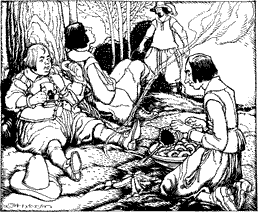
Here, seated on the green sward, by the side of a small stream that ran sparkling among the grass, they refreshed themselves after the toils of the seas by feasting lustily on the ample stores which they had provided for this perilous voyage.
By this time the jolly Phœbus, like some wanton urchin sporting on the side of a green hill, began to roll down the declivity of the heavens; and now, the tide having once more turned in their favor, the Pavonians again committed themselves to its discretion, and, coasting along the western shores, were borne toward the straits of Blackwell’s Island.
And here the capricious wanderings of the current occasioned not a little marvel and perplexity to these illustrious mariners. Now would they be caught by the wanton eddies, and, sweeping around a jutting point, would wind deep into some romantic little cave, that indented the fair island of Manna-hata; now were they hurried narrowly by the very basis of impending rocks, mantled with the flaunting grape-vine and crowned with groves which threw a broad shade on the waves beneath; and anon they were borne away into the mid-channel and wafted along with a rapidity that very much discomposed the sage Van Kortlandt, who as he saw the land swiftly receding on either side, began exceedingly to doubt that terra firma was giving them the slip.
Wherever the voyagers turned their eyes a new creation seemed to bloom around. No signs of human thrift appeared to check the delicious wildness of Nature, who here reveled in all her luxuriant variety. Those hills, now bristled, like the fretful porcupine, with rows of poplars (vain upstart plants! minions of wealth and fashion!), were then adorned with the vigorous natives of the soil—the hardy oak, the generous chestnut, the graceful elm—while here and there the tulip tree reared its majestic head, the giant of the forest. Where now are seen the gay retreats of luxury—villas half buried in twilight bowers, whence the amorous flute oft breathes the sighings of some city swain—there the fish-hawk built his solitary nest on some dry tree that overlooked his watery domain. The timid deer fed undisturbed along those shores now hallowed by the lover’s moonlight walk and printed by the slender foot of beauty; and a savage solitude extended over those happy regions where now are reared the stately towers of the Joneses, the Schermerhornes, and the Rhinelanders.
Ah! witching scenes of foul delusion! Ah! hapless voyagers, gazing with simple wonder on these Circean shores! Such, alas! are they, poor easy souls who listen to the seductions of a wicked world—treacherous are its smiles, fatal its caresses. He who yields to its enticements launches upon a whelming tide, and trusts his feeble bark among the dimpling eddies of a whirlpool! And thus it fared with the worthies of Pavonia, who, little mistrusting the guileful scene before them, drifted quietly on until they were aroused by an uncommon tossing and agitation of their vessels. For now the late dimpling current began to brawl around them and the waves to boil and foam with horrific fury. Awakened as if from a dream, the astonished Oloffe bawled aloud to put about, but his words were lost amid the roaring of the waters. And now ensued a scene of direful consternation. At one time they were borne with dreadful velocity among tumultuous breakers; at another hurried down boisterous rapids. Now they were nearly dashed upon the Hen and Chickens (infamous rocks!—more voracious than Scylla and her whelps), and anon they seemed sinking into yawning gulfs that threatened to entomb them beneath the waves. All the elements combined to produce a hideous confusion. The waters raged, the winds howled, and as they were hurried along several of the astonished mariners beheld the rocks and trees of the neighboring shores driving through the air!
At length the mighty tub of Commodore Van Kortlandt was drawn into the vortex of that tremendous whirlpool called the Pot, where it was whirled about in giddy mazes until the senses of the good commander and his crew were overpowered by the horror of the scene and the strangeness of the revolution. How the gallant squadron of Pavonia was snatched from the jaws of this modern Charybdis has never been truly made known, for so many survived to tell the tale, and, what is still more wonderful, told it in so many different ways, that there has ever prevailed a great variety of opinions on the subject.
As to the commodore and his crew, when they came to their senses they found themselves stranded on the Long Island shore. The worthy commodore, indeed, used to relate many and wonderful stories of his adventures in this time of peril—how that he saw specters flying in the air and heard the yelling of hobgoblins, and put his hand into the pot when they were whirled round, and found the water scalding hot, and beheld several uncouth-looking beings seated on rocks and skimming it with huge ladles; but particularly he declared, with great exultation, that he saw the losel porpoises, which had betrayed them into this peril, some broiling on the Gridiron and others hissing on the Frying-pan!
These, however, were considered by many as mere fantasies of the commodore while he lay in a trance, especially as he was known to be given to dreaming, and the truth of them has never been clearly ascertained. It is certain, however, that to the accounts of Oloffe and his followers may be traced the various traditions handed down of this marvelous strait—as how the devil has been seen there sitting astride of the Hog’s Back and playing on the fiddle, how he broils fish there before a storm, and many other stories in which we must be cautious of putting too much faith. In consequence of all these terrific circumstances the Pavonian commander gave this pass the name of Hellegat, or, as it has been interpreted, Hell-Gate,242-1 which it continues to bear at the present day.
The darkness of the night had closed upon this disastrous day, and a doleful night was it to the shipwrecked Pavonians, whose ears were incessantly assailed with the raging of the elements and the howling of the hobgoblins that infested this perilous strait. But when the morning dawned the horrors of the preceding evening had passed away—rapids, breakers, whirlpools had disappeared, the stream again ran smooth and dimpling, and, having changed its tide, rolled gently back toward the quarter where lay their much-regretted home.
The woe-begone heroes of Communipaw eyed each other with rueful countenances; their squadron had been totally dispersed by the late disaster.
I forbear to treat of the long consultation of Oloffe with his remaining followers, in which they determined that it would never do to found a city in so diabolical a neighborhood. Suffice it in simple brevity to say that they once more committed themselves, with fear and trembling, to the briny element, and steered their course back again through the scenes of their yesterday’s voyage, determined no longer to roam in search of distant sites, but to settle themselves down in the marshy regions of Pavonia.
Scarce, however, had they gained a distant view of Communipaw when they were encountered by an obstinate eddy which opposed their homeward voyage. Weary and dispirited as they were, they yet tugged a feeble oar against the stream, until, as if to settle the strife, half a score of potent billows rolled the tub of Commodore Van Kortlandt high and dry on the long point of an island which divided the bosom of the bay.
Oloffe Van Kortlandt was a devout trencherman. Every repast was a kind of religious rite with him, and his first thought on finding himself once more on dry ground was how he should contrive to celebrate his wonderful escape from Hell-Gate and all its horrors by a solemn banquet. The stores which had been provided for the voyage by the good housewives of Communipaw were nearly exhausted, but in casting his eyes about the commodore beheld that the shore abounded with oysters. A great store of these was instantly collected; a fire was made at the foot of a tree; all hands fell to roasting and broiling and stewing and frying, and a sumptuous repast was soon set forth.
On the present occasion the worthy Van Kortlandt was observed to be particularly zealous in his devotions to the trencher; for, having the cares of the expedition especially committed to his care, he deemed it incumbent on him to eat profoundly for the public good. In proportion as he filled himself to the very brim with the dainty viands before him, did the heart of this excellent burgher rise up toward his throat, until he seemed crammed and almost choked with good eating and good nature. And at such times it is, when a man’s heart is in his throat, that he may more truly be said to speak from it and his speeches abound with kindness and good fellowship. Thus, having swallowed the last possible morsel and washed it down with a fervent potation, Oloffe felt his heart yearning and his whole frame in a manner dilating with unbounded benevolence. Everything around him seemed excellent and delightful, and, laying his hands on each side of his capacious periphery, and rolling his half closed eyes around on the beautiful diversity of land and water before him, he exclaimed, in a fat, half-smothered voice, “What a charming prospect!” The words died away in his throat, he seemed to ponder on the fair scene for a moment, his eyelids heavily closed over their orbits, his head drooped upon his bosom, he slowly sank upon the green turf, and a deep sleep stole gradually over him.
Van Kortlandt awoke from his sleep greatly instructed, and he aroused his companions and told them that it was the will of Saint Nicholas that they should settle down and build the city here. With one voice all assented to this.
The great object of their perilous expedition, therefore, being thus happily accomplished, the voyagers returned merrily to Communipaw, where they were received with great rejoicings.
It having been solemnly resolved that the seat of empire should be removed from the green shores of Pavonia to the pleasant island of Manna-hata, everybody was anxious to embark under the standard of Oloffe the Dreamer, and to be among the first sharers of the promised land. A day was appointed for the grand migration, and on that day little Communipaw was in a buzz and bustle like a hive in swarming-time. Houses were turned inside out and stripped of the venerable furniture which had come from Holland; all the community, great and small, black and white, man, woman and child, was in commotion, forming lines from the houses to the water-side, like lines of ants from an ant-hill; everybody laden with some article of household furniture, while busy housewives plied backward and forward along the lines, helping everything forward by the nimbleness of their tongues.
By degrees a fleet of boats and canoes were piled up with all kinds of household articles—ponderous tables; chests of drawers resplendent with brass ornaments; quaint corner cupboards; beds and bedsteads; with any quantity of pots, kettles, frying-pans and Dutch ovens. In each boat embarked a whole family, from the robustious burgher down to the cats and dogs and little negroes. In this way they set off across the mouth of the Hudson, under the guidance of Oloffe the Dreamer, who hoisted his standard on the leading boat.
As the little squadron from Communipaw drew near to the shores of Manna-hata, a sachem at the head of a band of warriors appeared to oppose their landing. Some of the most zealous of the pilgrims were for chastising this insolence with powder and ball, according to the approved mode of discoverers; but the sage Oloffe gave them the significant sign of Saint Nicholas, laying his finger beside his nose and winking hard with one eye, whereupon his followers perceived that there was something sagacious in the wink. He now addressed the Indians in the blandest terms, and made such tempting display of beads, hawks’-bells, and red blankets that he was soon permitted to land, and a great land speculation ensued. And here let me give the true story of the original purchase of the site of this renowned city about which so much has been said and written. Some affirm that the first cost was but sixty guilders. The learned Dominie Heckwelder records a tradition that the Dutch discoverers bargained for only so much land as the hide of a bullock would cover; but that they cut the hide in strips no thicker than a child’s finger, so as to take in a large portion of land and to take in the Indians into the bargain. This, however, is an old fable which the worthy Dominie may have borrowed from antiquity. The true version is, that Oloffe Van Kortlandt bargained for just so much land as a man could cover with his nether garments. The terms being concluded, he produced his friend Mynheer Ten Broeck as the man whose breeches were to be used in measurement. The simple savages, whose ideas of a man’s nether garments had never expanded beyond the dimensions of a breech-clout, stared with astonishment and dismay as they beheld this burgher peeled like an onion, and breeches after breeches spread forth over the land until they covered the actual site of this venerable city.
This is the true history of the adroit bargain by which the island of Manhattan was bought for sixty guilders; and in corroboration of it I will add that Mynheer Ten Breeches, for his services on this memorable occasion, was elevated to the office of land measurer, which he ever afterward exercised in the colony.
The land being thus fairly purchased of the Indians, a circumstance very unusual in the history of colonization, and strongly illustrative of the honesty of our Dutch progenitors, a stockade fort and a trading-house were forthwith erected on an eminence, the identical place at present known as the Bowling Green.
Around this fort a progeny of little Dutch-built houses, with tiled roofs and weathercocks, soon sprang up, nestling themselves under its walls for protection, as a brood of half-fledged chickens nestles under the wings of the mother hen. The whole was surrounded by an inclosure of strong palisadoes to guard against any sudden irruption of the savages. Outside of these extended the cornfields and cabbage-gardens of the community, with here and there an attempt at a tobacco-plantation; all covering those tracts of country at present called Broadway, Wall street, William street and Pearl street.
I must not omit to mention that in portioning out the land a goodly “bowerie” or farm was allotted to the sage Oloffe in consideration of the service he had rendered to the public by his talent at dreaming; and the site of his “bowerie” is known by the name of Kortlandt (or Courtlandt) street to the present day.
And now, the infant settlement having advanced in age and stature, it was thought high time it should receive an honest Christian name. Hitherto it had gone by the original Indian name Manna-hata, or, as some will have it, “The Manhattoes”; but this was now decried as savage and heathenish, and as tending to keep up the memory of the pagan brood that originally possessed it. Many were the consultations held upon the subject without coming to a conclusion, for, though everybody condemned the old name, nobody could invent a new one. At length, when the council was almost in despair, a burgher, remarkable for the size and squareness of his head, proposed that they should call it New Amsterdam. The proposition took everybody by surprise; it was so striking, so apposite, so ingenious. The name was adopted by acclamation, and New Amsterdam the metropolis was thenceforth called. Still, however, the early authors of the province continued to call it by the general appellation of “The Manhattoes,” and the poets fondly clung to the euphonious name of Manna-hata; but those are a kind of folk whose tastes and notions should go for nothing in matters of this kind.
Having thus provided the embryo city with a name, the next was to give it an armorial bearing or device. As some cities have a rampant lion, others a soaring eagle, emblematical, no doubt, of the valiant and high-flying qualities of the inhabitants, so after mature deliberation a sleek beaver was emblazoned on the city standard as indicative of the amphibious origin and patient and persevering habits of the New Amsterdammers.
WALTER THE DOUBTER
It was in the year of our Lord 1629 that Mynheer Wouter Van Twiller was appointed governor of the province of Nieuw Nederlandts, under the commission and control of their High Mightinesses the Lords States General of the United Netherlands and the privileged West India Company.
The renowned Wouter (or Walter) Van Twiller was descended from a long line of Dutch burgomasters, who had successively dozed away their lives and grown fat upon the bench of magistracy in Rotterdam, and who had comported themselves with such singular wisdom and propriety that they were never either heard or talked of; which, next to being universally applauded, should be the object of ambition of all magistrates and rulers. There are two opposite ways by which some men make a figure in the world—one by talking faster than they think, and the other by holding their tongues and not thinking at all. By the first many a smatterer acquires the reputation of a man of quick parts; by the other many a dunderpate, like the owl, the stupidest of birds, comes to be considered the very type of wisdom. This, by the way, is a casual remark, which I would not for the universe have it thought I apply to Governor Van Twiller. It is true he was a man shut up within himself, like an oyster, and rarely spoke except in monosyllables; but then it was allowed he seldom said a foolish thing. So invincible was his gravity that he was never known to laugh or even to smile through the whole course of a long and prosperous life. Nay, if a joke were uttered in his presence that set light-minded hearers in a roar, it was observed to throw him into a state of perplexity. Sometimes he would deign to inquire into the matter, and when, after much explanation, the joke was made as plain as a pike-staff, he would continue to smoke his pipe in silence, and at length, knocking out the ashes, would exclaim, “Well! I see nothing in all that to laugh about.”
The person of this illustrious old gentleman was formed and proportioned, as though it had been molded by the hands of some cunning Dutch statuary, as a model of majesty and lordly grandeur. He was exactly five feet, six inches in height and six feet, five inches in circumference. His head was a perfect sphere, and of such stupendous dimensions that Dame Nature with all her sex’s ingenuity would have been puzzled to construct a neck capable of supporting it; wherefore she wisely declined the attempt, and settled it firmly on the top of his backbone just between the shoulders. His body was oblong and particularly capacious at bottom; which was wisely ordered by Providence, seeing that he was a man of sedentary habits and very averse to the idle labor of walking. His legs were short, but sturdy in proportion to the weight they had to sustain, so that when erect he had not a little the appearance of a beer-barrel on skids. His face, that infallible index of the mind, presented a vast expanse, unfurrowed by any of those lines and angles which disfigure the human countenance with what is termed expression. Two small gray eyes twinkled feebly in the midst, like two stars of lesser magnitude in a hazy firmament, and his full-fed cheeks, which seemed to have taken toll of everything that went into his mouth, were curiously mottled and streaked with dusky red, like a spitzenberg apple.
In his council he presided with great state and solemnity. He sat in a huge chair of solid oak, hewn in the celebrated forest of The Hague, fabricated by an experienced timmerman of Amsterdam, and curiously carved about the arms and feet into exact imitations of gigantic eagle’s claws. Instead of a scepter he swayed a long Turkish pipe, wrought with jasmine and amber, which had been presented to a stadtholder of Holland at the conclusion of a treaty with one of the petty Barbary powers. In this stately chair would he sit and this magnificent pipe would he smoke, shaking his right knee with a constant motion, and fixing his eye for hours upon a little print of Amsterdam which hung in a black frame against the opposite wall of the council-chamber. Nay, it has even been said that when any deliberation of extraordinary length and intricacy was on the carpet the renowned Wouter would shut his eyes for full two hours at a time, that he might not be disturbed by external objects; and at such times the internal commotion of his mind was evinced by certain regular guttural sounds, which his admirers declared were merely the noise of conflict made by his contending doubts and opinions.
HE WAS INTERRUPTED BY WANDLE SCHOONHOVEN
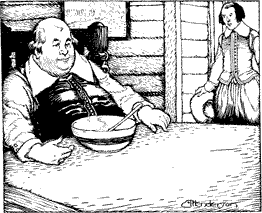
The very outset of the career of this excellent magistrate was distinguished by an example of legal acumen that gave flattering presage of a wise and equitable administration. The morning after he had been installed in office, and at the moment that he was making his breakfast from a prodigious earthen dish filled with milk and Indian pudding, he was interrupted by the appearance of Wandle Schoonhoven, a very important old burgher of New Amsterdam, who complained bitterly of one Barent Bleecker, inasmuch as he refused to come to a settlement of accounts, seeing that there was a heavy balance in favor of the said Wandle. Governor Van Twiller, as I have already observed, was a man of few words; he was likewise a mortal enemy to multiplying writings or being disturbed at his breakfast. Having listened attentively to the statement of Wandle Schoonhoven, giving an occasional grunt as he shoveled a spoonful of Indian pudding into his mouth, either as a sign that he relished the dish or comprehended the story, he called unto him his constable, and, pulling out of his breeches pocket a huge jack-knife, dispatched it after the defendant, as a summons, accompanied by his tobacco-box as a warrant.
This summary process was as effectual in those simple days as was the seal ring of the great Haroun Alraschid among the true believers. The two parties being confronted before him, each produced a book of accounts written in a language and character that would have puzzled any but a High Dutch commentator or a learned decipherer of Egyptian obelisks. The sage Wouter took them one after the other, and, having poised them in his hands and attentively counted over the number of leaves, fell straightway into a very great doubt, and smoked for half an hour without saying a word; at length, laying his finger beside his nose and shutting his eyes for a moment with the air of a man who had just caught a subtle idea by the tail, he slowly took his pipe from his mouth, puffed forth a column of tobacco-smoke, and with marvelous gravity and solemnity pronounced—that, having carefully counted over the leaves and weighed the books, it was found that one was just as thick and as heavy as the other; therefore it was the final opinion of the court that the accounts were equally balanced; therefore Wandle should give Barent a receipt, and Barent should give Wandle a receipt; and the constable should pay the costs.
This decision, being straightway made known, diffused general joy throughout New Amsterdam, for the people immediately perceived that they had a very wise and equitable magistrate to rule over them. But its happiest effect was that not another lawsuit took place throughout the whole of his administration, and the office of constable fell into such decay that there was not one of those losel scouts known in the province for many years.
HOW THE COLONISTS LIVED IN THE DAYS OF WALTER THE DOUBTER
The houses of the higher class were generally constructed of wood, excepting the gable end, which was of small black and yellow Dutch bricks, and always faced on the street, as our ancestors, like their descendants, were very much given to outward show, and were noted for putting the best leg foremost. The house was always furnished with abundance of large doors and small windows on every floor, the date of its erection was curiously designated by iron figures on the front, and on the top of the roof was perched a fierce little weathercock, to let the family into the important secret which way the wind blew. These, like the weathercocks on the tops of our steeples, pointed so many different ways that every man could have a wind to his mind; the most stanch and loyal citizens, however, always went according to the weathercock on the top of the governor’s house, which was certainly the most correct, as he had a trusty servant employed every morning to climb up and set it to the right quarter.
In those good days of simplicity and sunshine a passion for cleanliness was the leading principle in domestic economy and the universal test of an able housewife—a character which formed the utmost ambition of our unenlightened grandmothers. The front door was never opened except on marriages, funerals, New Year’s days, the festival of Saint Nicholas, or some such great occasion. It was ornamented with a gorgeous brass knocker, curiously wrought, sometimes in the device of a dog, and sometimes of a lion’s head, and was daily burnished with such religious zeal that it was ofttimes worn out by the very precautions taken for its preservation. The whole house was constantly in a state of inundation under the discipline of mops and brooms and scrubbing brushes; and the good housewives of those days were a kind of amphibious animal, delighting exceedingly to be dabbling in water, insomuch that an historian of the day gravely tells us that many of his townswomen grew to have webbed fingers like unto a duck; but this I look upon to be a mere sport of fancy, or, what is worse, a willful misrepresentation.
The grand parlor was the sanctum-sanctorum where the passion for cleaning was indulged without control. In this sacred apartment no one was permitted to enter excepting the mistress and her confidential maid, who visited it once a week for the purpose of giving it a thorough cleaning and putting things to rights, always taking the precaution of leaving their shoes at the door and entering devoutly in their stocking feet. After scrubbing the floor, sprinkling it with fine white sand, which was curiously stroked into angles, and curves, and rhomboids with a broom—after washing the windows, rubbing and polishing the furniture, and putting a new bunch of evergreen in the fireplace—the window shutters were again closed to keep out the flies, and the room carefully locked up until the revolution of time brought round the weekly cleaning day.
As to the family, they always entered in at the gate, and most generally lived in the kitchen. To have seen a numerous household assembled round the fire one would have imagined that he was transported back to those happy days of primeval simplicity which float before our imagination like golden visions. The fireplaces were of a truly patriarchal magnitude, where the whole family, old and young, master and servant, black and white—nay, even the very cat and dog—enjoyed a community of privilege and had each a right to a corner. Here the old burgher would sit in perfect silence, puffing his pipe, looking in the fire with half-shut eyes, and thinking of nothing for hours together; the goede vrouw on the opposite side would employ herself diligently in spinning yarn or knitting stockings. The young folks would crowd around the hearth, listening with breathless attention to some old crone of a negro who was the oracle of the family, and who, perched like a raven in a corner of the chimney, would croak forth for a long winter afternoon a string of incredible stories about New England witches, grisly ghosts, horses without heads, and hair-breadth escapes and bloody encounters among the Indians.
In those happy days a well-regulated family always rose with the dawn, dined at eleven, and went to bed at sunset. Dinner was invariably a private meal, and the fat old burghers showed incontestable signs of disapprobation and uneasiness at being surprised by a visit from a neighbor on such occasions. But, though our worthy ancestors were thus singularly adverse to giving dinners, yet they kept up the social bonds of intimacy by occasional banquetings called tea-parties.
These fashionable parties were generally confined to the higher classes—or noblesse—that is to say, such as kept their own cows and drove their own wagons. The company commonly assembled at three o’clock and went away about six, unless it was in winter time, when the fashionable hours were a little earlier, that the ladies might get home before dark. The tea-table was crowned with a huge earthen dish well stored with slices of fat pork fried brown, cut up into morsels, and swimming in gravy. The company, being seated round the genial board and each furnished with a fork, evinced their dexterity in launching at the fattest pieces in this mighty dish—in much the same manner as sailors harpoon porpoises at sea, or our Indians spear salmon in the lakes. Sometimes the table was graced with immense apple pies or saucers full of preserved peaches and pears; but it was always sure to boast an enormous dish of balls of sweetened dough, fried in hog’s fat, and called doughnuts, or olykoeks—a delicious kind of cake at present scarce known in this city, except in genuine Dutch families.
The tea was served out of a majestic delft teapot ornamented with paintings of fat little Dutch shepherds and shepherdesses tending pigs, with boats sailing in the air, and houses built in the clouds, and sundry other ingenious Dutch fantasies. The beaux distinguished themselves by their adroitness in replenishing this pot from a huge copper tea-kettle which would have made the pigmy macaronies of these degenerate days sweat merely to look at it. To sweeten the beverage a lump of sugar was laid beside each cup, and the company alternately nibbled and sipped with great decorum, until an improvement was introduced by a shrewd and economic old lady, which was to suspend a large lump directly over the tea-table by a string from the ceiling, so that it could be swung from mouth to mouth—an ingenious expedient which is still kept up by some families in Albany, but which prevails without exception in Communipaw, Bergen, Flatbush, and all our uncontaminated Dutch villages.
At these primitive tea-parties the utmost propriety and dignity of deportment prevailed. No flirting nor coquetting; no gambling of old ladies nor hoyden chattering and romping of young ones; no self-satisfied struttings of wealthy gentlemen with their brains in their pockets; nor amusing conceits and monkey divertisements of smart young gentlemen with no brains at all. On the contrary, the young ladies seated themselves demurely in their rush-bottomed chairs and knit their own woollen stockings, nor ever opened their lips excepting to say Yah, Mynheer, or Yah ya, Vrouw, to any question that was asked them, behaving in all things like decent, well-educated damsels. As to the gentlemen, each of them tranquilly smoked his pipe and seemed lost in contemplation of the blue and white tiles with which the fireplaces were decorated, whereon sundry passages of Scripture were piously portrayed: Tobit and his dog figured to great advantage; Haman swung conspicuously on his gibbet; and Jonah appeared most manfully bouncing out of the whale, like Harlequin through a barrel of fire.
The parties broke up without noise and without confusion. They were carried home by their own carriages—that is to say, by the vehicles Nature had provided them—excepting such of the wealthy as could afford to keep a wagon. The gentlemen gallantly attended their fair ones to their respective abodes, and took leave of them with a hearty smack at the door, which as it was an established piece of etiquette, done in perfect simplicity and honesty of heart, occasioned no scandal at that time, nor should it at the present: if our greatgrandfathers approved of the custom, it would argue a great want of reverence in their descendants to say a word against it.
In this dulcet period of my history, when the beauteous island of Manna-hata presented a scene the very counterpart of those glowing pictures drawn of the golden reign of Saturn, there was, as I have before observed, a happy ignorance, an honest simplicity, prevalent among its inhabitants, which, were I even able to depict, would be but little understood by the degenerate age for which I am doomed to write. Even the female sex, those arch innovators upon the tranquillity, the honesty, and gray-beard customs of society, seemed for a while to conduct themselves with incredible sobriety and comeliness.
Their hair, untortured by the abominations of art, was scrupulously pomatumed back from their foreheads with a candle, and covered with a little cap of quilted calico which fitted exactly to their heads. Their petticoats of linsey-woolsey were striped with a variety of gorgeous dyes, though I must confess these gallant garments were rather short, scarce reaching below the knee; but then they made up in the number, which generally equalled that of the gentlemen’s small-clothes; and, what is still more praiseworthy, they were all of their own manufacture, of which circumstance, as may well be supposed, they were not a little vain.
These were the honest days in which every woman stayed at home, read the Bible, and wore pockets—ay, and that too of a goodly size, fashioned with patchwork into many curious devices and ostentatiously worn on the outside. These, in fact, were convenient receptacles where all good housewives carefully stored away such things as they wished to have at hand, by which means they often came to be incredibly crammed; and I remember there was a story current when I was a boy that the lady of Wouter Van Twiller once had occasion to empty her right pocket in search of a wooden ladle, when the contents filled a couple of corn baskets, and the utensil was discovered lying among some rubbish in one corner. But we must not give too much faith to all these stories, the anecdotes of those remote periods being very subject to exaggeration.
Besides these notable pockets, they likewise wore scissors and pincushions suspended from their girdles by red ribbons, or among the more opulent and showy classes by brass, and even silver, chains—indubitable tokens of thrifty housewives and industrious spinsters. I cannot say much in vindication of the shortness of the petticoats: it doubtless was introduced for the purpose of giving the stockings a chance to be seen, which were generally of blue worsted with magnificent red clocks, or perhaps to display a well-turned ankle and a neat, though serviceable foot, set off by a high-heeled leathern shoe with a large and splendid silver buckle. Thus we find that the gentle sex in all ages have shown the same disposition to infringe a little upon the laws of decorum in order to betray a lurking beauty or gratify an innocent love of finery.
From the sketch here given it will be seen that our good grandmothers differed considerably in their ideas of a fine figure from their scantily dressed descendants of the present day. A fine lady in those times waddled under more clothes, even on a fair summer’s day, than would have clad the whole bevy of a modern ball-room. Nor were they the less admired by the gentlemen in consequence thereof. On the contrary, the greatness of a lover’s passion seemed to increase in proportion to the magnitude of its object, and a voluminous damsel, arrayed in a dozen of petticoats, was declared by a Low Dutch sonneteer of the province to be radiant as a sunflower and luxuriant as a full-blown cabbage. Certain it is that in those days the heart of a lover could not contain more than one lady at a time; whereas the heart of a modern gallant has often room enough to accommodate half a dozen. The reason of which I conclude to be, that either the hearts of the gentlemen have grown larger or the persons of the ladies smaller; this, however, is a question for physiologists to determine.
But there was a secret charm in these petticoats which no doubt entered into the consideration of the prudent gallants. The wardrobe of a lady was in those days her only fortune, and she who had a good stock of petticoats and stockings was as absolutely an heiress as is a Kamschatka damsel with a store of bear skins or a Lapland belle with a plenty of reindeer. The ladies, therefore, were very anxious to display these powerful attractions to the greatest advantage; and the best rooms in the house, instead of being adorned with caricatures of Dame Nature in water colors and needlework, were always hung round with abundance of homespun garments, the manufacture and the property of the females—a piece of laudable ostentation that still prevails among the heiresses of our Dutch villages.
The gentlemen, in fact, who figured in the circles of the gay world in these ancient times corresponded, in most particulars, with the beauteous damsels whose smiles they were ambitious to deserve. True it is their merits would make but a very inconsiderable impression upon the heart of a modern fair; they neither drove their curricles nor sported their tandems, for as yet those gaudy vehicles were not even dreamt of, neither did they distinguish themselves by their brilliancy at the table, and their consequent renconters with watchmen, for our forefathers were of too pacific a disposition to need those guardians of the night, every soul throughout the town being sound asleep before nine o’clock. Neither did they establish their claims to gentility at the expense of their tailors, for as yet those offenders against the pockets of society and the tranquility of all aspiring young gentlemen were unknown in New Amsterdam; every good housewife made the clothes of her husband and family, and even the goede vrouw of Van Twiller himself thought it no disparagement to cut out her husband’s linsey-woolsey galligaskins.
Not but what there were some two or three youngsters who manifested the first dawning of what is called fire and spirit, who held all labor in contempt, skulked about docks and market-places, loitered in the sunshine, squandered what little money they could procure at hustle-cap and chuck-farthing, swore, boxed, fought cocks, and raced their neighbors’ horses; in short, who promised to be the wonder, the talk, and abomination of the town, had not their stylish career been unfortunately cut short by an affair of honor with a whipping-post.
Far other, however, was the truly fashionable gentleman of those days. His dress, which served for both morning and evening, street and drawing-room, was a linsey-woolsey coat, made, perhaps, by the fair hands of the mistress of his affections, and gallantly bedecked with abundance of large brass buttons; half a score of breeches heightened the proportions of his figure; his shoes were decorated by enormous copper buckles; a low-crowned, broad-brimmed hat overshadowed his burly visage; and his hair dangled down his back in a queue of eel-skin.
Thus equipped, he would manfully sally forth with pipe in mouth to besiege some fair damsel’s obdurate heart—not such a pipe, good reader, as that which Acis did sweetly tune in praise of his Galatea, but one of true Delft manufacture and furnished with a charge of fragrant tobacco. With this would he resolutely set himself down before the fortress, and rarely failed, in the process of time, to smoke the fair enemy into a surrender upon honorable terms.
Happy would it have been for New Amsterdam could it always have existed in this state of lowly simplicity; but alas! the days of childhood are too sweet to last! Cities, like men, grow out of them in time, and are doomed alike to grow into the bustle, the cares, and miseries of the world.
WILLIAM THE TESTY
Wilhelmus Kieft, who in 1634 ascended the gubernatorial chair (to borrow a favorite though clumsy appellation of modern phraseologists), was of a lofty descent, his father being inspector of windmills in the ancient town of Saardam; and our hero, we are told, when a boy made very curious investigations into the nature and operation of these machines, which was one reason why he afterward came to be so ingenious a governor. His name according to the most authentic etymologists, was a corruption of Kyver—that is to say, a wrangler or scolder—and expressed the characteristic of his family, which for nearly two centuries had kept the windy town of Saardam in hot water, and produced more tartars and brimstones than any ten families in the place; and so truly did he inherit this family peculiarity that he had not been a year in the government of the province before he was universally denominated William the Testy. His appearance answered to his name. He was a brisk, wiry, waspish little old gentleman; such a one as may now and then be seen stumping about our city in a broad-skirted coat with huge buttons, a cocked hat stuck on the back of his head, and a cane as high as his chin. His face was broad but his features were sharp, his cheeks were scorched into a dusky red by two fiery little gray eyes; his nose turned up, and the corners of his mouth turned down, pretty much like the muzzle of an irritable pug-dog.
WILLIAM THE TESTY
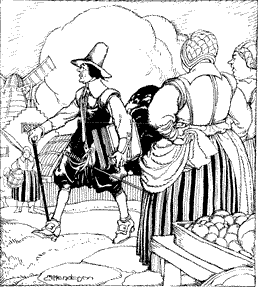
I have heard it observed by a profound adept in human physiology that if a woman waxes fat with the progress of years, her tenure of life is somewhat precarious, but if haply she withers as she grows old she lives forever. Such promised to be the case with William the Testy, who grew tough in proportion as he dried. He had withered, in fact, not through the process of years, but through the tropical fervor of his soul, which burnt like a vehement rushlight in his bosom, inciting him to incessant broils and bickerings.
Wilhelmus Kieft was a great legislator on a small scale, and had a microscopic eye in public affairs. He had been greatly annoyed by the factious meetings of the good people of New Amsterdam, but, observing that on these occasions the pipe was ever in their mouth, he began to think that the pipe was at the bottom of the affair, and that there was some mysterious affinity between politics and tobacco smoke. Determined to strike at the root of the evil, he began, forthwith, to rail at tobacco as a noxious, nauseous weed, filthy in all its uses; and as to smoking, he denounced it as a heavy tax upon the public pocket, a vast consumer of time, a great encourager of idleness, and a deadly bane to the prosperity and morals of the people. Finally, he issued an edict prohibiting the smoking of tobacco throughout the New Netherlands. Ill-fated Kieft! Had he lived in the present age and attempted to check the unbounded license of the press, he could not have struck more sorely upon the sensibilities of the million. The pipe, in fact, was the great organ of reflection and deliberation of the New Netherlander. It was his constant companion and solace: was he gay, he smoked; was he sad, he smoked; his pipe was never out of his mouth; it was a part of his physiognomy; without it his best friends would not know him. Take away his pipe? You might as well take away his nose!
THE TESTY WILLIAM ISSUED FORTH LIKE A WRATHFUL SPIDER
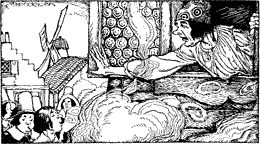
The immediate effect of the edict of William the Testy was a popular commotion. A vast multitude, armed with pipes and tobacco boxes and an immense supply of ammunition, sat themselves down before the governor’s house and fell to smoking with tremendous violence. The Testy William issued forth like a wrathful spider, demanding the reason of this lawless fumigation. The sturdy rioters replied by lolling back in their seats and puffing away with redoubled fury, raising such a murky cloud that the governor was fain to take refuge in the interior of his castle.
A long negotiation ensued through the medium of Antony the Trumpeter. The governor was at first wrathful and unyielding, but was gradually smoked into terms. He concluded by permitting the smoking of tobacco, but he abolished the fair long pipes used in the days of Wouter Van Twiller, denoting ease, tranquillity and sobriety of deportment; these he condemned as incompatible with the dispatch of business; in place whereof he substituted little captious short pipes, two inches in length, which he observed could be stuck in one corner of the mouth or twisted in the hat-band, and would never be in the way. Thus ended this alarming insurrection, which was long known by the name of The Pipe Plot, and which, it has been somewhat quaintly observed, did end, like most plots and seditions, in mere smoke.
But mark, O reader! the deplorable evils which did afterward result. The smoke of these villainous little pipes, continually ascending in a cloud about the nose, penetrated into and befogged the cerebellum, dried up all the kindly moisture of the brain, and rendered the people who used them as vaporish and testy as the governor himself. Nay, what is worse, from being goodly, burly, sleek-conditioned men, they became, like our Dutch yeomanry who smoke short pipes, a lantern-jawed, smoke-dried, leathern-hided race.
Nor was this all. From this fatal schism we may date the rise of parties in Nieuw Nederlandts. The rich burghers, who could afford to be lazy, adhered to the ancient fashion and were known as Long Pipes; while the lower order were branded with the plebeian name of Short Pipes.
PETER THE HEADSTRONG
Peter Stuyvesant was the last, and, like the renowned Wouter Van Twiller, the best, of our ancient Dutch governors, Wouter having surpassed all who preceded him, and Pieter or Piet, as he was sociably called by the old Dutch burghers, who were ever prone to familiarize names, having never been equalled by any successor. He was, in fact, the very man fitted by Nature to retrieve the desperate fortunes of her beloved province, had not the fates, those most potent and unrelenting of all ancient spinsters, destined them to inextricable confusion.
To say merely that he was a hero would be doing him great injustice: he was in truth a combination of heroes; for he was of a sturdy, raw-boned make like Ajax Telamon, with a pair of round shoulders that Hercules would have given his hide for (meaning his lion’s hide) when he undertook to ease old Atlas of his load. He was, moreover, as Plutarch describes Coriolanus, not only terrible for the force of his arm, but likewise of his voice, which sounded as though it came out of a barrel; and, like the self-same warrior, he possessed a sovereign contempt for the sovereign people, and an iron aspect which was enough of itself to make the very bowels of his adversaries quake with terror and dismay. All this martial excellency of appearance was inexpressibly heightened by an accidental advantage with which I am surprised that neither Homer nor Virgil have graced any of their heroes. This was nothing less than a wooden leg, which was the only prize he had gained in bravely fighting the battles of his country, but of which he was so proud that he was often heard to declare he valued it more than all his other limbs put together; indeed, so highly did he esteem it that he had it gallantly enchased and relieved with silver devices, which caused it to be related in divers histories and legends that he wore a silver leg.
Like that choleric warrior Achilles, he was somewhat subject to extempore bursts of passion, which were rather unpleasant to his favorites and attendants, whose perceptions he was apt to quicken, after the manner of his illustrious imitator, Peter the Great, by anointing their shoulders with his walking-staff.
He was, in fact, the very reverse of his predecessors, being neither tranquil and inert like Walter the Doubter, nor restless and fidgeting like William the Testy, but a man of such uncommon activity and decision of mind that he never sought nor accepted the advice of others, depending bravely upon his single head, as would a hero of yore upon his single arm, to carry him through all difficulties. To tell the simple truth, he wanted nothing more to complete him as a statesman than to think always right, for no one can say but that he always acted as he thought. He was never a man to flinch when he found himself in a scrape, but to dash forward through thick and thin, trusting by hook or by crook to make all things straight in the end. In a word, he possessed in an eminent degree that great quality in a statesman called perseverance by the polite, but nicknamed obstinacy by the vulgar. A wonderful salve for official blunders, since he who perseveres in error without flinching gets the credit of boldness and consistency, while he who wavers in seeking to do what is right gets stigmatized as a trimmer. This much is certain—and it is a maxim well worthy the attention of all legislators great and small who stand shaking in the wind, irresolute which way to steer—that a ruler who follows his own will pleases himself, while he who seeks to satisfy the wishes and whims of others runs great risk of pleasing nobody. There is nothing, too, like putting down one’s foot resolutely when in doubt, and letting things take their course. The clock that stands still points right twice in the four and twenty hours, while others may keep going continually and be continually going wrong.
Nor did this magnanimous quality escape the discernment of the good people of Nieuw Nederlandts; on the contrary, so much were they struck with the independent will and vigorous resolution displayed on all occasions by their new governor that they universally called him Hard-Koppig Piet, or Peter the Headstrong—a great compliment to the strength of his understanding.
THE BATTLE WITH THE SWEDES
“Now had the Dutchmen snatched a huge repast,” and, finding themselves wonderfully encouraged and animated thereby, prepared to take the field. Expectation, says the writer of the Stuyvesant manuscript—expectation now stood on stilts. The world forgot to turn round, or rather stood still, that it might witness the affray, like a round-bellied alderman watching the combat of two chivalrous flies upon his jerkin. The eyes of all mankind, as usual in such cases, were turned upon Fort Christina. The sun, like a little man in a crowd at a puppet-show, scampered about the heavens, popping his head here and there, and endeavoring to get a peep between the unmannerly clouds that obtruded themselves in his way. The historians filled their inkhorns; the poets went without their dinners, either that they might buy paper and goose-quills or because they could not get anything to eat; Antiquity scowled sulkily out of its grave to see itself outdone, while even Posterity stood mute, gazing in gaping ecstasy of retrospection on the eventful field.
The immortal deities, who whilom had seen service at the “affair” of Troy, now mounted their feather-bed clouds and sailed over the plain, or mingled among the combatants in different disguises, all itching to have a finger in the pie. Jupiter sent off his thunderbolt to a noted coppersmith to have it furbished up for the direful occasion. The noted bully Mars stuck two horse-pistols into his belt, shouldered a rusty firelock, and gallantly swaggered at the elbow of the Swedes as a drunken corporal; while Apollo trudged in their rear as a bandy-legged fifer, playing most villainously out of tune.
On the other hand, the ox-eyed Juno, who had gained a pair of black eyes overnight in one of her curtain lectures with old Jupiter, displayed her haughty beauties on a baggage wagon; while Vulcan halted as a club-footed blacksmith lately promoted to be a captain of militia. All was silent awe or bustling preparation: War reared his horrid front, gnashed loud his iron fangs, and shook his direful crest of bristling bayonets.
And now the mighty chieftains marshalled out their hosts. Here stood stout Risingh, firm as a thousand rocks, incrusted with stockades, and intrenched to the chin in mud batteries. He was a gigantic Swede, who, had he not been rather knock-kneed and splay-footed, might have served for the model of Samson or a Hercules. He was no less rapacious than mighty, and withal as crafty as he was rapacious, so that there is very little doubt that had he lived some four or five centuries since he would have figured as one of those wicked giants who took a cruel pleasure in pocketing beautiful princesses and distressed damsels when gadding about the world, and locking them up in enchanted castles without a toilet, a change of linen, or any other convenience; in consequence of which enormities they fell under the high displeasure of chivalry, and all true, loyal, and gallant knights were instructed to attack and slay outright any miscreant they might happen to find above six feet high; which is doubtless one reason why the race of large men is nearly extinct, and the generations of latter ages are so exceedingly small. His valiant soldiery lined the breastworks in grim array, each having his mustachios fiercely greased and his hair pomatumed back, and queued so stiffly that he grinned above the ramparts like a grisly death’s head.
There came on the intrepid Peter, his brows knit, his teeth set, his fists clinched, almost breathing forth volumes of smoke, so fierce was the fire that raged within his bosom. His faithful squire Van Corlear trudged valiantly at his heels, with his trumpet gorgeously bedecked with red and yellow ribbons, the remembrances of his fair mistress at the Manhattoes. Then came waddling on the sturdy chivalry of the Hudson. There were the Van Wycks, and the Van Dycks, and the Ten Eycks; the Van Nesses, the Van Tassels, the Van Grools, the Van Hoesens, the Van Giesons, and the Van Blarcoms; the Van Warts, the Van Winkles, the Van Dams; the Van Pelts, the Van Rippers and the Van Brunts. There were the Van Hornes, the Van Hooks, the Van Bunschotens; the Van Gelders, the Van Arsdales, and the Van Bummels; the Vander Belts, the Vander Hoofs and the Vander Voorts, the Vander Lyns, the Vander Pools and the Vander Spiegles. There came the Hoffmans, the Hooghlands, the Hoppers, the Cloppers, the Ryckmans, the Dyckmans, the Hogebooms, the Rosebooms, the Oothouts, the Quakenbosses, the Roerbacks, the Garrebrantzes, the Bensons, the Brouwers, the Waldrons, the Onderdonks, the Varra Vangers, the Schermerhorns, the Stoutenburghs, the Brinkerhoffs, the Bontecous, the Knickerbockers, the Hockstrassers, the Ten Breecheses, and the Tough Breecheses, with a host more of worthies whose names are too crabbed to be written, or if they could be written it would be impossible for man to utter—all fortified with a mighty dinner, and, to use the words of a great Dutch poet:
“Brimful of wrath and cabbage.”
There Came on the Intrepid Peter
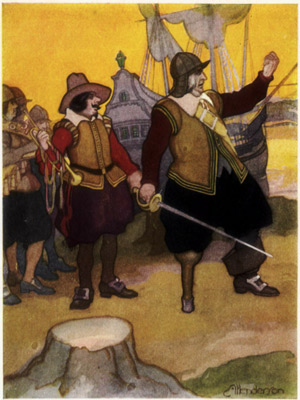
For an instant the mighty Peter paused in the midst of his career, and, mounting on a stump, addressed his troops in eloquent Low Dutch, exhorting them to fight like duyvels, and assuring them that if they conquered they should get plenty of booty; if they fell they should be allowed the satisfaction, while dying, of reflecting that it was in the service of their country, and after they were dead of seeing their names inscribed in the temple of renown, and handed down, in company with all the other great men of the year, for the admiration of posterity. Finally, he swore to them, on the word of a governor (and they knew him too well to doubt it for a moment), that if he caught any mother’s son of them looking pale or playing craven, he would curry his hide till he made him run out of it like a snake in spring-time. Then, lugging out his trusty saber, he branished it three times over his head, ordered Van Corlear to sound the charge, and, shouting the words, “Saint Nicholas and the Manhattoes!” courageously dashed forward. His warlike followers, who had employed the interval in lighting their pipes, instantly stuck them into their mouths, gave a furious puff, and charged gallantly under cover of the smoke.
The Swedish garrison, ordered by the cunning Risingh not to fire until they could distinguish the whites of their assailants’ eyes, stood in horrid silence on the covert-way until the eager Dutchmen had ascended the glacis. Then did they pour into them such a tremendous volley that the very hills quaked around, and certain springs burst forth from their sides which continue to run unto the present day. Not a Dutchman but would have bitten the dust beneath that dreadful fire had not the protecting Minerva kindly taken care that the Swedes should, one and all, observe their usual custom of shutting their eyes and turning away their heads at the moment of discharge.
The Swedes followed up their fire by leaping the counterscarp and falling tooth and nail upon the foe with furious outcries. And now might be seen prodigies of valor unmatched in history or song. Here was the sturdy Stuffel Brinkerhoff branishing his quarter-staff, like the giant Blanderon his oak tree (for he scorned to carry any other weapon), and drumming a horrific tune upon the hard heads of the Swedish soldiery. There were the Van Kortlandts, posted at a distance, like the Locrian archers of yore, and plying it most potently with the long-bow, for which they were so justly renowned. On a rising knoll were gathered the valiant men of Sing-Sing, assisting marvelously in the fight by chanting the great song of Saint Nicholas; but as to the Gardeniers of Hudson, they were absent on a marauding-party, laying waste the neighboring watermelon-patches.
In a different part of the field were the Van Grolls of Antony’s nose, struggling to get to the thickest of the fight, but horribly perplexed in a defile between two hills by reason of the length of their noses. So also the Van Bunschotens of Nyack and Kakiat, so renowned for kicking with the left foot, were brought to a stand for want of wind in consequence of the hearty dinner they had eaten and would have been put to utter rout, but for the arrival of a gallant corps of voltigeurs, composed of the Hoppers, who advanced nimbly to their assistance on one foot. Nor must I omit to mention the valiant achievements of Antony Van Corlear, who for a good quarter of an hour waged stubborn fight with a little pursy Swedish drummer, whose hide he drummed most magnificently, and whom he would infallibly have annihilated on the spot but that he had come into the battle with no other weapon but his trumpet.
But now the combat thickened. On came the mighty Jacobus Varra Vanger and the fighting men of the Wallabout; after them thundered the Van Pelts of Esopus, together with the Van Rippers and the Van Brunts, bearing down all before them; then the Suy Dams and the Van Dams, pressing forward with many a blustering oath at the head of the warriors of Hell-Gate, clad in their thunder-and-lightning gaberdines; and lastly the standard-bearers and body-guards of Peter Stuyvesant, bearing the great beaver of the Manhattoes.
And now commenced the horrid din, the desperate struggle, the maddening ferocity, the frantic desperation, the confusion and self-abandonment of war. Dutchman and Swede, commingled, tugged, panted, and blowed. The heavens were darkened with a tempest of missiles. Bang! went the guns—whack! went the broadswords—thump! went the cudgels—crash! went the musket-stocks—blows, kicks, cuffs, scratches, black eyes, and bloody noses swelling the horrors of the scene! Thick thwack, cut and hack, helter-skelter, higgledy-piggledy, hurly-burly, head over heels, rough and tumble! Dunder and blixum! swore the Dutchmen; splitter and splutter! cried the Swedes; storm the works! shouted Hardkoppig Pieter; fire the mine! roared stout Risingh; tanta-ra-ra-ra! twanged the trumpet of Antony Van Corlear—until all voice and sound became unintelligible, grunts of pain, yells of fury, and shouts of triumph mingling in one hideous clamor. The earth shook as if struck with a paralytic stroke—trees shrunk aghast and withered at the sight—rocks burrowed in the ground like rabbits—and even Christina Creek turned from its course and ran up a hill in breathless terror!
Long hung the contest doubtful, for though a heavy shower of rain, sent by the “cloud-compelling Jove,” in some measure cooled their ardor, as doth a bucket of water thrown on a group of fighting mastiffs, yet did they but pause for a moment, to return with tenfold fury to the charge. Just at this juncture a vast and dense column of smoke was seen slowly rolling toward the scene of battle. The combatants paused for a moment, gazing in mute astonishment, until the wind, dispelling the murky cloud, revealed the flaunting banner of Michael Paw, the patroon of Communipaw. That valiant chieftain came fearlessly on at the head of a phalanx of oyster-fed Pavonians and a corps de reserve of the Van Arsdales and Van Bummels, who had remained behind to digest the enormous dinner they had eaten. These now trudged manfully forward, smoking their pipes with outrageous vigor, so as to raise the awful cloud that has been mentioned; but marching exceedingly slow, being short of leg and of great rotundity in the belt.
And now the deities who watched over the fortunes of the Nederlandters having unthinkingly left the field and stepped into a neighboring tavern to refresh themselves with a pot of beer, a direful catastrophe had well-nigh ensued. Scarce had the myrmidons of Michael Paw attained the front of battle, when the Swedes instructed by the cunning Risingh, levelled a shower of blows full at their tobacco-pipes. Astounded at this assault and dismayed at the havoc of their pipes, these ponderous warriors gave way and like a drove of frightened elephants broke through the ranks of their own army. The little Hoppers were borne down in the surge; the sacred banner emblazoned with the gigantic oyster of Communipaw was trampled in the dirt; on blundered and thundered the heavy-sterned fugitives, the Swedes pressing on their rear and applying their feet a parte poste of the Van Arsdales and the Van Bummels with a vigor that prodigiously accelerated their movements, nor did the renowned Michael Paw himself fail to receive divers grievous and dishonorable visitations of shoe-leather.
But what, O Muse! was the rage of Peter Stuyvesant when from afar he saw his army giving way! In the transports of his wrath he sent forth a roar enough to shake the very hills. The men of the Manhattoes plucked up new courage at the sound, or, rather, they rallied at the voice of their leader, of whom they stood more in awe than of all the Swedes in Christendom. Without waiting for their aid the daring Peter dashed, sword in hand, into the thickest of the foe. Then might be seen achievements worthy of the days of the giants. Wherever he went the enemy shrank before him; the Swedes fled to right and left or were driven, like dogs, into their own ditch; but as he pushed forward singly with headlong courage the foe closed behind and hung upon his rear. One aimed a blow full at his heart; but the protecting power which watches over the great and good turned aside the hostile blade and directed it to a side-pocket, where reposed an enormous iron tobacco-box endowed, like the shield of Achilles, with supernatural powers, doubtless from bearing the portrait of the blessed Saint Nicholas. Peter Stuyvesant turned like an angry bear upon the foe, and seizing him as he fled by an immeasurable queue, “Ah, caterpillar!” roared he, “here’s what shall make worm’s meat of thee!” So saying, he whirled his sword and dealt a blow that would have decapitated the varlet, but that the pitying steel struck short and shaved the queue forever from his crown. At this moment an arquebusier levelled his piece from a neighboring mound with deadly aim; but the watchful Minerva, who had just stopped to tie up her garter, seeing the peril of her favorite hero, sent old Boreas with his bellows, who as the match descended to the pan gave a blast that blew the priming from the touch-hole.
Thus waged the fight, when the stout Risingh, surveying the field from the top of a little ravelin, perceived his troops banged, beaten, and kicked by the invincible Peter. Drawing his falchion and uttering a thousand anathemas, he strode down to the scene of combat with some such thundering strides as Jupiter is said by Hesiod to have taken when he strode down the spheres to hurl his thunderbolts at the Titans.
When the rival heroes came face to face each made a prodigious start in the style of a veteran stage champion. Then did they regard each other for a moment with the bitter aspect of two furious tom-cats on the point of a clapper-clawing. Then did they throw themselves into one attitude, then into another striking their swords on the ground first on the right side, then on the left; at last at it they went with incredible ferocity. Words cannot tell the prodigies of strength and valor displayed in this direful encounter—an encounter compared to which the far-famed battles of Ajax with Hector, of Æneas with Turnus, Orlando with Rodomont, Guy of Warwick with Colbrand the Dane, or of that renowned Welsh knight Sir Owen of the mountains with the giant Guylon, were all gentle sports and holiday recreations. At length the valiant Peter, watching his opportunity, aimed a blow, enough to cleave his adversary to the very chine; but Risingh nimbly raising his sword, warded it off so narrowly that glancing on one side, it shaved away a huge canteen in which he carried his liquor: thence, pursuing its trenchant course, it severed off a deep coat-pocket stored with bread and cheese; which provant, rolling among the armies, occasioned a fearful scrambling between the Swedes and Dutchmen, and made the general battle to wax ten times more furious than ever.
Enraged to see his military stores laid waste, the stout Risingh, collecting all his forces, aimed a mighty blow full at the hero’s crest. In vain did his fierce little cocked hat oppose its course. The biting steel clove through the stubborn ram-beaver, and would have cracked the crown of any one not endowed with supernatural hardness of head; but the brittle weapon shivered in pieces on the skull of Hardkoppig Piet, shedding a thousand sparks like beams of glory round his grizzly visage.
The good Peter reeled with the blow, and, turning up his eyes, beheld a thousand suns, beside moons and stars, dancing about the firmament. At length, missing his footing by reason of his wooden leg, down he came on his seat of honor with a crash which shook the surrounding hills, and might have wrecked his frame had he not been received into a cushion softer than velvet which Providence had benevolently prepared for his reception.
The furious Risingh, in despite of the maxim, cherished by all true knights, that “fair play is a jewel,” hastened to take advantage of the hero’s fall; but as he stooped to give a fatal blow, Peter Stuyvesant dealt him a thwack over the sconce with his wooden leg, which set a chime of bells ringing triple bobmajors in his cerebellum. The bewildered Swede staggered with the blow, and the wary Peter seizing a pocket-pistol which lay hard by, discharged it full at the head of the reeling Risingh. Let not my reader mistake: it was not a murderous weapon loaded with powder and ball, but a little sturdy stone pottle charged to the muzzle with a double dram of true Dutch courage, which the knowing Antony Van Corlear carried about him by way of replenishing his valor and which had dropped from his wallet during his furious encounter with the drummer. The hideous weapon sang through the air, and true to its course as was the fragment of a rock discharged at Hector by bully Ajax, encountered the head of the gigantic Swede with matchless violence.
This heaven-directed blow decided the battle. The ponderous pericranium of General Jan Risingh sank upon his breast, his knees tottered under him, a death-like torpor seized upon his frame, and he tumbled to the earth with such violence that old Pluto started with affright, lest he should have broken through the roof of his infernal palace.
His fall was the signal of defeat and victory: the Swedes gave way, the Dutch pressed forward; the former took to their heels, the latter hotly pursued. Some entered with them, pell-mell, through the sally-port; others stormed the bastion, and others scrambled over the curtain. Thus in a little while the fortress of Fort Christina, which, like another Troy, had stood a siege of full ten hours, was carried by assault without the loss of a single man on either side. Victory, in the likeness of a gigantic ox-fly, sat perched upon the cocked hat of the gallant Stuyvesant, and it was declared by all the writers whom he hired to write the history of his expedition that on this memorable day he gained a sufficient quantity of glory to immortalize a dozen of the greatest heroes in Christendom!