THE FALL OF THE ALAMO
Reading edition
Texas began its struggle for independence from Mexico in September, 1835, driven to it by the fact that under the rule of the new republic their treatment was little better than it had been while Mexico herself was under the Spanish control. No sooner, however, had the Texans declared their independence than General Cos led a large detachment into the state and determined to drive out of it those Americans who had settled there. The Mexican general met with so fierce a resistance that he was compelled to take refuge behind the walls of the Alamo in San Antonio de Bexar.141-1 He had seventeen hundred men, but in spite of this fact the two hundred and sixteen Texans under General Burlison stormed the place, captured the Mexican general and sent him under parole to his brother-in-law, the famous Santa Ana.141-2
A garrison of about a hundred and sixty men under the joint command of Colonel Travis142-3 and Colonel Bowie142-4 was in the Alamo in February of 1836. About this time there came to the Alamo David Crockett142-5 of Tennessee, a famous hunter, warrior and politician, who had already represented his district in Congress, where he distinguished himself by his rough and powerful oratory.
On the afternoon of February 22nd, a large force of Mexicans under General Santa Ana arrived at San Antonio, and the next morning demanded an unconditional surrender of the fort and its garrison. Although the Texans were taken almost completely by surprise, Travis answered the demand with a cannon shot, and the Mexicans raised the red flag which signified “no quarter.”
The next morning the following proclamation was issued by Colonel Travis:
To the people of Texas and all Americans of the world. “Commandancy of the Alamo, Bexar, “February 24, 1836.
“Fellow Citizens and Compatriots,—I am besieged by a thousand or more of the Mexicans under Santa Ana. I have sustained a continued bombardment and cannonade for twenty-four hours and have not lost a man. The enemy have demanded a surrender at discretion; otherwise the garrison is to be put to the sword if the fort is taken. I have answered the summons with a cannon shot, and our flag still waves proudly from the walls. I shall never surrender or retreat. Then I call on you in the name of liberty, patriotism, and everything dear to the American character, to come to our aid with all despatch. The enemy are receiving reënforcements daily, and will no doubt increase to three or four thousand in four or five days. Though this call may be neglected, I am determined to sustain myself as long as possible, and die like a soldier who never forgets what is due to his own honour and that of his country. Victory or death!
“(Signed) W. BARRETT TRAVIS, “Lieut.-Col. Com’t.”
When the Mexicans were first seen in San Antonio the defenders of the Alamo were thrown into a panic, for no one dreamed that enemies were in the vicinity; yet no one of the hardy garrison thought of flight, and after the first surprise was over, order was quickly restored and everything put in readiness for a bitter contest. The possible conflict of authority between Colonel Bowie and Colonel Travis was prevented by the fact that the former had been stricken with pneumonia and was lying in the hospital, a very sick man.
It was soon found that the siege lines of the enemy were not so close but that messengers might be sent through. One or two privates were despatched to bring assistance, but none succeeded in doing so. On the twenty-ninth of February it was resolved to send Captain Seguin, who spoke Spanish fluently, and who might by his own personal influence accomplish what the simple messages alone seemed unable to do. Seguin had no horse of his own, so he went to Colonel Bowie and borrowed his equipment, though the latter was so ill that he scarcely recognized the man who made the request. After a perilous ride, in which they were fired upon by the Mexicans, Seguin and his single aid succeeded in reaching the camp of volunteers which was forming at Gonzales. Here he induced thirty-six men to leave the camp and proceed to the Alamo, which they entered, thus raising the number of defenders to about a hundred and ninety. On the third of March,144-6 Travis sent another courier with a letter to his governor. In this he stated the situation calmly, urged him to assist him, and closed with the following words: “The bearer of this will give your honorable body a statement more in detail, should he escape through the enemies’ lines. God and Texas! Victory or death.“
For about ten days Travis held the little fort under a storm of cannon balls, which really were more alarming than destructive, for few, if any, of the defenders were killed or wounded. Travis felt that they had been almost miraculously preserved, and in all the hardy company was born a feeling that they could not lose in this terribly one-sided contest. Every day they looked to the northward, hoping to see relief coming, and every night turned in disappointment to the little rest that was allowed them. They fought manfully, wasting no ammunition and making every shot count. Until the final assault, the execution done by the guns was overwhelmingly in favor of the Texans.
The Mexicans had fixed on the morning of the sixth of March for the final assault. Their infantry met, between midnight and dawn, at convenient distances from the fort, in four columns. To each column was assigned a commanding officer with a second to take his place in case the first was disabled. Some of the columns were provided with scaling ladders, axes and other implements by which they might mount the wall or open breaches in it. The cavalry was stationed at different points surrounding the fort, so that they would be able to cut off any fugitives who might escape from the fort. The attack was probably led by General Castrillon, a Spaniard, who had already had a brilliant military career.
THE MEXICANS STORM THE FORT
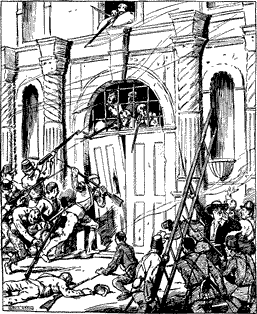
It is not thought that Santa Ana engaged personally in the assault, as it is known that before the advance was made, he was stationed with several bands of music and a batterv about five hundred yards south of the Alamo, and that from this point he gave the bugle-signal for the advance. At double-quick time the columns advanced simultaneously against the little fort, one rushing through a breach which had already been made in the walls at the north, a second storming the chapel and a third scaling the west barrier.
General Cos, who had been captured by the Texans the year before and who was released on parole, broke his word of honor and led the storming column against the chapel. All this had been so planned that the several columns should reach the walls of the fort just as the coming dawn gave light enough to guide their movements. When the hour came, the bugle sounded, and the Mexicans, maddened by their losses and determined to avenge themselves on this courageous little troop, rushed forward to the walls while their bands played the assassin music that signified “no quarter.”
It is difficult to give an orderly account of the conflict which followed, but some incidents stand out boldly. General Cos was repulsed from the chapel, and the column which attacked the north wall was badly cut before it succeeded in making an entrance. Here at the breach they met Colonel Travis in person, and here after the action he was found dead with a bullet hole through his head, and by his side a Mexican officer pierced to the heart by a sword still held in the hand of the dead Texan. On the west side the walls were scaled, and after bitter fighting the garrison, driven from the outer defenses, took refuge in the low barracks and other buildings, where, being more united, they could fight to better advantage. However, there was no easy means of communication between the buildings, and thus the surviving Texans soon were broken up into small groups, fighting desperately against the overwhelming numbers of the Mexicans. There was no need of leadership, however, or of direction from officers. The Mexicans purposed to allow no quarter, and nothing remained for the Texans except that each man should fight to the last, doing as great execution as he could before finally falling under the weight of numbers.
THE DEFENDERS FIRING FROM WINDOWS
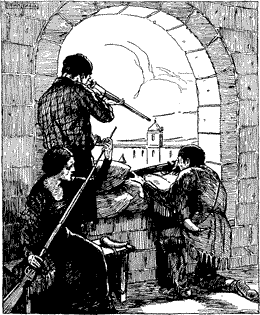
Again and again the enemy charged upon the little buildings, while from the windows and loop-holes the crack of rifles and the whiz of bullets showed that the living defenders were still active. It is not exaggerating to say that the assailants fell in heaps, for around each little building and before the long barracks the carnage was dreadful. One by one, however, the buildings were carried at the point of the bayonet, and the little groups of Texans broken up and destroyed.
The last point to yield was the chapel, which seems to have been held by a somewhat larger force than any of the other buildings. However, after the parade grounds were cleared and the other companies destroyed, it was possible to burn the most of the fort and thus batter it down and kill its brave defenders.
It is said that toward the close of the struggle in the chapel, Lieutenant Dickinson was seen to leap from one of the windows with a small child in his arms, and that both were shot as they leaped. This was perhaps the last act in the great tragedy, for if any were alive in the chapel after the lieutenant made his attempted escape, they were quickly bayonetted where they stood.
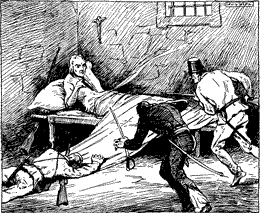
With the dead and dying strewn around, Santa Ana entered the fort. What he saw there, we cannot attempt to describe, but a few things we must mention. In his own room they found Colonel Bowie dead in his bed, where he had lain too sick to rise; but he had had strength to use his weapons, for four Mexicans had fallen, shot to death in the room, while a fifth lay across the bed with the Colonel’s terrible knife sticking in his heart. Near the door of the magazine it is said that they found Major Evans, the master of ordnance, shot down with a burning match in his hand, before he could fire the powder and blow the fort and his enemies into the air.
COLONEL BOWIE USED HIS WEAPONS TO THE LAST
Upon a high platform in one corner, there was a small cannon which was turned upon the Mexicans in the fort and did terrible execution. Who handled it is not exactly known, but near it were found the bodies of David Crockett and five of his companions. It is said, though possibly without much foundation, that when Santa Ana stepped into the courtyard he found Crockett and his companions still fighting.
Concealed in one of the rooms under some mattresses, five men were found, and under a bridge crossing an irrigating ditch another was discovered. All these were immediately shot by the orders of Santa Ana, and so hastily and excitedly was it all done that a Mexican was killed with them by accident. The wife of Lieutenant Dickinson, a negro servant of Travis, and a few Mexican women were the only human beings whose lives were spared.
Thus fell the Alamo. In thinking of this bloody tragedy, we must remember that these were simple citizens, bound together by no tie save their affection for one another and their loyalty to a state of whose independence they were as yet ignorant, for though Texas was then the “Lone Star State,” no intimation of the Texas declaration of independence had reached Travis or his devoted followers. According to the report of General Santa Ana, the action lasted but thirty minutes from the time the enemy entered the walls till the resistance was completely quelled.
So many false reports have been made of the number engaged in this struggle that it is impossible even now to tell definitely. We do know that the number of Texans was less than two hundred, and it is probable that about twenty-five hundred Mexicans were engaged in the assault. All the Texans were killed, and from the various accounts we are led to infer that about five hundred Mexicans fell, a number which shows that the defense of the Texans was indeed fierce and bloody.
The history of our country does not show any incident of greater bravery or more heroic self-sacrifice, and it is hardly to be conceived that such a defense will ever be excelled. This was no disciplined force fighting under trained officers, but a group of simple, manly men, not agreeing in all things, but united with the one idea of fighting against cruelty and oppression.
On the Capitol grounds at Austin, Texas, a monument was erected in 1891 to the heroes of the Alamo. On it is this inscription:
“Thermopylæ had her messenger of defeat: The Alamo had none.”
During our war with that country, the Mexicans under his command were several times defeated, and Santa Ana resigned his commission. In 1853 he was for the last time made president, but before his term expired he was for a third time driven from his country in disgrace.