UNDER THE SHADOW OF THE WHITE PASS
Reading edition
I have stumbled upon a few "tough" corners of the globe during my wanderings beyond the outposts of civilisation, but I think the most outrageously lawless quarter I ever struck was Skagway in the days of its early infancy. Now, I am told, Skagway is a flourishing township, boasting of the orthodox amount of "broad" streets and "palatial" buildings for an American "boom" camp. This may be, though—unless the geographical features of the district have altered—I can hardly credit it. When I was there the embryo city balanced itself precariously along the lower slopes of the White Pass, and a good percentage of the population had to be content with huts built on piles within the tidal limit of the Lynn Canal. In short, there was no room to build anything, and Skagway existed simply because it marked the entry to the Yukon's frozen treasure. Its permanent residents were, for the most part, sharpers of the worst type; indeed, it seemed as if the scum of the earth had hastened here to fleece and rob, or, failing those gentle arts, to murder the unwary voyagers to or from the Golden North. There was no law whatsoever; might was right, the dead shot only was immune from danger.
It was late autumn in the year when the first news of Klondike riches burst upon the world, when I, with my companion Mac, arrived at the head of the Lynn inlet, en route for the land of snows and nuggets. Our ship, the Rosalie, carried a goodly number of passengers, but they were mainly of the ruffian "store and saloon-keeper" variety, and few, if any, of them ever got beyond the pass. The true gold-miner is proverbially poor, and as yet his kind had not been numerous on the trail. As for myself, I was enterprising if nothing else, and my companion made up for my deficiencies in other respects. He was a ferocious individual without a doubt, my worthy henchman; without him my early journeyings would have ended before they had well begun, but, being a hardened traveller, he knew how to adapt himself to circumstances, and how to come off best in a scrimmage, both of which traits were brought fully out before we had been long in the villainous little camp of Skagway. Our first twenty-four hours' experiences may be worth relating.
We were the only representatives of Old England in these uncouth parts at this period, a fact which had not made us any more beloved by the aggressively hostile Yankees on board the Rosalie. Times without number they told me how the "great American nation" could wipe the British Isles off the face of the earth at a moment's notice, and how a "free-born American" was equal to a dozen Britishers, and how we two would be swallowed alive by these same men should we dare say a word to the contrary. We bore a good deal of this sort of thing in silence, though occasionally throughout the protracted voyage my fiery aide-de-camp retaliated angrily, and did considerable damage among his tormentors, who proved to be warlike only in their speech. But this is a digression, and though I could write pages on that momentous cruise—we ran aground five times, and were practically wrecked twice—I must desist and continue my narrative.
The first man we saw after being dumped on the muddy shores of Skagway Bay was a short, red-headed individual, with ruddy countenance to match, who fairly bristled with weapons of the most bloodthirsty description. He approached Mac and me as we stood hesitatingly by the water's edge looking around for some habitation wherein we might find refuge for the first night of our sojourn in a strange land.
"Hallo, stranger!" he saluted, affably, firing a huge revolver unpleasantly close to my ear in a most nonchalant manner.
"Hallo!" I said without enthusiasm, feeling cautiously in the rear of my nether garments to make sure that my own gun was where it ought to be.
He seemed somewhat hurt at the stiffness of my rejoinder, and toyed suggestively with his revolver for some moments without speaking. Meanwhile Mac proceeded unconcernedly along the beach to where a huge hulk lay moored, whose broad beam bore the legend in giant letters—"Skagit Hotel. Recently of San Francisco. Finest accommodation in town."
I was preparing to follow in my comrade's footsteps, marvelling at the enterprise which had brought the old dismasted schooner so opportunely to such a region; but my friend with the gun was not to be put off.
"Say, stranger," he growled, stepping before me, "you don't know who I am, I reckon——"
"I don't," I interrupted, shortly, "and I am not over anxious to make your acquaintance either."
He glared at me savagely for an instant, then broke out into a hearty laugh. "For a darned Englisher you are mighty pert," he said, "an' I won't slaughter you—just yet. Still, for your future benefit I may tell you that my handle is Soapy Sam, an' I've planted considerable men like you in my time. I'm a bad man, I is, but your ignorance saves ye."
The conversation was being uncomfortably prolonged; yet I dared not make any movement. "What's the damage, Soapy?" I asked contritely. "I suppose you are collecting toll in your polite way?"
He lowered his weapon and grinned. "Every tenderfoot as lands in this here city has to play poker with me or fight," he acknowledged smilingly.
I realised my position at once. It was painfully clear to me that the "fight" would be all on one side, and could only end in one way so long as Soapy held the "drop," and it was also clear that the alternative was to submit to wholesale robbery. A loud shout at our back made us both turn with alacrity, and behold there stood Mac with his long Winchester repeater levelled fairly at Soapy Samuel's head. The wily individual had scented danger, and had made a détour expressly for my benefit.
"Say when," he murmured calmly, from behind his artillery, "and I'll blow the deevil into vulgar fractions."
I stepped out of range of fire without delay. Soapy's fingers twitched on the stock of his lowered revolver as his ferret-like eyes blinked down the muzzle of the deadly tube, which never wavered a hair's breadth. Then his weapon dropped from his nerveless hand, and slowly his arms were upraised towards the sky, and he smiled an exceedingly sickly smile.
"You've got the pull on me this time, partner," he said. "I caves."
At this moment a hoarse chorus of cheers rang out from the vicinity of the Skagit Hotel. The inmates had assembled on the upper deck to witness the discomfiture of their common enemy.
"Shoot him!" they roared; "he killed old Smith."
But Mac was not disposed to make himself public executioner. "Ye'd better vanish, Soapy," he grunted.
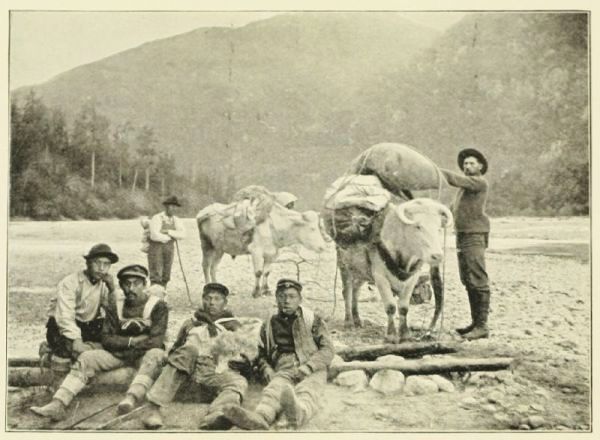
A Party of Miners going in by the Skagway or White Pass Trail.
"Never mind the cannon ye dropped; it'll just suit me. Quick, fur I'm getting nervish."
Soapy fled, slipping and stumbling through the snow in his intense haste. But when he had placed a good hundred yards between him and his conqueror, he turned and waved his hand cheerily.
"I bear no ill-will, boys," he shouted; "I was clean bested. But," and he turned towards the Skagit, "I'll have it out with you afore long, and don't forgit it."
A yell of derision greeted him in return. Apparently the Skagit dwellers meant to take all chances with a light heart. Mac grounded his rifle with a grunt of satisfaction.
"This is the deevil's ain country we've struck," he grumbled. "It's a blessed thing I got insured afore I left auld Scotland." I agreed with him heartily, and together we sought the hospitable shelter of the stranded hotel, where we were welcomed effusively by the proprietor thereof, a merry-faced Irishman of the name of O'Connor.
"We're chock full up, but we'll gladly make room for you, boys," he said. "It wouldn't be safe to allow you to go up among Soapy's gang."
I expressed my gratitude for his tender solicitude, then made sundry inquiries as to the prospects of crossing the pass within the next day or so.
"You want to cross the pass?" he echoed, in amazement. "Why, you won't be able to do that until next spring. The snows are on, and the trail is blocked with hundreds of dead horses anyhow."
I had heard this statement so often of late that I was in nowise taken aback. "We certainly did not come here for the good of our health," I said. "We'll try the Chilcoot Pass if the Skagway route is impossible. Dyea is not very far from here, I think?"
"Only about four miles round about," he replied. "It is at the head of the inlet you would see before your ship branched in here. A mighty miserable place it is, for the winds sweep right down from the sea almost constantly."
"We didn't expect to find roses growing on the track," snorted Mac, impatiently. "We'll try and get round to Dyea in the morning."
But now another difficulty arose. There were no boats to be had stout enough to withstand the heavy gales which, as we had just been told, blew ceaselessly up the funnel-like entrance to the Chilcoot Valley, and even if there had been, our outfit of flour and miscellaneous foodstuffs was rather an unwieldy factor to be considered.
"It's a maist ungodly country," commented Mac gloomily. "There seems to be nae room for anybody but thieves an' murderers, and it' very funny that there's no' an honest gold-miner among the lot."
Our fellow-passengers nearly all had found congenial quarters further back in the city, and one or two had erected their tents on the beach, forgetting in their haste to found a home that the tide would wash over their camp site about twelve o'clock that same night. Yet no one cared to inform them on the matter, and Mac watched their progress with undisguised joy, and howled with delight when one of his old enemies began to haul timber from the hillside for the purpose of building a substantial edifice on the sinking sands.
"They might know that the old Skagit couldn't have walked up here," laughed our host. "But they'll find out their mistake soon enough, I reckon," and he chuckled, long and loudly.
Having partaken of dinner, Mac and I sallied forth to visit the scattered array of huts and tents which constituted the town.
"Look out for Soapy Sam," warned a swarthy-visaged man in picturesque attire. "He's a nasty sort of skunk to meet, even in the daytime, as you already know. If ye get into trouble just yell on me—Black Harry is my handle—and I'll be with you in a couple of shakes."
I thanked the dusky warrior, who indeed looked as if he could give a very good account of himself when necessary, and with the butt of my revolver clutched tightly in my hand, I walked citywards with Mac, who gravely whistled selections from a hymn entitled, "There is a Happy Land." On our arrival in Klondike Avenue, as the main thoroughfare was elegantly styled, not a solitary individual was to be seen. The weather was bitterly cold, and the denizens of the camp, with commendable good sense, avoided all danger of frostbite by keeping within the shelter of their wigwams. The deserted avenue was therefore a most dreary spectacle, and the gathering shadows of night hanging over the grim pass in the background did not tend to enliven the gloom of the scene.
"And to think that for the last fortnight I hae heard nothing but stories o' American grit, American hardiness, American—everything," soliloquised Mac, sarcastically; "yet every deevil o' them is frichtened o' catchin' cold—but hallo! what's this?"
He directed my gaze towards a flaring poster nailed to a tree. We approached, and read the rude notice. "In the Skagit Hall to-night. Grand concert. Miss Caprice, of New York, the world-famed variety actress, will hold the camp in thrall. Leave your guns at home, and come early to avoid the rush. N.B.—Poker tables have been fixed up for the convenience of the audience."
The last clause gave the key to the whole concern. Miss Caprice—whoever that might be—was merely an extra attraction. Appended was a weird diagram purporting to be a sketch of the aforesaid Miss Caprice in the intricacies of one of her dance specialities. Mac shuddered and looked pained.
"This is maist decidedly no place for a white man," he asserted, with a sigh. Then we turned and headed back for the Skagit, where in the later hours the world-famed artiste was billed to disport herself. As we passed by a large log structure set back among the trees, I was surprised to hear a husky voice call out to us, and while we hesitated the door of the hut swung open, and Soapy Sam appeared and beckoned mysteriously. He apparently had discarded his armoury, but I was not disposed to trust much to appearances, at which our old enemy looked considerably aggrieved.
"I bear no grudge, boys," he said. "No man can say that Soapy Sam went back on his word. You downed me fair."
"Then what is it?" I inquired suspiciously.
"Ye must admit, Soapy, ma man," added Mac drily, "that your reputation even among yer ain folk is no' just rosy."
But Soapy was evidently determined not to be offended by anything we might say. He approached with hands extended in token of good faith, and, noting this, we stayed our progress and waited wonderingly to hear what he wished to speak. He did not enlighten us much, however.
"I say, boys," he whispered when he came near, "can you both swim?"
Mac nodded. "But it wouldna be a pleasant diversion in this weather," he remarked, with a shudder.
"Then don't go near the Skagit to-night," said Soapy impressively. "There's a storm rising, and I shouldn't wonder if the old barge bursts her moorings before morning."
He was gone in an instant, and Mac and I gazed at each other in dismay. "What can he mean?" I said.
"Heaven knows," growled Mac; "but we'll likely find out before very long. He's a gey slippery customer, is Soapy, an' no' easily understood, I'm thinkin'."
We continued on our course meditating deeply, but, no solution of the mysterious warning presenting itself, it escaped our minds utterly in the noisy excitement that prevailed on our return to the Skagit. O'Connor, the proprietor, was all agog with the importance of his position as master of ceremonies; he was busily superintending the placing of a rickety old piano when we made our appearance, and he immediately seized on Mac for a song during the evening, a favour which was most promptly refused.
"Miss Caprice an' me wouldna suit on the same programme," was the worthy diplomatist's excuse. "Get Black Harry an' Soapy Sam—"
"Soapy Sam is barred this circus," sternly interrupted O'Connor. "I'm running a concert to-night, not a funeral undertaking establishment." Assuredly Soapy Sam's prowess was no mean factor to be considered.
At 7 p.m. prompt—as advertised—the entertainment began. The room was crowded with truly all sorts and conditions of men, and the air reeked with tobacco smoke. The piano manipulator—a bewhiskered and groggy-looking personage in top-boots—took his place with stately grace as befitted the dignity of his office. He ran his fingers clumsily over the keys as if seeking for some lost chord or combination, which, however, he did not find, and then he rattled out an ear-shattering melody in which the audience, after a moment's pause, joined lustily. In the midst of the uproar thus let loose a gaudily-bedecked creature of the female persuasion, wearing a grin that almost obliterated her features, appeared on the raised stage at the end of the saloon, and joined in the pandemonium, her shrill voice screaming out the touching information that there would be "a hot time in the old town to-night," which coincided with the item on the programme.
This was Miss Caprice—a type of the "noble and enduring" women whom recent "Klondike" novelists have portrayed so tenderly in their "realistic" romances. Heaven forbid that the respectable British public should be thus deceived. There was no woman with any claim to the name on the long trail in these days.
It would be impossible to describe the course of that memorable "concert." It continued in spasms—or turns, which I believe is the correct term to use—far into the night, with occasional interruptions in the shape of fights and wordy altercations among the poker players, diversions which lent pleasurable variety to the entertainment, though now and again it seemed as if a funeral or two would surely result therefrom. But all smoothed off harmoniously under the influence of Miss Caprice's moving melodies, which always were turned on at opportune moments. Mac said that her voice was like unto the buzzing of a steam saw in cross-grained wood, but perhaps he was prejudiced, or his artistic senses a trifle too fine. Anyhow, she pleased the multitude mightily, and they roared out their appreciation boisterously at the conclusion of each of her vocal exercises, and implored her to continue her soothing ditties unendingly. The too free use of the flowing bowl was probably accountable for the warmth of their approval; but Miss Caprice, having indulged in equal degree with her admirers, was getting less and less able to trill forth sweet sounds for their edification, and matters were fast beginning to assume a by no means inviting aspect.
Several times during the progress of events Mac and I endeavoured to make an unobtrusive exit, but all to no purpose.
Slowly the time dragged on its weary course, then suddenly I became aware that the old Skagit was rising with the incoming tide. She swayed cumbrously once or twice, and her rotten timbers creaked and groaned dismally under the strain, but no one seemed to consider these indications worthy of attention, and the roystering chorus went on without interruption. At intervals I could hear vague voices calling excitedly without, and I guessed that the men who had built their homes in the sand were having a bad time.
Another half-hour passed. By this time the taste of the audience had reached the sentimental stage, and they loudly clamoured for a song suited to their altered temperament. The accompanist, however, persisted in playing the "hot time" tune to everything, so he was discharged with ignominy by the scornful prima donna, who announced in broken accents that she would give a rendering of "Ashtore" without musical assistance, which was most unwise on her part. Still, she persisted at her task, and got to the end of the first verse without mishap; but as she screamed out the last wailing notes of the chorus the old Skagit gave a sudden lurch, and sent her reeling head foremost into the centre of the room.
"What's the matter with the darned barge?" howled several indignant voices among the crowd, but no answer was forthcoming. The Skagit at that moment was seized with convulsions, and rolled and pitched in a most unaccountable manner.
"Howlin' blazes!" yelled Black Harry. "The happy home must have broken loose."
The rush that followed is beyond description. Mac and I, being less affected by the motion of the hulk than the majority, reached the deck first. Away far back to the right the lights of Skagway shimmered out over the smooth waters of Skagway Bay. To the left the faint illuminations of Healy's Store at Dyea shone at the head of the Chilcoot Inlet, along which great seas were rolling in from the main channel. We had drifted out with the ebbing tide, and we were now being borne onwards by the uninterrupted ocean gales. If we escaped being dashed to pieces against the rocky bluffs of the peninsula, we might be driven ashore on the mud banks at Dyea; but it was certain that the Skagit could not return to her wonted anchorage that night.
Loud and deep were the curses that now arose from all on board.
"It's Soapy Sam's work," howled O'Connor. "He must have cut the moorings. He said he would do it."
Then I remembered Soapy's warning, but held my peace, and while the men raved, and threatened, and prayed in turn, the old Skagit dashed on her new course, buffeted by the great seething rollers crowding in from the sea, and spinning like a top in the swirling waters. Crash! At last we had struck, and the surging waves swept over the deck in a copious flood, and the night was filled with the shrieks of the frenzied band, who feared the worst; but it was only a sand bar after all, the first of a series of similar obstacles that bar the Dyea Channel at high water.
"We could never have got round here ourselves," muttered Mac, as we stood watching the slowly-receding waves. "It is a fact that it's a gey ill wind that blaws naebody good."
In a short space the Skagit lay high and dry where she had been deposited, and for the first time we learned that the Dyea Bar stretches out three miles from the village. But I was satisfied. As Mac had implied, the Skagit had unconsciously done us a service of no mean order in transporting our outfit nearer the Chilcoot Pass. With calm contentment he and I sought peaceful slumber in the humble quarters allotted to us earlier in the day, while the rest of the ship's company—including Miss Caprice—started to climb the dividing mountain ridge to Skagway on the trail of the elusive Soapy.