ACROSS THE CHILCOOT PASS
Reading edition
The snow was falling in thick, blinding sheets when we reached Lake Linderman, and struggled up the first precipitous climb leading to the dreaded Chilcoot.
A death-like stillness lingered in the valley; the towering mountain peaks enclosing the chain of lakes had formed ample protection from the elements; but soon we ascended into a different atmosphere, where the wind burst upon us with dire force, and dashed the snow in clouds against our faces. In vain we laboured on; my comrades sank at times to their necks in the snow, even the sleigh was half buried in the seething masses, and rolled over continuously. I alone had snow-shoes, and for the first time in the seven hundred miles' trail we had traversed I strapped the long Indian "runners" to my moccasins, and endeavoured to pad a track for the following train, but the attempt proved futile. Two hours after leaving the lake we had barely progressed a mile, and the air was becoming dark and heavy with the increasing fury of the gale, which tossed the white clouds aloft, and showered them over our sorely-tried caravan. Never had we dreamed of encountering such weather. We had come from the silent Klondike valley, where the tempests were hushed by the Frost King, who reigned with iron hand.
At two in the afternoon we reached timber limit, and here a few stunted trees showed their tips above the snow, but beyond the bleak surfaces of Deep and Long Lakes appeared bare and forbidding, and the loud shriek of the gathering gale warned us to venture no further that day. We hurriedly scooped a hole in the snow, and lined it with our furs; then the sleigh was mounted as a bulwark against the drifts, and we lay down in our strange excavation, exhausted and utterly disheartened. Mac at length broke the silence. "We might have a fire o' some sort," he said, looking round. Very gingerly he and his companion crawled towards the tree-tops, and broke off the tough green branches. After much coaxing the unwilling wood ignited, and we clustered joyfully round the pungent smoke—for there was little else—and endeavoured to infuse some warmth into our frozen bodies. The thick blackness of night was rapidly closing over, and the storm showed no signs of diminishing; so we obtained what timber we could from the tree-tops, and stored it in our shelter to feed the feeble fire through the long dreary night. Then we thawed some snow, and boiled a "billy" of coffee, and the warm fluid helped to sustain us greatly; but still the wind howled and the snow pattered down on our faces with relentless force, and the drifts from the edge of our pit ever and anon deluged us. How we passed that night is beyond description. We huddled near to each other for warmth, while our dog beside us groaned and shivered violently despite all our efforts to protect him from the icy blasts.
Morning at last arrived, but no welcome light appeared; the air continued murky and dense with flying snow. Ten o'clock, eleven, and twelve passed, and we were beginning to despair of getting a start that day. Then the gloom merged into a dull grey haze, and we could distinguish faintly through the driving mists the glacier peaks flanking Long Lake. We had thawed snow and made coffee for breakfast, but notwithstanding that fortification we felt ill-prepared to renew our battle with the elements.
"We'll make another try, boys," I said, after a brief survey around. "We may reach the summit to-day, but the chances are against it."
Dave was again harnessed to the sleigh, and with three separate ropes attached we straggled forward on different tracks, and pulled as if for dear life. Slowly we forged ahead over Deep Lake, staggering, stumbling, and floundering wildly. Even Dave sank in the yielding track, and his efforts to extricate himself would have been amusing—under different circumstances. As we proceeded the gale increased, and almost hurled us back, and I noted with alarm the heavy gathering clouds that seemed to hang between us and the pass; they spread rapidly, and with them came fresh blasts that whistled across the white lake surface, and tore it into heaving swells even as we looked. I prayed for light, but the gloom deepened and the snow fell thicker and faster. At length we reached the cañon leading to Crater Lake, and with every nerve strained we fought our way forward literally foot by foot. The snow-wreaths here were of extraordinary depths, and several times my companions would disappear altogether, actually swimming again to the surface, for only such a motion would sustain the body on the broken snow.
At three o'clock we had travelled but two and a half miles, and the storm was yet rising. Had we been provided with food our position would not have caused us much alarm, but coffee had been our lot for forty-eight hours, and now raw coffee alone must be our portion, for we were above timber limit, and so could have no fire. Starvation from cold and hunger combined promised to be rather a miserable finish to our labours. The deep breathing of my companions betrayed their sufferings; their weakened frames could ill endure such buffetings. At every other step they would sink in the vapoury snow, while poor Dave's muffled howls were pitiful to hear.
"We'll have to camp again, boys," I shouted. But where could we camp, and preserve our already freezing bodies? As I have said, we were beyond timber limit; only the dull, drifting snow appeared on every side, and the darkness was quickly hiding even that from view. I relinquished my sleigh rope, and battled forward against the blizzard alone. My snow-shoes skimmed rapidly over the treacherous drifts, but the extreme exertion was too much for me, and I had to come to a halt. The air in such a latitude, and at a 3,500-feet altitude, is keen enough even when there is no blizzard raging. In the few hundred yards I had sped ahead I had left my comrades hopelessly behind; they were blotted from my sight as if by an impenetrable pall. Suddenly, through a cleft in the driving sleet, I caught a glimpse of a blue glistening mass close before me. I remembered that I was in the vicinity of the large glacier at "Happy Camp," but the glacier had evidently "calved," for it was formerly well up the mountain side. I staggered over to it, and felt its glassy sides with interest; then I noticed a great cavity between the giant mass and the mountain-ledge. It was indeed a calved glacier, and in its fall it had formed a truly acceptable place of shelter. I cried loudly to my companions, but only the shriek of the blizzard was my reply. I was afraid to leave my "find" in case I might not discover it again, so I drew my Colt Navy and fired rapidly into the air. The sound seemed dull and insignificant in the howling storm, but a feeble bark near at hand answered back, and through the mists loomed my doughty henchmen with their sleigh-ropes over their shoulders, and crawling on all fours beside the dog. They had been forced to divide their weight over the snow in this strange fashion, and even as it was they sank at intervals with many a gasp and splutter into the great white depths. "Happy Camp!" I cried.
"This is an end o' us a' noo," Mac wearily groaned, staggering into the ice cavern.
"Happy Camp" was the name derisively applied to the vicinity in the summer. It was then the first halting stage after crossing the pass, and as no timber existed near, no fires could be made, and hence the name. But what it was like at this time, in midwinter, is beyond my powers to describe. Imagine a vast glittering field of ice stretching from the peaks above to the frozen stream below, and a small idea of its miseries as a camping-ground is at once apparent. Yet it was a welcome shelter to us at such a time, and we dragged the sleigh into the dark aperture thankfully, and, wrapping ourselves in our blankets, listened to the moaning of the storm outside. At each great rush of wind the walls of our cave would quiver and crackle, and far overhead a deep rumbling broke at intervals upon our ears. Our glacier home was certainly no safe retreat, for it was gradually, yet surely, moving downwards. My companions recognised their perilous position immediately they heard the well-known grinding sound, but they said nothing—they were evidently of opinion that we were as safe inside as out, and, as Stewart afterwards grimly said, "It would hae been an easier death onywey."
The cold was very intense, and we shivered in the darkness for hours without a word being spoken. To such an extremity had we been reduced that Mac and Stewart assiduously chewed the greasy strips of caribou hide which did duty as moccasin laces, while I endeavoured, but with little success, to swallow some dry coffee. If we could only have a fire, I reasoned, we might live to see the morning, but without it there seemed little hope.
We had all grown apathetic, and indeed were quite resigned to a horrible fate. I was aroused from a lethargic reverie by the piteous cries of Dave, who remained still harnessed. I patted his great shaggy head, and pulling my sheath-knife, cut the traces that bound him. As I did so my hand came in contact with the sleigh, and at once a new idea flashed over me.
"Get up, boys!" I cried. "We've forgotten that the sleigh will burn."
In an instant they were on their feet. One thought was common to us all—we must have a fire, no matter the cost. Mac lighted a piece of candle, and stuck it on the hard ground. Then he and Stewart attacked the sleigh energetically, and in a few moments the snow-ship that had borne our all for seven hundred miles was reduced to splinters. Eagerly we clustered round as the match was applied, and fanned the laggard flame with our breaths until it burst out cheerily, crackling and glowing, illuminating the trembling walls of the cavern, and causing the crystal roof to scintillate with a hundred varying hues. Sparingly Mac fed the flame; if we could only keep it alive till morning the blizzard might have abated. Piece by piece the wood was applied, and the feeble fire was maintained with anxious care. Hour after hour passed, and still the blizzard howled, and the swirling snow-drifts swept to our feet as we bent over our one frail comfort, and protected the wavering flame from the smothering sleet.
At various times throughout the weary hours I fancied I could hear a faint moaning without our shelter, but the inky blackness of the night obscured all vision, and after aimlessly groping in the snow for some minutes after each alarm, I had to crawl back benumbed and helpless.
"It must have been the wind," said Stewart.
"There's nae man could cross the pass last night," spoke Mac.
Dave lay coiled up on my blanket apparently fast asleep. The noble animal had had nothing to eat for two days, and I feared he would not wake again. Suddenly, however, he started up, growling hoarsely. The moaning sound again reached our ears, prolonged and plaintive. Then came the sharp whistle of the blizzard, clear, decisive. There could be no mistake. Assuredly some unfortunate was out in the cruel storm. Our four-footed companion struggled to his feet with an effort, and swaying erratically, he rushed from the cave whining dolefully. We gazed at each other in silence; we dreaded the discovery we were about to make.
"Keep the fire alight as a guide to us, Mac," I said, and Stewart and I went out into the storm. And now Dave's deep-mouthed barks penetrated the dense mists, and we crawled towards the cañon in the direction of the sound; but we had not far to go. A few yards from our retreat I felt Dave's furry body at my knees, and then my hand came in contact with a human form half buried in the drifts.
"It's a man, Stewart," I said, and he answered with a groan of sympathy. We extricated the stiff, frozen body from the engulfing snow and dragged it tenderly towards the light we had left; and there, in that miserable spot, we strove to bring back the life that had all but fled.
"We have nothing to gie him," said Mac hopelessly; "an' the fire's gone oot."
"There should be some coffee," I answered, "and the furs and my long boots will burn."
Soon our treasured possessions smouldered and flamed; boots, moccasins, silver-tipped furs—all that we had that would simmer or burn was sacrificed, and a piece of ice from the wall was thawed and slowly boiled. When the hot fluid was forced between his lips the rescued man opened his eyes and looked around. Soon he had recovered sufficiently to speak a few words. He had ventured across the Chilcoot, despite all warnings from the miners at Sheep Camp. He had wandered over Crater Lake all day, not knowing where the valley lay owing to the dense mists prevailing. "The blizzard has been blowing on the pass for two days," said he; "your light attracted me last night, but I could not reach it." Such was the tale of the poor victim of the pass; he died before morning, despite our struggles to save him, and we felt that we could not survive him long.
No light appeared at ten o'clock, nor was there any promise of the blinding storm abating. Our fire had gone out, and we sat in darkness beside the lifeless body we had saved from the snows.
"We'll make another try, boys," I said. "We may as well go under trying, if it has to be."
Our load was small enough now; the pity was we had not lightened it sooner. I strapped the small mail-bag to my shoulders; my comrades carried all further impedimenta, and, leaving the dead man in his icy vault we staggered into the darkness and forced an erratic track towards the Chilcoot Pass. Crater Lake was reached in two hours; I could only guess we had arrived at it by the evenness of the surface, the air was so dense that objects could not be distinguished even a few feet distant. I tried to fix a bearing by compass, but the attempt was futile, the needle swaying to all points in turn, owing to the magnetic influences around. Then we felt for the mountain-side on the left, and staggered over the blast-blown rocks and glaciers along its precipitous steeps.
As we neared the summit the howl of the blizzard increased to a shrill, piercing whistle, but we now were sheltered by the pass, and the fierce blast passed overhead. All this time we forced onward through a murky gloom with our bodies joined with ropes that we might not lose one another. At three in the afternoon I calculated that we were near the crucial point at which the final ascent can be negotiated, and we left the white shores of Crater Lake and clambered up into the rushing mists where the blizzard shrieked and moaned alternately, and hurled huge blocks of glacier ice and frozen snow down into the Crater valley. The top was reached at last, and no words of mine can describe the inferno that raged on that dread summit. We lay flat on our faces and writhed our way forward through a bubbling, foaming mass of snow and ice. Our bodies were cut and bruised with the flying débris, and our clothing was torn to rags. The blizzard had now attained an extraordinary pitch, the mountain seemed to rock and tremble with its fury, and inch by inch we crawled towards the perpendicular declivity leading to the "Scales"—full eight hundred feet of almost sheer descent. Cautiously we manœuvred across the great glacier that rests in the Devil's Cauldron—a cup-shaped hollow in the top of the notorious pass—and at once the blaze of a fire burst before our eyes, illuminating the apparently bottomless depths beyond.
The ice-field on which we lay overhung the rocks to a dangerous degree, and I realised that we must make the descent from some other part of the semicircular ridge. We crept back hurriedly, and as we stood gasping in the "cauldron" before making a détour to find a possible trail, a mighty rumbling shook the pass, and we clutched at the snow around, which flew upwards in great geyser-like columns, almost smothering us in its descending showers. The overlapping ice had plunged into the valley, carrying with it hundreds of tons of accumulated snow; we escaped the powerful suction by a few yards only.
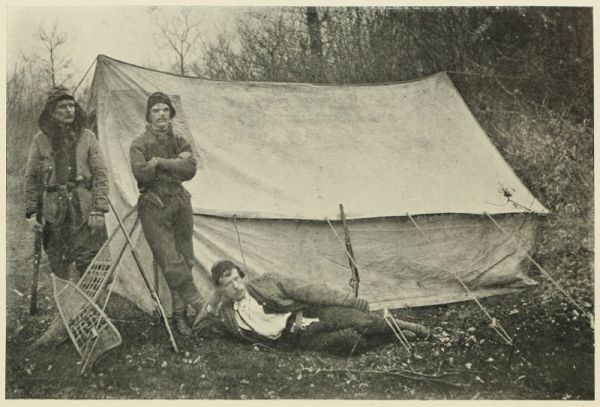
On the safe side of the Pass Again. Mac—Self—Stewart.
When we approached the edge a second time a smooth, unbroken snowsteep marked the trail of the glacier, and to it we consigned ourselves, literally sliding down into the black depths. We were precipitated into an immense wreath of snow covering the scales for over a hundred feet. The fire had been blotted out with the icy deluge, but luckily, as we learned later, the fire-feeders had abandoned their post long before the avalanche had come down. Three hours later we arrived at Sheep Camp, and entered the Mascotte saloon, where the assembled miners were clustered round a huge stove in the centre of the room, listening to the ominous shriek of the gale outside.
No one dared venture out that night, but in the morning the four days' blizzard had spent itself, and we formed a party to explore the damage done. A light railway that had been laid to the Scales was completely demolished, and half down to Sheep Camp the channel of the Chilcoot River was filled with enormous ice boulders. An avalanche had also fallen on Crater Lake during the night, and when we had painfully climbed the now bare summit the frozen plateau beyond was rent for nearly a mile with enormous gashes over ten feet in width, and the ice cleavage showed down as far as the eye could reach.
PART II
UNDER THE SOUTHERN CROSS