PROSPECTING IN BRITISH NEW GUINEA
Reading edition
The life of the prospector in New Guinea is not fraught with many pleasures, but in my experience, oftener than elsewhere, he enjoys that exquisite sensation which attends the unexpected finding of gold, and here the dreary monotony of life in the Australian interior is exchanged for conditions more congenial to his wandering nature.
British New Guinea is to most people the least-known part of our empire; but there are few valleys in its dark interior in which the prospector has not "chipped" some quartz formation, or "panned" some sand from the river's bed. The British flag was first planted in Eastern New Guinea by Captain, now Admiral, John Moresby, of H.M.S. Basilisk, in 1872. This officer, whilst employed in superintending the pearl shell fisheries in Torres Straits, learnt that adventurers, both American and French, were contemplating expeditions and occupation of the then unknown shores of Eastern New Guinea.
The captain of the Basilisk, being aware of the great strategical importance of these coasts to Australia, resolved to forestall any such attempt, and fortunately succeeded in securing for England the whole of Eastern New Guinea and its adjacent islands. Ultimately, however, a large part of his labour was lost owing to the retrograde policy of the times, when Germany was allowed to seize so considerable a part of North-Eastern New Guinea without opposition.
Samarai has now eclipsed Port Moresby as the chief port of the possession. It is built, or rather erected, upon a small island at the extreme south-east of the mainland, and is in direct communication with Cooktown in Queensland and the Australian capitals. From Samarai coasting-steamers run regularly to the mouths of the Mambare, Kumusi, and Gira rivers on the north-eastern coast, and in the upper reaches and sources of these rivers are the great gold deposits, the origin of which has completely baffled the mineralogist and geologist to explain. The men there do not trouble themselves as to its origin, however, and while the river-beds continue to yield a sure and steady quantity of gold to the ordinary miner, and the mountain gorges or creeks provide sensational "finds" for the more daring prospector, no one cares whether the presence of the precious metal is in accordance with the views of geologists or otherwise.
"It is a fact that the bottom is on top," said an old pioneer. "But then the outcrops are all inside the darned mountains, so we are quits."
The township of Tamata is the most important centre of the New Guinean goldfields, but the Yodda Valley camp rivals it closely, and it is expected that some of the new camps at the base of Mount Albert Edward will in time surpass them both. The fierce, unreasoning hostility of the natives renders prospecting at any distance from the settlements an extremely dangerous occupation, as the writer, who has had several experiences among the cannibalistic tribes of the lower ranges, can testify. As a rule, however, the prospector scorns all such dangers, and if he escapes the dreaded fever, trusts to his rifle for protection and his luck for fortune, and straightway proceeds to cut a path into some unknown river valley.
The famous Yodda Valley, where men at first made fifty ounces of gold (equivalent to £180 per day), was discovered in such manner, and if the stories of some of the prospecting parties who crossed New Guinea in all directions were given to the world, doubtless a "rush" would set in towards the deadly fever-swamps, unparalleled in the world's history both for its general extent and the amount of victims. Round the camp-fires at night, enveloped in their smoke to escape the many pests, the men of the various settlements regularly gather to discuss the latest news from the coast, and to consider the many strange reports of "great strikes" constantly circulated by the friendly natives. Frequently a party is organised to go and prove the truth of any such report, and when in turn word is sent back that the chances are good, a general exodus often takes place, all setting out for the new fields with light hearts and high hopes.
Miners cannot stay in New Guinea for more than one season at a time; they are forced by repeated attacks of the various fevers to leave their work and take a "spell" in the southern parts of Australia or New Zealand. In my opinion lack of proper food is the prime cause of these fevers, as it is only when the men are "run down" that the kuri-kuri breaks out among them. The stores are floated as far as possible up the rivers in oil-launches and whale-boats, and then transported overland to the camps by native carriers in the employment of the diggers. The majority of the miners are Australians; but in most prospecting parties there is usually a Scotsman and an Irishman, and not infrequently a German.
In the party with which I was associated there were two typical Australian prospectors, one German, one Irishman, and, including myself, two Scots. We also had six native carriers and two dogs. My Scottish comrade said that "the dugs were as guid as ony twa men"; but however that might apply to the whites, it was at least unfair to our dusky "boys," who were Fly River natives, and only cost one shilling each for wages per day. We all had had experience on other goldfields, and each man was fever-proof, which in New Guinea means impregnated with quinine. "Doc," the Irishman, was a Dublin University man of some repute. He had been in turn a member of a famous North Polar expedition, and an officer in the American Philippino campaign. Mac had been everywhere, but his accent seemed to become more pronounced the farther from home he wandered. The two Australians, Emu Bill and Starvation Sam, were good specimens of the wandering Anglo-Saxon. Bill was one of the pioneers of Coolgardie, but if he were addressed by his real name, William Hambley, he would probably not recognise it. Sam was the son of a governor of a not unknown "'link' in our chain of Empire"; but as he adopted his cognomen to hide his identity, and no one would dream of calling him anything else, perhaps I will be excused from going further into his family history. He was six feet five inches in height, had been in his time soldier, sailor, missionary, pearler, outlaw, and mail-carrier, from which description all Queenslanders and South Sea travellers will immediately recognise him. Our German companion was a first-class mineralogist and an excellent comrade—and cook; but he deeply resented the appellation of Kaiser, which Mac bestowed upon him.
"I am not Cherman," he would say. "I vas been as mooch English as you, Scodie."
"A ken that fine, Kaiser," Mac would answer. "A'm Scotch frae Dundee."
We left Tamata with the intention of prospecting the Owen Stanley ranges, and among the miners in general were considered to be the most experienced and best-equipped prospecting party that ever essayed that venture. Our journey for the first week was, allowing for the nature of the country—uneventful. A crocodile gripped one of our carriers while crossing the Ope River, but making a combined attack on the huge saurian, we forced it to relax its hold, and finally, as Bill remarked, "Ther' war one inseck less in the darned country." Another day we were attacked by myriads of bees, and, despite our face-nets, they inflicted much pain upon all. The New Guinean bee does not sting, in the strictest sense of the word; it has an intense craving for salt, and, obeying some instinct, it fastens into the skin and raises great blisters thereon by its peculiar suction action. At lunch-time we carefully made a pile of dry brushwood, and shook a small packet of salt over it. Instantly the bees left us and followed the salt down through the loose heap, and then with a chuckle of delight, and a grunt of satisfaction from Kaiser, Mac applied a lighted match. Doc said that Mac chased the only bee that escaped for over half a mile, but at any rate we were not troubled further that day.
Continuing our journey, which at first had been through the swampy and pestilential morass formed by the Ope River's periodical overflow, we at length crossed the "divide" between the Ope and Kumusi waters, and travelled through a country in which brilliantly-hued creepers blazed from the tree-tops, and luxuriant vegetation flourished everywhere. Gaudy-plumaged parrots, cockatoos, and birds of paradise flitted overhead, making the forest resound with their deafening chatter. Snakes of nearly all varieties started from the dense under-growths as we approached, and our dogs had plenty of exercise in chasing these undesirables. They in turn were the hunted when near rivers, and many a narrow escape Mac and his charges had from the enormous and impregnable crocodiles that infested the banks of all streams.
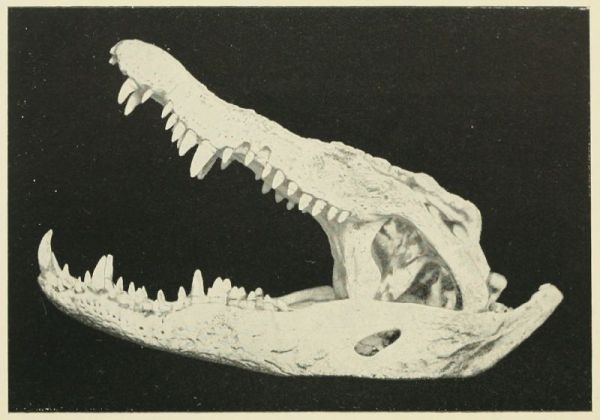
Crocodile's Jaws.
There were several native villages in the district which we now traversed, but having had previous experience of the treacherous nature and cannibalistic proclivities of most of the tribes in that quarter, we avoided them, and altered our course when we struck a native pad or track. We knew that our tracks must be seen, however, and nightly expected a visit from the warriors, who, fearing only the Government police, looked upon prospecting parties as the lawful prey allowed them by a considerate Government. We were not disappointed. One night, when camped near the Kumusi, and about thirty miles from the Yodda Valley camps, the long-expected attack came, and, to Mac's intense disgust, we did not stay to argue the point, but departed hurriedly and ignominiously. Two days later we reached the Yodda, and camped for some time, to try our luck and hear the latest reports from the mountains. A day previous to our arrival a strong party had set out to prospect Mount Scratchley, and while we were camped a famous pioneering company arrived from the interior, and reported the discovery of vast gold deposits in the gullies of the higher ranges. Several of the members showed some peculiar stones which they had taken from the mountain ravines, and one veteran, in whom Sam recognised an old comrade, hinted mysteriously that the nuggets and slugs which they had with them came from a lava deposit at the source of the Gira, in German territory. While Doc and I noted that significant fact for future reference, Kaiser was more interested in the stones.
"Dat is vat is called zircon," he whispered to me, as he placed a pebble on his tongue. "Gott! it is over twenty carats," he continued excitedly. "Ask him ver it vas come from."
"Why not ask him yourself?" I suggested jokingly, but the reproachful look he gave me made me regret that I had spoken. Kaiser's race, in most British colonies, is always suspected of underhand dealing. On my inquiring of the owner where he had found the stones, he placed them in my hands.
"In some creeks in the back ranges," he answered. "You can have them all. I ain't going to carry them further."
"But look," I said, chipping the edge of one, and disclosing a translucent mass of pale straw colour, in which a tinge of port wine danced according to the manner in which the stone was held.
"I don't care," he replied. "I is a gold-miner, an' I knows that every ounce of gold is worth £3 17s. 6d.; but that is darned stuff only Jews will buy, and I'll throw them away if you don't want them."
I had no spare money—the prospector never has—and as he refused to take a new Winchester rifle and my silver-mounted revolver, I did not know what to give him in return.
"Ye'll need all yer pop-guns where ye are goin'," he said. "I is going down to South Aus. with my pile; but say, if ye has any fruit-salt, or sugar, or quinine to spare, I an' the boys would be ontarnally obliged to ye."
I gave him a bottle of quinine tabloids, and another of saccharine, and, as few of the miners had ever heard of the latter substance, and of course seldom carried sugar, their delight was a treat to see. We entertained them to dinner, and next morning they started for the Kumusi River, en route for the coast, Samarai, and Australia. At the same time we picked up their old tracks and steered for the distant peak of Mount Scratchley.
Our progress was now necessarily slow, for, in addition to being in a hostile country, through which Sir William Macgregor and his native police was the only armed force that had ever passed, we had to carry on prospecting operations. Three days out, our first "strike" was made. We bridged a deep river in the usual manner, by felling a tree across from bank to bank, and after we had crossed, Kaiser, who was an enthusiastic botanist, descended into the channel to examine a curious growth on an under branch.
"Come on, Kaiser," shouted Mac; "there's nae gold doon there."
"Bring up a sample, anyhow," Bill added, throwing him a gold-pan; and laughingly we all passed on, leaving our inquisitive comrade to follow at his leisure. Shortly afterwards Doc shot a wild pig, and, as all prospectors adopt the rule of dining when opportunity offers, a halt was called for that purpose. During cooking operations Kaiser arrived, carrying Bill's gold-pan. Bill took the dish from his hands with the intention of replacing it in its former position on a carrier's back; but, to his loudly and vigorously expressed astonishment, he found that his comrade had followed his instructions, and actually carried about two pounds of sand from the river's bed.
"Lor', but ye is green, Kaiser!" he remarked, preparing to throw the sand out.
"Haud on a wee," Mac cried, seizing his arm; "it's aye whaur ye dinna expect to find gold that ye get it. Noo, I dinna think there's ony there, so try it."
Bill looked at Mac in thoughtful silence for a minute.
"I reckon it's worth trying, anyhow," cried Sam. "Pitch it here, an' I'll pan it."
Bill did so, and Sam walked over to a creek near. Shortly after we were all startled by his shout. "Did you salt" (add gold to) "this dirt, Scottie?" he roared.
"Get oot, man, an' no mak' a fool o' yersel'!" Mac answered, walking over. "Hallo! Come here lads," he continued; "we've struck it!"
In a moment six excited men were round the pan, to which Sam was still imparting a gentle concentric motion, and, to our unbounded amazement, every movement of the dish still increased the comet-like tail of deep red gold in the ripple of the pan.
"Well, I'll be jiggered!" said the two Australians simultaneously.
"I'll be d—darned!" remarked Mac, with great feeling.
"Mine Gott! Tree ounce stuff!" cried Kaiser.
"Better come and have dinner," suggested Doc.
I do not remember what I said; but even our "boys" babbled away in unintelligible but excited language. Of course we returned to the river—one of the Kumusi head-waters—and by sundown had tested the sands at various points for a distance of two miles on both sides of our bridge. Kaiser, meanwhile, had set to work with his pan, and when we returned to our camping-ground he had about half an ounce of coarse gold to show for his efforts.
Next day we pegged out six prospectors' claims along both banks of the stream, including, of course, as much of the alluvial land on either side as our claims would allow. For several days afterwards we devoted some time to the most promising bars and deposits; but, as we had neither the tools nor the material for constructing sluice-boxes, our methods were restricted to simply washing the "dirt" in our pans. On the fourth day Mac threw down his pan, ejaculating at the same time the most-used word in his fairly-extensive vocabulary.
"What is the matter, Mac?" I cried, from the opposite bank.
"I dinna see hoo I shood hae tae work like a Clyde steevedore," he answered, "when ony man wi' the sma'est scienteefic abeelities could get as much gold in hauf an hoor as the lot o' us can in a day."
"Explain, Mac. Have you an idea?"
"Ay, thousands o' them. But what's tae hinder us frae taking a wheen split bamboos an' stringing them thegether like a sheet o' galvanised iron——"
"Nothing. We have our axes. But what——?"
"Turn the affair upside down and lean it against the bank there. Some o' us could throw the sand on tae the thing and Kaiser could keep it goin' wi' enough water tae wash the sand awa.'"
"But the bamboo is too smooth. The gold would be carried over the edges with the sand."
"Pit a hale bamboo in atween every twa split yins, an' if the gold could rise ow'r that it wad be too licht for savin' ony way."
"All right, Mac," I responded. "You make the affair, and if it works we will appoint you our chief engineer."
Mac did not answer. He knew that all his appointments merely meant so much additional work left to him as a matter of course; and even as things were, he never had "ony time for meeditaishun." He made his corrugated inclined plane, however, and as all his comrades, excepting Kaiser, laughed at his idea, he worked it himself for the first day. That evening, as we sat in the smoke of our camp-fire, Doc remarked, "Well, boys, I made about an ounce to-day, but I can't say that I care much about the work."
"I reckon I is good for an ounce too," said Bill.
Sam was cook, Kaiser camp-guard, and I had been writing up my log, so we had nothing to say. Mac evidently—like an Australian bushman—believed that silence was golden, for it was only after being asked several times that he spoke. "Ah, weel," he said reflectively, "there's some folk in this weary world content tae work awa' frae morn till nicht for a paltry three pounds seventeen an' saxpence worth" (one ounce of gold), "but I'm no ane o' them."
"Mac is home-sick," Doc laughed.
"Has your patent turned out a duffer?" inquired Sam.
"I reckon Scottie is keeping back his gold from his mates," said Bill aggrievedly.
"How much did you get, Mac?" I interrupted soothingly, for Mac had been my companion in many a journey, and I understood his nature well.
"I dinna ken," he answered, handing me a fair-sized pouch; "aboot hauf a pun', I think."
"What!" roared the men, springing to their feet.
"Lor, Scottie! Does ye mean——?"
"Eight ounces exactly," I announced. "Mac has made £30 for one day's work."
"Scodland for ever!" shouted Kaiser from the midst of a cloud of native tobacco-smoke, and the others echoed his sentiments. Next day all hands assisted at Mac's machine, which showed in its construction many signs of that gentleman's ingenuity; but it had not been designed to bear the strain now put upon it, and after a few hours' work the bamboo ripples fell away. However it may apply in other circumstances, it is a recognised law among prospectors that misfortunes never come singly, therefore we were not surprised that afternoon when the river suddenly came down "a banker" (in flood) and carried away all our preparations for a new machine. Doc, who was of a philosophical nature, went out shooting when it became apparent that no further work could be done that day. When he returned to camp I saw from his face that the last of our misfortunes had not yet been reached.
"The Papangis and Babagas are out," he said quietly.
"That means——?" I said.
"That we'd better git, quick an' lively too," interrupted Bill.
"This creek runs into a large river about three miles down," continued Doc, "and there is a palisaded village near the junction. I saw some canoes drawn up on the banks, and from their design and peculiar ornamentation I at once guessed who their owners were. There were also some bearing the symbol of the Sizuretas; but probably they were those taken from that tribe when the great massacre occurred. I did not see any natives, and as I was quite close to the palisades I therefore concluded that they did not wish to be seen, and you can all guess what that means."
Doc's words caused great consternation, and when our "boys" gathered that they were in the country of the dreaded Papangi they set up a wailing. "Papangi no good. Hims eat poor black devils. Stick head on pouri dubus" (sorcerer's house), cried one, on whom we had bestowed the title of King George.
"Dinna you be frichtened, ma man," said Mac consolingly. "If ony o' the Papangi heathens come near enough I'll gie them sic a feed o' lead that their ghosts'll hae indegeestion." King George did not understand all that Mac said; but he brightened up considerably at his words, and at once began to infuse spirit into his companions. Mac was always delighted at the prospect of a fight; but as these tribes had only a month previously murdered and eaten most of the inhabitants of Angerita, the chief village of the Sizuretas, and afterwards successfully given battle to the Warden of the Northern Division and his police, who had gone to punish them, we thought discretion the better part of valour, and prepared to move, much to Mac's disgust.
"Are ye gaun to rin awa' again?" he bellowed indignantly. "Let's get ma gun, an I'll gang an' fecht them ma'sel."
"An' your head vas look vell on pole-top, Scottie," said Kaiser as he struck our tent.
"We will fight if we can get a good camping-ground where they can't get behind us," I said, and with that Mac had to be content.
In a marvellously short space of time our carriers were loaded and across the stream, after which we cast our bridge adrift and started up the north bank, intending to follow the river to its source, and then prospect for the lode from which the gold was shed. The sun had just disappeared as we began our march. We had not stayed for supper, and perhaps this fact had something to do with the depressing influence that seemed to rest upon all. Animal life had suddenly become very active; and to feel a coiling, writhing object among the feet, or to tread upon some nameless amphibious creature, was anything but a pleasant sensation.
The moon shone brightly for the first two hours, and we travelled much faster than is usual in New Guinea. Our dogs, however, seemed conscious of some impending danger that was not yet apparent to us; and it grieved Mac sorely to see how his dumb charges hung so closely to his person, and how spiritless they had become.
"I fancy we should have stayed and risked a fight," Doc said at length, as we paused at the mouth of a narrow ravine through which the stream rushed furiously. "Our boys will never face that."
"Can't we get over the top?" I suggested; but Bill and Sam, who had been reconnoitring, said our only possible course was to traverse the stream and trust to there being no pools. This prospect was not very pleasing. "We did not know the length of the ravine, nor what animals might have their homes in its depths, and our nerves were already at high tension.
The moon was now obscured with banks of dark clouds that had suddenly shot up from beneath Mount Victoria, and the birds of night, before so noisy, were now strangely silent. The atmosphere had also become oppressively close, and we had to throw down our loads, from sheer physical inability to longer sustain them.
"It's a 'buster' comin'," Sam gasped; "git up the flies—quick!" A flash of lightning lit up the valley as he spoke, and a terrific thunder-clap reverberated through the ravine. A minute of what felt unnatural silence passed, during which we all struggled with our long canvas "fly," and then the storm burst. We had got our flour-and rice-sacks under cover, and following Kaiser's example, crawled in under the folds beside them. The rain was the heaviest I have ever experienced, and soon we were drenched to the skin, even through the thick canvas. Suddenly one of the dogs started up, and instinctively fearing some new calamity, I gripped his nostrils tightly, while Doc crawled to the edge of our covering.
"It's them," he whispered. "They are on the other bank; Heaven help us if we are discovered!"
"Let me oot!" growled Mac; "I'm no gaun to be speared like a rabbit in a hole."
"Shut up, Mac," I remonstrated. "It's too dark for them to see, and they cannot cross the water in any case." The patter of feet could now be heard on the opposite bank, and an occasional Che-ep (battle-cry) showed that we were not mistaken. In this new excitement we soon forgot our miserable condition; and from the characteristic behaviour of the individual members of the party, it was evident that the actual presence of danger had dispelled the strange feeling of depression which previously had almost unnerved us. Mac was muttering to his dogs, Bill and Sam were—unconsciously, I believe—pouring out a torrent of Australian bush words which, as Kaiser afterwards said, "sounded like poedry." Kaiser himself, I knew, was munching a piece of damper, which with thoughtful precaution he had carried from our last camp. Our boys lay still, as if asleep. I was so engrossed in the study of my comrades that events outside passed unnoticed until Doc's voice startled us. "Come out, boys!" he cried; "all is clear." We crawled from under our soaked covering, and found Doc puffing at his pipe as serenely as if he had just risen from supper. The storm had ceased, the moon was shining again, and the dark clouds were speeding towards the Yodda Valley.
"Evidently our friends were surprised by the 'buster' as much as we were," Doc said; "at any rate, they have gone home to dine on something else."
"That minds me that I'm hungry tae," cried Mac; "come on, Kaiser; gi'e us a haun.'"
By some miraculous means these two worthies got a fire kindled, and while we dried ourselves by the blaze of the gum-logs, the "billies" were boiled, and soon some copious draughts of thick black tea made us feel quite recovered. When morning came the waters in the gorge had subsided, and after a hasty breakfast we forced a passage up the stream, and finally emerged on the wooded slopes of the mountains.
The details of our journey from thence onwards would require too much space to enumerate. We steered for the distant ranges, because we wished to prospect them before the state of our stores rendered that impossible, knowing that, if unlucky, we could always come back to the sands of the river. We were attacked twice by hunting tribes of what must have been the notorious Tugeris; but we were no longer inclined to run away, and for the benefit of the gold-seeker who might come after us, we taught them that it was dangerous to interfere with prospectors.
One day in the middle ranges we traced up a rich gold formation, and by the primitive method of dollying with improvised tools obtained 110 ounces from it in three days. In this region—near the source of the Gira—signs of gold were everywhere; but we were not equipped for systematic mining, and could only treat the rich free ore or the alluvial deposits. There seemed to be few natives here, and owing to the height above sea-level the country was much healthier than in the lower valleys. One day we came on a deserted village, in the stockaded garden of which were cocoanut and betel palms, and the usual taro and sweet-potatoes. The sugar-cane and tobacco-plant were also much in evidence, showing that some civilising influence—probably that of the missionaries—had been at work among the former inhabitants. We saw no sign of life, however, and therefore concluded that the fierce Tugeris had recently raided the place.
Another day Doc and I, while climbing up the mountain-side from our camp, found our progress suddenly barred by a steep gully that cut transversely along the slope. Descending with difficulty into the valley, and following up the course of an old water-channel, we found a heterogeneous deposit of zircons, sapphires, topazes, and many other gemstones amidst the débris of an extinct blowhole. We gathered some of what appeared to be the best, intending to find out their value at the earliest possible opportunity. The valley formation itself would have gladdened the heart of any geologist; from any point lower down the mountain the slope seemed continuous, and only when at the edge of the "breakaway" was the valley evident.
We were now near the German boundary, and hesitated between our desires and our duty as law-abiding prospectors. While camped on doubtful territory an incident occurred that may serve to illustrate more than one thing. We were satisfied with our luck so far; and therefore light-hearted, so much so that one night Mac began to sing, and soon we all joined him. The air was very clear on the mountains, but it struck me that the echoes lingered strangely; and after we had turned in for the night, volumes of sound still rose and fell on the atmosphere, sweeter far than that produced by our own rough voices. Next night, as we sat at supper regarding ruefully our fast-diminishing stores, we were startled by a loud "Hallo!" "Hallo!" we shouted back, and then to our astonishment four men and six carriers marched into our fire-lit circle.
"It's a graun' nicht," cried one. "Hae ye onything for eatin'?"
"Well, I'll be—Scotched!" remarked Doc, while Mac sprang to his feet and stared at the new-comers.
"You are just in time," I said. "What clan do you represent?"
"Macpherson; A'm frae Laggan-side. Sandy here is a Glesga man, but Bob an' Jim are Englishmen; they're nane the waur o' that——"
"We heard you singing last night," interrupted Bob. "We are as hungry as hawks—but how is the war?"...
The new party had just come from a protracted trip in German territory, and they told many strange tales of what they had seen in that mysterious land. Unfortunately their stores had given out, and on investigation we found that ours could not last more than ten days for both parties. However, as Mr. Robert Elliot informed me, they had made enough gold to warrant their going back again; and, pending considerations as to the advisability of our joining forces, we all resolved to have a "spell."
We eventually reached the coast at Holnecote Bay; a week after we landed at Samarai, and eight days more found us in Sydney.
Here two Hebrew gentlemen offered Sam and Kaiser a £10 note for our entire stock of gem-stones. In consequence of this generous offer (!) and the fact that his great height afforded an easy means of identification, we had to send Sam rather hurriedly to Melbourne. We eventually restored peace, however, by selling our stones to the afore-mentioned individuals for £80; and since then Aaron K. has informed me that one stone alone, when cut into four parts and polished, fetched fifty-three sovereigns.