THE FINDING OF "GOLD BOTTOM" CREEK
Reading edition
As the season advanced the ground hardened so that with our primitive fire-burning methods we could barely thaw more than eighteen inches of gravel in the short day, and even this occasioned tedious labour. The depth of bedrock was sixteen feet, and the frost had penetrated far beyond this level, so that our tunnelling operations along the line of the wash proceeded very slowly indeed. The miners around had begun to flock into Dawson to frequent the saloons and gamble away their hardly-earned gold, all declaring that it was too cold to work—the thermometer registered 25 degrees below zero—and soon Skookum Gulch was almost deserted. "Cap." Campbell and "Alf" Mackay alone remained to keep us company.
My knowledge of the Chinook tongue had been of considerable service to me, and the Indians inhabiting the upper Thron-Diuck valley occasionally visited our camp, bringing many presents of dried salmon and caribou, all of which Mac and Stewart accepted with voluble thanks. Then one day "King James," the chief of the tribe, paid us the honour of a call.
"Why you dig, Mis'r Mac?" he interrogated, apparently much mystified to see us excavating the ground.
"Fur GOLD, ye heathen," howled Stewart, popping his head above the shaft.
King James did not understand the full significance of the remark, but smiled indulgently when I translated it, and solemnly inclined his head towards the speaker.
"You squaw," he said, "you squaw to Mis'r Mac." Which meant that he considered Stewart somewhat presumptuous in addressing a chief of the Thron-Diucks.
After much talk had been indulged in, King James appeared to realise that we were really searching for gold, and had no idea of carrying away or shifting the course of his river; and his dry old face spread out in a broad grin when I explained that much gold, in our country, was equivalent to many squaws. Suddenly he turned and strode solemnly towards his sleigh, which was guarded by several richly-robed squaws and half a dozen youthful warriors; and after groping among the bearskin rugs for some time he came back to me, displaying in his greasy palm a beautiful specimen of alluvial gold: it was large and flat, with smooth surface and water-worn edges; it must have weighed at least three ounces. I gazed in bewilderment; the Indians rarely looked for gold, which to them was not even so valuable as silver, and the latter metal they used only for making ornaments. Mac and Stewart were soon by my side, and while we examined the specimen with undisguised interest, King James lit his pipe—a former present from myself—and puffed leisurely, eyeing me the while with a half-amused expression.
"What think o' that, Mis'r Mac?" he asked at length.
"It's good stuff, King James," I strove to answer in his language, and with a sigh I offered it back. My surprise was great when he waved it aside right royally, and placing his grimy hand on my shoulder in quite a fatherly manner, he spoke out several sentences rapidly.
"Hold hard, King James," I cried. "I cannot follow you if you talk in that fashion. Come into my tent and have some 'baccy."
He smiled benignly, and spoke a few words to the sleigh attendants, who immediately unhitched the dogs and proceeded to build a fire near at hand; then he followed me to my camp and ensconced himself by the stove. I still carried the nugget in my hand, but obeying the old chief's directions, I now placed it in a bottle with my other specimens and sat down beside him. Stewart meanwhile turned his attention to culinary matters, and while the billies boiled, King James and I conversed earnestly on matters dear to the Indian heart.
He was no lover of the white men who had invaded his domain and driven his people to seek the refuge of the mountain fastnesses, and he intimated plainly enough that he should not be sorry to see Dawson City speedily deserted by the white intruders. As for gold, the idea of grown men seeking for the yellow metal aroused his keen amusement, and he was very incredulous about my statements as to its value in the wigwams of the white people. After the subject of his woes had been gone into at great length, and our hearty sympathies enlisted, he remained silent for a time as if absorbed in thought. Then his eyes surveyed the mining implements and firearms in the tent, and finally rested upon my nugget collection with a newly-awakened sparkle of interest.
"You come wi' me, Mis'r Mac," he said thoughtfully, after a long pause, "Heap big bear on Thron-Diuck; you come wi' King James——"
I shook my head vigorously; we were not very anxious to shoot big game at that time, but his hospitality would not be denied.
"Me show you whar big gold come from. Me show you Gold Bottom," he hastened to add: "too much gold for white men in Dawson—me show you, Mis'r Mac."
Stewart was so astounded at the old chief's last words, spoken in broken English, that he nearly chopped his fingers with the axe instead of the solidified flour he was preparing to bake.
"I'll gang," he bellowed.
"An' me," growled Mac, who, like his comrade, had only understood the last sentence.
King James smoked stolidly for a few moments, then patted Stewart patronisingly on the back. "You good squaw," he said, gazing at the half-baked flour with much approval, "you come wi' me."
The appellation "squaw" by no means pleased the fiery Stewart, and he would have burst out angrily had I not restrained him.
"Yes, I guess we'll go with you, King James," I replied. "I want to see Gold Bottom Creek badly, and I don't anticipate any evil effects from too much gold." And so the compact was made, and old "Leatherskin," as Stewart promptly dubbed him, smiled softly when I explained to him the workings of my big game rifle, and went into a transport of delight on being presented with a serviceable Colt revolver and a box of cartridges. Suddenly his face clouded, and he said anxiously—
"Only you come, Mis'r Mac; only you an' squaws."
I restrained my companions with difficulty from rushing at him to choke back the objectionable epithet; then an idea struck me. I wanted "Cap" Campbell and Mackay, my adjoining burrowers in the frozen gravel, to accompany me; they had shared with us the plodding uncertainty of things at Skookum Gulch, and I wanted them to reap some of the benefits attached to the discovery of the mysteriously-famed "Gold Bottom" before the district was rushed. I could hardly doubt that King James's information was correct, and the specimen given me was sufficient for even the most incredulous-minded person. The inducement was very real indeed, but the chief would only allow Mis'r Mac an' squaws.
"All right, King James," I said, "but I have two more squaws." He eyed me with a look that was fast changing from one of mere friendliness to one of much respect.
"You great man, Mis'r Mac," he grunted. "Four squaws? Ugh!"
When he saw the brawny giants that Mac hastily called in, his surprise was unbounded. "Good squaws," he chuckled.
"What in tarnation does the old skunk mean?" said Mackay, and Campbell's anger was rising visibly.
"Look here, boys," I said. "King James has told me of a creek that is lined with gold, and this is a sample"—I showed them the specimen received. "He asks me to go and take charge of the lot, but only myself and squaws. You had better be squaws for once in your lives. Savez?"
They did "savez," and made every effort to show their cordiality to the King, who appreciated their advances with tolerant grace, but grinned expansively when he saw their well-filled cartridge-belts.
Stewart made a triumphant success of his cooking that day, and in honour of the occasion he filled the little "doughboys" with pieces of dried apricots and peaches, and, indeed, everything in that line our larder afforded. So luxurious a repast did he provide that King James sighed regretfully when he rose to go.
"You come to-morra', Mis'r Mac!" he cried when he was rolled up in his sleigh blankets, like, as Mac said, an Egyptian mummy.
"Right!" I answered, waving him goodbye. But he had not finished.
"Be sure bring cook squaw," he murmured contentedly.
The long whips cracked and the dogs bounded forward; the shriek of the sleigh-runners effectually drowned Stewart's vehement curses; and the King departed.
Next morning we started out for the Indian camp. Mac and Stewart had the tents struck, and it with the blankets packed in neat rolls on our sleigh soon after sunrise. Our rather small store of flour and other necessaries found ample space on the same conveyance, and to this load Dave was harnessed. Campbell and Mackay did not delay us; they were up betimes and had their dog-sleigh ready with ours. The temperature this morning registered 30 degrees below zero, and even while we were engaged tying the sleigh ropes, long icicles formed at our chins and dripped from our eyelashes.
"Are you ready, boys?" I cried to my freshly-acquired squaws.
"Right!" they responded with one voice.
"Gee up, Dave," said Mac, and with a bound and a shriek our sleigh led the way towards the Klondike's unknown source. We were not much concerned about leaving our properties on Skookum Gulch; it was not likely that any one would "jump" our claims; the weather was too cold for the tender feet of Dawson to venture out around the creeks. Soon we left the Dome in the distance behind, and swiftly we crashed through the powdered snow and blown ice on the main river. No white man, at this time, had explored the head waters of the Klondike. In the earlier season I had attempted the task, but was repelled by the deep gorges and grim cañons that marked the river's channel for many miles when near an outlying spur of the "Rockies." Now we forced a trail far beyond my furthest travel, tracing here and there the track of the old chief's sleigh where the runners had cut deep through the blistered ice. Our visages were soon framed in icicles, and our cheeks rendered stiff by a thin film, as of glass, which caused us much pain. Mac and Stewart ambled beside the staggering dogs, occasionally helping them over obstacles and badly-blown patches. For once they were forced to march in silence, for their mouths were sealed as if by iron bands.
The Grand Cañon was entered soon after midday, and the majestic powers of old King Frost had so metamorphosed the dark gorge that we made our trail over the frozen torrent almost nervously. The great stalactites and dripping ice cones shut out the sky completely, and we forged ahead in a vague eerie shadow reflected from the translucent pillars. Here and there the roar of the flood echoed from giant clefts in the ice, and caused the glassy walls to quiver and crackle; then again came the oppressive calm, broken only by the dull rumble of the rushing torrent full fifty feet below.
It is impossible to picture the grandeur of an Alaskan cañon when the elements hold it in thrall; there is nothing like it in the whole world. Nevertheless, we were not sorry when we emerged into the comparatively open country beyond, and picked up afresh the track of King James's sleigh which we had been unable to trace in the gorge. Our destination could not now be far distant, for the frowning peaks of the Rockies loomed directly ahead, and the valley was rapidly becoming lost in the minor ranges that appeared; we were surely near the mystic source of the golden Klondike. The dogs never slackened their trot, though now and then they staggered and stumbled over large ridges of blistered ice, which cut their paws cruelly. Our moccasins were being quickly reduced to shreds, and our clothing generally had become stiff with the frost and rent in great holes by contact with the brittle, flaking ice. Few white men would have dreamed of making such a journey on such a day. I contented myself with that reflection, though probably the miners in their snug huts at Dawson would have dubbed us colossal fools for venturing so far back into the Indian territory; but gold was always an irresistible incentive.
"I reckon," said Campbell, coming up from behind, and grimacing frightfully as he spoke, while the ice shivered on his face with the effort, "this is not much of a picnic, is it?"
It was some minutes before I could reply, and while I strove to coax the muscles of my mouth to relax without doing serious injury to my features, Stewart's hoary visage shook itself clear of its icy sheath with a crackling, splintering sound, and his voice rang out—
"I see the Injun camp! Hurroo! D——!" The last expression was given in a most sorrowful tone as he felt the blood trickle on his cheeks and freeze into icy appendages.
"You've got to think a lot before speaking in this country," I sympathised, but he would not open his mouth again.
Rounding a bluff, we saw, nestling in the shadow of a great pine-forest, an array of mud huts and tepees covered with caribou skins. Many fires were blazing in the vicinity, fed lavishly with logs drawn from the wooded slope behind. A number of King James's subjects superintended operations with unmoved faces; it was a routine to which they had long become accustomed—for bear-fires were very necessary indeed in these parts; Bruin had not yet reconciled himself to his winter slumber, and, as I have noted, the Klondike valley was infested with various species of his kind.
With a sigh of thankfulness I signalled to Mac to draw up alongside the largest fire, and he needed no second bidding. A few moments more and we were all eagerly thawing ourselves before the blaze. Even the dogs crept as close as the burning logs allowed, and warmed their poor frozen bodies on all sides, turning continually, as if on a revolving toast-rack. From the most imposing hut now came rushing towards us King James, with numerous squaws; and while the King congratulated me effusively on my safe arrival, the squaws beamed coquettishly on my companions, who felt in no wise complimented by their attentions.
"They tak' us fur squaws, Stewart!" howled Mac, more in sorrow than in anger; then I heard them both with much deliberation calculate out the value of the Queen squaw's dress as she stood by them, speaking words of welcome in a tongue they could not understand.
"It's a rale guid beaver," I heard Mac say.
"An' what a bonny silver-tip cloak," burst in Stewart.
"An' the moccasins," continued the first speaker, "are faur ow'r guid fur an Injun tae wear."
At this juncture I turned anxiously; I thought it very necessary.
"For heaven's sake, Mac," I said, "leave the squaw's beavers and moccasins alone. We'll get murdered if old King James——"
"Wha's touchin' their belangin's?" interrupted Mac indignantly; but despite his righteous outburst, I knew that he and his doughty comrade would have had little qualms about appropriating the bonny beavers and moccasins also. Their logic was vague, but conclusive enough to satisfy themselves. However, with much grumbling they unharnessed Dave, and started to erect the tent in a sheltered spot, Campbell and Mackay having already got their smaller canvas home fixed up.
"It's fair disgracefu'," muttered Mac, as he pulled on the guy-rope, "tae think o' livin' near Injuns! We're comin' faur doon in the world surely."
"Ye're richt there," spoke Stewart mournfully; "bit, man, did ye ever see sic a bonnie beaver?"
Next morning, when the dim grey light was beginning to appear, we set out to explore the creek containing "too much gold." King James's sleigh led the trail, for which I was truly thankful. The dangerous nature of the route from the Indian camp was all too apparent. Miniature glaciers hung perilously over each mountain ridge, and formed a sight well fitted to unnerve any man but an Indian; and when we crawled over their glassy surfaces, and slid down on the "other" side, it seemed to me that we were running risks enough for all the gold in Klondike. We had not gone very far, however, before King James drew up his dogs in the bed of a deep chasm that traced directly from an enormous ice-field overhead. I looked around and saw the frozen channel of the Thron-Diuck about a hundred yards below; the King had taken us by a "short cut" over the mountains rather than follow the much easier route by way of the main river. For a moment I thought that he had purposely meant us to lose our bearings, but he soon dispelled that fear.
"Gold Bottom here, Mis'r Mac," he said. "You dig." He measured about a four-feet length on the snow, meaning, I suppose, that we should find bedrock at that level. "You find much gold, Mis'r Mac, too much gold——"
"Hold hard!" I interrupted; "I guess we'll deserve all we get. This is the devil's own part of the world we've struck."
King James grinned incredulously, but kept silence; and arranging his sleigh rugs, he whipped up his long line of dags and sped back over the trail we had just traversed. We watched him till his sleigh, careering dangerously, rushed down into the valley beyond. The mining instincts of Campbell and Mackay now overcame their dislike of our chill and uncompromising surroundings.
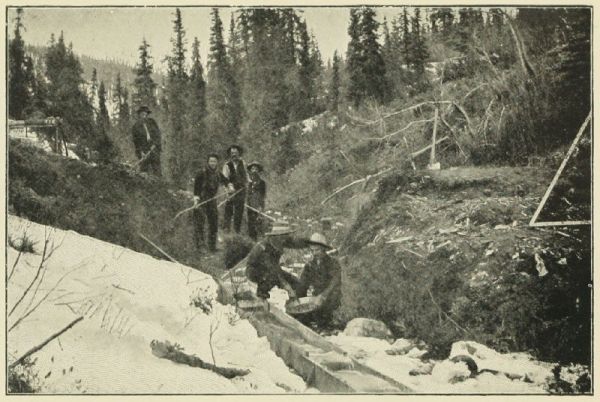
Gold-Bottom Creek.
"It looks likely country," said Campbell, "and I shouldn't wonder if that glacier has worn down quite a lot of gold."
We were not long in pitching our tents and building several fires to thaw off the icicles that clung to our faces; then we felt much more enthusiastic over our prospects. The timber was plentiful, and close at hand; we were far indeed from the madding crowd.
"We'll make a start, boys," I said; "we'll see whether old Leather-skin spoke correctly."
My two companions were rather disconsolately surveying the scene.
"Too much gold!" muttered Mac in derision. "No vera likely. It wad tak' hundreds o' thoosands o' pounds tae pey me fur ma sufferin's in this God-forsaken country."
All day long we kept great logs burning over the frozen gravel silted up on the edge of the channel. Slowly we excavated the "dirt" in fragments, picking energetically at it after each fire had been cleared away. The icy body of the creek had evidently long since been formed, for not a drop of water flowed beneath; and after sinking a few feet we came to a level where the frozen mass contracted from the old river-bed, leaving a clear dry space in which a man could almost stand upright. We at once abandoned our shaft, and crawled into the strange cavern formed. The gravel over which the torrent had flowed was dry, and hard as flint. We had reached bedrock on the true channel of the stream, and with water still flowing overhead! A yet unfrozen fluid gurgled in the heart of the great ice column above; the effect was wonderfully beautiful.
"I guess we'll stick to the shaft, boys," said Mackay; "this looks uncanny," and he scrambled out; the idea of working underneath the flowing stream was too much for him, though he was a veteran miner. Campbell and I soon followed his example, leaving Mac and Stewart, who were not easily daunted, to survey the wonders of Nature at their leisure. They at once commenced picking the frozen channel, and the thud! thud! of the blows came to our ears, as we stood by the fire above, as the sonorous notes of a deep-toned bell. Already the murky gloom of an Alaskan night was fast closing over, though it was yet but two o'clock in the afternoon. Thud! thud! thud! went the pickaxes below, and I marvelled at the persistence of my companions, for I knew they could make little impression on the flinty sands.
Suddenly the echoes ceased, and the sounds of a wordy altercation rumbled up towards us; a few minutes later Mac popped his head out of the shaft and beckoned me mysteriously, then disappeared again. Wonderingly I let myself down through the narrow aperture and wriggled into the cavern. A strange sight met my gaze. A lighted stump of candle was stuck in the ground, and its pale light, reflected against the glistening roof, gave the scene a somewhat unearthly appearance. Stewart was kneeling on the gravel, examining carefully a flat, pebble-shaped stone; beside him was heaped quite a number of similar fragments, and these were evidently the results of my companions' labours, for many hollows in the channel showed where the pebbles had been extracted. When I entered, Mac was feverishly rubbing one of the pieces against his moccasined leg.
"What kind o' stane dae ye ca' that?" he asked eagerly, handing his prize to me.
"I've tell't him it's ironstane," broke in Stewart in a convinced tone of voice, "but Mac aye likes tae be contrairy."
The specimen given me was a rough and rusty-looking pebble, very much water-worn. At first glance it certainly looked like ironstone, and its weight proved it to be either of that nature or—I dared not hoped the alternative. I took my sheath knife and endeavoured to scrape the edges, but they were hard as flint.
"A kent it was ironstane," grumbled Stewart, yet I was not satisfied. I held the specimen close to the candle-flame for several minutes until it was heated throughout, then I again tried my knife on the edges. The effect was astounding; the rusty iron coat peeled off as mud, and lo! a nugget of shining gold was brought to view.
With a howl of delight Stewart started up, cracking his head against the crystal ceiling in his haste. " Gold!" he shouted, and grabbed at the handful of stones he had collected. "Mak' some mair," he said.
But there was no need to doubt further; every rusty-coloured pebble unearthed was in truth a fine alluvial specimen of the precious metal, and when scraped each tallied in every characteristic with King James's nugget. The iron coating was but a frozen mud cement which had formed over the irregularities of surface with vice-like tenacity. The bed of the creek was indeed gold bottomed; the King had not stated wrongly.
Campbell and Mackay soon joined us; they had become alarmed at my prolonged absence.
"This beats Bonanza and El Dorado hollow," was the first individual's comment.
"Well, I'm jiggered!" feebly murmured Mackay, gazing blinkingly around.
The light danced and shone on the yellow fragments, and sparkled on the crystal dome. The sight was truly gorgeous. Even the fabled Aladdin's cave could hardly have surpassed the splendours of that Alaskan icy vault.
It was plain to us that the depth of "pay gravel" could not be more than a few inches at most; the steep declivity of the channel was a sure proof of that fact, and our "find" would not, therefore, take long to work out. It promised, however, to be the richest strike in the Klondike valley. The gold being so close to the mother lode, which was, unfortunately, covered by the glacier, was all of a coarse nature; none of the pieces collected came under the pennyweight limit, and one specimen we computed to be at least five ounces....
Such is the record of one of our prospecting trips to the glacier streams of the Upper Klondike, and "Gold Bottom Creek" from that time occupied an honoured place in every miner's reference book.