THE PERILS OF THE TRAIL
Reading edition
All through that dread winter no news reached civilisation from the frozen El Dorado, no communication had been established with the great mushroom city of the far Nor'-West, and only the wildest sort of speculation could be indulged in as to the fate of the pioneer inhabitants of the Klondike valley. Only too late was the knowledge forced upon the almost fanatical gold-seekers that the iron grip of an Arctic winter was upon them, effectually barring retreat and sealing the narrow gates of the country against all further expeditions from the outside. They had lived on in the steadfast belief that the "Great American nation" would send in supplies in good time to prevent any likelihood of starvation. But so ignorant was the world regarding the nature of the northern land that many companies continued even at that time in Seattle and San Francisco to outline in the press their plans for sending stores to Dawson in the "coming" winter—this in November, when the elements had already a vice-like grip of the country.
Several expeditions really started, but so ludicrous were their equipments that they without exception failed to penetrate beyond the coastal barriers—the grim old Chilcoot and the murderous Skagway trail.
And so in the "promised land" the chill November blasts were hushed and the deadly quiet of a December frost reigned supreme. The majority of the miners worked out on the creeks, but when the intense cold forced them to cease their labours they flocked into Dawson and idly frequented the saloons, bragging of their riches to their less favoured comrades, and cursing the ungodly nature of the country in forcible language.
At this time very few had more than three months' provisions, and the majority were at their last bag of flour. The stores would sell nothing unless at fabulous prices. Everything commanded one dollar a pound. Even salt, that cheap but necessary commodity, had the same value. Baking powder was unpurchasable—there being none. Before long one hundred dollars was offered and refused for a sack of rolled oats. The restaurants for a time supplied "meals" at exorbitant charges, yet one by one they had to give out for want of supplies. The end came when seven dollars was asked and given freely for a meagre portion of bacon and beans—the staple food of the Arctics. Only a few days did this establishment—"Dawson's Last Hope"—hold out, and then the familiar legend, "No supplies," was posted on the logged doorway. It was only then that the real state of affairs was impressed upon the unthinking people.
Many tragedies were enacted in that northern mining camp during the weeks that followed. A kind of panic prevailed. Short rations was the rule, and starvation only too frequent. There seemed nothing but death ahead for all. On short rations, with the thermometer averaging forty-five below zero! who could view such a prospect with equanimity? Thefts of goods were often attempted, and almost invariably death by revolver bullet was the end of the poor hungry would-be thief's career, for the necessaries of life were more strictly guarded than gold. Gold could not buy them. Many would have given their all gladly for a sack of flour. Long before Christmas all work was suspended. The population took to their log-huts, and barricaded every nook and cranny in vain endeavour to keep out the cold. Daylight appeared at ten o'clock in the morning, and night closed over the camp soon after three. The "city" seemed deserted, all but for the presence of a few dog-sleighs, which were constantly employed in carrying timber from the mountain-side. The strong men who had dared the elements and dragged the gold from the unwilling soil now gave way utterly. The keen air whetting their appetites rendered their existence on short rations a long-drawn-out agony. The weaker element soon fell ill, and then a reign of terror began. Fever became prevalent, and the little cemetery soon had to be extended to accommodate the many victims to its fury.
A "roll-up" of the miners was by unanimous consent held to reason out the dangerous situation, and it was decided as a last desperate resource to attempt the long overland route to Dyea across the treacherous Chilcoot Pass. Until the arrival of my party over the ice none had dreamed that such a journey was practicable. During the heart of an Arctic winter, to march seven hundred miles over ice and unfathomed snows! The idea seemed absurd, yet it now became the only hope of life to all. That "roll-up" is pictured clearly before me now, and never again do I expect to be present at a more cruelly dramatic gathering. Starvation showed plainly on every face; each white frosted visage was seamed and furrowed as if by a load of care. They were indeed a motley crowd, comprising representatives of all nationalities. To me fell the questionable honour of leadership. I was supposed to know the valley of the Yukon better than any present, nearly all of whom had entered by way of St. Michael's.
"All right, boys," I said, in answer to their request, "my party will make the trail for you as far as Big Salmon River. Then Major Walsh may be able to advise us what to do."
And so the strange company began its long and deadly march. Half a dozen dog teams headed the column, after which came men pulling their own sleighs, and at the rear wearily trudged the multitude who carried their all in packs bound with straps to their shoulders. It was a strange and pitiable spectacle at the start; what would it be at the finish?
The Stewart River was reached in four days, and here the "blown" ice was almost insurmountable. It piled up in great blistering sheets, the elevations in some places exceeding a height of twenty feet. Over these obstacles the dog-sleighs crashed, breaking a way for the long trailing human caravan. Moccasins were cut into shreds, and clothing soon became tattered and torn. The thermometer had now dropped to fifty degrees below zero, and many became frost-bitten. Not a few lost the use of their arms, and marble-hued noses were common indeed.
Sometimes I would get well ahead of the main party, and from a convenient point watched them approach and pass. A stranger sight could not be imagined. The staggering line of dogs came first; over their lowered heads the long whips cracked, and the poor brutes bounded forward with nerve and life in every motion. Then the weary sleigh-pullers passed in solemn array, shoulders bent and bodies leaning forward. Their sleighs were pulled along to the accompaniment of the harsh grinding sound emitted from the iron runners on the frozen snow. Lastly, the "packers" straggled in Indian file, and they were surely a sight to be viewed with mingled feelings. Tall men, short men, stout men—and they were few—and thin men followed in miscellaneous order. Some were lame, and limped painfully; some had their heads bandaged, many wore nose coverings, and a few were minus the nose altogether. Strange it was to see at intervals, when this almost weird procession lagged to the rear, how strenuously they would endeavour to recover ground, and when with one accord they broke into a run the spectacle offered would have been laughable had it not been so seriously, so truly a race for life.
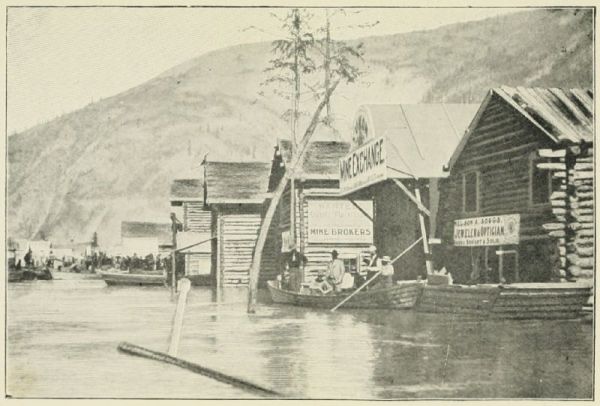
Dawson City.
Salmon River was reached at last. Five men had died on the trail and two were seriously ill, though they dragged themselves along, helped occasionally by the dog-sleighs. Here I formally gave over my responsible charge to Campbell and Mackay, and having been entrusted with mails and despatches for the coast, with barely a halt pushed on ahead with Mac and Stewart. Our stores had diminished greatly beyond my calculations, and it was evident that an extreme effort must be made to increase our rate of travel. Yet despite our utmost endeavours, when we entered upon the snowy wastes of Marsh Lake we pulled a sleigh on which reposed a few furs, a bag of mineral specimens, and about as much flour as would make one good square meal.
For the last several days our progress had been severely hampered by the increasing depth and softness of the snow filling the valley of the Yukon as we approached nearer the dreaded pass. Our daily march since leaving the northern capital had rarely fallen below twenty-eight miles, until the unfrozen White Horse Rapids had stayed our advance and caused us to make a wide détour; but now, do what we might in our semi-famished condition, we could barely travel twenty miles in as many hours, and full eighty miles yet intervened between us and the sea. On this day we had been on the trail since sunrise, and the darkening shadows of night were already beginning to creep over the billowy wastes, though it was but two hours after noon.
"We are near the end of the lake, boys," I shouted encouragingly, as I noticed the failing efforts of my companions. "We must try and reach Tagash River to-night."
Mac groaned dismally, and Dave emitted a plaintive howl as he struggled in his harness. Then Stewart, who had grown wofully cadaverous of late, stopped and addressed his compatriot.
"I mind, Mac," said he, "that there used to be an Injun village aboot here."
"I hae a disteenct recollection o' the place," returned Mac shortly, bending to his labours afresh.
"We are passing that same village now," I cried cheerily. "That makes ten miles since our last halt."
The sleigh stopped with a jerk; half a dozen log-huts with a like amount of totem poles, were plainly observable among the dense timber on shore.
"Them Injuns must have something for eating in they houses," spoke Mac thoughtfully, gazing at the rude structures intently.
"But we have nothing to barter, and we know they won't sell," I broke in impatiently.
He made no reply to my remark, but turned to Stewart, who was evidently in a fit of deep mental abstraction: "What's your idea, Stewart, ma man?" he asked insinuatingly, and that individual responded promptly.
"I am wi' ye, Mac, every time, but I hope it's no' a graveyard like the last we tackled." They threw down their sleigh-ropes simultaneously, and were half-way to the village before I had recovered myself.
"Hold hard!" I roared. "What——"
Mac's substantial figure spun round at once. "We'll be back in a meenit," he whispered mysteriously.
I loosened Dave from his harness, and hastened after the doughty pair, expecting every instant to hear sounds of deadly strife, but all remained silent as a tomb, and I shuddered with painful recollections. I found them cavorting around the largest edifice in the group in a manner that under different circumstances would have seemed ludicrous.
"There's naebody in the hooses," cried Stewart gleefully. "The whole tribe must have gone out moose-hunting."
Not infrequently a village is entirely deserted in this way, and I heaved a sigh of relief. "But they may be back at any time," I said, glancing fearfully round.
Mac shrugged his shoulders; "I think, Stewart," he remarked in a most matter-of-fact tone, "I think the door is the weakest place after all."
I swallowed my scruples at a gulp, and became interested in the proceedings at once. Strangely enough, for the moment we all seemed to have forgotten how very similarly our first escapade of the kind had opened.
Crash! Mac's broad shoulder butted the barricaded doorway right ponderously, but though the heavy logs quivered and bent, they resisted the shock. And now Stewart braced himself for the attack, and together they hurled themselves against the wavering supports. There was a resounding echo as the entire structure gave way, and with many chuckles of delight the adventurous couple disappeared within, while I remained outside, my rifle at full cock, listening for the tramp of moccasined feet that would herald the Indians' return. I heard Mac strike match after match, muttering discontentedly the while, and Stewart's dissatisfied grunts filled me with dismay. Was our depredating raid to go unrewarded?
"There's jist the sma'est bit o' caribou ye could imagine in the hale hoose," snorted Mac indignantly. "It wis high time the deevils went huntin', I'm thinkin'."
"Let's try the other hooses," counselled Stewart.
At that moment Dave gave a long, low growl, and immediately an indescribable chorus of yells issued from the forest near at hand. Then, to my horror, I perceived numerous dark forms speeding towards me. Instinctively I levelled my rifle, then by an extreme effort of will lowered it again. We were surely in the wrong. "Come on, boys," I cried, "we must run for it."
"Haud on till I get that bit o' caribou," murmured Mac desperately.
A moment more, and we made a wild burst in the direction of the sleighs, pursued by a number of stalwart warriors, whose vengeful shouts inspired our failing steps with an unwonted activity.
"Let's stop and fecht the deevils," implored Mac, as we grabbed the ropes of our sadly-light conveyance, and even at that juncture he examined his stolen piece of caribou with critical interest. "It's no' fit for human use," he protested angrily. "I'm no' goin' to run for nothing."
But the yelling horde at our heels made him think better of it, and muttering sundry maledictions he hitched on to the rushing sleigh, and lumbered manfully alongside his gloomy compatriot. Fear did certainly lend wings to our flight, and by the time we had reached the outlet leading to Tagash Lake, our pursuers were far in the rear, the obscuring darkness probably being much in our favour. And then, as we hastened over the shelving ice on the connecting river, we beheld a sight that drew from us ejaculations of sheer chagrin. A great fire blazed on the shores of the frozen stream, illuminating in the background a solidly-built logged erection, and showing clearly the outlines of a giant Union Jack fastened to a tree close by. Not a soul was in sight, but I could fancy the comfortable group inside the generous dwelling whiling away the time before a glowing stove or indulging in a luxurious dinner.
"It's a Government station," I said drearily. "It must have been put here just before the ice closed in."
We halted for an instant, and gazed wistfully at the snug police camp. Here surely we might obtain some little stores for our urgent needs, but how dared we ask? The Indians were British subjects, and would indeed be treated with more consideration than we might expect, for it is the policy of the Canadian authorities to protect, even to the outside extreme, the rights of their dusky subjects. Then, again, we had been long on the trail, and our clothing was rent and ragged. The police might judge us by appearances, and then—I did not care to think what might happen. Many thoughts flitted through my mind as we stood there hesitatingly, and my worthy companions, by their silence, showed that they too were thinking deeply. The unmusical cries of our pursuers jarred on our meditations with seemingly awakening vigour.
"They've got our trail," I said sadly. "We'd better get along."
"Civilisashun be d—— d," fervently, if ambiguously, muttered Mac and Stewart almost with one voice, and we staggered out into the bleak, snowy plains of Tagash Lake, and pursued a dogged course southward.