SHOOTING THE WHITE HORSE RAPIDS
Reading edition
It was a month later when we reached the shores of Lake Linderman en route for the frozen North. The Chilcoot Pass had presented an almost impassable barrier to our advance; a light film of snow clung to the bare rocks and filled the numberless crevices of the "Summit"—that last grim climb, where the Dyea trail mounts all but perpendicularly upwards to the blizzard-swept glacier cap of the pass—and no room for foothold could be traced. It would be impossible to describe that frightful climb. When we reached the top and saw far below the twisting line of Indian "packers," who seemed to stick like flies to the white wall, we could not understand how the ascent had been accomplished.
Crater Lake, on the "other" side, was covered with a broad sheet of ice which was not sufficiently strong to bear our sleighs, or weak enough to allow of a passage being broken for our portable canvas boat. Here we were delayed many days, laboriously dragging our outfit to a less lofty and more congenial climate.
Long Lake, Deep Lake, and Mud Lake were successfully negotiated in turn; their waters glistened cold and cheerless, surrounded by the great snowy peaks that were rapidly opening out into the magnificent Yukon valley. Far down in the hollow, seemingly in a sunnier and well-timbered spot, nestled Lake Linderman, and beyond, the Yukon channel could be traced between the ever-widening mountain ranges. We had packed sleighs in our outfit, not expecting to use them until we reached the Klondike river, and how successful they might prove should it be necessary to force a trail across the frozen waters was a matter for conjecture.
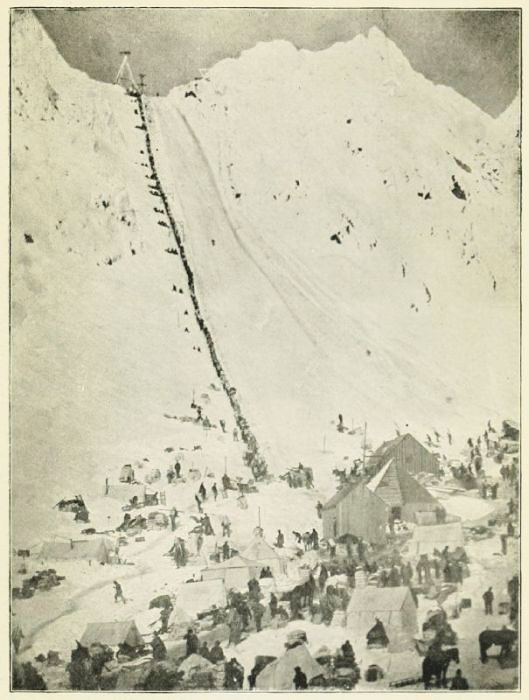
The Chilcoot Pass.
At this time Linderman's shores were the scene of much bustle; many intending voyagers were building their boats in feverish haste, for they knew that the elements must soon lay firm grip on the waters, and render their work useless.
Major Walsh, the Canadian Administrator of the Yukon Territory, had just made his appearance from over the Skagway trail, and he was all eagerness to proceed. He immediately bought—at fabulous prices—the boats that were built, and, without a day's delay, set sail northwards with his staff.
Two days after the Major's departure, I succeeded in purchasing a twenty-feet "Dorie" from a disheartened miner who had decided to return to Dyea, and wait for the ensuing spring.
I need not detail our journeyings for the next few days. Linderman was sailed over within two hours, then the half-mile porterage between it and Lake Bennet was accomplished after much labour. This latter lake is twenty-eight miles in length, its northern extremity narrowing down to a deep and swift-flowing channel, which extends but a few hundred yards before expanding into a broad, shallow lake or lagoon, colloquially known as "Caribou Crossing." The current here is sluggish, and the water abounds in shoals and sandbanks, which at that time were a sore trial to the adventuresome navigator with his precious freight of flour and other necessaries.
Tagash Lake forms the next link in the great lake chain of the Yukon, and it stretches full twenty-nine miles, then contracting to a fierce-flowing stream by which the Canadian Customs Offices are now stationed.
Beyond this is Marsh Lake, and here it was that our troubles began.
Not a breath of wind stirred the waters of the lake, and our crudely-built dorie, containing 1,000 pounds of flour and 1,000 pounds of miscellaneous foodstuffs, ploughed slowly through the wide expanse to the accompaniment of much wheezing and groaning of oars, and an endless string of forcible expletives that burst from the lips of my stalwart companions, who provided the motive power of the ungainly craft. The favouring wind had died away, and, unaided by the sails, we could make but little headway over the still water. The weather had become strangely cold considering the earliness of the season, and I was almost benumbed as I sat in the steersman's perch, directing the course by sundry sweeps of a great-bladed Indian paddle, which I wielded with both hands.
"Keep it up, boys," I encouraged. "We are more than half-way through the lake."
"Twa miles an 'oor," grunted Mac between his efforts. "This is the worst boat I ever pulled."
Stewart, his companion, another brawny Scot who had joined me at Dyea, rested his oar for a moment to breathe a sympathetic swear word of much intensity; then together they bent to their labours, and the rasp of the oars, and the brief swish of the eddying pools created, alone broke the deadly quiet.
Towards nightfall I was surprised to notice here and there large sheets of ice on the lake surface, and occasionally our heavily-laden boat would grind against these obstacles, shouldering them off with much effort: then my oarsmen's long sweeps would rend and split them as they passed alongside.
It was very plain that the Yukon headwaters were fast freezing over.
"We'll have to keep going all night, boys," I said, "for we'll be ice jammed if we camp anywhere around here."
The fierce torrent issuing from the end of the lake and rushing towards the dread White Horse Rapids would in all probability be free from ice—if we could reach that far.
Strenuously my companions pulled at their oars. The gloom deepened, then the stars came out, and by their feeble light I could distinguish far ahead a scintillating field of ice.
The sight caused me almost to despair—we had been sailing since early morning, and were tired and very hungry.
Before I could get the head of our boat turned inshore, it had crashed through several flaking sheets, and immediately after I realised that we were hopelessly in an ice maze from which there seemed no exit.
"We'll gang straight on," said Mac, with determination, and he levered powerfully with his oar against the frosted masses.
A quarter of an hour passed, then the up-turning stem of the dorie went thud against an immovable barrier, and I knew that we were indeed ice-jammed beyond the possibility of forcing a passage with the oars. Nor could we return, for the ice-pack we had negotiated for miles was now seemingly welded together in one solid mass.
Cautiously Mac put his moccasined foot over the prow and bore heavily on the glittering ice; it neither strained nor yielded.
With a fervent malediction he jumped on "shore," and felt the edge of the sheet.
"It's mair than twa inches," he said sorrowfully. "Hoo can we get through this?"
Very sadly we got out of our boat, and, taking the cooking utensils, the tent, and some flour and coffee, sought a sheltered spot among the dense timber on the lake side. Soon we had almost forgotten our woes, and were regaling ourselves with copious draughts of coffee and much hard damper.
From our tent door we could see our boat stuck fast amid the ice. How we were to get it free I could not well imagine. In the morning, however, we awoke with renewed energy and more hopeful hearts.
"We cannot have far to go, boys," I said. "We'll cut down a couple of trees and use them to break a passage."
After breakfast we lost no time in making the effort. Armed with the heavy logs, we re-embarked, and soon the ponderous hammers had begun their work and a passage was slowly made towards the Yukon. With great reluctance our boat moved ahead, leaving a trail of glittering ice boulders. Mac leaned over the bow and opened the channel, while Stewart and I belaboured the masses that closed in on either side.
About midday we neared the end of the lake, and the channel beyond appeared a rippling, crackling flood of jagged ice-floes.
We felt the suction of the current long before we had reached the limit of the ice-field. The sheets became thinner and broke away readily, so that the oars came again into play, and we crashed onward impetuously on the bosom of an irresistible stream.
At last we were free, and our boat dashed madly into the narrow egress, bumping, grinding, and rocking against the detached fragments of ice that appeared everywhere.
With a great effort we managed to slow our craft before coming into contact with a sharp jutting rock that reared high in the middle of the stream, and then we found that it required all our energies to evade the miniature icebergs that rushed alongside. These floating dangers looked harmless enough, yet they were fully six inches deep in the water, and contact with them would result in much damage to the planks of our dorie. Several times, indeed, we were almost overturned by colliding with unusually large floes.
In another hour we had nearly navigated the extent of Miles's canyon, and only several hundred yards ahead I noticed Major Walsh's flotilla, buffetting the seething waters cumbrously, while the men at the oars strained every muscle to escape the perils that abounded in their course.
"We're not far away from the White Horse, boys," I said to my sturdy henchmen, who were working away like galley slaves. They ceased their labours for a moment to look round, and at once our vessel swung about and drifted dangerously near the rocky river steeps.
"We maun keep a way on her," said Stewart.
"Let's ken when we're through," said Mac, and their oars cleft the water like the paddle floats of a fast river steamer.
The current was flowing at the rate of ten miles an hour, and to keep a steering way on our unwieldy barge was, as may be understood, no easy matter.
Frantically I swung my paddle and strove my utmost to avert the calamity that every moment seemed to threaten us.
We were rapidly gaining on Major Walsh's outfit. He had four boats in all, three of them being clumsy barges laden entirely with provisions. These latter were manned by several members of the North-West Mounted Police, who worked their oars from difficult-looking perches among the flour sacks.
The police boats, however, steered a very erratic course, sometimes being carried forward almost on their beam ends. I guessed that the heavily freighted craft had become unmanageable; certainly the steersmen seemed to have no control. Yet I had little time to notice those ahead, for our own "clipper" required every attention.
"Keep her going, boys," I yelled, as I worked my steering paddle with a will, evading rocks, boulders, and ice floes in turn.
Suddenly the white dashing surf of the Rapids came into view, the river narrowed to a fraction of its former width, and over the cataract a jagged sea of the dangerous floes crackled and roared into the abyss beyond.
I saw the Major's first boat fly like an arrow from the bow into the heart of the boiling foam; it careened dangerously on taking the sweep, then righted itself and disappeared into the flying mists.
"Steady, Mac!" I cried, as our craft entered the race. The dense spray almost obscured the great deflecting rock, and we rushed seemingly to destruction.
Then, before my eyes, there appeared an awful spectacle. Faster than I can write the words—one, two, three—each of Major Walsh's three boats reared high in the sleety mist and overturned one after the other as they took the curve.
"Let her go, boys," I bellowed. "Bend to it." The crucial moment had arrived; we were enveloped in foam, and were dashing straight towards the torrent-deflecting bluff. I leaned far back over the stern of our half-submerged boat, and with a mighty stroke of the paddle swung her head round, and we grazed death by barely half a dozen inches.
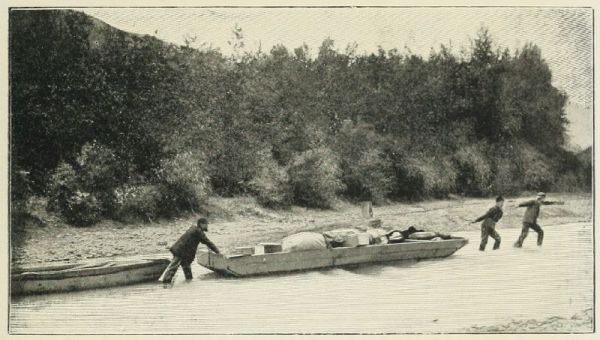
After the Rapids.
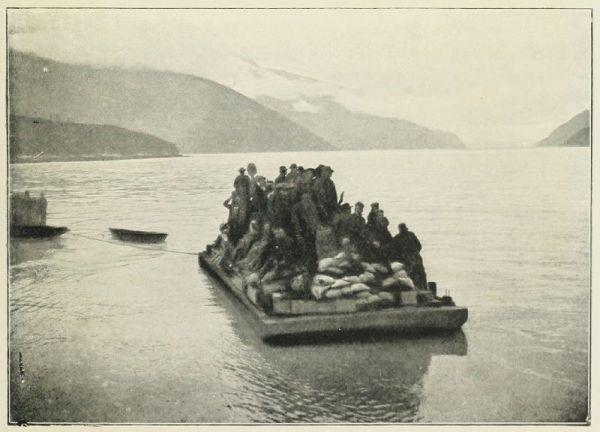
Klondike-Bound Miners and their Outfits on Lake Linderman.
A moment more and we were floating in almost placid waters. Beside us bobbed three smashed boats. Major Walsh stood sorrowfully on shore assisting dripping men from the water.
"It's all over, boys," I said to my crew; "you can ease off now," and I steered for the beach and lent my aid in the work of rescue.
The half-drowned Canadians were dragged ashore gasping and almost senseless, and while we scanned the grim waters anxiously for a trace of one still missing, his body was tossed at our feet by the relentless waves. Soon after, the sand was littered with sacks of flour, and beans, and miscellaneous foodstuffs.
Several camps were in evidence around this melancholy spot, erected by men who had lost their all in the rapids, and were only waiting a chance to return to civilisation. They eagerly accepted the Major's offer to purchase their scanty outfits, and without loss of time that intrepid old Indian fighter had embarked again for the north. To him it was a race with the elements, but the elements won after all, and compelled him to make his winter camp at Big Salmon River, forty miles further north, where we overtook him a few days later.
"It's no use my lads, you can't do it!" he said, on my reiterating my intention of proceeding onwards. "Why, the river's frozen solid from here to St. Michael's."
"Then we'll put skids under the old boat and make her into a sledge," quoth Mac, drily, and I hailed the suggestion with encouragement.
We duly arrived at Dawson City after many days and weeks of ceaseless struggle with the elements on that long and terrible icy trail, and our coming was received with rejoicings by the few half-starved miners who at that time peopled the "City." We had proved the feasibility of an over-ice route to Dyea.