IN THE GUM-LAND OF WANGERI
Reading edition
There is a region away in the far north of New Zealand, where sooner or later the wanderer who knows the world by the track of his footsteps must surely gravitate, there to mingle with kindred spirits and pursue the even tenor of life's way for a brief space under tranquil circumstances, digging for the Kauri-resin deposits of former ages along the fern swamps and uplands, amassing wealth if fortune favours, but casually content with the generous subsistence his peaceful labours at the least will bring, until his restless nature compels him to journey forth again on his ceaseless pilgrimage.
My acquaintance with this odd corner of the globe was made some years ago, when chance—fatality, the gum-diggers would call it—led me to take a trip on a coasting steamer trading from Auckland northwards. I had never heard of the gum-digging industry except in the vaguest way, and curiosity had fired my interest in inverse ratio with the amount of information gathered. But I could not help noticing that all my inquiries on the subject were treated with scantily hidden disapproval, and in consequence I never pressed my apparently awkward questions, fearing that I had by accident hit on a conversational topic, which, like that of convict history in Australia, had best be tabooed. So it happened that when the SS. Bulimba moored alongside the jetty in the beautiful harbour of Wangeri, I stepped ashore, meaning to put in a day or so in the picturesque little township which looked so alluring from the water, yet wholly unaware of the fact that I had at last reached the centre of the gum country. That was a small matter, however, on which I was speedily enlightened.
I had just got clear of the long wharf, and was looking about the quiet street in which I found myself, in hopes of spying the hospitable portals of an hotel near at hand, when four extremely ragged men emerged from the doorway of the establishment I had at that moment decided to patronise. Their outward appearance was bad—very bad, and though I have foregathered with all sorts and conditions in my time, I like to choose my company when I can. I resolved promptly to pass on to some other house. The disreputable quartette were now hurrying towards me, and I moved aside to give them ample room to go by. Three of the party were engaged in animated discussion; the fourth walked a little way ahead, his eyes fixed listlessly on the ground. He looked up as he noticed the shadow across his path, and at once an expression of relief brightened his weary countenance.
"I ask your pardon, sir," he said, with quaint courtesy. "But will you do me a small service?"
My hand slid into my pocket involuntarily; then I recollected that I was not in Britain, and withdrew it again carelessly. "Fire away," I said; "what's the trouble?"
The argumentative trio had meanwhile ceased their wordy altercations and were staring at me eagerly. Their polite spokesman began again:—
"I presume you have been in the various Australian cities?"—he nodded in the direction of my portmanteau, which I had set down in the middle of the road, whereon were emblazoned the advertising devices of many enterprising hotel proprietors.
"You are certainly a lineal descendant of Sherlock Holmes," I ventured with mild sarcasm, half wondering if in this remote settlement I had stumbled upon an adapted version of the old, old confidence trick.
He appeared to understand my innuendo, for he flushed up angrily, then suddenly glancing at his dilapidated wardrobe, he checked a fiery outburst and smiled feebly instead. His companions too seemed powerfully affected by my simple remark, and their wrath did not cool down as swiftly as I would have wished. They crowded around me threateningly, while the vials of their speech overflowed in a tempestuous torrent of indignant reproaches.
"We is Ostralians," they bellowed with one voice, "we is——"
"Calm yourselves, boys," I entreated. "You're over-sensitive to be abroad in this wicked world. I said nothing——"
"An' don't say it again," interrupted the tallest and ugliest of the group. "I is known as Long Ted in these parts, I is; an' I fights when my fur is raised, I does."
It was now my turn to feel annoyed; the aggressive nature of the party almost confirmed me in my first doubt.
"Suppose you stand out of the way," I suggested. "I'm not holding a levee——"
The leader at this stage endeavoured to throw oil on the troubled waters. "I must apologise for bringing this trouble upon you," he said, frowning severely on his associates. "We are not tramps, though I have no doubt our looks are against us. We are gum-diggers out for a spell; at least my companions are on a holiday; I—I am only going to take care of them."
"Then the gum-diggings are here?" I exclaimed in surprise.
"All round about for sixty miles or more," Long Ted answered gruffly. "English Bob is going to Melbourne with us——"
"Sydney," interjected a voice at his elbow.
"Adelaide," prompted another.
English Bob quelled the rising storm with an impatient gesture. "You promised to let a stranger decide the matter," he cried appealingly; then turning to me he continued, "Will you be so kind as give me your opinion on these three cities mentioned. In short, which is the finest of the lot for a holiday?"
A murmuring babel of sound followed his words, and the three fire-eaters glared at me savagely, awaiting my verdict. But I had once before been in a similar position—only once, but that was enough. I realised that the harassed Englishman had in tow a South Australian, a citizen of New South Wales, and a Victorian. I approached the delicate question warily.
"Adelaide is a tidy little town," I hazarded tentatively. Long Ted's basilisk-like eyes peered at me dangerously.
"And Melbourne is a fine city," I continued reflectively. Long Ted smiled, but his nearest neighbour snarled. I could venture no further. "Not for gold or precious stones will I commit myself," I protested. "I am a peaceable individual——"
"Ho, ho, ho," laughed English Bob in genuine merriment, slapping me heartily on the shoulder. "You've sized them up right away. I have never been in Australia myself, and cannot understand why my companions should have such diversified opinions on a simple subject. I am certainly obliged to you for showing them my difficulty, for if you cannot tell them what they ask, how can I?"
"Toss for it, boys," I recommended; "it will be the safest way, and can arouse no ill-feeling."
"Right you are, mate," shouted Long Ted, and a twin echo of applause intimated that all danger of immediate disturbance was at an end. I seized my portmanteau in haste, and proceeded on my interrupted course; but the fighting trio leisurely kept pace, Long Ted gently insinuating the bag from my hand into his own horny palm as we walked along.
"If you don't mind," spoke English Bob, coming up in the rear, "I'd like to—to shout for you. We've plenty of time to catch the old Bulimba, and for my own part I'm not very anxious whether she sails south without us or not."
I marvelled at this strange dénoûement, but said nothing, and together we entered the hotel they had so recently vacated. Within the five minutes following our advent into the gilded "saloon bar," I had become fairly well acquainted with the vicissitudes of the gum-digger's life. Long Ted was as exceedingly communicative as English Bob was reticent, while the remaining pair added titbits of information now and then as occasion demanded.
"But what sort of men make it their special calling?" I asked at length. "No one seemed very willing to give me any knowledge on the subject in Auckland."
English Bob roused himself, and looked at me curiously. "We are a cosmopolitan lot," he answered, with just a note of sadness in his voice; "we come from all corners of the globe; but no one makes it a special calling unless, perhaps, a few Maoris——"
"We is the dead-beats o' civilisation, that's what we is," put in the garrulous Ted, with cheerful emphasis. "But say, boss, what is you goin' to do here? Is you goin' into the gum country? Is you full up o' Sydney and Melbourne too?"
I evaded the pertinent allusion, not knowing exactly its true import; I was commencing to understand why the gum-diggers were looked upon with suspicion by their eminently respectable brethren of the towns. Yet in spite of myself my sympathies went out to the world-wanderers who seemed to be brought together in this land through the subtle hand of an all-wise Providence.
"Give me the bearings of the camps, and I'll go out right away," I said. "Gum-digging may suit me as well as gold-digging, and I want to know what it's like, anyhow."
At that moment the Bulimba's shrill whistle sounded out on the still air, and Long Ted immediately grabbed his "swag" and made a bolt for the door, a proceeding which his two Australian comrades copied with alacrity.
"Hold on, boys," I cried; "she won't sail for an hour yet; this is only a warning blast. Surely you are acquainted with the habits of coasters by this time."
English Bob, however, had made no movement, and missing him the excited trio came back. "I knows the old Bulimba," howled Ted. "Captain Thompson would hustle the blasted barge out just on purpose. Come on, Bob."
The Englishman stretched himself lazily, and started to follow his companions, who were again half-way down the street. "Goodbye, sir," he said; "I'll see you again soon if you are to remain in the country. But one word—don't judge by appearances on the gum-fields."
I returned his greeting, and thanked him for his advice, "Here's the Auckland Express," I said, fishing that paper from my pocket. "It is the latest date, and will be something to read on the boat."
He took it eagerly, and glanced casually down the open sheet; then his face paled, and the paper dropped from his nerveless fingers. I turned aside for a moment, and when I looked again, English Bob's countenance was stern and hard.
"You'd better go," I advised kindly; "the Bulimba will be moving out soon."
He shook his head. "I have decided to stay and go back with you to the fields," he answered with an effort. "But I'll run down to the wharf and say good-bye to the boys."
He was gone before I could speak another word, and wonderingly I picked up the paper which had caused such a sudden change of programme. Only one item appeared in the page he had scanned which could in any way be considered of remotest private interest. But it read as follows: "Robert Lorimer, the absconding Bank Manager of a country town in England, has at last been traced to New Zealand. Local inquiries are being instituted, but it is regarded as tolerably certain that the defaulter will be found in the northern gum-land, and the police of that district have been warned accordingly. Meanwhile the port of Auckland will be stringently watched."
That was all, yet viewed in the light of recent events it was amply sufficient to suggest to me that English Bob and Robert Lorimer were one and the same person. Still, my late interrogator as to the attractions of Australian cities did not strike me as being such a man as the bald news paragraph implied. His face was gentle, and contained a certain quiet dignity, which I felt assured could belong to no criminal's countenance. His manner, too, was distinctly in his favour. Already I had forgotten the unprepossessing garb of the outer man. My reflections were cut short by the dismal shriek of the Bulimia's syren—sure signal that that persevering vessel was at last under way.
"Yes, she's off now," volunteered the bar-tender, surveying the deserted arena beyond the counter ruefully, and making a mental calculation, I have no doubt, as to the probable "stagger juice" capacity of his solitary remaining customer. I disappointed him mightily by making my way outside, and there, to my surprise, I saw English Bob approaching with Long Ted expostulating volubly by his side.
"Hallo, Ted!" I cried, "have you also decided to remain where an unfeeling civilisation sent you?"
"Of course I stays with the boss," responded that gentleman, wiping an imaginary tear from his eye, "but my poor old swag has gone with Slim Jim and Never Never Dan. They would have stopped too, only they couldn't swim, an' the darned ship had moved off afore they knew we wasn't comin'."
"We'll go back to our old camp by the coach to-night," said English Bob. "I'm tired of even this fringe of civilisation already. Will you come?"
I needed no pressing. Somehow I felt that I was being drawn into the final act of a life's drama; the damaging testimony of the Auckland Express loomed largely before my vision, but the pale sad face of the exile awakened in me pity rather than repulsion, his silent exercise of a superbly strong will aroused in me admiration.
"I shall be glad to go with you," I answered.
That night we journeyed by mail-coach out towards Wangeri, a constantly shifting settlement forming the headquarters of the ever-roving gum-diggers. For the early part of the route our lumbering vehicle careered over rocky bluffs and steeps, then down into beautiful alluvial valleys and forest glades, where silvery streams of purest water gushed onwards to meet the sea, their winding channels, glittering in the moon's filtering beams, showing at intervals through the wavy fronds of the stately kauri. But soon the majestic forest lands gave place to rolling plains of burnt soil, with occasional stretches of fern-swamp and tea-tree dunes.
"This is the old forest country of New Zealand," explained English Bob. Ted had long since fallen asleep.
"And is the gum not to be found here also?" I asked, somewhat nonplussed to find the site of an ancient forest so bare and desolate.
My companion gravely acquiesced. "Gum-diggers are not as a rule a careful class," he said; "and the young timber on these flats has all been recklessly burnt down to suit their needs."
Long and deep channels here and there intersected the scorched wastes, and mounds like gigantic mole-hills were abundantly evident. But in the vague light only a blurred panorama of the true aspect of things could be seen; which was perhaps just as well, for the New Zealand Government has long complained about the devastating nature of the gum-seeker's employment. They certainly do not make the desert "blossom like the rose," but if an opposite parallel could be drawn, it would suit them exactly. This feature of affairs was due, I was told, to the plodding and ceaseless excavations of a number of Austrians who stormed the country many years before, and not to the more leisurely routine pursued by the orthodox happy-go-lucky digger.
Once again, however, we entered a broad timber belt which extended far along with undulating hillside forming our southern boundary at this stage, and seemingly feathered the land for a very considerable distance northward also. And now many twinkling lights began to shine through the sparse foliage at the base of the tall kauri, and fleeting glimpses were caught of groups of men standing at the doors of their "whares," watching the coach rumble past with an odd listlessness which seemed the more strange considering that the arrival of the mails was but a weekly occurrence, and sometimes not even that when the rainy season was on, and the valleys and flats alike were flooded to a dangerous depth.
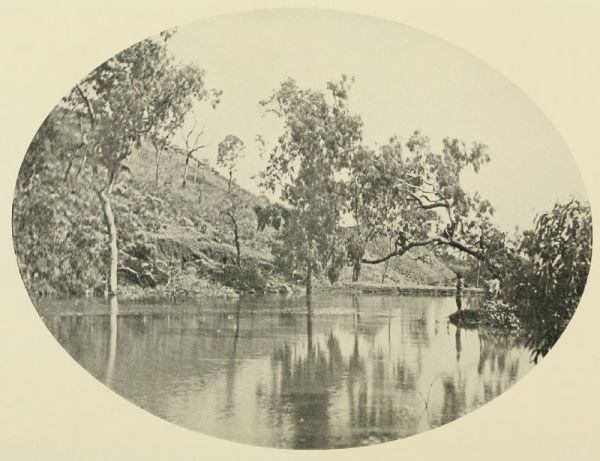
The Gum-Diggers' Swimming Pool.
"Their interest is in their daily occupation," said English Bob, guessing my thoughts. "The men you meet here for the most part know the world well. This is a haven of rest for the wide earth's wanderers. Mail day to them means little, for they receive few letters and perhaps send less."
"And have you travelled far, that you speak in such a strain?" I asked chidingly. "Surely the world has not grown dim to your eyes, which have seen fewer years than mine."
"Years do not always bring sadness," he answered evasively, "nor does the lack of them make one the less liable to suffer. As for my travels—do not ask. I have——"
"Wangeri," yelled the driver, reining up the horses with a jerk which had the effect of propelling the slumbering Ted heavily on to the floor of the coach. The words that issued from that valiant warrior's lips then were sulphurous in the extreme, and the offending Jehu, hearing of his own premeditated doom, slid hastily from his perch and vanished into the night. There was little indeed to see at Wangeri. A small "store and post-office" occupied the central position in a forest clearing, and around it in a straggling ring about a dozen log huts were dully discernible through the gloom.
"The whares are scattered all through the forest for miles around," said English Bob. "Wangeri is only a kind of station for the export of the resin collected. But come along to my little wigwam; it is a bit away from the others, but it's on a good patch, and you are welcome to try your luck with Ted and me."
I expressed my gratitude in, I fear, rather stinted terms, for the eerie shadow of the great pines had a somewhat depressing influence on my spirits. I tramped on with my new acquaintances in silence, my swag slung picturesquely over my shoulder as in days of yore.
"It is a bit lonesome like," grumbled Long Ted, as he marched on ahead, separating the festooning branches for our easier progress. "Can you blame a man for being ragged after this?" he demanded irrelevantly a few moments later, his mind apparently reverting to our first meeting. It was clear that Long Ted's frustrated holiday was still a rankling subject in that worthy's breast.
The air was wonderfully cool and invigorating, despite the enclustering thicket, and the absence of the ubiquitous mosquito made me marvel not a little. It was the deathlike silence that hurt; it oppressed the senses to an appalling degree, and tended to reduce one unaccustomed to forest solitudes to an enervating state of melancholy. Had the journey been made by daylight it might have been different, but fate ordains that the traveller to this land should first see Nature's most dreary aspect. I was startled from my unprofitable musings by English Bob shouting—
"Here we are at last. Now, Ted, make us some supper; and let us be merry, for to-morrow we——"
"Go out gum-digging," I prompted, sinking down in a corner of the aptly-named wigwam with a sigh of relief.
It was a week later. The sun was shining brightly over the sylvan slopes of the great gum region, and tinging the nodding plumes of the stately forest giants with a deep bronze effulgence; yet down below the spreading branches a perpetual twilight reigned, and here, piercing and trenching the mossy sward in search of the fossilised resin residue, the strangely assorted waifs of the world wandered, English Bob and I had become fast friends during our brief sojourn together. Concerning his past I did not inquire, having already learned that the grim gum-land swallows up many of life's tragedies; but day by day I expected a dread dénoûement. The newspaper paragraph still haunted me; my mind was filled with conflicting doubts and fears. The motley assembly who formed our neighbours near and distant were a generous and true-hearted people, among whom it was a pleasure to abide. The same environment affected all, and for the time we were as one huge family, dwelling within the encircling arm of grand old mother Nature.
Each day we sallied out armed with spade and spear, the latter implement being merely a long pointed stick provided with a handle for leverage, and rarely indeed did we return to camp without a goodly store of the amberlike deposit. The method of working was simple. By means of the spear the spongy soil was easily penetrated, and the presence of any gum strata localised at once, after which the spade came into play. The value of the crude material thus brought to the surface was no mean figure, ranging from £50 to £70 a ton.
This morning we had been exceptionally fortunate, Long Ted spearing a huge block of the gelatinous substance almost with his first effort, and we were busy clearing away the covering earth when two woe-begone individuals appeared before us.
"Slim Jim and Never Never Dan," gasped Long Ted, gazing at the apparitions in undisguised wonder. "Where—what—how—an' ye does have a mighty neck to come back in them togs."
Then I noticed that the miserable-looking pair were arrayed in fashionable raiment, though already considerably torn by contact with the entangling brush.
"We didn't git no farther than Auckland," muttered Slim Jim shamefacedly. "We didn't calc'late on goin' nowheres without the boss, so we has come back."
English Bob smiled. "But how have you managed to arrive at this time?" he asked. "Surely you did not walk from Wangeri."
"We just did," asserted Never Never Dan. "We couldn't wait on the bally old coach, so we came right away last night——"
"Come an' have some tucker, you heavenly twins," roared Ted, relinquishing his shovel, his honest face glowing with pleasure at the return of the prodigals.
When they had departed towards the hut, English Bob looked at me inquiringly. "Could you imagine men like these in any other country than this?" he said. "They are just like children."
Slowly the sun climbed up in the heavens, and we two persevered at our work of excavation. Then gradually I became aware of the rhythmic hoof-beats of many horses sounding faintly in the distance, and soon the dense forest rang out with the unwonted echoes. And now the rushing of the gum-diggers hither and thither came plainly to our ears, and a chorus of warning cries swelled out above the prevailing din—"The troopers are coming."
At once the truth flashed over me that the man whose whare I shared was the object of their search; the inevitable crisis had come at last. As for him, he stood almost defiantly erect, with the blood alternately surging to his cheeks, then leaving them deathly pallid.
I laid my hand on his shoulder. "Why do you try to hide from me that which I already know?" I said gently. "Sometimes it is possible to help——"
"You know?" he gasped.
"I saw the paper," I answered simply.
He covered his face with his hands, and his whole frame shook with a strong man's emotion. "Do you—believe?" he asked hoarsely, without looking at me.
"Assuredly not," I said.
He gave a sigh of thankfulness. "I have been tracked like a dog all over the world," he murmured brokenly, "but I have reached the end of the tether now."
"But why did you run away?" I asked hurriedly. "Surely an innocent man only courts disaster by flight."
The troopers were now near at hand. I could hear their sergeant talking to some of the diggers scarcely a hundred yards from where we stood. English Bob recovered himself with an extreme effort of will. "I may have been foolish," he said quietly, "but things looked very black against me, and—and the disgrace would have killed my old mother."
I did not reason further. "There may be a way of escape yet," I said, seized with an uncontrollable impulse. "We are both very much alike. I'll talk to the sergeant."
"No, no!" he cried, " I cannot allow——"
"Why, man," I interrupted impatiently, "it's your only chance. They'll find out their mistake soon enough."
"Good morning, boys," came a jovial voice from the timber, and its owner, a stalwart New Zealander, bearing the emblem of his office on his arm, rode forward alone. We responded to this cheery salutation gloomily.
"Why," he exclaimed, "you've struck a patch here. But I do wish you people would be more careful and take out licences before you start to dig. The Government is getting rather riled about your free-lance way of working."
"But we have licences," I remarked mildly.
He laughed. "I'm glad of that," he said, "for I find very few of your neighbours have thought it necessary, and my troopers seem to have the deuce of a job in explaining matters to them." He wheeled his horse, then reined up again suddenly, and came back. "Which of you is Robert Lorimer?" he said directly.
His method of procedure appeared to me unnecessarily cruel. "That's me," I answered sharply, before my companion could speak. "But couldn't you have asked at first?"
He stared at me wonderingly. "Great Southern Cross, man!" he cried. "What!" He broke off in a long low whistle, and held out his hand. "Let me be the first to congratulate you, sir," he said. "Of course you could not have heard, but you needn't be so hard on me for all that. But let me tell my story," he continued, waving aside my interruptions. "I was instructed from headquarters to come for you officially seven days ago, but though I am a policeman I don't like the job of running any man to earth, and I delayed until I should have to come in any case to attend to the licence question. Only yesterday I was informed that the warrant was off, as the notes you were accused of stealing had been found in an old ledger, placed there, no doubt, by some careless clerk. That's all. Good luck to you, my boy, and a safe journey home."
He was gone in an instant. Then English Bob and I clasped hands in silence.