OSCAR BIE (continued 2)
E. E. (Ernest Edward) Kellett translation
The man to accomplish the great work was François Couperin, called by his time “the Great.” The piano-player of to-day hardly knows his name; and yet it is only two hundred years since men spoke of him in the same breath with Molière and Watteau. A genial, smiling, clean-shaven man—so the somewhat unsatisfactory portraits depict him—with half-length peruke, polite and yet slightly subtle, with a certain priestly sobriety of demeanour, his light fingers run over the hundred adornments of his spinet-pieces. He seems half astonished at his fame, and wholly ignorant that a whole art is one day to rear itself on his shoulders. It was only with difficulty that the pressure of his friends induced him to print his dances, which he wrote for himself in memory of his experiences, or the preludes which he wrote as exercises for his numerous pupils, or the concertos which he composed for Louis XIV.’s Sunday musical evenings. He watched with painful anxiety the tedious process of engraving. As we to-day inspect these prints, we are struck by the joyous naïveté of the art, by the graphic awkwardness with which the notes overflow the five-lined limits of the clef, and by the soul which breathes from the delicately-engraved prefaces. He thinks that his portraits are accurate pictures, and thankfully acknowledges his indebtedness to the intimate character of his instrument. His notes as to execution, his “gaiement,” “tendrement,” and “sans lenteur” (he is always warning the performer against slowness) and all the other guides to interpretation which he inserts, he excuses by saying that the pieces seemed to express something which could not be embraced in accurate language. In spite of all this pedantry of teaching he appeals to the sensitive musical appreciation which will find the right way of interpretation; and in spite of all this reference to the spiritual momentum of music he is a stern disciplinarian in form and technique. In the midst of the utmost freedom of movement we discern a strong feeling for style, just as in the contemporary architecture the most playful license of the rococo is strangely mingled with the most sober attention to classical rules.
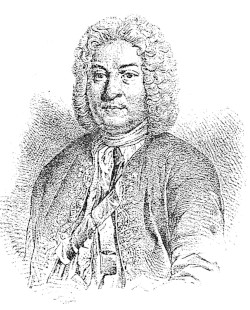
François Couperin, “Le Grand.”
The Couperins, like the Chambonnières, were a widely spread musical family. It was old Chambonnières who, in a noteworthy fashion, had discovered Louis Couperin, the uncle of François. One morning the father of François and his two brothers who lived in the neighbourhood of the old master, brought a serenade for his inspection. Chambonnières was struck with it, asked after the composer, brought him to Paris, and thus laid the foundation of the fame of the family from which the great perfecter of his work was to spring. François was born in 1668. He lost his father when he was ten years old, but in Tomelin, the organist of St Jacques-la-Boucherie, he found a teacher and a second father. His life, as its details have come down to us, was simple and uneventful. He became organist of St Gervais and chamber-clavierist to the king, and died in 1733. But the dedications of his works enable us to conceive him more definitely. He appears in them as the professional artist and man of the world, pampered by noble ladies, and kissing their hands with graceful flatteries. We see him as he moves in the salons of Paris, which were then beginning to realise their mission. He is the admired artist of the court which he charms with his chamber-music; the intimate of the Duke of Burgundy and of the Dauphin, of Anne and Louis of Bourbon, giving his lessons and receiving pensions of a thousand francs. A true lady’s man, he thinks the hands of women better adapted to the clavier than those of men. He is the first to sanction ladies in his own family as clavier-players. His daughter Marguerite Antoinette, and his cousin Louise, played at court. Marguerite even became the teacher of the Princesses, and was official royal clavier-player—in France certainly, and probably in the world, the first woman to hold such a post.
The music of Couperin has something of this feminine quality. It is more truly “virginal” music than that which Queen Elizabeth once played in her quiet chamber. But its grace is not hidden; it is coquettish and conscious of itself. It is the high style of grace which belongs to the French culture of the eighteenth century. A spinet stands on a smooth parquet, and the ladies sit around with their roguish eyes and tip-tilted noses, smiling at all the well-recognised allusions, as the then flourishing pastel-art has fixed them for us in light colours. It is light, entertaining music, in which the thoughts of their own accord run on bright and resplendent paths. Short pieces; courantes with their lively, scarcely broken triple-rhythms; allemandes in their decorous and interwoven quadruple time; minuets with their pretty, melodious triple rhythm; chaconnes and passacaglie rearing their piquant erections on slow-moving basses; sarabands in their triple movements and interesting national colouring; gavottes with their graceful movement in soft two-time, the hurrying fugal gigues, and all the many other unnamed dances—all these give the ear, without exertion, a subtle delight. The rondo-form takes a supreme rank; it is constantly growing from a simple round-dance with refrain into a genuine clavier-composition, seeming to forebode the sonata which still remains unborn within it. Its theme, like a Ritornel, recurs among the “couplets” or episodical passages; but it is only seldom that the couplets set themselves in conscious opposition to the theme. Usually they adopt its rhythm or the character of its melody, and play with it until, neatly and gracefully, they glide back into the theme itself. There is no iron rigidity of thematic handling. A delicate colour-sense holds the parts together. Couperin does not regulate his pieces according to any definite scheme of dance-successions; he binds the dance and the non-dance, the piece in one or more sections, together into one bouquet which he offers to his lady-friends, often with a polite dedication appended, under the general title of “Ordre.” Twenty-seven such “Ordres,” in four volumes, were published by him between 1713 and 1730.
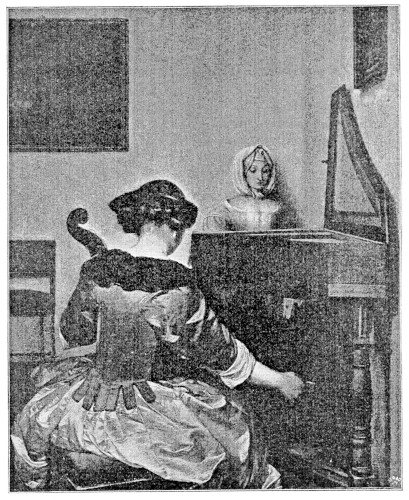
Concert. Painting by Gerard Terborch (1617-1681), in the Royal Museum at Berlin.
The music of Couperin is as simple as possible. But we must not judge its sound by the somewhat heavy pianofortes of our time, which, even in the playfulness of a rapid passage, seem conscious of an arrière pensée. No; the spinet, which, even at its saddest, had a joyous exhilaration—this was the instrument of this playful music. The passages glide on, usually in two voices, of which the one is played by the right hand, the other by the left; and whether these voices are tied in chords or chord passages, or whether—as occurs more rarely—full chords, usually arpeggio, stand between, in either case there is a delicacy which recalls to us the origin of French clavier-music in the sweet-toned lute. But Couperin advanced yet further. In his last “Ordres” his compositions increase in depth; the more luxuriant conceptions and deeper feelings of a lesser Beethoven show themselves; the playful and ornamental element recedes into the background, and the compositions become those of a master who has summed up whole centuries of music in himself. From the insipid melodies of Lully’s time Couperin has fashioned more graceful and charming turns of expression; not only roguishly dancing-melodies, in which the vigorous popular songs seem to live again, but also melodies of the intellect, in which the soul of Mozart might seem to dwell. He prefers to advance in the diatonic scale; and the sense for the general outline of the composition, which is so often wanting in the older generation, is in him so unerring that he permits, with inimitable skill, the semiquavers of his “papillons” to sway up and down through entire bars. Yet occasionally his melodies seem ashamed of their nakedness, and, as in the “Sailor’s Song,” draw the flowery robe of adornments so closely round them that we can scarcely trace their limbs. There are the well-known short and long grace-notes, upper or lower, the pincés, ports de voix, tremblements, and the whole apparatus of ornamentation, which was then larger than it is now, and which, in spite of the stern admonitions of the composer’s marks, was frequently at the mercy of the performer. Like almost all composers of that day, Couperin gives in his first volume the table of his ornamentations, but he insists strongly on their exact carrying out. To players of to-day his agréments are anything but pleasant. They seem to destroy our sense for the pure run of the voices, and are painful in their superabundance. But we must play them with historical fingers, and seek to understand the psychology of their expression. They give to the quick clavier-tone a significance of its own; they are, so to speak, running drills, cutting the tones deeper into the relief of the piece, some more, some less, until they bring out the light and shade which serve to aid expression in the material of the clavier. Could we hear Couperin play, we should certainly hear the pure voice more distinctly than we imagine, enfolded as it would be here and there by deeper or brighter shadows of the ornamentations which bring out its form in plastic manner. His was a technique which was lost to us with the thorough comprehension of this music. Couperin took pains to bring it to the highest perfection. At times he introduced a slight tempo rubato; he took from the note at the conclusion something of its length, and gave to another at the beginning a short pause for breath, inventing for the former the mark of aspiration, for the latter that of suspension. Here the endeavour was the same as with Prall-triller[41] and grace-notes. Instead of the ornamentation, the short pause, like the white mounting of a picture, raises the important note, giving to it its meaning and with the meaning the due expression. But later, in the last “Ordres,” Couperin must have felt the inadequacy of these marks. The aspirations and suspensions retreat into the background, while the sign ) becomes more prominent. This sign simply marks off an independent musical phrase in order to resign its due interpretation to the sympathetic feeling of the player. Such is the trouble he takes with the traditional style of ornamentation and its spiritual expression.
But the remaining musical peculiarities of his composition follow the simplest lines of development. Freedom of motive increases. Tremolo accompaniments, interesting sequences, a playful counterpoint—this latter especially in the pieces for two claviers, or in the “Pièces croisées” for clavier with two manuals—in fact an inexhaustible array of new forms arises. Thus the harmonisation simplifies itself along with the advance of the entire musical development. Couperin modulates, into the dominant or sub-dominant, by means of their related notes, in major and minor keys. By his turn for repetitions of short figures on changing basses—a truly modern motive—or by bold passages of passing notes—for instance, in the saraband “La Majestueuse,” we find once e flat, d, f sharp, g, a, one over another—he gives us interesting harmonies, which appear, especially in the allemandes, as full, heavy chords, already anticipating Bach.
The theatre of Couperin is rich and varied. The representations which we see in this theatre under the innumerable titles of the pieces, range over the whole world. Some of the characters are also not strange to us; others we soon learn to know; a few remain unintelligible to us since the relations they betoken are too subjective. But all lend to the pieces a personal value and an intimate charm, as Goya’s editions present them to us; and it is from them that the clavier derives its great significance as interpreter of this intimate personal art.
“Nanette” greets us with her pleasant quavering melody; “Fleurie” is more subtle, and sways delightfully in richly-adorned 6/8 time; the “Florentine” blooms in graceful, gentle play of quick triolet-figures; but the “Garnier” has the dress of the confined fantastic time, having not yet cast off her heavy folds. “Babet” is “nonchalamment” contented; “Mimi” has a temperament which the many slurs and points of the ornamentation can scarcely fully exhibit. “Conti” (or “les Graces incomparables”) works lullingly out her counterpoint; “Forqueray” (or la Superbe) has a physiognomy of almost academic severity. Many ladies pass by us in these pastel-portraits. We are amused with the divine Babiche (Les amours badins) and the beautiful Javotte (or the “Infanta”); but the most beautiful in melody is Sœur Monique, an intellectually delicate creation, and the most beautiful in construction is “La Couperin” (perhaps the musician’s cousin Louise) who poses before us in a masterly, stately, and slightly fugal movement.
Then follow the troops of nameless ones. First the nuns—the blondes in the minor and the brunettes in the major section. Then the charming and melodious representatives of landscapes: Ausonian, Bourbon, Charlerois, Basque. Then the “Enchantress,” who of course in process of time suffered much from her magic. Then the “Working Woman,” who finishes her course, but is surpassed in it nevertheless by the “Diligent One.” The “Flatterer” and the “Voluptuous Woman” are a relatively quiet pair. The “Gloomy One” is sharply defined, with her dismal, jerky passages, and the heavy full chords. The “Sad One” exhibits the light sentimentality of all archaic melodies. The “Spectre” sweeps past in slurred thirds. Close behind come the “Gray Women” with their ponderous sad march. The “Fox-Tail” has tripping broken chords; the “Lonely One” shows her caprices in the rapid successions of grave and gay. Then follow, in endless succession, the “Princesse d’Esprit,” “l’Insinuante,” “l’Intime,” “la Galante,” “la Douce et Piquante,” faithful ones, risqué ones, bold, visionary, mysterious ones, with their chromatic descents. “Le Turbulent” is one of the few men in the list.
His more general portraits are the most satisfying. They depict emotions, characters, animals, plants, landscapes, occupations, bits from all kinds of life, which are often inscribed with the favourite antique titles. Thus “Diana” with her broken chords leads us into the forest, and shortly after in the second part we hear her horns sounding; while in the “Hunt” a more romantic note is struck. In a broad violoncello-like “Romance” the wood gods are singing and the satyrs dance a very melodious and attractive Bourrée. The Amazon rushes on in thirds, which bear a striking likeness to the leit-motif of Die Walküren; and Atalanta runs past in rapid figures. Hymen and Amor sing a marriage-song, the former in the first part more firmly, the latter in the second more delicately and tenderly. The Bells of Cythera sound to us from the holy island, rising and falling alternately, enlivened by glissando-passages. This motive Couperin adopted a second time in “Les Timbres.”
The Bees hum and revolve round one point; the Butterflies flutter past in ravishing triplets; the Fly buzzes and dances round her own melody; the retiring Linnet hurries through restless triplets; the complaining Grasshopper chirps in endless imitative short grace-notes; the Eel twists itself now tightly, now loosely; the Amphibian creeps along in legato notes, winding itself through bar-sections of Schubertian length; the Nightingale in Love sings her piercing plaintive accents in quick and ever quicker trills, or as Victor chants more joyfully and triumphantly. Or, again, blooming lilies rise before us in delicate self-enfolding figures with petal-like ornamentations; the sedge rustles eternally to its melody; the poppy spreads abroad a wonderful secret mysterious tune, with many slow arpeggio thirds; and garlands twine themselves in festal guise on a canonic trelliswork.
Life unfolds itself in its entire wealth. Here we have the rolling play of the waves, there the purling and rippling of the brooks, and the twittering of the birds—a foretaste of the slow movement of the Pastoral Symphony. Then again, under the name of “Bontemps ou l’étincelante,” an appeal is made to the emotions of springtide or fair weather; we live as it were in a small forest of enchantment. In the second part—Les Grâces Naturelles—one of Couperin’s most intellectual melodies breaks forth, showing all the chaste delicacy of Mozart. There rises the blooming landscape of St Germain en Laye; farther off we catch a sight of teeming orchards from which the music of bagpipes sounds forth. The reapers draw nigh with cheerful song; the buffoons—males in minor and female in major—stir their happy limbs; the jugglers appear and ply their tricks;—we can hardly distinguish the trick and its solution, or the rapid intermingling of left and right hand—the knitters lace their rolling semiquavers together right to the “falling meshes” at the end; the click-clack of the lace-makers—tic, toc, choc, tic, toc, choc—beats joyfully hither and thither in the broken chords of a pièce croisée. Even the milk-maids of Bagnolet have their appropriate pieces. There the gossipping wife—a reminiscence of Jannequin—beats her rapid bubbling motive; there the short rolling courses of the famous little windmills play their humorous part; here hobbles a cheery lame man along; there staggers a bizarre, syncopated, now swift, now slow Chinese. “The Man with the queer Body” makes his springs, in scattered notes, and close by stands the idyll of “Dodo,” or “Love in the Cradle,” the bass of which rocks itself to and fro in a pièce croisée. “Wavering shadows” glide ghost-like in sadly-sounding movements throughout this play of life.
The “Sentiments,” full of feeling, with their beautiful “anticipation” notes, the long legato-movement of the “Idées Heureuses,” the “Regrets” and “Amusements” musically darting to and fro, the syncopated tender “L’Ame en Peine,” the wonderful “Langueurs Tendres,” the somewhat lengthy “Charmes,” the “Agréments” with their agréments, the free diatonic of the various morning melodies,[42] the gentle toying of the “Bagatelles,” of the “Petit Rien,” of the “Brimborions,” the rapture-like “Saillie”—these are inward reflexes which have not quite the clear sensuousness and realism of the outer experiences. The following are the most elaborately worked out, and are presented in “cycle” form.
The “Earlier Ages” appear in four figures—the first exercise gives the syncopated “Muse naissante,” the second the rocking “Enfantine,” the third the rioting “Adolescente,” the fourth the “Délices” in violoncello style, which is Couperin’s favourite for the attainment of the most delightful effects.
Or the great “Shepherds’ Feast” with the twanging musettes of Taverni or Choisy, and the lightly rocking rhythms.
Or the five-act Ballet of the “Pomp of the great and ancient Menestrandise.”[43] Act I., the pompous entry of the Notables and sworn probationers. Act II., a bag-pipe song of the hurdy-gurdy-men and beggars. Act III., a joyous dance of the jugglers, clog-dancers, and Merry-Andrews with bears and monkeys. Act IV., a duet of the crazy and the lame. Act V., breaking up of the whole troop by the animals—furious étude in semiquavers.
Next, the cycle of the old and young men; the former sober, the latter happy.
But, before all, that original of Schumann’s Carnival, “Les Folies françaises ou les Dominos.” Maidenhood in invisible colours, Shame in rose, Impetuosity in red, Hope in green, Faithfulness in blue, Perseverance in gray, Longing in violet, Coquetry in a domino of many colours, the old gallants in purple and gold, the cuckolds in brown, silent Jealousy in dark gray, Rage and Desperation in black. Externally the form is that of a great ballet of the time; internally it is the variation of collected pieces on a single harmonic succession, its contents are the allusions easily comprehended at the time; the characterisation is carried through with great skill; but its musical setting is even shorter than is usually the case with Couperin’s clavier-pieces.
The Preludes, which Couperin appended to his “Art de Toucher le clavecin,” he named, in accordance with their ad libitum performance, the Prose of clavier-literature. These dances and pictures were to him the poetry, rhymed and rhythmical. And it was precisely their formal completion which was of importance for the future of clavier-literature. We see the forms developing. In his best pieces the Sonata is already foreshadowed. The fulness of motives, as they occur to him in his two best compositions, the splendid “Favorite” and the stupendous “Passacaille,” is elsewhere thematically limited. In the recapitulation of the main theme at the beginning of the second part of the pieces, in the rhythmic similarity between the rondo-motive and its “couplets,” in many a thematic working-out, shown for example in “La Trophée” with its wonderfully modern sonata-style, lies the promise of thematically-developed music of succeeding generations. To the same purpose is his increasing sense for the association of several pieces. The many slow second pieces, or the popular dances such as the Polonaise, the Sezile, the Musette, which form the concluding parts of a group, the repetition of the first part after the second, the divisions into slow movement, slower, and lighter, which are specially visible in “La Triomphante,” and “Les Bacchanales”—all these are as much the germ of the future sonata arrangement, as the severer thematic was the germ of sonata-playing. The charm for us lies in observing, in the springtime of art, the natural uprising of these forms which appear to us almost laws of nature.
His “Art de toucher le clavecin,” the first school-book specially devoted to the clavier, was published in 1717 and dedicated to the king. This was a noteworthy advance. There was to be no longer a teaching of mere notation, but a teaching of technique and execution. “The method which I here propose,” says Couperin, “is unique, and has nothing to do with the tablature, which is only a counting of numbers. I deal here chiefly with all that belongs to good playing. I believe that my observations are clear enough to please connoisseurs and to help those who are willing to be helped. As there is a great difference between grammatical and rhetorical rules, so there is an infinite distance between tablature and the art of good playing.” Such a general musical “fabrication” and grammar, in spite of many advanced ideas, had been the work of St Lambert, which appeared from 1702 to 1707, and which in its first part (called “Principes du Clavecin”) devotes only a few lines to actual clavecin playing, and extends the second part (called “De l’accompagnement”) also to the organ, and other instruments. It is painful to him that his experience is treated lightly and turned into a “school.” The parents of the pupils, he says later, ought to place the most implicit reliance on the teacher, and yield him the completest powers. The teacher even takes the key of the instrument with him, and no playing should be attempted without his supervision. The scholar sits with his fore-arm horizontal before the clavier, elbows, hand and fingers in a line—the fingers thus lying quite flat on the keys. He has his body turned very slightly to the right, and the right foot a little stretched out. In order to prevent grimacing while playing, he often places a mirror in front in which he can watch his motions. A bar over the hands occasionally regulates the equality of their height; for the holding of the hands high makes the tone necessarily hard. Looking about of any kind is forbidden, and above all, coquetting with the public as if the playing were no trouble at all. And although, finally, everything in the performance depends on experience, taste, and feeling, yet rules are given for performance to which the player must conform. Couperin frequently disregards the fingering of his predecessors, and to the examples which he gives of his new art he adds confidently in a side-note that he is convinced that few persons in Paris have the old rules in their heads—Paris being the centre of all good. Step by step we have harder and harder studies developed from a single figure, and directions for finger exercises fill the rest of the volume. The change of fingers on one note, the avoidance of the same finger twice in scale passages, the first application of the thumb in passing under are his characteristic points. These are all symptoms of the endeavour to form a legato style suitable to the clavier; they are the external indications of the suppression of the lute. Couperin’s abhorrence of a vacuum runs through his whole teaching of the clavier. The adornments, the avoidance of too long note-values, the legato finger-exercise—all are the systematic development of the powers which arise from the necessity of short tones in the clavier. He once introduces a charming short fugal allemande, in which both voice-parts work in contrary motion in most flowing style in order to show what “sounds well” on the clavier, and opposes to it the one-sided broken chords of the Italian sonatas of whose light style he has on other grounds the highest opinion. “The clavier has its peculiarities as the violin has its. If its note cannot swell, if the repetitions of one tone by striking do not suit it, it has advantages on the other side, precision, neatness, brilliancy, and width of compass.” Perhaps Couperin was the first who had an absolutely good ear for the clavier.
In comparison with him his elder and younger contemporaries must give place. Dumont, le Begue, D’Anglebert, Loeilly, Marchand, Dandrieu, and even the brilliant Rameau, composer of operas and founder of modern musical theory, are his inferiors. It is now demonstrated that Rameau published his first clavier-compositions in 1706, seven years before those of Couperin. But these pieces had just as little meaning and result as those of Marchand which appeared the year previously. They must have differed little from the style of the old school of Chambonnières. Rameau in later years is much freer and more developed, like Couperin, whose work he continued with the happiest results. He is no pioneer, but an improver of the ways. How powerful are his allemandes, how dainty his gigues, how brilliant the conduct of the thematic in his Cyclopes and his Trois Mains! What a depth of invention appears in his variations on Gavottes, in his Gigues, and in his splendid Niais de Sologne! How wonderfully melodious is his “L’Enharmonique,” what a realism is there in his “Hen” and in the “Call of the Birds”! How clear, how penetrating, how rich in promise is his technique! In him there are musical conceptions of extreme penetration and melodious harmonic turns which live for ever in the ear. From the “twenties” to the “sixties” all kinds of new editions of his works were produced, so popular were they, as they would still be, if the public knew these enchanting little works.
Thus the fame of the clavier is fixed in the Paris of the beginning of the eighteenth century, and its future assured. It is a kind of symbol of history that from the guild of violinists, founded by a king of violin-players, which reigned throughout the seventeenth century, should have proceeded, first the dance-masters, for reasons of independence, and then the organists and clavierists, who actually maintained that a musician was he only who played an instrument with full harmony. The orchestra went its own way, the “grande bande des violons” and the “petits violons” of Lully’s time having laid the foundation. The clavier was again the opponent of the orchestra, and concentrated the whole body of tone in its keys. An intimate, personal interpreter of musical emotions, it chooses to perform its functions in itself. Its consciousness of its own importance grows to a height. No longer will a clavecin-player when accompanist be the Cinderella among a company of proud sisters. “The clavierist,” cried Couperin indignantly, “is the last to be praised for his share in a concerto. What injustice! His accompaniment is the foundation of a building which supports the whole, and of which no one ever speaks!”
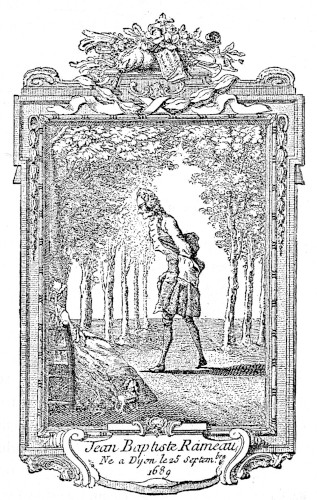
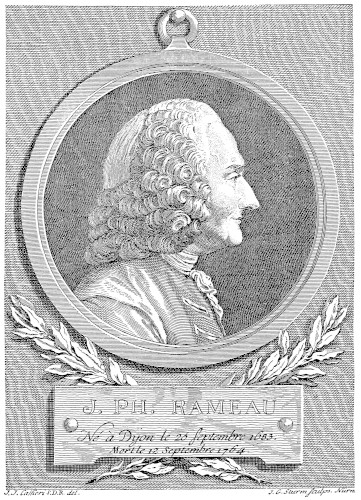
Rameau, out walking. Old engraving from the Nicolas-Manskopf collection, Frankfort.
“This battle was fought near Tutbury town When the bag-pipers baited the bull, I am king of the fiddlers, and swear ’tis a truth, And call him that doubts it a gull; For I saw them fighting, and fiddled the while, And Clorinda sung Hey derry down: The bumpkins are beaten, put up thy sword, Bob, And now let’s dance into the town. Before we came to it we heard a great shouting, And all that were in it look’d madly; For some were a’ bull-back, some dancing a morrice, And some singing Arthur a Bradley.”
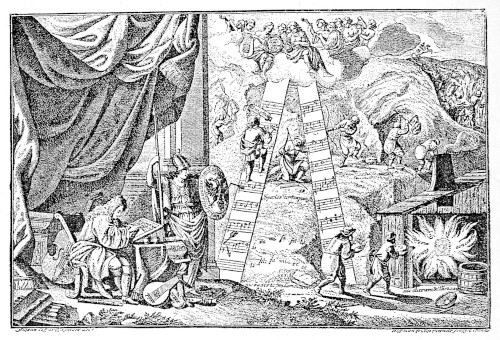
Old engraving after Wagniger’s design. The true musician is climbing up the Ladder of Contrapuntal Art ever higher and higher (see in the engraving the words plus ultra) to the Concert of Angels (legitime certantibus). From the “Basis and Fundamental Tone” the musical notes are being carried to the Gold-furnace (various flames in which are labelled, e.g. motet, canzonet, canon, etc.). The enemies are seen up above breaking the tritone, the false fifth, and the ninth; arrows are being shot at the Artist on the left as he writes (volenti nil difficile, “nothing is difficult to the willing mind”), but they are shattered on the Shield of Minerva, on which is represented the Austrian Eagle.
Scarlatti
Domenico Scarlatti, perhaps the greatest clavier-player that Italy ever had, prefaces a collection of thirty sonatas, which appeared at Amsterdam,[44] with the following words: “Amateur or professor, whoever thou art, seek not in these compositions for any deep feeling. They are only a frolic of art, intended to increase thy confidence on the clavier. I had no ambition to make a sensation; I was simply requested to publish the pieces. Should they be not utterly unpleasing to thee, I shall all the more willingly undertake other commissions, in order to rejoice thee in a lighter and more varied style. Take then these pieces rather as man than as critic; so only shalt thou increase thine own content. To speak of the use of the two hands—D denotes dritta, the right, and M manca, the left. Farewell!” It is noticeable how here in a few words the whole essence of Italian clavier-music is summed up—the fresh, cheerful disposition of the artist; the respect for the amateur; the pleasure in mere sound and in musical construction; the thorough working-out of intellectual motives (in the manner of the Étude); and the stress laid upon the equal participation of both hands as essential factors in the “concert,” [using this word in its older sense as expressing the association of two or more vocal or instrumental “parts”]. The word “concert” was well understood in these early days to mean the combination of two viols; and music of such a kind was, in form and in content, the true precursor of clavier-music, in which the right and left hand “parts” are strictly on an equality both in difficulty and importance.
These are the distinguishing marks of Italian clavier-art, and within these limits it works.
But Scarlatti is especially remarkable to us in the present day, in that he occupies the position of an early writer whose pieces still play a part, though a small one, in modern public concerts. Liszt, for example, was partial to him, and arranged his “Cat’s Fugue”; while Bülow edited a representative selection from his pieces. Czerny published (through Haslinger) two hundred of his so-called Sonatas—though, by the way, the last of these pieces belongs really to the father, Alessandro Scarlatti. Before that time the remains of the master had formed no inconsiderable part of private manuscript collections, such as those of the Abbé Santini in Rome, and others.[45]
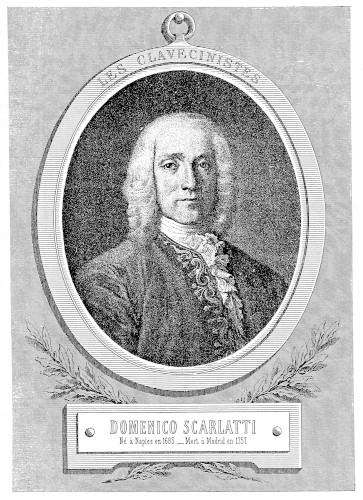
Domenico Scarlatti, the famous son of the not less famous Alessandro, who was a composer of operas and chief of the Neapolitan School, exhibits in old portraits a serious, severe, even pedagogic countenance. There is also much of the pedagogue in his pieces; yet I think him fresher, gayer, more happy in life and mind than this face would lead one to suppose. His “Exercises” move with vigorous strides, and are far too full of esprit to be pedantic. His life was that of an artist universally honoured, and rejoicing in his fame, a type of which his contemporary Handel is the model; and his biography reveals no less activity than his works. A pupil of his renowned father, in the midst of the volatile, melody-loving, easily-stirred Neapolitan world, he set out early for Rome, in order to become the scholar of the great theorist Gasparini and of the organist and clavier-player Pasquini. In 1709, at the age of twenty-six, he made the acquaintance of Handel at Venice, and in sheer admiration, followed him to Rome. There he remained ten years, and became kapellmeister of St Peter’s, gaining a reputation by the works of his genius. In 1720 we suddenly find him in London as clavicymbalist of the Italian opera. Here his “Narcissus” was performed. A year later again he was in Lisbon, where the King of Portugal made efforts to detain him, and where for a time he gave lessons to the Princess. At this time the fame of his playing and of his compositions reached the farthest bounds of Europe, and he ranked thenceforward as the first executant of the age. He returned again to Italy, and from Italy to Spain. He remained in Madrid from 1729 to his death in 1757. Here all kinds of honours were showered upon him; he was Knight of St James, and chamber-player to the Queen, who still retained a grateful memory of the lessons he had given her at Lisbon when she was Princess of Asturias. To her he dedicated his first-published pieces, prefixing to them the lively preface above quoted.
Italian music has to French the relation which Bull has to Bird, or the virtuoso to the poet. In Scarlatti we seek in vain for any inner motive, nor do we feel any need of an emotional rendering on the part of the performer; his short pieces aim only at sound effects, and are written merely from the love of brilliant clavier-passages, or to embody delicate technical devices. They are not denizens of Paradise, who wander, unconscious of their naked beauty, under over-arching bowers; they are athletes, simply rejoicing in their physical strength, and raising gymnastic to a high, self-sufficient art. We admire them, as we admire an acrobatic troupe of strong and stout character; we admire them—not too much, yet with a certain eager anticipation of the next interesting and unusual feat of skill. We wonder at their mastery of technique, and the systematic development of their characteristic methods; we rejoice that they never, in their desire to please, abandon the standpoint of the sober artists; but our heart remains cold. There is an icy, virgin purity in this first off-shoot[46] of absolute virtuosity, which kindles our sense for the art of beautiful mechanism, for the art of technique per se—an art which, after all, the historian of the clavier must not depreciate by comparing it with that of the inner music.
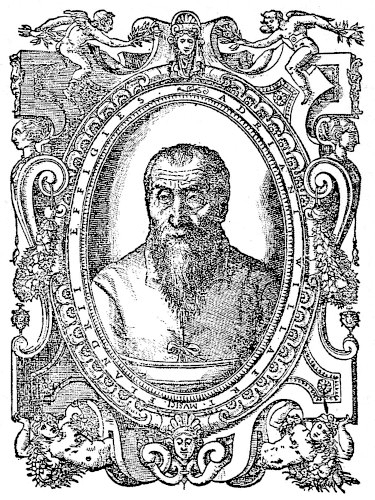
Adrian Willaert, of Venice, after the engraving published in 1559 by Antonio Gardano, Venice.
The Scarlatti style is a genuine product of the Italian musical emotion. The Italian is not born for heavy, contrapuntal, “vain ticklings of the ears”; nor, on the other hand, for too intimate effusions or symbolic mysteries. He is sensuous through and through; delight in playing and in sound is the very life of his music, as delight in outline and in colour is the very life of his painting. The intoxication of absolute tone runs through the masses of his churches, the operas of his theatre, the chamber-music of his salons. Delight in sound gave the impulse to every Italian musician in his bid for fame. It created virtuosity, which loves playing for its own sake; it created the dramatic choruses, with which the Venetian school began its career; it created the melody predominating over the harmony, with the discovery of which in the Florentine opera the greatest blow was struck for the new principles of “secular” musicianship. From love of sound the Venetians cast the instruments free from their old corporate unity, and gave them an individual meaning and value. From love of sound Frescobaldi led the organ, Corelli the violin, Scarlatti the clavier, to undreamt-of technical creations. And the bel canto of the human voice almost attained the capacity of an instrument; so small was the influence of the mere words. They were enamoured of melody, which, unlike the ecclesiastical counterpoint, sought its new objective not in the manifold transformation, but in the natural development of a motive: they were captivated with the “da capo” repetition of concerted pieces or arias, a habit grounded on the psychological law of the higher effectiveness of all repeated passages. They rioted in the multitude of forms, in which they found a place for every kind of music, for every “tempo,” every rhythm, and for all kinds of expression. Throughout all this was to be perceived the sensuous Italian love for music, which expressed in this manifoldness its freedom of artistic activity, and in that freedom the unity of thematic construction and consequently the unity of formal repetition.
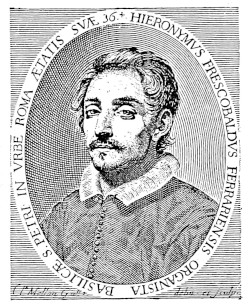
Frescobaldi.
Technical ability was appreciated in Venice earlier than elsewhere. The registers of organists at St Mark’s go back to 1318. In Venice not the office only, but the art, was honoured. The musician was not, as he was much later at Florence, interrupted by the ringing of a bell, if he continued his performance too long. The emancipation of artists, which in our own century we have seen carried out in the person of the orchestral conductor, was in Venice effected by the instrumental musician; and as to-day the orchestra has grown in repute by the agency of the conductor, so in those days the prestige of instrumental music advanced alongside that of the performer. At the beginning of the seventeenth century a Frescobaldi could already gain so important a position as player of the organ and clavier, that it was said that no clavier-player was respected who did not play after his new fashion. When he gave his first recital in St Peter’s, thirty thousand persons were there to hear him. What Frescobaldi was in the first half of the seventeenth century, that was Pasquini in the second half. In Italy, Austria, and France he was treated like a prince; and his tombstone bears the proud inscription, “Organist of the Senate and People of Rome.” With Scarlatti the art of clavier-playing reaches its height, and begins to decline. It is not clavierists but violinists, the wordless rivals of the singers, who have carried the type of Italian virtuosity into our own times—Corelli, Vivaldi, Locatelli, Tartini, Paganini.
This sensuous devotion to music apart from inner meaning, this passion for poetic beauty, the Italians have not yet, even under Wagnerian influences, wholly forgotten. The victorious rule of absolute tone, while it constituted their greatness, carried with it the germ of their decay. Virtuosity is the mark of their art and of their life. We must take them as they are, in the whole light-hearted temperament of their existence. This Bohemian type of the Italian musician of the time may profitably be compared with the similar French type. What a seductive brilliancy there is in the adventurous career of a Bononcini! His operas are received at Vienna with unparalleled enthusiasm. Queen Sophia Charlotte is the clavier-player at the production of his “Polifemo” in Berlin. In London he enters upon a contest with Handel, in which social intrigues are involved with high political aims. Next, he appears in a lawsuit, and is unmasked as a common plagiary[47] of a madrigal of Lotti’s; shortly after he is away to Paris with an alchemist, who swindles him of all his property, and leaves him to make his living by the sweat of his brow to his ninetieth year. Stradella’s fate is well known—how he ran away with the mistress of a Venetian before the first performance of his own opera;[48] was more than once attacked with a dagger, and finally actually murdered.[49] What, compared with this, is the story of Rameau’s youthful love and its punishment, and of his tardy attainment of the haven of fortune, or what the anecdotes of Marchand, with his love affairs, his expulsion from Paris, and his smiling return? The dangerous glitter of this Italian Bohemianism is the fitting framework of that sensuous, lively, irresponsible music.
It was inevitable that the Italians should invent the opera—the opera, in which every thing tends rapidly to the spectacular; singers, scene painters, musicians, and the public. Apart from its relation to opera all Italian music is unintelligible, and it is no accident that for centuries the Italians stood in the forefront of opera. Those lucky misunderstandings are well-known, which led, about the year 1600, to the rise of this form of art. A circle of Platonic dreamers (led by Giovanni Bardi, Count of Vernio) in Florence, anxious to revive the ancient tragedy, engaged certain musicians to compose monodic songs with accompaniment. They merely meant by this to be antique; but as a matter of fact they were unconsciously acting along the line of the most modern of needs, which had long tended towards isolated melody. The dainty and delicate songs, which took their origin in this, the Venetians, and afterwards the Neapolitans, accepted eagerly as a material on which to construct forms of ravishing virtuosity, until a Jomelli, with his dashing bravura passages on the most solemn words, finally arrives at that very “laceramento della poesia”[50] which the Florentine reformer Caccini had once fanatically combated as a madness of the ancient song in several parts. In a very short time the opera runs through the whole gamut of the joys and sorrows of virtuosity. The sweet charm of sound, exhibited by a voice which bears the melody, so suited to the narrow outlines of poetry, is found in the old vestal airs of Caccini and Peri. The delight in a multitude of forms, in an alternation of different rhythms in short portions of the aria, lived in the songs of the Venetian Cavalli, in which we are reminded of the alternating tempi of the old instrumental pieces[51]—the toccatas, fantasias, and canzoni. Yet empty vanity shows itself all too soon. The original simplicity was overlaid by various corrupt accretions, first by songs, introduced in loose dependence on the action, then by complete concerted pieces, which are indicated in the libretto—together with directions to tailors, architects, and decorators, and alongside of the titles and orders of the performers. In Naples, worse still, the music gradually declines into a stiff and wearisome form and sweet playful nothingness. The well-defined outline of the aria appears, now regularly written “da capo”; it alternates to a tiresome degree with the accompanied recitative; the chorus recedes into the background before the soloists. It is the old typical form, skilfully adapted to virtuosity, precisely as a sonata of Scarlatti is differentiated from a toccata of Frescobaldi or Pasquini. Originality is vanquished; elegance has created a set of formalities in which technique can freely exercise itself. The substantive style, so to speak, has given way to the adjective, and matter is conquered by form. This Neapolitan class of opera, which thus exalts the virtuoso, begins with Alessandro Scarlatti. He is the father of that species of art which is afterwards included in the name of Italian opera, in which we see a contempt for the words, a love of vocal bravura, the supremacy of the aria, and a delight in the human voice as an instrument. In the forms of his ornamentations we discover again in antitype the passages of Domenico; in his love of the da capo and instrumental repetitions of vocal phrases we see once more in antitype Domenico’s repetitions of shorter or longer groups of bars. In the “Alessandro nelle Indie” of the Neapolitan Leonardo Vinci the hero sings arias full of slurred “divisions,” syncopations, unprepared sevenths, which to a man acquainted with Scarlatti’s sonatas appear to bear a strong family resemblance to Scarlatti. Old rubbish bears germs of new creations; released from the heavy burden of the words, the light play of the voices in the clavier-pieces introduces a fresh, youthful life that is full of promise for the future.
The isolation of the voice and of the instrument, the sensuous delight in sound, demands a chamber-music and a chamber-style. Chamber-music demands the Maecenas of the great house, and the wealthy amateur, who is so powerful a factor in every advance of art. Roman musical life, for instance, draws its strength from the practical encouragement of the Pope’s, or from the concerts and operas performed in aristocratic houses. A Venetian nobleman, Benedetto Marcello, became a distinguished and favourite composer, a poet and a satirist. A Roman nobleman, Emilio dei Cavalieri, became the founder of the modern oratorio, an opera-composer of the advanced school, perhaps even the very earliest composer of vocal monody. Vincenzo Galilei, the father of the astronomer, became known by his monodies in that circle of Florentine Platonists, to whose worthy amateurism is due the origin of the opera; and he wrote a work on the technique and fingering of all instruments.
Music in the home is in Italy not too intimate, but proud, splendid, mere pastime. Like the opera of the virtuosos, like the secularised church-music, it tends to rely upon effect, and lives on applause. It depends chiefly on the performer, and knows little of the mutual intelligence of souls. A subtle aristocratic love of music runs through the Italy of the Middle Ages. Many are the names of high-born men and women who had mastered the art of the lute by ear—for a notation was as yet unknown.[52] In the Decameron (1350), alongside of the novel-telling, it is song, lute-playing, viol-playing, dance and choral refrain, with which that pleasant company loves most to kill the time.
The music of dances, songs, and instrumental pieces, which was soon to find its proper home in the clavier, is a child of the world, and, in the view of a serious theoretician like Pietro Bembo, it is exposed to all the dangers of emptiness and vanity. In 1529 he writes to his daughter Helena, who like many of the women in her position, intended to receive instruction on the clavier in her convent: “As to your request to be allowed to learn the monochord,[53] I answer that you cannot yet, on account of your youth, understand that playing is only suited for idle and volatile ladies; whereas I desired you to be the most pure and loveable maiden in the world. Also, it would bring you but little pleasure or renown if you should play badly; while to play well you would have to devote ten or twelve years to practice, without being able to think of anything else. Consider a moment whether this would become you. And if your friends wish you to learn to play in order to give them pleasure, reply that you do not wish to make yourself ridiculous in their eyes; and content yourself with the sciences and domestic occupations.”
A hundred years later chamber-music is at its zenith. The great Carissimi (d. 1674) put the flourishing chamber cantata[54]—that half-dramatic, half-lyric song of the seventeenth century—by the side of the monodic church-songs of Viadana; and Steffani added his renowned chamber-duets. The case was precisely similar with instrumental music; by the side of the “sonata da chiesa,” with its free and independent style, came the “sonata da camera,” as a suite of favourite dance forms;[55] and the “concerti,” with their several instruments playing to a small accompanying orchestra. Above all, the possibility is now realised of suitably accompanying monodies and concerted works on the clavier, from the figured bass; and this in its turn contributes not a little to the victorious advance of the melodic song. But as a solo-instrument, the clavier suns itself in the light of the chamber-style, in which brilliancy, dexterity of hand, and elasticity of form are not less admired than the many small and spirited caprices, which in the “grand” style of music have perhaps not yet been attempted.
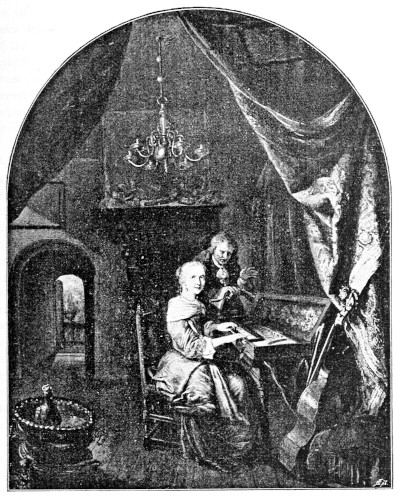
A Clavier Lesson. Painting by an unknown Dutch Master, 17th century, in the Royal Gallery at Dresden.
Among all the instruments of tone which achieve an independent existence in Italy, the clavier naturally takes its stand last. From its first movement towards this independence, in Venice in the sixteenth century, to the full liberty of a Scarlatti, stretches an interval of a hundred and fifty years. It was in fact partly too much occupied in the orchestra, and partly too dependent on the technique of the organ. We find it already in the orchestra in the first operas of Peri; under Monteverde, the first of all great orchestral geniuses, there were two claviers, on the right and left of the stage. They serve to accompany solo singing, or, along with small organs, to fill up the harmony of the orchestral body. As a rule the operatic composer writes only the figured bass, but occasionally adds some of the melodic voice-parts; the conductor completes the score, leaving to the several players, however, a certain freedom of improvisation in colouring, a freedom which a well-trained musician would not abuse to the detriment of the tout ensemble.
But clavier-pieces pure and simple had a characteristically dependent existence. Even in that Venetian circle where Willaert (1490-1563) Gabrieli,[56] and Merulo moved, in which instruments were first emancipated, in which they were boldly introduced into church-music, and solo-pieces were written for orchestral or for keyed instruments, even here the soul of the clavier lay still fettered. It is the organ that indicates colour and takes the lead. In the pieces of the two Gabrielis, or of Merulo, the old contrapuntal, pictorial fashion lives still almost untouched by external disturbances; and the picture seldom allows us to anticipate that stiff adherence to the theme, and that well-wrought harmony which, in the England of the same age, we found so full of promise. Down to the time of Frescobaldi, organist at St Peter’s in 1615, who stands as a landmark in this development, the Italian sense for absolute music is far too strong for an “applied” music to be able, as it did in France and England, to modernise the instrumental pieces by their necessary dependence on song and dance. Canzoni[57] are treated in a light fugal style; the so-called Ricercari[58] represent another and freer fugal form; the toccatas, capriccios and fantasias are variegated attempts to unite all tempi and all kinds of playing in one piece. The composers are aiming at typical forms, and only attain an unrestrained formlessness which all these pieces with their trifling differences alike exhibit. The juxtaposition of chords, successions of canonic imitations, free alternations of tempo, piquant applications of the newly-discovered chromatic possibilities—all these interest these writers much more than character or expression. All these ricercari, canzoni, fantasias, toccatas, are alike “sonatas”—pieces which exist for the sake of their tones and technique, and, as Couperin says, not in the least for the sake of their soul or content. Dance-suites and variations on songs, which as time went on gained in popularity, sharpened, here as elsewhere, the sense for form; but these never became the predominant class. The free form of the fantasia always ranked as the principal species of the higher clavier-pieces. In Frescobaldi we already see the process of crystallisation. His canzoni and fugues not only exhibit for the first time the good fugal style familiar to us, but also betray the modern sense for arrangement and method in their frequent division[59] into three movements, and in their progressive quickening of tempo. He it is also who reduces under a distinct law of arrangement the various movements of the whole instrumental fantasia.
With Pasquini in the second half of the seventeenth century, we meet the visible line of demarcation between organ and clavier. Hitherto the organ had been in everything the predominant partner. The whole aspect of the clavier-pieces was that of the organ. The old Venetians had frequently written for it in three or four parts and brought the instrument into popularity. But even Frescobaldi had written no piece for clavier alone. Diruta, organist at Chioggia, the pupil of Merulo, wrote a dialogue between 1597 and 1609 on the best method of playing organ and clavier, and had of course drawn attention to the characteristic features of clavier-playing; but all his observations on holding the hands horizontal,[60] on the good and bad fingers (the second and fourth are the “good,” and fall on the strong accents of the bar), or on the ornamentations and their execution, are in the first instance written with reference to the organ. Indeed, he actually begins his book with a panegyric on that instrument. As a matter of fact the true emancipator of the Italian clavier was Pasquini. He wrote for the clavicymbal alone; in his figures and style of play he thus early showed a genuine sense for the clavier; he abandoned the practice of setting chord passages and runs in close juxtaposition, but elaborated out of the two the proper clavier style; he brought into strong connection with a theme the quicker and slower parts of his sonatas, and set them clearly over against each other; and he attempts, as in his Capriccio on the motive of the cuckoo’s song, to draw from the clavier all kinds of characteristic effects, still wild and confused, but full of the freshness of spring.
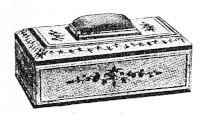
Virginal in shape of a work-box.
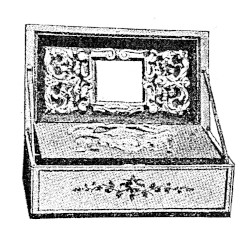
The same opened, showing the instrument within, which can be taken out.
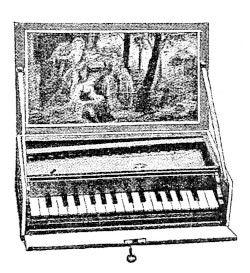
The instrument taken out. Constructed in 1631 by Valerius Perius Romanus. De Wit collection, Leipsic.
So far is the early Italian clavier (when the violin begins its victorious career) from assuming a leading position, that the cembalo can do nothing better than make use of the experiences of the violin. For we must give up the legend of the genius of Michel Angelo Rossi. This story is one of the most amusing freaks of musical history. We find in many popular collections of old music an andante and allegro in G major by this man, who is tolerably well known as an operatic composer and violinist. He was a pupil of Frescobaldi and died in 1660. This piece is so captivating in its melody, so decided in its form, so restrained in its arrangement, that it would have done honour to Mozart. Had these pieces truly sprung from the intavolatura of Michel Angelo Rossi, the modernity of their form and melody would give such a shock to musical history that it would be shivered into fragments. Yet a man like Pauer, who published them, could actually believe that this music was possible before 1660.[61] A later historian, Rolland, in his “Histoire de l’Opéra avant Lully et Scarlatti,” led astray by the same mistake, fancies he detects in the choruses of Rossi’s opera of Hermione anticipations of the Zauberflöte.[62] Parry alone, the author of the brilliant article on the sonata in Grove’s Dictionary of Music, has boggled at this pseudo Rossi. Heaven knows to whom the pretty little pieces really belong. It is not unlikely that Scarlatti wrote them in his old age.
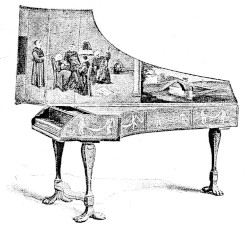
Italian cembalo, from a monastery, of the 18th century. Made of cypress wood. The pictures on the lid represent a concert of monks and a landscape. On the sides of the case are Cupids and garlands. De Wit collection, Leipsic.
The thematically precise sonatas and concertos of Corelli, the old violin master; the pieces of Vivaldi, so wonderfully rich in melody; the intellectual suites of Locatelli; it is in these violin works that the form of the Italian instrumental piece first appears, deriving itself from the joint experiences of the free toccata and of the fettered dance. Corelli, who died so early as 1713, was one of those strange phenomena in the history of art, which reach the utmost heights of an epoch, without freezing into an icy classicism. His pieces are even to-day of a ravishing sensuousness, and must be produced in the flowery dress of an improvised coloratura.[63] They mark the highest point in the monodic style of the virginal Italian music. From the point of view of melody they are the freshest dances and arias written about 1700, full of unparalleled invention and of a rhythmical freedom which anticipates the scherzi of Beethoven. They are indeed the works of a genius in form. But they never stiffen into one shape, like the operatic overtures.[64] In Corelli the sonata still stands in the full bloom of its manifold forms. Among his numerous pieces there are not many which exhibit precisely the same arrangement of the movements and of their tempi, or of the various dances. Even the number of these movements varies, so that one can lay down no precise rule. Slow movements begin, or stand in the middle, or come at the end; or even, with a modernised reminiscence of old times, introduce themselves for a few bars[65] between the allegros and the vivaces. This is, from the point of view of form, the same rhythmic freedom which Beethoven, on deeper material grounds, reintroduced in his latest sonatas and quartets. All is held together by an ornamental, delicate, and thematic filigree-work. More rarely, as in the fourth Sonata da chiesa and in the fifth Sonata da camera, a certain thematic relation between the several movements is to be detected; but within the movement the thematic conception is so worked out that it is treated with natural modulations and appropriate intermediate passages. The movement falls into two parts which are repeated as a matter of course; the second part begins with the modulated main motive of the first. Occasionally, as in the allemande of the tenth concerto and in the allegro of the twelfth, we find an exact return to the first theme. This combination of the da capo system with the modulation of the theme; and in the midst of this the miniature da capo system of the concerted violins imitating each other; and especially the favourite concluding repetitions of bars, alternating from forte to piano,—all these became the groundwork of the Scarlattian style.
The da capo is in fact the scaffolding of this formal music. To our modern minds it appears pointless; but in those days it was natural enough. Some day the history of musical repetition ought to be written; it would be indeed the history of quite half of music. Even in Greek writings we meet melodic repetitions; it is on the principle of imitation that the contrapuntal style of the Middle Ages[66] is built; from the repetition of parts, or the rearrangement of the themes, musical sentences become capable of new effects; and further, there was the germ of progress in the thematic conception of whole bars, whole groups of bars and whole movements, which finally, whether arias or sonatas, were taken da capo. This is the last step of thematic music which has shaken off the contrapuntal forms. To-day we are in a period of repetition which, for want of a better word, we may call “Thematic.” In dependence on the old beginnings of programme-music, which were greatly developed by Beethoven, the new subjective repetition takes the place of the older. This new form works chiefly in the idée fixe, in the Leit-motiv, which is subtly treated and varied according to the situations represented. Founded deep in the essence of music, the principle of repetition has at all times been an ever-changing, ever re-incarnating characteristic of the condition of the tonic art.
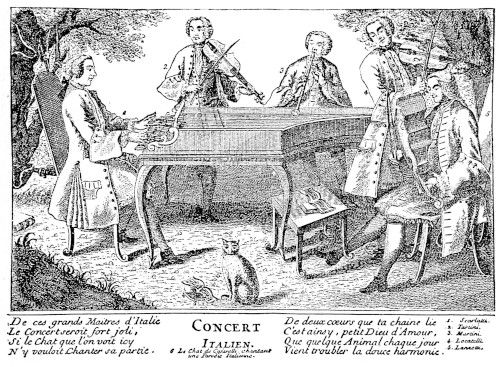
Old engraving representing Scarlatti playing a Harpsichord with two rows of keys; and certain well-known contemporaries of his. A satire on the unheard-of successes of the famous Italian Soprano, Cafarelli. From the Nicolas-Manskopf collection, Frankfort-on-Main. Cafarelli’s cat is sitting in the foreground singing an Italian parody. The persons represented are named on the right. The two verses are as follows: “The concert of these great Italian masters would be beautiful, if the cat did not join in. Just in the same way, the sweet harmony of two souls joined by the god of Love is constantly being interrupted by some animal or other.”
It gave to the Italian sonata of its time the same character of unity which the rhythm of the dance gave to the French clavier-piece. But, before the separate movements could reach their full formal development, the emancipation of the thematic subjects from counterpoint, and their absolute self-dependence, must be completed. The Italian ear, from its mere pleasure in motive and its development, released the subject from obligatory contrapuntal treatment. From the old thin forms of toccata and capriccio sprang fugal exercises with poor and limited themes, to which, so early as 1611, the old Francesco Turini gives the sounding title of sonatas. They are full of the passages associated with solo-instruments; they sound with flexible melodies; they run off in the measured steps of the dance, and circle round with repetitions of motives, groups, and movements. The point which a Rameau, in his “Cyclopes,” attains by an extension of the rondo-form—perhaps under the gentle influence of the sonata—is reached by the Italian by formalising the free fantasia, under the influence of the dance. It is form at which everything on all sides aims.
In Scarlatti’s sonatas we have very rarely more than one movement; the two-movement groups of the sonatas, numbered by Czerny 122 and 123, are exceptions. The pieces might be combined into sonatas on the Corellian model but for the lack of slow movements, which Scarlatti did not willingly write for the brilliant and spirited clavier. The structure of the movements displays that perfect freedom which still reigned in that springtime of the age of musical form. If we are so inclined, we may often detect, as in the prototype, a[67] first and a second theme; but the signs of this later form of the typical sonata are still so hidden that in many pieces we might, with equal justification, detect five or six themes in the more melodious or decorative passages. All is in transition, but the thematic conception is never left utterly in the background. The motives come out in apparently reckless profusion, but scarcely one remains without its adequate treatment. We observe all possible arrangements. Sonata 110 has a perfectly incongruous middle movement; in Sonata 111 a moderato alternates with a presto, and both are repeated in fuller elaboration. On the other hand some sonatas preserve throughout the same rhythmical movement. As a rule the second part of a movement concludes like the first, but in a different key, just as it began like the first, but again in a different key; or sometimes Part II. begins with some different motive from that of Part I., or even with one absolutely new. Usually the beginnings of both parts are somewhat stiff in their thematic, while their later course is usually more free. The development of a main motive—which in later times begins the second division of a movement in sonata form—is as yet confined to no definite part. Not rarely it is despatched in the first part, as in Sonata 169, where the dactylic-trochaic motive is so taken up, more or less decidedly, in the first part, that only the very briefest reminiscence is left for the second. The general construction is well illustrated in the eighth sonata—runs of five semiquavers (sic) in A minor[68]—a fugal movement proceeding in crotchets, diatonically rising and chromatically descending—groups of diminished sevenths descending to C—conclusion, the semiquaver motive again. Part II.: the latter motive modulating from C, through G minor to D minor, with an insertion of the former figure in crotchets, developed as in the conclusion of Part I., and returning from D minor to A minor.
Formal structure is the be-all and end-all of the Italian sonata. Technique is its very life. An inexhaustible brilliancy and exclusive adaptation to the clavier is the characteristic of Scarlatti. He has in his eye the thousand possibilities of clavier-technique, and throughout his pieces there breathes a glow of enthusiasm which draws us easily from beginning to end with the sweet grace of an irresistible rhythm. The successive retardations, as in the arias of his father Alessandro’s Rosaura, the changes of hands, the rivalry of concerted violins, the delight in passages of quavers with thirds and sixths as their harmonic accompaniment, such as is seen in the pieces of Corelli, long-sustained notes with sudden leaps which seem to be derived from the violin—all this is yet treated from the point of view of the clavier, and, so to speak, new-born from it. There is little song in Scarlatti, and a singing phrase is preferably repeated with brilliant decorations; for the leggiero is much better adapted to the spinet than the arioso. As a rule, both hands roll on in a two-voiced exercise in pure and simple movement without any additional encumbrance of heavy harmonies. It is a spectacle of fireworks. Deep bass-tones are suddenly introduced; high thirds fly off; thirds and sixths are darted in; close arpeggios swell into monstrous bundles as they are filled in with all possible passing-notes; octaves are vigorously introduced; the hands steer in contrary motion, to one another, away from one another; they are tied into chains of chords; they release themselves alternately from the same chords, the same groups, the same tones; unison passages in the meanwhile run up and down; chromatic tone-ladders dart through, then slowly moving phrases or still-standing isolated treble notes are seen confusedly dotted over the changing bass as it runs up and down, in a kind of upper pedal point; harsh sevenths one after another; repeated notes, syncopated effects, parallel runs of semiquavers with leaping side-notes, such as we know so well in Bach; sudden interchanges from major to minor, a device of which the Neapolitan operas are so fond; bold characterisation by means of sudden pauses; startling modulations by means of chromatic passages; embellishments rarely introduced; a delicate arrangement of tones from the severest fugues to the most unrestrained bourrées, pastorales, or fanfares—such is the world of Scarlatti’s clavier-music. The “plucked” clavier (clavichord)[69] as yet does not admit of the delicacies of touch[70] which delight us in the pianoforte; and its technique, too, will have to consider the three main problems—how to arrange the musical conception in the light and lively style suitable to the clavier, how effectively to combine the two hands, and how to use the opportunities which spring from the divided movements of the single hand. These three problems—what the fingers can do, what the hands can do, and what the clavier can do—are solved by Scarlatti with all the readiness of his Italian temperament. His style luxuriates in the liveliest crossings of the hands—a practice he is said to have diminished as years increased his bodily dimensions; and his ideas blossom out into a captivating, often eccentric freshness, as, for example, in his fugal theme G, B♭, E flat, F sharp, B♭, C sharp [D] (ascending), which he has taken as the foundation of his best known and perhaps most splendid composition, the Cat’s Fugue. Legend indeed asserts that these boldly combined tones were suggested to him by a cat gliding along the keyboard.
The most distinguished names of those who have laboured with success at the Italian clavier are those of Alberti,[71] whose preference for the skilfully broken chord-accompaniment has given rise to the title “Alberti Bass”; Durante, who was dry, calculating, and destitute of emotion; Galuppi, the graceful and courtly; the somewhat superficial Porpora; the subtle Paradies; and Turini, who is by far the most brilliant of all the Italian inheritors of the mantle of Scarlatti. They take two or three movements for a work; they combine dance-pieces and sonata-pieces; they pursue new melodic and rhythmic graces; but they all group themselves around or after their hero, Domenico Scarlatti, who, as first and greatest, has ushered in the pure Italian delight in sound as voiced by the clavier.[72]
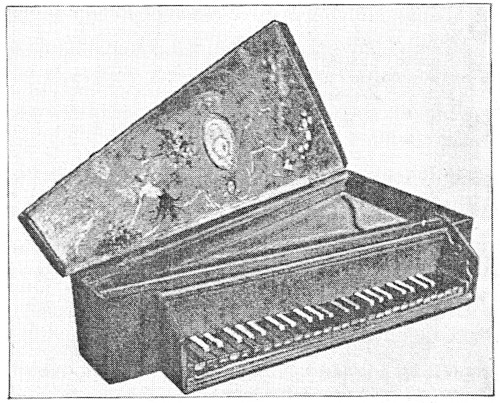
An Octave Spinet (tuned an octave higher than usual). 18th century. De Wit collection.
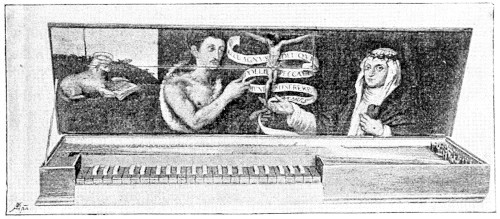
German Clavichord, 17th century, “gebunden” (explained on page 22). De Wit collection.
Bach
In 1717, when Scarlatti as yet dreamed not of his Spanish renown, and shortly after Couperin’s first little pieces had appeared, the Parisian clavecinist Marchand made a journey to Germany. At the Polish court of Dresden he created a furore by his playing, and a famous contest was the result, got up, as it appears, by intrigue, between Marchand and an organist of Weimar, Johann Sebastian Bach. The King was present in person. Marchand began by improvising variations on a French song, and was loudly applauded. Bach then took the same theme, but varied it twelve times over so marvellously that without further contest he carried off the palm from his famous adversary, who, when Bach proposed a competition on the organ, incontinently fled from Dresden.
Who was this Bach, and what was this sudden development of German music? Hitherto not much had been heard of it in foreign countries, and on looking at the German tablatures[73] of the older time one could only recognise an honourable but somewhat clumsy struggle. In the sixteenth century, perhaps when, in wider circles, some mention was made of the great vocal compositions of Isaac and Senfl, a certain Nürnberger, Hasler by name, proposed himself to Gabrieli in Venice as a pupil, and later his renown was heard at the courts of Vienna and Dresden. In the next century another German, Johann Jakob Froberger, was associated with Frescobaldi in Rome, and his fame also was afterwards heard at the Viennese court. He cannot have been unpopular, for a number of anecdotes clustered round his name. Froberger, and with him Pachelbel of Nürnberg, began the emancipation of the clavier in Germany. In the Hanse Towns of the north were good organists, such as Buxtehude in Lübeck and Reincke in Hamburg; but no one in Italy or France troubled himself with them.
The fame of Italian sonatas and French suites was such a matter of course, that the Leipzig organist, Kuhnau, when he in 1700 published his collections of genuinely German clavier-pieces, plumed himself mightily, in his chatty prefaces, on the fact that now at last, even in Germany, good music was to be had, which could take its place by the side of the foreign. “Even in Germany,” he exclaimed, “oranges and citrons at last bloom!” The excellent Kuhnau ventured to give the title of sonata to a piece on the model of the Italian sonata da camera, although it was written not for violin but for clavier. Hence it is often said that he was the creator of the clavier-sonata. But this piece has nothing in common with the later popular composition of that name; it was a cento of several movements in various tempi, as the suite was a cento of several dances. Nay, the Cyclopes of Rameau stands nearer to the later type than this. The suites and sonatas of Kuhnau are pure clavier-pieces, somewhat marred by the usual failings of youth, and running every theme to death, but clear, vigorous, and adapted to the fingers, smooth in feeling and modern in technique. But the most curious work of Kuhnau is his “Biblical Histories.” Here he illustrates on the clavier all kinds of Scriptural stories, like the death of Goliath, the cure of Saul, the marriage of Jacob, Hezekiah’s recovery, the life of Gideon, and Jacob’s death, in sonata-form, on the model of the programme-music[74] of the time, and with the assistance of verbal elucidations. Yet Kuhnau is as little as Froberger or anyone else a forerunner of Bach, who so overshadows the work of his predecessors that one may almost say he is independent of them.
It is indeed hard to compare Bach even with the other wonders of the history of art. For there is scarcely one who is so identical with his art as is Bach with music. A Michel Angelo does not include a Rembrandt, nor a Rembrandt a Monet; but in Bach there is a Beethoven, a Schumann, a Wagner. I believe that if the Almighty had wished to offer to men in sensible form what at that time was called music, he would then have given them the work of Bach. In it there are the deepest secrets of musical polyphony, as well as the most intense degrees of decadent expression; the mysticism of the Middle Ages is there no less than the perspective of the future. But content and form are not dissociated as they are in history; they are identical, they are one and the same, as they are in the philosophic concept of music. Once, and perhaps once only, in this world has the “Thing in Itself” been realised, and the difference between concept and actuality been reduced to nothing. The history of music can be written with almost exclusive reference to Bach. We might show how it has converged towards him and again diverged from him in search of its special partialities. We might point out how it revolves round him, comes to him, and goes from him in the course of the centuries, just as in the case of the imitative arts we show that they come from Nature and go to her.
Bach’s life was the most uneventful conceivable. He made no journeys to Rome and Paris; he learned musical literature by studying and copying. A true “Old Master,” he sits with his serious, almost severe countenance, in the midst of his large family of twenty children, all musical, and composes for instruction or for his own pleasure, without seeing many of his compositions printed. His renown had no wide extent;[75] his bold extravagances aroused only that hostility which does not bring honour, and in his successive posts at Arnstadt, Weimar, Köthen, and Leipzig, he had little opportunity for sunning himself in the rays of princely favour. A single moment of his life perhaps stands out prominently, when Frederick the Great at one of his concerts received the list of strangers in Potsdam, and interrupted the playing to say to his officers, “Gentlemen, old Bach has arrived.” He was instantly summoned, and, in his travelling dress as he was, improvised on a theme of the King’s, which, when completed and published, he dedicated to the King as “Musikalisches Opfer.” When two great men meet, the whole world feels the electric shock.
With the appearance of Bach the whole history of music turns to Germany. And clavier-music, so far as it has a particular meaning, is henceforth German. England, France, and Italy, sink either gradually or suddenly into the background.
Bach’s clavier-music is a complete world, a mirror of his music as a whole. As Nature is her whole self in every leaf, so in every piece or group of pieces Bach is the whole Bach. Thus for the first time it came about that the clavier became capable of interpreting the whole nature of a great man. With the early Englishmen it was the embodiment of the whole tone-poet; with Couperin the whole man, indeed, but a man who was nothing but a dancer; with Scarlatti a whole clavier-player; but with Bach the whole nature of a man of whom it is impossible to say whether the musician or the intellect in him was the greater. This was the first outstanding peak attained by the clavier.
The natural creative principle from which Bach works, that which gives unity to his being, is the conception of counterpoint. Music can be written in which every single voice is treated as an independent line, and in which the art of combining these lines reaches the highest possible development, as in a picture of Holbein—and this is counterpoint. Or music could be written, in which an upper melody, clearly illuminated, runs on an advancing basis of accompanying harmony without much attention to purity of voice, as in a work of Ribera—and this is the style resting on “accompaniment.” Bach’s essence lies in the contrapuntal method. He conceives the voices over against one another; and at the very moment in which he interjects a motive, there is a second or third motive introduced, embracing the other in contrapuntal wise.
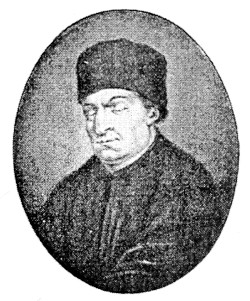
Konrad Pau(l)mann, the first German writer for keyed instruments, blind. Died 1473. After a modern drawing by Wintter.
Yet he has taken the accompaniment-style also into himself. Just as little as he can ever be censured for defect in melody, so little has he ever neglected the newer “secular” harmony—rather, he has carried on his counterpoint in accordance with its laws. He has of course as little respect as any other first class musician for the common Italian accompaniment with its singing melody alone. If he adopts it, it is in very discreet fashion; the richly decorated arioso soaring above the vigorously moving basso continuo in such delicate arrangement that we think rather of an ornamented contrapuntal passage than of a light singing voice accompanied by the cembalo with figured bass.
In this secularisation of counterpoint by means of the contrasting features of an arioso, the foundation of a bass, and the modern system of a network of harmony, he exhibits the characters of both musical styles in one, and gives us the unification of two epochs, which necessarily opened a boundless prospect into the future.
Two or more voices running alongside are treated in their relation to one another. Here the simple contrapuntal exercise, which sets them neatly together, and enfolds their rhythms into each other, will soon cease to satisfy. The best-sounding contrapuntal relations are those in which the voices show some slight traces of imitation. From the lighter imitations rises the stricter canon,[76] and at last the exact and regular succession of canonic repetitions is reached. The ideal is then an exercise in which every note of every voice has its imitative relations, and in which the whole is so interconnected that not a stone can be removed without bringing about the fall of the whole structure.
We see Bach himself at this work. He works more lightly and elegantly, or more heavily and massively, not by arbitrary choice, but according to his subject. He begins with a Prelude, in which a gentle interlacing of voices answers to his mood; imitations, arising as if of their own accord, are inserted here and there. Then there is the final gigue of a suite, in which a rapid 6/8 theme has to be treated, in spite of its rapidity, with a certain canonic severity, which gives solidity to the conclusion of the whole suite. Then again we have a slow movement of intertwining voices, such as is found after the first preluding bars of the F sharp minor and C minor Toccatas; the voices alternately take up the mournful themes, with no strict regularity of exact succession, wonderfully floating, according to a fixed purpose, and gently swimming in their harmonies, with no recognisable support, almost a fairy-like echo of mediæval counterpoint. Or, finally, there is a regular fugue, which stands there like a monument, with hardly a superfluous note; in regular succession the voices present the theme in single or double counterpoint, always alternately imitating at the fourth or fifth, with a never-failing reference to the tonic key; and near the close, where still greater closeness of imitation is demanded, proudly and stiffly vaulted over with diminutions or augmentations of the theme.
Bach has left us clavier-works in which we see perfected the simplest form which the contrapuntal conception could assume in his hands. These are the fifteen “Inventions” and the fifteen “Symphonies,” which in the manuscript appear with the inscription, “Straightforward directions, by which the amateur of the clavier, but especially the one anxious to learn, is shown a plain method, not only of playing properly in two parts, but also, on further progress, to undertake three obbligato parts; at the same time also not only gaining good inventions, but also personally performing them, and, above all, attaining a cantabile style in playing, as well as a good foretaste of composition.” This curious preface ends, “Verfertiget von Joh. Seb. Bach, hochf. Anhalt-Cöthenischen Capell-meister, Anno Christi 1723.”
The simple homeliness of the time speaks in this title-page; and it is well to appropriate to-day as much of this as possible, in order to lose nothing in the enjoyment of these fifteen two-voiced Inventions and these fifteen three-voiced Symphonies. Even to-day Bach demands the desire of learning in amateurs, who should feed their pleasure with diligence, and enter into the feelings of the composer. One who sits at the clavier with a zeal worthy of Bach’s compositions, will find in these thirty simple contrapuntal pieces a small storehouse of treasures. He will be captivated by the elegance of this canonic music as soon as his fingers are able to play in parts; but he will never be released from the influence of the many-coloured glittering character of these compositions. They are the drawings of a master, which in a few strokes depict great objects; sketches of a great artist, so full of scholarship that they cover the whole of life. The solemn Invention in F minor, the eccentric one in B flat major, the Symphony which sounds so mournfully in E flat major, or the chromatically gloomy F minor, the sprightly staccato G minor, the graceful A major whose traces are to be found in so many works of a later time, and the rhythmical, freely-singing B minor, with its harp-like strokes, in which Beethoven and Chopin, yet unborn, seem to meet—these pieces were then unique in literature, and still remain so.
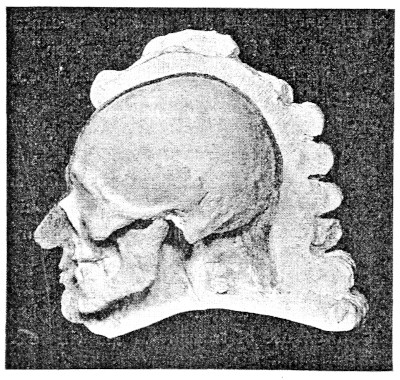
Skull of Sebastian Bach, with Seffner’s modelling of his features.
In these fantasy-pieces the fugal conception is dealt with on a small scale; in the Toccatas on a large scale. The clavier-toccatas of Bach are free pieces of that wonderful many-sidedness of construction which a music might still possess that had not yet stiffened into conventionalism. When we sit down to play the Inventions and Symphonies, we point our fingers as if for miniature work. But when we sit down to the Toccatas, we dispose our arms and hands, as would have been said in Bach’s time, “in einer gewissenen grossartigen Freyheit,” with a certain large freedom. These Toccatas will be eternal favourites, because of their air of improvisation which develops the fughetta out of the preludic movement, and scatters the playful, pleasant technique in the midst of the severities of imitation. Inexhaustible in the apparent formlessness of their form, they stand on the threshold of modern literature as the great models of that true clavier-style which will always have a touch of the extempore as one of its characteristic features.
In the Toccatas it can be seen how Bach permits his fugal conceptions organically to grow. It is in them that we see the psychology of the fugue more purely than in the strictest formal fugal movements. Take, for example, the F sharp minor Toccata. Here the fingers preludise over the keyboard, gradually growing slower, the passages differentiate themselves into motives, which gently imitate each other, until at length they come to rest on a solid bass. This is the moment of lyric inspiration; and the soul sighs itself out in a slow movement, which weaves itself in fugal style, speedily sweeping forth in its own free, harmonious woven-work. A staccato-motive breaks in; rolling semiquavers soon crystallise around it; it grows and swells in a three-voiced fugue; loosens itself, becomes lighter, and passes off into an operatic joyousness, circling round in repetitions, which to us seem almost too wide for the narrow significance of this motive. A pause, and in the new-won freshness emerges the first chromatic adagio-motive as a lively floating fugue, soon breaking forth into four voices, and ending in a stirring finale.
Take the D major Toccata. Here there is a joyous prelude of ascending scales, running off in chords and tremoli. An insertion of a fresh capriccioso motive follows, which pursues its course mingled with playful figures. A pause in adagio; mournfully moving melodies, freely accompanied by tremoli; softly passing over into a quiet three-voice fugue, which again leads to preluding passages, speaking recitatives, broken chords, till the great wild hunt of triplets surges in its fugal power. This D major piece is in content and technique Schumann all over.
Similarly, one easily recognises the development of soul in the solemn C minor Toccata, which is dominated almost throughout by a charmingly-constructed fugue; or in the D minor Toccata, with its stirring and beautiful adagio-movement; the G minor with its bacchanalian finale; the rapid G major; and the never-to-be-forgotten E minor with its clearness and restraint. They are all built up on an inner meaning, and show a grandeur in their intimate nature such as only Beethoven has dared to express on the clavier, and a soulfulness never surpassed by a programme-musician in our century in his own style. But the fugue has in them become the indwelling soul, and the whole speech of music has absolutely ascended into their form. We see it come, grow, and depart.
One who has investigated the psychology of Bach’s fugue in the Toccatas, will no longer fail to recognise it in his pure and absolute fugues. A fugue of Bach—this sounds to the lay musical ear as the very sum of all that is academic. But in reality never were fugues written which were developed less academically, or which flow so entirely from the soul. Only take the fugal form not as the end in itself, and not as a mere example of musical architecture—only take pains to discover the spirit of its unfolding—and we shall be astounded at the endless variety of the inward musical life which is profusely showered into this form. The essence of a fugue of Bach is just this freedom from all architecture, this suppression of all calculation in favour of the spiritual development. The fugal form, that well-known series of enlargements and arrangements of the pure canon, is to him a prime datum, from which, nevertheless, he has formed no unbending principle. But he works with this material in such a way that he keeps the development of a piece always subordinate to the character which the fugal theme imposes on him. The theme is the title, the piece the contents.
His genius reveals itself in perception of the thousand possibilities of unfolding which lie in his themes—some advancing diatonically, some studded over with pauses, some with sudden stops on sevenths, some marching on in massive choral style, some humorously staccato, especially those with startling false accents, others drawn in large outlines which excite curiosity and scarcely stand forth in their clear rhythm till the ninth or tenth bar, and which he was so fond of because they gave the strongest stimulus to the coming development.
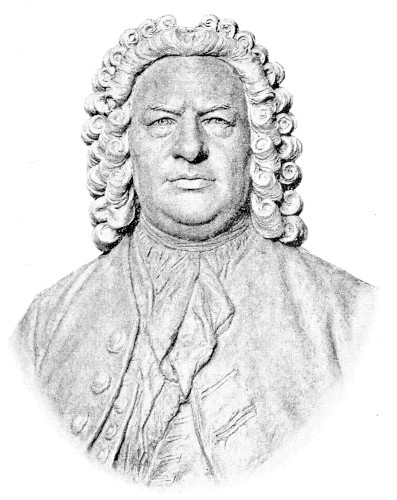
J. S. Bach.
Bust by Carl Seffner. Modelled on the actual skull. After His, J. S. Bach (Vogel, Leipsic).
Let the “layman” accustom himself not to be frightened by fugues. The fugue in the grand style of Bach, constructed with that unparalleled art which the first C major fugue in the “Wohltemperiertes Klavier” displays, or which is shown in the C sharp minor fugue, with its three themes gradually stratified one above the other, or rolling themselves off with that extraordinary ease which we daily admire in the famous A minor—this kind of fugue is a necessary speech of music: it is melody, it is a natural language which can never disappear. To grasp it, to assimilate it, until the many voices or even many themes of its development stand clearly before our eyes in their full characteristic value, is a feast for the musical epicure to which hardly anything else can be compared. Bach’s fugues are playable. They are not too easy; but they are so in the spirit of the clavier that the fingers soon lose their timidity, and the work is as a mirror in which they speedily recognise the necessary nature of their motion. And there is an eternally fresh animation in this activity, in which no deception, no dilettantism, no superfluity can exist for a moment.
The great artist, to whom the “Fantasy” is a presupposition, does not work on it, however much it may seem to the crowd a chief aim; he works on the form which requires this kind of work. We see Bach, through his whole life, labouring at the fugue; and the encyclopædic work, in the midst of which he died, “The Art of Fugue,” shows us heights of power in this form which make us dizzy. Besides certain scattered fugues, he has made a collection of different periods in the two volumes of the “Wohltemperiertes Klavier.” Here every major and minor mode of every semitone is doubly treated, with a prelude and fugue—a comprehensiveness of arrangement which was partly due to the taste of the time,[77] and partly can be referred to the secondary aim of the work, which was the introduction of a system of clavier-tuning which should be sufficient for practical purposes, in which no acoustic solecisms should be committed to suit convenience, and in which all the keys should be used indifferently and in their completeness by pupils. It is not hard to detect that the unity of these two volumes is not very complete. Even Spitta, a meritorious but somewhat tasteless biographer, who seeks to find the “higher” unity in all Bach’s works, is compelled to grant that there are varieties of style and intrusions of alien matter in the “Wohltemperiertes Klavier.” But that is no loss. The brilliant many-sidedness of its contents can support even this discontinuity of style (which, by the way, is but a slight discontinuity) and this artistic fusion of certain preludes and fugues, which originally were not composed with a view to each other. No one will fail to perceive how wonderfully the preludes combine with each other and with many of the fugues. The whole, perhaps, gains something of the character of the old composite epics, such as Homer or the Bible. Bach’s autograph of the first part bears the date 1722; there is no complete autograph of the second part, and this Bible of clavier-playing was first printed in 1800, two or three generations after its production.[78]
If we look at the original editions of the six works which were printed in Bach’s time, they speak in no uncertain tone of the taste of the age. From 1726 to 1730 appeared the “Klavierübung”—the first part, with the suites which are known as “Partiten.” In 1735 we have the second part of the Klavierübung, containing the Italian Concerto and the “Ouverture nach französischer Art” (also a suite). In 1739 appeared the third part, in which are found organ chorales along with four duets for two claviers. In these the distinction between organ and clavier is as feebly marked as it always was before the invention of the pianoforte. The fourth part, which appeared in 1742, contains the great Variations for clavicymbal with two keyboards. Besides these, in 1747 appeared the “Musikalisches Opfer,” in which the theme of Frederick the Great is elaborated; and, in 1752, two years after Bach’s death, was published the “Kunst der Fuge.” He could only venture on the printing of the “Kunst” in his later years, when the Bach fugue had made some way in the world. The “Musikalisches Opfer” came out under the protection of the King; all the other clavier-pieces which seemed to him likely to pay for the printing are of a lighter kind—suites and concertos “for the delight of amateurs,” as it stands on the title-page. The three types of the great Bach counterpoint—the miniature Invention, the free Toccata, and the absolute Fugue—then, as now, appealed to too select a circle to attain the popularity of dances and concertos.
If Bach’s greatness is in the former works stupendous, in the latter it is loveable. Here we learn to know his other side. It is his “other manner.” Here, instead of the severe canonic development of a theme, attention is paid to the voices as parts of a harmonious whole; he steps down from the cothurnus, and moves familiarly in pleasant comedy. Still, the contrapuntal conception is the basis of the structure; but simply harmonised floriations of melody are interwoven, so that the clavier almost rivals the arioso of a violin. Between the extremes of the first movement of the “Chromatic Fantasia,” with its free rhythms, arpeggios, recitatives, and song-passages, and of the second movement, the regular fugue—extremes which mark the two limits of Bach’s style—there is an endless abundance of methods of treatment, in which now the contrapuntal element and now the arioso takes the lead. We see Bach in this second group of his clavier-works, the suites and concertos, pass over into the enchanting fields of Italian sensuous music. But it is remarkable how he never loses for a single moment his unique depth and his insatiable delight in form. There is a very abyss between a suite of Bach, founded on the Eternities, and one of Handel’s, owing its popularity to the transitory charms of dexterous trivialities.
There are three great groups of Bach’s clavier-suites: the so-called Partiten, which appeared in print in his own life-time, the “English Suites,” and the “French Suites.” The Partiten, which were first published separately, must, as the earliest work of this author known to the public, have struck the whole world with bewilderment. It was the first bound of a unique genius, the elevation of a traditional form of art into quite unparalleled shapes, a storm of intellectual lightning in a region long regarded as exclusively owned by Frenchmen and Italians. Even to-day the Partiten belong to the most select class of clavier-literature; and I cannot for a moment conceive how they are not to be regarded as superior by many degrees to the English and French suites. In no book is the future of music more clearly foretold. To see in the B flat major corrente, Chopin; in the B flat major gigue, Schumann; in the C minor sinfonia, Beethoven; in the C minor Rondo and Capriccioso, Mendelssohn; in the A minor Scherzo, Mozart, is no mere enthusiastic fancy.
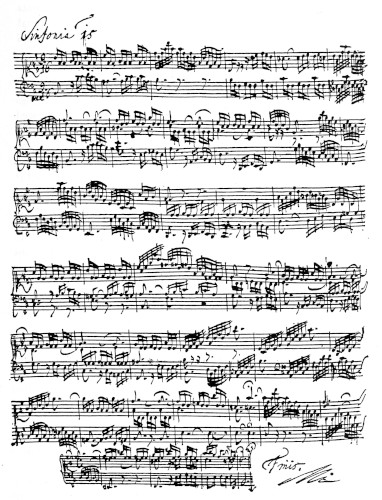
The Fifteenth Sinfonia of John Sebastian Bach, from the Royal Musikbibliothek, Berlin.
The Partiten outgrew the ordinary scheme of the suites (allemande, corrente, saraband, gigue) as Beethoven’s sonatas outgrew the old scheme of sonatas. They have given a new life and a new spirit to a traditional form. The suite, which at the end of the seventeenth century has become merely conventional, is so elevated by the spirit of Bach that it thenceforward stands in the world of actuality. Even Schumann selects a similar form for the expression of modern emotions. The suite having been thus despatched, the sonata is in similar fashion put into precise and regular form, to be transfigured later by Beethoven with the same modern spirit. Bach had the fortune and the genius to relegate the traditional suite into the past, and to see the conventional sonata dawning in the future. Thus with him the dance-piece and the free piece remained fresh and lively. Suite and sonata were only different external ways for reducing several pieces to unity. There, men took their stand on the old familiar series of dance-tunes, without ever thinking of the dances themselves; here, they found for the first movement a practical form, and, in the event, ranged the adagio, scherzo, and rondo together, just as their predecessors had used the saraband, minuet, and gigue. On this tendency to unity on the part of the clavier-pieces, from the first English variations, through Couperin’s Ordres, to Bach’s suites, Italian sonatas and German sonatas, Chopin’s Albums, Schumann’s Scenes, Liszt’s Epics, too much stress need not be laid. Even more than the orchestra, the clavier leans to short pieces, but the intellect demands some excuse for binding them together.