OSCAR BIE (continued 4)
E. E. (Ernest Edward) Kellett translation
It must be observed at this point that the world had meanwhile become really musical—or perhaps less truly musical than music-loving. Nay, more; political events, as formerly church ceremonies, could now be celebrated in music. The famous concerto which Beethoven gave in honour of the Vienna Congress was perhaps the first great occasion on which music lent itself in festal manner to the adornment of public events. It was now no longer a mere incident in a commemorative display, but to a great extent pure music; and the rapid and vigorous education of men to instrumental music by the classical masters was the necessary precedent condition of the attainment of this point. In these matters the clavier played its important part as an intermediary and a teacher; it made the innovations into current coin, scattered them among people in their homes, and accustomed their ears to understand better and better the absolute language of music, as it dealt in wider and wider abstractions. The publishers were more active, the issues more frequent, the popular settings more numerous and artistic. Even the great men themselves take a share in the work. A frequent phenomenon in the music-trade is that composers like Clementi, Dussek, and Pleyel, themselves open publishing houses—and secure the advertisement of their wares, oftener perhaps than was really necessary.
International exchange became more active year by year. If we look to London, we see Johann Christian Bach at work, helping to give form to the Sonata; we observe Haydn and Pleyel in vigorous rivalry for the favour of the public; we see the virtuoso Clementi from Italy setting up a clavier-school. In Petersburg meanwhile lives the Englishman, Field, one of the chief nocturne-romancists, and Klengel and Berger, the Germans, all three brought out by Clementi. Next we see there also J. W. Hässler, the ex-hatter, who has left behind such agreeable works that Bülow regarded him as a good intermediary between Mozart and Beethoven. In Paris the opera is the favourite agent of musical pleasure. With Gluck the old quarrel between the Italian and the northern manner is renewed. Chamber-music retreats into the back-ground. Schobert and Eckard, decorative musicians, are hardly known beyond the border; and Adam and Kalkbrenner, who restore the fame of French clavier-technique, leave productive art on one side.
In Vienna there is a swarm of prominent figures. Gradually the city is preparing itself for the state of things which in 1820 W. C. Müller thus describes in one of his “Letters to German Friends”: “It is incredible how far the enthusiasm for music, and especially for skill on the piano, is now being carried. Every house has a good instrument. The banker Gaymüller has five by different makers; and the girls especially play a great deal.” Indeed, a glance at the society of Vienna at that time shows us innumerable ladies, ranging from the merest amateurs to the maturest artistic performers, thronging round the great and the mediocre alike. Even Beethoven, the misanthrope, sees himself surrounded by them; he cannot keep from them, nay, he often does not choose to do so. The Baroness Ertmann, Julia Guicciardi, Nanette Streicher, are some of the actual persons of the fair sex, who, amid innumerable legendary beings, hovered about the Master. As usual where social life forms the basis of culture, the ladies come to the front. Invitations fly in bewildering profusion; the great houses exchange their guests; new compositions are made known in the salons before they find a publisher; and when they are published, old acquaintances become subscribers. This narrow circle gives a great opportunity for the advance of chamber-music. An accurate observer will notice how the modern international musical public slowly develops itself from this old-fashioned, close corporation.
The names of the best teachers are in every mouth. Czerny, who was destined to raise Vienna technique to its height, and to become the teacher of a Liszt, tells us in his Memoirs who were known as the best teachers in Vienna at the commencement of the century: “Wölffl, distinguished by his bravura-playing; Gelinek, universally popular for his brilliant and elegant execution; Lipawsky, a great sight-player, renowned for his performance of Bach’s fugues. I still remember how Gelinek once told my father that he was invited out for an evening to break a lance with a foreign player. ‘We mean to hew him in pieces,’ said Gelinek. Next day my father asked Gelinek how the fight of yesterday had gone. ‘Oh,’ said he, ‘I shall remember yesterday’s fight. The young man has a devil. I never heard such playing. He improvised fantasias on an air I gave him, as I never heard even Mozart improvise. Then he played compositions of his own, which are in the highest degree wonderful and grand, and he brings out of the piano effects the like of which we never heard of!’ ‘Ah,’ said my father, astonished, ‘what is this man called?’ ‘He is,’ said Gelinek, ‘a little, gloomy, dark, and stubborn-looking young fellow, and he is called Beethoven.’”
Beethoven was discontented. He knew what lay within him, and yet could not help seeing how the crowd preferred to shout itself hoarse over the brilliant exponents of technique, then beginning to swarm over Vienna. He was brought into a contest not only with Gelinek, but with Wölffl, who was renowned for his abnormally long fingers. Such contests are a mark of the times. As yet the division of labour between composers and interpreters had not been introduced. Playing and invention had a more intimate association. The following is the programme of the “Academy,” which Mozart performed in 1770 at Mantua: “First, a symphony of his own composition; secondly, a pianoforte concerto, which he will play at sight; thirdly, a sonata just placed before him, which he will provide with variations and afterwards repeat in another key. Then he will compose an aria to words given to him, sing it himself, and accompany it on the clavier. Next, a sonata for the cembalo on a motive supplied him by the first violin[111]; a strict fugue on a theme to be selected, which he will improvise on the piano; a trio, in which he will take the violin part all’improviso; and, finally, the last symphony of his own composition.” No sharper contrast can be conceived than this performance offers to the modern concert. Almost all is here arranged for sight-playing and improvisation, or for the instantaneous exertion of inventive or executant skill. There is in this still a good deal of the earlier notion of music, in which the conception and visible development of a theme was preferred to the performance of a completed work. Later, the demand for such instantaneous performances gradually disappears. In Mozart the cadenza at the conclusion of the concerto-movements remained as the last refuge of the improviser in the written-out piece. Beethoven insisted that his E flat major concerto should be performed without an improvised cadenza.
At a period in which instantaneous performances were so popular, contests of the kind mentioned above were not misplaced. But Beethoven had more to suffer in them than others, since his genius had already outgrown them. He was a poet who loved to live apart and to offer his gifts in a more intimate fashion. How wonderfully did that very deafness, which turned his genius inward, preserve him in later years from public playing and conducting! But, before, he had been forced to enter the lists not only with Wölffl, with Gelinek, with the renowned technist Hummel, but actually with so contemptible an artist as Steibelt. This Steibelt was one of the disgraces of the age. Bespattered with praise, he rushed through Europe with his trashy compositions, his battles, thunder-storms, Bacchanals, which he played ad libitum, while his wife struck the tambourine in concert with him. The populace was enraptured, for Steibelt and Madame tickled their nerves with sparkling shakes and tremolos. At the house of the Count von Fries he fell in with Beethoven. A quintett of Steibelt’s and the B flat major trio of Beethoven’s (Op. 11) were played. In the latter occur the variations on a theme of Weigl, from the opera L’Amor Marinaro. Beethoven was out of humour and would not play. A week later the same company met again. On this occasion a quintett by Steibelt is again played, and to it Steibelt adds a series of wild clattering variations on the same theme of Weigl. Such “Leit-motive” attacks are familiar in these contests. It is well known that underlying Mozart’s Zauberflöte overture is a theme which Clementi had already used in his B flat major Sonata. Clementi had played it in a contest with Mozart, who did not care much for the Italian “mechanical” artist. But Beethoven this time avenged himself bitterly on Steibelt. After a long persuasion from his friends he stepped negligently to the piano, struck with one finger a few notes from the just-played quintett, and twisted it in and out until he had produced a fantasia; but Steibelt, before the conclusion of the piece, left the room and never came near him again.
Thus Beethoven lived in a world with which he had no sympathy. It is true that there were some houses in which the higher class of music was openly cultivated. Such a house was that of Van Swietens, where Beethoven often played to a late hour from Bach’s Wohltemperiertes Klavier. But the multitude, whose musical horizon was bounded by the Italian opera, occupied itself with the glitter and splash of the executants. In such a city old Diogenes might have sought long for a man. A composer of the best class, Friedrich Wilhelm Rust, who in the midst of his capriccios in the style of Philip Emanuel often showed features reminding us of Beethoven, died at Dessau in 1796 alone and inglorious. A Franz Schubert lived close by Beethoven, but no one knew of his existence. Those who are heard of are virtuosos and writers for the pianoforte. Dussek, however, is of importance not only from the technical point of view, but from that of true art. He is noteworthy also as the first musician to compose almost wholly for the piano, with or without accompaniment. How distant are the times when we could feel surprise when a piece appeared written for piano alone! And this man, within the limits of his genius, made the poetry of the piano into a life-work. It is as if for the first time an anticipation of Chopin rose before us; but the likeness is after all only in externals. Dussek is the bourgeois romancist, when he spends his whole year in the country with his lady-love; but he is the true son of the eighteenth century when he in turn attaches himself to successive princely patrons. Especially devoted was he to the musical Prussian Prince Louis Ferdinand, on whose death at Saalfeld he wrote a suitable composition. His style would seem to have been noble and full, and his pieces are more charming than was usual at the time. Unlike Hummel he was very partial to the pedal; and it is in his pages, perhaps, that we find it for the first time accurately employed. His works themselves are of all kinds and degrees of merit. When, led by his national temperament (he was a Czech), he gives full play to the dance forms in the last movement, he strikes a fine and fresh note. He was one of the first to use syncopations effectively. But he has also written a final movement, that of the E flat major sonata in 6/8 time, which has a true and solid worth over and above its dance-form. He is less attentive to his first movements, and his most famous sonata, that in A flat major, which he entitled “Retour à Paris,” disappoints in this regard our expectations. In his second movements he is quicker to light on tones which, by their tender character, linger in the memory; as above all in the slow movement of the D major in 2/4 time.
After all, if Dussek does not stand among the immortals, he yet, in intellect and power of invention, ranks among the lesser stars[112] to whom we owe the full elaboration of the popular forms. His style is soon grasped. We know one of his sonatas already as soon as we hear the first bars. A broad first theme gives us a good tune; then it goes smoothly flowing through grateful passages to the second theme in the dominant or relative key. Other runs give the fingers some further opportunity for bravura; perhaps a third scrap of melody peeps out, and we are at the landmark of the first double bar. Next some suitable free fantasia is arranged, which sounds more scholastic than it is; we pass with it through a series of related keys—until a motive already known, the first theme, brings us back again with a smooth glide to the beginning, from which point the movement practically repeats itself. In the following movements there is a longer melody adorned with variations. In the third a seductively familiar theme tickles our fancy, which at times spreads itself out in bravuras, or gives itself effect in a very poor imitation of a fugue.
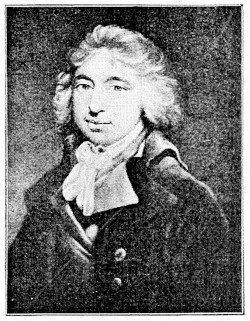
Dussek.
In company such as this Beethoven stands absolutely alone. It is true he has not yet wholly cast off the garment of his time. In many a harmonic phrase, in many a formal turn, he is a child of the period; above all in many a naiveté. And he not seldom exerts himself about passages which are utterly unworthy of him. He, the composer of the A major symphony, wrote at the same time the incredible “Battle of Vittoria.” Conscious advance, such as Wagner set before himself, is to him unknown; and we find among his later works various things that remind us of an earlier period, as, for example, the wonderfully Mozart-like C major Rondo for the pianoforte. But his naiveté was strangely warped; and thus arose noteworthy mixtures of style, such as we so often observe in men who stand on the borders of two ages. His character was the most complicated that ever musician had; and only investigators who know not the demon of the great soul, can seriously ascribe the paltry avarice of the master to humane goodwill for the notorious nephew whom he supported. A soul like Beethoven’s is a mystery into which we can only penetrate slowly and with difficulty; and who knows—even if perhaps the deepest secrets of his “last style” should become common and familiar, whether even then the last word would have been said on this strangely complicated and distorted character? But Beethoven composed from the soul outward. This was the great novelty. And we must penetrate into his soul if we will rightly apprehend him.
The enthusiastic compiler, Thayer, who died while writing Beethoven’s biography—musical history has often been the death of its authors!—remarks very excellently how differently from others Beethoven already sketches out his work. The motives stand there in hasty cursive—applications of motives—tone-ideas in words—as a painter sketches or a poet notes down his observations or inspirations. It bubbles up not like Bach’s steady stream of self-restraint, but in a torrent of unmeasured passion, which regards self-restraint as a weak concession and the correctness of the “galants” as a lie. In this man music spoke in words, not in pictures. He had the unparalleled boldness to tear out his secret feelings, all bleeding as they were, and hold them up before his own gaze. It was the boldness of a Zarathustra-nature. He belonged to those who worship Bacchus, not to those who follow Buddha. In Thayer’s possession was a note from Beethoven to his friend Zmeskall of Domanovecz. “For the future I bid farewell to the cheerfulness which I sometimes enjoy; for yesterday, through your Zmeskallic chatter, I became quite gloomy. The devil take them—I don’t want to know anything of their universal morality. Might is the morality of men who distinguish themselves above others. It is my morality, anyhow. If you start on me again, I shall pester you until you find everything I do noble and praiseworthy.”
We shall then only understand Beethoven thoroughly when we leave form on one side and take music as a speech. It is no feeble paradox to say that the reason why Beethoven, in his operas and songs, paid so little attention to the words, was because the music was to him words enough. To this greatest of instrumental geniuses was revealed the great secret of pure music, which, precisely because it has no speech or language, speaks infinitely the more profoundly. Words obstruct it. When Beethoven, at the end of the Ninth Symphony, has recourse to the human voice, everyone feels that it was to him only the highest of all instruments, with which he can do yet more than with trombone or contrabass. It is the utmost triumph of the pure musician who can draw even the voice under his sway.
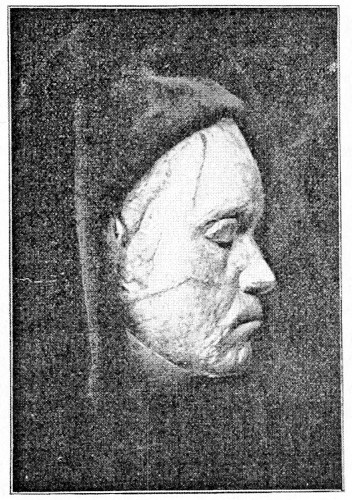
Cast of Beethoven’s living face, 1812.
Music is to him a speech, because it is full of associations of ideas, which bring tones into relation with the outer world, and make them reverberate with a thousand inner meanings. In his orchestra we hear nature, as in his pianoforte we hear the orchestra. Not without reason has Bülow, in his edition of Beethoven, in more than one place translated the piano-piece for the reader into score, in order to make its content clearer. These are things which did not exist in Bach. The world of tone has sacrificed her great unity for the great fragmentariness of unveiled speech, and a never dreamt-of height was thus reached in that absolute tone speech, which formerly in Venice and in England had taken the place of the mediæval vocal music.
What a Gabrieli, a Bull, a Bird, a Couperin, each in his own way, had begun, was by Beethoven brought to full completion. Here was the perfect opposition to the Middle Ages. Here was the Michael Angelo who could stand alone against the ancients. The abstractions were perfected, the relations more general, the language more intelligible. If Beethoven began his first Symphony with a chord of the seventh, it was possible to understand what he meant by it. To this man, who completed one epoch in beginning another; to this symphonist and chamber-musician, the clavier must become a daily necessity. His life has been written in his works. Words, which could only fetter him, are kept at a distance; the notes tell the story by themselves.
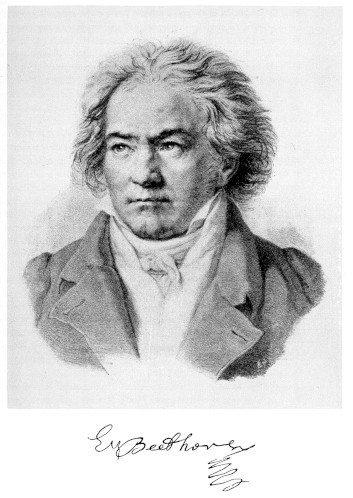
Lithograph by C. Fischer, after the original portrait of 1817, by A. Kloeber (1793-1864).
If we would understand Beethoven’s language we must study the way in which he works out his motives. His peculiarities are the peculiarities of the naturalistic school. The melody mounts or falls as his emotion mounts or falls. He takes a motive and narrows it until its parts curve upon each other, and then again makes it greater and broader, until it lies open before us. This is a deep and mysterious language, which deals with the tones as a word, an expression; which looks on us, shall I say? like the eye of certain animals—we understand them through and through, and yet their speech is not ours. But the most powerful agent in stirring our emotion is the rhythm, that soul of all expression. It is the absolute pulse of things, which only the finer ears can hear in the outer world; it lies here before us in its artistic purity. The pauses, the leaps, the syncopations, the gigantic parallelisms of structure, the dynamic surprises, leave but a thin wall of partition between the phenomenal and the transcendental of music. There is no longer any reserve in the language. There are some movements in which Beethoven’s music stands at the very doors of verbal speech: such, for example, as the allegretto in Op. 14, 1 and the first movement of Op. 90. The words appear to tremble on the lips; but it would be the disappearance of the apparition were we to utter them.
Over Beethoven’s realm broods a deep tragedy. A constraining seriousness speaks to us—the dark abyss of passionate emotion: a total pitilessness, a gloomy brooding, accents of misery, a unison of terror. Beethoven began his piano publications with the three sonatas (Op. 2.) dedicated to Haydn; works full of inexhaustible inspirations, of the ravishing freshness of youth. The second is introduced by sharp accents and those broad extensions of chords by means of octaves, which remained to the end characteristic of the author. Another man would have begun the piece after this tragic cry, with the contrapuntally-rocking motive. But the first of his greater tragic outbreaks was the mighty Sonata in C minor, the so-called Pathétique, which he dedicated to his patron Lichnowsky. Upon the heavy, slow introductory passage follows the stormy First Movement, whose themes are, first, a tempest of rage, secondly, an utter despair; and the Grave intrudes its monitory remembrances in the midst. Unity of colouring is preserved. Over the second singing movement, and the third with its rondo-like passages, lies the same sombre tone; and the conclusion is sharply cut short.
Beethoven revels in the gloomy. He buries himself in deep tones, as in the Andante of the Pathétique or in Op. 22, its cheerfulness notwithstanding. Later, on the magnificent Broadwood, which he received from England as a present, he goes with delight into the regions of the deep. A mystic tremolo attracts him; and the “trios” of his scherzi are full of the sonorous murmuring of billowy chords.[113]
A new and grand expression of pain is the last movement of the Moonlight Sonata (Op. 27, 2), which is as full of hopelessness as the last movement of the other Sonata of this great pair (Op. 27, 1) is full of invigoration. The threatening strokes of the quaver chords which sharply define each repetition of the stormy motive-passages, the quivering secondary theme, the unrestful rests, the melodies, which seek to calm down the seething bass; all this was a world of seriousness which the clavier had not yet learned to know.
But this was still a composition, compared with the naturalistic chaos of the Recitative Sonata (Op. 31, 2). This first movement is a remarkable embodiment of gloomy brooding, which is continually being disturbed by despairing cries, until it finally loses itself in that resignation of utter indifference, which is a typical form of Beethoven’s tragic finales.
It seems to me beyond question that the impulse which drove Beethoven to compose great piano-pieces was supplied by the concerto-form. The concerto, in its secular character, had not remained without its advantages; it was broader and freer than the regular sonata. It avoids reprises in the first movement, and arranges the divisions with more circumspection. In order to give the clavier-player a chance to rest, the orchestra must take over some independent parts. It begins with a broadly planned section, which so to say arouses curiosity, in which various themes are treated; and portions of this introduction are then inserted between the successive entries of the pianoforte, or even simultaneously with them. The piano itself appears usually three times. In the first and last of these the music is to some extent repetition, the intermediate section is a kind of free fantasia. Even in Mozart a strict unity of theme between the orchestral and the solo sections is not always to be observed; it was Beethoven who first carried it thoroughly out. He it was who with visible affection fashioned the concerto form. It is no accident that the two last of his pianoforte concertos, the G major and E flat major, to-day enjoy an exuberant popularity. What Mozart had promised in his C minor concerto, these perform to admiration. They are built entirely on that plastic sensuousness which is the essence and the aim of the concerto. Their themes are remarkably adapted for a polyphonous orchestral development, for a delicate imitation on the piano, or for the storm of the fullest harmonies.
The technique, whether of the piano or of the orchestral colouring, though joyous, is yet severe. Far from all coquetry and all mere show—the technique stands, especially in the cheerful E flat major, on a height of extraordinary purity. The form is clear, but not so precise as not to admit of modifications in single sections, especially those devoted to the solo instrument. The intellectual G major, the technical E flat major, represented an extreme of happy sympathetic innovation.
We only need to compare the great Waldstein Sonata in C major (Op. 53) with the Concertos, in order at once to see that the latter have stood godfather to the former. There are not merely external likenesses, as when the piano figures a theme which might have been played already on the orchestra, or when more important divisions close with a long shake, as in all concertos the piano sections usually do on the re-entrance of the tutti; or when with passages played pianissimo, and hurrying ghostlike, or in octaves, an effect is introduced which in Beethoven’s concertos the delicate piano is generally used to play out in contrast with the orchestra. Rather the important likeness lies in the whole broad outline. The themes appear as a rule twice, as is naturally the case in the concerto; the exposition is done leisurely and cheerfully; a cadenza, such as Beethoven had already used (e.g., in Opp. 2, 3, and 27, 2), gives to the conclusion of the first movement a specially concerto-like quality. The second slow movement is a short emotional transition, such as Beethoven has written so exquisitely in the G major and E flat major concertos; and the last movement, far from being a “concession” to the “light-robed” muse, is a spirited rondo, in brilliant style it is true, but in its augmentations and diminutions, its stretto and the trill-conclusion, a genuine Beethoven—as no other could be.
As thus the dependence on the broad effects to which the concerto style had accustomed the hearer, gave to the first movement of the sonata a new form and extent which it had hitherto not known, it was possible for Beethoven to infuse into it a tragic content which soars far above the general coloration of the “Pathétique” and the brooding naturalism of the “Recitative” Sonata. Here for the first time we hear those trumpet-calls to the battle with Fate, those heavy rolling waves at the return to the first theme, which later in Op. 111 found so concentrated an expression. A monumental epic develops itself about the conflict, which usually forms the content of first movements. This mighty form represents a mighty picture.
What was thus given in the Waldstein was deepened and unified in the Appassionata (Op. 57). The uniform colouring of the Pathétique is here deepened by hints taken from the concerto. A sublime and rhythmical theme, based upon the simplest harmony, a solemn unison, dominates the first movement. The second theme, lyrical as it appears, is really only fashioned out of the first. As the movement progresses, we seem to hear mysterious winds, stormy seas, convulsions of nature. A cadenza, straight from the heart, leads to the most colossal stretto ever written: a wild upheaving, a sudden down-sinking and extinction. Its spiritual connection with the choral-like andante con moto is obvious. The note of aspiration is heard throughout, first by pauses, then by a clearer and clearer expression in those deeply-felt variations, which finally repeat their theme. The despair of the final movement is the last act—a giant melody, uttered in piercing cries, sinking down panting in the middle, and at the end breaking out into Bacchanalian revelry, in which laughter and ruin are inextricably mingled.
This was the most comprehensive tragic picture ever drawn by Beethoven on the piano; and it has therefore remained a unique composition. His works tell us that he outgrew the epoch in which misery is enjoyed. His tragic art leads us beyond despair not to Nirvana, but to the Elysian fields. Hymns of joy sound around him. Strong joy, Dionysian strength, was the aim of this Faust. What he once depicted in the wonderful monologue of Op. 27, 1, becomes his life. In the Elysian Fields the fugue of adolescence returns to him, giving him repose and safety. In it he allows the tragedy of Op. 106 to tower heavenwards. Or, ethereal, world-dissolving glories shine around him—these are the bright, cheerful phrases of the E major or A flat major Sonatas, in which they now give the theme, now the figuration, or in the scherzo, grow up in flowery profusion. Into this serenity he allows the tragedy of the last Sonata (Op. 111) to pass at last. After a movement of wild outcry come the simply resigned variations, which finally mount from dull earthly devotion to angelic harmonies, to end in the glitter of their smile, in the bright sphere of their unearthliness.
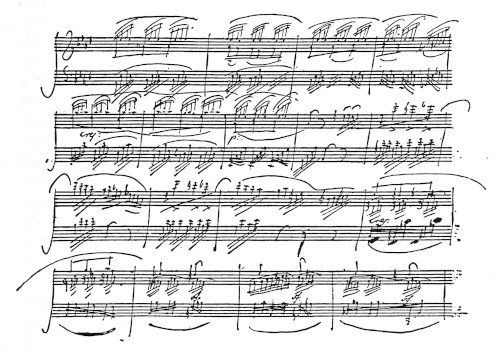
From Beethoven’s A flat major Sonata, Op. 26. Royal Musikbibliothek.
To understand the joyous Beethoven of later years we must remember the capricious Beethoven of youth. A strong leaven of cheerfulness lay in him, a healthy will, which knew how to be humorous.
The sportive Beethoven lies in the lap of Nature. There he hears the entrancing imitations of his Haydn Sonatas, the hurrying ghost-like scherzo with its Schubert-like romantic middle movement (Op. 10, 2), the sparkling Rondo of the Variation Sonata. This we must hear played by Risler in order to appreciate its inimitable humour and poetry, which is based entirely on the soft touch of the contrary motions. The most perfect of Nature prayers, a Pastoral Symphony on the pianoforte, is the Pastorale (Op. 28). Not only the second movement with its bird-like middle part; nor only the third with its extreme cheerfulness, nor the fourth with its outlook on the woods, its delight in the chase, its joyous conclusion; but also, and in the highest degree, the first movement, are confessions of Beethoven’s natural symbolism. This work stands on that indefinable border-line between the comic and the tragic, which is the unfailing mark of the intensest poetry. It is a complete picture of the world. Beethoven’s scherzi, his most peculiar form of art, which in the Sonata take the place of the old minuets, stand on this ground, and might be termed “secular,” in comparison with the dramatic embodiments of his first movements, or the complete picturings of the last.
The Rondos exhibit a similar process of alteration. In them first, so early as the time of Philip Emanuel Bach, had the capacity of tonic art to “let a theme speak,” been exercised. They allowed a theme its full expressive value. To Beethoven, accordingly, in his first period, such rondos appealed with the strongest effect, and their charming melodies throng in his earlier sonatas. But he was able to give this form a still deeper meaning. In place of the melodies he adopts genuine motives of pregnant brevity, which, as in Op. 10, 3, he develops with characteristic reserve. These pieces, as contrasted with the old melodic rondo, show a convincing naturalism. To the old rondo they are related as his scherzo to the minuet. Equally significant is his love for certain diatonically moving accompaniment figures, as in Op. 14, 1, or Op. 28; he thus avoids the impression of a regularly harmonised theme, and allows the naturalistic motive to predominate over the formal melody.
In the treatment of form in general, the sonatas exhibit a series of different experiments, which are of emotional interest. His other chamber music—the Violin Sonatas, the Trios, and all the rest, to which I now only allude—could not accomplish the suppression of form like the free, pure piano-pieces. The great Fantasia for chorus, orchestra, and piano (the latter treated in concerto fashion), which we value as an anticipation of the Ninth Symphony, was unique in its disregard of rule. Psychologically viewed, the sonata-form is much richer in content, and unravels the most wonderful mazes. Here is the history of the re-constituted sonata-form; a history which is too complicated to run in a straight line.
Down to Op. 10 on the whole we stand on the classical ground of the sonata. In the three Sonatas, Op. 10, appear the first important irregularities. Both in the first and in the second Sonatas there is, in the “free” part, a quite new theme introduced, which points to a definite design; and in the third we find that wonderful D minor movement, with its utter abandonment to melancholy, which by means of a stretto[114] in the Largo raises itself absolutely out of the contemporary style. Yet all this was new only in tone; it was no more absolutely new in idea than the Grave of the Pathétique or the Variation Sonata with its Marcia Funebre, where the middle section is introduced by means of realistic drum-reverberations.
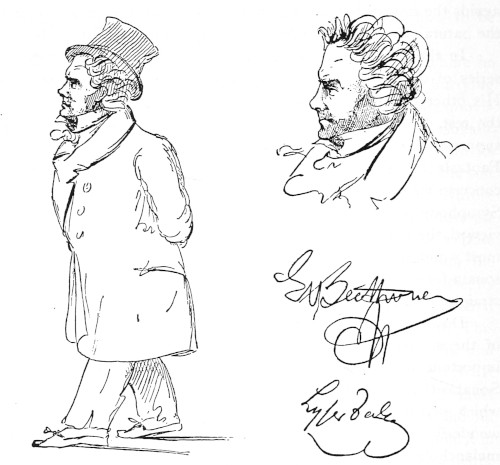
Lyser’s Sketch of Beethoven.
An essential change is to be observed in the two sonatas Op. 27. We are at the beginning of the nineteenth century, not far from the time of the composition of the Eroica Symphony. Beethoven was fully conscious of the freedom of these sonatas (E flat major and C sharp minor): he inscribed both “Sonata quasi una fantasia.” In the E flat major a dainty andante movement meets us, whose voices are strongly interwoven. It develops itself slightly, in variation manner, but it is interrupted, once by a sustained melody, again by a stormy episode in C major. What has become of the rondo with its couplets? There follows the apparition of a rolling, beating, gigantic scherzo, beginning in C minor and ending in C major. The C (always attacca subito) prepares us for the bright A flat major adagio, which gently takes us up till the whole idea is exhausted. Finally we have the wholesome, powerful, and busy E flat major movement, arranged in free rondo-form, with its stirring reminiscences of the adagio. The twin sonata in C sharp minor is the so-called Moonlight, with its classical first movement, which was a unique expression of melancholy; and which, only slightly interrupted by the episodic allegretto, breaks out again into the despair of the presto agitato, which we have learnt to know as one of the most deeply tragical of Beethoven’s outbursts. Of a sonata as a regular composition there was here no further idea. These were transcripts from experiences.
The experiences of Beethoven’s life in the following period, so far as they are recorded in the diary of the piano-sonatas, exhibit a certain archaic character. In this period from 1803-4 (the period of Op. 31) to 1811 (Op. 81 a) lie the most varied tendencies in confusion. It is a mighty attempt in all possible paths, but the reader will soon see that every path leads to a definite goal. In all the paths there is an attempt to grasp certain great elementary principles, which lie outside the direct development, and which are made subservient to the new spirit.
This archaism of form appears first as an application of old forms to modern purposes. In the G major (Op. 31, 1) we are surprised by strange retrogressions—which yet are not mere retrogressions. The rosy coloration of the adagio draws past recollections into new life. The third movement shows us Bach’s application of the pedal bass, transfigured by passing through the mind of Beethoven. In Op. 31, 3 the minuet returns again, and in other passages, with their simply-cut melodies on “Alberti” basses[115] we seem to have gone back a generation. In the “easy” sonata (Op. 49) and the “Ländler” (Op. 79) this tendency reaches its height. It is a return to nature; a growth of simplicity, in all points, however trifling; the reaction experienced by every mature genius. Beethoven never wholly lost this tendency to reaction. He became in his later days more Mozartian than he had been even in his youth, and more of a Bach than Bach himself.
The second path leads us back not to the form but to the essential nature of Beethoven’s youthful period. The delicate work of the porcelain age lives again in him; above all in the charming F sharp major Sonata, of which he himself was so fond. It is quite extraordinary how in Beethoven the spirit of a past time receives life under astonishingly new forms. This graceful filigree-work, with its sweeping unearthly conclusion in the first section,[116] built entirely on delicate inspirations, piquant harmonies, dainty modulations—has wonderfully shot up in such colour, as autumn blossoms only can offer. Take next the famous Les Adieux, dedicated to his pupil, the Archduke Rudolf (E flat major). It shows a delight in the minute and the intimate, such as we meet in old Dutch pictures. There is not a passing-note, not a modulation, which was not worked under the magnifying glass. I should myself not like to omit the last movement, known as the “Wiedersehen.”
The beautiful characteristics of the “Absence” Sonata are well known; the various metamorphoses of the three descending notes, more or less obvious, but always helping to enlarge the meaning of the first idea [see, for instance, in the first Adagio, bar 7; also the bass of each phrase from bar 10 (third quaver) to the first double bar; then in the Allegro, bars 19-21, in the bass, and the semibreves just before the repeat; also in the “free” part after the repeat mark; and 13 bars from the end of the movement, left hand, etc.], the meaning of a dreary longing, which Beethoven tries to portray in the “Lebewohl” movements. The tender expression of the Andante, the trembling joy and almost overpowering delight of the “Wiedersehen,” the sweet charm of the delicate prolongation of this movement at the Poco andante near the close, all these cannot but deserve mention here. Of course there was nothing new in having three movements labelled with such names as these. What was new was the inner unity which was attained in this piece, and which was only equalled by the delicacy of the workmanship itself. To this (so to speak) archaic and delicate style was added the world-embracing Art which found its proper field in the C major (Waldstein, Op. 53) and the F minor (Appassionata, Op. 57) sonatas. Thus was the proper foundation laid for the grandiose poems of the last six Sonatas, which lead the three streams into one course.
The first of these (Op. 90) is in two movements, like the last: the first, a thoughtful and restful movement without reprise, with a new motive in its development; the second, a slow rondo, embracing the parts of the theme fugally. It is a work which, like all these last sonatas, is never thought of as a “piece,” but stands before us in one transparency, laying bare the inmost fibres of the man.
In Op. 101 an unparalleled height of thematic development is attained. Rhythmical motives are plentiful; the smoothly flowing six-eight time; the same with accent completely displaced (as in bar 29, etc.); the vigorous dotted quaver and semiquaver of the Vivace; the prominent formula of the section in B flat in the same movement, etc. As before in the Appassionata, the boundaries between first and second themes fade away before the consciousness of their unity. The Sonata exhibits thematic in all its forms. The fugue half changes into the rondo, free in expression, lively in character. An unearthly sweep of music, born tone by tone, rolls over us; the e a of the motive is its air-built scaffolding. It is the streaming forth of the most inward intuition of tone; a special kind of absolute naturalism, which yet enfolds in itself the future of music. We think of the “Bagatelles,” which Beethoven wrote and published at this time, cabinet-pieces of remarkably genuine character.
Then suddenly rises before us the “Grand Sonata” (Op. 106). We recognise no longer the old well-known features. It has assumed the forms of the giant-world; it laughs in its greatness, in its childlikeness. Will it really permit itself to be played by human hands? We are at the mysterious limits of piano-music. Rhythms marked by sharp blows, modulations in thirds, enharmonics, narrow-cut successions of chords[117]—these are the very hand of Beethoven. The first movement works with its three themes—an Olympian poem—as far as the stretto. Its development rests on a fugal foundation. The scherzo is all rhythm; in the trio, it is all unrhythmical; mystical colours, sliding passages from B flat minor to D flat major, as in the Ninth Symphony from D minor to B flat major. The Adagio is so to speak the last possibility of the old form, wide as life itself, Michael Angelo-like in its strenuous longing for F sharp major. The transitional passage, the Largo, which introduces the last movement, like an old Toccata, tries this and that, prelude-wise, and striving after fixed forms. The three-voiced giant-fugue is the deliverance, in whose retardations the old storm, however, still conceals itself. But there is a joy in the mighty straining of these dissonances, which Bülow ought not to have tried to soften. Theme and counter-theme, “cancrizans” canon,[118] lyrical episodes, dainty counter-motives, inversions, new canonic motives, tied up again with the fugue, contrary motions, diminutions. This old lofty tone speech remained serious; it is the refuge of the anchorite who turns back to the powers of Nature, and finds rest in the wise observation of the stars. It is the utmost of art for art. Who is there whom it troubles?
Three flowers bloom in this late garden, three unique documents of a pure masterdom: the “playing” sonata, the “landscape” sonata, the “life” sonata. The first is on the heights of pure technique, the second is a clarified objective picture, the third is pure subjective inwardness.
Op. 109 opens with a graceful impromptu-like harp-play of broken chords, which twice thicken themselves in recitative songs. A somewhat hard sounding scherzo stands in the midst. It is closed by the variations on that never-to-be-forgotten melody in E major, which, through reflective romance, cheerful étude-like activity, sober fugues, bright trill-heights, lead back to the captivating simplicity of their theme. The freedom of the first movement and the confinement of the second are both made use of by the third.
We have a landscape in the A flat major (Op. 110). Over the sward rises the tender song. Butterflies and sun-glitter are the accompaniment. A wholesome strength mounts up and cheerfully wings its way. In a pause of meditation it comes to rest; and from the contemplation rises the old eternal lamentation of man. From its last breathed tones ascends the fugue, the great law of nature. Once again the lament, broken, helpless, dashing itself blindly against fate—and all the more dazzling is the fugue, embracing all, Truth with its disregard of the individual.[119] Thus does Beethoven express his pantheism.
But even this sonata seems feeble in comparison with the unheard-of intensity and greatness of Op. 111. The master sits at the piano, and his hands run preluding over the keys, in broad, piercing, dashing chords, which become closer and intenser round the node-point of the dominant. From the dominant grows a theme of savage grandeur, of Titanic power, all-embracing in its widening grasp, its Medusa-locks flying in the air, crushing out all sweetness and softness, till, as it came, it sinks terribly to earth, in those helpless diminuendo chords,[120] with no ritardando, such as Beethoven alone experienced. In the elemental song of the Adagio comes the release. In its variations it spreads itself out into a world-embracing grandeur, till its wisdom attains the two extremes of deep internal ardour and ethereal brightness, whose opposition is developed in the last pages in broad lines. The earth remains below; the minor conclusions are forgotten; the forms have become a twilight dream; only when our soul meets the Master-Soul does man attain to these realms.
At this time the inventive composer-publisher Diabelli had a good idea. He composed a childish waltz in C major, and invited fifty of the most distinguished composers and virtuosos of Vienna and the Austrian states to be kind enough to set variations to it. Beethoven sent him thirty-three variations, which appeared as Op. 120. Diabelli may well have been astonished. He had perhaps some dread of the “last” Beethoven who was then so full of youth. But he had not expected anything of this kind. Perhaps he did not quite know whether it was all done in earnest. Even the name of Beethoven did not aid the venture much. The world during many years troubled itself little about it, and let the strange colossus alone. It was reserved for Bülow, who had the keenest sense for the last efforts of Beethoven’s genius, to penetrate deeply into the great mass. He observed that the thirty-three variations are no co-ordinated series; they are an inner drama, like one of the later sonatas. They rise from the explanatory sections which lay out the theme, through a gentle minor group, by a double fugue, into calmer regions; a minuet concludes, which is no minuet, but one of those wonderful resurrections which were the old Master’s special love. The variations are a testament, as the Goldberg variations were those of Bach. From melody to canon, from gloom to parody, from archaism to anticipations of the future, from popularity to the philosophy of the hermit, from mysticism to dance, from technical glitter to the mystery of enharmonics, they lead us along three and thirty paths to different realms.
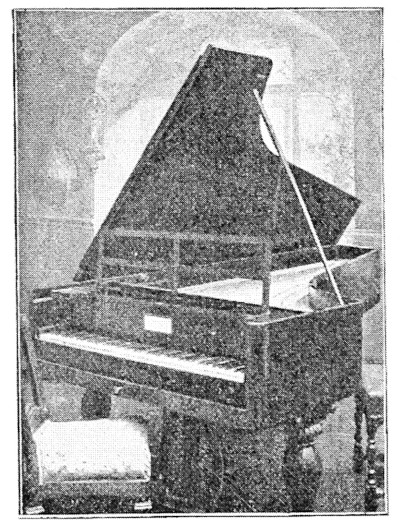
Beethoven’s last Grand Piano, by Graf, Vienna, with four strings to each note, on account of his deafness.
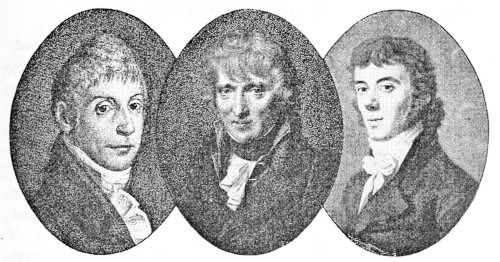
Viennese pianoforte players about 1800. Eberl. Gelinek. Wölffl.
The Virtuosos
Beethoven’s playing was naturalistic. In him there were no tricks of technique to be admired, no mere virtuosity to praise; but the hearers were stirred to their hearts. In this storm and stress, this whispering and listening, this awakening of the soul, they recognised an original naturalism of piano-playing, standing by the side of the naturalism of his creative art. Rhythm was the life of his playing. He thought out all technique with a view to rhythm. In the Berlin Library is a collection of Cramer’s Études, containing a series of annotations by Schindler, the well-known biographer of Beethoven. The expressions are so remarkable that the spirit of Beethoven has not unjustly been detected in them. Shedlock, in fact, has published them simply as Beethoven’s elucidations of Cramer, whose Études the Master is known to have prized exceedingly. In every Étude the melos, or latent melodic air, which lies at the base of the figurations, is brought into prominence, and the rhythmical presentation of these figurations is made as accurate as possible. The rest is for the most part left to the time, the diligence, and the ability of the player. Thus could a great creator look at Études. Of necessity he looked at them from a totally different point of view from the virtuoso pure and simple. He cared chiefly for the presentation of the idea, for the inwardness of the piece. Everything that was written down in concrete notes served to him but as a means for that expression, the mastery of which was the mastery of interpretation. From this point of view Beethoven would have written his “Klavierschule,” of which he often spoke in his latter years. With mere fingering and wrist action he would have had little indeed to do.
This great task was undertaken by a band of artists who must not be undervalued. They stood in the first rank of virtuosos. It is precisely at this time that technique first properly arises as an art; and their zeal in the attempt to solve the new problem was great indeed. They discover new possibilities of expression, they disclose new effects in the capacities of the pianoforte, and they reveal an inventive power in these new paths which offers the most surprising beauties. We must consider them from the right side, and never forget that the development of the piano could never have taken place so naturally and organically unless its technical advance had gone on in parallel lines with its spiritual progress.
I have here no other aim than to view things under a certain species aeternitatis. What was done by Bird, Bull, Couperin, or Pasquini, though to-day perhaps only one in a thousand piano-players knows their names, was of more importance than a Polacca of Kalkbrenner or an Étude of Ludwig Berger. We have a fixed horizon; what is not within it remains outside it. Lives of entire and rich content, sorrows and joys of extreme intensity, may sink into oblivion; they are in history a mere grain in the quicksand. It is useless to look up in my index the name of everybody who has composed a Rondo or given piano-lessons in Moscow. We must content ourselves with those who, by the great halting-places, have deserved a monument on the way: those only without whom history would offer a distinct blank.
A very great work is represented by the theoretical piano-schools, which followed one another at this time in close succession. If in the little book of Philip Emanuel Bach there was the beginning of a unifying system, on which the following age had only to build, yet, in the face of the most varying theories of the first half of our century, we can but recognise that piano-teaching, from mere excess of zeal, never succeeded in developing a genuine system. It has always been the tendency of the piano-teacher to keep in the past an ideal to worship, while with the present he has such a poor understanding that every new method of instruction makes a tabula rasa of the preceding method, begins all afresh, and allows the pupil salvation only according to its private judgment. Piano-study has never enjoyed the advantage possessed by other sciences, of building up from century to century, each upon the last. In theory it has remained a mere mosaic; and it has been saved only by practice.
It is practice also that gives a certain systematisation, not to the teaching, but to the history of teaching. All the separate workers at the great task, little as they admit the possibility of salvation outside their own creed, are yet driven forward by the stream of time and by the results of experience; and the law of averages brings about a clear advance apart from their personal agency. If we compare the systems of the eighteenth century, the schools of Philip Emanuel, of Marpurg, and that of Daniel Gottlob Türk, which closes this series, with the works of the epoch on which we have now entered, we see clearly how practice has marked out the path for theory, always reflecting upon itself, itself inducing its decomposition into its constituent à priori and empirical parts, and finally limiting itself to a mere application of experience.
The Pianoforte School which was written by Adam was a kind of pronunciamento of the Paris Conservatoire. This Conservatoire, founded in the midst of the troubles of the Revolution, ultimately gave French technique a position to which for a long time it had been a stranger. Adam’s principle is to put the “manieren” more on one side, and to avoid that too eager devotion to the teaching of general composition with which the books of the eighteenth century had been occupied. In its place he brings the study of touch more prominently forward. The day of the spinet is over; the hammer-clavier now dominates the world, and leads theorists to attempt methods of touch which may correspond to its possibilities of delicate expression. The pedals also begin to play their part. Adam recognises four pedals, of which one is our damper-raiser, and three serve for soft effects. Gradually they have been reduced to two, the damper-raiser and the so-called “soft” pedal.
A great opponent of all use of the pedal was Hummel. In our time it is no longer necessary to point out that the pedal, an integral part of the hammer-clavier, deserves not to be rejected, but simply to be treated on its own artistic lines. But Hummel stands, in his theoretic relations, so strongly on the foundations of tradition, that his attitude can excite no surprise. His “Ausführliche theoretisch-praktische Anweisung zum Pianofortespiel,” which appeared in 1828, is the crown of the united exertions of piano theory. This voluminous work, which gained with difficulty a circulation that it soon lost for ever, is a system, carried out into the minutest details, of all the technical capacities of the piano; so systematic, indeed, that here theory, by deductive methods, discovered effects which practice could not have attained alone. It is an unparalleled example of theoretic speculation, and yet really nothing more than the extension of Marpurg’s or Türk’s old-fashioned methods. These countless headings in capital letters, each describing a different class of “passage,” these numbered possibilities of fingering, these pedantic elucidations, beginning always from the first over again, are nothing but, as he calls them, an “Anweisung,” mere directions, abstraction from reflection outward. Any one who has mastered the first part has the second already at his fingers’ ends, but this master of dissection troubles himself not a whit on that point, and knows no economy in pupilage. He is opposed to learning by heart, since the fingers, he says, ought to find the keys without sight: so far is he from the modern view that only a complete mastery of a piece renders adequate interpretation possible. He troubles himself little about a science of touch. He introduces the “manieren”; but, contrary to the method of the eighteenth century, he makes the trill begin on the upper note. So far is a system of execution from his purpose that he can actually write as follows: “Runs and notes going upwards are executed crescendo, downwards diminuendo; but there are cases in which the composer intends the reverse, or that they should be played with even strength.” Hummel’s book is to-day a monument of misguided diligence, great in its patient calculation of permutations, but a dead curiosity.
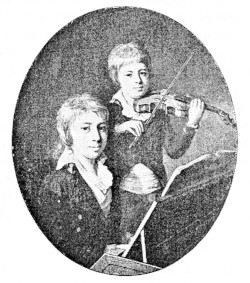
The Brothers Pixis. 1800. Engraved by Sintzenich after Schröder.
If, on the other hand, we look at Kalkbrenner’s Paris Pianoforte School, which he dedicated “to all the conservatoriums in Europe,” we see—with no heavy artillery—advances of all kinds which in part fill up the perspective of Adam. Where Hummel has ten main classes of fingered passages, he has only six; five-finger exercises for the unmoving hand; scales in all forms; thirds, sixths, and chord-forms; octaves with the wrist; trills; overlapping of the hands. In this there is more thrift, while there is no talk of absolute completeness. The “manieren” slowly cease to occupy important chapters; the pedals again come by their own; for Kalkbrenner as a Parisian hates the dry tone of the Vienna pianoforte. Execution also begins to receive a systematic treatment. Interesting references are made to punctuation in order to illustrate musical phraseology; conclusions on the tonic are a full stop; on the dominant a semicolon; while interrupted cadences are a note of exclamation. This is naive enough, but it is at any rate a beginning.
We are thus already standing at the point at which clavier theory decomposes itself into its elements. If Hummel was the great theoretician, Czerny was the great man of practice; a quite unique person, the hero of all piano-teachers, whose practical eye runs equally over all the possibilities of playing, and works them out in separate parts; the genius of the Étude. He it was who discovered the great secret that no separation of methods of fingering is of any avail in practice, but that the perfection of the fingers must be carried out solely on the basis of their mechanical gymnastic. It is useless to try to apply my five fingers to so many theoretically possible permutations; the important question is what practical use can be made of my fingers according to their physical structure. Czerny has no obsolete rules of practice, but a science of mechanism; thus taking the very opposite pole to Hummel. Piano-study, which with Couperin and Philip Emanuel was still a part of a musical training with just the necessary amount of mechanics, became with him primarily the gymnastic of the fingers with the addition of instruction in touch and execution. Long past are the times when the good old clavier was only used to “fill” the song, which was after all the essence of music. From music we have come to the fingers. A science of the fingers is constructed, and the fingers are trained as earlier only the throat was trained. Technique has remembered her own ways, and made the last first. The emancipation of finger-gymnastic was an epoch-marking point in the treatment of the piano, the desired answer of theory to practice, which for a long time had recognised the specific art of the piano. It was perhaps the last important stride in its emancipation when the results of practice were made the groundwork of instruction. Czerny, in his great Pianoforte School, his Opus 500, is almost entirely free from the à priori theory. He transfers mechanics to music. With good results he treats individual cases, as for example, when he appends to the beginning of passages a finger-exercise not given in the scale; he designs immediately to return to the usual fingering in order to arrive duly at the extreme notes with the extreme fingers, and to avoid unnecessary underpassing. It was reserved for a later time not merely to bring the note-material lying before us into harmony with economic fingering, but also to make execution, which with Czerny has but a loose dependence on the finger-exercise, re-act upon the fingers. Bülow, for example, is fond of unusual fingering, in which the execution forbids any too easy playing, and a too loose rendering is prevented by irregularities in the succession of the fingers.
The mechanics of the fingers formed the first part of piano-instruction; touch and execution were the second. Their importance as means to the mechanism of music was fully seen; and in the “Technical Studies” of Plaidy, or in Köhler’s “Methode für Klavierspiel und Musik” (1857), they are as exhaustively handled as before had been the “manieren” or the thorough-bass. The former contents himself with the simple terms, Legato, Staccato, Legatissimo, and Portamento; the latter gives a more mechanical division, always according to the use of the fore-arm, the finger-joints, the wrist, or the elbow. Neither is complete, neither supplies a systematic advance on the lines of his predecessors; and we should be astonished at these divergences if we set the numerous schools of these times, from a theoretical point of view, over against one another. Practically considered, however, they agree well enough. The holding of the hand as enjoined by Philip Emanuel Bach has remained on the whole unaltered down to the present day. With trifling differences, which concern the relation of the extreme fingers to the middle finger, and the profile of the back of the hand, Bach, Türk, Müller, Hummel, Logier, Kalkbrenner and the rest, are at one as to the support of the arm which carries the hand, and of the hand which carries the fingers as they descend. In Paris Logier constructed an instrument to hold the hand in practice, in shape like a bracket, which he named “chiroplast.” Kalkbrenner, in his “Guide-mains,” introduced some modifications on the chiroplast; but such mechanical contrivances gained no general acceptance. Logier’s speciality was his prefatory note that the finger must remain in continual touch with the key. With this was allied that special kind of sensuously charming touch which differentiated the Parisian school from the brilliant playing of the Viennese and the emotional style of the English. That carezzando, or stroking of the keys, was a favourite practice of Kalkbrenner and Kontski in Paris. To-day Risler remains perhaps alone in this school with his pure sensuous charm of touch.
If, in the whole great group of technical artists, which is bounded on the one side by Wölffl, Wanhal, Kozeluch, Eberl, in Mozart’s generation, and on the other by Thalberg and Liszt in ours, we should look for truly pre-eminent spirits, then we should have remaining Clementi, the father of all technique; Hummel, the inventor of the modern piano-exercise; and Czerny, the genius of teaching. But if we ask for the lines of the motion which runs through this epoch, we observe the victory of a virtuoso impulse, which goes back to Hummel, over a plainer and more intellectual tendency which has its rise in Clementi. The school of Clementi prefers the English pianoforte with its heavier but richer touch; that of Hummel the Viennese, with its lighter tone, which lends itself more easily to effects.
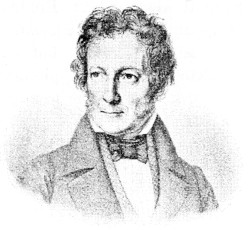
Ludwig Berger. Pupil of Clementi; founder of a widely influential piano-school at Berlin. Lithograph by Wildt.
But it is not possible to draw a sharp line between the two groups. A Moscheles serves not less the spirit of Clementi than that of Hummel. The simplicity of Cramer, the counterpoint of Klengel, the plainness of Ludwig Berger, the intensity of Field, belong to the circle of Clementi’s influence. Berger’s pupils, Greulich, Heinrich Dorn, Wilhelm Taubert, Albert Löschhorn, whose studies still live, carry this style down to our own time. The teaching of Hummel lived on in Ferdinand Hiller, Benedict, Wilmers, Baake, Ernst Pauer, the Viennese Pixis. While Beethoven left behind him as actual pupils only the Archduke Rudolf and Ferdinand Ries, a respectable imitator, his temporary pupil Czerny passed over into the wake of Hummel, and brought the Viennese style to a final victory. Kalkbrenner, Moscheles, Weber, Liszt, Thalberg, Döhler, Madame Oury, Madame Pleyel, Theodore Kullak, Pollini, of whom many belong externally to Clementi’s school, passed as apostles of Viennese technique to all lands from St Petersburg to London, from Paris to Milan.
Certain traditions of musical coteries and centres of instruction exhibit with this international character some more or less important local groups. In Prague men adored Tomaschek, the composer of Eclogues and Rhapsodies; Dionysius Weber, the first director of a Conservatorium there; and his successor Kittl. From Tomaschek’s school proceeded Alexander Dreyschock, the specialist of the left hand; Ignaz Tedesco, the “Hannibal of octaves”; and Schulhoff, the fashionable composer. In the middle of the century the Prague tradition was upheld by Proksch.
In Frankfort lived Vollweiler, who enjoyed a widespread renown as a teacher, and later went to St Petersburg; and Aloys Schmitt, whose delicate Études have been taken up by Bülow into his great collection of educational pieces.
Vienna alternates, but never loses in wealth. Berlin and St Petersburg as yet produced no fixed or permanent school. Leipzig takes its colour from the foundation of the Conservatorium with Mendelssohn and Moscheles and their fellow-citizen Schumann. England, from Clementi to Moscheles, imported a constant succession of Continental artists. The influence of the Conservatorium runs far and wide. A Strassburger named Hüllmandel, who took up his abode in Paris in 1776, had started clavier-instruction there. His pupil Jadin was director of the piano at the new Conservatoire. For forty-six years after 1797, Adam, whose name we remember because of his improved piano-school, carried on his labours in Paris. He was a tasteful professor, and brought the Parisian renown to its height. Kalkbrenner, the acrobat, succeeded him. Adam’s colleague, Pradher, was the teacher of those worst of fashionable composers, Herz, Hünten, Rosellen, shallowest and emptiest of musicians. Within the same walls was a Chopin!
The life of the great virtuosos is a reflection of the unrest inseparable from their calling. It is indeed no longer a life of adventure, as with Marchand and Froberger; there is method in the madness. The life of the executant, no less than the execution, has found its form. The concert-campaigns are the foundation; the warrior returns to his home at greater and greater intervals; until at last, when delight in recitals has waned along with the pliancy of the fingers, some resting-place or other is found—a share in a piano-manufactory or a steady round of instruction. During the campaigns instruction also takes a kind of locomotive form; devoted pupils follow the master, and leave him at fitting places, to pitch their tents there and make room for other peregrinating pupils. Or, on the other hand, pupils swarm from all parts of the earth to a place which the Master is always leaving, but to which he constantly returns—like the summer students of German universities—a type of professional existence of which Liszt’s Weimar period gives perhaps the most famous exemplification.
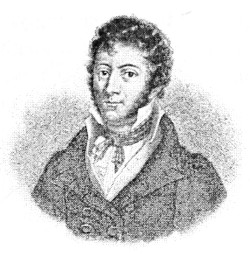
John Field, 1782-1837. Steel engraving by C. Mayer.
Muzio Clementi (1752-1832) was the first to exhibit this form of virtuoso-life on the great scale. Born in Italy, he found a home in London through the support of a wealthy Englishman; but he was far from showing the sedentary character of a Bach, a Couperin, or a Beethoven. Virtuosity impels to travel, as composition keeps a man at home. The difference which we observed between the sensitive anchorite Bach and the cosmopolitan popularity-hunter Handel, appears again between Beethoven and these executants. Mozart was too many-sided, and besides he died too young, to become a universal teacher of the piano; but Clementi lived almost three generations, during which half Europe grouped itself round him and his pupils. Down to 1780 he was still “cembalist” at the London Italian opera; during the next ten years he undertook two great tours, one to Vienna, the other to Paris. Meanwhile he became partner in an English piano-firm, which failed, whereupon he founded one of his own along with Collard. He set out for St Petersburg with his pupil Field; left him there; but on the way gained two new pupils, Berger and Klengel, whom also he established in St Petersburg. On one of his tours at Berlin he married, only to lose his wife shortly after. In 1810 he made another circular tour through Vienna and Italy. He spent another whole winter in Leipzig, and married a second time. His last years, when the world had outgrown him, he spent quietly in London.
In the life of Hummel (1778-1837), the favourite pupil of Mozart, posts as kapellmeister with Esterhazy, in Stuttgart and in Weimar, with a longer, unattached residence at Vienna, regulated the varying domiciles at which he lived. Weimar, as a great resting place, enjoyed through him its first musical renown, which reached half through the period of Goethe. In the intervals he took his concert-tours to Dresden, Paris, Holland, Berlin, Belgium, England, Scotland, and St Petersburg. These, as far as the furloughs of a kapellmeister permitted, recurred with a certain regularity, till they gradually ceased entirely.
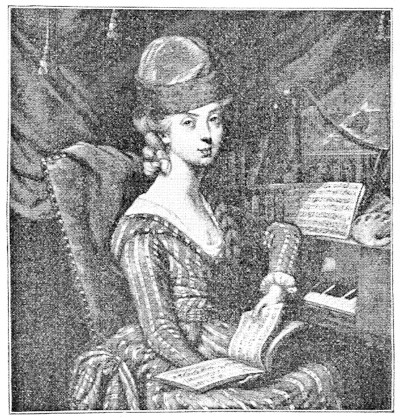
Marcelline Czartoryska, née Princess Radziwill, pupil of Czerny. Engraved by Marchi.
Cramer (1771-1858) had two long stays in London, in the midst of which a sojourn at Paris occupied the years from 1832 to 1845. He found a secondary occupation in a London musical house, in which he was a partner from 1828 to 1842. Kalkbrenner (1784-1849), on the contrary, lived in Paris, but his residence there was interrupted by a nine years’ stay in London (1814-1823). He too had secondary interests. He was concerned with Logier in a company for the exploitation of the “Chiroplast,” and he had also a share in a piano-factory. Moscheles (1794-1870) had no business. His external life was made up of his youthful time in Vienna with Beethoven and Meyerbeer, his sensational Parisian recitals of 1820, his glorious stay in London from 1821 to 1846, and his professoriate at the Leipzig Conservatorium. At intervals, of course, he made Continental concert-tours.
Among all the great virtuosos and teachers only Czerny had a really fixed abode (1791-1857). As a boy of fifteen he was already a teacher in Vienna, and as such he died there; his tours also being few and far between.
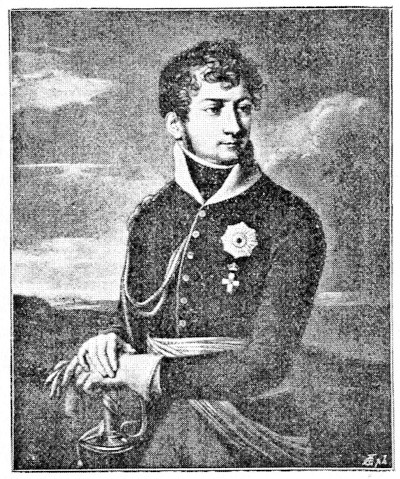
Prince Louis Ferdinand. Engraved by Geiger after Grassy.
But Czerny is in this respect an exception. Otherwise the international play of virtuosity led to an exchange and co-operation, to the mutual curiosity and desire to learn, which mark the concert-life of that age. Duet-playing by great executants, in private or in the concert-hall, is nothing unusual throughout this time. But the genuine interpreter does not as yet exist. The player has mostly a personal interest in the piece performed, and the friends assist at the christening. It is the time of the Hexameron. Exchange is often even too self-abnegatory. Moscheles composed for Cramer (with whom, as also with Ries and Kalkbrenner, he often played duets) a last movement for Cramer’s own sonata for two pianofortes. Later on he took the piece back again and tacked it on to his well-known piece, “Hommage à Haendel!” We need not then be surprised at such gruesome pasticcios as the programme of a London Philharmonic concert under Weber,[121] when were played the C sharp minor concerto of Ries, the E flat major of Beethoven, and the Hungarian Rondo of Pixis.
The two volumes of “Recollections of the life of Moscheles,” which his wife compiled from diaries and letters, give a clear view of the rich international concert-life of this age. Year by year we follow the kaleidoscopic existence of these artists, who see each other constantly and constantly part. Triumphs of virtuosity fill the winter seasons, followed by recreation in the country and preparations for an enlarged repertoire. The halls echo with jubilation and applause; and the audiences, especially the easily-kindled Viennese, are enthusiastic in their cheers. Music has become so popular and the compositions are so extraordinarily banal that it certainly did not often occur that they were rejected for shallowness—although, on the other hand, Kalkbrenner’s experience with a Beethoven symphony at a Paris Conservatoire concert was a sad warning to those who try to improve the public taste. The dilettantes push forward the more, the circle of instruction widens the cheaper and better the pianos become. They push themselves into rivalry with the artists in great concerts; as Moscheles relates of the celloist Sir William Curtis and the pianists Oom and Mrs Fleming. “I have to hear so much insipid music.” “Musique mise à la portée de tout le monde.” From professional piano-playing—and they often played at two places in an evening—the artists took recreation with the good temper which never failed in those years. The great singer Malibran would sit down to the piano and sing the Rataplan and the Spanish songs, to which she would imitate the guitar on the keyboard. Then she would imitate famous colleagues, and a Duchess greeting her, and a Lady So-and-so singing “Home Sweet Home” with the most cracked and nasal voice in the world. Thalberg would then take his seat and play Viennese songs and waltzes with “obligato snaps.” Moscheles himself would play with hand turned round, or with the fist; perhaps under the fist disguising the thumb, which in Moscheles’ peculiar way of playing used to take the thirds under the palm of the hand.
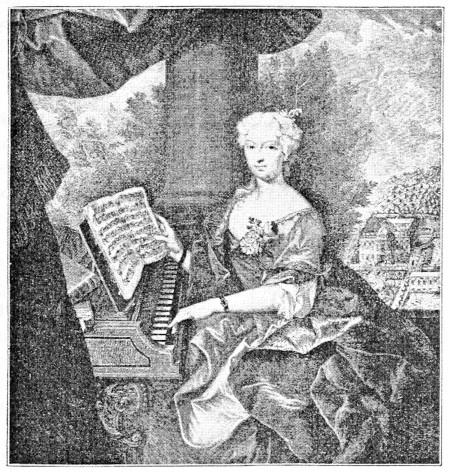
Marie Charlotte Antoine Josephe, Countess of Questenberg.
These players preferred to play their own compositions. The separation between composer and virtuoso was not yet complete. Of course, when Ferdinand Hiller in his “Life of an Artist” says that he had never heard either Hummel or Chopin, Thalberg or Moscheles, play a piece by another composer, his experience was at least unique. Moscheles, for example, even played Scarlatti on the old harpsichord. But, as a rule, they abode by the old custom, so far at least as amateurs were not concerned. These latter were in their instruction-books liberally provided with historical material.
Improvisation also flourished in concerts and soirées; and playing and composing, which in improvisation form a true union, can only with difficulty be severed in an age of creative virtuosos. Kalkbrenner composed while playing, and played while composing, so that no one could tell the difference between the two; and Czerny used to invent the necessary étude in the midst of the lesson. Thus it happened—a state of things unparalleled to-day—that the beloved duet-playing could be combined with the equally beloved improvisation—mutually contradictory as they appear. Moscheles speaks of an improvised duet with Mendelssohn. The latter played in the bass some English songs in ballad-style; the former interwove in the treble the scherzo of his friend’s A minor symphony.
Slight as was the advance yet made in division of labour between player and composer, there was equally little comprehensive division between the species of music. We do not hear of chamber-music evenings, pianoforte evenings, orchestral concerts. All was mingled in one; and chamber-music finds the same audience as the symphony. A piano-recital without orchestra was a rarity; and the concerto-form is almost de règle in all the greater performances. This is seen in the compositions of this period, which, as a rule, so far as they are specially adapted to public performance, were written for orchestral accompaniment. By their side were editions for private use, including the important orchestral portions. This concerto-piece could not greatly or permanently aid in the advance of a delicate or intimate piano-music. Through the rarity of special piano recitals it was not so easy to get pianos when they were wanted. In Frankfort there lived a well-known old lady who had absolutely the only piano store in the city. People had to praise her playing, to blow the trumpet of advertisement for her wares (they were Streicher’s), to court her and cringe to her in order to get an instrument for a concert.[122]
In 1837 Moscheles ventured to introduce piano-evenings without orchestra. This was an important step. But even yet the evening was not wholly devoted to the piano. A soprano or contralto filled the gap between one performance and the next. How long was it before the serious nature of a concert was universally acknowledged! Possibly here the production of dubious works of the performer’s own led to a low, acrobatic conception of the true state of affairs; and it was only the interpretation of good works by others, which were more serious, that saved taste from complete degeneration. The public gradually became quiet, and felt itself turned from educator into educated. The court ceases to take its supper during the playing;[123] the cantatrice no longer concludes her roulades with a smile worthy of the circus; and a singer is no longer hissed off the stage if he forgets to give his hand by way of thanks to his fair partner. Slowly it is realised that the concert is not a place for showing off, nor a mere form of social amusement, but a religious service.
This composite structure of virtuosity carried to the extent of vapidity, and of interpretation carried into historical research, is reflected in the compositions of the period. On the one side the tradition was exactly carried on; people began to view the existing classical works—Mozart’s and Beethoven’s Sonatas, or all kinds of pieces by Scarlatti, Bach, and Handel, as material for study; they republished half-forgotten or badly edited authors like Scarlatti; they even wrote sonatas “in the style of Scarlatti”; they arranged for the piano great quantities of the most various chamber or orchestral music. Alongside of the historical tendency stands, as so often, the international. Spanish, Irish, Russian, Italian, Polish national airs and rhythms are taken en masse into the circle of salon music; the air swarms with Polonaises, Boleros, Gipsy airs, Ecossaises, Tarantelles. But this quite cosmopolitan music was stamped by a fade enthusiasm for beauty; and there is bound up with the pieces an empty sentimental greeting or a hypocritical reminiscence. The mythological titles of the seventeenth century, and the realistic ones of the eighteenth, yield to the sentimental ones[124] of the bourgeois empire. But never was this system of naming pieces on a lower level; and never did it so corrupt the taste of the believing multitude. Even to-day we are not yet freed from its traces. Then there are the “Hommages à Beethoven” or “à Händel” corresponding to the old “Tombeaux,” but with less sincerity of intention. Then there are the “Fire pieces”—a whole collection of dedications to fire brigades—the “Burning of Mariazell,” and the “Ruins of Wien Neustadt,” figure among the salon-music of Czerny. Then follow the geographical recollections—the innumerable souvenirs of all possible towns, rivers, mountains, and people, such as the “Souvenir de mon premier voyage,” “les Charmes de Paris,” “le Retour à Londres,” etc. By their side are genuine characteristic titles chiefly employed to gild the pill of the “study.” Most objectionable of all are the favourite opera-fantasias, which are specially in vogue in the Parisian school. These tear the airs almost from the very mouths of the singers, and the composer’s completed melodies from his work, and stuff the pot pourri with passages, figurations, and fragments of études, with spurious slow introductions and sentimental passages, so that finally absolutely nothing of the essence of the original airs is left. These are perhaps the worst examples of want of style and taste to be found in the history of art. Here the curse of popularity came home to roost; here was reached the extreme point, in the publicity of the concert and of society, which the clavier had to pass through since the development of the hammer-mechanism. Any harshness in an artistic work was sufficient to condemn it; invention was tabooed; smoothness and the tickling of the ear were the only law. What in Paris was done by Herz, Hünten, Karr, Rosellen, Kontski, and their fellows, made a great sensation, and quickly vanished. Hünten received for a moderate-sized work from fifteen hundred to two thousand francs; to-day he is banished even from the salon. Karr wrote to order hundreds of pieces; to-day no amateur knows a single one out of the huge mass. And the days in which Kontski’s “Reveil du lion” was put in the hands of pupils appear to be past for ever.
The interdependence of piano and opera was not merely external. In Paris the opera, with its world-ruling influence, not merely forms a musical centre to which everything gravitates; it is itself subjected to the great law of this period—the law of mosaic work and of the aim to please. In the thirties and forties the world had thus reached hollow ostentation in the grand opera, and in the comic opera mere ballet-dancing. “Where,” wrote Wagner at that time, “where has the grace of Méhul, of Isouard, of Boieldieu, and of the young Auber gone, chased out of sight by the abject quadrille rhythms, which to-day rattle through the theatre of the opera comique and keep everything else out?” What was seen there was like what was heard on the pianoforte—pointless situations, introduced for the sake of the “business,” tirades which seem to be closed with the smile of the acrobat when he has finished his trick—technique, and nothing but technique. A librettist like Scribe is loaded with commissions, surrounded by Parisian or foreign composers—even Wagner in his youth having once written to him. He understands how to manufacture the proper substratum for the musical triflings. Read from this point of view Auber’s later operas, as the “La Part du Diable,” or those overtures whose whole structure depends on the fact that they are skilfully adapted to dances; or that daub-work in the musical setting with the jaundiced transition passages, where a proper modulation would be almost out of place; or those boleros, which people sing in circumstances of the utmost grief, without being able to raise themselves to the height of the irony; or those étude colourations, introduced in the most indifferent places provided they pay, and developing themselves vigorously about a single vowel; or those scores, which are so miserably transparent that one can see the author first rapidly composing them at the piano and then putting in the instrumentation slap-dash. It is the first, and let us hope, the last time, that the piano reaches its hand to the opera—a most unfruitful elective affinity. Opera and piano are necessarily and essentially hostile. In the Paris of that day, when absolute music, as well that of Berlioz as that of Chopin, is still a modest retiring flower, the crowd ran after the gentle titillation of the opera, and the mass of piano music moves in the operatic humdrum path. Among the Parisians as among the Italians there was assuredly not an operatic composer who did not invent at the piano and transfer his inventions from the piano to the opera. Donizetti has left an interesting letter to his brother-in-law Vesselli, which was fastened as an inscription on his piano: “Do not sell this piano at any price, for it contains my whole artistic life from 1822 onwards. Its tone lingers in my ears. In it murmur Anna, Maria, Fausta, Lucia. Let it live as long as I live! I lived with it my years of hope, of wedded happiness, of loneliness. It heard my cries of joy, it saw my tears, my disenchantments, my honours. It shared with me my toils and the sweat of my brow. In it dwells my genius, every section of my path. It saw your father, your brother, all of us; we all have tortured it; it was a true comrade to us all, and may it always be a comrade to your daughter as a dowry of a thousand sad and happy thoughts.”
There seems so much that is contemptible in this technical school that it would almost appear, at least from the artistic point of view, to have lived in vain. And yet it was at this time that a form sprang into existence which, born from technical necessities, became a custom, and from a custom a style, and so emphatically a style that it was able to enter into effective rivalry with the older styles—the contrapuntal, the thematic, the leit-motif. We are still under its dominion. This form is the Étude.
The Étude was not the invention of the technists. It existed in germ in Bach; it half grew out of thematic; only the visual angle altered with time. In an invention or symphony of Bach a motive is treated according to the free laws of imitation; it is used up in all the voices, for all fingers. In a Prelude on some thematic ground-subject, in a fugue with its stern code of canonic succession, the same is the case: the motive is expended on itself. But between the broken chords of Bach’s C sharp Prelude and those of Chopin’s C sharp Étude there is a vast difference in the treatment. What in the one is used with a view to the motive is here expended with a view to the technique. Bach sets before him the artistic possibilities of the theme: Chopin the mechanical. Bach wrote many of his preludes with educational purposes; but he did not compose them with a sole view to their full practical value. As in theory the musical and the mechanical cannot be sharply severed, so the pieces are half for the purpose of supplying music, half means of instruction. The mechanical part was obliged first to emancipate itself before the conception of the Étude could be fully grasped. On the straight line leading from the old thematic to the Étude style, the conception of the motive altered itself. Motives were now found which could be arranged according to their technical productiveness. We see perhaps even the same motive, considered first contrapuntally or as a fixed idea, but afterwards according to its mechanical value.
There are motives whose interest lies in the size of the hand; or in the playing of a legato passage simultaneously with the chords in the same hand;[125] or again, contrary motion of chords in both hands has to be carried out; or, yet further, attention is paid to an easy gliding of the hand over great stretches; or finger-changing on the same key is the ground-idea. The piece may aim at cantabile or at the perfect legato in a fugato movement, or at the practice of octaves, pearl-like scales, pianissimo touch, the freedom of the left hand, a double melody, or any of the hundred technical possibilities. There are dry and insipid methods of thus working out academically a technical idea; but it is also possible to see in delicate and ingenious ways, slumbering germs of great fruitfulness in the technical motive, and to develop powers of unexpected beauty. The one way sees in a broken chord only the means of using it in major or minor modes, or in the seventh, or in some unusual successions, first for the right hand, then for the left, then for both, and perhaps finally with sustained notes. Theory is satisfied, a practical object provided, the academic conscience laid to rest. But the other way sees in the broken chords their elementary character, the germ of the Rheingold or of the Götterdämmerung. It permits them first to sound slightly, then to grow further and further, to assume a daemonic grandeur; like eternal signs, to stretch over the heavens and embrace the worlds. Thus, no less than the other, it presents all the nuances of major, minor, seventh, right, left, up and down; but it covers these technical variations so perfectly with the sense of the inner meaning that they become identified, and can never be separated: the technical and the characteristic content have, in the mind of a genius like this, involuntarily become a unity. Such a master, for example, takes the neat finger-changing on one note as the means for a rococo-sketch, the pianissimo leaps for a dance of the elves, the rolling passages in the left hand for the roar of the sea with elemental upper parts; the rhythmical varieties in left and right for graceful fetters of the dance; the scurrying glide over the black keys for a picture of homely pleasures. Here reveals itself the entire fruitfulness of the technical setting, which—who could believe it?—precisely by the limitation of the motive, approaches very near to characteristic art and realism of presentation. Here is a rich field opened to technical subjectivity. Personality is very variously displayed in the setting of a technical idea. Contrast with Clementi, who scarcely ever shows any specific sense of character in a motive, such a man as Hummel, who on theoretic grounds calculates out the utmost technical possibilities of a motive; or Czerny, who in a practical manner attains the same many-sidedness; or Cramer, who was the first to find his way back to music from technique; or Moscheles, Chopin, Schumann, who cannot think technique without feeling character.
Deep and mysterious is this connection between the Étude and its musical setting. Like the fugue the simplest Étude goes back to those elemental foundations which cannot fail of their impression, even if practically nothing is composed upon them. I hear some simple scale-étude of Bertini played, with the smooth harmonies on which it is built. There is nothing in the piece, no soul reveals itself to me, and yet there is a weird charm in these eternal ground-motives of all music, and in their tonics and dominants which are so to speak anchored in eternity. The dull man is soon wearied by them, but the sensitive man instantly responds. At this point the Étude sinks down to the great mother of all music: like the fugue it springs directly out of Nature. With the consciousness of character the Étude grows tuneful. In the studies of Moscheles, in the Symphonic Études of Schumann, in Chopin’s studies, art creates what Nature created. From the technical theme rises a certain spiritual aroma, reminding us of a tune, a scene, a landscape; the tune condenses itself in the return of the technical motive; it collects itself all the more narrowly and closely, in proportion as all contrasts and secondary tunes keep their distance. It is a spiritual melody, set in a firm frame, as condensed as neither the free fantasia form, nor the thematic sonata, nor the canonic fugue, had ever presented it. The tune is so concentrated that it cannot dispense with the frame, or it would fly to pieces. It has no capacity of transference; it prefers to exist as a fragment ready-made.
It is thus that the Étude fixes the form. It favours fixed and limited technical models, which fit mosaic-wise into each other. It is opposed to huge, Beethoven-like emotions and their expression; its horizon does not pass beyond two pages. It is still further removed from Bach’s method, which depended on plain thematic development; it loves the speedy and the limited, and confines itself entirely to the practical. It penetrates into all works in which technical brilliance gives a false impression of the contents, or in which the greatness of the contents only finds its last expression by technique.
The technical setting of the form, and the technical expression, pass over entirely into the consciousness of the time, and create new works in chamber-music, opera, and orchestra.
Compare the development of a sonata by Weber with that of one by Beethoven; for example, Weber’s fourth in E minor with Beethoven’s Op. 28—two sonatas which in original idea, a soft melodic tune, were not so unlike as they turned out to be. In Beethoven the first melody develops itself on a 3/4 rhythm, which begins and ends naturally; the second theme is an unforced contrast to the first; gradually figurations attach themselves, which are natural offshoots of them, intertwining themselves without losing their original dependence; all grows logically out of itself; the end is given in the beginning, and the progress in the variation. In Weber, on the contrary, each piece is carried through by itself: the whole is no organism but a mere pasticcio. The sensitive first subject is treated in its naked melodic beauty; a semiquaver passage is attached to it; a bald enharmonic study leads on to the second theme, which treats its soothing character from many sides; and only the “free” section brings the whole a little closer together. And we know how even in the best men of this period the great creative organism, in which every part conditions its own subordinate part, gives place to a mere isolation and to total want of system. In the concertos, after the traditional mutual compliments of orchestra and piano, the solo instrument starts, with surprising suddenness, on its passages, which are strung together from étude-pieces, selected haphazard. At the conventional places the curtain is withdrawn, and the whole glitter of technique is displayed. The harsh transitions, the quick returns, the jostling fugues, are not only a peculiarity, say, of Schumann—they are the style of the time. They are the framing style of a time which does not care for the want of restraint that attends great emotions.
Its preference is for constructive logic in detail. More genuine piano music than the Étude there cannot be. The essence of the piano has in it become music. Matter and aim here alone determine the form, which no longer speaks merely in a universal musical language.
The piano follows the lines of the time, which pursues technical purity in all things. In the representative arts certain styles were long seen to predominate, which for limited periods were indifferently transferred to all objects without respect to matter or aim. Renaissance, Gothic, antique, exhibit their churches, their tombs, their doors, their tables, their cupboards, their keys, whether they are bosses or reliefs, marbles or bronzes. In our century technique begins to speak its first word: a chair is to be a chair; a carpet shall be constructed with a view to the aim of carpets; a vase must speak in accordance with the material of vases; and painting must in the first instance be painting. A cupboard is not an entrance to a temple; a table leg not a statue. These are intrusions which art has not often experienced in its history. With music the case was not dissimilar. The fugal style ruled once so mightily that it drew church, dance, salon, fantasia, tune, all indifferently, under its sway. The good fugue was a good tune, and the best tune could only be expressed in contrapuntal form. Now, however, the emancipation had taken place. The organ no longer worked necessarily along with the piano, nor the song with the violin; and the orchestra became conscious of its power as a totality. What the Venetians had once timidly begun was now carried into actual fact; and the artistic form of the étude was the seal of this individualising process. The much-praised Paganini had no longer, like Corelli, to prompt the piano, as far as its content was concerned, from the violin outwardly. Paganini-études, by Schumann, were strict piano-pieces, which as far as form went borrowed nothing from Paganini, and in matter only a groundwork of notes. They strive towards the brilliancy of Paganini’s execution—that astonishing, spiritual technique, which aroused so wonderfully the emulation of a Liszt. And in turn there passed from the piano the brilliancy of a technique which inspired the orchestra to its own special triumphs. The “Queen Mab,” the “Mephistopheles,” the “Feuer-Zauber,” and the “Valkyries’ Ride” did not need to envy the piano. Yet without the fame of the Étude they would never have been so brilliant.
Clementi. Engraved by Neidl after Hardy.
We are now coming nearer the personalities themselves. It is no long stride from the virtuosos to the romantic writers; the latter are only to be explained by reference to the former. We pass slowly from the domain of pure virtuosity to that of compositions of deeper meaning; from the realm of the teacher to that of the poet; from piano purism to the longing after poetic interdependence; from the noise of concerts to the intimate retirement of the home.
In Clementi these signs appeared first. What he had to say was little; but what he had to teach was only the more in consequence. He collected, he tested, he drew out his experiences, and never willingly abandoned the historical attitude. This was the first recoil on the classical period. Clementi’s Studies were so fruitful that even a Beethoven was not unmoved by them; although of course there were many who opposed themselves to his speciality, the passages in thirds and sixths for one hand. Mozart hated this unrest; he aimed at a graceful and easy style. But the growth of technique soon shook off this old-fashioned rococo method; it aimed at universal conquest.
As Clementi still lives in what we may call his “grand-pupils,” so his Gradus ad Parnassum has remained the father of all Étude-works, often reprinted, often re-edited. It is easy to recognise in it its antiquated constituent parts. No principle of distinction is adopted between the fingering of diatonic and chromatic scales. In his directions Clementi begins his chromatics with E. The Études move in a peculiar middle region between compositions and exercises. Single Études, like the splendid Presto in F sharp minor, reach the heights of a Cramer (Simrock, 24). He even provides genuine fugues in order that the fugal style may also be practised. In one Étude (Simrock, 38) cantabile and triplets are mingled as exercises. Often again three pieces appear together as a suite—a patriarchal retention of old customs. Others again are mere dry and insipid instruction-exercises. We follow with pleasure the process by which fixed technical problems gained in content as time went on. For example, the change of finger on one key is in Clementi a mere tedious motive with three notes only (Simrock, 20). In Cramer (Pauer, 41 ff) is already perceived the charm which short held notes may introduce into this monotonous exercise; and the drollery which a change of fingers as the characteristic motive carries concealed in itself, gives the character to the piece. Chopin, in his well-known C major study (Op. 10, 7), gives us a good example of this scheme of fingering, which is carried out strictly, the alternation of thumb and first finger never being interfered with, even on the black keys, in spite of the various awkward chords that occur. Thus he gives perfect freedom to the piquant turns and droll character of the piece without to any extent spoiling its effectiveness as an Étude.