OSCAR BIE (continued 5)
E. E. (Ernest Edward) Kellett translation
Over against the Gradus of Clementi, as a remarkable collection of the most varied pieces, stand certain smaller studies of a more defined physiognomy. The well-known “Préludes et Exercices” are written in all the keys, and keep on the whole to the scale-motive. The “Méthode du Pianoforte,” with its fifty lessons, collects all kinds of airs and old pieces, provided with marks of fingering—which, however, are very much behind those of Czerny. The book is noteworthy as one of the first important attempts to make use of already existing pieces, not the work of the collector, as material for studies. Very soon the sonatas of Beethoven appear in these collections, where they are arranged according to their difficulty. Here are Handel, Corelli, Mozart, Couperin, Scarlatti, Pleyel, Dussek, Haydn, Paradies, and the Bachs.
Clementi sowed his wild oats in a series of preludes and cadenzas which he published (Op. 19) under the title of “Characteristic Music.” These were written in the styles of certain masters and other famous clavier-teachers, such as Haydn, Kozeluch, Vanhall, Mozart, Sterkel, and Clementi himself. It was half a jest, and a very moderately successful one; but it is worth noticing as a sign of an interpretative and compiling tendency.
Among the hundred sonatas and sonatinas, for one or two players, which Clementi left behind, there is not a single one without interest or utility from the standpoint of instruction; but from that of content there is at most only one which can to-day attract us by its originality or genius. This is the so-called Dido sonata, dedicated to Cherubini; and even in it the genius is cold. In the other sonatas we see the body of a Beethoven without the soul. It is Scarlatti once again—trivial and soul-less; but unlike Scarlatti, who cut short what had a short life, it is pretentious in its eternal repetitions. It is a manufacture of music, nourished by the didactic spirit: compared with the full effects of Hummel it is an empty style.
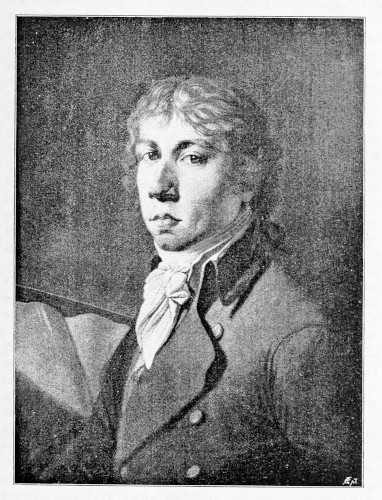
J. N. Hummel. Engraved by Fr. Wrenk (1766-1830), after the portrait by Catherine von Escherich (beginning of 19th century)
The index to Cramer’s works does not look promising. The Variations, Impromptus, Rondos, Divertissements; the Victory of Kutusoff; the Two Styles, ancient and modern; the Rendezvous à la Chasse; un jour de Printemps; Hors d’œuvre, grande sonate dans le style de Clementi; or the combined composition, in the fashion of the time, by Cramer, Hummel, Kalkbrenner and Moscheles, of variations on Rule Britannia—all these are equally unattractive. The hundred and five sonatas are almost unknown. Cramer’s importance lies entirely in his Études, which have been frequently reprinted and arranged. Of the various editions the finest is Pauer’s English “édition de luxe,” which is adorned with a fine engraving of Cramer. Here he is all genius and sensibility. The somewhat highly-coloured nose, on which he himself used to jest, attracts no notice in the portrait. “It was Bacchus who put his thumb there,” he would say; “ce diable de Bacchus!” The whole delicate spirit of Cramer breathes in these Études, which to-day are unforgotten and unsurpassed in their kind. Their instructive value lies in the isolation of the technical exercise, which is made less exacting by skilful introduction of contrary motion at the proper point, while the most noble musical forms mount up from them. They are pieces full of character, and without titles, to be heartily reverenced. On the other hand “Cramer’s Pianoforte School,” which went through countless editions in his own time, has now become useless. The most noteworthy thing we find in it is a preface on preludes and codas, which, unlike Clementi’s, does not simply copy the approved models, but sets forth theoretically a series of “styles” in such improvisations, from the simplest chords to melodic development. In the period of public improvisations such instructions were not without their use. Preluding is still a “style” with us; codas we excuse ourselves. But in those days a player saw nothing out of place in the direct connection of such free inventions with the piece before him. And Cramer was still old-fashioned enough not to object to interweave with pieces of Mozart all kinds of flourishes—often, as Moscheles assures us, trivial indeed.
Over against Clementi, the genius of teaching, and Cramer, the genius of technique, stands Hummel as the inventor of the modern piano-exercise. Dussek had already, by his unusually full collection of exercises, accustomed the public ear to the new state of things; but Hummel brought the charm of the pianoforte and the effects of the seven octaves within the reach of all. What our amateurs, from the days of Chopin, know so well, that full and satisfying tone, that blazing colouration, is all in Hummel.
In his huge Piano School a combination in Hummel of the old master and the modern player is very visible. He systematises fingering into the following divisions: (1) advancing with simple finger-order in easy figure-successions; (2) passing the thumb under other fingers or other fingers over the thumb; (3) leaving out one or more fingers; (4) changing a finger with another on the same key; (5) stretches and leaps; (6) thumb and fourth finger on the black notes; (7) the passing of a long finger over a shorter, or of a short under a long; (8) change of different fingers on a key, with repeated or not repeated touch, and often the repeated use of the same finger on several keys; (9) alternation, interweaving, or crossing of the hands; and, finally (10), the legato style. A stupendous work indeed; and for every head of the fingering, for every technical possibility, a number of examples are introduced, with the completest calculation of permutations ever seen. There are in all two thousand two hundred examples, and more than a hundred exercises develop the possibilities of playing between C and G. Before every exercise stand the harmonic ground-chords. And thus comes to pass the great miracle, that by means of the utmost conceivable combinations, by means of the hundred chromatic subtleties, musical figures are formed which no composer had previously invented, and which lead on to sound-effects never before suspected. In the examples of an exercise-book lay undreamed-of novelties in piano-composition.
Hummel himself had a very modest opinion of his own compositions. He knew that he had made no advance in the path of Beethoven; and that no greatness was possible outside of it. “It was a serious moment for me,” he said once at Weimar to Ferdinand Hiller, “when Beethoven appeared. Was I to try to follow in the footsteps of such a genius? For a while I did not know what I stood on; but finally I said to myself that it was best to remain true to myself and my own nature.” With this determination Hummel founded the new, rich school of piano-playing, delighting in sound, and revelling in execution, in which even seriousness and passion are expressed with pomp and circumstance. Brilliancy has expelled grace, and the pompous the lightness of the dance.
Like most of his contemporaries he composed at the piano, making pencil-notes the while. But he heard it as though he were his own audience. “When I sit at the piano,” he said, “I am standing at the same time in yonder corner as a listener, and what does not appeal to me there is not written.” This was not Beethoven’s method. Such a conscious striving after effect was not consistent with absolute sincerity. The concerto was the mainspring of Hummel’s creativeness. The innumerable concertos and concert-fantasias take the first rank among Hummel’s works. They appeared also with quartet-accompaniment, and also with a second piano, or arranged for one piano. He wrote, unlike Clementi, far more concerto-pieces than sonatas. All kinds of Variations, Rondos, Capriccios, and “Amusements,” gratified his publishers. He wrote dances in the profusion characteristic of the time. The Sonata in A flat for two pianos is precisely in harmony with the age. It is only in the second half of the century that original works of this kind begin to lose vogue, while the duet confines itself to the drawing-room. The Duet attained its highest point in Schubert.
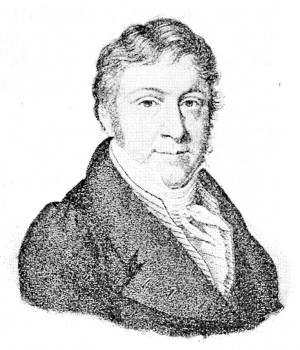
Hummel in his later years. From a steel engraving by C. Mayer.
Hummel’s works bristle with sound-effects. We observe many full chords, as in the orchestra, when all the groups of single instruments are employed in full harmony. The treble of the instrument is for the first time properly used in the grand style, a noble contrast to the melodic, burlesque, dæmonic, firework style of Steibelt and the rest. We meet the genuine pianoforte charm of sharp chromatic successions, where a Bacchanalian tumult of colour appears to sound a rattling fire of sensuous effects. Even modulations are conceived from the side of technical effectiveness; and chromatic insertions or sudden third-passages, charming us in the vigorous voice of the piano, are of common occurrence. The various registers of the piano, the bass, the middle, and the treble, are applied to surprising effects; a note of one register suddenly thrown into the other gives a colour of its own. Passages rapidly gliding through the various registers give a glittering spectrum. Take, for example, such a development as that of the second solo conclusion in the last movement of the A minor concerto. Here, starting at the con dolcezza, we find the pianoforte bringing into play most of the effective methods of the concerto style. The simply-harmonised cantabile, for the solo instrument alone; the repetition of the melodic phrases by the clarinet, etc., with an arpeggio accompaniment on the pianoforte; the ornamentation of the phrase by delicate scale-passages; the closing lines of bravura for the right hand; the showy chromatic scales, accented by superimposed thirds on the first of every group of four semiquavers; the sequences of semiquavers descending chromatically; the string of shakes for both hands which introduce the final point d’orgue (four bars in strict tempo); all these are commonplaces of Hummel’s style, and are of interest as an illustration of the fashionable music of the time.
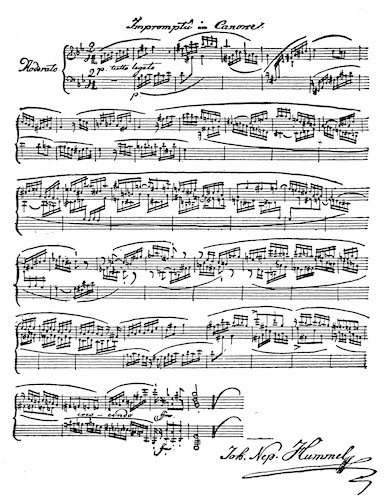
A Canonic Impromptu, by J. N. Hummel, from the original edition of his Pianoforte School.
The concerto pieces of Hummel stand in respect of intrinsic value below the solo pieces. His great concerto fantasia, “Oberon’s Magic Horn,” is a banal piece of bravura with artistic references to Oberon. The part of it demanding most execution is the great storm with its thunder and lightning on the piano—a somewhat different performance from the tame storm in the Fitzwilliam Virginal Book. But the solo pieces also are of unequal merit. Fashionable compositions, like the Polonaise “La Bella Capricciosa,” which was then eagerly heard, are no longer tolerated. Hummel at his best, as we know him in his immortal Sextet, lives in certain delicate turns, such as are common enough in Wagner’s earlier operas, but were then a style of the time, making use of the melody both of Mozart and of modern days. The better Hummel is also seen in certain Schumann-like movements, full of fire and feeling, such as the fresh pulsating Scherzo “all’antico” of Sonata Op. 106, or the concluding movement of Fantasia Op. 18. Perhaps the Bagatelles (Op. 107) are his most interesting clavier-piece. Even to-day they show no sign of age; there is not a dead note in them. In them the pupil of Mozart is seen in the dainty melodic lines, such as an Audran has revived in our day; but the forerunner of Liszt is equally visible. In the last Bagatelle, the “Rondo all’Ongarese,” he stands precisely between the two epochs. The true spirit of nationality, as Dussek so happily applied it in his sonatas, mingles with classical reminiscences, as the concluding phrase clearly shows. Fugato episodes, derived from tradition, are interwoven with surprising anticipations of that method of variation which works by diatonic movement—a method very familiar to us from Liszt’s Rhapsodies. Hummel then is a kind of Janus.
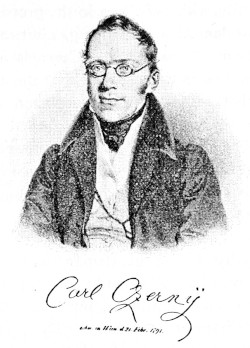
Czerny. Lithograph by Kriehuber, 1833.
Much more simple was Czerny, king among teachers, whose life and work were taken up with the enforcement of one great principle. Every piece must be played in that manner which is most natural and applicable to the case in hand, and which is fixed partly by the notes before us and partly by the execution. His genius for teaching was so cultivated that in a moment he could devise the right study for a student who exhibited any defect. How precisely he worked in such matters a glance at his “Higher Steps in Virtuosity” will show. The themes of the Études in the third volume are called: (1) seven notes against two or three; (2) five against three; (3) five against three in another manner; (4) passing of the fingers over the thumb; (5) passing under of the thumb with a quick alternation of the stretching and retraction of the fingers; (6) motion of certain fingers while the others remain stationary; (7) broken octaves legato. This is not the grammar of Hummel with its theoretical chess-play of possibilities; it is the method of Toussaint-Langenscheidt, which invents its exercises from the data of experience. In the great Piano School the exercises are always continued in the course of the instruction. The scales are recommended for daily preliminary practice, and duet-playing is drawn into the circle of regular exercise. It is, of course, impossible to review the whole enormous crowd of his works. In addition to the numerous general practice-pieces, which appeared in manifold combinations, there are the special pieces also: the school of velocity, of legato and staccato, of ornaments, of the left hand, of fugue-playing, of virtuoso-performance; the art of preluding, the introduction to fantasia playing, octave-studies, the practice of the full common chord and of the chord of the seventh in broken figures; and everything besides. It is a mighty arsenal of mechanical appliances. His works are numbered up to Op. 856; but all except the Studies are lost in oblivion; they are mere hack-work. Even the greater Studies are, in musical value, inferior to Cramer’s. Czerny’s great collections from previous masters are the work of a practical historian. Such are the arrangement of the Wohltemperiertes Klavier, the edition of Scarlatti, the arrangements of Beethoven, Mozart, or Mendelssohn for two or four hands; and the innumerable selections of the most brilliant passages from the works of masters from Scarlatti and Bach to Thalberg and Liszt. His practical History of Piano-playing—the first that ever appeared—was thrown into a didactic form and appended to the great “Art of Execution.” Every composer is treated from the point of view of playing, under six heads. Clementi is to be played with a steady hand, firm touch and tone, distinct and flowing execution, precise declamation; Cramer and Dussek cantabilmente, without glaring effects, with gentle legato and the due use of the pedal; Mozart with less pedal, clearly, staccato, with spirit and vigour; Beethoven and Ries characteristically, passionately, melodiously, with a view to the tout ensemble; Hummel, Meyerbeer, and Moscheles brilliantly, rapidly, and gracefully, with definition in the proper parts, and intelligent but elegant declamation. Thalberg, Liszt, and Chopin, the great innovators, form a class apart. Czerny’s astonishing genius for instruction embraces the whole field of the clavier, with a many-sided capacity that seems almost more than human. A greater teacher there never was than he. He gathers all into his net, even the works of his own pupils; he practises everything, even setting it for three or four pianos; he arranges everything, even isolated passages of great masters; he composes everything, even penny variations and Chinese rondos.
In Kalkbrenner we see the lowest type of the time. Externally a fine gentleman and artistic man of the world, he is inwardly hollow and vapid. It is hard even to give an idea of this extreme emptiness; but it is well illustrated in such a piece as the “Charmes de Berlin.” This great virtuoso won his triumphs in the worst kinds of salon-music as well as with all sorts of Études, Concertos, and Sonatas. Le Rêve, Le Fou, La Solitude, Dernières Pensées Musicales, La Mélancolie et La Gaité, La Brigantine, are some of these detestable compositions. But his opera fantasias touch the very nadir. Here a sort of sanction is given to an utter want of taste. After largo introductions, full of feeling, he slices favourite melodies into passages, till the contour of the air is utterly destroyed, and the commonest cadenzas are flung higgledy-piggledy into their artistic forms, and so we rush off into a sweep-dance. The fantasia, once the freest outcome of the musical soul, becomes a wretched conglomeration of fragments of Études. Kalkbrenner once remarked, as Ferdinand Hiller tells us, “Ze Tance is a tream, a referie; it begins with lofe, passion, despair, and it ends wid a military march.” The story is true enough.
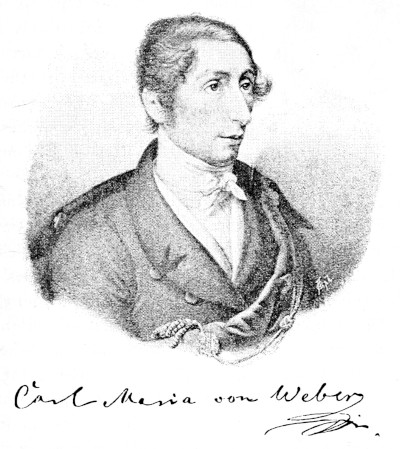
Lithograph by Eichens, after Vogel, 1825.
To imagine that with Weber we already pass over into the fairy-land of romance is, alas, a mistake. He would doubtless have made the transit had not an early death overtaken him in the midst of the uprising of genius that began in 1820. But, as it is, his piano music belongs to the technically rich but spiritually empty style of the time. If he did not still live as operatic composer and orchestral poet, his piano-compositions would be forgotten. His technique, successful as it was, is never so rich as that of the majority of the virtuosos of his time. It is not hard to perceive that he recurs again and again to certain motives. The ornamentation which was earlier called “Anschlag”—the preparatory striking of the under and over note before the main note, which is seen brilliantly exemplified in the Rondo in E flat major—the S-curves of the melody, which are a simple re-arrangement of this “anschlag”—the “pizzicato” notes over embellishing or broken accompaniments—held notes over struck chords—broken combinations of three notes, ranging themselves chain-like after one another—these are his somewhat limited repertoire. In the Polonaises in E flat major and in E major, in numerous operatic variations, in Écossaises and popular national dances, he pays his tribute to the time. But there is no local colouring in the variations on the Russian “Schöne Minka,” or on a Gipsy song. Dussek and Hummel were in this point his superiors. The intellectual themes, like the second of the C major concerto, show the greatness of Weber as behind a mask. The favourite concerto Op. 79, if judged by a severe standard, is only a fashionable if very clever and successful mosaic of neat Études with the requisite melody. The daintiest mosaic piece, the March, is given to orchestra alone, as if Weber had felt compelled to enter his proper abode. Liszt perceived this when he played in the concerto, and played the tutti brilliantly with the instruments, and thus exhibited a remarkable tour de force. The four sonatas, often utterly trivial, are in the main a congeries which perishes by its eclecticism. As with all his contemporaries, the first movements, those touchstones of the inner meaning, are the weakest. The subjects are thin, the framework is that of the drawing-room; and the other movements have a higher stylistic value. The powerful rhythm of the second movement in the C major, the excellent minuet-scherzo, the stirring perpetuum mobile as last movement are admirable single ideas. But the importance rises only slowly; the fourth sonata has, not inner meaning, but a certain majesty. Yet what is this romance, this octave-scherzo with its rapid waltz-trio, this masquerade of elves, to Chopin, to Schumann, or even to Mendelssohn? Weber’s most popular piece is also his purest—the Invitation to the Dance. It is a pot-pourri, such as the age loved; and the very title is à la mode. But the conception of forming the introductory adagio as a dialogue, the brilliant advance from the ravishing waltz to Bacchanalian tumult the pure and not virtuoso-like colouring, which rests on this happy invention, raise the work far above all that is merely fashionable.
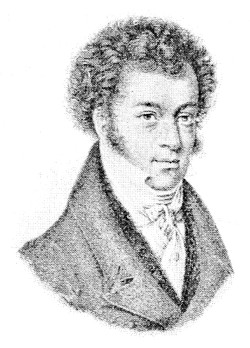
Moscheles in his youth.
The true man of the transition is Moscheles—double-souled, with his concessions to modishness on the one side, and on the other his wealth of invention and his musical intensity. He was born out of due time. He ought to have left virtuosity behind him, in order to be able to give full play to his characteristic, not undramatic, and broad-lined art. To-day he is almost forgotten; no opera, as in Weber’s case, preserved his fame to our times. But his works more than repay study; if our pianists would once again take up his C major concerto, they would be amazed.
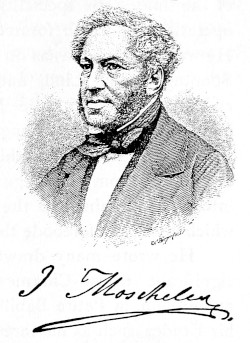
Moscheles, later, 1859.
In his youth he composed Variations on the Alexander March, with which he was compelled, much against his will, when a ripe composer, to dazzle the world. It was one of the most popular of concert pieces. It is not true that in later years he altered his style and wrote more soberly. His very sober Melancholy Sonata (Op. 49), written fairly early, in one movement, with its charming accompaniment figure, reminds us of the Parsifal tremoli. And on the other hand, a later work, the Danish, Scotch, and Irish Fantasias (this latter on the Last Rose of Summer), are pot-pourris in full modish style. What would the Virginal Book composers of English and Scotch folk-songs have said to these variations? In order to avoid the fashionable appearance, several movements are even written in various tempi, as in a sonata. In his A flat minor Ballade, on the contrary, he has with astonishing dramatic force struck the legendary tone in a free and genuine manner, in a sort of romantic rondo.
Moscheles, who was the first master to arrange for piano an orchestral score by another writer (that of the Fidelio, by commission from Beethoven), was unable to escape the operatic rechauffées of the time. His speciality was the putting together of different operatic airs, which formed the favourite repertoire of a singer. He wrote such fantasias on the favourite pieces of Pasta, Henriette Sonntag, Jenny Lind, and Malibran. They are commonplace enough. Yet this same Malibran, after her sudden death, he honoured in an “Hommage,” which was one of his finest pieces. There is in it an unearthly power of invention, a dramatic life, as if drawn from the stage; spirit breathes in every bar; and the interest is sustained to the final sorrowfully rising cross-passages, which strangely forebode the longings of Tristan for the sea.
He wrote many drawing-room pieces, which bore the usual significant titles—Charmes de Paris, La Tenerezza, Jadis et aujourd’hui, la Petite Babillarde. Similar titles he superscribed to his Études, such as his three Allegri di Bravura and his characteristic Studies (Op. 95). Among the former are La Forza and Il Capriccio; among the latter are Juno, Terpsichore, Moonlight at Sea, Dream, and Anguish. In these the seeker after mode will be disappointed. They are pieces worthy of Schumann in power of form; half exercises, half characteristic pieces, reaching that height of technique where air and étude unite in the closest bonds. The work which Cramer began has reached the height of artistic achievement. For here, where meet knowledge, technical sense of form, and poetic conception, the peculiar musical vein of the age is found. The fugal “Widerspruch” [contradiction] is an artistic construction that stands alone; “Anguish” is a penetrating tuneful picture, which once more reminds us of Wagner; it is a foretaste of Siegmund’s flight or of the Valkyrie Prologue.
The untitled Études Op. 70, which rank as his best work, stand out as the forerunners of the Studies Op. 95. There is the same delicate characteristic sense; they are a gallery of tone pictures, among which the twelfth Étude in B flat minor is never to be forgotten. It is a Night-Piece in the style of Schumann. But all is calculated for human fingers, not for those of Liszt, like Op. 95. And here we feel patiently after the essential nature of the musical Étude. We observe the inner relation between mechanical and spiritual motion. Expression and difficulty grow alongside; the straining of the fingers is involuntarily the straining of the soul; their smooth gliding is the gliding of emotion, and the stress of mind is loosened in the muscles of the fingers as they move over the keys. It is thus that the irreconcilable at last meet.
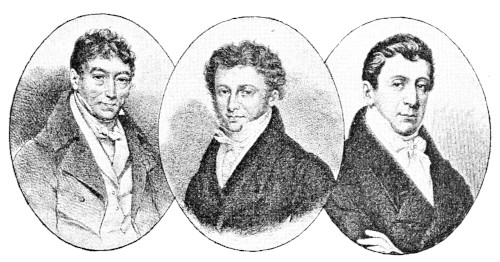
Parisian and London Pianists at the beginning of the 19th century. L. Adam. Kalkbrenner. Cramer.
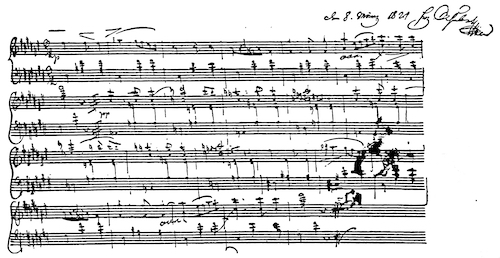
Waltz by Schubert. Berlin Royal Bibliothek.
The Romantics
Where definitions fail, the word appears at the right time. The word proves the existence of things, even if they cannot be sharply defined. The word is the artistic form of a transient emotion; it was made for things which were nameless till its creation; it was girded with associations which fastened themselves on to this conception. Such a word is Romance. Romance is not a return to the popular, to nature, nor to the mediæval, it is no love for the legendary or the symbolic or the most delicate forms of the most delicate stirrings of the soul. It was indeed the one of these things to one set of persons and another for others; but in reality it is none of these and all of these. If I say it is an oppositum to synthesis, or intimateness from the point of view of all possibilities, I have defined it very coldly. But its essential point seems to be its reactionary character. It aims not at raising structures, but at reading souls, and it finds a thousand ways of so doing. These thousand ways cannot be crammed into one definition. We strike only gently the chord of the word, so symbolic, so harmoniously chiming. It is a feeling whose value is not to be analysed.
Near the great architect Beethoven lived the first musical Romantic, the well-beloved Franz Schubert. He felt the burden of existence as only musicians can feel it. But he had inexhaustible fountains of consolation, which sang to him melodies almost more profusely than to Mozart, and he did his utmost to throw the melodies, without too much pedantry or Titan-pride, into songs, symphonies, quartets, and impromptus, as the inspiration took him. He had no long life for working, but he used his time well. It is now many, many years since his death, and still numbers of his works are unpublished. His best teacher was the people, and their songs and dances. The unsophisticated musical feeling, which came to light in this popular song and national dance—the simple natural phrases, the speaking soul, the genuine sense for drama—these were the formative principles of his immortal songs, and these gave the character to his piano music also. Men have been studying his numerous national dances as in a Bible of the dance for fifty years. There are still rare and beautiful flowers to be found among them; others have been picked out by the virtuosos, and transformed to hothouse plants in many forms, not always so stylish as Liszt’s Soirées de Vienne. The case has been the same with his four-hand Marches, whether Caractéristique, Héroique, or Militaire. If we return to their original forms, a surprising air as from country meadows meets us.
He lives entirely in music. From the far land of invention float the melodies, eternally varying, giving colour to the harmonies, and pouring themselves out to their very last note. The ear cannot have enough of them, and, full of the holiest delight, pursues them to the end of their heavenly course. In Paradise there is no time; and these melodies are a prologue to eternity. Schubert died at thirty-one. His D minor quartet, one of the loveliest compositions ever written, leads us to imagine that he would have been the greatest musician of the century. But he has left us only the works of his youth—a youth of intellectual intimateness and smiling sunshine. In delicacy of musical feeling we put no one above him. He stands before us in the small band of original and delicate minds, whose secret can make the life of higher emotions happy. Let not him who has not delicate fingers touch Schubert. To play him means to have a dainty touch. The keyboard appears unmaterialised: only so much of the mechanism seems to remain as is necessary to render living the conception of this beauty. In peaceful hours we enjoy him most, and confess that there is no tone-poet whom we love so deeply from the heart as Schubert.
In this, those things of their own accord are separated out, in which Schubert did not follow only his natural impulse to the popular song. He was in the first place no master or teacher of musical construction. His scores are simple, and even in his four-handed duets (he has left behind him duets of surpassing beauty) whole passages could often be rendered as they stand by a single player.
Schubert never appears a slave to the arrangement he adopts; but the movement flows so naturally from his pen that there is no want of harmony between his idea and its realisation. He is just as little a special artist of the form. He has written many sonatas—four-handed and two-handed; but he cares little for the form. Where he can subject his dainty ideas to this mould, as in the first three movements of the duet in B flat major, he is interesting to us. When he cannot easily do so, he has recourse to variations in the style of the time or to all kinds of academic free fantasias. In this case he speedily becomes antiquated. But we must again remember that he has left us only youthful works. His latest sonatas, particularly those in A major and in B flat major; his latest chamber-music and symphonies, the wonderful Schumann-like F minor fantasia, and the Beethoven-like duet “Lebensstürme” in rondo form, are more weighty in structure and show him on the way to throw his great conceptions into more recognised forms: in this style he would have grown into a great artist.
The “Wanderer” Fantasia stands on the boundary line. The method of writing a free fantasia on a song-motive—on this occasion one of his own—by which the ordinary four movements are preserved, was then à la mode. That the last movement should begin with a fugato, which soon passes over into more general virtuosity, was equally common. In the more purely virtuoso passages, specially in the quite conventional coda, Schubert is the very child of the Viennese school. The free fantasias are rather in Hummel’s than in Beethoven’s style—preserving a middle path between the two. The form is so free that from the waltz movement of the scherzo to the weighty fugue, from the song of the adagio to the conventional conclusion, almost all the styles of piano music that exist are packed in. But if a song or a waltz rhythm or a special tone expression appears, then we observe with what alacrity Schubert sets about his work. He prepares it beforehand with a certain effort. He caresses the new theme; for example, on the entrance of the melodic E flat major theme in the first movement, in the dramatic deep tremolo in the adagio, and in the pianissimo D flat major waltz in the third movement.
Nothing is more distinctive of Schubert than the development of the Fantasia Sonata Op. 78. The first movement hardly hangs together. A wonderful theme, depending on delicate touch, is mingled with empty technical intermediate passages. The Andante is a Volkslied, arranged as in sonatas; as a whole treated somewhat feebly, but with sudden small intermezzos, at first in F sharp major (bar 47), where suspensions in Schubert’s true style sound in softest pianissimo in the middle voices. In the third movement a ravishing minuet meets us, running in cheerful rhythms, with a waltz-like conclusion which anticipates one side of Schumann, and with a dainty trio in B major, in bell-like tones and magical retardations such as Schubert himself hardly surpassed. Thus a G sharp[126] in the chord of the dominant seventh, with which the melodic chain is ornamentally interwoven, was a discovery rich in wonders. And the last movement with its original popular dance, which he overheard directly from the heart of the people where the basses rumble below and the fiddle-bows spring on the strings; with the two laughing trios, in which Johann Strauss is entirely anticipated; national dances with a dainty melody, which conclude so lingeringly in the spiritual chorale-tone (in C major)—pictures like these music had not hitherto known. All kinds of foreign national airs had, of course, been dealt with in artistic style; and Schubert himself, in his brilliant Hungarian Divertissement for four hands, has painted a gipsy picture with all his dexterity in rhythm; but the German national airs had received but scanty attention. Here, at last, we find the German folk-music, which found in the Viennese dance-composers its popular embellishment, and in Schumann its artistic treatment.
With his Impromptus and Moments Musicals, those small impressionist forms, Schubert placed piano-literature upon a new basis. Here is found that form of chamber music which is most peculiar to the piano as a solo instrument with full harmony. It is not a sonata, which is founded by the great laws of universal tonic art; nor a concerto, which drags the piano before a many-headed multitude which delights in distraction; nor an operatic fantasia or variation on an air, which forbids the charm of free improvisation; no technical elaborated étude, nor a scientifically constructed fugato;—but a piece which brings single selected musical thoughts into a short artistic form, no longer in extent than the tone-colour of the instrument permits; yet, with all infelt genuineness, informed with the best effects of the piano, which the player, as he composes in solitude, feels in full intensity. Almost all Schubert’s pieces retain something of the spirit of the time. Some are a kind of variations; others études, a third class dances; but they are constantly more than mere echoes of the time; they are founded on an inner genuineness, and much too full in expression to permit of being included under any category of the external. In Beethoven’s life we witnessed the way in which a world-embracing genius gradually threw off the traditional form; in Schubert we see how an intimate spirit gradually rises above the style of the time. This development is included between the Sonatas and the Wanderer Fantasia on the one hand, and the Moments Musicals on the other. At the same period in which the technical musicians accomplished the outward emancipation of the clavier, these short pieces (Kurze Geschichten) made it inwardly free.
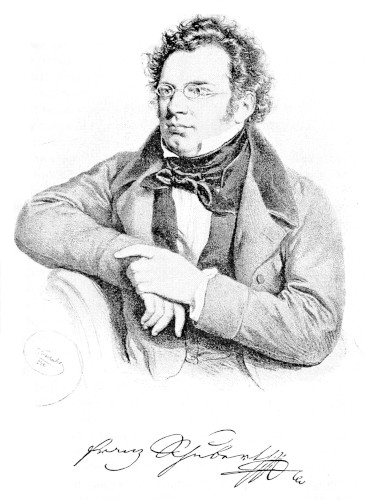
Lithograph of 1846, by J. Kriehuber (1801-1876).
As Impromptus the two groups, Op. 90 and Op. 142, were published. Those of the first group have all penetrated deeply into our musical consciousness. All roads lead us back again to the first Impromptu with its simple popular melody in two sections, which is varied in so many extraordinary ways; and with that melodious middle-movement, more joyous and ethereal, than any that had ever been heard before on the pianoforte. Who can forget the second with the light étude-like triplet-swinging in E flat major and the mighty B minor middle section; or the third with its wonderful G flat major melody, its divine modulations and its captivatingly simple conclusion, revealing unexpected melodic wonders in a broken chord of the seventh; or the fourth, a light floating figure with its short Volkslied intermezzi and the long drawn out melody of the trio in C♯ minor—Schumann all over!
The second group of Impromptus (Op. 142) stands below the first in importance. It was with Schubert as with Mozart; good and bad inspirations came to him alike, and he could not discriminate them. Yet they contain the dainty A flat major piece, which demands nothing but a gentle touch; and in the variations of the third Impromptu (which is therefore no impromptu) the likeness to Schumann is once more astonishing. It is a peculiar pleasure to detect Schumann in Schubert, and it is a piece of historic justice which has often been neglected.
More successful, indeed Schubert’s greatest achievement, was the “Moments Musicals,” which appeared in 1828, the year of his death. The first of these is a naturalistic free musical expatiation; the second a gentle movement in A flat major; the third the well-known F minor dance—in which a dance became a penetrating and sorrow-laden tongue—the fourth the Bach-like C sharp minor moderato, with its placid middle section in D flat major; the fifth a fantastic march with a sharply cut rhythm; and the sixth, perhaps Schubert’s most profound piano-piece, that reverie in still chords, which only once are more violently shaken in order to lull us to sleep with its pensive and dainty sorrow, its delicate connections, its singing imitations, its magic enharmonics, and its sweet melodies rising like flowers from the soft ground. The conclusion of the trio, in the style of a popular chorale, with its harmonisation in thirds, is (like many of his harmonic passages in octaves or sixths) exceedingly characteristic of the popular nature of Schubert’s music.
We have been turning over the leaves of a book from which Schumann and Chopin might have found matter to fill years of their lives. In form and colour, melody and movement, the model was before them. This modest man, who in his Vienna solitude wrote such things as these for himself, loved a few good friends, but publicity he hated. A composer who never appeared in public—was the like ever seen before? In the aged Beethoven the world understood it; but in this young man it could only reward it with indifference. He remained willingly unknown, like so many of his companions in sorrow who wished to be artists in themselves without relation to others, and without the encumbrance of patronage. The times were altering in music as in painting. The patronage of the State or of the Prince is disappearing; the commissions the artist receives become fewer and more distasteful; he becomes more intimate and is constrained to offer his works to the public, and to supply what it will purchase. Supply and demand rule art as well as anything else: but nowhere is the severance so painful. Pensions are irksome, and official posts are not to be had otherwise than indirectly. The struggle after the ideal which is the life of the artist is purer than it ever was. The type which Feuerbach and Böcklin represent in painting, that new type of artist who can be happy without commissions and without honorarium, is first clearly exhibited by Schubert in the musical world. Publicity, to which Beethoven at first had recourse, and which he would have carried further had fate not opposed, was impossible to Schubert. He had to live on a pension, his applications for posts were rejected, publishers were timid, and very slowly indeed did his songs win their way to favour. Goethe never answered him on receiving his songs; and Beethoven, to whom he shyly dedicated his Variations (Op. 10) as “admirer and worshipper,” only learnt to know him in the last days. As he began, so he died. The publishers had still to work through the whole century in order to bring out his works, which they dedicated in very stylish manner to Liszt, Mendelssohn, or Schumann: as Schubert closed his eyes he knew as little as the world that his simple integrity had won a new realm for art.
Some years after Schubert’s death, in November 1831, a certain Robert Schumann published as his first work some Variations, whose theme was formed on the name Abegg (A B E G G). It was easy to see that the Countess Abegg, to whom they were dedicated, was a pseudonym for a good lady, whom the author had once admired as a beauty without otherwise troubling himself much about her. The theme was worked out a little too painfully, and the Variations moved in eclectic style among influences derived from Beethoven, Weber, and the contemporary virtuosos; but their originality was nevertheless unmistakable. It was not the worn-out contemporary style of variations; and many sound traces of that naive dilettantism, which always stands at the cradle of the new, were easily to be detected. Sudden pianissimo effects, single selected technical motives, an original melodic gift for singing with contrapuntal voice-parts and new forms of accompaniment, rapid harmonic changes by the chord of the seventh, legendary romance in the finale alla fantasia, the successive release of the notes of a chord, from the lowest to the highest—all this led men to wait eagerly for Schumann’s next work.
This next work bore the title of “Papillons”—a title not unknown in contemporary drawing-room music. But here there was nothing of the drawing-room style. These butterflies seemed to come from the regions where Schubert had found his flowers. Thence they brought a breath of short lyrical songs—a concentrated breath of severe and restrained beauty. A wonderfully penetrating heart-felt tone breathed through them. The world had now to do with a reflective, deeply musical nature, far removed from all the merely brilliant virtuosity of the time: it was a romantic spirit. After the short slow introduction came the waltz, whose outlines inevitably recalled Schubert; but its emotions were personally felt. There were melodic passages in octaves for alternate hands, dying away in the aria with the “nachschlagbegleitung”[127] down to pianissimo, a splendid fugato-march in spirited style, episodes of popular songs, sportive whisperings, sparkling polonaise rhythms, melodious effects working out of very gentle full chords, canonic melodies in lively motion, repetitions of earlier bars in later sections to represent the external unity of these little stories, and as a conclusion the “Grossvater” song. The whole is united contrapuntally with the first waltz. The carnival is silenced—this appears suddenly in words—the tower-clock strikes six (and high enough on the upper A); a full chord of the seventh piles itself up gradually and closes the piece.
No one knew what was the chief impulse which led Schumann to write these “Papillons.” Those who corresponded with him alone knew that he was thinking of the “Flegeljahre”[128] of Jean Paul. From Jean Paul he received his spiritual nourishment, and those to whom his letters came could tell that he hardly sent off one without including in them a rhapsody for the Bayreuth poet. In this intermediate world between the highest earnestness and endless laughter he preferred to live in ironic love and loving irony. To reflect deeply on immortality, and at the same time to drink in comfortably the sweet odour of the girdle cake which the goodwife is cooking in the kitchen—it is in this mixed light that the poet stands, who has so characterised himself. The fantastic boundaries of the real and the imaginary world, of the most insipid flatness of the animal nature and of the most ethereal heavenly flights, alike attract him. His delicate soul flies to Nature, and Nature is to him—so he writes to his mother—the great outspread handkerchief of God, embroidered with His eternal name, on which man can wipe away all his tears of sorrow. But the tears of joy too—and when every tear falls into a rapture of weeping—whence came these tones in the soul of a musician? The world had never yet understood them. It knew them in literary circles, which busied themselves with romantic new creations, where unknown regions seemed suddenly to open themselves between the everyday and the legendary, and which demanded new, painfully twisted words for the wild tumult of their representations. Where pure music had long wandered alone, the poets and the æsthetics had now penetrated; and was now a musician to give them a hand to speak in their tongue? This was a surprising turn. Upon the musical poet came the literary musician. The one could only gain; had the other anything to lose? No; Schumann seemed musician enough to prove that nothing was lost. None of his friends, to whom he recommended the perusal of the conclusion of the “Flegeljahre”—whose masked dance, he said, the Papillons were intended to transform into tones—would have expected this pure and genuine music from him. I imagine they all puzzled their heads to know what the wild Jean Paul had to do with these dainty musical butterflies. And it is to-day even harder for us.
A delicate musician read Jean Paul, and the grotesque figures of this “Walt und Vult” combined in him with a world of tone, which slumbered within him, in those deep regions of associated ideas which stand at the basis of artistic creation. They there formed a special union with their musical counterpart, the simplest, most natural, and least academical creations which the art of tone ever saw—those of Schubert. So early as 1829 Schumann, who was then a student, wrote to Frederick Wieck from Heidelberg: “When I play Schubert, it is as if I were reading a Romance of Jean Paul set to music.” Jean Paul and Schubert are the gods in Schumann’s first letters and other writings. He cannot shake off the ethereal melancholy, the “suppressed” lyrical tone, in Schubert’s four-handed A major Rondo: he sees Schubert, as it were, in bodily shape, experiencing his own piece. No music, he said, is so psychologically remarkable in the progress of its ideas and in its apparently logical leaps. There is a rare fire in him when he speaks of Schubert. How eager is he for new publications from Schubert’s remains! Yet, while he is devouring a volume of his national dances, he is weeping for Jean Paul. In the Papillons, we hear, there was Jean Paul; and what we find in them, is Schubert. What was to come of this conjunction?
This question was very satisfactorily answered in the next work (Op. 3). This was a collection of Études with a textual introduction on motives after Paganini, but adapted to the piano. Considered as a whole it was technical to a degree, yet without disguising the real Schumann. And what was the meaning of the Introduction? Every great pianist had already written his “School” or wanted to write it. Did these barren finger-directions speak for the virtuoso Schumann?
The Intermezzi (Op. 4) answered in the negative. These were genuine pure music without any external pretensions. It was possible already to recognise the true style of Schumann: the characteristic features were repeated. Dotted motives, built up in fugato style; delicate melodies with the “nachschlag” accompaniment and with other melodies superimposed; reflective repose in chords; syncopated rhythm; parallelisms of the air in octaves; all these were as before. In the slurred thirds and the sequences, and especially the diatonic runs, which seem to gather their strength as they go, the model was not Schubert but Sebastian Bach. There was something in this not merely of his absolute, self-contained music, but even of his means of expression. At this time of course this could do no harm. In the fifth and sixth intermezzos Schumann’s personality would seem to have entirely ripened. This marked propensity to “anticipations,” those pianissimo unisons, those sharp detonations of C and C sharp, D and D sharp; the singing legato middle voices developing in the canonic manner, the absolute transference of whole passages by means of a single note foreign to the scale, generally effected by an anticipation; all this had grown into a definite musical picture, extraordinarily sympathetic, in which soul and technique were united. With stern sadness the hands grip one within another, to bring out the “suppressed lyric” of the piano; and a delicate noble spirit guides them, which delights to express strange things in strange forms. With stern sadness, as in the style of Jean Paul, and right in the midst of the music, where an answering voice intrudes itself, Schumann writes over the notes the words, “Meine Ruh ist hin”—my peace has departed. This is not as text, but merely as a comment by the way.
Then came Op. 5, free variations in romantic style, on a theme by Clara Wieck; and Op. 6, called “Davidsbündlertänze.” They were dedicated to Walther von Goethe, and bore as motto the old proverb:—
“In all’ und jeder Zeit verknüpft sich Lust und Leid; Bleibt fromm in Lust, und seyd dem Leid mit Mut bereit.” [In all and every time, our joy and sorrow meet: Gird up thy loins and go, bravely thy fate to greet.]
In the later revised edition Schumann cut out this good old saying, as he omitted so much of the first and heartfelt edition. “Two readings may often be of equal value,” says Eusebius once in the aphorisms. “The original one is usually the best,” adds Raro. Why did not Schumann follow his own Raro? Raro was the most delicate of the “Davidsbündler.” He was in his irony, which had drunk deep of worldly wisdom, raised far above the storm and stress of Florestan and the gentle, simple complaisance of Eusebius. In Florestan there was much of Beethoven, in Eusebius an echo of Schubert. Raro was to surpass and combine them in a higher unity. But Raro is just—rare.
The “Davidsbündler” declare war on the Philistines, and of an evening bring their dances together, which are then published in a single volume. Florestan contributes the stormy ones, Eusebius the gentle ones; while Raro puts in his word as seldom as in actual life. Such bands of Romanticists we have heard of before; we think of Hoffmann’s Serapion Brothers, and their zeal against the Philistines. Herz and Hünten, and all the musical lions of the drawing-room were to be put aside. There was still music after Beethoven. David’s companions meant, like their prototype, to put the Philistines under a harrow. Even the explanatory notes of his “Bündler” were cut out by Schumann in his later revised edition. He smiled perhaps at the beautiful fancies of his youth, when he seemed to carry three temperaments warring in his soul. And yet this fictitious society was the truest expression of his romantic soul, in which living music and literary reflection met together. They were his fellow-workers in his life’s work, whom he could never renounce.
The moment had come when the world busied itself with Schumann in somewhat wider circles. It asked after his private circumstances, and gained the answer—surprising, and yet no longer utterly surprising—that here an academically educated man had become a musician—a phenomenon long unknown, and only possible in this new era of art, in which one could give oneself up to composition without having to wait for a commission for each single work.
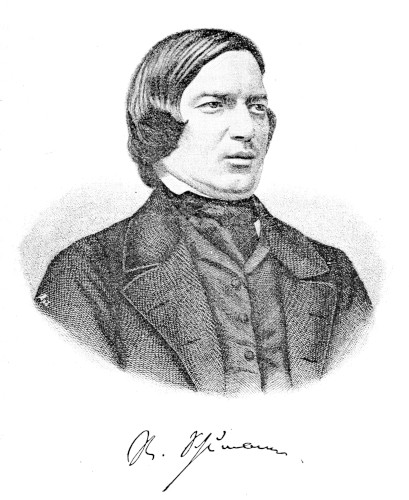
Engraving by M. Lämmel
Schumann had attended the Zwickau Gymnasium in due course; and at eighteen, in 1828, he entered the legal profession at Leipzig. His piano-lessons under Frederick Wieck of course attracted him far more than jurisprudence; and when, after an interval spent at Heidelberg, he returned to Leipzig, the die was cast. The letter to his mother in which he announces his decision is to-day interesting for the light it throws on his intentions. Naturally, he thought of the career of a virtuoso; and, in order to make his fingers supple, he hung one of them in a sling while practising, with the result that first the finger and then the whole hand was maimed, and Schumann was saved for pure composition. Composition is soon intimately knit with love for Clara Wieck, the daughter of his teacher, whose great talent was to compensate him for his own lost power. We cannot forget his youthful letters to Clara, which form the conclusion of the edition of “Schumann’s Letters,” which she issued. Never were more lyrical letters written. He dedicates to Clara his whole power of creation; it is she that lives in all his pieces, and to create was to think of her. Before this he tells her legends and supernatural tales. “Look now at your old Robert; is he not still the frivolous ghost-tale teller and terrifier? But now I can be very serious too, often the whole day long—but don’t trouble about that—they are generally processes in my soul, thoughts on music and compositions. Everything touches me that goes on in the world—politics, literature, people. I think after my own fashion of everything that can express itself through music, or can escape by means of it. This is why many of my compositions are so hard to understand, because they are bound up with very remote associations, and often very much so because everything of importance in the time takes hold of me and I must express it in musical form. And this, too, is why so few compositions satisfy my mind, because, apart from all defect in craftsmanship, the ideas themselves are often on a low plane, and their expression is often commonplace. The highest that is here attained scarcely reaches to the beginning of what is aimed at in my music. The former may be a flower, the latter is the poem, so much the more spiritual; the one is an impulse of raw nature; the other the work of poetical consciousness.”
In these words Schumann penetrated into his own heart; and there is nothing to be added to this characterisation of his literary music. The new type existed in its purity; namely, the musician, standing on the height of the representative art of the time, of which type Wagner was the best expression. There is a strange likeness in these two opposed natures. What in Wagner passed over into the external, in Schumann passed into the intimate. Where the one carries us along with him in an intoxicating rush, the latter is a personal enjoyment for retiring souls. The one lives in the orchestra, and plays the piano badly; the other dreamed first for the piano, then for the chorus, and never was able to express himself tolerably through the orchestra. Wagner never burst into tears, like Schumann, when he before his wanderings played for the last time on the beloved instrument which had heard all the sorrows and joys of his youth. And Wagner never wrote to Madame Cosima as Schumann wrote to Clara: “You speak in your last of a cosy place where you would like to have me—do not aim too high—I ask no better surroundings than a piano and you close by. You will never be a kapellmeisterin in your life; but inwardly we are a match for any pair of kapellmeisters, are we not? You understand me.”
This man of delicate feeling, who wished to reduce piano-culture to a system, was editor of a paper, which he founded at Leipzig in the year 1834, along with certain friends and men of like tastes, of whom he seems to have valued most Schunke, who died very soon. This “New Magazine of Music” was Schumann’s special medium, and in it he published his splendid and very spirited criticisms and aphorisms; later, when Brendel purchased it from him, it was of equal use to Wagner, his exact opposite. Till 1844 Schumann edited it for the most part personally; and his position aided the spread of his works, which laid themselves out so little for popular success. Still more effective was the career of his betrothed, who because of certain awkward obstacles only became his wife in 1840. This was his most productive year. It saw the appearance of a hundred and thirty-eight songs, and of the cycle of Heine’s lyrics (Op. 24). If the betrothed Clara and the piano were spiritually united, the married Clara and the song were equally so. Thus the songs stand precisely midway between his youthful piano-writings and the orchestral and choral efforts of his later years. And indeed the piano succeeds better in them than in any song hitherto written. The accompaniments of “Du, meine Seele” or of the F sharp major “Ueberm Garten durch die Lüfte,” are minute and scrupulous pieces of artistic work.
The eighteen “Davidsbündler,” Schumann’s first complete piano-work, were composed in 1837. Clara contributed the first bars—a cheerful musical motto. Schumann was fond of accepting his first bars as gifts from friends. The Romancist was fond of these incursions into actuality, this poetry in the real. As the letters A B E G G had once taken his fancy, so later did A S C H. And once he wrote in Gade’s family album a piece on “Gade, Ade” (Gade, farewell).
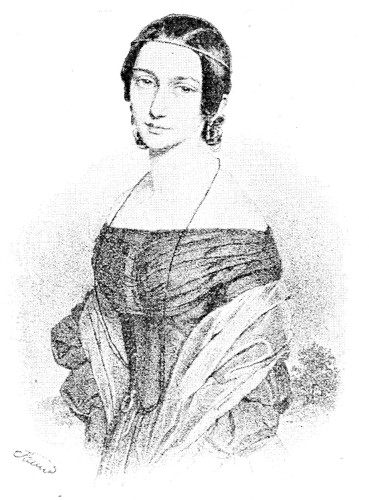
Clara Schumann, née Wieck.
Schumann’s music is characterised in few strokes; it is never hard to recognise its features. The interwoven melodies, the love of “anticipations,” the rollicking humour, which might almost be borrowed from old drinking songs, the contrapuntal collisions of the bass on which the light waltz flutters down, the cheerfully pensive codas, the restlessness of his syncopated rhythms, the sweet lulling romantic tone mingled with wild and vigorous march-motives, the full effect of broken chord passages of mounting fifths, the conclusions of the sections abruptly broken off by a staccato chord—all these were to be seen in spring-like freshness in the “Davidsbündler.” We have there the “einfaches stück” of Eusebius, the free recitative in No. 7 beginning with arpeggiando chords for the left hand. Next, “Florestan’s lips quiver.” Then follow the extraordinarily beautiful E flat major (No. 14) with its airy melancholy; the staccato, passing humorously over into the “Wie aus der Ferne,” and finally “Happiness speaks out of his eyes.” Nothing so wonderfully simple, so old-new, so true, so German, had been painted on the piano since Schubert. And here was a yet more modern spirit—a mind whose depths were not merely over-flowed by the streams of music, but were pictured in delicate musical emotion. The construction is clean and simple; the language refined and lofty; the whole the consolidated improvisation of a mind standing at the highest point of representative art. More perfect improvisations it did not lie in the nature of the piano to produce. It was the high-water mark of piano literature.
I pass rapidly over Op. 7, one of his earliest composed pieces, the toccata, brilliant in colouring, delicately chased, bold in construction, wonderful in technique; and Op. 8, a concert allegro, in which he, certainly in an unusual way compared with the literature of the time, sacrifices a little to popularity, and thereby crushes out certain beauties. I pass on to Op. 9, the “Scenes Mignonnes” of the carnival, in which neither technical nor concert problems were to be mastered. The motive of the carnival is A S C H, which is the name of the home of one of his musical lady friends and which contains all the letters of Schumann’s name which are adapted to the stave.[129] A bustling ball-play develops itself, Pierrot and Harlequin appear, a Valse Noble unites the parties, the mask of Eusebius is seen through, and the gentleness of Florestan is resumed, the Coquette frisks by, Papillons flutter round, and the letters A S C H dance a rapid waltz. Chiarina and Estrella, not unknown characters, are represented; and Chopin appears in person between them. A short recognition scene in the time of the Polonaise, in which we hear the dainty causeries among the marching rhythms—the miniature ballet of Pantaloon and Columbine—a comfortable allemande, into which Paganini suddenly darts with his most extravagant leaps; in the distance a gentle confession of love;—all comes again together in the polite and festal promenade of the couples. There is a pause; and then reminiscences run through the memory; one melody restlessly pursues another; room is made; the final effect comes; the “Davidsbündler” begin an abusive march against the Philistines; they roar out the Grandfather song—“Grandfather wedded my Grandmother dear, so Grandfather then was a bridegroom, I fear”—and the people enjoy it, till they all, with a “Down with the Philistines,” join in, and a galloping stretto finishes the boisterous amusement.
The inscriptions Schumann inserted later. He took a literary delight in putting in an “Estrella,” as it is seen in old copper engravings. It was the pleasure of the delicate man of taste in labelling. But he laid no stress on this nomenclature; the relations indicated were as wide as before, when there were none of these labels. We are reminded of Couperin, whose miniature porcelain pictures were ticketed just like this moving panorama of tunes, and in surprisingly similar style. In both the titles were nothing but a halt in the midst of full musical representation; they involved no limitation, no point of departure. Under like tickets, works came into the world which were separated in time and in tone by whole centuries. Schumann himself almost thought the titles a trifle too theatrical. The Davidsbündler, he said, are related to the carnival like faces to masks.
Among the works that followed, technical and purely musical gifts alternated. As Op. 10 we have further Paganini Études, with wide stretches, contrapuntal, transformed in the spirit of Schumann. Here, as before, the order of publication did not correspond to that of composition. The F sharp minor sonata (Op. 11) was begun contemporaneously with the Impromptus. It was dedicated to Clara. It is a romantic deepening of the sonata form, cast throughout in these small lyrical sections which are peculiar to the time, but here are held together by an internal unity. We must feel this unity in order not to cut up the work into mere fragments. An oceanic vastness spreads over it, whose tone is struck in the broad introduction. It has a first theme, contrapuntal in style, and a second of full-voiced melody; the working-out attaching new ideas half in imitative, half in étude fashion. On the third, the A, which drags itself over, the aria begins its deep-felt lament, in three melodies with the genuine Schumann-like coda, sighing itself away under the final slurs. The fresh staccato canon work of the scherzo carries us with it. Two wonderful trios introduce themselves, the second with the remarkable recitative. The conclusion is formed by a modest movement which is put together like a mosaic out of a stormy quaver theme, two cantabiles, a syncopated motive, a section in full chords and a stretto. We shall only feel the unity if we give our playing a touch of improvisation. In a word the case is this; in a sonata of Schumann what most charms us is the movements regarded separately; and in the movements, the separate passages. This Sonata, like the others of his works, must be considered as a volume of lyrical poems.
The “Fantasie-stücke” were the next work. These again are a completed picture, for the most part broader in conception than the Davidsbündler, with which they were contemporaneous in composition. They were the ideal of delicate piano composition, and have remained so down to the present day. The sweet “Abendruhe,” the stormy “Aufschwung,” the dainty “Warum,” the capricious “Grillen,” the gloomy “Nachtscene,” in which Schumann was thinking of Hero and Leander, the “Fabel,” alternating in Ritornell and Staccato; the “Traumeswirren,” and the beautiful “Ende vom Lied,” whose humour sounds again wonderfully in the intellectual augmentation at the conclusion—all this formed an extraordinary picture-gallery. The height of art was attained in the “Nacht,” where the dark rolling accompaniment, the solitary sighs in the gloomy air, the deep returns to darkness, the gently sounding and wild shrieking cries and emotional songs, over the gurgling accompanying figure which runs through the whole, made one of the immortal piano-pieces.
A more purely technical work was the Études Symphoniques, written in 1834 simultaneously with the Carnival, on a theme of Fricken’s. These variations are as significant for Schumann as the Goldberg variations for Bach or the Diabelli variations for Beethoven. They are a breviary of all specialities in expression. All Schumann’s characteristics were here: the strongly accented fugue, the tied notes with repeated chord accompaniment, the cantabile with broken chords, the staccato chords in canon, the dotted rhythms of Var. IV., the complicated syncopations of Var. V., the bold phrasing of Var. VI., the Bach-like style of Var. VII., the hurrying rush of semiquavers in Étude IX., the duet of voices with tremolo accompaniment in Var. IX., the march with contrapuntal treatment on pedal points which concludes the work—all was here; and all was made into a delicate étude in which that union of technique and poetry was constantly completing itself in fresh form.
In the Sonata (or concerto) “without orchestra” (Op. 14) which he recast later without introducing much warmth of feeling, we observe chiefly the strong influence of Bach, which informs the last movement. If we look closely, indeed, we shall be often reminded of Bach in the last works, particularly in the Symphonic Études. Certain slurred ornamental figures, certain tricks of accompaniment, the play of dotted and triplet rhythms, the canonic carrying-out of the theme, left no doubt that Schumann had been trained on Bach, and that he had strengthened his musical consciousness by the study of a music in which there is not a superfluous line. The Letters make this certain. In 1832 he sat over the Wohltemperiertes Klavier, his Grammar, and occupied himself in analysing the fugues down to their minutest ramifications. “The use of such a process is great, and has a morally strengthening influence upon the whole man; for Bach was a man, through and through; in him there is nothing half-finished, nothing halting; all is written for eternity.” All this has a special and peculiar influence on Schumann. The abstract music of a Bach is mingled with the concrete representative secondary aims of romance, which find an entrance all the more easily as this absolute art, free from all words and all that is ephemeral, is by far the most expressive to the profoundly musical spirit. Bach’s art expresses every phase of feeling, and the emotions are so wide-embracing that they never find a boundary in the domain of reality. This art is the original realm of all transcendental desires. “The profound power of combination, poetry and humour in the new music,” wrote Schumann in 1846, “has its origin for the most part in Bach. Mendelssohn, Bennett, Chopin, Hiller, the so-called Romantics, as a whole, stand far nearer to Bach than to Mozart; for as a whole they know Bach through and through. I myself daily confess to this high power, to purify myself, and to strengthen myself through him.”
Along with Bach was mingled in his mind the author Hoffmann. There was a remarkable elective affinity in the sympathies of his nature. The “profoundly-combining” Bach took the place of Jean Paul, and the story-teller Hoffmann took the place of Schubert. The twists and turns of a writer, whose style might be called “contrapuntal,” found their continuation in the musician who brought all counterpoint into a wonderful “incommensurable” harmony; and the popular simplicity of a musician found its complement in the dreamy lyricism of a genius who had formed perhaps a more beautiful anticipation of the whole music of our century than its actual state has realised. This poet, himself a musician, valued the most romantic of all arts, “one might almost say, the only genuine romantic art; for its subject-matter is the eternal: music opens to man an unknown realm which has nothing in common with the external world of sense, and in which he leaves behind all defined feelings in order to give himself up to an inexpressible longing.” And the poet leads us into a realm of magic. In the “Kreisleriana,” the garden into which the author leads us is full of tone and song. The stranger comes up to the young squire and tells him of many distant and unknown lands, and strange men and animals; and his speech dies away into a wonderful tone, in which he expresses unknown and mysterious things, intelligibly, yet without words. But the castle maiden follows his enticements, and they meet every midnight at the old tree, none venturing to approach too near the strange melodies that sound therefrom. Then the castle maiden lies pierced through under the tree, and the lute is broken; but from her blood grow mosses of wonderful colour over the stone, and the young Chrysostom hears the nightingale, which since then makes its nest and sings its song in the tree. At home his father is accompanying his old songs on the clavicymbal, and songs, mosses, and castle-maiden, are all fused in his mind into one. In the garden of tone and song all sorts of internal melodies rise in his heart, and the murmur of the words gives them their breath. He tries to set them to the clavier, but they refuse to come forth from their hiding-places. He closes the instrument, and listens to see whether the songs will not now sound forth more clearly and brightly; for—“I knew well that the tones must dwell there as if enchanted.”
Out of a world like this floated all sorts of compositions into Schumann’s mind, as once from the “Flegeljahre” of Jean Paul. Thence came the “Scenes of Childhood,” where we listen to tales of foreign lands and men, and dream by the hearth, and play Blind-Man’s Buff, and then bend forward to hear, for the Poet is speaking. They are his miniature painting; of a gentle ineffable grace. Only a “Romantic” can love children thus. Schumann himself had a particular fondness for these little pieces, whose smallness was their very essence.
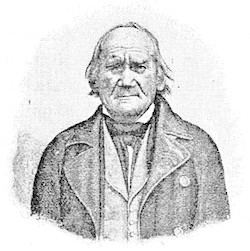
Louis Böhner, the original of Hoffmann’s Kreisler. Engraved by Freytag.
From Hoffmann also came the inspiration of the “Kreisleriana,” so called after Hoffmann’s tale of the eccentric Kapellmeister Kreisler. In 1834 Ludwig Böhner, the original of Kreisler, met Schumann. Once “as famous as Beethoven,” he jeered at men till they now jeer at him. In his Improvisations, here and there, we catch a glimpse of the old brilliancy; but elsewhere it is all dark and waste. “Had I time,” says Schumann, “I should like to write ana of Böhner to the papers. He himself has given me plenty of material. In his life there has been too much both of joy and of sorrow.” Here was a happy conjuncture for Schumann’s genius. A suggestive bit of life, and its poetic setting by Hoffmann, which had first appeared to him as literature, was transformed into music, and a work was born whose title, as so often, he borrowed from a fiction with whose contents it had but little connection, except as suggesting the groundwork. The “Kreisleriana” was his greatest work. The artist who brings life itself, gently transfigured by literary art, into musical emotion, never before or since became so clear a personality. The piano has advanced into the midst of a life-culture. A thousand threads run from all sides into this intimate web in which the whole lyrical devotion of a musical soul is interwoven. The piano is the orchestra of the heart. The joys and sorrows which are expressed in these pieces were never put into form with more sovereign power. For the external form Bach gave the impulse; for the content, Hoffmann. The garlanded roses of the middle section of No. 1, the shimmering blossoms of the “inverted” passage in the “Langsamer” of No. 2, the immeasurable depth of the emotions in the slow pieces (4 and 6), the bass unfettered by accent, in the final bars of No. 8, leading down to the final whisperings, are all among the happiest of inspirations.
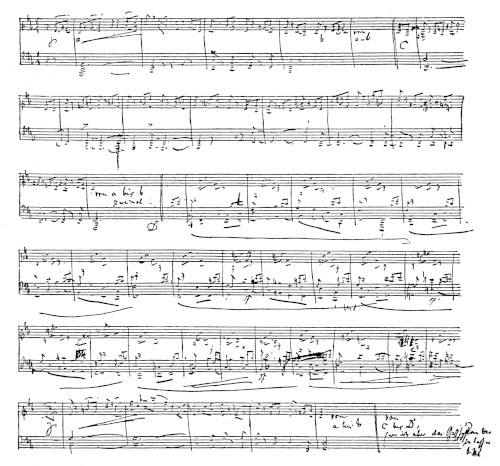
The last piece in Schumann’s “Kreisleriana,” main movement. After the autograph in the possession of Baroness Wilhelm von Rothschild, Frankfort a.M. Differs from the printed edition, being simpler and more massive.
The Kreisleriana are dedicated to Chopin; the Fantasia Op. 17 to Liszt. We are on the height on which the first artists of the piano are greeting each other; on which breathes the purest atmosphere of this intimate music; we are on the heights of a culture which has become the dominating power of the world. The Fantasia is, so to speak, a confession of this devotion. In its first movement there is an undefinable romantic feeling as of the words woven round a legendary theme (he called it first the “Ruin”), with mysterious passages, answering voice-parts, mystic ghostly calls. In the second there is the grand triumph, a panegyric on technique and toil—he called it the “Gate of Victory.” In the third is the poetic transfiguration (at first called “Star-picture”), with its ethereal dances and the dying sound of harps, and the sweeping mist, broken chords with pedal, resolved in rubato, over which descend the mournful melodies.[130] The first movement is not free from the variation-technique of the time; the second is a tribute to virtuosity; the third, a half Schubert. Contrasted with the Kreisleriana of 1838 we recognise an earlier style of 1836, and we wonder at the strong power of progressive development in Schumann—a power, which, strange to say, some would deny to him. But the Fantasia was so happily felt that it despised time and still to-day stands in the forefront. As there are Études which seem to hold out a hand to Romance, so here Romance held out a hand to technique; and the Fantasia, in its three forms, remained a classic monument of all the contemporary tendencies. When Schumann published it he cut out the old inscriptions, its profits being devoted to assisting in erecting the Beethoven monument at Bonn, and wrote above the first movement this motto from Schlegel: “Through every tone there passes, to him who deigns to list, in varied earthly dreaming, a tone of gentleness.”
In the productive year 1838, before the Scenes of Childhood, Schumann had written three books of “Novellettes,” which were now published for the first time and dedicated to Henselt. Springing from his happiest period the music flows as if of its own accord, and its framework is admirable. They are the most subtle pieces conceivable for the piano, and the most popular of his compositions, neat and regular music. Their construction is transparent; the sections arranged for contrasted effects. In the first piece we have the March, the Cantabile, and the Canon; in the second the glitter of semiquavers and the delicate rocking Intermezzo; in the third the humorous Staccato and the wild B minor section; in the fourth the dance and the song mingle with the staccatos of the sequences; in the fifth a Polonaise, in a style approached by few, and Intermezzi in legato, cantabile, and staccato; in the sixth and seventh the effective contrasts of scherzo, canon, and cantabile; in the eighth an air in duet alternates with several trios; all kinds of sections are attached, a voice from afar, and free repetitions, as if everything left over had been thrown into it. They are unsurpassed, wonderfully dainty pieces; but the Kreisleriana were an experience.
The charming smoothness of the Novellettes was no longer alien to Schumann’s feelings. The older he grew the more he strove to attain a “dry light,” which might easily prove dangerous to his romantic temperament. He began to despise the exuberance of his youthful works. We cannot, in reading the last piano works of Schumann, restrain a certain feeling of pain. Where once the stream bubbled and sparkled, it now flowed too evenly; where before the music was felt, it is now constructed. A new ideal comes slowly into the circle of Schumann’s sympathies, and that was Mendelssohn. He not only admired Mendelssohn’s greatness, placing him perhaps even above Chopin, but, as his works show, he envied his constraining plastic art, which possibly he mistook for monumental calm.
In piano-literature Mendelssohn is the composer for young girls, the elegant romancist of the drawing-room. From the sphere of polite literature, where passion must be trimmed and neat, and where there is no sentence passed without amiability, and a smiling laissez-faire rules the day, there penetrates into glowing romance the limitation of this neatness, and a formality well adapted to the drawing-room. The old Volkslieder, the simple Ritornells, the tones of aspiration in forgotten old airs, the dances of elves, the moonlight love-scenes, are all brought on to a parquet for the delectation of comfortable people. It is a gilt-edged lyricism, without any unbefitting exhibition of unseemly feeling; a mere art of perfumery compared with Bach and Schubert. The development of the pieces shall exhibit nothing to shock; it shall run on in the most intelligible manner. A dainty accompaniment-figure is formed, which plays some bars alone; then follows the melodious and soothing theme, which moves in certain sequences and delights to rock itself to and fro on related degrees of the scale. The strophic divisions are clearly defined; small cadenzas mark the main sections; and at the conclusion there appears a miniature canon or a vigorous episode, which leaves behind a good impression on the mind of the satisfied listener.
At the head of this enormous branch of piano-literature stands Mendelssohn. His “Songs without words,” of which six books appeared in his life and two more after his death, gave the decisive form to this class of Short Story in music. All the technical devices of the time, the wide stretches, the broken accompaniments, the multiplicity of rhythms, are here adapted to the drawing-room. The Volkslieder are put, as it were, into evening dress. That in A minor is surrounded towards the conclusion with octaves, which are merely technical, and without emotional significance. The Funeral March, compared with that of a Beethoven, is as if it were written for a set of marionettes. The Spring Song is, so to speak, set on wires. And all is so beautiful, so objectionably beautiful! It tells us all through that it is beautiful, and the composer moves his head to and fro with the music, and says, “How beautiful it is!” Until at last, when we have grown to man’s estate, we can endure it all no longer; or at most we take up once again from time to time this or that song, preferably one in quick time—perhaps the Spinning-Song, the best of all.[131]
From these drawing-room romances of Mendelssohn one piece is to be taken apart, as equally pleasing both to young and to old. This is the Elf-music. Such music, with its gay dancing of gnomes, intermingled with a slightly sentimental air, was wonderfully suited to Mendelssohn’s genius. He never surpassed his overture to the Midsummer-Night’s Dream, written at seventeen. There are four of these “Elf” or “Kobold” pieces for the piano. The first, in the Character-Pieces, Op. 7, begins in E major, shoots rapidly past, and ends very daintily in the minor. The second, Op. 16, 2, begins on the contrary in E minor, and concludes in a very spirited fashion in the major—a very poetical little Battle of the Mice, with tiny fanfares and dances, all kinds of squeaks, and runnings to and fro of a captivating grace. The third is the Rondo Capriccioso (Op. 14), for which all piano-players have a deadly hatred, but which is much prettier than we are inclined to think to-day, when it is worn out. Finally we have the F sharp minor Scherzo, which was written for the “Album des Pianistes,” with dotted, staccato, and singing themes, and stands out among his pieces.
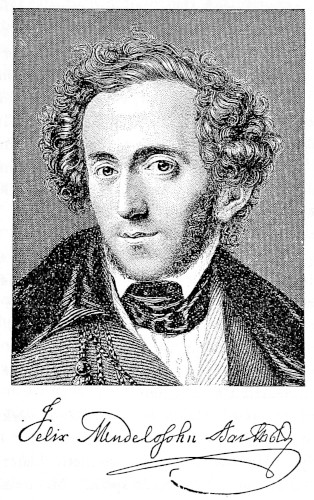
Head of Mendelssohn, after Hildebrand.
Mendelssohn was one of the few great musicians, whose whole life, from cradle to the grave, was lived in sunshine and happiness. From his joyous youth to his European renown as head of the Leipzig Conservatorium his life was a round of serenity, and at its zenith he might well die. Sunshine and happiness are in his works; storm never breaks in, no sigh moves to tears. His storms and sighings never forget their artistic calm. His pieces cast friendly glances on all sides, and are quite conscious of the friendly glances they receive in return. As beautifully as their author played—he played rarely but willingly in concerts—they present their technique, so popular, so charming; sounding more difficult to play than they are. The technical content is chiefly rapid staccato, whether of single notes or chords; the ornamentation of melodies in arpeggio; brilliant repetitions obtained by rapid alternation of the two hands; free obligato use of the pedal; and a showy use of a facile right hand.
These find their most popular expression in the conclusion of the Serenade, in the first movement of the D minor Concerto, and in the E minor Prelude. Popular even ad nauseam are the Concert-pieces, the B minor capriccio (the favourite fantasia with march-conclusion), and the two piano concertos, all of which are practically in one movement, with partial repeats. In technique these appear to owe an obligation to Weber, for whom Mendelssohn had a heartfelt admiration.
The third group of Mendelssohn’s piano works, along with the “Short Stories” and the concertos, are the “Bachiana,” or, more properly, “Handeliana.” An æsthetic historic sense is a rooted characteristic of the romantic spirit. Mendelssohn’s studies in Bach and Handel had a great influence on his development, and are plainly shown in some of the “Seven Character-Pieces,” with their soft, gentle, old-world conduct of the melodies, and the clever fugal movement which seems to set an ancient counterpoint on to Mendelssohnian harmonies. Here belongs the Fantasia, Op. 28, with its three contrapuntal movements; also the famous E minor fugue and its companions in Op. 35, with the appended chorale and the pompously smooth partwriting, fall into this place. It is constructed entirely differently from the fugue of Bach, which grows up from within; it is a grafting of a fugato on the trunk of a drawing-room piece. Finally, we recall the “Variations sérieuses,” composed in 1841, the purest, most solid, most massive work that Mendelssohn ever wrote for the piano, without a suspicion of triviality, filled full with intellectual outlines and harmonies, a splendid erection, but—throughout dependent on Schumann.
We have thus returned to Schumann, whom Mendelssohn so nobly repaid for his admiration. This elegant composer, who, whether as poet, as concertist, or as a follower of Bach, was always equally clear and plastic, might well appear to Schumann the fulfilment of his own aims. He had not wavered as to whether he was called to be a musician, though he had perhaps regarded business as the easier course. At his pieces he had toiled as Heine toiled at one of those smooth-flowing poems of his. The doubt may well have often recurred to him whether the flow was checked. But from this Mendelssohn the music flowed so easily from the fingers, and stood so clear and transparent before him. At one time he believes that the stream is clear, and he rejoices over the speed with which he finishes twelve sheets in a week. This work was the “Humoreske,” which entirely puts aside the earlier fragmentary romance, and throws all, joy and sorrow, into the same crucible. Thus we gain a piece bearing all the marks of decadent imitation of Bach’s traditions, and even of those of Schumann himself, in spite of isolated, delicate, lyrical traits, which occur specially in the G minor section (Einfach und Zart). We are now in March 1839. Schumann writes to Clara, asking her why she chooses the Carnival to introduce him to people who do not know him. Why not rather choose the Fantasie Stücke, in which one does not nullify the other, and in which there is a comfortable breadth? “You like best storm and lightning at once, and always something new that has never been.” Then also he put his “Arabesque” and his “Blumen-stück” together, which has nothing but the title in common with Jean Paul. As a matter of fact, nothing was new, and everything had been. It had become a question whether the limits of the possibilities of the piano had not already been overpassed. As Op. 22 he brought out the Sonata in G minor, which he had composed earlier; a piece, compared with the F sharp minor, rounded and of satisfying content. The final pithy movement he replaced by one of neater and smoother character. It is sad to hear him, in his letters, speaking with great empressement of the Nacht-stücke (Op. 23) and then to find that there is nothing special in them. As Op. 26 appeared the “Carnival Jest” (Faschings-schwank) which brought back his old style of the “short story,” but forced into a sort of sonata-arrangement. The vigorous “Reveillé” in F sharp major, the fine painting of the restless bustle, the beautiful Romance, the delicate simplicity of the Scherzino, with its canonic conclusion, the singing Intermezzo, which in breadth and value on the whole surpassed Mendelssohn—all these have ill prepared us for the great falling off in the Finale. This piece was Schumann’s last great utterance on the “subjective” piano. In the meanwhile the Song had taken him captive, and dominated his whole nature. In Schumann development proceeded almost according to classes. After the Song came chamber-music, then chorus, then the symphony.
Among his later piano-pieces we find all sorts in various styles—partly interesting as showing an advance upon himself, partly, alas, mere decadent imitations of himself. The fulness of ideas and of titles is quite astonishing in his “Jugendalbum,” in his “Albumblätter” containing the dainty Slumber Song, and in the “Bunte Blätter” containing the Geschwind-marsch. The most delicate aftermath of Romance proper was the “Waldscenen” in which the “Eintritt” and the “Verrufene Stelle” are worthy of a musical Hoffmann. The Hunting Song is in the style of Mendelssohn. As late fruits of the intimate piano lyric appear the sweet variations for two pianos, which we cannot choose but love, the four-handed Eastern Pictures (Bilder aus dem Osten), in which Chopin plays a part, and the Songs of Early Morning, and to Bettina, which show a beautiful touch of a later style, often reaching the borders of motives from Parsifal. But most important were certain concertos. Of these the limpid A minor, dedicated to Hiller—the first movement of which was composed earlier—in its freedom and colouring recalling Beethoven, and finally showing traces of Chopin’s influence, is a perfect work. Finally, we must not omit the Concert Allegro (Op. 134) dedicated to Brahms, a brilliant creation, often recalling Bach, with a theme very much in the style of Brahms, and many interesting repetitions of earlier figures of Schumann’s own. Why has it been almost forgotten?
Like Schubert throughout his music, so has Schumann in his chamber-music left us his youth. He broke off the regular practice of it at about the same time of life as that at which Schubert died. During the next fourteen years a slow decline in the artistic freshness of his works made itself noticeable; and finally, alas, his genius deserted him.
At this time some one wrote: “Thalberg is a king, Liszt a prophet, Chopin a poet, Herz a lawyer, Kalkbrenner a troubadour, Madame Pleyel a sibyl, Döhler a pianist.” The reader will observe that Schumann is not even mentioned in this list. In Paris, as yet, he did not count. There was an utter absence of the frivolous in his music, and it had none of the qualities which were likely to conquer the great world. Chopin scarcely ever required his pupils to play the works of Schumann, and would seem to have had very little taste for them. On the other hand, it was Schumann who gave an impulse to the popularity of Chopin’s works in his magazine, as early as the appearance of the Variations on the theme “Reich’ mir die Hand” (Op. 2). Indeed, the rapid and enduring fame in Germany of Schumann’s only true rival was due to Schumann himself.
“Chopin a poet.” It has become a very bad habit to place this poet in the hands of our youth. The concertos and polonaises being put aside, no one lends himself worse to youthful instruction than Chopin. Because his delicate touches inevitably seem perverse to the youthful mind, he has gained the name of a morbid genius. The grown man who understands how to play Chopin, whose music begins where that of another leaves off, whose tones show the supremest mastery in the tongue of music,—such a man will discover nothing morbid in him. Chopin, a Pole, strikes sorrowful chords, which do not occur frequently to healthy normal persons. But why is a Pole to receive less justice than a German? We know that the extreme of culture is closely allied to decay; for perfect ripeness is but the foreboding of corruption. Children, of course, do not know this. And Chopin himself would have been much too noble ever to lay bare his mental sickness to the world. And his greatness lies precisely in this, that he preserves the mean between immaturity and decay.
His greatness is his aristocracy. He stands among musicians in his faultless vesture, a noble from head to foot. The sublimest emotions, towards whose refinement whole generations had tended, the last things in our soul, whose foreboding is interwoven with the mystery of the Judgment Day, have in his music found their form. At this Judgment Day appears to be expressed what man kept dark within himself, and shuddering sought to hide from the light. Now it has become free without becoming plebeian; it has been uttered without becoming trivial. This miracle is sung by geniuses, who are not cold as marble, nor of such unreal beauty that we, to our horror, are constrained to believe that there is an anti-human classicism. No; the angels bear those delicate features as they weave nobility and joy into one. These are Polish piquancies, tender and shining eyes of inner fire, with happy heavy lids, and gently curved outlines, in which pride and spirit blend together; speaking lips, which have something sweet to say, and gentle, melting contours.
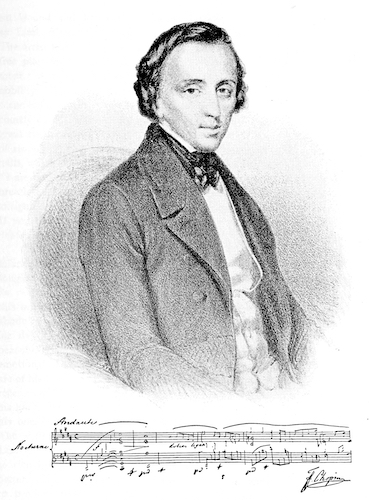
Chopin. Anonymous Lithograph, after portrait by Ary Scheffer (1795-1858).
Chopin gave recitals but rarely. In his youth—who was ever, as a youth, without visions of a virtuoso-life?—he sometimes did so; but even then with little enthusiasm. If he was heard in Paris, it was at very select matinées at the Pleyel salon, to which only with difficulty was admission to be obtained. The exiled aristocracy of Poland, the world of Parisian art and letters, and ladies, sat around and listened. Réunions intimes, concerts de fashion, as Liszt called them, were the purest piano-recitals ever given. The artist knew his audience; and in that small circle there was free play for the isolated poesy which sounded from the instrument. A delicate genius had won back for the piano its reserved nobility. There was here no fracas pianistique, no noisy circus-scene before a many-headed, unknown, indeterminate public; but courtly culture without the court. When in 1834 Chopin gave a great recital in the Italian Opera, he was undeceived by the want of response which he found, and necessarily found, in those great halls, which only dissipated his dainty playing. He said to Liszt, “I am not fitted for public playing. The public frightens me, its breath chokes me, I am paralysed by its inquisitive gaze, and affrighted at these strange faces; but you, you are meant for it. If you can’t win the love of the public, you can astonish it and deafen it.”
Chopin once said of himself that he was in this world like the E string of a violin on a contrabass. His finely-strung nature sought retirement, and fate had given him precisely that longing for rest and harmony which of necessity made the contrabass of this world excessively painful to him. He ran restlessly from one abode to another, till he found in the Place de Vendôme the best for dying in; he became more and more retiring, called for peaceful pearl-gray carpets, and gave full play to all his decorative emotions, which are the external proof of a harmonic soul. The art of his life was driven into isolation, into inclusion in the sacred recesses of his musical poems; and he knew well how so to level his life to the external observer, that the biographers—apart from his one great passion—had never so uneventful a life to record. The well-known description of an evening with the master, which Liszt gives in his fanciful but yet so true biography of Chopin, is so rich in character that reality itself could hardly have done it better. A melting twilight in the room, the dark corners seeming to produce themselves into infinity, the furniture covered with white hangings, no candle except by the piano and by the fireside. We distinguish Heine, Meyerbeer, the tenor Nourrit, Hiller Delacroix, the unemotional Minkiewicz, the gray-haired Niemcewicz, and George Sand with propped arm leaning back in a chair. The people stand round Chopin in the twilight, and hardly know whence these magic tones come. [The English reader will recall the exquisite description of Chopin’s playing in Crawford’s romance “With the Immortals.”]
We can easily see why Chopin could never compose duets. Not only did he devote himself exclusively to the piano—he wrote nothing in which the piano does not bear a part—but he broke with the custom of writing duets for one or two pianos. A single Rondo for two pianos, of the year 1828, was found among his remains. How he smiled once at Czerny, who “had composed another overture for eight pianos and sixteen persons, and was very happy over it.” Chopin opened to the two hands a wider world than Czerny could give to thirty-two. And further, he selects and rejects with great care before publishing. He prints nothing which does not absolutely satisfy his mind both as a whole and in its details.
Between his youth in Poland—which was soon closed to him on political grounds—and his last journey through England and Scotland, his stay in France stretches like a peaceful background of exclusively artistic activity. A thousand anecdotes cluster round him, but only a few of them have stood the test of criticism and comparison. In his “Life of Chopin”—and there are few musical biographies equally good—Niecks has collected everything that is told, and all the arguments against the authenticity of the various tales. Even upon that famous scene, in which the Countess Potocka sings the dying Chopin to his eternal slumber, the traditions are contradictory. There are few letters to help us. Chopin was too reserved to write them. It was said that he would rather go right through Paris to decline an invitation by word of mouth than write his excuse. And of the few letters he actually did write, the best appear to have been burnt in the sack of Warsaw. Nevertheless there is a certain charm in being thus obliged, as it were, to see him in shadow.
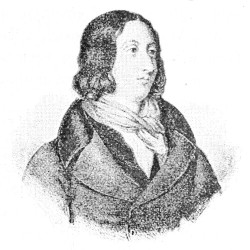
George Sand, in man’s dress. Lithograph by Cecilia Brandt.
A sweet tie bound him to his native country. The fundamental characteristic of the Poles, who united the merits of the Gaul and of the Slav, that character of modesty and resignation, of sadness and of reminiscence, flowed all the purer into the works of the artist. It was easy to see that almost every one of Chopin’s compositions, even if it was not a Mazurka, sprang from the rhythm and sentiment of the Mazur (Magyar) music; but it had been all steeped in the spirit of the Parisian life. A milieu of his own was here, of a charming and cultivated kind, of which there are but few; the milieu of fair Polish ladies, who in Paris lived for their aspirations and their temperaments. As Liszt said, the French alone saw in the daughters of Poland a yet unknown ideal: the other nations had not the slightest suspicion that there was anything worthy of admiration in these elusive sylphs of the dance, who smiled so happily of an evening, and in the morning lay sobbing at the foot of the altar; in these apparently distracted travellers, who, if they journeyed through Switzerland, drew the curtains of their carriages lest the sight of the mountain-landscape should erase the memory of the limitless horizon of their own native plains. Is not this a paraphrase of Chopin’s music?